The Janitor’s Secret Trial
Part 1
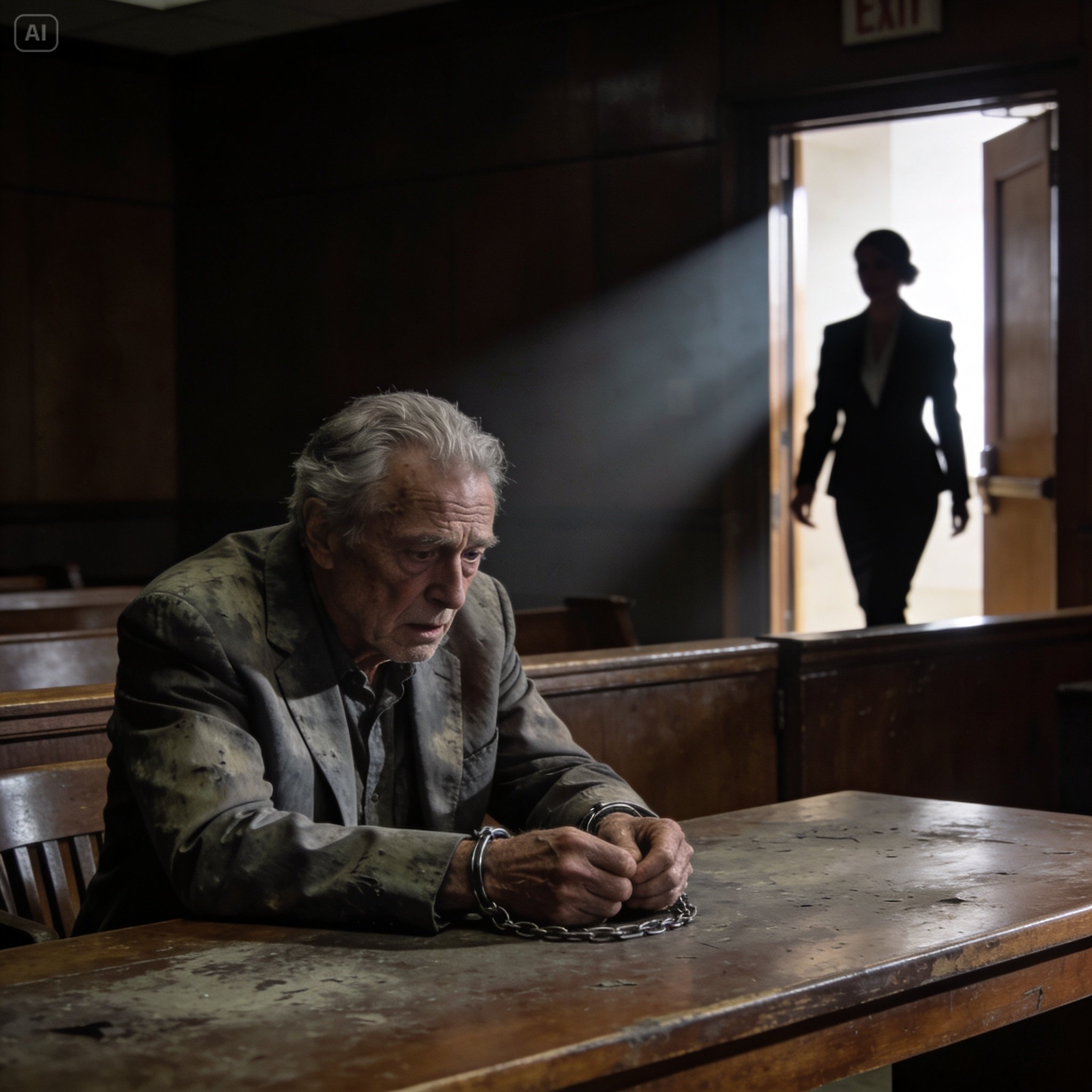
The handcuffs were cold, a biting, clinical chill that felt like it was soaking straight into my bones. I kept my eyes fixed on the scuffed linoleum of the courtroom floor, noticing a spot near the defense table that hadn’t been waxed properly. Habits die hard, I guess. Even when you’re being accused of stealing three million dollars from the school district you’ve served for thirty-two years, you still notice the missed spots.
“Mr. Carter, do you understand the charges against you?” the judge asked, her voice echoing off the high ceilings.
I didn’t look up. I couldn’t. If I looked up, I’d see the faces of the teachers I used to wave to every morning. I’d see the principal, a man I’d shared coffee with for a decade, now looking at me like I was a common parasite. To them, I was just Samuel, the quiet guy in the blue Dickies who emptied the trash and fixed the leaky pipes. I was the “poor janitor” who lived in a cramped apartment on the wrong side of town.
I didn’t have a high-priced lawyer. I had a public defender who looked like he’d rather be anywhere else, flipping through a file he’d clearly only opened ten minutes ago. He didn’t know about the nights I’d spent working three jobs. He didn’t know about the crushing weight of the secret I’d carried for twenty years. He just saw a tired old man who was an easy win for a prosecutor looking to make a name for himself.
The prosecutor, a sharp-featured man in a suit that cost more than my annual salary, paced in front of the jury. He spoke about “unaccounted funds” and “manipulated digital ledgers.” I barely knew how to send a text message, let alone hack a school’s financial system, but the paper trail they’d fabricated was a masterpiece of lies. They needed a scapegoat for the superintendent’s gambling debts, and I was the only one who didn’t have the resources to fight back.
“He’s a man who felt the world owed him something,” the prosecutor sneered, pointing a finger at me. “A man who hid behind a mask of humble service while lining his pockets with money meant for our children’s future.”
I felt a lump in my throat. I hadn’t stolen a dime. Every penny I’d ever earned had gone toward milk, winter coats, and SAT prep books for three girls the world had discarded. I’d found them behind the school dumpster on a freezing October night in 2006. Hannah was ten, Grace was seven, and little Abby was only four. They were bruised, terrified, and running from a foster system that felt more like a prison.
I should have called the police. I should have called social services. But when Hannah looked at me with those hollow, pleading eyes and whispered, “Please don’t let them take us back,” I knew my life was over and theirs was just beginning. I raised them in the shadows. I took on midnight shifts at the warehouse and dawn shifts at the school, skipping meals so they could have a life.
I never told them I was in trouble. I didn’t want my mess to stain their bright futures. Hannah was a top-tier litigator in Manhattan, Grace was a surgeon in Chicago, and Abby was a high-level investigator for the Department of Justice. They were my pride. They were my only reason for breathing.
The judge was about to call for a recess when the heavy oak doors at the back of the courtroom groaned open. The sound was like a gunshot in the silence. I didn’t turn around, but the prosecutor stopped mid-sentence, his mouth hanging open. The entire room went dead quiet.
Then, I heard it. The rhythmic, confident click of heels on marble. It was a sound I knew by heart—the sound of the girls I’d raised, now grown into women who sounded like they owned the ground they walked on. I felt a hand on my shoulder, a familiar, steady touch that made the trembling in my chest finally stop.
“Your Honor,” a voice rang out, sharp as a diamond and twice as hard. “My name is Hannah Carter, and I’m here to represent my father.”
I looked up then, my vision blurring with tears. Standing there, draped in power and fury, were my three girls. But the prosecutor wasn’t just shocked—he looked terrified. Because he knew exactly who they were, and he knew that the “poor janitor” wasn’t alone anymore.
Part 2
The silence in that courtroom wasn’t the peaceful kind you find in a library or a church on a Monday morning. It was the heavy, suffocating silence of a bomb that had just been dropped but hadn’t quite detonated yet. I felt the sweat slicking my palms, the salt stinging the small cuts I’d gotten yesterday while scrubbing the industrial vents in the school kitchen. I looked up at Hannah, and for a second, I wasn’t in a court of law facing twenty years in a federal penitentiary. I was back in that cramped, drafty apartment on Miller Street, watching a ten-year-old girl with matted hair and a fierce, protective stance try to shield her little sisters from a world that had already decided they weren’t worth the effort.
She didn’t look like that girl anymore. She looked like a predator who had just scented blood in the water. Her suit was charcoal grey, tailored so perfectly it looked like armor, and her eyes were cold enough to freeze the air in the room. Beside her, Grace and Abby stood like sentinels. Grace had this calm, clinical detachment that she must have perfected in the OR, but her knuckles were white where she gripped the back of my chair. Abby, my little Abby, was staring at the prosecutor with a look of such pure, focused loathing that I actually felt a flicker of pity for the man.
The prosecutor, a guy named Miller who had spent the last three days treating me like a piece of gum stuck to the bottom of his shoe, was fumbling with his yellow legal pad. He looked like he’d just seen a ghost, or three of them. His smug grin had vanished, replaced by a nervous twitch in his left eyelid that I found strangely satisfying to watch. He cleared his throat, the sound rasping and thin in the vast space.
“Your Honor,” Miller stammered, finally finding his voice but losing his composure. “This is highly irregular. Mr. Carter has already been assigned counsel. We are mid-trial. You can’t just… people can’t just walk in here and claim representation.”
The judge, a woman named Halloway who was known for having a temper like a jagged piece of glass, leaned forward. She looked from Miller to Hannah, her eyebrows climbing toward her hairline. She’d spent the last forty-eight hours looking at me like I was a cockroach, but now there was a spark of genuine curiosity in her eyes. “Ms. Carter, I assume you are a member of the Bar in this state?”
Hannah didn’t even blink. She reached into her leather briefcase and pulled out a folder with the kind of deliberate slowness that makes people lean in closer. “I am admitted to practice in the state of Ohio, the state of New York, and before the Supreme Court of the United States, Your Honor. My sister, Abigail Carter, is here as a consultant on behalf of the Department of Justice, and Dr. Grace Carter is here as an expert witness regarding the defendant’s physical and mental state during the period in question.”
The murmuring in the gallery erupted into a dull roar. The teachers, the school board members, the local reporters who had been salivating over the “Janitor Thief” headline—they were all leaning over the benches, whispering frantically. I could hear the word “sisters” being hissed like a secret. They didn’t get it. They couldn’t understand how the man who emptied their pencil sharpeners could be related to these powerhouses.
“Order!” Halloway slammed her gavel, the sound cracking through the room. “Quiet in my court or I’ll have the bailiffs clear the gallery. Ms. Carter, approach the bench. Mr. Miller, you too. Mr. Henderson, since you’re currently the counsel of record, you might as well join them.”
My public defender, Henderson, looked like he’d just won the lottery and was terrified someone was going to take the ticket away. He scrambled toward the bench. I sat there, my heart hammering against my ribs like a trapped bird. I watched them whisper, the judge gesturing sharply, Miller shaking his head violently, and Hannah standing perfectly still, her posture radiating a terrifying level of confidence.
I looked back at Grace. She caught my eye and softened for a split second. She reached out and squeezed my hand. Her fingers were warm, unlike the cold steel of the cuffs that had been removed just before the session started.
“We’ve got you, Pop,” she whispered. The word “Pop” hit me harder than any accusation Miller had thrown at me. I hadn’t heard them call me that in years. Not because they didn’t want to, but because I’d pushed them away. I’d told them that my life as a janitor was a world they needed to leave behind. I’d told them that I was a reminder of a childhood of poverty and fear that they needed to bury so they could fly.
“You shouldn’t be here,” I rasped, my voice sounding like gravel under a boot. “You’ve worked too hard. If this goes wrong, if they link you to me… your careers…”
“Our careers don’t mean a damn thing if the man who built them is rotting in a cell for something he didn’t do,” Abby said, her voice low and dangerous. She was looking at the laptop the prosecution had used to show the “evidence” of my supposed hacking. “And trust me, Samuel. Whoever set you up was sloppy. They thought because you’re a janitor, nobody would look twice at the code. They thought nobody would care enough to dig.”
The huddle at the bench broke up. Miller walked back to his table looking like he’d just swallowed a mouthful of vinegar. Hannah walked back to me, her face a mask of professional steel. She didn’t sit down. She turned toward the jury, twelve ordinary people from this small Ohio town who had been told I was a monster.
“Your Honor,” Hannah said, her voice projecting to the very back of the room. “The defense moves for an immediate continuance of forty-eight hours. We have just come into possession of forensic digital evidence that not only exonerates my client but identifies the actual party responsible for the embezzlement of the district’s funds.”
Miller jumped up. “Objection! This is a classic stall tactic. The evidence has been vetted by the district’s IT department!”
“The same IT department headed by your brother-in-law, Mr. Miller?” Abby asked, not even looking up from her own tablet.
The silence returned, but this time it was lethal. Miller’s face went from pale to a deep, bruised purple. The judge looked at Miller, then at Abby, then back to Hannah.
“Continuance granted,” Halloway said, her voice dropping an octave. “We reconvene in forty-eight hours. And Mr. Miller? If what I’m hearing about family ties in the IT department is true, you’d better start looking for a very good lawyer of your own. Court is adjourned.”
The gavel hit. The room exploded into chaos. Reporters were jumping over seats, cameras were flashing, and the bailiffs were trying to keep the crowd back. Hannah, Grace, and Abby surrounded me, a wall of fierce loyalty that blocked out the rest of the world.
They led me out a side exit to avoid the scrum. We ended up in a small, sterile conference room in the back of the courthouse. The fluorescent lights flickered overhead, humming with a nervous energy. I sat down at the metal table, my legs finally giving out. I looked at the three of them, really looked at them for the first time in years.
Hannah was pacing, already on her phone, barking orders to someone in New York about “suppression motions” and “chain of custody.” Grace was checking my pulse, her brow furrowed in concern. Abby was typing at a speed that seemed impossible, her eyes reflecting the blue light of her screen.
“How did you find out?” I asked.
Abby looked up, a grim smile playing on her lips. “You think you can just vanish, Pop? You think we don’t have Google alerts for your name? When the ‘Janitor Arrested’ story hit the local wire, my office flagged it within twenty minutes. I called Hannah before the first news cycle was even over.”
“I told you to stay away,” I said, the guilt washing over me. “I told you I was fine.”
“You lied,” Grace said, her voice gentle but firm. “You’ve been lying to us for twenty years, Samuel. Telling us you had enough to eat when you were skipping meals to pay for my medical school applications. Telling us the heating in the apartment was fine when you were sleeping in your coat so we could have the extra blankets. You’ve spent your whole life being a martyr. But the one thing you didn’t realize is that you raised us to be fighters. You can’t be surprised when we fight for you.”
I put my face in my hands. The weight of the last few months—the midnight interrogations, the cold stares from neighbors, the crushing loneliness of that jail cell—it all started to crack. I felt a sob catch in my throat, a raw, ugly sound that I’d been suppressing since the day the feds knocked on my door.
“They have records, Hannah,” I choked out. “They showed me. My login was used. My bank account… there was money in it. Five thousand dollars I couldn’t explain. I don’t even know how to use the payroll software. I just click the button to sign in like they told me to.”
Hannah stopped pacing. she sat down across from me and took my hands. Her palms were soft, not like mine. I’d made sure of that. I’d worked the extra shifts so she’d never have to know the sting of lye or the ache of a back worn out by a mop.
“Listen to me, Dad,” she said, using the word for the first time. “They used you because you were the perfect ghost. You’re the guy who’s everywhere but nowhere. You have access to every office after hours. You have a key to the server room because you have to clean the floors in there. They used your credentials because they thought nobody would ever believe you were innocent. They thought you were just an uneducated old man who got greedy.”
“Who did it?” I asked.
Abby turned her tablet around. On the screen was a complex web of names and dollar amounts. In the center, circled in red, was a name I recognized instantly. Thomas Vance. The superintendent of schools. The man who had given me a plaque five years ago for ‘loyal service.’ The man who had shaken my hand and told me I was the ‘backbone of the district.’
“Vance was drowning,” Abby explained, her voice cold and analytical. “Offshore gambling. He owed people who don’t take IOUs. He started skimming from the lunch programs, then the special ed budget. When the auditors got close, he needed a place to dump the trail. He created a shell account in your name, moved small amounts through it, and used your terminal in the maintenance office to finalize the transfers.”
“But the five thousand?” I asked. “The money they found in my account?”
“A plant,” Hannah said. “He deposited it via an ATM in a blind spot of the bank’s security. He wanted the police to find it. It was the ‘smoking gun’ that would stop them from looking any deeper. He thought he’d bought himself a clean slate by sacrificing yours.”
I felt a cold rage beginning to replace the fear. I’d cleaned that man’s office for fifteen years. I’d watered his plants. I’d found his lost wedding ring in the trash once and returned it to him, and he’d thanked me with a five-dollar Starbucks gift card. He knew I had nothing. He knew I was a widower with no family—or so he thought.
“Can you prove it?” I asked.
Abby’s eyes lit up with a predatory gleam. “Pop, I work for the DOJ. I have access to things Vance couldn’t even imagine. He deleted the logs, but he didn’t realize that the district’s cloud backup has a secondary encryption layer he didn’t have the keys for. I’ve already recovered the IP addresses. The transfers weren’t made from your office. They were made from his vacation house in the Poconos while you were clocked in and scrubbing the gym floors.”
“But we need more than just the IP,” Hannah added, her lawyer brain already three steps ahead. “We need to break his alibi. We need to show the jury the man behind the curtain. And to do that, we’re going to need to talk about the girls in the dumpster.”
I stiffened. “No. We agreed. We never talk about that. If the state finds out I took you in without going through the proper channels, if they find out I hid you… they could still come after me. Or worse, they could look into your backgrounds. Your adoptions weren’t exactly… standard.”
“Samuel, look at us,” Grace said, standing up and gesturing to the room. “We aren’t those scared little girls anymore. We are the system now. Hannah is the law. I am the science. Abby is the investigation. We aren’t hiding anymore. We’re coming out into the light, and we’re bringing the truth with us.”
The next forty-eight hours were a blur of motion. We didn’t go back to my apartment. Hannah moved us into a high-end hotel in the city, the kind of place where the lobby smells like expensive perfume and nobody asks questions if you have enough credit. It was a world I’d only ever seen through the windows of the offices I cleaned.
I watched them work. It was like watching a well-oiled machine. They didn’t sleep. They lived on black coffee and adrenaline. Hannah was on the phone with the New York Times and the local news stations, carefully leaking just enough information to turn the tide of public opinion. She wanted the “Janitor Thief” narrative dead before we stepped back into that courtroom.
Grace was on the phone with the hospital board, arranging for a leave of absence, while simultaneously reviewing my medical records. She was horrified to see that I’d been ignoring a heart murmur for years because I didn’t want to spend the money on a specialist.
“You’re going to kill yourself for us,” she snapped at one point, her eyes brimming with tears as she looked at a printout of my EKG. “Stop it, Samuel. Just stop it.”
Abby was the most terrifying. She sat in the corner of the hotel suite with three different laptops open, her fingers flying across the keys. She was digging into Vance’s life, peeling back the layers of his “respectable” existence. She found the gambling debts. She found the mistress in Florida. She found the secret bank accounts in the Cayman Islands.
“He’s a cliché,” she muttered, her eyes fixed on a screen full of bank statements. “A greedy, mediocre man who thought he could step on the ‘help’ to stay afloat. He has no idea what’s coming for him.”
I felt like an intruder in their lives. These were sophisticated, brilliant women. They spoke a language of power and influence that I didn’t understand. I felt the old shame creeping back in—the shame of the blue jumpsuit, the shame of the calloused hands, the shame of being the man who had nothing to give them but a roof and a bowl of soup.
On the morning of the second day, there was a knock at the hotel door. Hannah opened it to find a man in a rumpled suit holding a stack of papers. It was Henderson, my public defender. He looked exhausted and terrified.
“They’re offering a plea,” he panted, stepping into the room. “The DA is panicked. They saw the news reports. They’re offering five years, suspended. No jail time. You just have to plead guilty to a lesser charge of ‘negligent oversight’ and pay back the five thousand.”
Hannah didn’t even look at the papers. She didn’t even look at Henderson. She just kept staring at the whiteboard where she’d mapped out her opening statement.
“Get out,” she said quietly.
“Hannah, listen,” Henderson pleaded. “It’s a win. He goes home today. No more court, no more risk. If we go back in there and lose, he’s looking at twenty years. This is a gift.”
Hannah turned then. She walked toward Henderson with a slow, measured gait that made the man back up until he hit the door.
“A gift?” she whispered, her voice vibrating with a suppressed fury. “You want my father to admit to being a criminal so your friends in the DA’s office can save face? You want him to carry a record for the rest of his life for a crime committed by a man who treated him like dirt? No.”
“But the risk—”
“There is no risk,” Hannah snapped. “Because by the time I’m done with Thomas Vance, there won’t be enough left of him to fill a thimble. Tell the DA to bring his best. Tell him to bring the feds. Tell him to bring whoever he wants. Because we aren’t here to negotiate. We’re here for an execution.”
She slammed the door in his face.
I looked at her, a chill running down my spine. “Hannah… maybe I should take it. I just want it to be over. I just want to go back to my life.”
“You don’t have that life anymore, Pop,” Abby said from the corner. “That life was a lie based on you being invisible. You aren’t invisible anymore. You’re the man who raised us. And the world is about to find out exactly what that means.”
The morning of the trial felt different. The air outside the courthouse was electric. There were satellite trucks lined up for three blocks. Protesters had gathered—some holding signs that said “Justice for Samuel,” others still clinging to the old narrative. The police had set up barricades.
When we stepped out of the black SUV Hannah had hired, the wall of sound was deafening. Flashbulbs went off like strobe lights. Reporters were screaming my name. I felt the familiar urge to duck my head, to disappear into the crowd, but Grace and Abby each took an arm, forcing me to stand tall.
“Head up, Samuel,” Grace whispered. “You have nothing to be ashamed of.”
We walked into the courthouse. The halls were packed. People who had avoided my eyes for months were now staring with a mixture of awe and confusion. We entered the courtroom, and I saw Vance sitting in the front row of the gallery. He was wearing a navy suit and a forced, practiced smile, but his eyes were darting around the room like a cornered animal’s.
He looked at me, and for a split second, I saw it. The arrogance. The belief that he was still the master and I was still the servant. He gave me a tiny, mocking nod.
Hannah saw it too. She didn’t nod back. She just adjusted her cuffs and walked to the defense table.
Judge Halloway took the bench. She looked exhausted, like she’d been up all night reading the briefs Hannah had filed at 3:00 AM. She didn’t look at Miller. she didn’t look at me. She looked straight at the court reporter.
“Let the record show that the defense has filed a motion to introduce new evidence and call a hostile witness,” Halloway said. “The court has reviewed the preliminary digital forensics provided by the Department of Justice. Mr. Miller, do you have a response?”
Miller stood up. He looked like he’d aged ten years in two days. His suit was wrinkled, and his voice was cracking. “Your Honor… the state… the state requests a recess to review these… these allegations.”
“Denied,” Halloway snapped. “You’ve had forty-eight hours. Ms. Carter, call your first witness.”
Hannah stood up. She didn’t call a digital expert. She didn’t call a bank auditor.
“The defense calls Thomas Vance to the stand,” she said.
The room gasped. Vance froze. He looked at Miller, who just looked down at his table. Vance had no choice. He stood up, his legs looking shaky, and walked toward the witness stand. He took the oath with a trembling hand.
Hannah didn’t start with the money. She didn’t start with the IP addresses.
“Mr. Vance,” she began, her voice smooth and conversational. “How long have you known my father, Samuel Carter?”
“About fifteen years,” Vance said, trying to regain his composure. He turned toward the jury, giving them a fatherly, concerned look. “And it breaks my heart to be here. Samuel was a trusted employee. I thought of him as a friend.”
“A friend,” Hannah repeated, circling the witness stand like a shark. “Is that why you gave him his login credentials for the district’s financial portal? Because you trusted him so much?”
“I… I didn’t give them to him,” Vance lied, his voice gaining strength. “He was the head custodian. He needed access to the maintenance budget. He must have found a way to bypass the security.”
“So, a man who still uses a flip phone and asks his neighbor to help him set his DVR somehow ‘bypassed’ a multi-layered security system?” Hannah asked, a hint of a smile on her lips.
“Desperate people do incredible things, Ms. Carter,” Vance said smoothly.
“They certainly do,” Hannah agreed. “For instance, a superintendent who loses six hundred thousand dollars at a casino in Atlantic City might do something incredible to keep his house, wouldn’t he?”
The gallery erupted. Miller was on his feet, screaming objections, but Halloway ignored him. Vance’s face went white.
“I don’t know what you’re talking about,” he hissed.
“I think you do,” Hannah said, reaching for a stack of documents. “I have here the records from the Borgata Hotel and Casino. I also have the logs from your private VPN, which show you logged into the school district’s server from your hotel room in Atlantic City on the night of November 14th—the same night four hundred thousand dollars was transferred into a shell account in Samuel Carter’s name.”
“That’s… that’s a lie!” Vance shouted. “The janitor did it! He had the keys! He was there!”
“He was there,” Hannah said, her voice dropping to a low, dangerous growl. “He was there cleaning the vomit off the floor of the gymnasium after the varsity basketball game. I have twelve witnesses, including the school principal, who saw him there until 2:00 AM. How could he be in two places at once, Mr. Vance? How could he be scrubbing floors in Ohio while his ‘login’ was being used in New Jersey?”
Vance was sweating now, actual drops of it rolling down his forehead. He looked at the jury, but they were looking at him with a cold, clear-eyed realization. The “poor janitor” narrative was dying, and the “corrupt official” one was taking its place.
“I… I must have been hacked,” Vance stammered. “Someone must have used my VPN.”
“Oh, we thought of that,” Abby shouted from the defense table, not even waiting for her turn to speak. She held up a tablet. “So we tracked the MAC address of the device used. It wasn’t a school computer. It was a MacBook Pro, serial number 88-XJ-992. That’s the laptop currently sitting in your briefcase, Mr. Vance. The one you refused to turn over to the police.”
Vance looked at his briefcase on the floor. He looked at the exit. He looked at the bailiffs, who were already moving toward him.
“You think you’re so smart,” Vance spat, his mask finally slipping. He looked at me, his eyes full of a venomous, class-based hatred. “You’re just a janitor. You’re nothing. You’re a placeholder. Nobody was supposed to care about you! You were supposed to just go away and die in a cell like the nobody you are!”
The courtroom was so quiet you could hear the hum of the air conditioning. The arrogance, the sheer, naked contempt in his voice—it was the final nail in his coffin. He’d just admitted, in front of a judge and jury, that he’d chosen me because he thought I was worthless.
Hannah stepped back, a look of grim satisfaction on her face. “No further questions, Your Honor. I believe the witness has said everything the jury needs to hear.”
The next few hours were a whirlwind. Vance was taken into custody right there in the courtroom. Miller, seeing the writing on the wall, moved to dismiss all charges against me with prejudice. The judge didn’t just grant it; she issued a formal apology from the bench, her voice thick with an emotion I hadn’t expected.
“Mr. Carter,” Judge Halloway said, looking at me with a respect I’d never felt from someone in her position. “The state has failed you. The system has failed you. But it is clear that you did not fail those you cared for. You are a free man.”
I stood up, my legs shaking. I felt the weight of the world—the weight I’d been carrying since that rainy night behind the dumpster—finally lift. I looked at my girls. They were crying. Not the silent, controlled tears of professionals, but the messy, relieved tears of daughters.
We walked out of the courthouse together. The crowd was different now. They weren’t just watching a spectacle; they were cheering. People were reaching out to touch my arm, to apologize, to tell me I was a hero. I didn’t feel like a hero. I just felt tired. I felt like a man who had finally finished a long, long shift.
We went back to the hotel. We sat in that expensive suite, surrounded by the evidence of their success and my sacrifice. We ordered room service—burgers and fries, just like the “feast” we used to have on the nights I got my bonus check.
“What now?” I asked, looking at the three of them.
“Now,” Hannah said, leaning back in her chair. “We get you out of that apartment. We get you that heart specialist Grace was talking about. And we find a way to tell the rest of the story.”
“The dumpster,” I whispered.
“Yes,” Abby said. “The statute of limitations on the ‘interference with custody’ stuff is long gone, Pop. And frankly, after today, no prosecutor in this country would dare touch you. The world needs to know how three ‘disposable’ girls became a lawyer, a surgeon, and a federal agent because one man decided that ‘invisible’ wasn’t the same as ‘incapable’.”
“I just wanted you to be safe,” I said, the tears finally coming. “I didn’t want the world to hurt you anymore.”
“You did more than keep us safe, Samuel,” Grace said, taking my hand. “You gave us a soul. You showed us that kindness isn’t about what you have, it’s about what you’re willing to lose. You lost everything for us. Now, it’s our turn to give it back.”
I looked out the window at the city lights. For the first time in twenty years, I wasn’t thinking about the floors that needed waxing or the trash that needed emptying. I wasn’t thinking about the bills I couldn’t pay or the secret I had to keep.
I was thinking about Margaret. I was thinking about how she would have loved to see them like this. I was thinking about the fact that I wasn’t a janitor anymore. I was a father.
But as the sun began to set, casting long, golden shadows across the room, Abby’s phone chirped. She looked at it, her expression darkening.
“What is it?” Hannah asked, her lawyer instincts instantly on alert.
Abby showed us the screen. It was an email from an encrypted address. No subject. Just a single attachment—a photo taken from a distance, through a long lens.
It was a photo of me, Hannah, Grace, and Abby sitting on the bench outside the courthouse just an hour ago. But there was something drawn over our faces in digital red ink. A circle, like a target.
And underneath the photo, a single line of text that made the blood in my veins turn to ice.
The Superintendent was just the middleman. You should have stayed invisible, Samuel. Now we have to clean up the mess.
The burger in my hand felt like lead. I looked at my girls—my brilliant, powerful, successful girls—and realized that the battle for my life was over, but the battle for theirs had just begun.
“Who else did Vance owe money to?” I whispered.
Abby’s fingers were already back on the keyboard, her face pale. “He didn’t just owe casinos, Pop. He was laundering money for a construction cartel that’s been overbilling the state for a decade. If we take him down, we take the whole board down.”
The room that had felt so warm and safe a moment ago suddenly felt cold. The gold of the sunset looked like blood.
“Pack your bags,” Hannah said, her voice dropping into that deadly, professional tone. “We aren’t staying here. We’re going to my firm’s safe house in the Hamptons. Now.”
“We can’t just run,” I said.
“We aren’t running,” Hannah said, looking at the target on the photo. “We’re repositioning. They think they can ‘clean up’ a janitor? They have no idea how hard it is to get rid of a stain like us.”
As we hurried out of the hotel, I looked back at the room one last time. I saw the empty burger wrappers, the expensive furniture, the discarded suit jackets. I realized then that I would never be invisible again. And in this world, being seen was the most dangerous thing of all.
We got into the SUV, the doors locking with a heavy, final thud. As we pulled away into the night, I saw a black sedan pull out from the curb behind us, its headlights dark.
I reached out and took Abby’s hand. She was trembling, just a little.
“Don’t worry, honey,” I whispered, though I wasn’t sure who I was trying to convince. “I’ve spent thirty years cleaning up messes. I know exactly how to handle trash.”
But as we hit the highway, the black sedan accelerating to keep pace, I knew this wasn’t a leaky pipe or a dirty floor. This was something much darker. And for the first time, I wondered if I’d saved my girls only to lead them into a slaughter.
Part 3
The interstate was a black ribbon of wet asphalt stretching toward the New York state line, but it felt more like a narrow hallway closing in on us. I sat in the back of the armored SUV, my fingers digging into the expensive leather upholstery until my knuckles turned a ghostly white. The hum of the tires against the road usually put me to sleep after a long night shift, but tonight, every vibration felt like a heartbeat of a predator. Behind us, the dark sedan maintained a hauntingly consistent distance, its lack of headlights making it look like a piece of the night had detached itself to follow us. Abby was a blur of motion in the seat next to me, her face illuminated by the cold, blue glare of three different mobile devices. “They’re using a signal jammer,” she whispered, her voice tight with a kind of professional fury I’d never seen from my little girl. “My satellite uplink is crawling, and I can’t get a clean ping on the sedan’s plates through the DOT cameras.” Hannah, sitting in the front passenger seat, didn’t turn around, but I could see her reflection in the side mirror. Her jaw was set so hard I thought her teeth might crack, and her eyes were fixed on the road ahead like she was trying to manifest our safety through sheer willpower. “How long until we hit the state line?” Hannah asked the driver, a man named Marcus who looked like he was carved out of granite. “Ten minutes, maybe twelve if this rain turns into a deluge,” Marcus replied, his voice a low, rumbling bass that didn’t betray an ounce of fear. “Once we cross, I can call in a favor with the New York State Police, but right now we’re in no-man’s-land.” I looked at Grace, who was sitting on my other side, her hands folded neatly in her lap, her eyes closed as if she were meditating or praying. But when I looked closer, I saw her lips moving—she wasn’t praying; she was reciting medical procedures, a coping mechanism she’d had since she was seven. “Subclavian artery, four centimeters below the clavicle, apply pressure, maintain airway,” she muttered under her breath, preparing for a reality I prayed wouldn’t come. I reached out and put my hand over hers, and the contact felt like a jolt of electricity; she was freezing, her skin clammy despite the heater. “We’re going to be okay,” I said, but the words felt like dry husks in my mouth, lacking any real weight or conviction. “Samuel, don’t,” Grace said, opening her eyes, which were wide and shimmering with a terror she was trying to categorize as a clinical symptom. “Don’t do the ‘dad’ thing where you lie to make us feel better; we saw the red circles, we know what that photo means.” I looked back out the rear window, and for a split second, the trailing sedan flickered its high beams, a deliberate, mocking gesture that sent a chill down my spine. It wasn’t just a tail; it was a psychological assault, a reminder that they could touch us whenever they decided the time was right. “Abby, give me the rundown on the construction cartel,” Hannah commanded, her voice cutting through the heavy tension in the vehicle. “I need to know who is at the top of this food chain if we’re going to survive the night.” Abby took a deep breath, her fingers never stopping their frantic dance across the screens. “The umbrella company is called Sterling Infrastructure, but it’s a front for a multi-state racketeering operation led by a man named Elias Thorne.” The name meant nothing to me, but I saw Marcus’s grip tighten on the steering wheel, his large hands shifting position. “Thorne is old-school,” Marcus grunted. “He doesn’t just sue you or bribe you; he erases the problem and everyone who ever saw the problem.” “He’s been overcharging the Ohio and Pennsylvania school districts for ‘earthquake retrofitting’ and ‘asbestos removal’ that never happened,” Abby continued. “We’re talking hundreds of millions of dollars funneled through Vance’s office into offshore accounts that Thorne controls.” “Vance was the bagman,” Hannah deduced, her legal mind deconstructing the conspiracy in real-time. “And by exposing Vance in open court today, we didn’t just clear Dad’s name; we ripped the veil off a billion-dollar criminal enterprise.” “Which means we’re not just witnesses anymore,” Grace added, her voice finally finding its professional steel. “We are the existential threat to Elias Thorne’s entire empire.” I felt a wave of nausea roll over me as the full weight of what I’d done settled into my gut. I thought I was saving myself; I thought I was letting my daughters save me; I never imagined I was leading them into the crosshairs of a monster. “This is my fault,” I whispered, the words sounding pathetic and small against the roar of the rain on the roof. “I should have just taken the plea; I should have gone to prison and kept you all out of this mess.” Hannah finally turned around, her eyes flashing with a fierce, uncompromising love that made me feel both ashamed and incredibly proud. “Stop that right now, Samuel Carter,” she snapped, pointing a finger at me. “You didn’t choose this; they chose to frame an innocent man because they thought nobody would fight for him.” “They calculated that you were a nobody, and they forgot that a nobody can be the father of people who can tear the world down.” “We aren’t victims here; we are the prosecution, the jury, and if necessary, the cleanup crew.” The SUV suddenly swerved, the tires screaming as Marcus fought for control, and I saw a second car—a silver SUV—merge aggressively from an on-ramp. It wasn’t trying to pass; it was trying to PIT maneuver us, its bumper clipping our rear quarter panel with a sickening crunch of metal. “Hold on!” Marcus shouted, his arms working the wheel with violent precision as he stabilized the heavy vehicle. The silver SUV pulled alongside us, and the tinted window slid down just an inch, revealing the cold, dark muzzle of a suppressed weapon. “Get down!” I screamed, grabbing Abby and Grace by the back of their necks and shoving them toward the floorboards. The sound of the bullets hitting the reinforced glass was like a hail of pebbles—a series of sharp thuds that left white spiderwebs in the window. “Armored glass will hold for a few rounds, but we can’t play tag with these guys forever,” Marcus yelled over the noise. He reached into the center console and pulled out a heavy handgun, tossing it to Hannah without looking away from the road. “You know how to use that?” he asked. “I grew up in a neighborhood where the police didn’t come, and my father taught me how to protect my sisters,” Hannah said, checking the chamber with a chilling familiarity. I looked at her, my heart breaking; I had taught her that because I was afraid, and now my fear had become her reality. “Abby, find me a way off this highway that isn’t a dead end,” Hannah ordered, her voice completely steady now. “Working on it! There’s an old service road for the quarry about two miles up, it’s unpaved but it leads to a state park.” “Take it,” Hannah said to Marcus. “We need to get off the main artery where they can’t pin us against the guardrail.” The chase became a blur of high-speed maneuvers and the terrifying sound of more rounds impacting our vehicle. Every time a bullet hit the glass, I flinched, my mind playing back twenty years of quiet mornings and school lunches. I remembered Abby’s first day of kindergarten, how she cried until I promised to stay by the window and wave every ten minutes. I remembered Grace’s graduation from medical school, how she’d pulled me aside and told me that every life she saved was a tribute to me. Now, all those memories were being threatened by a silver SUV and a man named Thorne who saw us as nothing more than an accounting error. Marcus took the exit for the quarry road at sixty miles per hour, the SUV bouncing violently as the tires hit the gravel and mud. The darkness here was absolute, the trees crowding the narrow path like silent observers to our potential execution. Behind us, both the dark sedan and the silver SUV followed, their headlights cutting through the trees like searchlights in a nightmare. “The road dead-ends at the quarry floor,” Abby shouted over the rattling of the interior trim. “There’s nowhere else to go, Hannah! We’re heading into a bowl!” “Good,” Hannah said, her voice dropping to a whisper that was more terrifying than the gunfire. “In a bowl, they have to come at us from one direction, and they won’t expect us to be waiting.” The SUV skidded to a halt in the center of the massive, moon-like landscape of the quarry, dust and steam rising from the tires. “Everyone out, now!” Marcus commanded, grabbing a tactical bag from the footwell. We scrambled out into the freezing rain, the mud sucking at our shoes, the air smelling of wet stone and old diesel. Marcus led us toward a rusted-out piece of heavy machinery—a massive excavator that looked like a prehistoric skeleton in the gloom. “Get behind the treads,” he directed, ushering Grace and Abby into the narrow space between the steel tracks and the mud. Hannah stood at the corner of the machine, her weapon raised, her eyes scanning the entrance to the quarry where the headlights were fast approaching. I stood next to her, feeling useless, my hands empty, my heart feeling like it was going to burst through my ribs. “Samuel, get back with the girls,” Hannah said, not looking at me. “No,” I said, my voice finally finding its strength, a deep, resonant tone that surprised even me. “I spent my life cleaning up after people like this; I’m not hiding in the mud while you stand out here.” I looked around and saw a heavy iron pry bar leaning against the excavator—a tool I’d used a thousand times in my career. I picked it up, the cold iron feeling familiar and right in my calloused grip. The two vehicles screeched into the quarry, positioning themselves in a semi-circle, their high beams blinding us. For a long moment, nobody moved; the only sound was the rain hitting the metal of the excavator and the low idle of the engines. Then, a door opened, and a man stepped out into the light—he was tall, thin, and wearing a coat that probably cost more than my apartment building. He didn’t look like a thug; he looked like a CEO, his hair perfectly groomed despite the storm. “Mr. Carter,” the man called out, his voice amplified by the natural acoustics of the quarry. “My name is Elias Thorne, and I think we’ve had a very significant misunderstanding today.” Hannah didn’t lower her weapon. “There’s no misunderstanding, Thorne. You framed an innocent man to hide your theft from the children of this state.” Thorne laughed, a dry, rattling sound that made the hair on my arms stand up. “The children? Please. That money was being wasted on failing systems; I simply redirected it to more… productive ventures.” “But your daughters… they are quite a surprise. I didn’t realize the janitor had such high-functioning progeny.” “It’s a shame, really. They have such bright futures. It seems a waste to end them in a hole in the ground.” “The only thing ending tonight is your streak of luck,” Abby yelled from behind the treads, her voice echoing with a tech-savvy confidence. “I’ve already uploaded the secondary encryption keys to three different federal servers with a dead-man’s switch.” “If we don’t check in by midnight, the DOJ gets everything—the offshore accounts, the bribes, the photos of you and the governor.” Thorne’s smile didn’t falter, but I saw his posture change, a subtle tightening of his shoulders. “A dead-man’s switch is only useful if the people holding it are actually dead, my dear,” Thorne said smoothly. “My associates here are very good at making people disappear without leaving a body to trigger a switch.” “We can do this the hard way, or we can talk about a settlement that ensures everyone leaves here very, very wealthy.” “We don’t want your blood money,” I shouted, stepping out from behind the excavator into the full glare of the headlights. “I raised these girls on honest wages. I scrubbed floors so they would never have to be like you.” Thorne looked at me, and for the first time, I saw a flicker of genuine irritation in his eyes—the irritation of a man who couldn’t understand why a bug wouldn’t just let itself be stepped on. “The janitor speaks,” Thorne sneered. “Tell me, Samuel, was it worth it? All those years of servitude just to die in the mud?” “It was worth every second to see my daughters become the women who will destroy you,” I said, my grip tightening on the iron bar. Thorne sighed, a weary sound of a man bored with the conversation. “Kill them,” he said, turning back toward his car. “Leave the old man for last. I want him to watch.” The two men in the silver SUV stepped out, their tactical vests visible under their jackets, their weapons coming up in a smooth, practiced motion. Hannah fired first, the crack of her handgun echoing like thunder in the quarry, and one of the men went down, clutching his shoulder. The other man returned fire, the bullets sparking off the excavator’s metal arm just inches from Hannah’s head. Marcus moved with a speed that defied his size, circling around the back of the machine to flank the shooters. I saw the man Thorne had called “associate” raising his rifle toward the space where Grace and Abby were hiding. I didn’t think; I didn’t plan; I just moved with the primal instinct of a father whose cubs were in danger. I lunged forward, the iron bar swinging in a wide, desperate arc, catching the man across the ribs with a sickening crack. He wheezed, the air leaving his lungs in a sharp burst, and I tackled him into the mud, my weight pinning him down. We rolled in the muck, his hands clawing at my face, my fingers searching for a grip on his throat. I was seventy years old, my heart was failing, and my joints ached with every movement, but in that moment, I was a titan. I felt the strength of thirty years of manual labor flowing into my arms—the power of every floor I’d ever waxed, every boiler I’d ever fixed. I slammed my forehead into his nose, feeling the cartilage break, and he went limp beneath me. I looked up, gasping for air, the rain washing the blood and mud from my eyes. Hannah was still pinned down by the man near the sedan, and Marcus was engaged in a brutal hand-to-hand struggle with a third assailant near the quarry entrance. Thorne was standing by his car, his face illuminated by the interior light as he watched the carnage with a detached, clinical interest. He reached into his coat and pulled out a small, elegant pistol—a toy compared to the rifles, but just as lethal. He aimed it at Hannah, who was distracted by the shooter in front of her. “Hannah, look out!” I screamed, but the wind swallowed my voice. I tried to get up, but my knees buckled, the exhaustion of the struggle finally catching up to my aging body. I watched in slow motion as Thorne’s finger began to squeeze the trigger, his face a mask of cold, aristocratic indifference. Suddenly, a bright flash of white light erupted from the darkness of the quarry’s upper rim, accompanied by a sound like a jet engine. A massive spotlight, a thousand times brighter than the car’s high beams, pinned Thorne to the spot, blinding him. “FEDERAL AGENTS! DROP THE WEAPON! DROP IT NOW!” a voice boomed from a loudspeaker, the authority of it shaking the very ground we stood on. The air was suddenly filled with the rhythmic thump-thump-thump of a low-flying helicopter, its rotor wash kicking up a storm of dust and rain. Tactical teams in black gear began rappelling down the quarry walls like spiders, their laser sights dancing across the mud. Thorne dropped his pistol as if it had turned red-hot, his hands flying into the air, his face finally showing the one emotion he’d tried to suppress: terror. Abby crawled out from behind the excavator treads, a triumphant, bloody grin on her face, holding up her tablet. “Dead-man’s switch?” she yelled over the roar of the helicopter. “I didn’t wait for us to die, you idiot! I sent the signal the second we hit the gravel!” “I had a direct line to the DOJ Rapid Response Team the whole time! You just followed us into a trap!” Hannah stood up, shaking the mud from her hair, her weapon still trained on the remaining shooter who was now face-down in the dirt. Grace ran to me, her medical bag already open, her hands moving over my chest and face with frantic, expert care. “Your heart, Samuel, stay still,” she commanded, her voice thick with a mixture of professional authority and raw daughterly panic. I lay there in the mud, the cold rain feeling like a blessing, watching the feds swarm over Thorne and his men. I saw Thorne being shoved against his expensive car, his face pressed into the hood as the zip-ties were cinched around his wrists. I saw my girls—my beautiful, fierce, incredible girls—standing together in the center of the chaos, the light of the helicopter making them look like angels of vengeance. The adrenaline began to fade, replaced by a crushing, soul-deep weariness that made every limb feel like it was made of lead. “Is it over?” I rasped, my voice barely a whisper. “It’s over, Pop,” Abby said, kneeling in the mud next to me, taking my hand. “Thorne is going away forever. The cartel is being dismantled as we speak. We’re safe.” I closed my eyes, the sound of the helicopter fading into a distant hum, the feeling of my daughters’ hands on mine being the only thing left in the world. I had spent my life thinking I was a failure because I had nothing to give them but my labor. I had spent my life in the shadows, cleaning up the messes of the powerful, thinking I was invisible and unimportant. But as the darkness began to pull at the edges of my vision, I realized I was the luckiest man who ever lived. I hadn’t just raised three girls; I had raised a revolution. And for a man like me, that was more than enough. I felt Grace’s hand on my neck, her fingers pressing against my carotid artery, her breath hitching as she felt the irregularity of my pulse. “Stay with us, Samuel,” she whispered, her voice breaking. “Please, just stay with us.” I wanted to tell her that I wasn’t going anywhere, that I had too many years of their lives to watch yet. I wanted to tell her that I wanted to see their children, to see the world they would build with the justice they had fought for today. But the darkness was getting heavier, a warm, thick blanket that promised a rest I hadn’t known in forty years. I felt myself slipping away from the mud and the rain, away from the sirens and the shouting, toward a quiet place where the floors were always clean and the silence wasn’t lonely. “I love you,” I managed to say, the words feeling like the final shift of a long, long day. And then, for the first time in my life, I let someone else clean up the mess.
Part 4
The monitor above my head beeped with a rhythmic, mechanical indifference that seemed to mock the chaos still swirling in my brain. It was a clean, sharp sound—the kind of noise that belongs in a world where everything is sterilized and organized by insurance codes. I opened my eyes slowly, the fluorescent lights of the ICU stabbing into my pupils like tiny needles of ice. The air in the room didn’t smell like wet gravel or gunpowder anymore; it smelled like bleach, floor wax, and that specific, heavy scent of oxygen. I tried to move my hand, but it felt like it was buried under a pile of wet sand, heavy and unresponsive. A soft, warm pressure squeezed my fingers, and I looked down to see Hannah’s head resting on the edge of my bed. She was still wearing her charcoal suit, but it was stained with dried mud and wrinkled beyond repair, her hair a tangled mess. “Hannah,” I croaked, the word feeling like I was swallowing broken glass, my throat raw from whatever tubes they’d shoved down it. She bolted upright, her eyes bloodshot and wide with a mixture of terror and relief that broke my heart all over again. “Dad! Don’t move, don’t try to talk yet,” she whispered, her voice cracking as she fumbled for the call button on the rail. “Grace! Abby! He’s awake! He’s back!” Within seconds, the room was full of them—my three girls, looking like they’d been through a war and won, but at a terrible cost. Grace was in her white lab coat, her face pale as a sheet, her professional mask finally discarded for the raw fear of a daughter. Abby was holding a tablet, her eyes fixed on the screen even as she leaned over to kiss my forehead, her fingers trembling. “You died, Pop,” Abby whispered, her voice a hollowed-out version of its usual self, her eyes refusing to leave mine. “Your heart stopped for three minutes in the helicopter; they had to shock you twice before we even cleared the quarry.” I looked at the ceiling, trying to process the fact that I’d been on the other side of the veil, in that quiet place I’d imagined. “Thorne?” I managed to ask, the name tasting like ash in my mouth, a reminder of the monster we’d faced in the dark. Hannah’s face hardened, that litigator steel returning to her eyes as she sat on the edge of the mattress, taking my hand. “He’s in a federal holding cell in Youngstown, being processed for racketeering, attempted murder, and a dozen counts of fraud,” she said. “The feds did a sweep of Sterling Infrastructure’s headquarters while you were in surgery; they found everything, Dad—every ledger, every payoff.” “Vance started talking the second the cuffs touched his wrists; he’s trading Thorne for a life sentence instead of the needle.” “The construction cartel is dead; the news is calling it the ‘Janitor’s Justice’ sweep, and the governor is sweating through his shirts.” I felt a strange, hollow sensation in my chest—not just from the surgery, but from the sudden absence of the secret I’d carried. For twenty years, I’d lived in the fear that someone would find us, that the past would come knocking with a warrant or a gun. Now, the past was on the front page of every newspaper in the country, and the men who had built that fear were in chains. “The girls… the dumpster…” I whispered, looking at the three of them, waiting for the shame or the legal fallout I’d always expected. “Nobody cares about the technicalities of a 2006 foster flight anymore, Samuel,” Grace said, her hand moving to check the IV drip. “The public sees a hero who saved three orphans from a broken system and raised them to be the ones who saved the state.” “The DOJ issued a formal statement this morning—they’re granting us retroactive legal status, and your record is being wiped clean.” “You aren’t a criminal, and you aren’t a janitor anymore; you’re the man who took down the biggest cartel in Ohio history.” I closed my eyes, letting the words wash over me, trying to find the man they were talking about inside the tired old body in the bed. I still felt like Samuel Carter, the guy who knew how to get gum out of carpet and which boilers would blow if you didn’t vent the steam. I didn’t feel like a hero; I felt like a father who had finally, for the first time in two decades, finished his shift. “We’re moving you, Pop,” Abby said, her voice bright with a forced cheerfulness that told me she was trying to keep herself together. “Hannah bought a house in the Hamptons—a real one, with a view of the water and a garden that doesn’t smell like exhaust.” “Grace took a position at NYU Langone, and I’m transferring to the New York field office for the DOJ; we’re all going together.” “No more Ohio, no more school districts, no more living in the shadows of people like Vance and Thorne.” I looked at her, at the fire in her eyes, and realized that they were still trying to protect me, even now. They were building a fortress around me, a world of luxury and safety to compensate for the decades of grit and grime I’d endured. “I don’t belong in the Hamptons, Abby,” I said, my voice gaining a bit of its old rasp, the stubbornness of seventy years returning. “I’m a man who likes a porch and a quiet street; I don’t need a mansion and a view of the Atlantic.” “You’re getting a porch, Samuel,” Hannah said, leaning in close, her eyes brimming with a soft, persistent love. “It’s a house with a wraparound porch and a yard big enough for the grandkids you keep hinting about.” “And you aren’t going to spend another day thinking about who is watching you or what bill is due on the first.” I looked at the three of them—the lawyer, the surgeon, the agent—and saw the echoes of the little girls in the dumpster. I saw the hunger they’d had for a life that wasn’t defined by loss, and I realized that this was their victory, too. They needed me to accept this life so they could finally believe that the struggle was truly over. “Okay,” I whispered, the word a surrender to a peace I never thought I’d be allowed to have. “The Hamptons.” The next week was a blur of medical clearances, physical therapy that felt like torture, and the constant presence of my daughters. They took turns staying in the room, sleeping in the uncomfortable vinyl chairs, refusing to leave me alone for even a minute. They brought me real food, smuggled in from high-end delis, and read me the news reports about the crumbling Thorne empire. I watched on the small TV above my bed as Vance was led into court in a jumpsuit that looked remarkably like my old one. He didn’t look like a backbone of the district anymore; he looked like a small, frightened man who had realized he was replaceable. Thorne was different—whenever the cameras caught him, he was silent, his face a mask of aristocratic rage that hadn’t quite accepted his downfall. But the biggest story wasn’t the arrests; it was the “Janitor’s Daughters,” a narrative that had captured the heart of the country. There were photos of the three of them standing on the courthouse steps, looking like the powerful women they were, their names synonymous with justice. I felt a strange sense of pride mingled with a lingering, protective fear—everyone knew their faces now, their history was public property. But when I mentioned it to Hannah, she just smiled, a cold, confident expression that reminded me of why she was so feared in court. “Let them look, Dad,” she said, filing a motion on her laptop without looking up. “We spent twenty years hiding; now, we want them to see us, and we want them to know what happens when they touch our family.” The day I was discharged, the hospital lobby was swarmed with reporters and cameras, a sea of flashing lights and shouting voices. Marcus was there, his arm in a sling but his expression as granite-like as ever, flanking us as we moved toward the waiting SUV. I sat in a wheelchair, feeling small and fragile, but my daughters stood around me like a phalanx of modern-day Valkyries. “Mr. Carter! One statement for the press!” a reporter yelled, shoving a microphone toward my face. I looked at the microphone, then at the camera, and for a second, the old janitor wanted to duck his head and apologize for the mess. But I felt Hannah’s hand on my shoulder, firm and steady, reminding me that I wasn’t that man anymore. “I’ve spent thirty years cleaning up after people who thought they were better than me,” I said, my voice carrying over the crowd. “I’m done cleaning. From now on, I’m just going to enjoy the view.” The drive to the coast was long, but this time the road didn’t feel like a trap; it felt like an invitation. We reached the house in the Hamptons as the sun was setting, the sky a bruised purple and gold that reflected off the calm water. It was a large, shingled house with a massive porch and white railings, looking like something out of a dream I’d never dared to have. There were no sirens, no helicopters, no dark sedans—just the sound of the wind in the dune grass and the distant crash of the waves. They helped me inside, the interior smelling of salt air and expensive wood, the furniture plush and welcoming. I sat in a large leather chair by the window, watching as Grace started organizing a kitchen that was larger than my entire old apartment. Abby was already setting up a high-speed secure network in the study, her fingers flying across the keys with a relaxed, happy rhythm. Hannah sat on the ottoman at my feet, her shoes kicked off, a glass of wine in her hand and a look of pure, unadulterated peace on her face. “You okay, Pop?” she asked, the light from the fireplace dancing in her eyes. I looked around at the house, at my daughters, at the life that had been built out of a rainy night and a heart that wouldn’t quit. “I’m more than okay, Hannah,” I said, feeling the weight in my chest finally settle into a quiet, steady beat. “I’m home.” For the first time in my life, I didn’t have a shift to start at midnight; I didn’t have a floor to scrub or a secret to guard. I looked out at the ocean, the vast, dark expanse representing a future that was finally, truly ours to write. I thought about Margaret, and I knew that wherever she was, she was watching this sunset with me, her heart as full as mine. I reached out and took Hannah’s hand, the silence between us filled with twenty years of unspoken gratitude and a love that had survived the dark. The janitor was gone, and the father had finally come home to stay. The world would move on, the headlines would fade, and the names of Thorne and Vance would eventually be forgotten in the annals of crime. But in this house, the story would live on in the laughter of the daughters who had turned a dumpster into a destiny. I closed my eyes, the sound of the waves lulling me into a sleep that didn’t require me to keep one eye open for the feds. I was Samuel Carter, and I had done my job.
FIN