The $18 Betrayal
Part 1
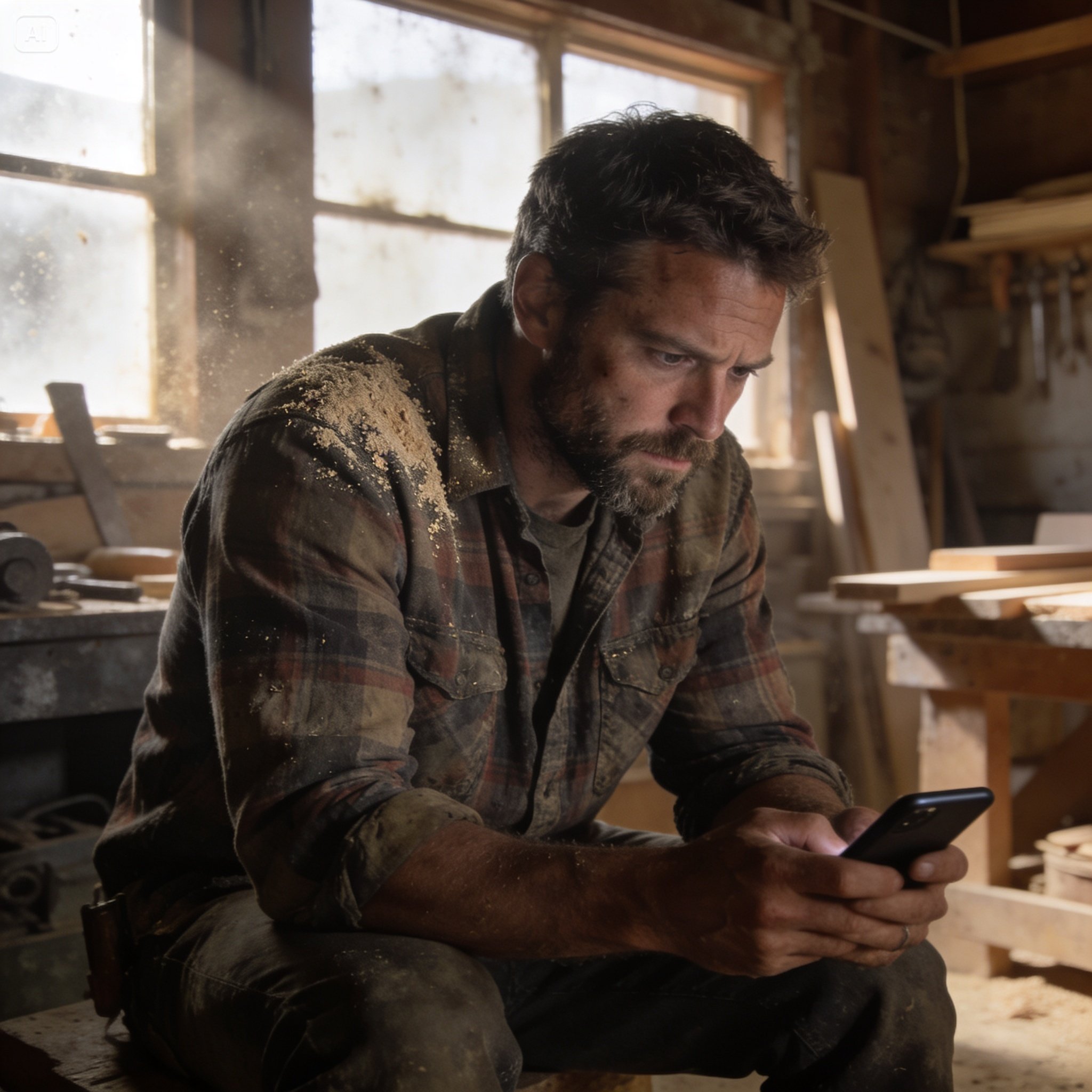
The fluorescent lights of the precinct felt like they were vibrating against my skull. I sat on the curb outside the warehouse, my termination papers crumpled in a fist that wouldn’t stop shaking. Marcus had done it. He’d finally managed to pin the missing inventory on the guy who couldn’t afford a lawyer to fight back. “We have witnesses, Jacob,” the supervisor had sneered, sliding that cold, final envelope across the desk. I looked at the asphalt, the realization sinking in like lead: I was thirty-four, a single father, and I had exactly eighteen dollars to my name.
The walk to the bus stop felt like a march to the gallows. Every step was a calculation of how many boxes of generic mac and cheese eighteen dollars could buy. How many days could I stretch the milk? How long before the landlord noticed the rent check wasn’t coming? I sat on the cold metal bench, the humid night air clinging to my skin like a second layer of grief. I just wanted to disappear into the shadows of the flickering streetlamp, but then I heard the sound. It was a jagged, wet sob coming from the person sitting three feet away.
She was tucked into herself, a woman in her late thirties with hair that had come loose from a messy knot. Her hands were trembling violently as she dumped the contents of a small purse onto her lap. Nickel after nickel, penny after penny. She was counting them with a frantic, desperate speed, her breath coming in short, panicked gasps. “Please,” she whispered to the empty air, “please be enough.” She counted again, and the sob that broke out of her chest was the sound of a person who had reached the absolute end of their rope.
I looked at her, and for a second, I didn’t see a stranger. I saw myself. I saw the mirror image of the desperation that had been hollowing out my chest all afternoon. I reached into my pocket and felt the two bills—a ten and a five—and the three singles. It was my daughter Grace’s dinner. It was our bus ride home. It was the only barrier between us and total insolvency. My mind screamed at me to keep it, to be selfish, to survive. But my hand moved anyway.
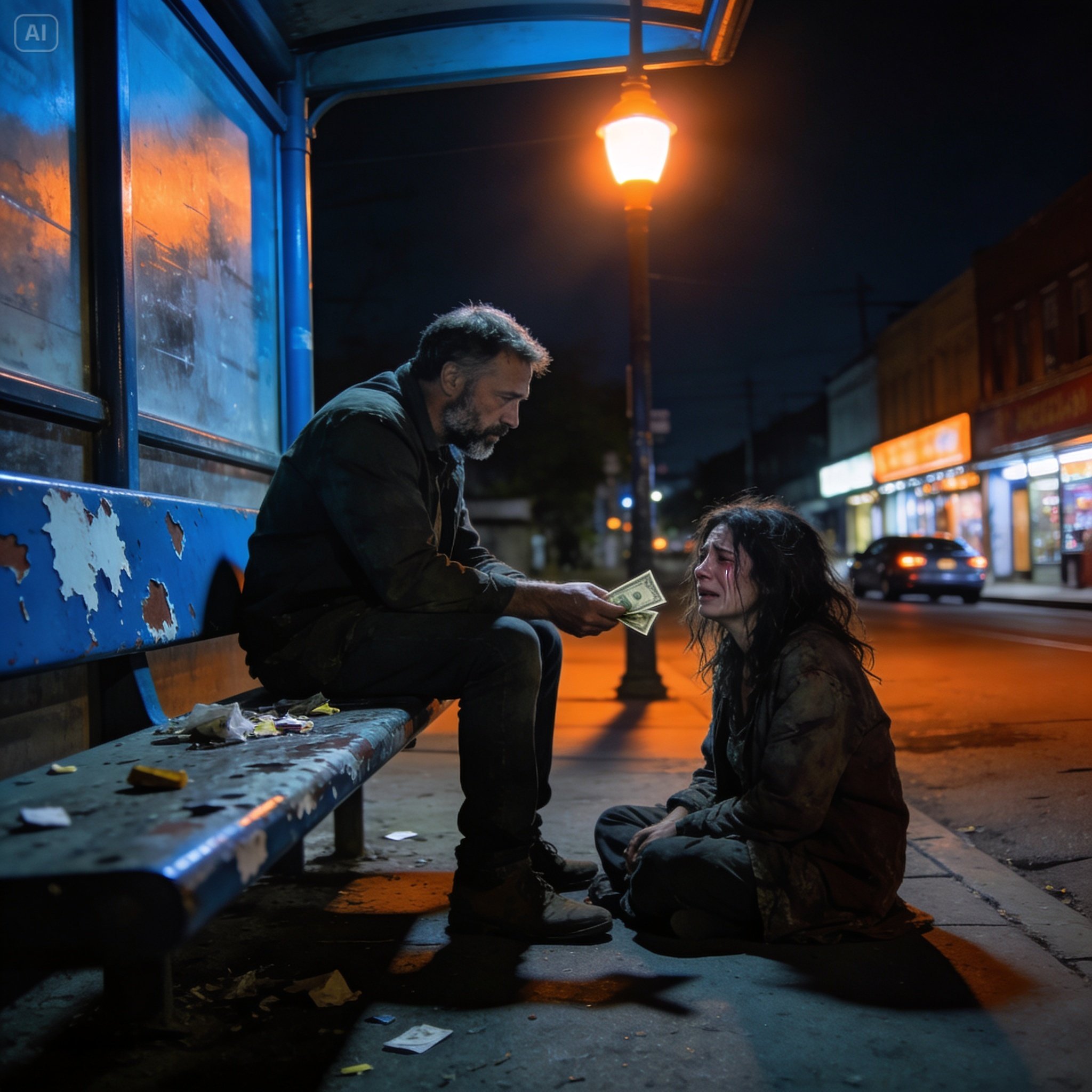
“Here,” I said, my voice sounding like gravel. I held out the crumpled bills. She looked up, her eyes bloodshot and rimmed with a terror so profound it made my heart ache. She stared at the money, then at me, her mouth hanging open. “I can’t,” she choked out, “that’s… you’re at this bus stop too. You need this.” I forced a smile that felt more like a scar. “I’m already lost,” I told her. “You look like you still have somewhere to get to. Take it. All of it.”
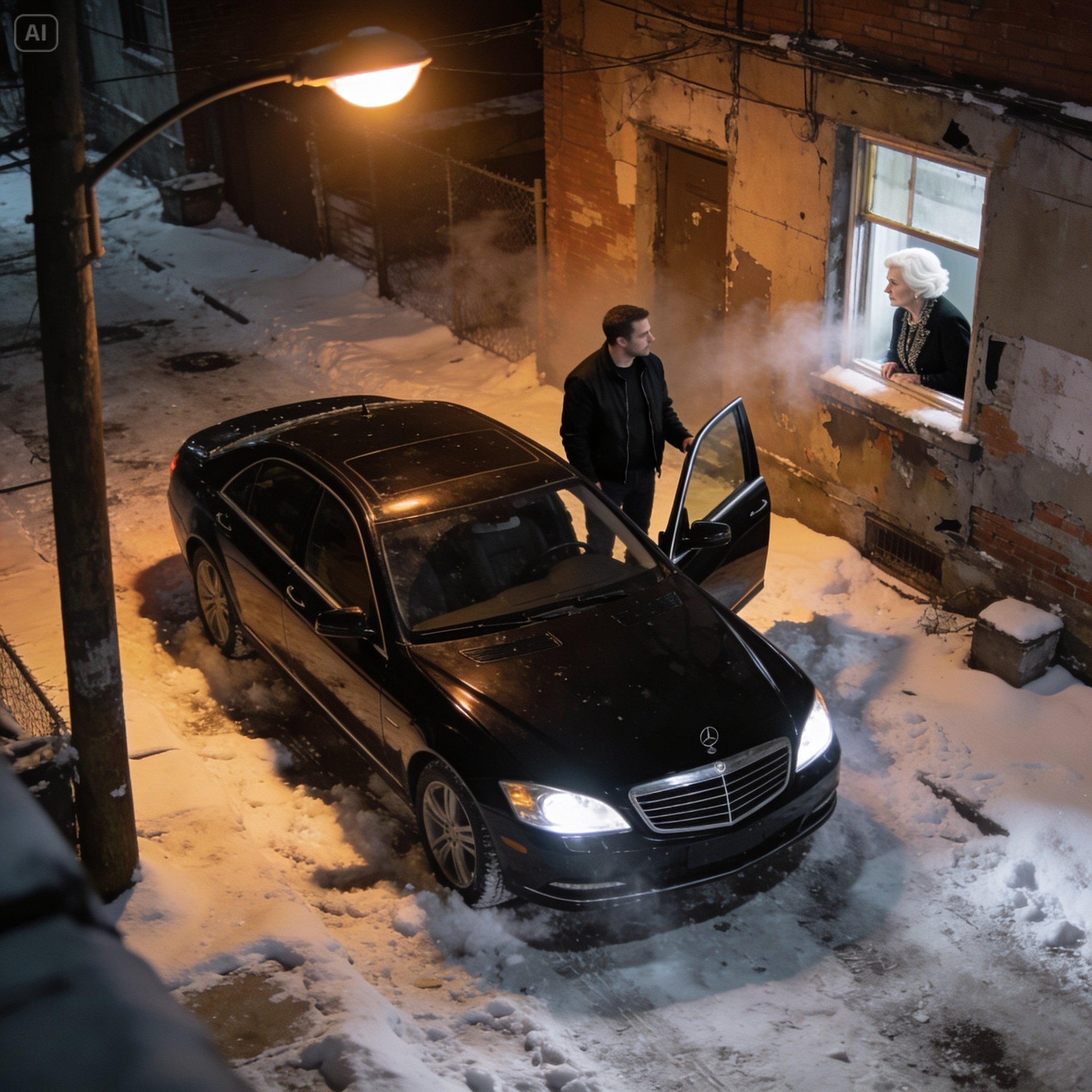
She took the money with fingers that felt like ice, weeping as she thanked me. The bus pulled up with a hiss of air brakes, and she vanished into the interior light. I watched the taillights fade, standing alone in the dark. I walked four miles home that night, my stomach cramping, my shoes wearing thin. I kissed Grace on the forehead while she slept, whispering apologies into her hair. I fell into a fitful sleep, only to be jolted awake at 8:00 AM by a sound this neighborhood never heard. It wasn’t the rattle of a garbage truck. It was the low, synchronized hum of high-end engines. I pulled back the curtain, my heart stopping as I saw five jet-black SUVs lining the curb, and the woman from the bus stop stepping out of the lead vehicle, looking like she owned the world.
Part 2
The silence that followed Charlotte’s invitation felt like a physical weight pressing against my ribs, making it impossible to draw a full breath.
I looked at the peeling linoleum floor of my kitchen, then back at this woman who looked like she belonged on the cover of a magazine, not in a drafty apartment that smelled like cheap laundry detergent and old coffee.
My mind was a chaotic mess of skepticism and desperation, the two halves of my brain fighting for control of my voice.
“You’re offering me a job?” I finally managed to croak out, the words feeling dry and heavy in my mouth.
“I’m offering you a lifeline, Jacob,” she said, her voice dropping an octave, losing that razor-sharp corporate edge for just a second.
“But more importantly, I’m offering you a seat at the table where we figure out who tried to erase me.”
She didn’t wait for me to process that; she just turned to look at the hallway where Grace was still hovering, her small face pale and wide-eyed.
“Grace, honey, do you think your dad is the smartest man you know?” Charlotte asked, her expression softening into something so genuinely kind it made my throat ache.
Grace didn’t hesitate, nodding her head so hard her pigtails flopped. “He can fix anything,” she whispered, her voice full of that terrifyingly pure childhood faith.
Charlotte looked back at me, her eyes locking onto mine with an intensity that felt like a challenge. “I don’t need a resume, Jacob. I need someone who understands that the world isn’t fair, but who is willing to fight to make it right anyway.”
I looked around my kitchen—at the stack of past-due notices pinned to the fridge with a ladybug magnet, at the empty cereal box, at the flickering lightbulb that I hadn’t been able to afford to replace.
Then I looked at my daughter, the person for whom I would walk through fire, and I realized I didn’t have the luxury of pride or hesitation anymore.
“When do I start?” I asked, my voice finally steadying.
“Now,” she said, standing up and smoothing the invisible wrinkles in her charcoal suit. “My driver is waiting, and we have four hours before the board meeting that will determine if I still have a company by sunset.”
The transition from my stagnant, quiet life to the high-velocity orbit of Lancaster and Associates was like being thrown into the deep end of a freezing pool.
I grabbed my only decent shirt—a faded blue button-down that I’d saved for funerals and court dates—and kissed Grace goodbye, telling her Mrs. Kate would be over in ten minutes.
As I stepped into the back of the lead SUV, the smell of expensive leather and ozone hit me, a scent that screamed wealth and untouchable power.
Charlotte was already on her phone, her thumb flying across the screen as she barked orders to someone named Richard about “forensic accounting” and “asset freezes.”
I sat in the corner of the plush seat, feeling like an imposter, watching the familiar, grimy streets of my neighborhood blur into the gleaming glass and steel of the financial district.
The office was a cathedral of capitalism, three floors of polished marble, glass walls, and people who moved with the kind of frantic purpose that only comes from chasing millions of dollars.
Heads turned as Charlotte marched through the lobby, her heels clicking like a metronome against the stone floor, with me trailing behind like a stray dog she’d picked up on the side of the road.
“Ignore them,” she muttered, not looking back. “Half these people are waiting to see if I fall, and the other half are the ones who tried to trip me.”
She led me into a glass-walled conference room where a man in his late fifties sat hunched over a laptop, his face the color of old parchment.
“Richard, this is the man I told you about,” Charlotte said, gesturing toward me as she tossed her leather briefcase onto the mahogany table.
Richard looked up, his sharp, bird-like eyes scanning me from my scuffed boots to my nervous expression, his lip curling just a fraction of an inch.
“This is him? The… bus stop savior?” Richard asked, his voice dripping with the kind of Ivy League condescension I’d spent my whole life avoiding.
“His name is Jacob, and he’s the only reason I’m standing in front of you instead of sitting in a ditch downtown,” Charlotte snapped, her voice cracking like a whip.
I felt a surge of gratitude toward her, but also a crushing sense of inadequacy; what could I possibly contribute to a room filled with people who spoke in spreadsheets and legal jargon?
For the next three hours, I sat in a corner and listened as they laid out the anatomy of a corporate execution.
Charlotte had been lured downtown by a fake emergency call from a client, her car had been remotely disabled, and her personal security—the men she trusted with her life—had mysteriously vanished just before the “robbery.”
“It wasn’t just a mugging, Jacob,” Richard explained, finally acknowledging my presence as he pulled up a series of internal documents.
“Someone has been siphoning funds into offshore accounts for eighteen months, and they needed Charlotte out of the picture before the annual audit triggered an automatic flag.”
I stared at the screen, the lines of numbers and codes looking like a foreign language, but then I saw a name that made my heart skip a beat.
“Derek Anderson,” I read aloud, pointing to a signature on a series of “miscellaneous equipment” invoices.
Charlotte froze, her hand hovering over her coffee cup. “My executive assistant? No. Derek has been with me since I started this firm in my garage.”
“I don’t know who he is to you,” I said, leaning forward as a familiar, gut-level instinct took over. “But I know those types of invoices. I’ve seen them before.”
I thought back to the factory, to the way Marcus had framed me—the fake requisitions, the signatures that looked just a little too perfect, the “witnesses” who were always in the right place at the wrong time.
“In the factory, they called it ‘ghosting the line,'” I said, my voice gaining a confidence I didn’t know I possessed. “You create a paper trail for equipment that doesn’t exist, then you ‘report’ it as stolen or damaged, and you pocket the insurance or the replacement cash.”
Richard frowned, tapping his pen against the table. “That’s a low-level scam, Jacob. We’re talking about millions of dollars here.”
“The scale is different, but the math is the same,” I countered, standing up and walking over to the glass board.
“Look at the dates. Every time an invoice was filed for this ‘high-end imaging tech,’ Charlotte was out of the office on a business trip.”
I started pointing to the patterns, the way the numbers spiked right before the quarterly reports, the way the “witnesses” for the equipment delivery were always the same three junior associates.
The room went silent as Charlotte stood up and walked toward the screen, her eyes narrowing as she traced the path of the money I was describing.
“Derek was the one who insisted I take his car that night,” she whispered, her face going pale as the realization settled in like a poison.
“He was the one who told me the client was waiting at that specific restaurant. He was the one who held my bag while I got into the car.”
The betrayal was written in the sudden, sharp lines around her mouth; she wasn’t just losing money, she was losing her sense of reality.
“He’s in his office right now,” Richard said, his voice low and dangerous as he reached for the intercom.
“No,” Charlotte said, her voice regaining its iron strength. “If we move now, he’ll have time to wipe the servers. We need to catch him in the act of the final transfer.”
She turned to me, her eyes shimmering with a mix of fury and something that looked a lot like respect.
“Jacob, I need you to do something that Richard can’t do. I need you to go into that office and talk to him.”
My stomach did a slow roll. “Talk to him? About what? I’m the guy who looks like he just crawled out of a gutter.”
“Exactly,” Charlotte said, a cold, predatory smile touching her lips. “I want you to play the part he expects. The desperate, pathetic man who found my wallet and is here to ‘claim a reward.'”
“He won’t see you as a threat. He’ll see you as a nuisance he needs to pay off quickly so he can get back to his keyboard.”
She handed me a manila envelope filled with dummy documents and a small, high-tech recording device disguised as a cheap plastic pen.
“While he’s busy trying to get rid of you, Richard will be bypassing the firewall from the server room. We need five minutes of him being logged into his master account.”
I took the pen, my hand shaking slightly. This wasn’t fixing a broken conveyor belt or hauling crates; this was playing a game where the stakes were people’s lives.
I walked down the long, carpeted hallway toward the corner office, my heart hammering against my ribs like a trapped bird.
The door was open, and I saw a man in his late twenties, his hair perfectly coiffed, his sleeves rolled up as he typed furiously on a triple-monitor setup.
He looked up as I shadowed the doorway, his expression shifting from annoyance to pure, unadulterated disgust in less than a second.
“Can I help you? This is a private floor,” he said, his voice smooth and curated, the sound of someone who had never had a callus on his hand in his life.
“I… I’m looking for Ms. Lancaster,” I stuttered, leaning into the role of the broken man I had actually been just twenty-four hours ago.
“I found something of hers. At the bus stop. I was told there might be… you know, a finders fee or something.”
Derek leaned back in his leather chair, a smirk playing across his face that made me want to jump across the desk and wrap my hands around his throat.
“Another one,” he sighed, reaching for a thick stack of cash in his top drawer. “Look, buddy, you’re the third ‘hero’ to show up today. Charlotte is a very busy woman.”
He peeled off two hundred-dollar bills and held them out toward me, the gesture so dismissive it felt like he was throwing scraps to a dog.
“Take this and disappear. If I see you in this building again, I’ll have security toss you into the street. Do we have an understanding?”
I didn’t take the money. I just stood there, looking at his computer screen, seeing the progress bar of a massive file transfer that was currently at eighty-two percent.
“It’s not just about the money,” I said, forcing my voice to tremble. “She looked really hurt that night. Like someone had really done her wrong.”
Derek laughed, a cold, hollow sound that echoed off the glass walls. “The world is full of people getting ‘done wrong,’ pal. Some people are just born to be at the bottom of the food chain.”
He stood up, walking toward me, his expensive cologne filling the small space and making me feel like I was suffocating.
“You think you’re special because you did a ‘good deed’? You’re just a footnote in a story you don’t even understand.”
He grabbed my shoulder, his grip surprisingly tight, trying to steer me toward the door. “Now, get out before I lose my patience.”
At that moment, the computer behind him emitted a sharp, high-pitched chime, and the screens suddenly turned blood-red.
Derek froze, his hand still on my shoulder, his face draining of color until he looked like a ghost.
“What… what is that?” he whispered, spinning around to look at the monitors where the words ‘Unauthorized Access Detected’ were flashing in giant letters.
“That,” Charlotte’s voice rang out from the doorway, “is the sound of eighteen months of your life being deleted by the police.”
She was standing there with two uniformed officers and Richard, her arms crossed over her chest, her eyes burning with a righteous, terrifying light.
Derek scrambled for his keyboard, but the officers were on him in seconds, slamming him face-down onto the mahogany desk as the handcuffs clicked shut.
He looked at me as they hauled him up, his eyes wide with a realization that came far too late. “Who are you?” he spat, his voice trembling with rage.
“I’m the guy from the bottom of the food chain,” I said, stepping closer to him so he could see the lack of fear in my eyes.
Charlotte walked over to me as they led Derek out in silence, the entire office floor standing still to watch the fall of the golden boy.
She didn’t say anything at first; she just reached out and took the plastic pen from my hand, her fingers brushing mine.
“You held him for six minutes,” she said, her voice soft but filled with an emotion I couldn’t quite name. “Richard only needed four.”
“I guess I’m a better actor than I thought,” I joked, but the adrenaline was starting to fade, leaving me feeling hollow and exhausted.
“No, Jacob,” she said, looking me straight in the eyes. “You weren’t acting. You were just being the man who doesn’t look away when things get ugly.”
The next few weeks were a blur of legal depositions, internal audits, and the slow, steady process of purging the rot from Lancaster and Associates.
I was given a small office next to Richard’s, a “Consultant” title that I still didn’t feel I deserved, and a salary that made me weep when I saw the first direct deposit.
But the most significant change wasn’t the money or the title; it was the way the world looked when I wasn’t constantly bracing for the next blow.
I could buy Grace the good cereal. I could pay the rent three months in advance. I could look in the mirror without seeing a failure staring back.
Charlotte started coming over to the apartment on Saturday mornings, bringing gourmet coffee and sitting on my lumpy sofa like it was a throne.
She’d help Grace with her homework, laughing at her jokes, while I watched them from the kitchen, my heart feeling like it was three sizes too big for my chest.
I knew it was dangerous—the boss and the “charity project”—but the lines between us were blurring faster than I could redraw them.
She wasn’t just a CEO to me anymore; she was the woman who had seen my lowest point and hadn’t flinched.
And I wasn’t just a factory worker to her; I was the only person in her life who had ever given her something without expecting a return.
One evening, after Grace had fallen asleep, we sat on the small balcony of my new apartment, the city lights twinkling below us like scattered diamonds.
“You’re thinking about the bus stop,” she said, her voice a low hum in the quiet night air.
“How did you know?” I asked, turning to look at her.
“Because I think about it every time I look at you,” she admitted, her hand moving to cover mine on the railing.
“I spent ten years building that company, Jacob. I thought I was strong because I had a high net worth and a board of directors that feared me.”
“But that night, sitting on that bench with nothing but a handful of pennies, I realized I was the weakest person in the city.”
She squeezed my hand, her eyes reflecting the neon glow of the streetlights. “You gave me eighteen dollars, but you also gave me my dignity back.”
“I just did what anyone should have done,” I said, feeling that familiar heat rise in my cheeks.
“No,” she corrected me, her voice firm. “You did what no one else did. And that makes you the most dangerous man I’ve ever met.”
I didn’t know what to say to that, so I just sat there in the silence, listening to the hum of the city and the sound of my own heartbeat.
But as the weeks turned into months, the professional relationship started to feel like a cage that we were both trying to figure out how to unlock.
The office gossip was a constant drone in the background—whispers about the “mystery man” and the “CEO’s pet”—but Charlotte didn’t seem to care.
She took me to charity galas where I felt like a penguin in my new tuxedo, and she stood by my side as I navigated conversations about hedge funds and global markets.
She taught me how to lead, not by shouting, but by listening, and I taught her that sometimes the most important thing you can do is just show up.
Grace started calling her “Auntie Charlotte,” a title that made Charlotte beam with a pride that no profit margin could ever provide.
But as the first anniversary of that night at the bus stop approached, the tension between us reached a breaking point that neither of us could ignore.
We were at a small bistro downtown, the kind of place where the waiters wear white gloves and the menu doesn’t have prices.
“Jacob, there’s something I’ve been wanting to ask you,” she said, her voice uncharacteristically nervous as she toyed with her wine glass.
My heart pounded against my ribs; I thought she was going to fire me, or tell me that the “consultancy” was over.
“I’ve been offered a position in London,” she said, her eyes dropping to the table. “A merger that would make Lancaster and Associates the largest firm in Europe.”
The air left my lungs as if I’d been punched in the gut. London. That was thousands of miles away from this city, from this life, from us.
“That’s… that’s incredible, Charlotte,” I said, the words feeling like ash in my mouth. “You’ve earned it.”
“I haven’t decided if I’m taking it yet,” she said, looking up, her eyes searching mine for something I was too afraid to show.
“Why wouldn’t you?” I asked, my voice barely a whisper. “It’s everything you’ve ever worked for.”
“Because everything I’ve ever worked for used to be a number on a screen,” she said, leaning across the table, her face just inches from mine.
“But now, everything I care about is sitting right here, eating an expensive steak and pretending he’s not in love with me.”
I froze, the sounds of the restaurant fading into a dull roar in my ears. I wanted to deny it, to protect myself, to keep the status quo.
But then I thought about that eighteen dollars. I thought about the risk I’d taken when I had nothing, and I realized that taking a risk when you have everything is the only thing that actually matters.
“I’m not pretending,” I said, my voice cracking with the weight of the truth. “I’ve been in love with you since the moment you stepped out of that SUV.”
Charlotte didn’t say a word; she just reached out and pulled me toward her, her lips meeting mine in a kiss that tasted like a beginning.
The rest of the night was a blur of whispered promises and the terrifying, exhilarating realization that our lives were about to change again.
But as I walked her to her car, a dark shadow moved in the periphery of my vision, a familiar shape that made the hair on the back of my neck stand up.
It was Marcus. The man who had framed me. The man who had started this entire chain of events.
He was standing by the entrance of the parking garage, his face twisted into a mask of pure, unadulterated hatred.
“You think you won, don’t you, Jacob?” he spat, stepping into the light, a heavy wrench gripped in his hand.
“You think you can just walk away from the mess you left behind? You think this fancy woman is going to save you forever?”
Charlotte stepped back, her hand flying to her mouth, but I stepped forward, the old instincts of the factory floor taking over.
“I didn’t leave a mess, Marcus. You did,” I said, my voice cold and flat. “And I’m not the same man you bullied a year ago.”
He lunged at me, the wrench whistling through the air, but I was faster, fueled by a year of bottled-up rage and the need to protect the woman I loved.
I dodged the blow and drove my shoulder into his chest, the impact sending him sprawling back against the cold concrete.
I stood over him, my chest heaving, realizing that I wasn’t just fighting Marcus; I was fighting every ghost of my past that had tried to keep me small.
“Get up,” I growled, “and if I ever see your face again, I won’t just call the police. I’ll make sure you never work in this city again.”
Marcus looked up at me, the bravado draining out of him as he realized that the “poor single dad” was gone, replaced by someone he no longer recognized.
He scrambled to his feet and disappeared into the shadows, leaving me standing there in the middle of the street, shaking with adrenaline and relief.
Charlotte ran to me, her hands trembling as she checked my face for injuries, her eyes filled with a terror that I’d only seen once before.
“Are you okay?” she whispered, her voice frantic.
“I’m fine,” I said, pulling her into my arms and holding her as if I’d never let her go. “I’m better than fine.”
We didn’t go to London. Charlotte turned down the merger, deciding instead to focus on building something here, something that mattered more than a global empire.
She promoted Richard to CEO, and together, she and I started a foundation dedicated to helping single parents get the professional training they needed to break the cycle of poverty.
We moved into a house with a yard big enough for Grace to run until she was exhausted, and a kitchen where the lightbulbs never flickered.
On the day of our wedding, a small ceremony in the backyard surrounded by the people who had stood by us, I looked at the guest list.
There was Mrs. Kate, crying into a silk handkerchief. There was Richard, looking uncharacteristically emotional in a tailored suit.
And there was Grace, standing at the altar with a crown of wildflowers, looking like the happiest kid in the world.
When it was time for the vows, I didn’t have a prepared speech. I just reached into my pocket and pulled out a small, framed shadowbox.
Inside was a crumpled ten-dollar bill, a five, and three ones—the exact eighteen dollars I had given Charlotte that night.
“I thought I was giving you my last eighteen dollars,” I said, my voice thick with emotion as I looked at my beautiful bride.
“But really, I was just making the best investment of my life.”
Charlotte laughed through her tears, reaching out to take my hand, her eyes locked onto mine with a love that felt like home.
“I love you, Jacob Miller,” she whispered.
“I love you, Charlotte,” I replied, and as the minister pronounced us husband and wife, I knew that the story wasn’t just beginning.
It was finally, beautifully, exactly where it was always meant to be.
Part 3
The “Consultant” badge felt like a lead weight pinned to my chest, even if the office it got me into was lined with glass and smelled of expensive cedar polish.
Walking into Lancaster and Associates every morning was a lesson in psychological warfare; I was the man who didn’t exist a year ago, now whispered about in every breakroom from the mailroom to the executive suites.
I spent my first three weeks buried in a windowless room with Richard, the CFO who looked like he’d been carved out of granite and fed a steady diet of audits and bitterness.
He didn’t trust me, and honestly, I didn’t blame him—I was a factory floor rat who had lucked into the inner sanctum because I’d played the “Good Samaritan” at the right bus stop.
“You think you’re a detective now, Jacob?” Richard asked one afternoon, tossing a three-inch-thick binder of expense reports onto my desk with enough force to make my coffee jump.
“Charlotte thinks you have a ‘gift’ for spotting patterns, but these are numbers, not broken machinery—if you miss a decimal point here, people lose their pensions, not just their lunch breaks.”
I didn’t blink; I just opened the binder and started scanning the line items, the same way I used to scan a conveyor belt for a misaligned gear or a hairline fracture in a steel plate.
“Betrayal has a rhythm, Richard,” I said, my voice flat and focused, not looking up from the page.
“People like Derek, they don’t just steal money; they steal time, and they leave a trail of small, insignificant lies that lead right to the heart of the bank account.”
I spent twelve hours a day cross-referencing shipping manifests with maintenance logs, looking for the “ghost” equipment I’d told Charlotte about during our first meeting.
I found the first discrepancy in a series of invoices for industrial-grade servers that were supposedly delivered to a satellite office in Phoenix—an office that had been closed for six months.
The signatures on the receiving end were digital, encrypted, and traced back to a shell company in the Cayman Islands that shared a physical address with a dry cleaner in Jersey City.
It was a classic “pump and dump” scheme at the corporate level, and the more I dug, the more I realized Derek hadn’t acted alone—he was just the lightning rod for a much larger storm.
I brought my findings to Charlotte on a rainy Tuesday, her office dim except for the glow of her dual monitors and the city lights reflecting off the wet glass.
She looked exhausted, the skin beneath her eyes bruised with fatigue, her hand trembling slightly as she reached for a pen.
“It’s deeper than we thought, Charlotte,” I said, laying out the spreadsheets that I’d color-coded with a red highlighter.
“There are three other department heads involved in the Phoenix project, and they’ve been using the company’s own internal auditing software to hide the transfers.”
She stared at the names—people she’d hired, people she’d invited to her home for holiday parties, people she’d considered the bedrock of her success.
“They’re trying to bankrupt me from the inside out,” she whispered, her voice cracking as she leaned back in her high-backed leather chair.
“They wanted to devalue the stock so a hostile takeover firm could swoop in and buy the company for pennies on the dollar, with them keeping their seats on the new board.”
The silence in the room was suffocating, broken only by the steady drum of rain against the window and the distant hum of the ventilation system.
“I gave them everything,” she said, her eyes filling with a cold, jagged anger that made me want to step back.
“I gave them bonuses when the market was down, I paid for their kids’ tuition, I treated them like family—and they were just waiting for me to turn my back so they could gut me.”
I walked around the desk and put my hand on her shoulder, feeling the tension radiating off her like heat from an engine.
“They didn’t count on one thing, Charlotte,” I told her, my voice low and steady.
“They didn’t count on you being the kind of person who helps a stranger at a bus stop, and they definitely didn’t count on that stranger knowing exactly how to dismantle a lie.”
She looked up at me, and for a split second, the CEO mask slipped, revealing the terrified woman I’d met on the bench.
“Stay with me tonight, Jacob,” she said, her voice a fragile thread in the dark room. “I don’t mean… I just mean, I can’t go back to that empty house knowing that everyone I trust is a predator.”
We spent the night in the office, fueled by bitter coffee and the shared adrenaline of a looming deadline.
We mapped out the counter-strike, a series of legal filings and frozen assets that would trigger the moment the markets opened on Friday.
It was a high-stakes poker game where we were betting everything on the hope that our evidence was cleaner than their cover-ups.
By 4:00 AM, the air in the office felt electric, a strange mix of professional intensity and a deepening, unspoken intimacy.
We were sitting on the floor of her office, surrounded by paper trails and empty takeout containers, the sun just beginning to gray the edges of the horizon.
“Why did you do it, Jacob?” she asked, her voice soft, looking at the faded photo of Grace I kept in my wallet.
“Why did you give a crying woman your last eighteen dollars when you knew you had a hungry child waiting at home?”
I looked at the photo of Grace, at her gap-toothed smile and the way she looked like she owned the sun.
“Because I knew that if I didn’t, the world would have finally won,” I said, the truth feeling heavy in my chest.
“I’d spent my whole life being told that if you’re poor, you’re invisible, and if you’re invisible, you don’t have to be kind.”
“But I didn’t want Grace to grow up in a world where her father was just another ghost who looked the other way when someone was breaking.”
“I gave you that money because I needed to prove to myself that I still had something the world couldn’t take away—my choice to be human.”
Charlotte reached out and took my hand, her palm warm against mine, her thumb tracing the calluses on my knuckles.
“You’re the only real thing in my life right now, Jacob,” she said, her eyes locked onto mine with an honesty that terrified me.
I wanted to kiss her then, to bridge the gap between the factory worker and the billionaire, but the ghost of my “9-5 hell” past whispered in my ear.
I was her employee; I was a charity case; I was the guy who could lose everything if I misread the signal.
I squeezed her hand and stood up, clearing my throat and pointing at the monitor.
“The markets open in three hours, Charlotte. We need to be ready.”
The “Friday Massacre,” as the tabloids later called it, was a surgical strike that left the corporate world reeling.
By 9:15 AM, three senior VPs were being escorted out of the building by private security, their company phones confiscated and their server access revoked.
Charlotte stood in the center of the trading floor, her voice amplified by the PA system, her face as cold and beautiful as a diamond.
“This company was built on integrity, and today, we’ve cut out the cancer that tried to kill it,” she announced to a room of stunned employees.
I watched from the shadows of the mezzanine, feeling a strange sense of closure as the men who had looked down on me were led away in handcuffs.
But the victory felt hollow when I saw Marcus standing by the elevators, his face a mask of shock as he realized the “thief” he’d framed was standing next to the woman who owned his paycheck.
He tried to run, tried to blend into the crowd of fleeing associates, but I met him at the lobby doors.
“Going somewhere, Marcus?” I asked, my voice a low growl that stopped him in his tracks.
“You set me up, Jacob,” he hissed, his eyes darting around the room like a cornered rat. “You used this woman to get back at me.”
“I didn’t use anyone,” I said, stepping into his personal space until he could smell the stale coffee on my breath.
“I just did my job. And it turns out, my job involves making sure people like you don’t get to ruin lives for sport anymore.”
I watched the feds lead him away, the same way I’d watched my own career go up in flames just months prior.
The aftermath was a whirlwind of legal depositions and corporate restructuring, leaving me and Charlotte in a strange, quiet vacuum.
The “consultancy” was over, the fraud was exposed, and the company was safe.
I expected a handshake, a generous severance package, and a polite “thanks for everything.”
Instead, Charlotte showed up at my apartment on a Saturday morning, her SUV idling at the curb, her arms full of groceries and a soccer ball.
“I told Grace I’d take her to the park,” she said, bypassing me and walking straight into the kitchen as if she lived there.
“And I told myself I’d tell you that London isn’t an option anymore.”
I followed her, confused and bracing for the “talk” I’d been dreading.
“What do you mean, it’s not an option?” I asked. “The merger… the expansion… that was your dream.”
She stopped unloading the groceries and turned to face me, her eyes bright and defiant.
“My dream was to be safe, Jacob. I thought safety meant being at the top of the mountain.”
“But I realized that the view from the top is just lonely if you don’t have anyone to share it with who knows what it’s like at the bottom.”
She walked over to me, her hands resting on my chest, the heat of her touch through my shirt making my heart skip a beat.
“I’m staying here. I’m building a new team, and I want you to be the head of operations.”
“Not because you’re a ‘hero,’ and not because I owe you eighteen dollars.”
“I want you because you’re the only person who saw me when I was invisible, and I never want to be invisible again.”
I looked at her, really looked at her, and realized that the “Good Samaritan” story was over.
This was something else—something raw, something messy, and something that felt like the first real thing I’d ever owned.
I leaned down and kissed her, the groceries forgotten on the counter, the world outside our little apartment fading into insignificance.
It wasn’t a cinematic kiss; it was desperate and clumsy and tasted like second chances.
But as I pulled away, I saw Grace standing in the doorway, her soccer jersey on backward, a huge grin on her face.
“Does this mean we’re getting pizza for dinner?” she asked, her voice full of pure, uncomplicated joy.
Charlotte laughed, a sound that filled the room and chased away the last of the shadows.
“Yes, Grace,” she said, looking back at me with a promise in her eyes that made the eighteen dollars feel like the smallest part of the story.
“We’re getting pizza. And we’re never going to bed hungry again.”
But the peace didn’t last as long as we hoped, because as we walked toward the door, my phone buzzed with an unknown number.
I answered it, expecting a telemarketer or a lawyer, but the voice on the other end turned my blood to ice.
“You think you’re safe in that ivory tower, Jacob?” the voice rasped, the sound of static and malice.
“You think putting me in a cell was the end of it? I still have friends on the outside, and they know exactly where your daughter goes to school.”
The line went dead, and the soccer ball slipped from my hand, bouncing hollowly on the floor as the room went cold.
I looked at Charlotte, then at Grace, and realized that the war wasn’t over—it had just moved to my front door.
I had to find out who was behind the voice before the sun went down, or the eighteen-dollar miracle was going to turn into a nightmare I couldn’t wake up from.
“Jacob? What is it?” Charlotte asked, her hand on my arm, sensing the sudden shift in the air.
“Get in the car,” I said, my voice sounding like it was coming from someone else. “We’re leaving. Now.”
I grabbed my keys and the shadowbox with the eighteen dollars, the only armor I had left.
The drive to Richard’s estate was a blur of high-speed turns and panicked glances in the rearview mirror.
I was convinced we were being followed, every pair of headlights in the twilight looking like a predator’s eyes.
When we arrived, Richard was waiting on the porch, a shotgun resting across his knees, his face grim.
“They hit my office an hour ago,” he said, his voice a low rumble. “Someone leaked the witness list for the Derek trial.”
“It’s not just about the money anymore, Charlotte. This is a vendetta.”
We spent the next six hours locked in Richard’s study, the walls lined with monitors showing the perimeter of the estate.
I watched the screens with a predatory intensity, my hands gripping the edge of the desk until my knuckles turned white.
I wasn’t a consultant or a dad then; I was the man who had survived the 9-5 hell by being tougher and smarter than the people who tried to break me.
And I was going to make sure that whoever threatened my family learned exactly why you don’t mess with a man who has nothing left to lose.
The first shadow appeared on the north fence at 2:00 AM, a silent silhouette against the moonlit grass.
Then another. And another.
They weren’t common thugs; they moved with the synchronized precision of professionals.
“They’re here,” I whispered, reaching for the heavy iron fire poker by the hearth.
Charlotte grabbed my hand, her eyes wide with terror. “Jacob, don’t. Call the police.”
“The police are twenty minutes away, Charlotte,” I said, my voice flat and cold. “They’ll be inside in five.”
I walked toward the door, the weight of the iron in my hand feeling right, feeling necessary.
I looked back at her one last time, at the woman who had given me a reason to fight.
“Stay in the panic room with Grace. Lock the door. Don’t open it for anyone but me.”
I stepped out into the hallway, the darkness swallowing me whole, my senses tuned to the sound of breaking glass and muffled footsteps.
This was the final audit, the one where the numbers were written in blood and the only thing that mattered was survival.
And I was going to make sure the balance sheet ended in our favor, no matter what it cost me.
I heard the back door splinter, the sound of heavy boots on the hardwood floor echoing through the house.
I pressed myself against the wall, my breath shallow, my heart a rhythmic thud in my ears.
The first man came around the corner, his silenced pistol leading the way, his eyes focused on the stairs.
I didn’t think; I just swung, the iron fire poker connecting with his temple with a sickening crunch.
He went down without a sound, and I stepped over his body, my eyes fixed on the shadows at the end of the hall.
“Jacob!” a voice screamed from the top of the stairs—Grace’s voice.
I looked up, my heart stopping as I saw a fourth man holding her, a knife glinting against her small, pale throat.
“Drop it!” he yelled, his voice echoing with a manic, desperate edge. “Drop the poker or she dies right now!”
I felt the world tilt, the floor beneath my feet turning into quicksand as I stared at my daughter’s terrified eyes.
I dropped the iron, the clang sounding like a funeral bell in the silent house.
“Let her go,” I pleaded, my voice breaking. “Take me. Just let her go.”
The man laughed, a high-pitched, jagged sound that made my skin crawl.
“You ruined everything, Jacob! You and your eighteen-dollar sob story!”
He stepped out of the shadows, and my breath hitched as I recognized the face beneath the tactical mask.
It wasn’t a hitman. It wasn’t a professional.
It was the one person I thought was on our side, the one person who had been in the room since the very beginning.
I stared at him, the betrayal feeling like a knife in my own gut, realized that the call had come from inside the house all along.
“Why?” I whispered, the word feeling like a prayer.
He just smiled, a cold, empty expression that told me everything I needed to know.
And as he tightened his grip on Grace, I realized that the hardest part of the story was just about to begin.
I had one chance to save her, one split second to make a move that would either end the nightmare or destroy my world forever.
I looked at the shadowbox on the floor, the eighteen dollars glinting in the moonlight, and I made my choice.
Part 4
The man standing over my daughter with a blade to her throat wasn’t some faceless mercenary or a ghost from my industrial past.
It was Richard Torres.
The “Salt and Pepper” CFO, the man who had supposedly been the bedrock of Charlotte’s recovery, the man who had just sat with us for six hours pretending to be our guardian.
The shock hit me like a physical blow to the solar plexus, knocking the air out of my lungs and leaving me paralyzed in the center of the dark hallway.
“Richard?” I gasped, the name tasting like ash and iron in my mouth.
He didn’t look like the polished corporate executive anymore; his tie was gone, his shirt was stained with sweat, and his eyes were wide with a frantic, twitching mania.
“Don’t look at me like that, Jacob!” he screamed, the knife trembling against Grace’s skin, a tiny bead of crimson appearing where the metal met her neck.
“You think I was going to let a factory reject and a charity-case CEO take away forty years of my life’s work?”
“I built this company while Charlotte was still playing with dolls, and I wasn’t going to let her ‘integrity’ burn it all down because she felt bad for a beggar!”
Every word was a jagged glass shard in the air, revealing the rot that had been hidden behind the tailored suits and the “natural leader” compliments.
Grace was silent, her eyes locked on mine, her small body stiff with a terror so absolute it made my vision tunnel into a pinpoint of white-hot rage.
“Let her go, Richard,” I said, my voice dropping into a low, vibrating register that I didn’t recognize as my own.
“You’ve already lost. The feds have the files. Derek talked. It’s over.”
Richard laughed, a high, broken sound that echoed off the high ceilings of the library, sounding more like a wounded animal than a man.
“Derek didn’t know anything! Derek was the distraction! I fed him the scraps while I moved the real weight!”
“And those files? Those were the ones I wanted you to find, Jacob. I used you to clean house, to get rid of the competition so I could have it all.”
I realized then that my “gift” for spotting patterns had been weaponized against me from the start.
The “ghost equipment,” the Phoenix project, the offshore accounts—it had all been a curated trail left by a master to lead a novice exactly where he wanted.
He’d used my desperation and my desire to be a hero to dismantle his own rivals within the company.
“But then you got too close,” Richard snarled, his grip tightening on Grace’s shoulder until she let out a muffled whimper of pain.
“You and her… playing house, talking about ‘foundations’ and ‘helping people.’ You were going to audit the internal reserves next week.”
I remembered the conversation Charlotte and I had just forty-eight hours ago about the “Final Audit,” and a cold sweat broke across my brow.
“The voice on the phone… that was you,” I said, the pieces of the puzzle finally snapping together in the darkness.
“Of course it was me! I needed you scared. I needed you to come here, to my ground, where I could finish this without the board watching!”
He started to back away toward the French doors that led to the balcony, dragging Grace with him like a human shield.
“Where are you going to go, Richard? The house is surrounded by your own security!”
He smirked, a grotesque twist of the lips that made my stomach churn with a sudden, sickening realization.
“My security? Jacob, these men don’t work for Lancaster and Associates. They work for me.”
The “shadows” I’d seen on the lawn, the men I’d thought I’d incapacitated—they weren’t intruders. They were his personal executioners.
The man I’d hit with the fire poker was probably already standing up, waiting for the signal to finish the job I’d started.
“The eighteen dollars,” I blurted out, my mind racing for anything that could break his concentration for a single second.
Richard stopped, his brow furrowing in confusion. “What? What the hell are you talking about?”
“The eighteen dollars I gave Charlotte at the bus stop. You think it was a sob story? You think it was about pity?”
I started walking toward him, one slow, deliberate step at a time, my hands held out where he could see them.
“It was an investment in a world that doesn’t include people like you, Richard.”
“It was the price of admission to a life where a man doesn’t have to sell his soul to feel powerful.”
He sneered, the knife dipping slightly as he prepared to scream another insult at me. “You’re a loser, Jacob! You’ll always be a loser!”
In that micro-second of distraction, I didn’t go for him. I went for the shadowbox on the floor.
I kicked the heavy wooden frame with all the strength in my right leg, sliding it across the polished hardwood like a hockey puck.
It hit Richard’s ankle with a sharp, heavy thud, the glass shattering and the wood splintering against his bone.
He buckled, his balance shifting just enough for Grace to do exactly what I’d taught her during our “self-defense” games in the park.
She bit down on his forearm with everything she had, her small teeth sinking deep into the muscle.
Richard shrieked, his arm jerking away, and for one heartbeat, there was daylight between the blade and her throat.
“RUN, GRACE!” I roared, lunging forward with a speed born of pure, primal adrenaline.
I didn’t tackle him; I threw my entire body weight into his chest, slamming him back against the glass of the French doors.
The glass exploded outward in a rain of crystalline shards as we tumbled onto the balcony, the cold night air hitting us like a physical slap.
We were grappling on the stone floor, a mess of limbs and labored breathing, the knife skittering away into the darkness of the garden below.
I was on top of him, my hands finding his throat, every ounce of the “9-5 hell” rage, every bit of the industrial grit, pouring into my fingers.
“You… moved… the… weight?” I wheezed, my thumbs pressing into his windpipe. “Now… move… me.”
Richard thrashed beneath me, his face turning a deep, bruised purple, his hands clawing at my wrists until the skin was raw and bleeding.
But I wasn’t letting go. I was an anchor. I was the factory floor. I was the bus stop. I was everything he’d tried to erase.
Suddenly, the balcony was flooded with white light, the roar of a helicopter overhead drowning out the sounds of our struggle.
“POLICE! DROP THE WEAPON AND PUT YOUR HANDS IN THE AIR!”
Flashlights cut through the dark from the lawn below, dozens of them, like stars falling to the earth.
Richard went limp beneath me, the fight draining out of him as the realization of his total failure finally hit home.
I rolled off him, gasping for air, my chest burning and my vision swimming with black spots.
Charlotte was there a second later, screaming my name, throwing herself onto the cold stone to pull me into her arms.
“Grace? Is she…?” I couldn’t finish the sentence, the fear choking me more than Richard ever could.
“She’s safe, Jacob! She’s inside with the officers! She’s okay!”
I collapsed against her, my head resting on her shoulder as the “security team” Richard had hired were tackled and zip-tied by actual federal agents.
It turned out that Richard’s “friends on the outside” were actually deep-cover informants who had been building a Rico case against him for years.
They’d been waiting for him to make a move that would prove his direct involvement in the violent intimidation and the offshore laundering.
The call to my phone? The feds had traced it in real-time, using it as the final piece of evidence to warrant the raid on his estate.
As they hauled Richard away in the back of a real police cruiser, he looked at me through the window, his face a hollow mask of defeated ego.
He didn’t look like a king anymore. He looked like a man who had realized that eighteen dollars was more than he would ever be worth.
The next six months were a blur of grand jury testimonies, depositions, and the slow, painful reconstruction of the company.
With Richard gone and the board of directors purged of his sycophants, Charlotte finally had the freedom to turn Lancaster and Associates into what she’d always wanted.
We didn’t just start a foundation; we turned the entire business model into a B-Corp that prioritized social impact over quarterly dividends.
I became the Chief Operating Officer, not because of a “gift,” but because I was the only person who knew how to bridge the gap between the boardroom and the breakroom.
The “shadowbox” was repaired, the glass replaced, and it now sits on the desk of my corner office, a constant reminder of the night the world tried to break me.
Grace still has a tiny scar on her neck, a thin silver line that she calls her “warrior mark.”
She’s ten now, a star on her soccer team and a girl who walks with the kind of confidence that only comes from knowing her father will always be there to catch her.
Charlotte and I got married on a rainy Tuesday, the same day of the week we’d spent that night in the office dismantling Richard’s empire.
It wasn’t a “society wedding.” We did it at city hall with Mrs. Kate as our witness and Grace as the ring bearer.
Afterward, we walked through the park, the three of us holding hands, just like in the pictures Grace used to draw.
We passed a bus stop, a cold, metal bench sitting under a flickering streetlamp, and we all stopped for a moment of silence.
“Do you ever wonder what would have happened if you’d kept the money?” Charlotte asked, leaning her head on my shoulder.
I looked at the eighteen dollars in the shadowbox of my mind, thinking about the hunger, the fear, and the factory floor.
“I wouldn’t have been me,” I said, kissing the top of her head. “And I wouldn’t have had you.”
We walked on, the sun setting over the city, the gold and orange light reflecting off the glass towers that no longer felt like a prison.
I realized then that the “poor single dad” wasn’t gone; he was just the foundation of the man I’d become.
I still buy the generic mac and cheese sometimes, just to remember the taste of the struggle that led me to the miracle.
I still walk through my old neighborhood, looking for the people who are counting pennies and counting the minutes until they fall apart.
And every time I see someone breaking, I reach into my pocket, I look them in the eye, and I offer them a choice.
Because sometimes, the smallest acts of kindness aren’t just about the money.
Sometimes, they’re about reminding someone that the story isn’t over yet.
Sometimes, they’re about the SUVs that are waiting just around the corner.
And sometimes, they’re about realizing that eighteen dollars can buy you the entire world if you give it away with the right heart.
I looked at my wife and my daughter, the two people who had turned my “9-5 hell” into a life worth living.
I knew that no matter what storms came next, no matter who tried to frame me or fire me or break me, I was ready.
I was Jacob Miller. I was a husband. I was a father. I was a survivor.
And I was exactly where I was meant to be.
FIN.