The Stranger in Booth Four
Part 1
The morning rush at Miller’s Diner was a symphony of clattering plates and truckers arguing over football scores.
The air was a thick, humid blanket of bacon grease and burnt coffee.
I moved with the mechanical precision of someone who had spent five years perfecting the art of being invisible.
To the regulars, I was just Olivia, the quiet waitress in her thirties who never messed up an order.
None of them noticed the way I stood too straight or how I scanned every exit before I poured a refill.
They didn’t see the thin, jagged scar hidden beneath the hem of my left sleeve.
The door chime rang at 8:30, a sharp metallic ding that usually meant another order of over-easy eggs.
But the atmosphere shifted the second he stepped inside.
He was weathered, his face etched with the kind of lines that only come from staring too long at a sun that wants to kill you.
One pant leg was pinned neatly above the knee, and a metal crutch bit into the linoleum with every step.
Beside him, a German Shepherd in a military-grade harness walked with a discipline that made the room go quiet.
The veteran scanned the packed diner, looking for a place to sit.
He approached a booth where two men were finishing their breakfast, but they suddenly decided they were waiting for someone else.
He moved to another, and a young couple conveniently looked at their phones, sliding closer together to block the space.
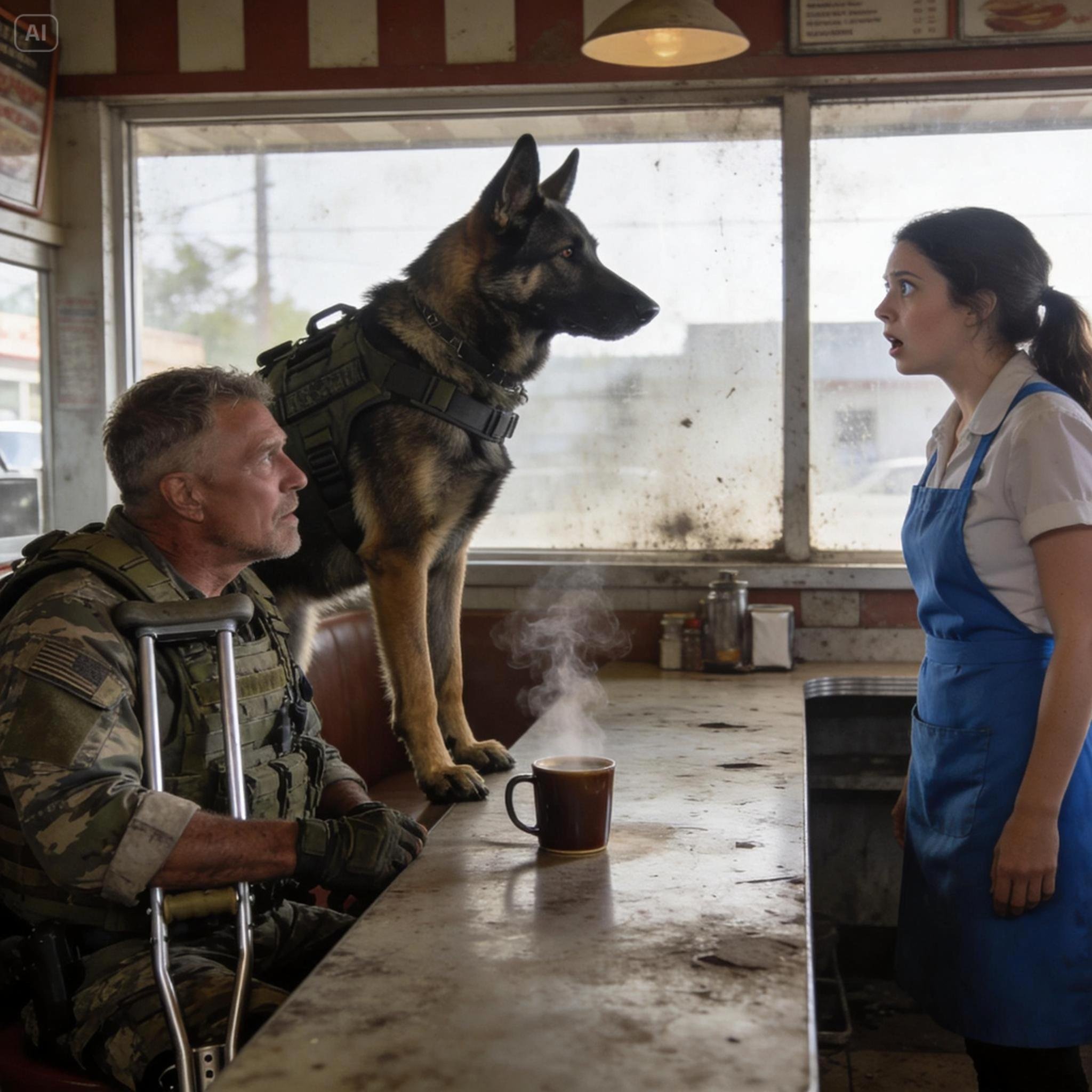
I watched him nod politely, his jaw tight but his expression remaining a mask of calm.
I’d seen that look before—in tents where the air smelled of copper and ozone.
“Sir,” I called out, my voice cutting through the awkward silence of the room.
I slid a stool out at the end of the counter, the one right next to the register.
“You can sit here if you’d like.”
The veteran’s eyes met mine, and for a split second, I felt a jolt of recognition that made my skin crawl.
He sat down, leaning his crutch against the counter, while the dog settled at his feet.
I poured him a coffee, my hand steady, but as I turned to grab the sugar, the dog didn’t settle.
The K9 suddenly froze, its ears pinned forward and its eyes locked onto me with a terrifying, soulful intensity.
The dog slowly stood up, ignoring its handler’s soft command, and walked toward me until its wet nose was inches from my apron.
The entire diner was staring now.
The veteran leaned forward, his eyes narrowing as he watched his highly trained K9 react to a simple waitress.
“Ma’am,” he whispered, his voice vibrating with a sudden, sharp realization. “Have we met before?”
Part 2
I didn’t want to answer him.
I wanted to slide the check across the counter, walk into the walk-in freezer, and scream until my lungs gave out.
But the K9, this massive, muscular beast named Rex, was currently leaning his entire weight against my shins.
It was a “contact comfort” move, something they train service animals to do for handlers having a panic attack.
The dog knew I was spiraling before I even felt the first cold drop of sweat slide down my spine.
The veteran’s eyes were like twin bores, drilling through the layers of the suburban waitress persona I had spent three years building.
“I don’t know what you’re talking about, sir,” I said, my voice sounding thin and hollow even to my own ears.
I reached for a stack of clean side plates, my fingers trembling so violently that the ceramic rattled like a warning bell.
The man didn’t blink; he just watched the plates, then watched my hands, then looked back at my face with a devastatingly calm expression.
“You’ve got the 1,000-yard stare, Olivia,” he said, using my name from the brass tag pinned to my apron like he’d known me his whole life.
“And you’ve got a surgical scar on your wrist that didn’t come from a kitchen accident or a car wreck.”
He leaned in closer, the scent of damp wool and old leather coming off his jacket in waves.
“That’s a friction burn from a high-pressure tourniquet, the kind that gets applied in a hurry when the world is exploding.”
I felt the oxygen leave the room, the walls of the diner closing in until all I could see was the weathered map of his face.
The truckers at the window booth had stopped talking entirely, their forks suspended halfway to their mouths like a scene from a frozen film.
Even the grill cook, a massive guy named Pete who usually ignored everything but the eggs, was standing still with a spatula in mid-air.
“I think you’re mistaken,” I whispered, though the way I was gripping the edge of the laminate counter told a completely different story.
“I’m just a waitress, sir. I’ve lived in this town for years, and I’ve never been further than the state line.”
The lie felt like ash in my mouth, dry and bitter and impossible to swallow.
The veteran let out a slow, heavy sigh and reached down to scratch the base of Rex’s ears.
“Rex doesn’t lie,” he said softly, his voice carrying a weight that made the hair on my arms stand up.
“He was a dual-purpose dog, patrol and detection, assigned to a specialized medical extraction team out of Bagram.”
He looked at the dog, then back at me, and his eyes softened into something that looked dangerously like pity.
“He doesn’t just react to scents; he reacts to people he’s shared a trench with.”
I felt the ghost of a sandstorm hitting my face, the grit getting into my teeth, the taste of metallic blood and burning rubber.
I could hear the rhythmic *thwump-thwump-thwump* of the Medevac blades cutting through the thin mountain air.
I could see the frantic movement of my own hands, covered in dark, slick fluid, trying to find a pulse that wasn’t there.
“Please,” I said, and the word came out as a broken plea that I couldn’t pull back.
“Please just eat your breakfast and go. I’m just trying to have a normal shift.”
The veteran didn’t move an inch; he just sat there like a monument to a past I was desperate to keep buried.
“There was a medic,” he started, ignoring my request as if he were reciting a prayer.
“In the summer of ’19, outside a village near Kandahar. We took a heavy hit, an IED that turned our lead vehicle into a scrap heap.”
I squeezed my eyes shut, but that only made the images sharper, the orange glow of the fire burning behind my eyelids.
“The team lead was down, both legs gone, and the K9 handler was pinned under the chassis with a chest wound.”
He paused, and the silence in the diner was so absolute I could hear the hum of the refrigerator in the back.
“The extraction bird was five minutes out, but the LZ was hot, taking fire from three sides.”
I could feel the heat of the fire again, the way the air shimmered with the intensity of the burning fuel.
“Everyone was screaming for the medic to pull back, to get behind the rocks because the second secondary was about to blow.”
My heart was hammering against my ribs, a frantic, irregular rhythm that matched the chaos of the memory.
“But the medic didn’t move. She stayed right there in the kill zone, her hands inside a man’s chest cavity, literally holding his life together.”
I opened my eyes, and they were stinging with tears I refused to let fall.
“That medic saved four guys that day before the bird even touched down,” he said, his voice dropping to a gravelly whisper.
“And then she vanished. No medals, no ceremony, no ‘welcome home’ parade. She just checked out and disappeared.”
He looked at the scar on my wrist, the mark left by the very equipment I’d used to save a man who’d eventually died anyway.
“They called her Angel 6,” he said, and the name hit me like a physical blow to the stomach.
I felt the air rush out of me, my knees bucking until I had to lean against the soda fountain for support.
“I don’t go by that anymore,” I managed to choke out, my voice barely audible over the sudden roar in my ears.
The veteran nodded slowly, a look of profound respect crossing his face.
“I figured. But Rex remembered. He was the dog pinned under that chassis.”
I looked down at the German Shepherd, really looked at him this time, seeing the silver fur around his muzzle and the small, jagged notch in his left ear.
The memory of a panicked, whining dog trapped in the wreckage flashed through my mind, a dog I’d kicked away so I could get to his handler.
“You… you were with the 75th,” I said, the military jargon slipping out before I could stop it.
The man’s smile was grim and knowing. “I was the guy on the radio screaming at you to get your head down.”
I felt a strange, dizzying sensation, like the floor of the diner had turned into water and I was drifting away from the shore.
For three years, I had been Olivia, the girl who liked classic rock and made a mean Denver omelet.
I had curated a life of mundane safety, a 9-5 hell that was beautiful because nothing ever happened.
I didn’t have to decide who lived and who died; I just had to decide if someone wanted wheat or white toast.
And now, in the middle of a Tuesday morning rush, the world I had built was being dismantled brick by brick by a man and his dog.
“Why are you here?” I asked, my voice gaining a jagged edge of anger.
“Why did you come here to find me? I didn’t want to be found.”
The veteran reached into his pocket and pulled out a small, tarnished piece of metal.
It was a challenge coin, the insignia of a unit that officially didn’t exist, the brass worn smooth by years of handling.
“I didn’t come here to find you, Angel,” he said, placing the coin on the counter next to his half-finished coffee.
“I was just driving through. But the universe has a funny way of settling debts.”
He looked at Rex, who was still leaning against me, his tail giving a single, slow thump against the floor.
“And Rex? He’s been looking for a reason to wag his tail like that for a long time.”
I stared at the coin, the weight of it, the history it represented, and the blood I knew had been spilled to earn it.
I thought about the night I left, the way I’d just walked away from the base with nothing but a duffel bag and a heavy heart.
I thought about the faces of the men I couldn’t save, the ones who haunted my dreams every time I closed my eyes.
“I’m not a hero,” I said, the words feeling like a heavy stone I’d been carrying for a thousand miles.
“I’m just a woman who couldn’t handle the noise anymore.”
The veteran stood up, his crutch clicking against the floor with a sound that seemed to echo in the silence.
“The noise never goes away, Olivia. You just learn how to tune the radio.”
He looked around the diner, at the patrons who were still staring, their faces a mix of confusion and sudden, unearned awe.
“You think these people see you? They see a waitress. They see someone who brings them eggs and wipes their spills.”
He leaned over the counter, his face inches from mine, his breath smelling of the black coffee I’d poured him.
“But I see you. And Rex sees you. And we know exactly what you’re worth.”
I felt a sob rise in my throat, a hot, painful lump that threatened to shatter the last of my composure.
I wanted to tell him about the nightmares, about the way I couldn’t stand the sound of fireworks or the smell of diesel fuel.
I wanted to tell him that I felt like a fraud, a ghost living in a body that didn’t belong to me.
But the words wouldn’t come; they were trapped behind a wall of three years of silence and survival.
The veteran reached out and placed his hand over mine, his grip firm and steady.
“You did your time, Angel. You don’t have to hide the scar like it’s something to be ashamed of.”
He pulled his hand back and adjusted his crutch under his arm, preparing to leave.
“Breakfast was great. Best I’ve had in a long time.”
He whistled low, and Rex immediately stood up, moving away from me to take his position at the man’s side.
The dog gave me one last look, a deep, intelligent gaze that seemed to say *I know*, and then he turned toward the door.
The veteran started to move away, but then he stopped and looked back over his shoulder.
“One more thing,” he said, his voice loud enough now that the entire diner could hear him.
“The handler? The one you thought you lost?”
I held my breath, the world tilting on its axis as I waited for the words that would change everything.
“He made it. He’s running a ranch in Montana now, training dogs for vets just like me.”
The room blurred as the tears finally spilled over, hot and fast, carving tracks through the makeup I used to hide my tired eyes.
“He still talks about the girl who stayed in the fire,” the veteran said with a final, sharp nod.
He turned and walked toward the door, his crutch rhythmically striking the floor like a heartbeat.
The door chime rang again, a cheerful, mundane sound that felt entirely out of place.
He was gone as quickly as he’d arrived, leaving behind a half-empty cup of coffee and a challenge coin that glowed under the fluorescent lights.
I stood there for a long time, the silence of the diner heavy and thick around me.
Nobody moved. Nobody spoke. Even the truckers seemed to understand that they had just witnessed something sacred.
I looked down at my wrist, at the scar I had hated for so long, the mark of my failure and my grief.
I pulled my sleeve up, exposing it fully to the light of the diner, no longer caring who saw it.
It wasn’t just a scar; it was a map of a moment when I had been more than just a waitress.
I reached out and picked up the challenge coin, the cold metal feeling heavy and solid in my palm.
“Olivia?” Pete the cook asked, his voice uncharacteristically soft from behind the kitchen window.
“You okay, honey?”
I looked at him, then at the regulars, then at the empty stool where a ghost had just been sitting.
I wiped my eyes with the back of my hand and took a deep, shuddering breath.
“Yeah, Pete,” I said, and for the first time in three years, I actually meant it.
“I’m okay. I’m just… I’m done hiding.”
I walked over to the coffee pot and picked it up, my movements still precise, but no longer mechanical.
I walked toward the booth where the two men had refused to let the veteran sit earlier.
They looked up at me, their faces pale and full of a sudden, deep-seated shame.
“Refill?” I asked, my voice steady and clear.
They didn’t answer; they just nodded, unable to meet my eyes as I poured the dark liquid into their mugs.
I moved through the diner, no longer an invisible ghost, but a woman with a history and a name.
The “9-5 hell” I had created didn’t feel like a prison anymore; it felt like a choice.
I thought about the handler in Montana, the man I’d thought I’d failed, the man who was alive because I’d stayed in the fire.
The weight in my chest, the one I’d been carrying since 2019, didn’t disappear, but it felt lighter.
I realized then that the veteran hadn’t come to settle a debt; he’d come to give me back my life.
He’d used his dog to find the one person who needed to be seen more than anyone else in that room.
By the time the lunch rush started, the story had already begun to spread through the small town.
People started coming in just to look at me, to see the “Angel” who worked at Miller’s Diner.
But I didn’t hide my arm, and I didn’t look at the floor when I walked past the windows.
I stood tall, my posture straight, my eyes scanning the room not for threats, but for people.
I was a waitress, yes, but I was also a medic, a survivor, and a woman who had seen the worst of the world and decided to keep going.
The scar on my wrist was no longer a secret; it was a badge of honor I wore for the ones who didn’t make it back.
And every time the door chime rang, I looked up with a smile, wondering if the next person through the door was someone else who needed to be seen.
The diner wasn’t just a job anymore; it was my post, and I was going to hold it until the next shift.
I looked at the challenge coin sitting on the shelf behind the register, a reminder of where I’d been and who I was.
The noise of the diner was still loud, the clattering of plates and the smell of bacon still thick in the air.
But the radio was finally tuned to the right frequency, and the music sounded better than it had in years.
I wasn’t just surviving another shift; I was living it, one cup of coffee at a time.
And as the sun began to set over the dusty parking lot, I knew I was finally home.
Part 3
The sound of the name “Angel 6” didn’t just vibrate in the air; it felt like a physical shockwave that shattered the glass jar I’d been living in for three years.
I looked down at the challenge coin resting on the laminate counter, its silver surface catching the harsh fluorescent light of the diner.
My vision began to tunnel, the edges of the room blurring into a hazy vignette of wood-grain patterns and greasy steam.
I could feel the sweat pooling at the small of my back, a cold, oily sensation that made my skin itch with the phantom weight of a ceramic plate carrier.
“Don’t call me that,” I whispered, my voice sounding like it was coming from the bottom of a deep, dark well.
I tried to pull my hand back from the counter, but it felt like my fingers were fused to the cold surface, anchored by the sheer gravity of the man’s words.
The veteran didn’t pull back; he didn’t even look surprised that I hadn’t denied it this time.
He just sat there on that swivel stool, his metal crutch leaning against the counter like a forgotten weapon, watching me with a patience that was terrifying.
“I looked for you, you know,” he said, and his voice was so soft it was almost drowned out by the hiss of the industrial toaster behind me.
“After the extraction, after the dust settled and we got stateside, I spent six months trying to find out where they sent you.”
I finally managed to rip my hand away, tucking it under my apron as if I could hide the shaking, though my entire body was vibrating with a low-frequency hum.
“I wasn’t sent anywhere,” I said, the words coming out in a jagged, staccato rhythm. “I left. I walked. I didn’t give them a choice.”
I looked at the truckers near the window, who were now pretending to be very interested in their check, though their ears were practically twitching to catch every syllable.
“You don’t just walk away from a Tier 1 attachment, Angel,” the veteran said, his eyes narrowing just a fraction.
“People like you… you’re an asset. You’re the bridge between the guys who break things and the guys who fix them.”
I felt a surge of sudden, hot anger flare up in my chest, a defensive fire that burned through the cold fog of my panic.
“I am not an asset,” I snapped, leaning over the counter until I was inches from his face, my voice a sharp, dangerous whisper.
“I was a human being who spent eighteen months watching the best people I’ve ever known get turned into red mist and scrap metal.”
I pointed a trembling finger at the scar on my wrist, no longer caring if the whole world saw the jagged, white line of the friction burn.
“I didn’t walk away because I was tired of the sand, sir. I walked away because I couldn’t look at a human being without seeing an exit wound.”
The veteran didn’t flinch; he didn’t even blink, he just absorbed the hit like he’d been trained to take a punch since he was in diapers.
“I know,” he said simply, and that one word carried more weight than all the medals in the Pentagon.
He reached down and patted Rex’s head, and the dog let out a soft, low chuff, his tail giving a single, mournful thump against the floor.
“Rex was there that night in the valley. You remember the fire, don’t you? The smell of the magnesium flares and the sound of the radio screaming?”
I closed my eyes, and the diner disappeared, replaced by the suffocating heat of the desert night and the rhythmic *thud-thud-thud* of a 50-caliber machine gun.
I could feel the grit of the sand in my teeth and the slick, warm sensation of blood on my latex gloves, a sensation that never truly washes off.
“I remember the dog,” I whispered, the memory hitting me with the force of a high-speed collision.
“He was pinned. The handler… he was trapped under the steering column, and the engine block was already melting.”
I could see the dog’s eyes in the darkness of the wreckage, wide and white with a primal terror that matched my own.
I remembered screaming at the other operators to help me, but they were too busy suppressing the ridgeline, the air thick with the “snap-crack” of incoming rounds.
“I had to cut the harness,” I said, my hands mimicking the motion of holding a trauma shear, my fingers twitching in the empty air.
“The dog wouldn’t leave his side. He was biting at me, trying to protect the man who was already gone.”
I opened my eyes and looked at Rex, really looked at the silver fur around his muzzle and the way he favored his back left hip.
“I didn’t think he made it,” I said, a single, hot tear finally breaking free and tracking through the foundation on my cheek.
“I thought when the secondary explosion went off… I thought everything in that circle was erased.”
The veteran shook his head, a ghost of a smile touching his weathered lips for the first time since he’d walked in.
“Rex is a stubborn son of a bitch. Just like his medic.”
He leaned back, his shoulders dropping an inch as if a massive weight had finally been shared between the two of us.
“The handler didn’t die that night, Olivia. He spent two years in San Antonio getting his face put back together, but he’s alive.”
The room tilted, the wood-grain floor seeming to liquefy beneath my feet as the ground-truth of my last three years shifted into a new shape.
“He… he made it?” I asked, my voice barely a thread of sound, a desperate hope clashing with the armor I’d built around my heart.
“He’s running a training facility in North Carolina now,” the veteran said, pulling a small, laminated business card from his wallet and sliding it toward me.
“He’s the one who gave me Rex. He told me if I ever found the medic who pulled them out, I should give her this.”
I picked up the card, the edges crisp and new, a stark contrast to the tarnished, ancient feeling of the challenge coin.
On the back, in a cramped, shaky handwriting that spoke of nerve damage and determination, were three words: *Still breathing. Thanks.*
I felt a sob build in the back of my throat, a raw, primal sound that I had to swallow back until it burned my chest like acid.
For three years, I had been mourning a ghost, living a half-life in a greasy diner because I thought I’d failed the only thing that mattered.
I thought I’d left a piece of my soul in that burning wreck, and now this man was telling me that the fire hadn’t consumed everything.
“Why did you come here?” I asked, my voice thick with emotion, my eyes searching his for a hidden agenda, a fed trap, a military recall.
“How did you even find this place? This town isn’t even on most maps.”
The veteran looked around the diner, his eyes lingering on the cracked vinyl of the booths and the fly-specked posters for local carnivals.
“I wasn’t looking for you, Angel. Not today.”
He let out a short, dry laugh that sounded like sandpaper on wood.
“I was just driving. Heading west. My GPS glitched out two miles back, and Rex started acting up the moment we hit the city limits.”
He looked at the dog, whose eyes were still fixed on me with an intensity that felt like a physical connection.
“He knew you were here before I did. I just wanted a cup of coffee and a seat that wasn’t a truck cabin.”
He looked back at the men in the booth, the ones who had pulled their chairs away as if my past were a contagious disease.
“I guess the universe decided I needed a refill on more than just caffeine today.”
I looked at the challenge coin and the business card, the two pieces of a life I’d tried to throw away like garbage.
I looked at my hands, the hands that were currently red from the chemical cleaner I used to scrub the counters.
These were the same hands that had held a man’s femoral artery closed while an entire mountain range tried to kill us.
“I’m not that person anymore,” I said, but the conviction was gone, replaced by a hollow, aching realization that the 9-5 hell was just a mask.
“You think you can just swap out the software, Olivia? You think you can just delete the training and the instinct?”
The veteran stood up, his crutch clicking loudly against the tile, the sound echoing through the hushed diner like a gunshot.
“You can wear the apron. You can pour the coffee. You can smile for the tips and pretend you don’t hear the helicopters in the wind.”
He leaned over the counter, his face inches from mine, his eyes burning with a fierce, uncompromising truth.
“But you’re still Angel 6. And the men you saved… we don’t forget the people who stayed in the fire when everyone else ran.”
He reached out and tapped the challenge coin one last time, the silver ringing with a clear, sharp tone.
“Keep the coin. It’s a debt that can never be paid, but it’s a reminder that you aren’t alone out here in the dark.”
He whistled low, a single, sharp note, and Rex immediately stood up, his ears pricking forward as he fell into a perfect heel beside the veteran’s good leg.
“The coffee was terrible, by the way,” the veteran said with a wink, the first bit of genuine humor breaking through his granite exterior.
“But the service… the service was world-class.”
He turned and started toward the door, his gait uneven but steady, the crutch marking a rhythmic “thump-slide” across the floor.
I stood behind the counter, frozen, my heart racing as I watched the only person who truly knew me walk out of my carefully constructed cage.
The door chime rang, a tinny, cheerful sound that felt like an insult to the gravity of the moment.
He was halfway across the parking lot before the paralysis finally broke, before the three years of suppressed trauma and hidden identity finally shattered.
“Wait!” I screamed, the word tearing out of my throat with a force that made the customers in the diner jump in their seats.
I didn’t stop to take off my apron; I didn’t stop to tell Pete I was leaving; I didn’t even grab my keys from the hook behind the register.
I just vaulted over the counter, my sneakers hitting the floor with a dull thud, and ran through the swinging glass doors into the blinding morning light.
The humidity hit me like a wall, the smell of damp asphalt and diesel exhaust filling my lungs as I sprinted across the gravel parking lot.
The veteran had already reached his dusty, black pickup truck, his hand on the door handle, but he stopped when he heard my footsteps.
He turned slowly, his expression unreadable as I skidded to a halt in front of him, my chest heaving, my breath coming in short, panicked gasps.
“You can’t just… you can’t just leave me here with this,” I panted, gesturing back toward the diner, toward the life that now felt like a suffocating lie.
“You can’t just walk in here, blow up my world, and then drive off to North Carolina.”
The veteran watched me for a long moment, the wind tossing his salt-and-pepper hair, his eyes reflecting the vast, empty sky of the American Midwest.
“I’m not leaving you with anything, Olivia. I’m giving it back to you.”
He opened the driver’s side door and climbed in, his movements slow and methodical, a man living with a body that had been broken and mended too many times.
Rex jumped into the passenger seat, his head appearing in the window, his tongue lolling out in a goofy, canine grin that seemed to mock my existential crisis.
“What am I supposed to do?” I asked, my voice small and desperate, the “Angel 6” inside me screaming for orders, for a mission, for a way out.
The veteran started the engine, the rumble of the diesel vibrating through the ground, a sound that felt like home and a threat all at once.
“That’s the beauty of being a civilian, Olivia. You get to decide.”
He shifted the truck into gear and looked at me one last time, his gaze piercing and full of a quiet, unshakeable respect.
“But if I were you… I’d start by taking off that damn apron.”
He pulled away, the gravel crunching under his tires, the dust kicking up in a cloud that obscured the truck as it headed toward the highway.
I stood in the middle of the parking lot, the sun beating down on my head, the silence of the morning rush feeling louder than any explosion.
I looked down at the blue apron tied around my waist, the fabric stained with coffee and grease, the symbol of my three-year surrender.
I reached behind my back and fumbled with the knot, my fingers shaking, my breath hitching in my chest.
With a sharp, violent tug, the knot gave way, and the apron slumped to the ground, a discarded skin that no longer fit the person standing inside it.
I looked at my arms, the muscles toned from years of lifting heavy packs and dragging men to safety, the skin tanned from a life spent outdoors.
I looked at the diner, at the face of my manager pressed against the glass, his expression a mix of confusion and mounting anger.
I knew if I walked back in there, I could apologize; I could tell him I had a panic attack, that the veteran was an old, crazy flame, that I was fine.
I could go back to the 9-5 hell, back to the invisibility, back to the quiet safety of being “just Olivia.”
But as I felt the weight of the challenge coin in my pocket, I knew that version of the story was over.
The fire hadn’t just consumed the Humvee in the desert; it had consumed the girl who thought she could hide from her own soul.
I turned away from the diner and started walking toward my beat-up sedan parked at the far edge of the lot.
I didn’t have a plan, and I didn’t have a map, but for the first time in three years, I knew exactly who was behind the wheel.
I got into the car and sat there for a moment, the heat of the interior making the air shimmer, my hands resting on the steering wheel.
I looked at the business card on the passenger seat, the words *Still breathing* glowing in the sunlight like a neon sign.
I picked up my phone and dialed the number on the card, my heart hammering a frantic rhythm against my ribs.
The phone rang once, twice, three times, each tone feeling like a countdown to a new life.
“Hello?” a man’s voice answered, and even through the static and the distance, I recognized the gravelly, Southern drawl of a man who had seen the end of the world.
I closed my eyes, the tears finally falling freely, a hot, cleansing rain that washed away the grit and the shame.
“This is Angel 6,” I whispered into the phone, the name feeling like a prayer and a promise.
“I hear you’re looking for me.”
The silence on the other end of the line was absolute, a heavy, pregnant pause that seemed to stretch across the thousands of miles between us.
“Angel?” the voice asked, cracking with a sudden, overwhelming emotion that made my own breath hitch.
“Is that… is that really you?”
I looked at the diner in the rearview mirror, a tiny, fading speck of a life I was leaving behind for good.
“Yeah,” I said, a fierce, sudden smile breaking across my face as I shifted the car into drive.
“It’s me. And I’m coming home.”
I pulled out of the parking lot, the tires screaming against the asphalt as I accelerated toward the highway, the wind rushing through the open windows.
The 9-5 hell was gone, replaced by the wide-open road and the terrifying, beautiful uncertainty of the future.
I didn’t know what North Carolina held for me, or if I could ever truly heal the parts of me that were still in the sand.
But as I watched the miles tick by, the speedometer climbing, I realized that for the first time in a long time, I wasn’t running away.
I was running toward something.
I reached into my pocket and gripped the challenge coin, the silver cold and reassuring against my skin.
I wasn’t just a waitress anymore, and I wasn’t just a ghost.
I was a medic, a sister, and a survivor.
And as the highway stretched out before me, a ribbon of gray asphalt leading toward the horizon, I knew I was finally free.
The war was over, but the mission was just beginning.
And this time, I wasn’t going to miss a single second of it.
I drove until the sun was high in the sky, the landscape changing from the flat plains of the Midwest to the rolling hills of the South.
I didn’t stop for coffee, and I didn’t stop for food; I just drove, the adrenaline and the hope keeping me awake and alert.
I thought about Rex, and the veteran, and the handler waiting for me in the hills of North Carolina.
I thought about the men I’d saved, and the ones I hadn’t, and for the first time, I felt like I could carry them both.
I wasn’t Angel 6 because I was perfect; I was Angel 6 because I was the one who didn’t quit.
And as the sign for the North Carolina state line flashed past, I let out a long, shaky breath and turned up the radio.
The music was loud, and the wind was hot, and the world was wide open.
I was finally, truly, breathing.
I reached over and touched the business card on the seat, a small smile playing on my lips.
“I’m coming, boys,” I whispered to the empty car.
“Just hold on a little longer.”
The road ahead was long, and the path wouldn’t be easy, but I wasn’t afraid.
I had been through the fire once, and I knew I could survive it again.
But this time, I was bringing the fire with me.
And as I crossed into the hills, the shadows of the trees dancing across the hood of my car, I knew that the best part of the story was only just starting.
Part 4
The roar of the highway was the only thing keeping the silence in my head from becoming deafening.
I was six hours into the drive, crossing the state line into the humid, pine-heavy air of North Carolina, and my hands were still fused to the steering wheel.
Every time I closed my eyes for a long blink, I saw the diner, the faces of those stunned truckers, and the silver notch in Rex’s ear.
I had been running for three years, building a fortress out of coffee grounds and cheap tips, and a man with a crutch had dismantled it in twenty minutes.
The challenge coin sat in the cup holder, vibrating against the plastic with a metallic chatter that sounded like a telegraph sending a message from a dead world.
I looked at the business card again, the ink of those three words—*Still breathing. Thanks.*—seeming to burn through the laminate.
The name on the front was Elias Thorne, a name I had screamed into a radio handset a thousand times while the sky rained fire.
He wasn’t just a handler; he was the heartbeat of the unit, the guy who kept the dogs calm when the mortars started walking toward our position.
I remembered the weight of him, the slick heat of his blood as I tried to pack a wound in the dark, my fingers sliding on the very floorboards the veteran had described.
I pulled into a rest stop just past Asheville, the mountains looming like jagged teeth against the bruised purple of the twilight sky.
I stepped out of the car, and my legs nearly gave way, the muscles screaming after years of standing behind a counter and hours of driving toward a ghost.
I walked to the edge of the asphalt, looking out over the valley, the fog rolling in like the smoke from a magnesium flare.
I wasn’t the waitress anymore; the blue apron was in a dumpster three hundred miles back, and the woman standing here felt raw, like a fresh wound.
I reached into my pocket and pulled out my phone, my thumb hovering over the call log, over the number that had changed the trajectory of my life.
I had spoken to him for three minutes at the diner parking lot, but it felt like I had been holding my breath for three years and had finally exhaled.
“I’m almost there,” I whispered to the empty air, the sound of my own voice surprising me with its sudden, sharp clarity.
I got back in the car, the engine turning over with a familiar rumble that now felt like a war drum, and I pushed further into the hills.
The address on the card led me down a winding, gravel road that felt like it was trying to shake the car apart, the trees closing in like a tunnel.
I saw the gate first, a heavy timber structure with a small, discreet sign that read *Aegis K9*, the letters carved deep into the wood.
A man was standing there, silhouetted against the glow of a porch light, a large dog sitting perfectly still at his side.
My heart did a slow, painful roll in my chest as I cut the engine, the silence of the woods rushing in to fill the space.
I stepped out of the car, my boots crunching on the gravel, and the man started walking toward me, his gait heavy and uneven.
It wasn’t the veteran from the diner; it was Elias, the man I had left for dead in the wreckage of a burning Humvee.
His face was a map of scars, a tapestry of skin grafts and surgical precision, but his eyes were the same deep, haunting green I saw in my dreams.
He stopped five feet away, the dog at his side giving a low, inquisitive whine that echoed the one Rex had made.
“Angel,” he said, and the word didn’t sound like a call sign; it sounded like a homecoming.
I couldn’t speak; the words were jammed in my throat, a messy pile-up of grief and relief that made my vision blur with sudden, hot tears.
I walked those last five feet and crashed into him, my arms wrapping around his neck, smelling the scent of cedar and high-quality dog kibble.
He held me with a strength that felt impossible for a man who had been blown apart, his hands steady against my back.
“You’re real,” I sobbed into his shoulder, the fabric of his work shirt dampening with my tears. “I thought I watched you burn.”
“I did burn, Olivia,” he whispered, his voice a rough rasp that vibrated through my chest. “But you pulled me out before the fire could take the rest.”
He pulled back, his hands staying on my shoulders, his eyes scanning my face with the same intensity the veteran had used.
“I heard about the diner,” he said, a small, crooked smile tugging at the scarred corner of his mouth. “Miller sent word that his best server just vanished into thin air.”
“He was looking for me for a long time, wasn’t he?” I asked, gesturing to the silent hills and the ranch behind him.
“We all were. Not to bring you back to the fight, but because a unit isn’t whole when a piece of it is missing.”
He led me toward the house, a sturdy, low-slung building that smelled of woodsmoke and old books, the walls covered in photos of dogs and soldiers.
We sat on the porch, the crickets providing a rhythmic backdrop to a conversation that had been three years in the making.
He told me about the surgeries, the months of physical therapy, and the day he decided that if he couldn’t fight, he would heal.
He’d started the ranch for guys like him, guys who came back with pieces missing and minds that wouldn’t stop screaming.
The dogs were the bridge, the same way they had been in the valley, a silent, steady presence that didn’t ask questions.
“I thought I was a failure,” I admitted, looking at the scar on my wrist, the white line glowing in the moonlight.
“I thought every man we lost was because I wasn’t fast enough, or strong enough, or brave enough.”
Elias reached over and took my hand, his palm rough and calloused, his grip grounding me to the porch and the present.
“You were the bravest person in that valley, Olivia. You stayed in the kill zone when the air was more lead than oxygen.”
He looked out over the dark fields where the K9s were sleeping, his expression one of profound, hard-earned peace.
“You didn’t fail anyone. You gave us time. And time is the only thing that matters when the world is ending.”
I stayed on the ranch that night, sleeping in a room that didn’t smell like bacon grease or industrial floor cleaner.
I woke up to the sound of dogs barking, a joyful, energetic noise that didn’t trigger a panic attack for the first time in years.
I walked out to the training field, watching Elias work with a young Shepherd, his movements patient and intuitive.
He looked at me and tossed a training lead, a silent invitation to step back into a world I thought I’d lost.
I took it, the leather feeling familiar and right in my hand, and for the first time, I didn’t feel like a waitress pretending to be human.
I spent the next month at Aegis, learning the rhythm of the ranch, the way a dog’s lean can settle a racing heart.
I helped with the medical side, patching up paws and checking vitals, my hands regaining the steady, surgical precision they’d had in the sand.
I wasn’t Angel 6 anymore, but I wasn’t the girl at Miller’s Diner either; I was something new, something forged in the middle.
The veteran from the diner, whose name I learned was Miller—the same man who owned the ranch’s sister site—visited often.
He’d sit on the porch with his coffee, Rex at his feet, and we’d talk about the things that people who haven’t been in the fire can’t understand.
“You look different,” he told me one afternoon, his eyes crinkling behind his sunglasses. “You don’t look like you’re waiting for an explosion.”
“I stopped waiting for it,” I said, watching a group of vets laughing as they ran an obstacle course with their new partners. “I realized the explosion already happened.”
I eventually went back to the diner, but only to pick up my final check and say a proper goodbye to Pete.
He looked at me for a long time, seeing the change in my posture and the way I didn’t flinch when a busboy dropped a tray.
“You found your people, didn’t you, Liv?” he asked, wiping his hands on his apron.
“Yeah, Pete. I found them.”
I left the 9-5 hell for good, trading the fluorescent lights for the North Carolina sun and the constant, steady companionship of the dogs.
Elias and I built something real at the ranch, a sanctuary for the ghosts and the survivors, a place where the noise finally tuned into music.
I still have the challenge coin; it sits on my nightstand, a reminder that the universe doesn’t forget, and it doesn’t leave debts unpaid.
I still have the scar on my wrist, but I don’t hide it under long sleeves anymore; it’s just part of the map of how I got here.
The diner was a season of hiding, a long winter in my soul that I needed to survive until the spring could find me.
Now, I look at the newcomers who arrive at the ranch with that same 1,000-yard stare I used to carry, and I know exactly what to say.
I pour them a cup of coffee, sit them down on the porch, and let the dogs do the rest of the talking.
I am Olivia. I am a medic. I am a sister. And I am finally, truly, whole.
The road from the desert to the diner was long and dark, but it led me exactly where I needed to be.
The veteran was right; the service was world-class, but the life I have now is even better.
I stood on the ridge one evening, looking out over the ranch as the stars began to poke through the velvet blue of the sky.
Elias walked up behind me, his hand resting on my shoulder, the silence between us full of a thousand unspoken understandings.
“You okay, Angel?” he asked, the old call sign sounding like a blessing in the quiet of the mountains.
I leaned back against him, feeling the steady beat of a heart I had once held in my hands, and I smiled.
“I’m perfect, Elias. I’m exactly where I’m supposed to be.”
The war was a lifetime ago, and the diner was a dream I’d woken up from, and the future was a wide-open field waiting for us to run.
I closed my eyes and breathed in the scent of the pines and the earth, a woman who had finally found her peace.
I wasn’t running anymore; I was standing my ground, and the ground was good.
FIN.