THE ARCHITECT OF ASH: THE GIRL THEY LEFT FOR DEAD
Part 1
The bazaar on Kalin’s Reach smelled like engine grease, burnt sugar, and the kind of organic rot that tells you the law hasn’t visited in a decade. I shouldered through the crowd, my thumb rubbing the cracked screen of a data pad. I needed a Series 7 coolant regulator, or my ship, the Driftwood, was never leaving this rock.
The twin suns beat down on my neck like a physical weight. At thirty-four, I felt fifty. That’s what happens when you spend your life in the “adjacent-to-smuggling” business—moving freight for people who don’t have names, only offshore accounts.
I almost missed her.
She was at the edge of the market, where the stalls thin out into gravel and dust. She was chained to a rusted structural post with a heavy-duty industrial link, the kind we use to secure multi-ton pallets during atmospheric re-entry. It was overkill for a girl so gaunt her ribs looked like a birdcage under her skin.
Her skin was a dull, bruised silver-blue. Her hair was a matted nest of white. She sat in the dirt, knees pulled to her chest, staring at nothing. Tied to the chain was a piece of scrap packing foam with one word scrawled in black marker: FREE.
Not free as in “liberated.” Free as in “abandoned.”
I watched a merchant steer his cargo sled within an inch of her bare feet. He didn’t even look down. To this market, she wasn’t a person. She was a discarded engine casing. A broken crate. Surplus inventory left at the curb because she wasn’t worth the fuel to transport.
I took ten steps toward the parts stall. Then fifteen. I stopped.
I’m no saint. I’ve seen things that would make a priest quit the cloth. But there was a stillness about her—a total, mathematical acceptance of her own erasure—that made my stomach turn. She wasn’t begging. She wasn’t crying. She had already arrived at the final answer: nobody was coming.
I turned back.
When I crouched three feet away, she flinched. It was a mechanical, terrifyingly practiced motion—arms up, elbows tight to the ribs, protecting the throat. My heart hit the floor. I didn’t say a word. I just set my canteen on the dirt between us.
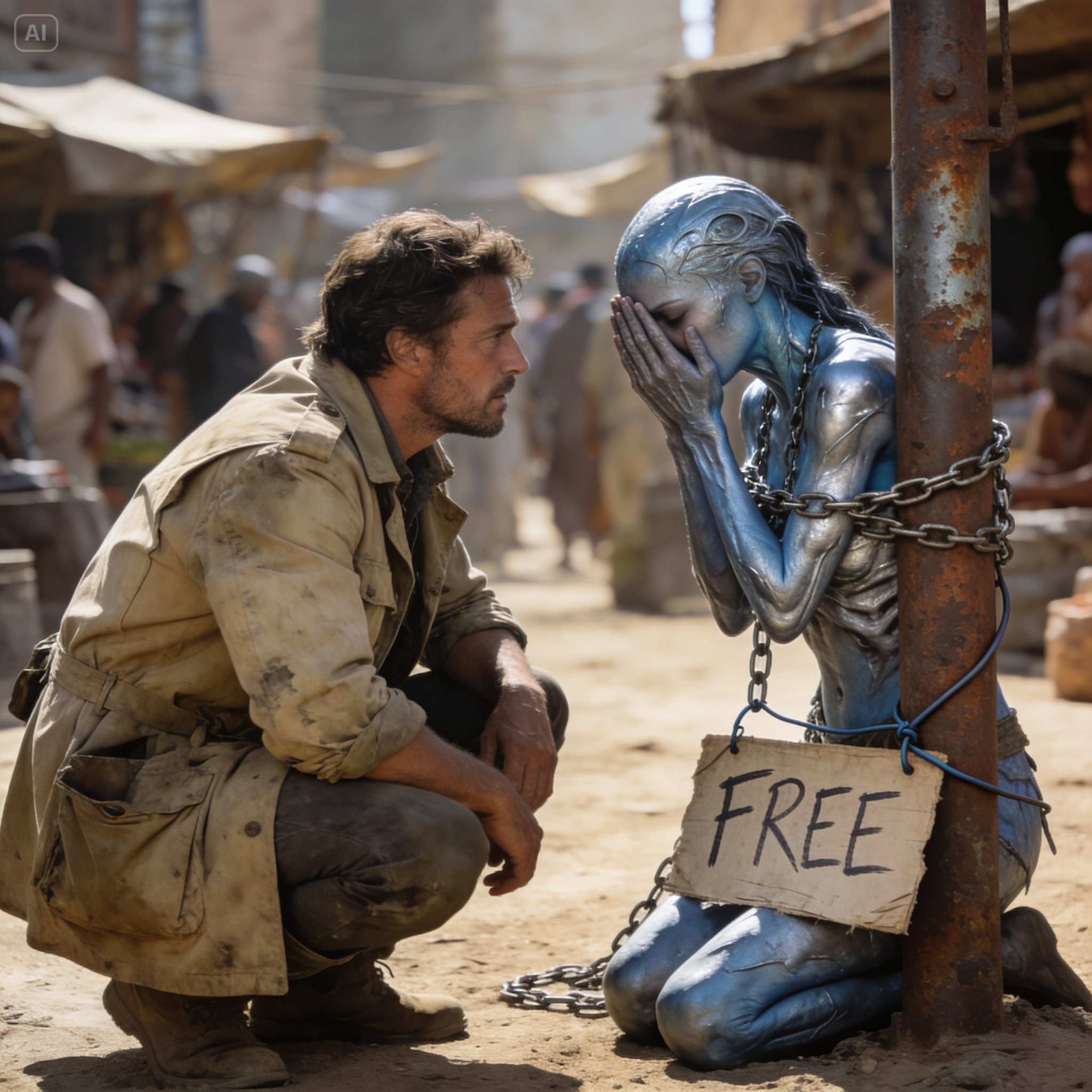
Her eyes found mine through her tangled hair. They were violet, hollowed out by exhaustion. When I reached for my bolt cutters, she went rigid, expecting a blow. Instead, I snapped the link.
The chain hit the dirt with a heavy clack.
“You can go,” I said, my voice sounding like I’d been swallowing glass. “Anywhere you want.”
She looked at her scarred wrist, then up at me. Her voice was a dry rasp. “Go where?”
I didn’t have an answer. I’d planned for the rescue, not the reality. But as I walked back toward the docks, I felt a shadow behind me. She was following—far enough to bolt, close enough to survive.
I didn’t know then that this “broken” girl was about to dismantle every lie I’d ever told myself.
Part 2
The Driftwood didn’t just feel like a ship anymore; it felt like a living thing that had finally stopped holding its breath. I spent the next six hours in the cockpit, ostensibly monitoring the long-range scans, but really, I was listening to the house. That’s what it was now. A house with a ghost in the basement.
Except this ghost had a wrench and a brain that worked in four dimensions. Every few minutes, a new indicator on my dash would flip from amber to a steady, confident green. The life support wasn’t just “functional” now; the air tasted like a mountain spring. No more metallic tang of recycled carbon. She was purging the systems, scrubbing away years of my own neglect.
I caught myself staring at the internal feed for the engine room. Thessaly was a blur of silver-blue movement. She didn’t move like a laborer anymore. She moved like a conductor. She had the primary plasma manifold open—something I hadn’t touched in three years because I was terrified I’d blow the seals—and she was recalibrating the injectors with a jeweler’s precision.
She looked up, eyes locking onto the camera lens for a split second. I felt like a voyeur, like I’d been caught looking at something private and sacred. I jerked my gaze back to the flight console, my face heating up.
“Cole.”
Her voice came over the comm, clearer than it had any right to be. She must have fixed the interference in the local loop, too.
“Yeah, Thessaly? Everything okay down there?”
“The fuel efficiency is up by twelve percent. But I found a bypass in the secondary cooling line. It was intentional. Someone tried to make this ship run hot. Why?”
I rubbed the back of my neck, feeling the grit of the Reach still under my skin. “The guy I bought it from. He was a piece of work. Probably wanted it to look like it needed constant maintenance so he could claim the tax write-offs for ‘damaged equipment.’ I just never had the guts to dig that deep into the guts.”
“It’s fixed now,” she said. There was a pause. “I’m coming up.”
When she stepped into the cockpit, she was carrying two cups of synthesized coffee. It was a small gesture, but in the context of the last forty-eight hours, it felt like a peace treaty. She sat in the navigator’s chair, her movements still cautious, still a bit guarded, but the flinch was gone.
“The Karathi,” she started, her voice low. “They won’t stop. You know that, don’t you?”
“I figured,” I said, taking a sip of the coffee. It actually tasted like coffee. “You’re a ‘trade secret’ with a heartbeat. People like that don’t just write off a loss. They audit it until they find it.”
Thessaly looked out at the stars, the violet in her eyes deepening as she watched the nebula we were passing. “It’s not just about the drive. It’s about the precedent. If an ‘asset’ can disappear, the whole system of Karathi labor contracts starts to look fragile. They’ll spend ten times what I’m worth just to prove that nobody gets out.”
“Well, they haven’t met me,” I muttered, mostly to convince myself. “I’ve spent a decade being invisible. I know every backdoor and black-hole station from here to the Core. We’ll drop you somewhere they can’t find you. Somewhere neutral.”
She turned to look at me, and for the first time, I saw the full weight of her intellect. It wasn’t just technical. It was strategic. “Nowhere is neutral for them, Cole. They own the banks. They own the fuel depots. Unless we change the math, we’re just running until the tank goes dry.”
“Then we change the math,” I said.
She leaned forward, her fingers tracing the edge of the console. “I left a backdoor in the resonance drive’s firmware. I didn’t think I’d ever be able to use it. I was a prisoner, after all. But if we can get close enough to a Karathi relay station… I can broadcast a kill-code. Every ship using my design—every warship, every interceptor—will have its drive core locked. Permanently.”
I nearly choked on my drink. “You’re talking about crippling the entire Karathi fleet. That’s not a getaway, Thessaly. That’s a declaration of war.”
“They declared war on me eleven years ago,” she said, her voice hard as a diamond. “I’m just finally shooting back.”
We spent the next three days in a fever dream of preparation. I pushed the Driftwood into the dark spaces between the lanes, running silent. We were heading for Sector 9, a cluster of industrial moons that served as the backbone for Karathi communications.
It was during those long shifts that I started to see the woman behind the engineer. She told me about the Vethari homeworld. She described the floating gardens and the way the wind sounded through the crystal spires—sounds she hadn’t heard in a decade. She talked about her father, who had been a poet, not a scientist.
“He hated technology,” she said, a ghost of a smile playing on her lips. “He used to say that if you couldn’t say it with a look or a song, it wasn’t worth saying. He’d be horrified to see what I’ve become. A woman who speaks in code and plasma frequencies.”
“I think he’d be proud,” I said. “You’re a survivor. In this galaxy, that’s the highest form of art.”
The closeness was creeping up on me. It wasn’t just the shared danger. It was the way she looked at the ship—like she loved it for its flaws. It was the way she’d fall asleep in the chair, her head lolling to the side, and I’d find myself wanting to cover her with a blanket, not because she was a “mission,” but because she felt like… home.
We reached the Sector 9 relay station on the fourth day. It was a massive, rotating needle of black metal, bristling with sensors and defense turrets. It looked like a weapon, not a piece of infrastructure.
“We have to get within five thousand kilometers for the burst to take,” Thessaly said. She was at the comms station, her fingers dancing over a modified data pad. “The defense grid will pick us up long before that.”
“Not if we look like trash,” I said. I’d been planning this part. “We’re going to dump the secondary cargo pods. We’ll fill them with scrap metal and a few low-level heat sinks. We’ll vent the atmosphere in the hold to create a debris cloud. To their sensors, we’ll look like a freighter that had a catastrophic hull failure. We drift in with the wreckage.”
“And if they decide to ‘clean up’ the debris with a laser battery?” she asked.
“Then it’s been a hell of a run, Thessaly.”
The maneuver was harrowing. The Driftwood groaned as I blew the pods. The ship bucked, and for a second, I thought we were actually going to break apart. We shut down everything. No lights. No gravity. No internal heat. Just two people in a cold, dark tin can, floating toward a needle of death.
I could hear her breathing in the dark. It was the only sound besides the occasional metallic pop of the hull contracting in the cold. I reached out, finding her hand in the shadows. Her fingers were ice-cold, but she gripped mine with a strength that surprised me.
“Cole,” she whispered.
“I’m right here.”
“If this doesn’t work… thank you. For the water. For the bolt cutters. For seeing me.”
“It’s going to work,” I said, though I didn’t believe it.
The proximity alarm on my wrist-pad vibrated. 5,100 kilometers. 5,050. 5,000.
“Now!” I hissed.
Thessaly hit the sequence. The Driftwood didn’t move, but I felt a subtle hum in the air—the high-frequency burst of the kill-code leaping from our ship to the relay. It was a silent shot fired across the galaxy.
For ten seconds, nothing happened.
Then, the relay station erupted. Not with an explosion, but with light. Every signal light on its surface turned red. The rotation slowed, then ground to a halt with a groan that we could practically feel through the vacuum.
“It’s done,” she breathed. “The code is propagating. Every relay in the network will carry it. Within an hour, their fleet is dead in the water.”
But our victory was short-lived. The relay station’s automated defense system didn’t need the resonance drive to function. And it didn’t like being hacked.
A siren blared inside the Driftwood.
“Targeting lock!” I yelled, slamming the power back on. The lights flickered to life, blinding us for a split second. “They’re painting us! We have to move!”
I jammed the throttles forward. The Driftwood screamed as the engines fought to overcome the lack of momentum. A beam of coherent light lanced out from the relay, missing our stern by less than fifty meters. The heat from the near-miss set off the fire alarms in the cargo bay.
“Another one coming!” Thessaly shouted.
I pulled the ship into a violent roll, the g-force pinning us into our seats. Another beam tore through the debris cloud we’d created, vaporizing the very pods that had hidden us.
We were out in the open. A lone, battered freighter against a god-tier defense array.
“I can’t outrun the tracking!” I grunted, my muscles straining against the stick. “Thessaly, I need a miracle!”
“Hold on!” she yelled. She was rerouting something—I could see the power levels on the main bus spiking into the red. “I’m slaving the shield emitters to the resonance harmonics! If I can match the frequency of their lasers, we can bleed the energy off!”
“That’ll blow the emitters!”
“Better the emitters than us! Do it!”
I didn’t argue. I pushed the ship straight at the station, narrowing the profile. The relay fired again—a direct hit on the forward shields. But instead of the ship shattering, the light seemed to wash over us like water, flowing around the hull in a brilliant, violet shimmer. The Driftwood shuddered, the smell of ozone filling the cockpit, but we held.
We punched through the inner perimeter, the momentum carrying us past the station and into the clear space beyond.
“Jump!” Thessaly screamed. “The core is ready! Go!”
I slammed the FTL drive. The stars stretched into long, white needles, and the universe disappeared.
We were safe. For five minutes.
We dropped out of warp in a quiet corner of the Veil Nebula. The ship was a wreck. Half the consoles were dead, the air was getting thin again, and the engine room was a graveyard of melted components. But we were alive.
I unbuckled and stumbled out of the seat, my legs shaking. Thessaly was already standing, leaning against the bulkhead, her face covered in sweat and grime.
We looked at each other—really looked at each other—in the flickering emergency light. The silence was heavy, pregnant with everything we hadn’t said.
“We did it,” she whispered.
“Yeah,” I said. “We did.”
I took a step toward her, intending to just put a hand on her shoulder, to offer some kind of comfort. But as soon as I touched her, the dam broke. She collapsed into me, her small frame shaking with the kind of sobs that take years to build up. I held her, burying my face in her tangled hair, feeling the heat of her skin against mine.
I realized then that I wasn’t just “adjacent to smuggling” anymore. I was a revolutionary. I was a target. And for the first time in my life, I had something I was willing to die for.
But as I held her, a new signal started chirping on the secondary comms. It wasn’t a Karathi code. It was something older. Something encrypted with a Vethari signature.
Thessaly pulled back, her eyes wide as she heard the tone. “That… that’s a distress call. From the homeworld. From the labor camps.”
She looked at the screen, and the color drained from her face.
“Cole,” she said, her voice trembling. “The kill-code… it didn’t just stop the ships. It triggered a fail-safe. The Karathi… they’re initiating a ‘liquidation’ protocol of all Vethari assets. They’re going to kill them all. Every last one of my people.”
The victory tasted like ash in my mouth. We hadn’t saved anyone. We had just sped up the execution.
“How long?” I asked, my voice cold.
“Seventy-two hours,” she said, looking at me with a desperation that broke my heart. “Unless we get to the central hub on Karath Prime and override the protocol manually.”
I looked at my broken ship. I looked at the woman I was starting to love. I looked at the impossible odds.
“Well,” I said, reaching for my wrench. “I guess we’d better get to work. We’ve got a planet to save.”
The Driftwood was bleeding. That’s the only way to describe the sound of a ship when the life support is wheezing and the gravity plating is on the fritz. Every time I inhaled, the air felt thin, like I was standing on top of a mountain in the Rockies with a pack of cigarettes and a bad attitude. We had seventy-two hours to stop a genocide, and my ship was currently held together by Thessaly’s prayers and some industrial-grade sealant I’d stolen from a freight yard three systems back.
I was hunched over the primary nav-array, my hands trembling as I tried to map a route to Karath Prime. It wasn’t just far; it was the heart of the spider’s web. Karath Prime wasn’t just a planet; it was a fortress world, a shining monument to corporate greed and “optimized” cruelty. Going there in a battered Terran-class hauler was like trying to rob a federal reserve with a plastic butter knife.
“Cole, look at this,” Thessaly said. She was standing by the engine room hatch, her face illuminated by the flickering amber light of a dying circuit.
I stood up, my knees popping like bubble wrap. I walked over and looked at the diagnostic pad she was holding. It was a mess of red lines and cascading failure warnings.
“The resonance surge didn’t just blow the emitters,” she whispered, her voice tight. “It backflowed into the core. We’re losing containment on the antimatter bottle. If we jump to warp again without a full purge, we aren’t going to Karath Prime. We’re going to become a new star.”
I let out a breath I’d been holding since the Reach. “Can we purge it?”
“Not while moving. We have to drop into sub-light, vent the coolant, and manually scrub the injectors. It’ll take six hours. Six hours we don’t have.”
I looked at her, at the silver-blue skin that was now smudged with carbon and grease, at the violet eyes that were wide with a kind of terror I hadn’t seen since I found her chained to that pole. She wasn’t just an “asset” anymore. She was the architect of a revolution, and she was terrified that her first act of freedom was going to be the death warrant for her entire species.
“Do it,” I said. “Drop us out of warp. I’ll go outside.”
“Outside?” She blinked, the white strands of her hair falling over her face. “Cole, the radiation levels in the nacelle housing are—”
“I know what they are,” I snapped, then immediately softened. “Look, Thess, you’re the only one who knows how to talk to the computer. You stay in here and run the sequence. I’ll take the mag-suit and the scrubber. I’ve done external hull work before.”
That was a lie. I’d patched a leak once while docked at a station with a beer in my hand. Doing it in the middle of deep space while the ship’s guts were screaming was a different beast entirely. But I couldn’t let her do it. She’d already been through enough “physical quotas” to last ten lifetimes.
We dropped out of warp with a bone-shaking jolt. The Driftwood groaned, a long, low metal shriek that sounded like a dying whale. The stars stopped being needles and became cold, distant pinpricks of light. The silence of deep space rushed in, pressing against the hull.
I climbed into the mag-suit. It was an old model, clunky and smelling of stale sweat and ozone. The helmet seal hissed, and suddenly my world was nothing but the sound of my own breathing and the crackle of the internal comms.
“I’m in the airlock,” I said. My voice sounded small in the helmet.
“Cole,” Thessaly’s voice came through, soft and shaky. “Be careful. If the purge starts early, the vent force will throw you into the void. Stay tethered.”
“I’m the king of tethers, Thess. Just watch the levels.”
The outer door slid open. The vacuum didn’t pull—it just was. It was a massive, infinite nothingness that wanted to swallow me whole. I stepped out onto the hull, the mag-boots clunking against the metal plates. Below me, the Veil Nebula was a bruise of purple and gold across the blackness.
I crawled toward the nacelle, moving like an insect. Every movement felt heavy, surreal. The radiation warning on my wrist-display began to chirp—a low, rhythmic pulse that told me I had about forty minutes before my DNA started unravelling like an old sweater.
I reached the injector housing. It was glowing a dull, angry cherry-red.
“I’m at the hatch,” I panted. “Starting the scrub.”
“The levels are spiking, Cole. Hurry.”
I jammed the scrubber into the port. The resistance was incredible. The build-up of calcified plasma was like trying to drill through diamond. I put my weight into it, my boots straining to keep their grip on the hull.
As I worked, my mind drifted. I thought about my life before the Reach. I was just a guy. A guy who had a 9-5 hell in a shipping warehouse on Earth until I realized the feds were never going to stop breathing down my neck for “unreported income.” I’d fled to the stars thinking I was finding freedom. But I was just moving from one cage to a bigger one.
Then I found her.
Finding Thessaly was the first time in thirty-four years I’d actually looked at the world and felt like it wasn’t just a place to survive. It was a place where things could be fixed. Not just engines. People.
“Cole! The Karathi!” Thessaly’s voice screamed in my ear, sharp enough to make me flinch.
I looked up, squinting against the glare of the nebula. Far off, three points of light were growing larger. Interceptors. Fast ones.
“How did they find us?” I yelled, working the scrubber with a frantic, desperate energy. “We’re in the middle of nowhere!”
“The kill-code,” she gasped. “It’s a two-way street. When the relay went down, it must have sent a final burst with our last known vector. They’re tracking the ion trail from the core leak.”
“How long until they’re in range?”
“Five minutes. Maybe less.”
“And the purge?”
“Leveling out. But I need three more minutes to stabilize the containment field before we can jump. Cole, get back inside! If they open fire while you’re out there—”
“I’m not done!” I roared, the scrubber finally catching. A spray of black, gritty carbon exploded from the port, drifting away into the dark like ash. “One more port! If I leave it, we’ll blow the second we hit warp!”
I scrambled to the next housing. My radiation alarm was screaming now, a high-pitched continuous wail. My vision was starting to blur at the edges, a dull ache blooming behind my eyes. That’s the cells dying, I thought with a strange, detached clarity. That’s the price.
The interceptors were close enough now that I could see the sleek, predatory lines of their hulls. They weren’t firing yet. They wanted the “asset.” They wanted her back in chains, and they wanted my head on a pike to show the next cargo hauler what happens when you develop a conscience.
“Cole, they’re hailing us!”
“Ignore them!” I jammed the scrubber into the second port. It wouldn’t budge. “Give me more power to the mag-locks, I’m slipping!”
“I can’t, I’m diverting everything to the core! Cole, please!”
The first shot hit the Driftwood’s far side. The hull beneath my feet bucked like a wild horse. I lost my grip. The mag-boots held, but my upper body slammed into the nacelle housing. I felt a rib snap, a hot, white flash of pain that stole my breath.
“Cole!”
I looked at the port. It was jammed. If I didn’t clear it, the ship was a coffin. I looked at the interceptors. They were banking for a second run, their weapon pods glowing with the promise of a killing blow.
I grabbed a heavy-duty pry bar from my belt. I didn’t use the scrubber. I just jammed the bar into the housing and pulled with everything I had left. I screamed, the sound echoing inside my helmet, a raw, primal sound of a man who refused to be a line item anymore.
The housing shattered. A geyser of blue-white coolant hissed into the vacuum, instantly freezing into a cloud of sparkling ice crystals.
“It’s clear!” I coughed, blood metallic in my mouth. “It’s clear! Jump, Thessaly! Jump now!”
“Not without you!”
“The tether’s locked! Just pull the switch!”
I felt the ship begin to vibrate—not the death-rattle from before, but a deep, powerful thrum. The Driftwood was waking up. I scrambled back toward the airlock, my movements sluggish, my body feeling like it was made of lead.
I made it to the hatch just as the second volley of fire raked the shields. The airlock hissed shut, and gravity slammed back into place, dropping me onto the floor like a sack of stones.
I didn’t even have time to take off the helmet before the world turned inside out. The FTL drive engaged. The scream of the space-time fold tore through the ship, and for a moment, I wasn’t a man, I wasn’t a pilot, I was just a collection of atoms being stretched across the galaxy.
Then, silence.
The gravity stabilized. I fumbled with the helmet seals, my fingers numb. I pulled it off and vomited onto the deck, the copper taste of blood and the sour sting of bile hitting me all at once.
“Cole!”
Thessaly was there. She dropped to her knees beside me, her hands hovering over my suit, afraid to touch me. Her face was a mask of grief and relief.
“You’re bleeding,” she whispered. “The radiation… the HUD said you took a lethal dose.”
I looked at her, trying to find my voice. “The HUD… is an optimist. I’m fine. Just… need a minute.”
She didn’t believe me. She pulled me into her lap, her cool hands finally resting on my cheeks. She was crying, the violet of her eyes shimmering with tears.
“Why would you do that?” she asked, her voice breaking. “You could have stayed inside. We could have tried something else.”
“There wasn’t… anything else,” I managed to say. “They were going to take you back, Thess. And I decided… back on the Reach… that nobody gets to own you again.”
She leaned down and pressed her forehead against mine. For a long time, we just sat there on the cold deck of the airlock, two broken things in a broken ship, drifting through the dark.
But we didn’t have a minute. We had sixty-four hours left.
“Help me up,” I said, gritting my teeth against the pain in my chest.
She helped me stagger to the galley. I took a handful of anti-rad meds and a stimulant that tasted like battery acid. It wouldn’t fix the damage, but it would keep my heart beating long enough to see Karath Prime.
We spent the next twelve hours in a state of hyper-focus. We weren’t just fixing the ship anymore; we were building a weapon. Thessaly showed me how to modify the Driftwood’s comms array to act as a localized EMP burst. If we couldn’t outshoot them, we’d fry their electronics the second they got close.
“It’ll burn out our own nav-comms,” she warned. “We’ll be flying blind once we use it.”
“I’ve been flying blind my whole life, Thess. At least this time I know where I’m going.”
As we worked, she started teaching me. Not just about engines, but about her people. The Vethari weren’t just engineers. They were a collective. They shared thoughts, emotions, and technical data through a subtle bio-electric field. When the Karathi took them, they didn’t just put them in cages; they severed that connection. They made them individuals. They made them alone.
“It’s the worst kind of torture,” she said, her voice hollow as she soldered a connection. “To go from being part of a symphony to being a single, screaming note in the dark. That’s why we broke, Cole. That’s why we stopped fighting. We weren’t a ‘we’ anymore.”
“You found me,” I said. “And I found you. That’s a start, isn’t it?”
She looked at me, and for a second, the bioluminescence in her skin flared—a soft, pulsing violet glow that felt like a warm breeze. “It’s more than a start. You’re the first person who didn’t try to tune me. You just listened.”
We reached the outskirts of the Karath system with forty-eight hours on the clock. It was a nightmare of traffic. Thousands of ships, from massive ore-freighters to sleek corporate yachts, all moving in a synchronized dance controlled by the central hub.
“There it is,” I whispered, looking at the viewport.
Karath Prime was a marble of gold and steel. Entire continents were covered in sprawling arcologies. The rings of the planet weren’t ice and rock; they were shipyards and orbital platforms. It was a world that had forgotten what dirt felt like.
“The central hub is on the dark side,” Thessaly said, her fingers flying across the console. “It’s a submerged facility in the Vorian Sea. They keep the servers underwater for cooling. We have to land, infiltrate the cooling intake, and get to the core.”
“Land? In a ship that’s on every ‘Most Wanted’ list in the sector?”
“Not as the Driftwood,” she said. She pulled up a file on the screen. It was a Karathi transport ID. “I still have the administrative bypass from my time in propulsion design. I can spoof our signature. For the next hour, we’re the Asset Recovery Vessel 99. They’ll clear us for a priority landing at the sea-base.”
“Asset recovery,” I muttered. “Fitting.”
The descent was a blur of adrenaline. We bypassed the orbital customs with a series of codes that Thessaly tapped out with terrifying speed. The atmosphere of Karath Prime hit us, the sky turning from black to a toxic, smog-filled orange.
We leveled out over the Vorian Sea. It wasn’t blue. It was a deep, oily black, choked with industrial waste. The sea-base sat in the middle of it, a massive, dome-like structure that looked like a giant eye staring up from the depths.
“Approaching the landing pad,” I said, my heart hammering against my cracked ribs.
“Wait,” Thessaly said, her voice dropping an octave. “Something’s wrong.”
On the scanner, six signatures detached themselves from the sea-base. Not interceptors. Heavies. Corporate Enforcer gunships.
“They aren’t clearing us for landing,” I said, grabbing the controls. “They’re boxing us in.”
“Unidentified vessel,” a voice boomed over the comms. It wasn’t the clipped professional tone from before. It was cold. It was the voice of a man who enjoyed his job. “This is Director Vane of Karathi Security. We’ve been expecting you, V-2271. And your… accomplice.”
“They knew,” I hissed. “Thessaly, they knew we were coming.”
“Of course we knew,” Vane continued. “You didn’t think we’d leave a backdoor in our own firmware without a tripwire, did you? The kill-code was a delightful little test of your initiative. And you passed. You brought the Driftwood right to our doorstep.”
The gunships opened fire.
The first hit took out our spoofed ID array. The Driftwood lurched, the sky spinning outside the viewport.
“Evasive!” I yelled, diving the ship toward the black water.
“We can’t outrun them in the atmosphere!” Thessaly shouted. “Cole, the EMP! Use it!”
“We’re too high! It’ll just kill our engines and we’ll pancake into the sea!”
“Then dive! Dive until we’re on top of them!”
I jammed the nose down. We were a falling brick of fire and metal. The gunships followed, their cannons raking our shields, tearing chunks of plating from the hull. The Driftwood was screaming now—the alarms, the metal, the wind.
We were five hundred meters from the surface. Four hundred. Three hundred.
“Now!” Thessaly screamed.
I hit the switch.
A wave of invisible force erupted from the Driftwood. Inside the cockpit, every screen went black. The lights died. The hum of the engines vanished. For a heartbeat, there was only the sound of the wind.
Outside, the gunships didn’t just stop. They died. Their navigation lights flickered out, their thrusters sputtered and went dark. Deprived of their computer-assisted flight controls, they didn’t just fall—they tumbled.
Three of them collided in mid-air, a spectacular bloom of orange flame against the black sea. The others plummeted into the water, disappearing beneath the oily waves.
The Driftwood hit the water at a shallow angle.
The impact was like hitting a concrete wall. I felt the seatbelts bite into my chest, the snap of my ribs echoing in my head. Water exploded over the viewport. We skipped across the surface once, twice, and then we were sinking.
Darkness. Cold. The sound of water rushing into the lower decks.
I fumbled for the manual release on my harness. My hands were shaking so hard I could barely grip the buckle. I fell out of the seat, landing in six inches of oily water.
“Thessaly!” I coughed, the darkness absolute. “Thessaly, answer me!”
“I’m… here.” Her voice was a wheeze, coming from the navigator’s side.
I crawled toward her, my hands finding the edge of the console. I felt her arm, then her face. She was cold, shivering.
“We have to get out,” I said, my voice urgent. “The hull’s breached. The ship is going down.”
I pulled her out of the seat. She was limp, her strength spent. I carried her toward the airlock, the water rising to our waists. The Driftwood was groaning, the pressure of the sea-base’s depths beginning to crush the air pockets.
We reached the manual hatch. I heaved on the lever, the metal groaning as it fought the external pressure. With a final, desperate shove, the hatch popped.
We weren’t in the open sea. We were inside the sea-base’s cooling intake.
The water rushed out, pulling us with it, dumping us onto a metal grate inside a massive, echoing chamber. The air was thick with the smell of salt and ozone. Above us, giant turbines hummed, pulling millions of gallons of water through the system.
I lay on the grate, gasping for air, watching the Driftwood settle into the intake basin. My ship. My only home. It was gone.
Thessaly sat up, coughing out water, her silver skin shimmering in the blue light of the turbines. She looked at the sunken ship, then at me.
“We’re inside,” she whispered.
“Yeah,” I said, standing up and reaching for the small sidearm I’d tucked into my belt. “We’re inside. Now let’s find that core.”
But as we stepped off the grate and into the dark corridor of the hub, the lights flickered on.
Standing at the end of the hall was a line of Karathi guards, their rifles leveled at our chests. And behind them, a tall, thin man in a pristine white suit, a small, cruel smile on his face.
“Welcome home, V-2271,” Director Vane said. “I believe you have something that belongs to us. And we have an execution to get back to.”
I looked at Thessaly. She wasn’t flinching. She wasn’t shielding her throat. She stood tall, her violet eyes burning with a cold, terrifying light.
“You don’t own me,” she said, her voice echoing through the chamber. “And by the time I’m done with this room, you won’t own anything at all.”
Part 3
The air inside the Karathi central hub didn’t smell like the ocean. It smelled like bleach and static electricity. Director Vane stood there in his pristine white suit, looking like a god of middle management, while his goons kept their rifles leveled at my chest. My ribs were screaming, my vision was swimming from the radiation, and I was pretty sure I was dripping oily seawater onto a floor that cost more than my last three ships combined.
“V-2271,” Vane said, his voice smooth as silk and twice as fake. “You’ve caused quite a dent in our quarterly projections. But I’m a man of business. Tell me where the encryption key for the kill-code is hidden, and I’ll make sure your death is… optimized for minimal discomfort.”
I felt Thessaly shift beside me. The air around her started to vibrate. It wasn’t a sound; it was a pressure in my molars. The violet glow in her skin wasn’t soft anymore. It was jagged, like lightning trapped under a thin sheet of ice.
“The key isn’t hidden, Vane,” she said. Her voice didn’t sound like the girl I’d rescued from the pole. It sounded like a tectonic plate grinding against the world. “The key is me. I am the hardware. I am the software. And you’re about to experience a total system crash.”
Vane’s smile faltered. “Kill the man. Take the asset.”
The guards didn’t even get a chance to squeeze the triggers.
Thessaly didn’t move her hands. She just exhaled. A pulse of pure bio-electric kinetic energy slammed into the room. It wasn’t an explosion; it was a localized rewrite of physics. The guards were tossed backward like they’d been hit by a freight train, their high-tech rifles shattering into components before they even hit the ground.
Vane scrambled back, his white suit stained as he tripped over his own feet. I didn’t wait for an invitation. I lunged forward, my boots skidding on the slick floor, and grabbed the nearest guard’s discarded sidearm. I didn’t aim for Vane. I aimed for the cooling intake controls.
“Thess, get to the terminal!” I yelled, firing a three-round burst into the primary console.
The room descended into chaos. Red emergency lights began to strobe, casting long, sickening shadows across the white walls. Automated turrets dropped from the ceiling, but Thessaly was a blur of violet light. She moved through the room with a terrifying grace, her bio-field shorting out the targeting sensors of the turrets before they could lock on.
She reached the central core—a massive, glowing pillar of liquid-cooled processors that hummed with the weight of an entire empire’s data. She slammed her hands onto the interface glass.
“I’m in,” she hissed. “But the liquidation protocol is hard-coded into the physical layer. I can’t just delete it. I have to overload the entire cooling system to force a hardware reset.”
“How long?” I asked, backing toward her, my eyes scanning the doors.
“I need ten minutes. Cole, if the sea-base loses cooling, the pressure will implode the dome. We won’t be able to get back to the intake.”
“Just do it,” I said, checking the charge on the stolen pistol. “I’ll buy you the time. Just make sure your people can breathe again.”
I took cover behind a fallen server rack. The doors at the far end of the hall hissed open, and a squad of Karathi “Cleaners”—the guys they send in when the regular security fails—stepped through. They were wearing full-body tactical gear, their visors glowing with thermal overlays. These weren’t the 9-5 mall cops from the Reach. These were professionals.
“Asset is at the core!” one of them barked. “Suppressing fire!”
The air turned into lead. They were using high-velocity flechette rounds that chewed through my server rack cover like it was wet cardboard. I blind-fired over the top, trying to keep them pinned, but they were advancing in a tight, disciplined wedge.
“Seven minutes, Cole!” Thessaly shouted.
The core pillar was starting to turn from blue to a violent, angry orange. Steam was beginning to hiss from the vents in the floor. The temperature in the room was skyrocketing.
I felt a flechette graze my shoulder, a hot sting that made my arm go numb. I switched the pistol to my left hand, my teeth gritted so hard I thought they’d shatter. I looked back at Thessaly. She was glowing so bright I couldn’t even see her face anymore. She was becoming part of the machine, her bio-field merging with the Karathi network.
“Thess, you’re burning up!” I yelled. “Your skin—it’s blistering!”
“It doesn’t matter!” she screamed back, and I realized she was crying, but the tears were vaporizing before they could hit her cheeks. “I can feel them, Cole! I can feel my people! They’re screaming… they’re being led to the chambers… I won’t let them go! I won’t!”
Her scream triggered something in the hub. The lights didn’t just strobe; they shattered. The orange glow of the core became a blinding white. The Cleaners hesitated, their thermal visors overwhelmed by the sudden heat signature.
I seized the moment. I stood up, ignoring the pain in my ribs, and sprinted toward the flank of their wedge. I emptied the magazine into the lead Cleaner’s neck seal. He went down hard. I grabbed his tactical grenade belt and yanked a pair of EMP charges.
“Eat this, you corporate hacks!” I roared, tossing the charges into the center of the squad.
The blast didn’t just kill their electronics; it threw them into a state of sensory deprivation. I followed up with the butt of the pistol, a raw, ugly brawl in the steam and the dark. I wasn’t a soldier; I was a guy who’d been pushed too far, fighting for the only thing that had ever made sense in a galaxy full of noise.
I took a hit to the stomach—a heavy, armored boot that sent me reeling. I hit the floor, gasping for air, the world spinning. One of the Cleaners loomed over me, his combat knife reflecting the white light of the dying core.
“Asset recovery is a messy business,” he growled.
A violet bolt of energy tore through the steam and hit him square in the chest. He didn’t just fall; he disintegrated.
I looked up. Thessaly was standing over the core, her hair a wild, white halo of static. The orange glow was gone. The core was black. Dead.
“It’s done,” she whispered, her voice barely audible over the sound of the rising water. “The protocol is dead. The Vethari are free.”
But the base was dying with it.
The groan of the dome was deafening now—the sound of millions of tons of black water pressing against the failing structural supports. The floor beneath us tilted. The water from the intake basin was rushing back into the hub, a cold, oily tide that was already up to our knees.
“We have to go!” I yelled, scrambling to my feet and grabbing her hand.
Her skin was hot—feverish—and she was shaking. The effort of the reset had nearly burned her out. I slung her arm over my shoulder and started dragging her back toward the intake.
We weren’t going to make it. I knew the math. The Driftwood was submerged, the intake was flooding, and the dome was seconds away from a catastrophic collapse. There were no escape pods in the hub. The Karathi didn’t believe in escapes for their assets.
We reached the grate where we’d first arrived. The water was a swirling vortex now, pulling everything toward the massive turbines.
“Cole,” Thessaly said, her eyes finding mine. She looked peaceful, despite the world ending around us. “There’s an emergency transport in the Director’s private hangar. Level 4. But the elevators are dead.”
“Then we climb,” I said.
I found a maintenance ladder. Every rung was a battle. My ribs were grating against each other, and my lungs felt like they were filled with hot sand. I climbed with Thessaly clinging to my back, her breath hot against my neck.
We reached Level 4 just as the first structural beam in the hub snapped. The sound was like a thunderclap. The floor buckled, and I watched through the transparent floor plating as the entire central core room was swallowed by the black sea.
The Director’s hangar was a small, opulent space filled with luxury shuttles. And there, standing in front of the sleekest one, was Vane. He wasn’t smiling anymore. He had a pulse-rifle in his hand, and he looked like a man who’d lost his entire world and wanted to take a piece of ours with him.
“You ruined it,” he hissed, his voice trembling. “The optimization… the efficiency… all of it, gone. Do you have any idea what this will do to the market?”
“I don’t give a damn about your market, Vane,” I said, stepping forward. I was empty. No gun. No strength. Just a guy in a ruined flight suit.
“You’re a glitch, Ashby. A statistical anomaly that should have stayed in the dirt.” He raised the rifle, aiming it at my head.
Thessaly stepped in front of me.
She didn’t use a blast. She didn’t use her bio-field. She just looked at him.
“You spent eleven years trying to turn me into a number,” she said. “But you forgot one thing about numbers, Vane.”
“What’s that?” he sneered.
“Zero always wins in the end.”
She touched the hangar’s emergency depressurization switch.
The wall of the hangar didn’t just open; it vanished. The explosive decompression was instant. Vane didn’t even have time to scream before the air in his lungs expanded and the vacuum of the hangar—which was currently underwater—turned into a high-pressure jet of oily black sea.
The force threw him out into the dark.
I grabbed a structural strut with one hand and Thessaly with the other. We were being hammered by the incoming water, the pressure threatening to crush our eardrums. We fought our way into the luxury shuttle. I slammed the hatch, the seal engaging just as the hangar collapsed entirely.
I threw myself into the pilot’s seat. It was a Karathi yacht—all leather and gold-trimmed displays. I didn’t care. I hit the ignition. The engines roared to life, a smooth, high-end purr that felt like an insult to the Driftwood’s memory.
“Get us out of here, Cole,” Thessaly whispered, collapsing into the co-pilot’s chair.
I punched the thrusters. The shuttle tore through the wreckage of the hangar, a silver needle lancing up through the black water and into the toxic orange sky of Karath Prime.
We didn’t look back. We climbed until the sky turned black, until the stars came back to greet us.
We were clear. We were alive. And for the first time in eleven years, the Vethari weren’t assets. They were a people again.
I looked at the long-range scans. Across the system, the Karathi fleet was still dark—thousands of ships drifting like dead leaves. The empire was paralyzed.
“Where to?” I asked, my voice cracking.
Thessaly looked at the stars. She reached over and touched the nav-comms, her fingers tracing a path back toward the Reach, and then further—toward a system that wasn’t on any corporate map.
“Home,” she said.
But as I began to plot the jump, a new signal appeared on the display. It was a high-priority, wide-band broadcast coming from the center of the galaxy. It wasn’t Karathi. It was the Terran Federation.
“This is the Federation High Command,” the voice said, cold and booming. “To all vessels in the Karath Sector: The Karathi Protectorate has been declared a failed state. Under the Emergency Sovereignty Act, all Vethari refugees are to be ‘secured’ for Federation evaluation. Any vessel harboring Vethari personnel is ordered to surrender immediately.”
Thessaly’s hand dropped from the console.
“It never ends, does it?” she whispered.
I looked at the massive Federation battle-carriers dropping out of warp on the horizon. They weren’t here to help. They were here to pick up the pieces of the empire we’d just broken.
“No,” I said, my jaw tightening as I gripped the controls. “It doesn’t end. But we’re getting better at the fight.”
Part 4
The Federation carriers didn’t just look like ships; they looked like floating monuments to bureaucratic inevitability. They were slate-gray, blocky, and hummed with a frequency that made the hair on my arms stand up. They weren’t here for the Vethari’s freedom. They were here for the Vethari’s utility.
I stared at the sensor array. Twelve battle-groups. They had effectively cordoned off the entire Karath system. It was a net, and we were the catch of the day.
“Cole,” Thessaly said, her voice dropping to a whisper. She was staring at the comms-link. “They’re broadcasting on a Vethari-specific frequency. They’re telling my people that the Karathi were ‘illegal combatants’ and that the Federation is here to provide ‘asylum and processing.’ It’s the same words, Cole. Just a different letterhead.”
I gripped the yolk of the luxury shuttle. My knuckles were white. The radiation sickness was starting to settle into a deep, hollow ache in my marrow, but the adrenaline was keeping the lights on.
“They think because the Karathi are dark, they can just walk in and claim the inventory,” I said. “They don’t realize the inventory just woke up.”
I didn’t head for the edge of the system. I headed for the highest orbit of Karath Prime, right into the middle of the debris field.
“What are you doing?” she asked, her hands hovering over the nav-controls. “We need to jump. If we hit the FTL now, we might slip through the gap in their sensor web.”
“We jump now, and we leave millions of your people to become ‘Federation assets,'” I said. “We didn’t break a corporate empire just to hand the keys to the feds. I’m tired of running, Thess. I’ve been running since I left Earth. I’m done.”
I flipped the wide-band broadcast switch. I didn’t use a Federation code. I used the open-channel frequency that every cargo hauler, smuggler, and independent pilot in the sector used to complain about fuel prices.
“This is Cole Ashby of the Driftwood,” I said, my voice echoing in the small cockpit. “I’m currently piloting a Karathi yacht in high orbit over Prime. Most of you know me. Most of you owe me a drink or a favor. And all of you know that the feds are about to turn this sector into a giant labor camp.”
I paused, looking at the massive Federation carrier The Pillar of Justice as it loomed in the viewport.
“The Karathi are down,” I continued. “The Vethari are free. But the feds are here to put the chains back on. I’m calling in every debt. Every independent ship in this sector—if you ever wanted to be more than a line item, now is the time. We aren’t fighting for a planet. We’re fighting for the right to not be owned.”
The silence on the comms lasted for ten seconds. Then, a voice crackled through. It was Jax, a grizzled old salt who ran a salvage rig out of the Reach.
“Ashby, you crazy son of a bitch. I heard what you did to the hub. My sensors are showing the Vethari protocol is dead. If the feds want to play ‘processing center,’ they’re gonna have to go through my scrap-haulers first.”
Another voice. Then five more. Then fifty.
Across the Karath system, the “invisibles”—the haulers, the miners, the people who lived in the cracks of the corporate world—started to move. They weren’t warships. They were rusty freighters, tugs, and scout ships. But there were thousands of them.
“Cole,” Thessaly whispered, her violet eyes wide. “They’re coming.”
“They aren’t just coming for us,” I said. “They’re coming for the Vethari.”
Thessaly closed her eyes. She reached out with her bio-field, not to the ship, but to the planet below. I saw the violet glow in her skin pulse, a steady, rhythmic throb that seemed to sync with the hum of the stars.
“I’m talking to them,” she said. “The Vethari. I’m telling them to move. I’m telling them to take the Karathi ships that are still in dock. The ones with the dead drives. I can teach them how to bypass the lockouts from here.”
“Can you do it for all of them?”
“I can try.”
For the next six hours, the Karath system became a theater of the impossible. Thousands of dead Karathi ships—freighters, transports, even a few light cruisers—started to flicker to life. The Vethari weren’t engineers anymore; they were a hive mind of technical brilliance, guided by Thessaly’s signal.
The Federation didn’t know how to react. Their doctrine was built for fleet engagements, not a chaotic, system-wide exodus of millions of civilian vessels.
“Unidentified vessel Ashby,” the Federation commander barked. “Cease your broadcast immediately. You are inciting a mass-migration event that violates interstellar safety protocols. Power down or be destroyed.”
I looked at the The Pillar of Justice. It was moving into an intercept vector. Its massive forward cannons were glowing.
“Safety protocols?” I laughed, the sound turning into a cough. “You’re worried about safety? You’re worried about losing your new labor force. We’re leaving, Commander. Try and stop us.”
The Federation carrier opened fire.
The beam of light was massive, a world-ending lance of energy. But it didn’t hit us.
A dozen salvage rigs and heavy freighters moved into the path of the beam. Their shields buckled, their hulls groaned, but they held the line. Jax’s voice came over the comms, grunting with effort.
“Keep ’em moving, Ashby! We can’t hold this forever!”
“Thessaly, now!” I yelled.
She hit the master override.
Millions of Vethari, on thousands of ships, engaged their resonance drives simultaneously. It wasn’t a jump; it was a rip in the fabric of space. The collective energy of the Vethari bio-field, amplified by the Karathi hardware, created a wormhole that spanned the entire orbit of Karath Prime.
The Federation ships were tossed aside by the gravitational wake. The carriers spun out of control, their sensor arrays blinded by the violet light.
“We’re going through,” Thessaly said. She reached out and grabbed my hand. Her touch was warm, solid. “Cole… whatever happens on the other side… thank you.”
“We’ll figure it out together,” I said.
We punched the thrusters. The luxury shuttle dived into the violet maw of the wormhole.
The sensation was nothing like warp. It was like being pulled through a needle of pure thought. I saw the history of the Vethari. I felt their joy, their grief, and their sudden, overwhelming sense of self. I felt Thessaly’s love—not as a word, but as a physical force that kept my heart beating when the radiation tried to stop it.
We dropped out of the wormhole in a system that wasn’t on any map. It was a nebula of deep blues and greens, tucked away in the “Dead Zones” where no corporate or Federation ship dared to travel.
Thousands of ships began to emerge behind us. A new diaspora. A people who had been line items, now a nation of ghosts.
I shut down the engines. The luxury shuttle drifted in the silence of the nebula.
The radiation was finally catching up. My hands were numb, and the world was starting to go gray at the edges. I looked at Thessaly. She was glowing—not with the jagged light of the hub, but with a soft, steady radiance that made her look like the gardens of her homeworld.
“We’re home,” she whispered, looking out at the nebula.
“Yeah,” I said, leaning back in the chair. “Not bad for a guy who just wanted a coolant regulator.”
She turned to me, her eyes seeing right through the suit, right through the sickness. She leaned over and kissed me—a soft, silver-blue warmth that tasted like mountain air and crystal spires.
“You saved us, Cole Ashby,” she said.
“No,” I whispered, my eyes closing. “We saved each other.”
The comms-link chirped one last time. It was Jax.
“Hey, Ashby. We’re down. The ships are holding. And hey… the feds? They’re still back there trying to figure out where the map went. I think we’re gonna be just fine.”
I didn’t answer. I didn’t need to. I just listened to the sound of Thessaly’s breathing, the hum of the stars, and the silence of a galaxy that finally realized it didn’t own us.
I was Cole Ashby. I was thirty-four years old. I was a smuggler, a revolutionary, and a man who had finally found the one thing that was truly, completely his.
Freedom.
FIN.