THE GHOST IN THE GARAGE: MY GRANDFATHER’S DEBT WAS A LIE, AND THE TRUTH WAS BURIED UNDER 50 YEARS OF DUST.
Part 1
The rain in Western Massachusetts in October doesn’t really fall. It hangs, a cold, indifferent shroud that soaks through your coat and chills you to the bone before you even realize you’re wet. It was that kind of rain the morning we buried my grandfather, Silas Thornberry. I stood at the edge of the freshly dug grave, one of just twelve people in black, a pathetic turnout for a man who had lived in this town for fifty-three years. I hadn’t cried. Not yet. The grief was a tight, cold knot in my chest, but the tears wouldn’t come. Maybe it was because my brother, Bennett, was standing across from me, a picture of impatience in a charcoal suit that probably cost more than my fourteen-year-old Honda. He checked his watch. Twice. Three times. His hair, silver at the temples in that way rich men’s hair turns silver, looked like it had been professionally styled for the occasion. He’d flown in from New York that morning and was scheduled to fly back that night. A quick in-and-out for the death of the man who raised us.
He hadn’t said a word to me. Not at the funeral home, not in the limousine that felt more like a cage, and not now, as the priest’s voice droned on about a time to be born and a time to die. Twenty-three years. That’s how long it had been since we’d had a real conversation. Twenty-three years since he’d packed his bags for the glittering promise of New York, leaving me behind to care for our mother. Someone had to. Mama’s hands shook so badly she couldn’t hold a fork. The multiple sclerosis was a relentless thief, stealing her from the inside out, piece by piece. Someone had to be there to feed her, to bathe her, to turn her in the night so the bedsores didn’t claim her body before the disease claimed her life.
Bennett got out. I stayed.
His version of staying in touch was a pre-printed Christmas card once a year, signed “The Hartwells.” It was a cruel joke, really. His wife had divorced him in 2014, and they never had children. The card was just from Bennett, a hollow gesture from a man who had outsourced his familial duty to a Hallmark assembly line. And now, here he was, twenty-three years later, checking his watch over our grandfather’s grave as if the old man’s final farewell was an inconvenient delay in his schedule.
The priest closed his book. The small crowd began to disperse, murmuring condolences that felt as empty as the gray sky. Bennett walked past me, his expensive shoes crunching on the wet gravel, not even bothering to make eye contact. “I’ll call you tomorrow,” he said, his voice clipped and distant. “We need to talk about the house.”
That was it. That’s all he gave me. I stood there alone in the downpour, watching the gravediggers waiting with their shovels at a respectful distance. The image of my grandfather’s hand in mine during his final moments flashed in my mind. The cold had started at his fingertips, a slow, creeping frost that moved into his palm, and then… nothing. He had looked at me right at the end, his eyes trying to form words his mouth no longer could. There was something he needed to say, a weight he needed to unburden. But all he’d managed was a single, faint squeeze of my hand before he was gone, leaving his secrets behind.
The next two days were a blur of scrubbing and bleaching. When I don’t know what to do, I clean. It’s the only way to quiet the noise in my head. I scrubbed the kitchen counters until my knuckles were raw, bleached the bathroom tiles until the fumes burned my eyes, and washed every dish in the cabinets, even the fine china that hadn’t been used since Grandma Eleanor died in 1990. The entire house smelled of Murphy Oil Soap and a grief so thick I could almost taste it. It was the same brand he’d used for forty years, the yellow bottle with the cartoon man on the label a permanent fixture under the sink. The grief came in waves, sudden and violent. One moment I’d be folding a dish towel, and the next I’d be on the kitchen floor, sobbing into the worn fabric like a lost child. Then, just as quickly, the wave would recede, leaving an eerie calm in its wake. I’d stand up, wipe my face, and keep cleaning. Because sitting still was unbearable. Sitting still meant thinking, and thinking meant feeling the full, crushing weight of it all.
The phone rang on Tuesday afternoon. I was perched precariously on a ladder in his study, dusting the top of a bookshelf filled with decades of engineering manuals and old issues of Road & Track. The caller ID flashed Bennett. I sighed, a weary breath escaping my lips, and climbed down to answer.
“Hello, Bennett.”
“Adelaide.” He was the only person who ever called me Adelaide. Not Addie, the name everyone else used. Adelaide, pronounced with the crisp, formal tone of someone reading from a legal document. It was his way of reminding me that we were no longer family, but parties in a transaction.
“I’ve been on the phone with the bank all morning,” he started, forgoing any pretense of a greeting. No “How are you?” No “I’m sorry for your loss.” Just business. “There’s a problem.”
I sank onto the edge of his old oak desk. “What kind of problem?”
“The house. There’s a second mortgage. He took it out four years ago.”
“He never told me that.” A cold dread began to seep into my veins.
“Of course he didn’t,” Bennett’s voice was flat, devoid of emotion. He had already played this entire conversation out in his head and was merely reciting his lines. “He’s three months behind. The balance is sixty-eight thousand dollars. The bank’s already filed for foreclosure.”
“Foreclosure?” The word was a punch to the gut. I could hear my own breath, loud and ragged in my ear.
“They’ve scheduled an auction for thirty days from now unless we pay the balance in full. Sixty-eight thousand dollars.” He paused, letting the number hang in the air between us. “I don’t have it, Adelaide.”
That stopped me. Because Bennett always had it. Bennett, with his four-bedroom house in Westchester, his gleaming Lexus, and the boat he kept moored in Greenwich. But I didn’t have the energy to argue. “What do we do?”
“We sell the house,” he said, the words sharp and final. “Adelaide, listen to me. I’m flying in tomorrow morning. I’m bringing my attorney. We’re going to inventory everything in that house, and we’re going to put it on the market within a week. Anything we get over the mortgage will cover funeral expenses. Whatever’s left, we split.”
He’d been dead two weeks. My grandfather, the man who had raised us, had been gone for two weeks, and his own grandson was already carving up his life for parts. The bank didn’t care about his fifty-three years in this town. His son didn’t seem to care either.
“Bennett…” I started, but he cut me off.
“Don’t make this difficult, Adelaide.”
He hung up.
I didn’t cry. I was surprised by that. I thought I would. Instead, a strange numbness settled over me. I stood up and placed the phone back on the desk. My eyes scanned the room—the bookshelves, the worn leather chair where he used to sit and read, the headrest darkened from forty years of his hair oil. And then my gaze fell on the bottom right drawer of the desk. I don’t know why, but a force I couldn’t explain pulled me toward it.
I pulled on the handle. It was stuck fast. I pulled harder, and it flew open with a sudden jerk that sent me stumbling backward. Inside, nestled among a leather-bound journal and a stack of old folders, was a small wooden box. It was tucked all the way in the back, its wood dark and smooth with age, like something that had been handled a thousand times. I picked it up. It was heavier than it looked.
Sitting in his chair, the leather cool against my skin, I opened the box. A heavy brass key lay on a bed of faded velvet. It was old, the kind of key you see in movies, with a square shaft and an intricately cut pattern of teeth that looked more like a piece of art than a functional object. Underneath the key was a plain white envelope. On the front, a single word written in his careful, left-handed script: Addie.
My hands began to shake. A minute ago, I was numb, a hollowed-out version of myself. Now, a tremor started in my fingers and radiated through my entire body. I could barely slide my finger under the flap to open it. The letter was a single page, folded in thirds.
My dearest Addie,
If you are reading this, I have gone to find your grandmother. There are things I never told you, things I never told anyone in this family. Not your father, not your mother, not Bennett. I had reasons. Some of them were good. Most of them were just reasons.
The key in this box opens the padlocks on the garage. Behind the workshop poster, the one of the Maranello factory, there is a safe. The combination is 546871. What you find there will explain everything. Don’t tell Bennett until you understand the whole story. Not because I don’t trust him, but because he doesn’t understand value the way you do. He never has. That isn’t a criticism, Addie. Some people see the world that way. Some don’t. You don’t.
The measure of a person is not what they own. It is what they give away. I have tried to live by that. Not always well, but always honestly. You were always the one who saw me, really saw me, when everyone else looked past. For that alone, you deserve the truth.
With all my love,
Grandpa
I read it three times, the words blurring through a sudden film of tears. I walked to the window and looked out at the backyard. At the end of the property stood the garage, a detached, windowless building painted the same dull red it had been my entire life. And on the door, three heavy padlocks. The same three padlocks that had been there for as long as I could remember.
I had only been inside once, when I was eight. The chain on my bicycle had come off, and I’d been crying in the yard. He’d come out of the house, wiped his greasy hands on a dish towel, and taken my hand without a word. He led me across the yard, unlocked the three padlocks, and pulled the heavy door open just wide enough for us to slip inside. He closed it firmly behind us.
“This is our secret,” he’d said, his voice low and serious, different from his usual gentle tone. “I don’t bring people in here, Addie. Do you understand?”
I had nodded, my eight-year-old heart swelling with the importance of being included in a grown-up secret. While he fixed my bike, I saw them. In the back of the garage, two enormous shapes loomed under yellowed canvas tarps, bigger than refrigerators, bigger than anything that belonged in a garage in a small Massachusetts town.
“Grandpa, what’s under there?” I had asked.
He had looked at the tarps, his face softening with an expression I didn’t understand at the time. It was a look of profound sadness, of a longing so deep it seemed to physically pain him. “Just old projects, sweetheart,” he had said, his voice thick with unspoken emotion. “Things from another life.” He’d handed me my bicycle, walked me out, and locked the three padlocks behind him. I never went in there again. For thirty-four years.
Now, I stood at the window, the brass key a heavy weight in my hand, the setting sun casting long, bloody shadows across the yard. Bennett was flying in tomorrow with a lawyer to liquidate our grandfather’s life. Whatever truth was hidden in that garage, whatever secret he had protected for over half a century, I had until morning to find it.
Part 2
The garage door was heavier than I remembered, heavier than it had any right to be. It felt like I was trying to push open a tomb. The sun had dipped below the oak trees, painting the yard in long, arterial streaks of red. I stood before the three padlocks, the brass key hot in my trembling hand, my phone’s flashlight app a pathetic beam against the encroaching dark. A dog barked three houses down. A car whizzed past on Maple Street. The world was moving on, oblivious to the fact that mine was about to shatter.
My heart hammered against my ribs, a frantic, sideways beat. He left you a key. The words from Bennett’s phone call echoed in my mind, a venomous counterpoint to my grandfather’s letter. We need to sell the house. For twenty-three years, Bennett had lived a life of gleaming surfaces and easy exits, while I had been anchored here, first by love, then by duty, and finally, by a quiet, gnawing inertia.
I remembered the day Mama was diagnosed. I was nineteen, working part-time at the diner, saving for community college. Bennett was already at Columbia, his letters home filled with talk of internships and networking events, a language as foreign to me as ancient Greek. I called him from a payphone, my voice thick with tears. “The doctors say it’s MS, Bennett. They say it’s progressive.”
There was a pause on the line, filled with the static of long distance and a chasm of emotional disconnect. “Right,” he’d said, his voice distracted. “Okay. Well, look, I’ve got this final exam review session I absolutely cannot miss. Send me the doctor’s report, will you? I’ll look it over.” He never did.
For the next ten years, my world shrank to the four walls of my mother’s bedroom. I learned the grim vocabulary of her illness: spasticity, dysphagia, cognitive fog. I learned to navigate the labyrinth of insurance claims and pharmacy calls. I learned the precise angle at which to hold a spoon so she could swallow without choking. I watched my own reflection fade in the bathroom mirror, replaced by the tired, sallow face of a full-time caregiver. My youth withered under the fluorescent lights of hospital waiting rooms.
Bennett visited twice. The first time, he stayed for a weekend, pacing the living room, talking loudly on his phone about mergers and acquisitions while Mama slept fitfully upstairs. He brought her a cashmere throw blanket, an absurdly expensive gift for a woman who could no longer feel the difference between cashmere and wool. “It’s the best, Addie,” he’d said with a self-satisfied smile. “Only the best for Mom.” The second time was for her funeral. He stood in the back of the church, a stranger in a well-tailored suit, and left before the reception. He had a flight to catch. He always had a flight to catch.
I inserted the brass key into the first padlock. It fit perfectly. With a turn, a loud click echoed in the twilight. My heart leaped into my throat. One lock down.
The money had always been a source of quiet shame. Grandpa Silas gave what he could from his meager pension, but it was never enough. I took on extra shifts at the nursing home, my body aching from lifting and turning patients all day, only to come home and do it all again for my own mother. There were nights I’d sit at the kitchen table, a mountain of bills in front of me, and just weep with the sheer, crushing weight of it all. I’d have to choose between a new prescription for Mama and fixing the leak in the roof. I chose the prescription. The bucket in the attic became a permanent fixture.
I once called Bennett, desperate. The furnace had broken in the middle of January. Mama was shivering under three blankets. “I just need a loan, Bennett,” I’d whispered into the phone, humiliated. “Just until I can get the next paycheck.”
“Adelaide,” he’d sighed, that sigh that dripped with condescension. “You have to learn to manage your finances better. I can’t just bail you out every time there’s a problem. Have you considered getting a second job?” I was already working sixty hours a week. I hung up the phone and called Grandpa. He came over an hour later with two space heaters and the five hundred dollars he’d been saving for his property taxes. He never mentioned it again. And all this time, a fortune sat rusting in his garage. All this time.
Second lock. Click. The sound was sharper this time, a metallic crack in the stillness. The chain slackened. Only one to go.
The last time I saw Bennett before this week, before the funeral, was the summer he left for good. He was packing his car, a shiny new convertible he’d bought with his signing bonus from some faceless corporation. I had just come from the hospital. Mama had had a bad fall.
“You’re really going, then,” I’d said, leaning against the doorframe of the house.
He tossed a leather duffel bag into the back seat. “Of course I’m going, Addie. It’s New York. It’s my future. You can’t expect me to stay here, can you?”
“Someone has to.”
He’d turned to me then, his face a mask of pity and impatience. “Look, I get it. You’re happy with this. This small town, this small life. That’s fine. For you. But I want more. I’m not going to end up like him.” He’d jerked his head toward the house, where Grandpa was sitting on the porch, reading the paper. “A failure. A small man in a small town who never amounted to anything.”
The words had struck me with the force of a physical blow. A failure. He was talking about the man who had stepped in to raise us when our own father had run off. The man who fixed our toys, who taught us to ride a bike, who sat with us through fevers and nightmares.
Third lock. Click.
I pulled the heavy chain off and let it fall to the concrete with a deafening clatter. The door stood before me, held shut only by its own immense weight and the secrets it guarded. I placed my hands on the cold metal handle and pulled.
The hinges didn’t creak. They screamed. It was a high, piercing shriek of metal on metal, a sound of protest from years of disuse that vibrated through my teeth and settled in my bones. I staggered back as a wall of stale, ancient air rolled out to meet me. It was a dense, physical presence, a smell of oil, dust, old metal, and something else, something organic and forgotten, the smell of time itself.
I reached inside, fumbling along the wall until my fingers found the light switch. I flipped it. Nothing. I flipped it again. A single fluorescent tube in the ceiling flickered, sputtered, and died. It sputtered again, a weak, greenish-white pulse. And then, with a reluctant, buzzing groan, the entire back row of lights hummed to life, flooding the space with a cold, harsh, clinical glare.
The garage opened up before me, and I forgot how to breathe.
It was exactly as I remembered it from thirty-four years ago, yet entirely different. The workbench was there, its surface scarred and stained with the ghosts of a thousand projects. Above it, on a pegboard, every single tool hung in its proper place, each one surrounded by a hand-drawn black outline. My grandfather’s meticulousness, his quiet order, was everywhere. On the corner of the bench sat a coffee mug, half-full. A thin film of mold covered the surface of the cold coffee. He had been out here. Recently. Maybe just a few weeks ago, before the end. Sitting here, on this bench, drinking his coffee, surrounded by his secrets.
And in the middle of the concrete floor, the two monstrous shapes, shrouded in their yellowed canvas shrouds, exactly as they had been when I was eight. Just old projects, sweetheart. Things from another life.
My hand was shaking so badly I could barely control it. I walked to the first tarp, my footsteps echoing in the cavernous space. I reached out and touched the canvas. It was stiff, almost brittle, like ancient parchment. The dust that came off on my fingers was thick and dark. Taking a deep breath, I gripped the corner of the tarp and pulled.
The world exploded in a choking cloud of dust. I couldn’t see, couldn’t breathe. For a full ten seconds, I was blind, coughing, my eyes burning. The fluorescent lights above might as well have been on the moon. Slowly, particle by particle, the dust began to settle. And what emerged from the haze, what took shape in the cold, buzzing light, was impossible.
A car. But not just any car. It was white, wedge-shaped, and impossibly low to the ground, all sharp angles and aggressive lines. The doors didn’t open outwards; they tilted up, like the wings of some futuristic bird of prey. I don’t know cars. I drive a Honda with 150,000 miles on it. But I knew this one. Every boy in my high school had a poster of this exact car on his bedroom wall in 1986.
A Lamborghini Countach. White. Pristine. Sitting in my grandfather’s garage for my entire life.
I couldn’t move. My hand was still gripping the dusty tarp. My mouth hung open, a silent, stupid O. A sound escaped my throat, not a word, just a raw exhalation of pure shock. And then, slowly, as if moving through water, I turned and looked at the second shape.
It was bigger than the first, longer, lower, and curved in a way the Lamborghini was not. Where the Countach was all aggression and angles, this shape was soft, sensual, almost feminine. I stumbled towards it, my legs feeling disconnected from my body. I took the corner of the second tarp and, with a final surge of adrenaline, I pulled.
It was red. The dust cloud was the same, the coughing fit was the same, the burning in my eyes was the same. But underneath it, underneath fifty-four years of accumulated history, was the most beautiful man-made object I had ever seen.
It was a deep, lustrous red, the kind of red that had a name, Rosso Corsa or something, a name that tasted of money and speed. And again, I knew this car. I knew it from a photograph on the cover of one of Grandpa’s Road & Track magazines from December 1985. The caption had read, “The Holy Grail.”
I remembered asking him, “Grandpa, what’s a holy grail?”
He had looked down at the magazine, a wistful, far-off look in his eyes. “Something so rare and so beautiful,” he’d said, “that men spend their whole lives looking for it.”
“Did you ever find one?” I had asked.
He hadn’t answered. He’d just quietly turned the page.
A Ferrari. A 1962 Ferrari 250 GTO. In the garage of my grandfather, Silas Thornberry. The man who wore the same brown cardigan for ten winters, who drove a Ford pickup with rust eating through the wheel wells, the man who couldn’t pay his sixty-eight-thousand-dollar mortgage.
My legs gave out. It wasn’t a conscious decision to sit; my body simply failed. I collapsed onto the cold, dusty concrete floor, surrounded by the impossible artifacts of a life I never knew. And I started to laugh. It was a wild, unhinged sound that quickly curdled into a sob. I couldn’t tell which was which anymore. I just sat there, in a cloud of dust and ghosts, making a sound that was half-grief, half-hysteria, and I couldn’t stop.
When I finally pulled myself together, it was full dark outside. I had no idea how long I’d been sitting there. The fluorescent lights buzzed on, indifferent. The cars remained, silent and solid, refusing to disappear when I blinked. I stumbled back to the house, my mind a whirlwind of confusion and a dawning, terrifying anger. I sat at the kitchen table, opened my laptop, and typed “Ferrari 250 GTO value” into Google.
The numbers that loaded onto the screen didn’t seem real. I read them once, then twice, then a third time. They didn’t change. Estimated value: $50 to $70 million. For one car. For the car in my grandfather’s garage. I typed in “Lamborghini Countach value 1985.” The number was smaller, but no less staggering. One million, maybe two.
I was sitting at the kitchen table of a house that was being foreclosed on for sixty-eight thousand dollars, while a treasure worth more than a thousand times that amount sat thirty yards away. And the laughter came again, bitter and sharp. He had let us struggle. He had watched my mother waste away in a county hospital. He had accepted the five hundred dollars back from me, the money he needed for his own taxes. He had lived a life of quiet poverty, a martyr to a secret I couldn’t begin to fathom. And he had let us all believe the lie.
I didn’t sleep. I sat at that kitchen table all night, the laptop’s glow casting a pale light on my face as I fell down a rabbit hole of automotive history. Only 36 of the 250 GTOs were ever made. They were considered the greatest sports car of all time, each one a legend. How? How did a small-town mechanic, a man I called a failure in my heart more times than I could count, a man my brother had called a failure to his face, end up with one?
The doorbell rang at 7:42 a.m., a shrill, intrusive sound that shattered the silence. I hadn’t slept, hadn’t showered, hadn’t eaten. I was still wearing the same sweater from yesterday, my hair a wild tangle, my eyes red-rimmed and raw. I dragged myself to the door and opened it.
It was Dorothy Bennett, my friend Dot from the senior care home. She was sixty-five, with kind eyes and silver hair pulled back in an elegant French twist. She was wearing her winter coat over her scrubs, on her way to the morning shift.
“Honey,” she said, her voice soft with concern. “You didn’t show up yesterday.”
“I’m sorry, Dot. I forgot to call.”
“I called you four times.”
“I know. I’m sorry. I…” My voice trailed off.
“Addie? Are you okay?”
I opened my mouth, but no words came out. I just stood there in the doorway of my grandfather’s house, a house that was no longer mine, with sixty-eight thousand dollars of debt and seventy million dollars worth of cars in the garage, and a brother who was flying in with a lawyer at ten o’clock to pick over the bones of our family. And I finally broke. The tears I’d been holding back since the funeral came in a gut-wrenching, silent torrent. I didn’t even cover my face. I just stood there and let the grief and the shock and the anger pour out of me.
Dot didn’t say anything. She just stepped inside, closed the door behind her, and wrapped her strong, warm arms around me. I sobbed into the familiar, comforting fabric of her coat, the scent of antiseptic and cheap perfume filling my senses. After a long while, when the sobs had subsided into shuddering breaths, I pulled back.
“I have to show you something,” I whispered, my voice hoarse.
She just nodded and followed me through the house, out the back door, and across the yard to the garage. My hands were shaking as I undid the three padlocks and heaved the screaming door open. I flipped the switch, and the cold, buzzing lights flickered to life.
Dot stopped dead in the doorway. She didn’t move. She didn’t speak. She just stood there, one hand pressed flat against her chest as if to hold her own heart in place, her eyes wide with disbelief.
“Oh, Addie,” she finally breathed, her voice a whisper of awe and confusion. “Oh, Addie.”
Part 3
Dot walked slowly into the garage, circling the Ferrari as if it were a sleeping dragon. She didn’t touch it, just looked, her hand still pressed to her chest. “Your grandfather,” she whispered, her voice thick with a wonder that mirrored my own.
“I know.”
“All this time.”
“I know.”
She stopped at the workbench, her gaze falling on the half-empty coffee mug, the perfectly outlined tools on the pegboard, and then to a large, faded poster on the back wall. It was a photograph of the Ferrari factory in Maranello, Italy, from sometime in the late 1960s.
“He used to come into Denny’s,” Dot said, her voice distant, lost in a memory. I looked up from the impossible car in front of me. “I waited tables there before I went into nursing. This was, God… 1981, 1982. He’d come in every Tuesday, sit at the counter for hours drinking coffee. Just one cup, refilled over and over. And he’d be drawing on the napkins.”
“Drawing what?”
“Engines, I guess. Pieces of engines. I never paid much attention. I just thought he was doodling to pass the time.” Dot turned to look at me, her eyes shining with unshed tears. “He told me something once. He’d had three cups by then, and he was feeling talkative. He said, and I never forgot this, ‘Dorothy, the worst mistake a man can make is letting other people define his worth.’” She wiped her eyes. “I always wondered what he meant.”
I looked at the Ferrari, a seventy-million-dollar monument to a secret. “I think I know now,” I said softly.
The poster. My grandfather’s letter. Behind the workshop poster, the one of the Maranello factory…
My heart began to pound a new, purposeful rhythm. I walked to the back of the garage, my eyes fixed on the poster. It was hanging slightly crooked, almost imperceptibly off-kilter, as if it had been put up in a hurry. I lifted it off the nail.
Behind it, set flush into the concrete wall, was a small, black steel safe with a brass dial and handle. Of course there was.
My fingers, slick with a nervous sweat, fumbled with the dial. The numbers from the letter were burned into my brain. 5… 4… 6… 8… 7… 1. I spun the dial, left, right, left. I pulled the handle. The heavy steel door swung open with a well-oiled whisper.
Inside was a treasure trove of a forgotten life. A heavy leather portfolio with the Ferrari emblem stamped in the corner. A second, thinner portfolio with the Lamborghini logo. A bundle of black-and-white photographs tied with a piece of brown string. A small, black velvet pouch. And at the bottom, a plain manila folder with three words written across the front in my grandfather’s meticulous script: Dispute. 1972.
I laid everything out on the scarred surface of the workbench. My hands went to the photographs first.
The first image was of my grandfather, but not the man I knew. This was a young man, maybe thirty, with grease on his hands and a brilliant, confident smile on his face. He was standing in a workshop, but it wasn’t this one. And next to him, with a hand on his shoulder, was a small, older man in dark sunglasses. It was Enzo Ferrari. The Enzo Ferrari. I’d seen his picture a hundred times in the magazines on the coffee table. Standing next to my grandfather. Smiling.
I dropped the photograph as if it had burned me. I picked it up again, my hands trembling, and turned it over. There was writing on the back, in a younger, more fluid version of my grandfather’s hand: Maranello, 1968. The day he told me he believed in me.
The next photo showed him bent over an engine on a test bench, pointing at something with a wrench. The next, he was on a podium, receiving a plaque that read, in both English and Italian, For Outstanding Innovation in Automotive Engineering. The next showed him standing in a sun-drenched Italian piazza, younger and happier than I had ever seen him.
I sat down hard on the workbench, pressing my hands against my eyes. I tried to reconcile these images with the man I knew—the quiet, cardigan-wearing man who had fixed my bicycle, who had let his house fall into foreclosure. The pieces didn’t fit. They were from two different puzzles. He hadn’t just worked at Ferrari. He had been someone there. Someone important.
He didn’t tell you. He didn’t tell anyone.
With a deep, steadying breath, I reached for the manila folder. Dispute. 1972.
The papers inside were typed on an old manual typewriter, the letters faint and slightly uneven. It took me twenty minutes to read through the dense legalese, but when I finished, a horrifying, heartbreaking clarity washed over me.
In 1971, my grandfather, Silas Thornberry, had developed a revolutionary new engine technology. The documents were vague on the specifics, calling it only “a substantial advancement of significant commercial value.” Ferrari had claimed it as company property, asserting it was developed on company time with company resources. My grandfather had disagreed. There had been a bitter fight, a battle of lawyers.
The resolution, in 1972, was a settlement. In exchange for surrendering all rights and claims to his invention, Silas Thornberry received two things: a single automobile, to be selected from the Ferrari production catalog, and a one-time financial payment. In return, he was to sign a permanent, ironclad, lifetime non-disclosure agreement. He could never speak of his work at Ferrari. He could never publish his research. He could never claim credit for his innovations. He could never tell a single soul what he had done there. If he ever violated the agreement, he would forfeit everything—the car, the payment, his entire legacy.
He signed it. In 1972, at thirty-three years old, he signed away his name and his life’s work. And he kept that promise for fifty-four years.
I sat there, the papers trembling in my lap. The car. The Ferrari 250 GTO sitting fifteen feet away from me. That was the settlement. He had picked the rarest, most valuable one. The Holy Grail. And he had hidden it away in a garage in a small town in Western Massachusetts for over half a century because he was forbidden to explain what it was, what it represented. If he had sold it, if he had even revealed its existence, he would have lost it.
And losing it wasn’t about the money. I finally understood. My anger began to cool, replaced by a cold, aching wave of comprehension. It was never about the money. That car was the only thing in the world that knew the truth. It was his proof. It was his receipt for a life he wasn’t allowed to claim. Selling it would have been the same as admitting he had been a failure. It would have meant surrendering the last piece of himself.
There was one more thing in the safe. An envelope. White, plain, just like mine had been. But the name on the front of this one was Bennett.
My grandfather had left a letter for him, too. He had put it in the safe with strict instructions not to show Bennett anything until I understood the whole story. But he had wanted to speak to his grandson. Even after all the silence, all the distance. Especially after.
I set the envelope on the workbench. I wouldn’t open it. I would give it to him. When the time was right.
A car door slammed in the driveway.
I froze, my blood turning to ice. I glanced at my phone. 9:47 a.m. Bennett. He was early. I heard two voices outside—Bennett’s, sharp and impatient, and another, an older, heavier voice. The lawyer. Mortimer Pritchard. Of course he brought the lawyer.
My mind, which had been a whirlwind of grief and confusion for two days, suddenly became sharp, clear, and cold. The sadness receded, replaced by a chilling, protective calm. I was no longer just a grieving granddaughter. I was the keeper of the secret. I was the guardian of my grandfather’s legacy. And I would not let them touch it.
I moved with a speed I didn’t know I possessed. I swept all the documents—the portfolios, the photos, the dispute folder, the letter for Bennett—back into the safe. I grabbed the small velvet pouch, shoving it in last without even looking inside. I slammed the heavy steel door shut and spun the dial, erasing the combination. I hung the Maranello poster back on the wall, making sure it was just as crooked as before.
I walked out of the garage, pulling the heavy door shut behind me. One by one, I snapped the three padlocks back into place. Click. Click. Click. I dropped the heavy brass key into the front pocket of my jeans, where it rested against my thigh, a hot, solid weight.
I walked around the side of the house just as Bennett was stepping onto the front porch. Charcoal suit, polished shoes, a self-important briefcase in one hand. Behind him stood the lawyer, a man in his sixties with gray hair combed straight back and a face that had spent forty years finding people wanting. He offered me a smile that didn’t reach his eyes. It was the smile of a predator that had already cornered its prey.
“Adelaide,” Bennett said, glancing at his watch. “You ready? We’ve got a lot to get through.”
I stood there, the key a burning secret against my leg. I thought of the cars. I thought of the photograph of my grandfather and Enzo Ferrari. I thought of the fifty-four years of enforced silence. I thought of the man who had chosen to be seen as a failure rather than sell his soul.
I took a breath and smiled. It was a small, careful smile. A calculated smile.
“I’m ready,” I said. “Come on inside.”
I held the door open as my brother and his lawyer walked past me, into the house that they intended to gut and sell. I glanced over my shoulder one last time at the garage at the end of the property, its red door and three padlocks standing guard. My grandfather’s secret.
Mine now.
I closed the door behind me, the soft click of the latch sounding like the cocking of a gun. The battle had begun.
Part 4
The door closed behind them, the sound swallowed by the heavy silence of the house. My heart was a cold, steady drum against my ribs. Bennett walked straight into the living room as if he owned it—which, in his mind, he half did. The lawyer, Mortimer Pritchard, followed, placing his expensive leather briefcase on the coffee table where my grandfather used to stack his car magazines. The thud it made was a sound of finality, the sound of a gavel falling. It said, I am here to take things away, Adelaide.
Bennett remained standing, his eyes sweeping across the room, cataloging every object. The lamp. The bookshelf. The recliner. I could almost see the dollar signs appearing in his head, a mental inventory for the estate sale.
“We need to start with the appraiser,” he announced to the room, though his words were directed at the lawyer.
“Mortimer’s already contacted an estate liquidator out of Boston,” he continued, turning to me. “They can have someone here by Friday.”
“Bennett.” My voice was quiet, but it cut through his monologue. He stopped, annoyed.
“What?”
“We need to talk first.”
He looked at me then, really looked at me, for the first time since he’d arrived. “About what?”
“About Grandpa.”
He let out a sigh, a specific, weary sound I had heard my entire life. It was the sigh he’d used when I was sixteen and tried to tell him Mama’s tremors were getting worse. The sigh he’d used at the funeral home when I suggested I should be the one to give the eulogy. It was the sigh that meant, Adelaide, you are an obstacle. You are wasting my time.
“Adelaide, we’ve got an hour, maybe two, before I have to head back to the airport.”
“I know,” I said, my voice betraying none of the turmoil inside me. “What is it?” he pressed, his irritation growing. I glanced at the lawyer, then back at my brother. This was it. The first step.
“I need to show you something,” I said. “Outside.”
He didn’t ask what. That was the strangest part. He just stared at me for a long, searching moment. Something flickered across his face—not understanding, but perhaps a flicker of curiosity, a crack in his armor of certainty. He picked up his briefcase. The lawyer started to rise, too.
I held up a hand. “Just my brother,” I said, my tone polite but firm. Mortimer Pritchard did not like that. His mouth tightened into a thin, disapproving line. But Bennett, to my surprise, didn’t countermand me. He just gave a slight nod. The lawyer sat back down on the edge of the couch, pulling out his phone and immediately starting to type, no doubt billing his time to my grandfather’s dwindling estate.
I led Bennett out the back door and across the damp yard. The world was quiet. Neither of us spoke. The silence was a heavy blanket, thick with twenty-three years of unspoken words, of resentment, of a love that had been eroded by distance and choices.
He stopped short when he saw the garage. The heavy chain lay coiled on the ground like a dead snake. The three brass padlocks were hanging open.
He looked at me, his brow furrowed in confusion. “That garage has been locked since I was a kid.”
“I know.”
“How did you…?”
“He left me a key.”
Bennett’s face did something complex then, a flash of hurt, of jealousy, of disbelief. “He left you a key?” The emphasis was a small, sharp jab.
“Yes.”
“Where was it?”
“In his desk.”
“You went through his desk?” The accusation was immediate.
“Bennett, please,” I said, my voice steady. “Just come inside. I need to show you this. Then you can be angry.”
He stared at me, his jaw tight. Then he let out a short, incredulous laugh. It was almost a snort. “Adelaide, whatever’s in here, it’s not going to change anything.”
Oh, how wrong he was.
I didn’t answer. I simply pulled the heavy door open. The hinges screamed their metallic protest, a sound that made Bennett flinch. I stepped inside, reached for the switch, and flooded the space with cold, buzzing light. I turned around just in time to see the look on my brother’s face.
He froze in the doorway, his forward momentum cut off as if he’d walked into a glass wall. He didn’t move for a very long time. His expensive briefcase was still in his hand, but his arm had gone slack, the bag hanging limply at his side as if he’d forgotten he was holding it. His mouth fell slightly open. The blood drained from his face, leaving it the color of paper.
“What?” It was a whisper, a puff of air. “What?”
I waited. I let the silence stretch, let the reality of the scene burn itself into his retinas. He took one hesitant step inside, then another, as if treading on holy ground. He set the briefcase down on the concrete floor, his movements slow and dreamlike. He walked toward the Ferrari, drawn by an invisible force, a man approaching an apparition. He stopped six feet away, his hand outstretched, almost touching the perfect red paint, before pulling it back as if he’d been burned.
“That’s… that’s a 250 GTO,” he stammered, his voice thin and reedy.
I nodded.
“That’s a 250 GTO, Adelaide,” he repeated, as if saying the words would make it real, or perhaps prove it was a hallucination.
I nodded again.
He tore his eyes away and looked at the Lamborghini, then back at the Ferrari, then finally, at me. His own voice was unrecognizable. “Is this… is this real?”
“Yes.”
“Is this real?” he asked again, his voice cracking.
“Yes, Bennett.”
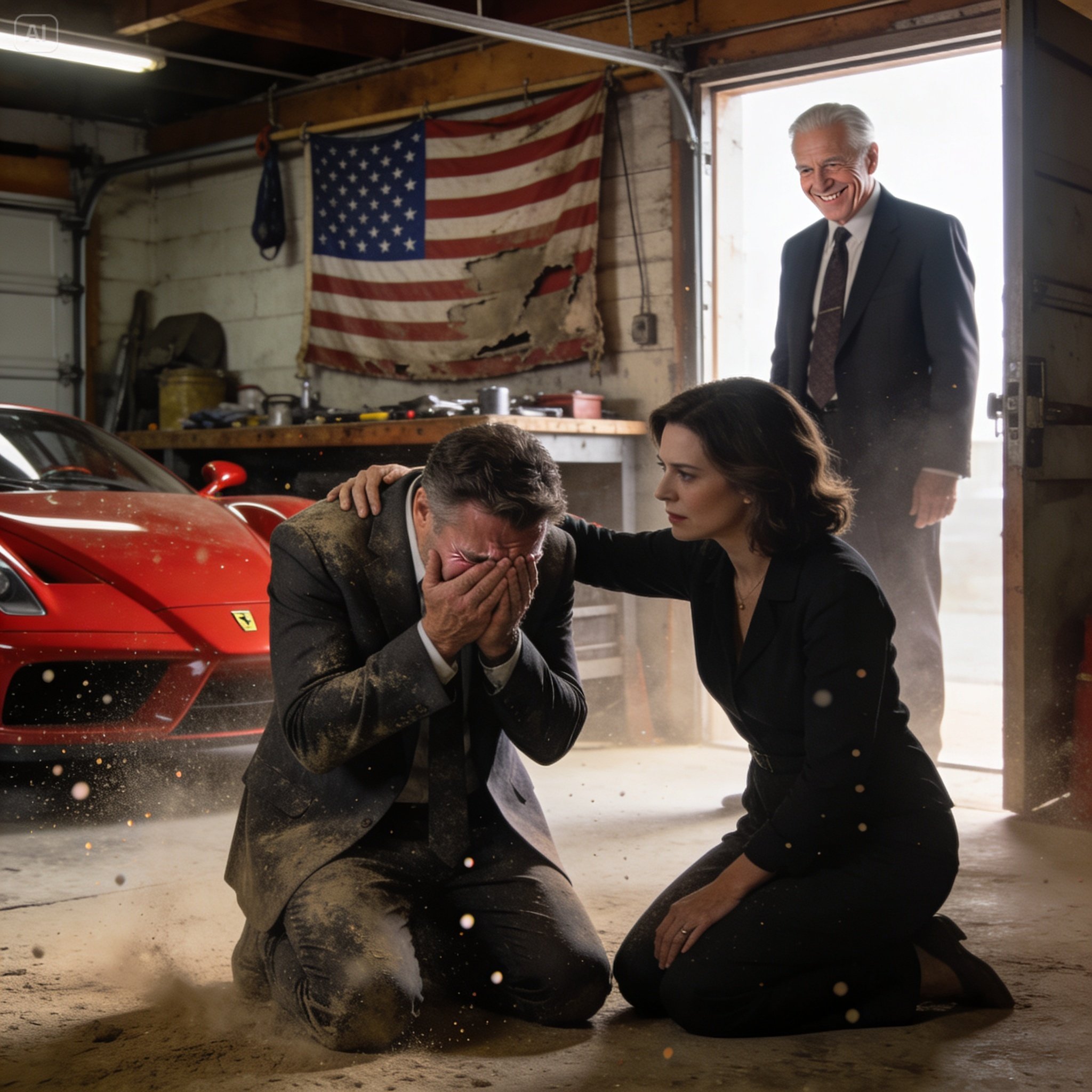
He sat down. Just like that. His legs buckled and he sat down hard on the dusty concrete floor, in his thousand-dollar charcoal suit. I walked over and slowly, cautiously, sat down next to him. Our knees touched. It was the first time we had been this close, this physically connected, in twenty-three years.
“Where did he get them?” he asked, his voice hollow, as if someone had scooped out his insides.
“He bought them.”
“Adelaide, look at me.” I turned to face him. His eyes, the same blue eyes that had once looked at me with such brotherly affection, were wet. I hadn’t seen Bennett’s eyes wet since our mother’s funeral. “He bought them with what?”
“Bennett,” I said gently. “You need to read something.”
I stood up, my movements deliberate and calm. I walked to the back wall, took down the poster, and spun the dial on the safe. 5-4-6-8-7-1. It opened with a soft click. I pulled out the manila folder. Dispute. 1972.
I handed it to him. He took it, his hands shaking slightly. He opened the folder and began to read.
I watched his face. It was like watching a landscape change over a century in the space of ten minutes. First, there was confusion, his brow furrowed as he tried to make sense of the legal jargon. Then came disbelief, his eyes widening, his mouth falling open again. And then came the anger. A dark, hot rage that started in his chest and climbed up his neck, turning his skin a mottled red.
He looked up from the papers, his eyes blazing with a grief so profound it was almost indistinguishable from hatred. “Mom,” he choked out.
“I know.”
“Mom died because we couldn’t afford the better treatment. The experimental drugs.” His voice cracked, shattering into a million pieces. “Bennett…”
“He had a Ferrari, Adelaide! He had seventy million dollars sitting in this garage, and Mom died in a county hospital! He let her die!”
“He didn’t let her die.”
“He LET her DIE!” he roared, the sound echoing off the concrete walls, a primal scream of anguish and betrayal. I put my hand on his arm. He flinched but didn’t pull away.
“Read the rest,” I said, my voice a firm, low anchor in his storm. “Read the agreement. Read what would have happened if he sold it.”
He looked down, his breathing ragged. He read. And I watched his face change again. It was slower this time. The anger didn’t vanish, but it was slowly being suffocated by something else. Something heavier. Something he hadn’t allowed himself to feel in a very long time.
Shame.
“He couldn’t tell anyone,” he whispered, the realization dawning.
“No.”
“He couldn’t sell it. They would have taken it back.”
“Yes.”
“He would have lost everything.”
“Yes.”
Bennett lowered the folder to his lap, his gaze fixed on the far wall, seeing nothing. “He chose the car,” he said, his voice flat with a new kind of pain. “Bennett…”
“He chose the car over Mom.”
“No,” I said, and the words came from a place of deep, sudden certainty. “He chose his name. The car was just the proof. The car was the only thing in this world that knew what he’d done. The only thing that said, ‘Silas Thornberry made this. Silas Thornberry changed something.’ If he sold it, he would lose that. He would lose the only part of himself he had left.”
Bennett’s face was breaking. I could see it happening. The carefully constructed facade of the successful, untouchable man he had built brick by brick, suit by suit, Lexus by Lexus, was crumbling to dust in a garage in Western Massachusetts, in front of the sister he had left behind.
“I called him a failure,” he whispered, his voice so quiet I almost didn’t hear it.
“What?”
“The summer I left for New York. I came back for a weekend. He sat me down on the porch swing and he said, ‘Bennett, you don’t have to chase money to be somebody. You can stay here. You can have a good life.’” He stopped, a choked sob catching in his throat. He was crying now. Not loud, not performative, just silent tears tracking paths through the invisible dust on his face, his shoulders shaking with the force of his regret. “And I… I told him I didn’t want to end up like him. I told him I didn’t want to be a small man in a small town.” His voice dropped to a shattered whisper. “I told him he was a failure, Adelaide.”
He buried his face in his hands, his body wracked with a grief that was twenty-three years old. I didn’t say anything. I just sat there on the cold floor of our grandfather’s garage, my brother sobbing beside me, the seventy-million-dollar ghost of our grandfather’s life watching over us. I put my arm around his shoulders. It was the first time I had touched my brother with affection in over two decades. He didn’t pull away. He leaned into me, a broken man, and he cried.
“Well, well, well.”
The voice, smooth and lacquered with greed, sliced through the sacred moment. We both went still. Mortimer Pritchard was standing in the doorway of the garage. I had no idea how long he’d been standing there, watching. His face was a mask of avarice. He wasn’t looking at us. He was looking at the cars, his eyes flicking back and forth, and I could almost see the dollar signs clicking into place like the tumblers of a safe.
He walked into the garage like he owned it, a smug smile spreading across his face. “Bennett, my friend. I had no idea.”
Bennett scrambled to his feet, wiping his face with the back of his hand. “Mortimer. I told you to wait inside.”
“Bennett, be reasonable,” the lawyer purred, his voice dripping with false sympathy. “This changes… well, this changes everything, doesn’t it? These cars need to go to appraisal immediately. Tomorrow. I have a contact in Boston—private auction, very discreet. We can have these moved before the week is out. The estate could clear forty, fifty million. Easy. And after my fees, after taxes, you and your sister would be looking at…”
“Stop,” Bennett said. The lawyer stopped, surprised. Bennett’s voice was not the voice he had arrived with. It was lower, quieter, and infinitely harder. “We’re not selling them.”
The lawyer’s smile flickered. He thought this was sentimentality, a temporary emotional hurdle. He thought we were fools. “Bennett, this is a life-changing sum of money. Your financial difficulties…”
“Get out,” Bennett said, his voice dangerously low.
“Now, let’s not be hasty…”
“Get out of my grandfather’s garage.”
For a single, telling second, I saw something flash in the lawyer’s eyes. Calculation. A man rapidly rearranging his strategy. The smile returned, smoother than ever. “Of course, Bennett. Of course. My apologies. I overstepped. I’ll be in the car.”
He turned and walked out, his posture oozing offended dignity. But I watched him go, and I knew. That man was not done. He had seen the treasure, and he would not walk away from it so easily. He thought he was dealing with a bankrupt fool and a small-town nurse. He thought he could still win. He thought we were weak. He was about to find out how wrong he was.
Part 5
After the lawyer left, a fragile silence descended upon the garage. The air, which moments before had crackled with confrontation, was now heavy with the dust of unspoken truths. Bennett sank back down onto the concrete floor, the fight draining out of him, leaving him looking smaller, older, and terribly frail.
“Adelaide?” he said, his voice barely a whisper.
“Yes.”
“There’s something I need to tell you.”
“Okay.”
He stared at his hands, hands that had only ever signed checks and tapped on keyboards, hands that looked pale and useless in the dusty, practical space of our grandfather’s workshop. “The house in Westchester,” he began, his voice flat. “The Lexus, the boat in Greenwich…”
“Yes?”
“None of it is paid for.”
I looked at him, my heart constricting not with anger, but with a sudden, painful wave of pity. “What?”
“Adelaide, I am… I am not what you think I am.” He finally looked at me, his eyes stripped bare of all pretense. They were the eyes of a terrified man. “I haven’t been what you think I am for a very long time. The house has two mortgages. The Lexus is leased. The boat… the boat is in a storage facility because I couldn’t keep up with the slip fees at the marina.” He took a shuddering breath. “My job… my job has been on the bubble for fourteen months. I am, Adelaide… I am about ninety days from bankruptcy.”
The confession hung in the air between us, more shocking than the seventy-million-dollar car standing a few feet away.
“That’s why I wanted to sell this house so fast,” he whispered, the shame so thick in his voice it was a physical presence. “Not because I didn’t care about him. Because I was going to use my half of the proceeds just to make my next mortgage payment.”
“Oh, Bennett,” I breathed. “I’m so sorry.”
He looked up, surprised, as if he’d been expecting judgment, a litany of “I told you so’s.” When he saw only compassion in my eyes, his face crumpled, and the last of his carefully constructed walls turned to dust. He was crying again, but this time it was different. It wasn’t the explosive grief of a son who felt betrayed; it was the quiet, desperate sorrow of a man who had betrayed himself.
Twenty-three years of distance, of resentment, of sibling rivalry, collapsed in that garage. I sat next to him, and for the first time since we were children, we were just a brother and a sister, lost and grieving together.
That evening, a tense, unspoken truce settled over the house. Bennett, exhausted and emotionally flayed, asked Pritchard to stay the night in the guest room. It was a move born of habit, of a years-long reliance on the man he thought was his friend and advisor. “We’ll sort this out in the morning,” he’d mumbled, unable to fully sever the tie. The lawyer had readily agreed, his smooth, reassuring smile back in place. He saw Bennett’s vulnerability not as a warning, but as an opportunity. He believed he could still manipulate the situation. He believed he still held all the cards.
I didn’t sleep that night, or the night before. My mind was a racetrack of images and revelations. I sat in my grandfather’s worn leather chair in the study, the box of my grandmother’s letters on the desk beside me, a silent testament to a love and foresight that transcended death. Around 6:00 a.m., as the first hint of grey light began to soften the edges of the window, I heard a sound from downstairs. A voice. Low, conspiratorial, talking on a phone.
I stood up, every nerve ending tingling with a sudden, cold premonition. I crept down the hallway, my bare feet making no sound on the old wooden floorboards. The kitchen door was open just an inch. Through the crack, I could see Mortimer Pritchard, his back to me, pacing by the window as he spoke into his phone. He thought he was alone. He thought he was safe.
“Yeah, two of them,” he murmured, his voice a low, greasy purr. “The 250 GTO and a Countach. Yeah, that one.”
There was a pause. I held my breath.
“No, no, the brother is on board. He’s just emotional. I’m working him. He’s broke. He’ll sign anything I tell him to sign by Friday.” Another pause. “The sister is going to be a problem, but I can handle her. Sentimental. Just get me a number we can use for the initial appraisal. Something low.”
A cold, reptilian fury coiled in my stomach. Slowly, deliberately, I pulled my phone from my pocket. My fingers, steady now, opened the voice memo app. I hit record.
“Yeah, well, sentimental’s got a price tag, too,” Pritchard chuckled. “I think we can move it. Lowball appraisal, quick private sale. Twelve million for the Ferrari, maybe eight hundred thousand for the Lambo. The buyer gets a steal, we get it done by the end of the month.” A pause. “My piece is the same. Ten percent, plus the kicker for… creative accounting.”
You don’t breathe. You don’t move. Twelve million? For a car worth seventy? He was going to rob my grandfather’s grave. He was going to rob us.
He kept talking, his voice dropping even lower, and I had to press my phone closer to the crack in the door. He talked about getting Bennett to sign over power of attorney for the estate. He talked about moving the cars to a private warehouse in Boston before the week was out, before “the girl” could get any funny ideas. He talked about the buyer, a private collector overseas “who does not ask questions and pays in cash.” Every word was a nail in his own coffin.
“No, look,” he said, his voice dripping with dismissive arrogance. “The old man’s dead. The grandmother’s dead. The mother’s dead. There’s just the two kids left, and one of them is bankrupt. We can do this clean. No one will ever know.”
I held the phone, my knuckles white, until I heard the definitive click of him ending the call. I didn’t run. I didn’t gasp. I walked silently back down the hall to the study, closed the door, and sat down at the desk. I played the first few seconds of the recording back, just to be sure. His voice, clear and damning, filled the small speaker.
It was there. I had him.
I sent a text to Bennett. Wake up. Come downstairs. Now. Quietly.
He came down five minutes later, his hair sticking up, his face puffy from a sleep that had clearly not been restful. “Adelaide? What’s wrong?”
I didn’t say a word. I just sat him down in the chair opposite me, handed him my phone, and hit play.
The man who listened to that four-minute recording was not the same man who had sat down. I watched his face cycle through every shade of disbelief and horror. Pink first, then white, then a sickly, ashen gray. And finally, a deep, burning red that climbed up his neck and into his ears and stayed there, a signal fire of pure rage.
When the recording ended, he stared at the phone for a full ten seconds. Then he placed it gently on the desk, stood up, and walked out of the room. He didn’t say a word. His movements were calm, deliberate, and terrifying.
I followed him. I couldn’t help it. He walked to the guest room and threw the door open so hard it slammed against the wall.
Mortimer Pritchard was sitting on the edge of the bed, whistling softly as he tied his silk tie. He looked up and smiled, a practiced, easygoing smile that died on his face when he saw the look on Bennett’s.
Bennett walked into the room, stopping directly in front of the lawyer. His voice, when he spoke, was unnervingly quiet. “You’re fired.”
The lawyer’s eyes flickered, his composure momentarily breaking. He tried to recover, to fall back on his well-worn manipulations. “Bennett? What are you—?”
“Get out of my grandfather’s house.”
“Bennett, whatever Adelaide told you is surely a misunder—”
“I have you on tape,” I said from the doorway.
The lawyer froze, his hands still on his tie. “What?”
“I have you on tape, Mortimer,” Bennett repeated, his voice like flint. “Talking to your buyer. About the lowball appraisal. About the kicker. About the overseas collector who pays in cash.”
The color drained from the lawyer’s face. The collapse was total and instantaneous. The predator was now the prey, and he knew it.
“Bennett, be reasonable,” he stammered, his bravado evaporating. “We can talk about this. There’s room here for everyone to be happy…”
“Get. Out.”
The lawyer finally understood. It was over. He stood up slowly, his movements stiff. He gathered his tie and his briefcase, the symbols of a life and career that were now in ruins. He walked past my brother. He walked past me in the hallway. He didn’t look at either of us.
We heard the front door close. We heard his car start, the engine catching with a panicked roar. We heard the tires spit gravel as it tore out of the driveway and disappeared down Maple Street, a coward fleeing the scene of his crime.
Bennett stood in the middle of the guest room, shaking. Not with fear, but with adrenaline and a righteous fury. I walked over to him and put my hand on his arm. He looked at me, his eyes wet with a fresh, more complicated wave of emotion.
“Adelaide, I almost… I almost trusted him. I almost let him…”
“But you didn’t,” I said firmly. “You stopped him.”
“He was my lawyer for nine years,” he whispered, the betrayal landing with its full, devastating weight. “He was my friend.”
“I know.”
“Adelaide,” he said, his voice breaking. “I don’t even know who I am anymore.”
I put my arms around him. I held my brother, my prodigal brother, in the hallway of our grandfather’s house as the morning sun streamed through the windows, burning away the shadows. He was right. He didn’t know who he was. Because the man he had been for twenty-three years had just collapsed, leaving a space for someone new, someone better, to be built in his place.
Part 6
The sound of an unfamiliar car engine, a low, confident purr, pulled us from our daze. It crawled up the gravel driveway and stopped. A black town car, the kind that speaks of quiet, serious money, sat gleaming in the noon sun. The driver, a man in a crisp black suit, got out and walked around to open the rear passenger door.
A man stepped out. He was in his late sixties, with a mane of white hair, a camel-colored overcoat draped over his shoulders, and shoes that cost more than my monthly rent. He held a leather attaché case in his right hand. He walked toward us, his steps measured and unhurried across the gravel. He stopped about ten feet from the garage, and a kind, patient smile touched his lips. It was the smile of a man who had been waiting a very long time to do this exact thing.
“Excuse me,” he said, his English precise, tinged with a soft Italian accent. “I am sorry to disturb. My name is Antonio Bianchi. I am with the Ferrari Heritage Department in Maranello. I am looking for the family of Silas Thornberry.”
The garage door was still open behind me. The fluorescent light was still on. The Ferrari, its perfect red curves catching the sunlight, seemed to glow from within. My brother stood frozen beside me. I couldn’t see anything but the man’s face, and the way his eyes, full of a deep, knowing sadness, looked past us and into the garage. He knew. He already knew. Whatever I had just spent two days uncovering, this man had been carrying it for longer than I had been alive.
I took a single step toward him. I heard my own voice, a stranger’s voice, say, “You’d better come inside.”
We sat in the kitchen, the same kitchen where my grandfather drank his coffee for fifty-three years, the same kitchen where I, at four years old, had asked him why he was sad. Bennett sat at the head of the table, in our grandfather’s seat. I placed a mug of black coffee in front of Mr. Bianchi.
He took a sip, his hands folded on the table. “Miss Thornberry, Mr. Thornberry, I am very sorry for your loss. Your grandfather… he was a very great man.”
My throat tightened. “You knew him?”
“No. Not personally. I knew of him. I have known of him for most of my career.” He paused. “Inside Ferrari, for a very long time, Silas Thornberry was a name we did not speak, but everyone knew. Because of the agreement. The 1972 agreement.” He looked at me. “You have seen it?”
“Yes.”
“We honored that agreement for fifty-four years. Because a deal is a deal. But then, two years ago, something changed.”
“What?” Bennett asked, leaning forward.
“Your grandfather wrote us a letter.”
Mr. Bianchi reached into his attaché case and pulled out a folder. He slid a single sheet of photocopied paper across the table. It was my grandfather’s familiar, careful script.
To the Heritage Department, Ferrari S.p.A.,
My name is Silas Thornberry. You know who I am. I am writing to inform you that I am dying. The doctors give me one year, possibly less. When I am gone, I am leaving the cars to my granddaughter, Adelaide. She will find what I have left for her, and she will understand. But there is something else. Something even she does not know exists. And I am asking you today to find a way to tell her after I am gone.
In 1974, after I returned to America, I continued my work privately. I filed five patents under a pseudonym. Those patents are still in use. Every high-performance engine made in the last forty years has touched some part of what I made. The royalties were placed in a private trust. I have never touched them. I will never touch them. The money is poisoned for me. But it is not poisoned for my granddaughter. When I am gone, please find her. Tell her she is the beneficiary. And tell her that her grandmother, who was the wisest person I ever knew, chose her long before I did.
Thank you for fifty-four years of silence.
Silas Thornberry
I read it three times, the words swimming before my eyes. I looked up at Mr. Bianchi.
“How much?” I whispered. “How much is in the trust?”
He cleared his throat. “As of last quarter… eight million, two hundred and forty thousand dollars.”
The paper fluttered from my fingers. Eight million dollars. He had sat in this kitchen, in his worn-out cardigan, with a leaky roof and a dying daughter and a broken heart, and he had eight million dollars he refused to touch. The anger I expected to feel never came. Instead, what rose in me was a wave of pure, unadulterated awe. He loved his own dignity more than he loved comfort, more than he loved security. He loved his name.
“He couldn’t touch it,” I said, the understanding settling deep in my bones. “Because if he used it, even a dollar, it would mean what they did to him was okay. It would mean he had sold himself.”
“Yes, Miss Thornberry,” Mr. Bianchi said softly. “And he never did.”
“There is one more thing,” he said, his expression gentle. “The Ferrari. We at Ferrari would be honored to buy it from you at fair market value. To bring it home to Maranello, where it belongs.”
“How much?” Bennett breathed.
“Based on the last comparable sale… perhaps sixty-five, perhaps seventy million dollars.”
The number landed on the table like a physical weight. Seventy million dollars. Enough to erase every problem, every worry, every debt. Enough to start a hundred new lives. Bennett was staring at me, his eyes wide. The entire world was waiting for my answer.
“No,” I said. The word was quiet, but it was absolute. Bennett and Mr. Bianchi both looked at me, stunned. “No, thank you. The Ferrari is not for sale.” I took a breath, the words finding me as I spoke them. “That car was never about money to my grandfather. And it cannot be about money to me, or it would betray him. I want it in a museum. I want his name on a plaque next to it. I want everyone who walks past it for the next hundred years to know who he was, and what he did.”
Mr. Bianchi’s kind eyes filled with tears. He smiled, a genuine, radiant smile. “That can be arranged, Miss Thornberry. That can absolutely be arranged.”
“And the Lamborghini,” I continued, a plan forming with startling clarity. “We’ll sell that. We’ll pay the bank, save the house. The rest will go into a foundation. In my grandfather’s name. His real name.” I looked at my brother, my partner now, in this strange new world. “Is that okay with you?”
Bennett nodded slowly, a look of profound peace settling on his face for the first time. “Adelaide,” he said, his voice thick with emotion. “That’s exactly what it should be.”
Mr. Bianchi stood up, shaking both our hands. “Your grandmother,” he said, looking at me. “She chose well.”
A year and a half later, I’m sitting on the porch swing as the October leaves come down on Maple Street. The world has changed, and yet it is exactly the same. Bennett sold the house in Westchester, returned the leased Lexus, and moved back to Millfield. He took his half of the Lamborghini money—after we paid off the house and all his debts—and poured it into the garage. It’s no longer a tomb of secrets; it’s Thornberry & Son Restoration, a thriving shop where he, with grease permanently under his fingernails and a red bandana in his back pocket, teaches at-risk kids how to rebuild classic engines. He looks ten years younger and a thousand times happier.
I still live in my apartment over the bookstore. I still work at the senior care home. But now, I also run the Silas Thornberry Foundation. We funded our first class of MIT engineering scholarships last spring. We’ve bought forty-seven pairs of hearing aids for residents in county homes.
The Ferrari sits in the New England Transportation Museum, under a soft spotlight. Next to it is a small bronze plaque: Silas Thornberry. 1939-2026. Engineer. Innovator. Quiet Man. The world ran on what he built. He never asked it to thank him.
I am reading the last entry in his journal, the one he wrote a week before he died.
The cars are not the inheritance, Addie. You are. You are the inheritance. You and what you do with what I left you. Your grandmother saw it first. I saw it second. Now you see it. That’s the chain. Make the chain longer, Addie. Find someone. See them. That’s the only inheritance that matters.
I close the journal as Bennett walks out of the garage, wiping his hands on a rag. He hands me a chipped coffee mug and sits beside me on the swing. In the garage, I can hear a girl named Ruby laughing. She’s sixteen, a former foster kid who didn’t speak for two weeks. Now she can time an engine by ear. She’s laughing with a boy named Anthony, who cried when Bennett told him he was a “natural” with carburetors because no one had ever called him a natural at anything before.
“Adelaide,” Bennett says softly, looking out at the quiet street. “What now?”
I smile, a real smile, one that reaches my eyes and my heart. I think of the chain, stretching from my grandmother to my grandfather, to me, to Bennett, to Ruby and Anthony and a girl from Buffalo who is designing a new fuel injection system. I think of the simple, terrible, beautiful act of looking at another person and truly seeing them.
I squeeze my brother’s hand.
“Now we keep the chain going, Bennett,” I say. “That’s all. That’s everything. We just keep the chain going.”