She brought her son in a wheelchair to their first date as a test to scare him away. But when he knelt down to speak to the boy, his own tears revealed a truth that would change all four of their lives forever.
The bell over the coffee shop door chimed at exactly 2 p.m., a sound that made Ethan Hayes’s heart seize. She was here. Clara Vance, the razor-sharp CEO he’d been texting for two weeks, the woman whose wit had made him laugh for the first time in three years. But she wasn’t by herself.
Ethan watched from his corner table as Clara navigated the entrance, her designer heels clicking with a steady, determined rhythm. Pushed ahead of her was a wheelchair, and in it sat a boy of about ten. His slender legs were still beneath a Star Wars blanket, but his bright eyes darted around the café as if he were plotting every possible exit. The buzz of conversation around them faltered. A woman nearby looked away too quickly. A teenager stared until his mother swatted his arm. The barista’s practiced smile tightened, melting into an expression Ethan recognized instantly—that awful cocktail of pity and unease people wear like a mask when faced with a disability.
Clara’s jaw was set, her knuckles white on the wheelchair’s handles. Ethan could see it in the rigid line of her spine: she was bracing for impact, ready for a fight, prepared to shield her son from whatever came next.
“Leo, honey, remember our plan?” she murmured. “We’re just popping in for a moment. Mommy just has to tell someone something important.”
The boy nodded, his fingers twisting in his lap. “He doesn’t know about me, does he?”
“No, sweetheart. He doesn’t.”
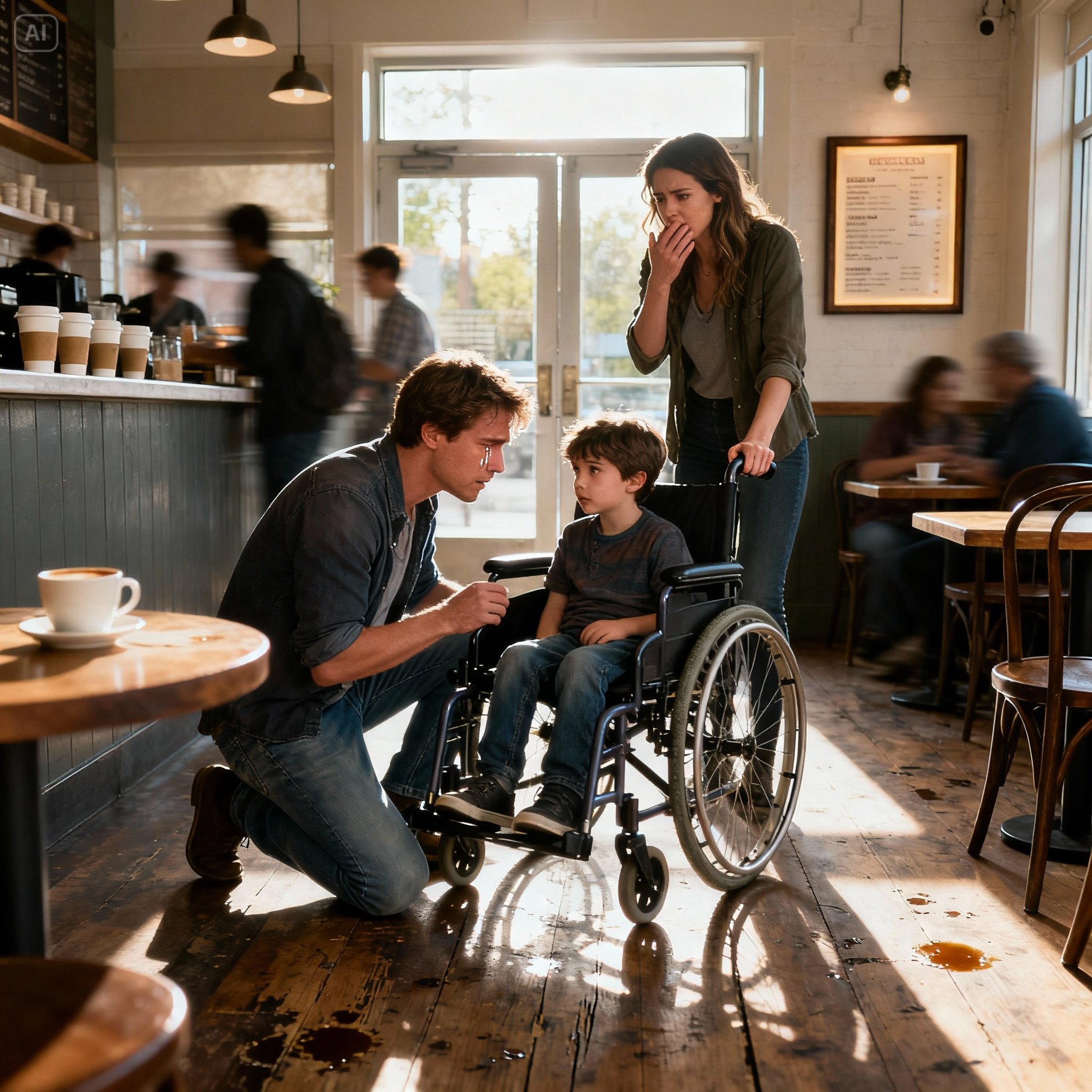
As Clara’s gaze swept the room, Ethan slowly rose from his chair. His mind wasn’t scrambling for an excuse or an escape route. Instead, a wave of profound, startling recognition washed over him. He knew that look in Clara’s eyes—that suit of defensive armor, that exhausted bravery. He saw a version of it every single morning in his own bathroom mirror.
She finally spotted him and froze mid-stride, her chin held high in a silent challenge. Her posture screamed, Go on. Get it over with. Run. They all do.
But Ethan did something that stopped her cold.
He walked toward them, his eyes fixed not on her, but on the boy. When he reached them, he dropped to one knee, bringing himself level with Leo. “You must be Leo,” Ethan said softly, extending his hand to the child first, ignoring Clara completely. “I’m Ethan. That is an awesome Star Wars blanket. Is that the Battle of Endor?”
Leo’s entire face transformed. A wary squint dissolved into surprise, then bloomed into a smile so radiant it could have powered a city block. “You know about the Battle of Endor?”
“Know about it? My daughter and I built the Lego Death Star last month. It took us three weeks because her hands don’t always cooperate, but we did it. Every last piece.”
A sound escaped Clara, half gasp, half sob. Ethan finally looked up at her, and that’s when she saw it. Tears. Real tears were tracing paths down this stranger’s face. But they weren’t the tears she’d steeled herself for—not pity, not discomfort. These were tears of recognition, of understanding. Of finding another soul who spoke the silent, secret language of hospital waiting rooms, of modified everything, of small victories that felt like winning the world.
“Hi, Clara,” he said, getting to his feet but keeping one hand gently on Leo’s wheelchair, as if it were the most natural thing in the world. “Would you both like to sit down? I picked this table because there’s plenty of room. My daughter, Maya, uses a chair sometimes, and she hates it when restaurants cram her into a corner.”
The words hung in the air, a suspended breath. “Your daughter?” Clara’s voice was a fragile crack. “Your daughter uses a wheelchair?”
“Juvenile arthritis. It’s progressive. Today’s a good day, so she’s at home, busy destroying our neighbor at checkers. She insists on moving the pieces herself, even if it takes forever. Mrs. Chen, the neighbor, just pretends not to notice when Maya accidentally knocks half the board over.” Ethan’s smile was soft and private, the smile of a parent who had learned to find joy in the most unexpected corners of life. “But you didn’t come here to listen to me talk about my daughter. Or did you?”
Clara sank into the offered chair as if her strings had been cut. The formidable CEO facade, the one that saw her through hostile takeovers and boardroom battles, completely disintegrated. “I brought Leo to scare you away,” she whispered. “I’ve done this twelve times.”
“I know.” Ethan pulled out his phone, his fingers trembling just slightly as he swiped to a photo. “This is Maya.”
The image showed a little girl with Ethan’s eyes and a grin that could banish shadows, sitting in a vibrant purple wheelchair. Her arms were thrown up in triumph beside a thoroughly demolished Lego city.
“Did she smash it on purpose?” Leo asked, leaning forward with genuine curiosity.
“No, that was an accident. She was trying to high-five me after we finished, but her joints locked up mid-celebration. Wiped out three weeks of work in two seconds.” Ethan’s laugh was free of bitterness. “She cried for about thirty seconds, then said, ‘Well, Dad, now we get to build it again, but better.’ That’s Maya. She finds the upside in everything, even when her own body is fighting against her.”
Clara’s hand flew to her mouth. “How long have you been doing this alone?” The question was heavy, loaded with a shared history.
“Three years. Her mother left when Maya’s condition got worse. She couldn’t stand watching our ‘perfect’ daughter struggle just to tie her own shoes.”
“Six years,” Clara countered. “Leo’s father stayed until he was four—long enough to see our son would never play catch in the yard or run beside him on a morning jog. He sends checks, very generous ones, but a check can’t teach a boy how to be brave when other kids stare on the playground.”
Leo had been listening, but now he tugged on Ethan’s sleeve. “Does Maya like space? I love space. I want to be an astronomer, but Mom worries because some observatories don’t have good access.”
“Funny you should mention that. I’m a structural engineer. I just finished consulting on the new accessibility renovations at the Chamberlin Observatory. Every floor, every telescope station, is fully accessible. I made sure of it.”
“Really?” Leo’s eyes widened. “You built ramps to the stars?”
“Ramps, elevators, wider doorways, adjustable telescope mounts—the works. Because everyone deserves to see the stars. Wheels or no wheels.”
Clara watched this man she had met for a date talk to her son as if he were the most fascinating person on earth. There was no fake enthusiasm, no performative kindness—just a genuine, magnetic connection. Most men saw the chair first.
“Most men are idiots,” Ethan finished her thought, then apologized. “Sorry, I shouldn’t—”
“No,” Clara laughed, a real, unburdened laugh for the first time in months. “You should.”
The barista appeared with their coffees, her discomfort obvious as she awkwardly maneuvered around Leo’s chair. Ethan saw Leo shrink, trying to make himself smaller, as if apologizing for the space he occupied.
“Hey, Leo,” Ethan said casually. “Want to see something cool?” He pulled his phone out again, this time to a video. It showed Maya in a gymnasium, her wheelchair decorated with ribbons like a parade float, spinning in circles while other kids in wheelchairs played a chaotic game of basketball around her.
“Is that wheelchair basketball?” Leo breathed.
“Saturday mornings, ten o’clock. Adaptive sports at the rec center. Maya is genuinely terrible at it, but she loves the chaos. They do racing, too. And sometimes they just have wheelchair dance parties. Because why not?”
“Mom, can I—?”
“We’ll see,” Clara said on autopilot, then stopped herself. “Actually, no. Not ‘we’ll see.’ Yes. If Ethan thinks it would be okay, then yes.”
“More than okay. Maya would love a new friend. She’s the only girl there right now, but she holds her own. Last week she ran over three kids’ toes and told them they were moving too slow.”
Leo giggled. “She sounds awesome.”
“She is. Don’t tell her I said that, though. Her ego is big enough.”
The conversation flowed as if a dam had broken. Clara told him about the first person who suggested she put Leo in a “home.” Ethan shared the quiet fury he’d felt when Maya’s own grandmother called her “broken.” They traded IEP horror stories and celebrated small wins: Leo’s first A in math, Maya painting a sunset with her stiff fingers.
“I run a medical tech startup,” Clara confessed. “We develop affordable mobility devices for kids. Prosthetics that grow with them, chairs that don’t cost more than a car. I started it after I got tired of fighting insurance companies for every single thing Leo needed.”
“That’s incredible. I’ve been designing accessible playgrounds in my spare time. Haven’t built one yet, but I have seventeen different plans. For swings that hold wheelchairs, for sensory gardens. For structures where all kids can play together, not just side-by-side.”
“Seventeen plans?”
“Couldn’t sleep. Started designing instead of staring at the ceiling, worrying about her future. Plan twelve is my favorite. It’s got a fully accessible rocket ship. Leo might like that one.”
Leo had pulled out a notebook and was sketching with intense focus. Clara glanced over and smiled. “He’s drawing Maya. It’s his way of remembering people he likes.”
“Can I see?” Ethan asked the boy directly.
Leo shyly held it out. The drawing was remarkable, capturing Maya’s determined spirit from just a single photo.
“You’re an artist,” Ethan said, his voice full of respect. “This is seriously good.”
“Kids at school say art is stupid. They say I only do it because I can’t play sports.”
“Kids at school are wrong about a lot of things. You know what Maya told a kid who made fun of her chair? She said, ‘I have wheels that help me move. You have a mouth that should help you think before you speak. I guess we all have equipment that doesn’t work right sometimes.’”
Leo laughed so hard he snorted, which only made him laugh harder. Clara watched her beautiful, brave boy, who had grown too quiet and careful, come roaring back to life under the gaze of this man who was no longer a stranger.
“I should confess something,” Ethan said, his eyes finding hers. “My sister made my dating profile. I almost canceled today. Three times.”
“Why didn’t you?”
“Because your messages made me feel like just Ethan again—not just Maya’s dad, not just the guy with the disabled kid. But I was terrified of telling you about her. I was going to wait until the third date, maybe the fourth.”
“Instead, I threw you into the deep end.”
“Best thing you could have done,” he said. “My version of normal includes knowing which restaurants have accessible bathrooms and carrying backup finger splints in my pocket.”
Clara reached across the table and took his hand. “I’ve been on twelve first dates this year. One man asked if Leo was ‘all there’ mentally. Another said he didn’t want to ‘play daddy to a defective kid.’ The last one ghosted me the second I mentioned the wheelchair.”
“Their loss,” Ethan said softly. “You don’t even know us.”
“I know enough,” he squeezed her hand. “I know you’re brave enough to bring your son on a first date because protecting him matters more than anything. I know you started a company to help kids like ours, because anger is only useful when you turn it into change. I know you’ve cried in more hospital bathrooms than you can count, but never where he could see you. I know you’ve become an expert in a medical field you never wanted to study. And I know you wake up every night wondering if you’re enough, if you’re doing it right, if your love can make up for everything you can’t fix.”
Clara’s tears finally came, silent and steady.
“I know,” Ethan continued, his voice thick with emotion, “because I live it, too. And for the first time in three years, I’m sitting across from someone who doesn’t need me to explain why I know the names of eight different types of joint inflammation, or why I count it as a win when my daughter can button her own coat.”
“Mom?” Leo’s voice was small. “Are you okay?”
“Yes, baby,” she whispered. “I’m very okay.”
“Is Ethan why we really came here? Not just to tell him something and leave?”
Clara looked at her perceptive son, who saw everything. “Yes,” she admitted. “Ethan is why we came.”
“Good,” Leo said simply. He turned to Ethan. “Are you going to date my mom?”
Ethan looked from Leo to Clara and back again. “I’d like to get to know both of you better. But that’s not just my decision. What do you think?”
Leo considered this gravely. “Do you like Star Trek?”
“The original or Next Generation?”
“Next Generation. Picard was the best captain.”
“Correct answer,” Ethan nodded. “Last question. If someone makes fun of my wheelchair, what would you do?”
Ethan met the boy’s gaze. “Depends. If it’s a kid, I’d explain why they’re wrong. If it’s an adult, I’d use bigger words to explain why they’re wrong. And if anyone ever tried to hurt you, wheels or no wheels, they’d have to go through me first.”
Leo looked at his mother. “I like him.”
“Me, too,” Clara whispered.
The manager approached. “Folks, I’m so sorry, but we’re closing in ten minutes.”
Ethan checked his phone, stunned. They had been there for three and a half hours.
As they headed for the door, Ethan fell into step beside Leo’s chair, his hand occasionally steadying it over an uneven tile. Not taking over, just supporting. Clara noticed. Leo did, too.
Outside, by Clara’s adapted van, she hesitated. “Frank… I just… I didn’t expect this. Someone to run toward us, not away.”
Ethan’s phone buzzed. A text from his neighbor. Maya says if you’re not home in 20 minutes, she’s making cereal for dinner. Again. He showed Clara, and they both laughed.
As Clara loaded Leo into the van, the boy called out, “Ethan, will Maya really be there Saturday?”
“Wild horses couldn’t keep her away. I’ll tell her you’re a new friend who likes space.”
“Tell her I think she’s brave,” Leo said quietly. “For the Lego thing and everything.”
“I’ll tell her. But Leo, you’re brave, too. Braver than most adults I know.”
The boy beamed, and Clara mouthed thank you over his head.
Later, on the phone with his sister, Megan, Ethan tried to explain.
“She brought her son, Mags. He’s in a wheelchair.”
“Oh, Ethan, I’m so sorry. That must have been awful.”
“No,” he cut her off, his voice breaking. “It was perfect. For the first time since Jennifer left, I met someone who just… understood. We’re seeing them Saturday. Maya’s going to have a friend, Mags. A real friend.”
That night, as he tucked Maya in, she asked, “How was your date?”
“How did you know I had a date?”
“Aunt Megan can’t keep secrets. Plus, you’re wearing your nice shirt.” She paused. “Was it good?”
“It was very good. She has a son.” Maya’s face fell. “He’s in a wheelchair.”
Her head snapped up. “What? Another kid like me?”
“Not exactly like you. His legs are paralyzed. But yes. Another kid who gets it.”
“And his mom likes you? Even though… I’m…”
“She likes me because of who you are, Maya. Not despite it.”
“Dad,” she whispered after a moment. “I’m scared. What if they see how hard it is on my bad days and leave, like Mom did?”
“Then they wouldn’t be worth our time. But sweetie, I don’t think that’s going to happen. When Clara saw me cry in the coffee shop, she didn’t run. She cried, too. Sometimes, broken people recognize each other. And then they realize they’re not broken at all—just waiting for someone else who speaks their language.”
Saturday morning was gray and drizzly—“arthritis weather,” as Maya called it. She insisted on going anyway. When they arrived at the rec center, Clara’s van was pulling up beside them. The lift lowered, and Leo appeared in a basketball jersey. The two children stared at each other across the wet pavement, a silent, careful assessment.
“Hi,” Maya said finally. “I’m Maya. I like your wheels. They’re purple.”
“I’m Leo. I like your jersey. But blue is a better color than purple.”
“No way. Purple is the best.”
“Want to argue about it while we play basketball?”
“Absolutely.”
And just like that, they were friends.
Clara and Ethan stood on the sideline, watching their children wheel onto the court. They watched Leo miss a shot entirely and Maya launch the ball backward by mistake. Both kids dissolved into a fit of laughter, the kind that comes from finding the one person who knows you have to laugh, because crying is the only other option, and laughing is so much better.
“I brought him as a test,” Clara admitted softly. “A filter. A way to fail fast. If you’d failed, Leo and I would have gone to the science museum.”
“But I didn’t fail. I saw him. I saw you both.”
The coach called for a water break, and the kids wheeled over, flushed with joy.
“Mom!” Leo exclaimed. “Maya says there’s a telescope at the observatory I could use from my chair. That Ethan built the platform for it! Can we go sometime? All four of us?”
“Does this mean you’re dating?” Maya asked bluntly. “Aunt Megan says you’re becoming a hermit crab, Dad.”
“My therapist says you need to take care of yourself,” she added, ignoring his mortified expression.
Leo nodded sagely. “Mom eats protein bars and calls it dinner. Adults are disasters.”
“Mom, you should date Ethan,” he declared. “He understands about the chair. Plus, he builds cool stuff.”
“And Dad,” Maya added, “you should date Leo’s mom. She’s pretty.”
Both adults turned bright red. “Out of the mouths of tiny tyrants,” Ethan muttered, but he was smiling. As the kids wheeled back to the game, he took Clara’s hand, interlacing their fingers. It felt complicated and imperfect and exactly right.
“Next Saturday?” he asked. “Dinner after? All four of us?”
“It’s a date,” she said.
That night, as Ethan tucked Maya in, she said, “Dad, I think Mom was wrong. We’re not broken. We’re just different. And different isn’t bad.”
Miles away, Leo was telling his mother, “She didn’t care about my chair, Mom. She just wanted to know if I liked purple or blue better.” He paused. “Are you going to marry him?”
“Leo, we just met!”
“So? When you know, you know. That’s what you always say about business. This isn’t business, though,” he added thoughtfully. “It’s better. It’s family.”
Three months later, at the same corner table in the same coffee shop, Clara and Ethan planned Leo’s eleventh birthday party: a space-themed bash at the observatory.
“Maya wants to give him a telescope,” Ethan said, showing Clara options on his phone. “She’s been saving her allowance for two months.”
Clara’s eyes misted over. “Our kids are amazing.”
“They get it from their parents.” Ethan looked over at the manager, who gave them a knowing smile and a small wave.
“Should we tell her?” Clara asked.
“Tell her what? That her coffee shop is where two families became one?” Ethan lifted her hand, kissing the simple ring he’d placed on her finger a week earlier, in a small ceremony where Maya and Leo had officially declared themselves brother and sister. “I think she already knows.”
And she did. The manager would tell the story for years: how a CEO brought her son on a blind date expecting rejection, and instead found a man who cried not with pity, but with recognition. She’d tell them about two children who taught each other that wheels were more practical than capes. But mostly, she’d tell them about the power of showing up exactly as you are, broken pieces and all, and finding someone who doesn’t want to fix you, but wants to build something beautiful with you.
Sometimes, love looks like wheelchairs and accessible ramps. Sometimes, it looks like a coffee shop on a Saturday, where two people stopped pretending everything was fine, and discovered that broken crayons still color beautifully. You just need someone who sees the masterpiece instead of the cracks.