A Homeless Woman’s Act of Kindness Sparks an Unlikely Love Story That Defies All Odds
She had only five pesos in her pocket, and it had been days since she’d had a proper meal. Even so, when she saw the old woman weeping, lost on the bustling avenue, she didn’t think twice. The rain had stopped just an hour before, but the streets of Bogotá still gleamed like mirrors under the neon glow.
Valentina Morales, just 21 years old, walked barefoot along Carrera Séptima, her feet long accustomed to the chill of the pavement. She had been living on the streets for four years, ever since losing her family in the Mocoa landslide. And though her stomach rumbled with a persistent ache, her eyes held a spark of hope that life had not yet managed to extinguish.
It was a Tuesday afternoon when she heard the crying—not the wail of a child, but the broken, desperate sobs of an elder. Valentina stopped in her tracks, her heart thudding against her ribs. She followed the sound until she found an elegant old woman sitting on the curb, tears tracing paths down her wrinkled cheeks. The woman was seated in an antique, worn-out wheelchair.
She wore a navy-blue dress that had once been expensive, leather shoes clearly not meant for walking, and a small handbag she clutched to her chest as if it were her last treasure. Her eyes, clouded by cataracts and confusion, darted everywhere, searching for something she couldn’t find.
“Ma’am, are you alright?” Valentina asked, approaching cautiously. Her voice was soft, afraid of startling the woman further.
The woman looked up, and Valentina saw the panic in her eyes. “No. I don’t know where I am, child. I went out to find the San Jorge pharmacy to buy my heart pills, but everything looks different. I don’t recognize anything.”
A lump formed in Valentina’s throat. She knew that pharmacy. It was fifteen blocks away, in a completely different part of the city. The old woman was utterly lost, and from her speech and attire, it was clear she wasn’t used to navigating the city center alone.
“What is your name, ma’am?” Valentina asked, sitting beside her on the curb.
“Elena. Elena Vázquez,” the old woman replied, drying her tears with trembling hands as she tried to maneuver her chair to face Valentina better. “I’ve lived alone since my husband died three years ago. My memory fails me sometimes, and my legs… they don’t obey me like they used to. The doctors say it’s normal for my age, but today I went out in my chair, and now I don’t know how to get back.”
Valentina glanced at her own bare feet, then at the sky, which was beginning to darken. She had a mere eighty pesos in her pocket, the sum of a full day of begging. She hadn’t eaten since the previous day’s breakfast, when a kind woman in Plaza de Bolívar had given her an arepa. But something in Elena’s face moved her deeply.
“I’ll take you, Mrs. Elena. I know where the pharmacy is.”
Elena looked at her, surprised. “But child, don’t you have other things to do?”
Valentina smiled for the first time in days. “Nothing more important than helping you.”
From a chic café across the street, Sebastián Herrera watched the scene unfold with disbelief. At 29, the heir to a multi-billion-peso construction empire, he was accustomed to the indifference of Bogotá’s streets. He had just left a boring business meeting, seeking a strong coffee before heading back to his office, when his attention was caught by the young woman with long, dark hair who had stopped to help the elderly lady.
What paralyzed him wasn’t the girl’s natural beauty, despite her worn and dirty clothes, but the genuine concern etched in her eyes. In his world of million-dollar contracts and people who approached him only for personal gain, the scene felt almost surreal. He watched as Valentina positioned herself behind Elena’s wheelchair, pushing it carefully, navigating around potholes, and stopping whenever the old woman needed a rest or the terrain grew steep.
Unable to stop himself, Sebastián paid for his half-finished coffee and stepped outside to follow them discreetly.
The path to the San Jorge pharmacy was long and arduous. The wheels of the chair squeaked faintly, and Valentina had to exert extra effort on the inclines, but she never complained. They paused every couple of blocks for Elena to rest and for Valentina to catch her breath. During these moments, they talked about Elena’s life. A shopkeeper who had earlier offered a better wheelchair approached them again.
“Hey, young lady, I see that chair is very old. Don’t you want to borrow mine? It’s in much better condition.”
Valentina was grateful, but Elena clung to the arms of her chair. “This chair belonged to my husband during his final years. I wouldn’t trade it for anything.”
Valentina learned that Elena had been a teacher for forty years, that she had lost her only son in a traffic accident, and that since her husband’s death, she had lived in a large, empty house in the northern part of the city.
When they finally reached the pharmacy, Elena searched her handbag and realized she had left her wallet at home. Her face fell, fresh tears threatening to spill.
“Don’t worry, Mrs. Elena,” Valentina said without hesitation. “I’ll pay for the pills.” She pulled out her eighty pesos and went to the counter. The pills cost two hundred pesos.
The pharmacist, an older man with a gray mustache, glanced at the crumpled bills and then at Valentina. “Child, this isn’t even half enough.”
It was then that Sebastián decided to intervene. He walked up to the counter and placed a 500-peso bill on the glass. “I’ll cover the rest,” he said simply.
Valentina spun around, startled. She saw an elegant man in a dark suit and polished shoes, his warm smile a stark contrast to his obvious wealth. “That’s not necessary, sir. I can…”
“It’s already done,” Sebastián interrupted gently. “Besides, I saw the journey you two made. What you did for this lady is not something you see every day.”
Elena, from her wheelchair, watched the exchange with curiosity. She had lived long enough to recognize when something special was happening. After buying the pills, Sebastián offered to drive them in his car.
Valentina hesitated. Her experience on the streets had taught her to be wary, especially of rich men. But Elena was exhausted, and the sky was threatening rain again. “Alright,” she finally agreed. “But only for Mrs. Elena’s sake.”
Sebastián’s car was a gleaming black BMW. As he helped Elena into the back seat, Valentina stood by the passenger door, feeling utterly out of place in her dirty clothes amidst the immaculate leather interior.
During the drive to Elena’s house, Sebastián couldn’t help but ask questions. He learned that Valentina had lost her parents and siblings in the Mocoa natural disaster, that she had arrived in Bogotá knowing no one, and that she had tried to find work but found it nearly impossible without documents or a fixed address.
“And you never thought about… well, doing bad things to survive?” Sebastián asked, genuinely curious.
Valentina looked at him with a mixture of sadness and pride. “My mother always said that poverty is no excuse to lose your dignity. I’d rather go hungry than steal from someone else.”
Elena, from the back seat, smiled. She had heard those very words from her peasant grandmother fifty years ago.
When they arrived at Elena’s house, a beautiful two-story residence in the Chapinero neighborhood, the old woman turned to Valentina before getting out. “Child, I don’t know how to thank you for what you did today. You didn’t just help me find the pharmacy. You restored my faith that there are still good people in this world.”
Valentina felt tears welling in her eyes. “You have nothing to thank me for, Mrs. Elena. Anyone would have done the same.”
“No,” Sebastián interjected, looking at her through the rearview mirror. “Not anyone. In fact, I saw dozens of people walk past before you stopped.”
After helping Elena inside, Sebastián returned to the car where Valentina waited in silence. The rain had started again, tracing small rivers down the windows. “Where can I drop you?” Sebastián asked.
Valentina pointed toward the city center. “Anywhere in the center is fine. That’s… where I sleep.”
Sebastián felt a pang in his chest. Throughout the drive, he had been mulling over an idea—one that sounded crazy even to him, but that he couldn’t shake.
“Valentina,” he said, stopping at a red light. “Can I make you a proposal?”
She eyed him with suspicion. “What kind of proposal?”
“Elena needs help. Her memory is failing. She lives alone, and today made it clear she can’t continue like this. What would you think about working as her caretaker?”
Valentina blinked, certain she had misheard. “I’m sorry?”
“I would pay you a million pesos a month, plus room and board. You would only have to keep her company, help with her pills, and make sure she doesn’t feel so alone.”
Silence filled the car. Valentina couldn’t believe what she was hearing. A million pesos was more money than she had ever seen in her life. “Why would you do something like that for me?” she finally asked.
Sebastián met her gaze directly. “Because in four hours, you showed me that people who help without expecting anything in return still exist. Elena needs someone like that, not a nurse who is only there for the money.”
Valentina felt her heart leap into her throat. Was it possible her life was about to change completely? “I don’t know if I’m suited for that. I’ve never professionally cared for anyone.”
“You don’t need professional experience,” Sebastián replied. “You need exactly what I saw today: a good heart.”
When the light turned green, Sebastián didn’t immediately accelerate. He waited for Valentina to make her decision. “And if it doesn’t work out, if Mrs. Elena doesn’t feel comfortable with me, then we’ll find another solution. But something tells me that won’t happen.”
Valentina closed her eyes, and for the first time in four years, she allowed herself to dream of having a roof over her head, a bed, food every day—of having a chance to rebuild her life.
“Okay,” she whispered. “I accept.”
Sebastián smiled, feeling a strange and novel satisfaction. He didn’t know exactly why, but he was certain he had just made one of the best decisions of his life.
“There’s one more condition,” he added, finally pulling away. “Tomorrow morning, I’m taking you to buy proper clothes. And I want you to know, Elena is special to me. She was my grandmother’s best friend. She practically raised me when I was a boy. Taking good care of her would mean a lot to me.”
As they drove back toward Elena’s house, neither of them could imagine that their chance meeting on a rainy Bogotá street would be the first chapter of a story that would change not only their lives, but their very definition of true love. The rain continued to fall, but for the first time in years, Valentina felt as though each drop were washing away her painful past, preparing her for a future she had never dared to imagine.
The Bogotá dawn filtered shyly through the curtains of the guest room at Elena’s house, but Valentina had been awake for two hours. All night, she had lain staring at the white ceiling, wondering if it had all been a beautiful dream from which she would wake up again on the cold pavement of Carrera Séptima. Her hands still trembled as she touched the clean sheets, as she felt the softness of the pillow beneath her head. It had been so long, she had forgotten what it was like to sleep in a real bed.
Elena had insisted she stay that first night, arguing it was too late for a young woman to be out alone, especially after all she had done for her. A soft knock on the door pulled her from her thoughts.
“Valentina, my dear, are you awake? I brought you coffee with milk and some arepas that Carmen, my housekeeper, made.” Elena entered, pushing her wheelchair with a tray balanced on her lap. Despite her physical limitations, she had managed to prepare a breakfast that looked like a king’s feast to Valentina.
“Mrs. Elena, you shouldn’t have bothered,” Valentina murmured, overwhelmed by such kindness.
“Bothered? Child, it’s been three years since I had someone to make breakfast for. Carmen only comes three times a week to clean and cook a little, but the rest of the time, this house is so quiet I sometimes think I’ll go mad.”
As they had breakfast together in the small dining room overlooking the garden, Elena shared more details of her life. She had been the principal of a public school for thirty years. She had lost her only son, Andrés, in a motorcycle accident when he was just twenty-five, and since then, she and her husband, Ricardo, had poured all their love into helping students in need.
“Ricardo always said God had taken away our chance to be biological grandparents to make us the grandparents-at-heart to hundreds of children,” Elena recounted, her eyes shining with nostalgia. “We created a small foundation to provide school scholarships—nothing grand, but we helped many young people get ahead.”
Valentina listened to every word, feeling a deep connection to this woman who, despite her losses, had chosen to turn her pain into hope for others.
At nine in the morning, the doorbell rang insistently. Elena frowned in confusion. “I’m not expecting anyone this early.”
Carmen, a sturdy woman in her fifties with her hair in a tight bun, appeared in the dining room with a curious expression. “Mrs. Elena, there’s a very elegant young man at the door asking for Miss Valentina.”
Valentina’s heart quickened. It could only be one person.
Sebastián was waiting in the main hall, impeccably dressed in a light gray suit, his smile widening when he saw Valentina appear. In his hands, he carried several bags from an exclusive boutique in northern Bogotá.
“Good morning,” he greeted, addressing Elena first with the respect her age commanded. “Mrs. Elena, I hope I’m not disturbing you so early. I came to fulfill my promise from yesterday.”
Elena observed him with the wisdom of her eighty years. There was something in the way this young man looked at Valentina, something that reminded her of how Ricardo used to look at her fifty years ago. “Not at all, young Sebastián. Come in, come in. Have you had breakfast?”
While Carmen served coffee for everyone, Sebastián explained his plan for the day. He had contacted a friend of his who owned a boutique, explained the situation without going into compromising detail, and selected several appropriate outfits for Valentina’s work.
“It’s not charity,” he clarified quickly when he saw Valentina’s uncomfortable expression. “It’s a work-related investment. A caretaker needs to look professional.”
The bags contained three complete outfits: soft-colored blouses, comfortable yet elegant pants, low-heeled shoes suitable for pushing a wheelchair, and even new undergarments. Everything was in Valentina’s exact size, which made her wonder how he had been so precise.
“My sister has the same build as you,” Sebastián explained as if reading her mind. “I asked her to help me estimate the sizes.”
Elena watched the exchange with a smile that grew wider by the moment. “Valentina, go try on the clothes. Sebastián and I have a few things to discuss.”
When Valentina disappeared upstairs, Elena guided her chair to face Sebastián, her still-lucid eyes studying him intently. “Tell me the truth, young man. Why are you doing all this?”
Sebastián held her gaze without flinching. “Because yesterday, I saw something I’ve never seen in my life.”
“And what was that?”
“Pure kindness. With no self-interest, no hidden agenda, no expectation of anything in return. In my world, Mrs. Elena, that doesn’t exist. People approach me for my money, my connections, for what they can get. But Valentina… she spent her last pesos on your medicine without knowing you, without knowing if she would ever see you again.”
Elena nodded slowly. “And what do you want from her?” The question was direct, without preamble.
Sebastián took a moment before answering. “Honestly, I don’t know yet. I just know that since yesterday, I haven’t been able to stop thinking about her. But I promise you something. My intentions are honorable. I will not hurt Valentina, nor will I take advantage of her vulnerable situation.”
“You’d better not,” Elena replied, her smile not quite concealing her warning tone. “That girl has suffered enough. If you’re playing a game…”
“I’m not playing,” Sebastián interrupted softly. “And if I may say so, I think you also need someone like Valentina in your life.”
Elena sighed deeply. “You’re right. This house is too quiet, and my memory… some days, I’m frightened by what I forget. Yesterday, when I went out for the pharmacy, for a moment I couldn’t even remember my own name.”
When Valentina came down the stairs wearing one of the new outfits, both Sebastián and Elena fell silent. The transformation was remarkable. The quality clothing highlighted her natural beauty, but more than that, something in her posture had changed. She looked more confident, more dignified.
“How do I look?” she asked shyly.
“Like the professional you’re going to be,” Elena answered with maternal pride. Sebastián simply nodded, unable to articulate the words to express what he felt seeing her.
The rest of the morning was spent organizing Valentina’s new responsibilities. Elena showed her the house: four bedrooms, three bathrooms, a spacious kitchen, living and dining rooms, and a study filled with Ricardo’s books. The backyard had a small vegetable garden that Elena could no longer maintain alone.
“My room is here on the first floor, ever since these legs started betraying me,” Elena explained, pointing to a room they had adapted near the main bathroom. “You can use any of the rooms upstairs, but I recommend the one overlooking the garden. It has the best view and gets a lot of sun in the mornings.”
Valentina chose the smallest room, the one that had been Elena’s sewing room. “I don’t need much space,” she explained, “and this way, I’ll be closer if you need me during the night.”
Elena felt her eyes fill with tears. It had been so long since anyone had cared for her well-being in that way.
Sebastián, who had remained discreetly in the background during the tour, approached before leaving. “Valentina, I’ll stop by tomorrow afternoon to see how you both are. If you need anything—medicine, food, whatever—here is my number.” He handed her a business card. “Don’t hesitate to call, no matter the hour.”
That first afternoon as an official caregiver, Valentina discovered her job was much more than administering medicine and pushing a wheelchair. Elena needed companionship, conversation, someone to listen to her tell the same stories over and over without impatience. They prepared lunch together, with Elena directing from her chair while Valentina followed her instructions to make sancocho, a stew Elena had mastered since her newlywed days.
The kitchen filled with familiar aromas and laughter when Valentina confessed she had never peeled a yucca in her life. “Oh, my child, how can you live in Colombia without knowing how to peel a yucca?” Elena laughed. “That’s like… not knowing how to make arepas.”
“I don’t know how to make arepas either,” Valentina admitted, sparking more laughter.
In the afternoon, while Elena rested in her room, Valentina explored Ricardo’s study. The walls were lined with books: Colombian novels, history, biographies, books on education. On the desk, under a pane of glass, were photographs of Elena and Ricardo at different stages of their lives: as young newlyweds, with their son Andrés as a boy, in their years as educators, on trips across the country. One photograph in particular caught her eye: a much younger Elena pushing a sick Ricardo in a wheelchair, both of them smiling in what looked like a park. On the back, in Elena’s careful handwriting, it said: “In sickness and in health. 2019.”
“Ricardo had a stroke when he was 75,” Elena said from the doorway, having woken from her nap. “The doctors said he would never walk again. For three years, I was his legs, his arms when he couldn’t move well, his memory when his began to fail.” Elena approached the desk, caressing the glass that protected the photograph. “Do you know what he told me the day before he died? He said he was the luckiest man in the world because he’d had someone who loved him unconditionally. That caring for the one you love isn’t a sacrifice; it’s a privilege.”
A lump formed in Valentina’s throat. “Did you never feel overwhelmed? Never want to give up?”
Elena looked at her with understanding. “Of course, my child. There were very hard days, days I cried in secret because I felt tired and then guilty for feeling tired. But do you know what helped me?”
“What?”
“Remembering that true love isn’t just for the easy days. It’s especially for the hard days. And that every day I could make his life a little bit better was a day worth living.”
That evening during dinner, the phone rang. It was Sebastián. “How is everything going?” he asked, and Valentina could hear the genuine concern in his voice.
“Very well. Mrs. Elena is teaching me how to cook.”
“And you, Mrs. Elena? How are you feeling with your new company?”
Elena took the phone. “Young Sebastián, this girl is a blessing. I haven’t laughed this much in years, and my sancocho soup has never tasted as good as when someone helps me prepare it with affection.”
After hanging up, Elena observed Valentina with a mischievous smile. “That boy is interested in you, you know.”
Valentina blushed. “Mrs. Elena, I don’t think so…”
“I’m eighty years old, my dear. I’ve seen enough lovers to recognize the signs. The way he looks at you, how he worries about you… it’s the same way Ricardo used to look at me.”
“But I… I’m not from his social class. He’s rich, educated, successful. I’m…”
“You are a beautiful, intelligent, kind, and hardworking woman,” Elena interrupted firmly. “And if he can’t see that, then he doesn’t deserve you. But from what I saw today, that young man knows how to value what’s in front of him.”
That night, before going to sleep, Valentina looked at herself in the mirror of the small bathroom in her new room. The woman looking back was different from the one she had seen reflected in shop windows for years. Her eyes shone with hope, her posture was straight, her smile was real. For the first time in four years, she dared to dream of a different future. A future where she wouldn’t have to worry about where to sleep, what to eat, or if she would see the next sunrise. A future where she could be useful, loved, valued. And in a secret corner of her heart, she began to wonder if that future might also include love.
As she fell asleep in her new bed, listening to the nocturnal sounds of a house that was already starting to feel like home, Valentina couldn’t imagine that on the other side of the city, Sebastián was also lying awake, thinking of her, and wondering how she had managed to change his life in less than twenty-four hours. The night wind of Bogotá whispered through the trees in Elena’s garden, as if the city itself were celebrating the start of a new story of hope and transformation.
Three weeks had passed since Valentina moved into Elena’s house, and the daily routine had created a beautiful, natural rhythm between the two women. Every morning, Valentina would wake to the song of the garden blackbirds and go down to prepare breakfast while Elena reviewed her medications with the precision of a Swiss watch. The afternoons had become their favorite time of day. After lunch, they would sit on the terrace overlooking the garden—Elena in her wheelchair under the shade of a large walnut tree, while Valentina read the El Tiempo newspaper aloud.
Elena would comment on the news with the insight of someone who had lived long enough to see history repeat its patterns, and Valentina would absorb every word like an eager student. “Colombian politics is like Bogotá’s weather, my dear,” Elena had told her one afternoon. “You never know if it will be sunny or rainy, but you can always count on it changing.”
But what had also begun to change was the frequency of Sebastián’s visits. What had initially been courtesy calls every couple of days had turned into almost daily appearances. At first, he arrived with perfectly valid excuses: bringing special medications for Elena, documents to formalize Valentina’s employment, or simply checking that everything was running smoothly. However, Elena was no fool. With eighty years of experience reading people, especially men in love, she could see what was really happening. Sebastián wasn’t coming to see how Elena was; he was coming to see Valentina.
One Thursday afternoon, while Valentina was watering the garden plants and Elena was resting in her room, Sebastián arrived with a different proposal. “I thought maybe you’d like to join me for dinner tonight,” he said, ostensibly addressing both women but with his eyes fixed on Valentina. “I know a very quiet restaurant in La Candelaria that has wheelchair access and serves the best traditional Bogotá food.”
Elena, from her bedroom doorway, smiled slyly. “Oh, my dear boy, what a shame, but I’m feeling a bit tired today. Why don’t you two go? Valentina has been working so hard and deserves an outing.”
Valentina blushed instantly. “Mrs. Elena, I can’t leave you alone.”
“Carmen is here until eight, and besides, I’m no longer a child who needs a babysitter 24/7,” Elena replied firmly. “Go on, go and have some fun.”
Sebastián tried to hide his satisfied smile. “Only if you’re sure you want to go, Valentina. I don’t want to pressure you.”
In all the time she had been living at Elena’s, Valentina had carefully avoided analyzing her feelings for Sebastián. It was true that she awaited his visits with an excitement she had never felt before. It was true that she tidied herself up a bit more on the days she knew he was coming. It was true that their conversations during family-style dinners had become the highlight of her days. But it was also true that the difference between their worlds seemed like an impossible chasm to cross.
“Okay,” she murmured finally. “But only if you promise we’ll be back early.”
The restaurant Sebastián had chosen was a magical place called La Puerta Falsa, hidden on a cobblestone street in Bogotá’s historic center. The walls were adorned with old photographs of the city, soft carranga music played in the background, and the aroma of tamales and ajiaco floated in the air like an invitation to the soul.
“This place is over 200 years old,” Sebastián explained as he helped Valentina to a table by the window. “My grandfather used to bring me here when I was a boy. He said this was where they served real Bogotá food, not those imitations in fancy restaurants.”
Valentina looked around in awe. She had never been in a place like this—authentic, full of history, where every table had its own personality and every dish told a family story. “Did your grandfather also work in construction?” she asked, genuinely interested.
Sebastián smiled with nostalgia. “No, he was a carpenter, a very humble carpenter who built furniture for middle-class families. It was my father who decided to turn that small workshop into a construction empire.”
While they waited for their food, Sebastián told her about his childhood—how he had grown up among blueprints and hard hats, how his father had worked eighteen-hour days to build the company, and how his mother had sacrificed her career as a teacher to support her husband’s business dreams.
“It sounds like a very close-knit family,” Valentina commented.
Sebastián paused before answering. “In business, yes. Emotionally… well, money has a strange way of complicating family relationships.”
When the food arrived—ajiaco for both of them, with corn on the cob, capers, and cream—Valentina realized it was the first time in years she had sat in a restaurant as a normal person, not as someone begging outside.
“What are you thinking about?” Sebastián asked, noticing her distant expression.
“About how different everything is now,” she answered honestly. “A month ago, if someone had told me I’d be having dinner in a place like this, wearing nice clothes after a day of honest work, I wouldn’t have believed it.”
“And how do you feel about all these changes?”
Valentina reflected as she stirred her soup. “Grateful. Scared. Hopeful. All at the same time.”
“Scared of what?”
“That it’s too good to be true. That one day I’ll wake up and all of this will have been a dream.”
Sebastián leaned forward, his voice growing more serious. “Valentina, can I promise you something? This isn’t a dream, and it’s not going to disappear.”
Their eyes met for a moment that seemed to stretch into eternity. There was something in the way Sebastián looked at her that made Valentina feel butterflies in her stomach, something she had never experienced before.
After dinner, they walked slowly through the cobblestone streets of La Candelaria. The colonial lights cast dancing shadows on the colorful facades, and the Bogotá night air had that unique coolness of a mountain city.
“Can I ask you something personal?” Sebastián said as they paused in front of an old church.
“Depends on how personal,” Valentina replied with a shy smile.
“Have you ever been in love?”
The question caught her by surprise. She was silent for a moment, looking up at the stars that were barely visible through the city’s light pollution. “No,” she answered finally. “When I was younger, before… before everything happened, there was a boy in Mocoa I liked, but we were very young. After the disaster, I never thought about those things again.”
“And now?”
Valentina felt her heart accelerate. “Now what?”
“Now… do you think about those things?”
The honesty in his voice, the vulnerability in his eyes, made Valentina feel as if she were standing on the edge of a cliff. She could step back, into the safety of her uncomplicated new life, or she could leap into the unknown. “Sometimes,” she murmured.
Sebastián took a step closer. “And what do you think about when you think about those things?”
Valentina looked him directly in the eye. “I think about how strange it is that someone like you would notice someone like me.”
“Someone like me? Rich, successful, educated, with a bright and uncomplicated future. And someone like you? Poor, without a formal education, with a painful past and an uncertain future.” Sebastián gently took her hands. “Do you know what I see when I look at you?”
Valentina shook her head, unable to speak.
“I see a woman who spent her last pesos on medicine for a stranger. I see someone who pushed a wheelchair for fifteen blocks under the sun without a single complaint. I see a person who reads the newspaper to an old woman every afternoon and listens to her stories as if it were the first time she’s heard them.” Their faces were very close now. “I see someone who has suffered so much she could have become bitter, but who chose to keep her heart open. I see beauty, intelligence, kindness… and I see the most extraordinary woman I have ever met in my life.”
The first kiss was natural, inevitable, as if it had been waiting to happen from the moment they met. It was gentle, timid at first, then more confident as they both realized the feeling was mutual. When they parted, Valentina had tears in her eyes.
“Are you okay?” Sebastián asked, concerned.
“It’s just… I never thought anyone would see me that way.”
“Well, they do. I see you that way.”
The ride home was quiet, but not uncomfortable. It was the silence of two people who had just crossed an important line and needed time to process what it meant.
Elena was waiting up for them in the living room, pretending to read a García Márquez novel but obviously watching for their return. “How was dinner?” she asked with feigned innocence.
“Very delicious,” Valentina replied, unable to completely hide her smile.
“The restaurant… very nice,” Sebastián added, also smiling.
Elena looked from one to the other and smiled with satisfaction. “Good. Well, I’m off to bed. Sebastián, drive carefully. And Valentina, don’t forget to lock the door.”
When Elena disappeared into her room, Sebastián and Valentina were left alone in the hall. “Do you regret it?” Sebastián asked softly.
“No,” Valentina answered without hesitation. “And you?”
“Not at all.”
They said goodbye with another kiss, more confident this time. And as Sebastián left, Valentina lingered at the door, touching her lips and smiling as she hadn’t smiled in years.
In her room, as she got ready for bed, she heard a soft knock. “Come in, Mrs. Elena.”
Elena entered, pushing her chair with a mischievous grin. “So?…”
“So, what?”
“Oh, my dear, don’t play coy. How was the date?”
Valentina blushed. “It wasn’t a date. It was just dinner.”
“A romantic dinner in La Candelaria with a handsome man who is obviously in love with you. If that’s not a date, then I don’t understand romance at all.”
Valentina sat on the bed, needing to talk to someone about what she was feeling. “Mrs. Elena, do you think this can work? We’re so different.”
Elena came closer and took her hands. “My dear, when I met Ricardo, I was the daughter of peasants, and he was the son of city merchants. Do you think our families were happy? But true love doesn’t know social classes.”
“How… how does one know if it’s true love?”
Elena smiled with the wisdom of her years. “Because it makes you want to be a better person. Because it makes you feel like the world is more beautiful. Because when you’re with that person, you feel like you’ve come home.”
That night, Valentina fell asleep dreaming of kisses under the Bogotá stars and the possibility that love—that feeling she had thought lost forever—had finally found its way into her life. And in another part of the city, Sebastián also lay awake, planning how to make that extraordinary woman feel as loved as she deserved. The Bogotá night wind carried with it promises of happier days, of healing hearts, and of loves blooming against all odds.
The love between Valentina and Sebastián had blossomed over two months like a flower finding its perfect moment to shine. Their meetings had become more frequent and natural—dinners at Elena’s, strolls through Bogotá’s parks, and conversations that stretched late into the night. Elena watched their happiness with the satisfaction of an expert matchmaker, but also with the concern of someone who knew how cruel the world could be to loves that defied social conventions.
The storm arrived on a Tuesday morning, when they least expected it. Sebastián had spent the previous night at Elena’s, sleeping on the living room sofa after a dinner that had run too late for him to drive back to his apartment. It was something that had started happening more often, which Elena permitted on the condition that they behave like decent people under her roof.
At seven in the morning, as Valentina prepared coffee and Sebastián helped Elena with her morning medication routine, the doorbell rang with an insistence that heralded trouble. Carmen, who had arrived early that day, appeared in the kitchen with a worried expression. “Mrs. Elena, there’s a very elegant lady at the door who says she’s Mr. Sebastián’s mother. She’s… very upset.”
Sebastián’s face went pale. “Damn,” he muttered under his breath. “How did she find me here?”
Patricia Herrera, 56, swept into the house like a hurricane dressed in Chanel. Her perfectly coiffed blonde hair, discreet but expensive jewelry, and erect posture radiated the kind of authority that only generations of inherited wealth can bestow. Her eyes, the same color as Sebastián’s but cold as steel, scanned Elena’s modest but cozy living room before landing on her son.
“Sebastián Alejandro Herrera Mendoza,” she said in a voice that could freeze hot coffee. “Can you please tell me what on earth you are doing?”
Elena, from her wheelchair, sat up with all the dignity her eighty years had taught her. “Good morning, ma’am. I am Elena Vázquez, and this is my home. How can we help you?”
Patricia glanced at her as if noticing her for the first time. “You must be the woman who is helping my son make the biggest mistake of his life.”
“Mom, stop,” Sebastián intervened, rising from the table. “You have no right…”
“No right?” Patricia wheeled on him, her eyes blazing. “I have no right to worry when my son disappears for weeks, abandons his responsibilities at the company, and ignores his family’s calls to play house with… with…” Her eyes settled on Valentina, who stood frozen by the coffee maker like a deer in headlights. “…with a domestic employee,” Patricia finished with contempt.
The ensuing silence was so thick it could have been cut with a knife. Valentina felt as if she had been slapped. All her insecurities, all her fears about the class divide, materialized in those three words, spoken with such disdain.
“Be careful what you say in my house,” Elena said, her voice, despite her age, carrying the authority of decades as a school principal. “Valentina is not a domestic employee. She is my caregiver and my friend.”
Patricia laughed bitterly. “Please, ma’am, don’t bother with euphemisms. I know exactly what this situation is.”
Sebastián stepped toward his mother, his face flushing with anger. “If you’re going to insult Valentina, you can leave right now.”
“Insult her? Sebastián, I’m trying to save you from yourself. Do you know what people are saying? Do you know how this affects our family’s reputation?”
“I don’t care what people say.”
“Well, you should! We have responsibilities, Sebastián. We have a name to protect, a legacy to uphold. Your grandfather didn’t build this empire for you to destroy it over a romantic whim.”
Valentina felt each word like a stab. Romantic whim. As if what she felt for Sebastián was something temporary, superficial, and worthless.
“It’s not a whim,” Sebastián said firmly. “I’m in love with Valentina.”
Patricia placed a hand on her chest dramatically. “In love? Sebastián, you’re 29, not 15. Love isn’t enough to build a life. What will you two possibly have in common? What will you talk about when the novelty wears off?”
“We talk about everything,” Sebastián countered. “Valentina is more intelligent and has more wisdom than most of the women in my social circle.”
“Wisdom? A beggar has wisdom?”
This time, it was Valentina who spoke, her voice trembling but clear. “Ma’am, with all due respect, I don’t think you know me well enough to judge me.”
Patricia turned to her, her eyes narrowed. “I know enough. I know you come from nothing, that you have no education, no family. I know my son found you on the street and that you’ve now latched onto him like a life raft.”
“That’s enough!” Sebastián shouted, but Valentina raised a hand to stop him.
“No, let her finish,” Valentina said, drawing herself up with a dignity that surprised Patricia. “I want to hear everything she has to say.”
Patricia, taking this as an invitation to continue her assault, stepped closer. “Very well. I want you to know that you will never be accepted into our family. You will never be more than a social experiment for my son. And when he gets tired of playing savior, he will leave you exactly where he found you.”
The words hit Valentina like bullets, but she refused to cry. Not in front of this woman, who was clearly expecting to see her break. “Are you finished?” she asked calmly.
Patricia blinked, taken aback by Valentina’s composure. “I am.”
“Good. Now, I’m going to tell you something, Mrs. Herrera. It’s true that I come from poverty. It’s true I don’t have a university education or a wealthy family. But it’s also true that I have principles that all your money can’t buy.” Valentina took a step forward, her voice growing stronger. “I have never lied to get what I want. I have never used someone for my own convenience. And I have never treated another person as if they were inferior because of their economic situation.”
Elena applauded softly from her chair. “Well said, my child.”
Patricia flushed, clearly unaccustomed to being answered back. “How dare you?”
“I dare because your son taught me that I deserve respect,” Valentina cut in. “And I dare because I will not allow you to humiliate me in the home of the woman who has treated me like a daughter.”
Sebastián looked at Valentina with admiration and pride. He had never seen her so strong, so sure of herself.
Patricia, feeling cornered, played her final card. “Sebastián, if you continue with this relationship, your father and I will have no choice but to cut you off completely from the family business. No inheritance, no job, no anything.”
The silence returned to the room. This time, Elena broke it. “Mrs. Herrera,” she said, her voice serene but firm. “Fifty years ago, I was a poor peasant girl who fell in love with a middle-class merchant. His family also rejected me at first. They said the exact same things you are saying now.”
Patricia looked at her attentively for the first time.
“And do you know what happened? We had fifty years of a happy marriage. We built a beautiful life together. We raised a wonderful son. And in the end, Ricardo’s family had to admit that true love is worth more than all the social conventions.” Elena guided her chair until she was directly in front of Patricia. “Your son has found something real, something valuable. If you cannot see that, it is your loss, not theirs.”
Patricia looked from Elena to Valentina to her son. In Sebastián’s eyes, she saw a determination she had never seen before. In Valentina’s eyes, she saw a strength she hadn’t expected to find. And in Elena’s eyes, she saw the wisdom of someone who had lived through what she was trying to destroy.
“This will not end well,” she murmured finally.
“Maybe not,” Sebastián admitted. “But I would rather try to be happy with the woman I love than be miserable with my family’s approval.”
Patricia walked to the door but paused before leaving. “When this ends badly, don’t come running back to us.”
“I won’t,” Sebastián replied without hesitation.
After Patricia left, a heavy silence descended on the house. Valentina sank into a chair, her hands trembling for the first time since the confrontation began. “Are you okay?” Sebastián asked, coming to her side.
“No,” she answered honestly. “I’m not okay.”
Elena came over and took Valentina’s hands in hers. “My child, don’t let that woman’s words affect you. She speaks from fear, not from love.”
“But she’s right about some things,” Valentina murmured. “We are very different. I don’t know your world. I don’t know how to behave in it.”
“And I don’t fully know yours,” Sebastián said, kneeling beside her chair. “But we’re learning together. That’s what matters.”
“What if it’s not enough? What if, in the end, she’s right and you get tired of me?”
Sebastián took her face in his hands. “Valentina, look at me. Do you remember what I told you the first night we had dinner together?” She nodded. “I told you that when I look at you, I see the most extraordinary woman I’ve ever met. That hasn’t changed. It won’t change.”
Elena smiled. “And remember what I told you, my dear. True love knows no social classes. Ricardo and I had to face the exact same thing.”
“And how did you overcome it?”
“By proving to each other every day that our love was worth fighting for. And by building a life so beautiful that, in the end, no one could deny we were made for each other.”
That afternoon, after Sebastián left to confront his father, Valentina and Elena sat in the garden under the walnut tree that had become their favorite place to talk. “Mrs. Elena,” Valentina said finally, “do you think I’m being selfish? That I’m ruining Sebastián’s life?”
Elena looked at her with the same maternal expression she had perfected over decades as an educator. “My child, do you love him?”
“With all my heart.”
“And does he love you?”
“I… I think so.”
“Do you think so, or do you know so?”
Valentina thought of all the nights Sebastián had spent talking with her until dawn, of the way he looked at her when he thought she wasn’t noticing, of how his eyes lit up whenever she entered a room. “I know,” she said finally.
“Then there is nothing selfish in loving and being loved. The selfishness lies in wanting to control another’s heart for one’s own convenience.”
That evening, when Sebastián returned, he brought the news that both Valentina and Elena had been dreading. “My father gave me an ultimatum,” he announced without preamble. “I either end the relationship with you, or they cut me off completely from the family company.”
Valentina felt her stomach drop. “And what are you going to do?”
Sebastián sat beside her on the sofa and took her hands. “I’ve already decided. I’m going to resign from the family business and start my own.”
“Sebastián, no. You can’t give up everything for me.”
“I’m not giving up everything,” he said gently. “I’m choosing what truly matters. I have savings, I have experience, I have contacts. I can build something new.”
“But your family…”
“My family will have to accept that I’m an adult capable of making my own decisions. And if they can’t, then maybe they don’t deserve to be in my life.”
Elena, who had listened in silence, finally spoke. “Sebastián, are you absolutely sure about this decision?”
“I’ve never been more sure of anything in my life.”
“And you, Valentina? Are you willing to build something new with him, knowing it won’t be easy?”
Valentina looked at Sebastián. She saw the determination in his eyes, the sincerity in his expression, the unconditional love he radiated toward her. And for the first time since Patricia’s visit, she felt that maybe, just maybe, their love could be strong enough to overcome any obstacle.
“Yes,” she murmured. “I’m willing.”
That night, as the Bogotá rain gently tapped against the windows, three people who had found a family in the most unexpected circumstances prepared to face the coming storms together. For they had learned that true love is not about avoiding difficulties, but about facing them with courage and determination.
Six months had passed since the Herrera family’s ultimatum, and life had settled into a different but beautiful rhythm for Sebastián, Valentina, and Elena. Sebastián had kept his word. He resigned from the family business and established his own construction firm, Herrera & Associates, specializing in social-interest housing. The first few months were tough, working from a small apartment he’d rented as an office, but his reputation for honest, quality work had begun to attract clients.
Valentina continued to care for Elena with the same dedication as day one, but now there was something different about her. Her confidence had grown exponentially after the confrontation with Patricia. She no longer walked with her head down or apologized for existing. She had started taking night classes in accounting at a technical institute, with the idea of helping Sebastián with his new company.
Elena, for her part, had found a new purpose. She had decided to reactivate the educational foundation she and Ricardo had created years ago, and with help from Sebastián and Valentina, they had started awarding scholarships to low-income youth. The house that once felt like a silent mausoleum now vibrated with life, conversation, and projects.
One October afternoon, while Valentina was helping Elena review applications for new scholarships, Sebastián came home earlier than usual, a strange expression on his face.
“Everything okay at the office?” Valentina asked, noticing his nervousness.
“Perfect. In fact, we just signed our biggest contract yet. A 200-home housing development,” Sebastián replied, but his mind was clearly elsewhere.
Elena, with the perceptiveness of her eighty years, watched Sebastián with curiosity. There was something in the way he moved, a contained energy that felt familiar. It was the same energy she had seen in Ricardo the day he decided to propose to her.
“Sebastián,” Elena said after dinner, when Valentina had gone up to her room to study. “Can we talk?”
Sebastián, who had been waiting for this moment for weeks, approached Elena’s wheelchair with nervous steps. “Mrs. Elena, I… there’s something I want to ask you.”
Elena smiled. “I’m listening, my boy.”
Sebastián knelt beside her chair, as he had done so many times as a child when she would comfort him after fights with his parents. “I want to ask for Valentina’s hand in marriage.” The words came out in a whisper, heavy with emotion and respect.
Elena felt tears well in her eyes. “Are you sure? Completely sure?”
“I’ve never been more sure of anything in my life. Valentina isn’t just the woman I love; she’s my partner, my inspiration, my home. I can’t imagine a future without her.”
Elena took Sebastián’s hands in hers, which were trembling slightly with emotion. “Sebastián, from the day you brought Valentina to this house, I’ve watched how you two have transformed. She has become more confident, stronger. And you… you have become more human, more real.”
Sebastián listened to every word with reverence.
“Valentina has been like the daughter I never had, and you… you’ve been like the grandson I always wanted. Nothing would make me happier than to see you married.”
Sebastián felt a lump form in his throat. “Does that mean I have your blessing?”
“You have my blessing, my support, and my love,” Elena replied, embracing him tightly. “But there’s something else.”
Elena broke away and guided her chair toward Ricardo’s study. Sebastián followed, intrigued. From Ricardo’s desk, Elena retrieved a small, blue velvet box that Sebastián recognized immediately. It was the box where Elena kept her most precious jewelry.
“This,” Elena said, opening the box to reveal an antique but beautiful engagement ring, “was the ring Ricardo gave me 53 years ago.”
The ring was perfect in its simplicity: a solitaire diamond on a white gold band, with small, engraved details that spoke of an era when jewelry was made with love and patience.
“Mrs. Elena, I can’t…”
“You can, and you will,” Elena interrupted firmly. “Ricardo and I never had children to inherit our family traditions. But Valentina is more than a daughter to me, and you are more than a grandson. I want this ring to continue its love story.”
Sebastián took the box with trembling hands. The weight of the ring was not just physical; it carried decades of true love, commitment, and fidelity. “How did Ricardo propose to you?” Sebastián asked.
Elena smiled with nostalgia. “It was nothing elaborate. He took me to the place where we first met, a small café in downtown Bogotá that no longer exists. He got down on one knee right there, between the tables, with all the customers watching. He told me he couldn’t offer me riches, but he could promise me a lifetime of love.”
“And it worked?”
“It worked because it was sincere. Because it came from the heart, not the ego.”
Over the next two weeks, Sebastián planned the most perfect proposal he could imagine. He didn’t want anything ostentatious or public. He knew Valentina well enough to know she would prefer something intimate and meaningful. He chose the garden of Elena’s house, specifically under the walnut tree where Valentina and Elena spent their afternoons talking. It was the place where Valentina had found peace after years of suffering, where she had learned to trust again, where she had blossomed as a woman.
The chosen day was a Saturday in November when Bogotá was at its best: clear sky, perfect temperature, and that golden light unique to the high plateau afternoons. Elena, the perfect accomplice, had suggested a special dinner in the garden to celebrate Sebastián’s new contract. Carmen had prepared all of Valentina’s favorite dishes: sancocho, stuffed arepas, and a tres leches cake for dessert.
When it was time for dessert, Sebastián grew more nervous than he had ever been in his life. His palms were sweating, and his heart was pounding so hard he was sure Valentina could hear it.
He began by standing up beside the table they had set under the walnut tree. “Valentina, there’s something I want to say.”
Valentina looked at him curiously, noticing his nervousness. Elena, from her strategic position, watched the scene with a smile she couldn’t hide.
“Eight months ago, I was a successful but empty man. I had money, prestige, everything a man my age is supposed to have. But I had no purpose, no passion, no real love.” Sebastián walked until he was standing in front of Valentina, who remained seated, but whose eyes were already shining with suspicion and emotion. “Then, on a rainy afternoon, I saw an extraordinary woman helping a lost old lady. I saw pure kindness, unconditional love, a strength I didn’t know existed.”
The first tears began to trace paths down Valentina’s cheeks.
“That woman didn’t just teach me what true love is; she taught me what it means to be a better person. She taught me that real wealth isn’t in a bank account, but in the heart.”
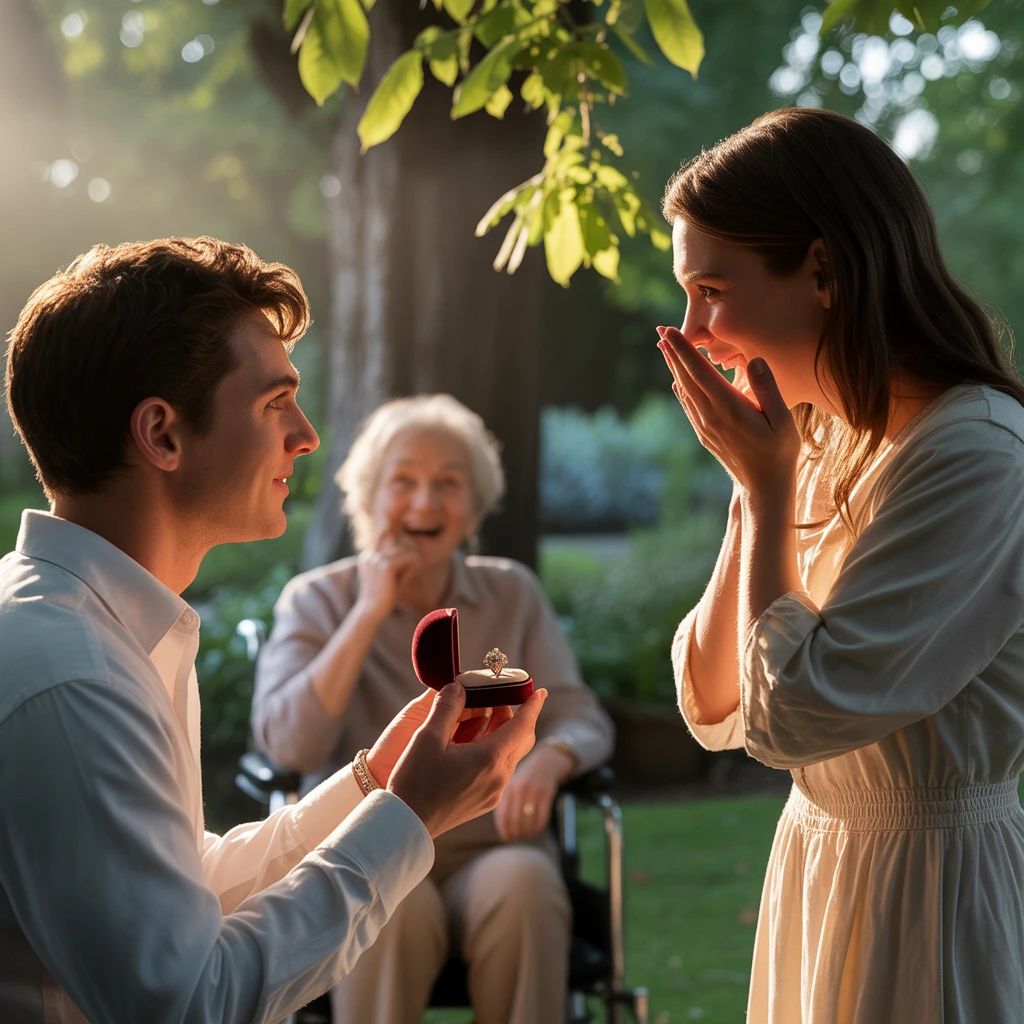
Sebastián dropped to one knee, pulling out the small blue velvet box. Valentina brought her hands to her mouth, unable to believe what was happening.
“Valentina Morales, I can’t promise you a life without difficulties. I can’t promise I’ll always have all the answers. But I can promise that I will love you with this same intensity until the last day of my life.” He opened the box, revealing Elena’s ring. “Will you marry me?”
The silence that followed lasted only a few seconds but felt like an eternity. Valentina looked at the ring, then at Sebastián, then at Elena, who was weeping silently with joy.
“It’s Elena’s ring,” she whispered finally.
“She wanted it this way. She says she wants it to continue its love story.”
Valentina rose from her chair and knelt in front of Sebastián, taking his face in her hands. “Sebastián, I can’t promise you a perfect life either. I’m still learning to live in your world. I still have days when I feel insecure, days when I think I’m not enough for you.”
“You are more than enough,” he murmured.
“But what I can promise you,” Valentina continued, “is that I will love you with everything I am. That I will work every day to be the woman you deserve. That I will build my dreams alongside yours.”
“Is that a yes?”
Valentina smiled through her tears. “It’s a resounding, complete, no-doubts-whatsoever yes.”
Sebastián slid the ring onto her finger. It fit perfectly, as if it had been made for her. Valentina watched it gleam in the Bogotá sunset and felt that her entire previous life had been merely a prologue to this moment.
Elena applauded from her chair, crying with happiness. “Carmen! Carmen, bring the champagne I’ve been saving!”
Carmen appeared, running from the kitchen with a bottle of champagne, as if she had been waiting for this signal all afternoon. “Was this all planned?” Valentina asked, laughing through her tears.
“Completely,” Elena admitted shamelessly. “Down to the last detail.”
That night, after the toasts, after calling their few close friends to share the news, and after planning the first details of the wedding, Valentina and Sebastián were left alone in the garden under the stars.
“What kind of wedding do you want?” Sebastián asked.
“Intimate,” Valentina answered without hesitation. “Just with the people who truly love us. In this garden, if Elena agrees. And afterward… afterward, we build the life we’ve always dreamed of. Together.”
Sebastián held her close, feeling that he had finally found his place in the world. It wasn’t in the family business, not in elite social circles. It was here, in this house filled with love, with this extraordinary woman in his arms, and a wise old woman who had given them her blessing.
“I love you, future Mrs. Herrera,” he murmured against her hair.
“And I love you, my future husband.”
That night, as Bogotá slept under its blanket of lights, three hearts celebrated the triumph of true love over conventions, money, and all the barriers the world had tried to place between them. Elena’s ring shone on Valentina’s finger like a promise that happy endings do exist for those who have the courage to fight for them.
The wedding preparations began immediately after the engagement, but they were not the typical arrangements for a traditional Bogotá wedding. Valentina had been clear from the start: she wanted an intimate, meaningful ceremony filled with genuine love, not social ostentation. Elena had become the head organizer, and her enthusiasm for every detail brought an energy back to the house that hadn’t been felt since the days when Ricardo was still alive.
“My dear,” Elena would tell Valentina each morning as they reviewed their to-do lists, “a wedding isn’t about impressing others. It’s about celebrating the love you’ve built together.”
Carmen had transformed into Elena’s right hand for all culinary aspects of the celebration. They decided to personally prepare all the food—a mix of traditional Colombian dishes that represented not only their tastes but also their roots and the beautiful simplicity that characterized their relationship.
Sebastián, meanwhile, handled the more technical aspects: permits, garden decoration, music, and the complex task of keeping everything within a reasonable budget. His construction company had started generating good income, but he was still far from the resources he would have had if he’d stayed with the family business.
“Do you regret not making peace with your parents for the wedding?” Valentina asked him one afternoon as he was stringing lights in the garden trees.
Sebastián stopped his work and looked at her directly. “Valentina, the most important day of my life will be filled with people who genuinely want to see us happy. That’s worth more than any forced reconciliation.”
They had sent invitations to just twenty people: Carmen and her husband, Jorge; Dr. Martínez, who cared for Elena; some of Sebastián’s new clients who had become friends; the professors from the technical institute where Valentina had studied accounting; and the few relatives of Elena who still lived in Bogotá. The most emotional decision had been to invite Father González, the priest from the neighborhood parish where Elena and Ricardo had lived their entire married life. He was an elderly man in his seventies who had known Elena since she was a young wife and had officiated Ricardo’s funeral three years prior.
“Father,” Elena had said when they went to ask him to officiate, “these young people have given me back my joy for living. I want you, who knew the love Ricardo and I shared, to be the one who blesses them so they may have the same happiness.” Father González had accepted immediately, moved by their story and by the way Sebastián and Valentina cared for Elena.
Two weeks before the wedding, Elena had an idea that deeply touched Valentina. “My dear, what would you think of wearing my wedding dress?”
They had gone up to the attic, a space filled with memories and carefully labeled boxes. Among photographs and family documents, Elena found the one she was looking for. The dress she pulled out was a work of art from the 1960s: ivory satin with delicate lace, long sleeves, a high collar, and an elegant drape that spoke of a time when clothes were made to last a lifetime. Despite being over fifty years old, it was perfectly preserved.
“Elena, it’s beautiful, but I couldn’t…” Valentina began.
“Of course you can,” Elena interrupted. “Look, it even seems to be your size.”
And indeed, when Valentina tried it on, the dress seemed to have been made for her. The waist fit perfectly, the length was ideal, and the classic style highlighted her natural beauty in a way no modern dress could have. Carmen, who had come up to help, wiped tears with her apron. “Miss Valentina, you look like a fairytale princess.”
Elena watched from her wheelchair, a radiant smile on her face. “Ricardo always said this dress had magic, that any woman who wore it with true love in her heart would look beautiful.”
The final days before the wedding passed in a whirlwind of activity. Sebastián had hired a small group of traditional Colombian musicians to play vallenatos and bambucos during the reception. Elena had coordinated with Carmen to prepare three different cakes: a traditional Colombian wedding cake with dulce de leche, a tres leches cake (Valentina’s favorite), and a small chocolate cake that had been Ricardo’s favorite, which Elena wanted to include as a tribute.
The wedding day dawned perfect. Bogotá awoke to one of those clear skies that only appear on the most special days, when the mountains seem closer and the air has a crystalline clarity. Valentina woke early, despite her nerves. Carmen was already in the kitchen, and Elena was up too, brimming with an energy she hadn’t shown in years.
“Good morning, bride,” Elena said as Valentina entered the kitchen. “How does the future Mrs. Herrera feel?”
“Nervous, excited, scared, happy—all at the same time,” Valentina replied.
“That’s exactly how I felt on my wedding day,” Elena said with a nostalgic smile. “Ricardo was so nervous he messed up his vows three times.”
At two in the afternoon, the guests began to arrive. The garden had been transformed. Lights intertwined in the branches of the walnut tree, and chairs were arranged in a semicircle. Sebastián, dressed in a dark blue suit that had belonged to Ricardo, waited by Father González under the tree, his smile radiant.
The musicians began a soft version of La Gota Fría as Valentina appeared at the back door. A hush fell over the guests. Elena, elegant in a lavender dress, accompanied Valentina, pushing her own wheelchair with one hand and holding Valentina’s arm with the other. It was a moving sight: three generations of strong women walking toward a hopeful future.
When they reached the walnut tree, Elena took both their hands. “A year ago,” she said, her voice clear and emotional, “these two young people came into my life when I needed them most. Today, I give them to each other, knowing their love will be as strong and enduring as the love Ricardo and I shared for fifty years.”
Father González began the ceremony with simple, profound words about the commitment of the heart. When it was time for the vows, Sebastián spoke first, his voice trembling with emotion.
“Valentina, when I met you, I thought I was saving you. Now I understand that you were the one who saved me. You saved me from an empty life, a future without purpose, a heart that had forgotten how to truly love.” He paused, his eyes shining with tears. “I promise to love you not only on the easy days, but especially on the hard days. I promise to build with you not just a house, but a home. I promise to respect you, protect you, and celebrate every day we have together as the gift that it is.”
Valentina, tears streaming down her cheeks, responded with a clear, firm voice. “Sebastián, you taught me that I deserve love. You taught me that my past does not define my future, and that true wealth is in the heart, not the bank.” Her voice grew stronger. “I promise to love you with the same intensity you have loved me. I promise to be your partner in all the dreams we build together. I promise to honor the gift of our love and to always remember that we were blessed by a wise woman who taught us that true love knows no boundaries.”
When Father González pronounced them husband and wife, the kiss they shared was gentle and full of promise. The reception that followed was exactly what they had dreamed of: intimate, joyful, and filled with genuine laughter. The musicians played late into the night. Sebastián and Valentina had their first dance to Amor Eterno, while Elena watched, her smile lighting up her face.
Later that night, the Dr. Martínez remarked to Elena that he had never seen her so happy and vital. “Doctor,” she replied, “when Ricardo died, I thought my love story was over. These children taught me that true love stories never end; they just transform.”
Near midnight, when the last guests had departed, Sebastián and Valentina found themselves alone with Elena in the garden. “Mrs. Elena,” Sebastián said, taking her hands, “we don’t know how to thank you for everything.”
“You have done more for me than you will ever know,” she responded. “You have given me a new family, a new purpose, and the joy of seeing true love blossom.”
Valentina knelt by her chair. “You will always be our family. This house will always be our home.”
“And you will always be my children of the heart,” Elena replied, embracing them both.
That night, for the first time as a married couple, Sebastián and Valentina slept in the room they had prepared on the second floor. Before they slept, they spoke of their dreams for the future: expanding Elena’s foundation, growing Sebastián’s company, and eventually starting a family of their own.
“Do you think Elena will be okay living with us when we have children?” Valentina asked.
“I think Elena will be the happiest grandmother in all of Colombia,” Sebastián replied, holding her closer.
Downstairs, Elena lay awake, smiling in the darkness and whispering a prayer of gratitude to the portrait of her husband on her nightstand. “Thank you, Ricardo,” she murmured. “You sent these angels just when I needed them most.” In that house full of love, three hearts slept in peace, knowing they had found exactly what they had been searching for their whole lives: a true family, built not by blood, but by unconditional love.
Ten months had passed since the magical wedding under the garden’s walnut tree, and the married life of Sebastián and Valentina had flourished. Herrera & Associates had become one of Bogotá’s most respected construction firms for its focus on dignified housing. Valentina had found her perfect balance: she remained Elena’s inseparable companion, had taken over full administration of the newly renamed Elena & Ricardo Vázquez Foundation, and worked as the accountant for Sebastián’s company.
Elena, for her part, had experienced a transformation that astonished even Dr. Martínez. Her vitality had returned, her memory had improved, and her sense of purpose was fully renewed. “It’s incredible what love can do for a person’s health,” the doctor had remarked to Sebastián.
The once-quiet house now buzzed with constant activity. Weekends were small family celebrations. Elena had even begun writing her memoirs, a project Valentina had encouraged. It was during one of these tranquil weekends that Valentina began to feel unwell, an ailment she initially dismissed as fatigue.
“I think you need to rest more, my dear,” Elena had said when Valentina rushed from the breakfast table.
Sebastián had also noticed she seemed paler than usual. “Don’t you think you should see a doctor?” he suggested.
After a week of persistent symptoms, Valentina finally agreed. Sebastián insisted on accompanying her to the appointment, canceling an important meeting. “No business is more important than your health,” he had told her. Elena stayed home, preparing a special lunch to celebrate the “perfectly fine” news she was sure they would receive.
The consultation began routinely. The doctor, a warm woman in her fifties, asked the usual questions. After a physical exam, which felt like an eternity for Sebastián in the waiting room, the doctor invited him in. Valentina was sitting on the exam table with an unreadable expression: a mix of surprise, emotion, fear, and what might have been pure joy.
“Mr. Herrera,” the doctor began with a smile that immediately put Sebastián at ease. “I have wonderful news. Your wife is perfectly healthy. In fact, she’s more than healthy. She’s pregnant.”
The silence that followed was profound. Sebastián looked from the doctor to Valentina and back again, as if the words needed time to travel from his ears to his brain. “Pregnant?” he finally repeated, his voice a mere whisper.
“Approximately eight weeks,” Dr. Ruiz confirmed. “By my calculations, the baby will be born around May of next year. Everything looks perfectly normal and healthy.”
Sebastián sank into the chair beside the exam table, his face a cascade of emotions: shock, then understanding, then a joy so intense that his eyes immediately filled with tears. “A baby,” he murmured, taking Valentina’s hands. “We’re going to have a baby.”
Valentina nodded, her own tears already flowing freely. “We’re going to have a baby.”
The doctor smiled, accustomed to these moments but never immune to their beauty. “I’ll give you some basic recommendations,” she said, her voice softening, “but the most important thing is to continue what you’re already doing: loving and taking care of each other.”
The journey home was a whirlwind of emotions and broken sentences. “How do you think Elena will react?” Valentina asked as they neared the house.
“I think she’ll scream so loud they’ll hear her in downtown Bogotá,” Sebastián laughed.
He was right. When they told Elena the news, her reaction exceeded all expectations. First, she fell completely silent, her eyes wide. Then, a smile spread across her face, illuminating her entire expression. Finally, she shouted with such force and joy that Carmen came running from the kitchen, thinking there was an emergency. “I’m going to be a grandmother!”
The following months passed in a beautiful haze of anticipation and preparation. Elena became the most enthusiastic grandmother-to-be in Colombia, knitting booties and reading baby-care books. Sebastián, for his part, began focusing his company even more on creating safe communities for young families. Valentina blossomed, her confidence stronger than ever as she expanded the foundation’s programs to support single mothers.
The baby arrived on a May morning after twelve hours of labor. Sebastián never left Valentina’s side. Elena paced the hospital hallways, a nervous sentinel in her wheelchair. When they finally heard the baby’s first cry, Sebastián collapsed into a chair, weeping with relief and joy.
Diego Sebastián Herrera Morales weighed 3.2 kilograms, measured 50 centimeters, and from his first moments, had the strongest lungs in the hospital. He had his mother’s dark hair, his father’s expressive eyes, and a gaze that suggested he’d arrived ready to conquer the world.
When Elena met her adopted grandson, the moment was so emotional that nurses paused to watch. With tears streaming down her wrinkled cheeks, she held out her arms. As Valentina placed the baby in them, she whispered, “Hello, my love. I’m your Grandma Elena, and I’ve been waiting for you my whole life.” Diego seemed to recognize the voice he’d heard for months and instantly settled in her arms, as if he knew he was in the safest place in the world.
The house was transformed by the sounds of a baby—cries in the night, giggles during the day. Elena, despite her physical limitations, became the most dedicated of grandmothers, developing an almost magical ability to soothe Diego.
When Diego turned six months old, the family gathered in the garden under the same walnut tree where Sebastián and Valentina had married, celebrating not just the baby’s half-birthday, but also the second anniversary of the day they had met.
“Exactly two years ago,” Sebastián reflected, holding Diego, “I was a man who thought he had everything but really had nothing that mattered.”
Valentina, sitting beside Elena, smiled at the memory. “And I was a woman who thought she had nothing but actually had everything needed to build something beautiful.”
Elena watched them, a look of profound satisfaction on her face. “And I was an old woman who thought her love story was over but discovered that the best love stories never end. They just transform and multiply.”
Diego, as if understanding the gravity of the moment, broke into his first true smile—a genuine, heartfelt grin directed at the three people who surrounded him with so much love.
That evening, as the sun set over Bogotá, four generations of love were represented in the garden: Elena with her wisdom, Sebastián and Valentina with their hope, and Diego with his future. The foundation had helped hundreds of students, the construction company had transformed communities, and in that house in northern Bogotá, a family had proven that true miracles come from the human heart when it decides to love without conditions. The story that had begun with a chance encounter on a rainy street was now complete, with the promise that true love not only transforms lives but creates legacies that endure forever.