A Disguised Millionaire Asked a Humble Waitress for a Meal. The Note She Gave Him Changed Everything.
Rain hammered against the windows of the most expensive penthouse in the city as Marcos Valiente, 42, watched the world from his perch. A sprawling metropolis, a city he had helped shape with his real estate empire, stretched out literally at his feet. But on this particular evening, as he gazed at the shimmering lights of thousands of lives he would never know, a conversation from earlier that day had planted a seed of doubt he could no longer ignore.
“Marcos, people respect your money, not who you are,” his brother Daniel had told him during a heated argument over family values. “If you showed up tomorrow without your fortune, without your name, without anything that identifies you as the great Valiente, nobody would treat you with a shred of dignity.” The accusation had struck him harder than he was willing to admit.
For decades, he had meticulously constructed his empire, accumulating a fortune that could sustain entire cities. But what had he truly built? Was it genuine respect, or was it merely fear cloaked in admiration? Julián Montero, his personal assistant for the better part of a decade, entered the office with a stack of documents for his signature. He was a meticulous man, loyal to the point of devotion, and he knew Marcos better than almost anyone.
“Julián,” Marcos said, turning from the window. “I want us to do something different. Something you’ll probably think is insane.” The assistant had learned that when his boss used that particular tone, he was about to propose something that defied all conventional logic.
“What do you have in mind, Mr. Valiente?”
“I want to disappear. Not literally, of course. I want to experience what it’s like to be treated as an ordinary person, without anyone knowing who I really am.”

Julián blinked several times, processing the request. “Are you talking about some kind of social experiment?”
“Exactly.” Marcos strode toward his desk, an idea beginning to solidify. “Over the next few days, I’m going to visit establishments in different parts of the city. Modest restaurants, neighborhood cafes—places the Marcos Valiente everyone knows would never set foot in. I want to see how I’m treated when I’m just another customer.”
“Sir, with all due respect, that sounds dangerous. Without your usual security, without—”
“That’s precisely why it makes sense,” Marcos interrupted, a smile not quite reaching his eyes. “I’ve spent decades surrounded by people who treat me a certain way because they know who I am. I need to know if my brother is right. I need to know if there’s genuine kindness in the world, or if everything is transactional.”
Julián sighed, recognizing the determined expression he knew all too well. “What do you need me to do?”
“Research small restaurants in working-class neighborhoods. Authentic places where regular people eat. Nothing fancy, nothing pretentious. I want the most ordinary place you can find.”
Days later, Marcos stood before a mirror, barely recognizing the man staring back at him. His designer Italian suit had been replaced with common clothes Julián had purchased from a second-hand store. His luxury watch rested in a safe, supplanted by a simple timepiece that had cost less than he typically spent on a coffee.
“‘The Corner of Flavor,’” Julián said, handing him an address written on a slip of paper. “It’s a family restaurant in the San Rafael neighborhood. Been in operation for thirty years, owned by the same family. The reviews speak of honest food and genuine service.”
“Perfect.” Marcos studied the address. “Don’t follow me too closely. I want to do this completely alone.”
“Mr. Valiente, at least let me stay nearby in case—”
“Julián, if you’re hovering over me like a bodyguard, the entire experiment loses its meaning. I need this. I need to know.”
Evening was descending when Marcos arrived in the San Rafael district. It was a world entirely removed from the one he inhabited. The streets were narrower, the buildings older. People walked with a purpose different from those who populated the financial district where his offices stood. “The Corner of Flavor” was exactly as Julián had described it: a modest establishment with windows that revealed a cozy interior, though one clearly worn by years of use. A hand-painted sign promised “Homemade Food with Love,” and through the glass, he could see several tables occupied by families and workers enjoying their dinners.
Marcos took a deep breath before stepping inside. The aroma that immediately hit him was intoxicating—a blend of spices, freshly cooked food, and something intangible that only restaurants with genuine history possess.
“Good evening. Welcome.” A warm voice greeted him. It belonged to a middle-aged woman with her hair pulled back, her expression speaking of fatigue but also an unshakeable dignity. Her apron was marked with the stains of honest work, and her hands had the look of someone who had labored hard for decades.
“Good evening,” Marcos replied, feeling a strange vulnerability. For the first time in years, no one recognized him. No one knew he could buy this restaurant a hundred times over without blinking.
“You can sit wherever you like.” The woman, whose name tag identified her as Elena, gestured toward the available tables. “I’ll bring you a menu in a moment.”
Marcos chose a table in the corner, discreetly observing the atmosphere. The other tables were filled with people who were clearly regulars. They chatted with familiarity, laughed with ease, and treated the place like an extension of their own homes. Elena returned with a laminated menu that had seen better days. “Something to drink while you decide?”
“Water is fine, thank you.”
As he studied the menu, Marcos couldn’t help but notice the prices. They were ridiculously low compared to the restaurants he frequented. An entire entrée cost less than what he normally left as a tip.
“Do you know what you’d like to order?” Elena had returned with a glass of water, placing it carefully before him.
“What do you recommend?”
For the first time, Elena offered a genuine smile. “The house stew is my husband’s specialty. Well, it was his specialty. Now I prepare it using his recipe. It’s the favorite dish of our regulars.” There was something in the way she mentioned her husband, a soft but persistent ache in her eyes, that sparked a pang of genuine curiosity in Marcos.
“Then the stew, please.”
While he waited for his meal, Marcos watched Elena work. She moved with efficiency between the tables, but there was something more to her service. She asked customers about their families, remembered details from previous conversations, and treated each person as if they truly mattered. At a nearby table, an older man was eating alone. Elena stopped beside him for longer than necessary, making sure he had enough bread, refilling his water glass without being asked, and inquiring about something that was clearly part of an ongoing conversation.
“Don Rodrigo, how is your grandson? Has he recovered from the flu yet?”
The old man’s face lit up. “Much better, Elena. Thank you for asking. Your chicken soup really helped him.”
“I’m so glad. Tell him we miss him around here.”
The interaction was simple, ordinary, yet it touched something deep within Marcos. When was the last time he’d had a genuinely human conversation with someone who wasn’t trying to sell him something or ask for a favor?
His food arrived, and the aroma immediately justified all the reviews Julián had mentioned. The stew was rich, complex, and clearly prepared with genuine care and attention.
“Is everything all right?” Elena asked, and Marcos sensed she actually cared about the answer.
“It’s excellent. Truly excellent.”
“I’m glad. My husband used to say that food prepared with love tastes different. I used to think it was just romantic, but after years of cooking, I think he was right.”
Marcos ate slowly, savoring not just the food but the entire experience. No one was looking at him with special deference, no one was rushing to please him. He was just another customer, and there was a strange freedom in that invisibility.
He was finishing his plate when the restaurant door swung open violently. A businessman entered with an irritated expression, speaking loudly into his cell phone. His suit was expensive. His demeanor was imperiously familiar to Marcos, because it had been his own for years.
“Finally, a place to eat,” the man said loudly, pausing his call. “Does anyone work here or what?”
Elena, who had been taking an order at another table, approached immediately. “Good evening, sir. I’ll be with you in a moment.”
“I don’t have a moment. I have an important meeting and I need to eat fast.”
Marcos watched the interaction with growing discomfort. The man treated Elena with a barely concealed contempt, as if his time were infinitely more valuable than hers.
“Of course, sir. If you could take a seat, I’ll bring you the menu right away.”
“I don’t need a menu. Just give me whatever’s fastest and hot.”
Elena maintained her professional composure, but Marcos could see the tension in her shoulders. “The roasted chicken is ready and—”
“Did you hear me? Whatever’s fastest. And bring the check with the food. I don’t have time to wait around.”
As Elena hurried toward the kitchen, Marcos felt a rising anger. That man was a perfect representation of him—someone who had forgotten that the people serving him were complete human beings with their own lives, their own pains, their own dignity. The man spent the next few minutes making loud calls, completely oblivious to the fact that he was disturbing everyone in the restaurant. When Elena brought his food, he barely looked up.
“Finally. And the coffee? Where’s the coffee?”
“I’ll bring you coffee immediately, sir.”
“It should have been with the food. What kind of service is this?”
Marcos clenched his fists under the table. Every word from the man was a painful mirror of behaviors he himself had exhibited countless times. The casual humiliation, the basic lack of consideration, the assumption that his time was worth more than anyone else’s.
Elena returned with the coffee, and the man tasted it, making an exaggerated grimace. “This is cold. You can’t even make a decent coffee.”
“I’m sorry, sir. I’ll bring you a new one.”
“Forget it. Just give me the check. This place is a disaster.” He left some money on the table without even counting, clearly less than what was owed, and stormed out of the restaurant, leaving a trail of tension and discomfort in his wake. Elena collected the money with hands that trembled slightly. Marcos could see unshed tears in her eyes, dignity warring with humiliation.
Without fully thinking it through, Marcos walked over to the counter where Elena was counting the cash the man had left. “Excuse me,” he said softly.
Elena quickly wiped at her eyes. “Yes, sir. Do you need anything else?”
“I want to apologize.”
She blinked, confused. “Apologize? You didn’t do anything wrong.”
“No, but I have been that man. Many times. I’ve treated people exactly as he just treated you, and I need you to know that I am profoundly sorry.”
The silence that followed Marcos’s words was so thick it felt physical in the small restaurant. Elena stared at him, her expression a mixture of utter confusion and something akin to shock. Her hands still held the insufficient cash the previous customer had left, but they were now completely still.
“Apologize?” Elena repeated, her voice barely a whisper. “Sir, I don’t know you. You’ve been a perfectly polite customer since you walked in.”
Marcos felt a lump form in his throat. It was true that he didn’t know her, that he had never treated her poorly, but he had treated hundreds of Elenas in his life with the same disregard he had just witnessed. The difference was that now, stripped of his public identity, he could truly see the impact of that behavior.
“I know, but I’ve been like that man who just left. For years, I’ve treated people in the service industry as if they were invisible, as if their dignity didn’t matter. And seeing what just happened, seeing how that man treated you… it was like looking in a mirror and hating what I saw.”
Elena studied him for a long moment. There was a raw sincerity in his words that seemed to disarm her natural defenses. Slowly, she set the money on the counter and wiped her hands on her apron.
“Do you know what the saddest part is?” she said finally, her voice taking on a different, deeper quality. “That man has probably already forgotten this interaction. For him, it was just another moment in his busy day. But for me, it’s another reminder that in the eyes of some people, I’m not really human. I’m just a function.”
The words struck Marcos like physical blows. For years, he had operated with exactly that mindset, never even questioning it. “Can I ask you something?” Marcos sat on one of the stools in front of the counter. “Why do you keep doing this? Why do you continue to serve with such dignity when you know some people are going to treat you like that?”
Elena leaned against the counter, and for the first time since Marcos had entered, she seemed to allow herself a moment of genuine vulnerability. “Because I have a daughter,” she replied simply. “Valentina is sixteen years old, and she’s the most brilliant person I know. She’s in her final year of high school with perfect grades. She dreams of studying medicine. She wants to change the world.” Her voice cracked slightly, but she continued with determination. “Every time someone treats me the way that man did, I think of Valentina. I think about her watching me, learning not just from what I tell her, but from how I live. If I let the cruelty of others destroy my dignity, what lesson am I teaching her?”
Marcos felt tears welling in his eyes, something he hadn’t experienced in decades. “Your daughter is lucky to have you as a mother.”
“I don’t know if ‘lucky’ is the right word,” Elena said with a sad smile. “I work double shifts six days a week. I see her less than I should. But what I can give her is the example of not letting your circumstances destroy who you are on the inside.”
At that moment, the kitchen door swung open and an older man in a white apron, stained with culinary evidence, emerged. His face was etched with years of hard work, but his eyes shone with a kindness that seemed unshakeable.
“Elena, is everything all right out here?” he asked, assessing the scene with the wisdom of someone who had seen much in his years.
“Yes, Don Arturo. I was just talking with this gentleman.”
Don Arturo came closer, extending a flour-dusted hand toward Marcos. “Arturo Méndez, owner of this humble establishment.”
Marcos shook his hand, noting the surprising strength in the old man’s grip. “A pleasure. The food was exceptional.”
“Elena told me about the previous customer,” Don Arturo said, his tone growing more serious. “Unfortunately, it’s not an isolated incident. But this restaurant has survived for thirty years because we refuse to let the indecency of a few define how we operate.”
“Thirty years,” Marcos repeated. “That’s incredible in this industry.”
“It’s been a journey,” Don Arturo said, leaning against the counter beside Elena. “I opened this place when my wife was still alive. She used to say that a restaurant isn’t just about food; it’s about creating a space where people feel human, valued. After she passed, I thought about closing, but then Elena came looking for work.”
Elena smiled fondly at the old man. “I had just lost my husband. I needed a job desperately, and Don Arturo gave me a chance when no one else would.”
“Why wouldn’t anyone else?” Marcos asked, genuinely curious.
“Because I hadn’t worked for months after my husband’s funeral,” Elena explained. “Because I was pregnant with Valentina. Because I admitted honestly that I had no formal restaurant experience. Most places closed the door in my face.”
“But I saw something in her that the others didn’t,” Don Arturo interjected with paternal pride. “I saw a woman who needed a chance, yes, but also a woman with an unbreakable spirit. And over these years, she has proven to be the heart of this place.”
Marcos felt a growing admiration for them both. “And your husband? What did he do?”
The question made Elena look down, clearly grappling with emotions that time hadn’t fully healed. “Joaquín was a schoolteacher. He taught literature at a public high school. He loved what he did with a passion I’ve never seen in anyone else.”
“What happened, if it’s not too indiscreet to ask?”
“A traffic accident,” Elena answered, her voice barely audible. “A distracted driver. Joaquín was on his way back from a parent-teacher meeting when… when it happened. He died instantly.”
“I’m so sorry.”
“I miss him every day,” Elena continued, wiping away tears that had begun to fall. “But I especially miss him for Valentina. She barely remembers him; she was two years old when he died. Sometimes I see her make an expression or say something, and I can see Joaquín in her. It’s as if a part of him continues to live.”
Don Arturo placed a comforting hand on Elena’s shoulder. “Joaquín would be incredibly proud of the woman Valentina is becoming, and proud of you for raising her with such strength.”
Just then, the front door opened again. A young woman entered, clearly exhausted but with an intense energy that was impossible to ignore. She carried a heavy backpack that seemed full of books, and her eyes immediately searched for Elena.
“Mom, I finished early at the library and—” She stopped upon noticing Marcos. “Oh, sorry, I didn’t know you were with a customer.”
“Valentina, sweetheart,” Elena’s face lit up immediately. “Did you finish your science project?”
Marcos observed the interaction with fascination. The transformation in Elena was complete. The weariness vanished from her eyes, replaced by a maternal love so pure it was almost palpable.
“I finished it and double-checked everything,” Valentina replied with evident pride. “Mrs. Ramirez says my research on stem cells could win the state competition.”
“Of course it could,” Don Arturo chimed in with a smile. “You’re the brightest student I’ve ever known.”
Valentina blushed at the praise, but Marcos could see the sharp intelligence in her eyes. There was something special about this young woman, a determination that reminded him of his own daughter at that age.
“Stem cells,” Marcos asked, genuinely interested. “That’s rather advanced research for the high school level.”
Valentina turned to him, assessing him with surprising maturity. “I’m interested in regenerative medicine. If I can get into the National University, I want to specialize in medical research that can help people with degenerative diseases.”
“Valentina lost her grandmother to Alzheimer’s,” Elena explained softly. “It’s what inspired her interest in the field.”
The connection between personal pain and professional purpose resonated deeply with Marcos. His own business trajectory had been fueled by the poverty he had experienced in his youth, though he had long forgotten that origin during his ascent.
“The National University is excellent,” Marcos commented. “Have you applied yet?”
The question caused a shift in the atmosphere. Valentina lowered her gaze, and Elena became visibly tense.
“Valentina has the grades,” Don Arturo said gently. “But the tuition… the tuition is impossible.”
“Valentina interrupted, her voice laden with contained frustration. “Even with a full scholarship, which I might get, the costs for lab fees, books, and materials are too high. I’ve been calculating and saving, but—”
“Sweetheart, we’ve talked about this,” Elena said firmly. “We’ll find a way. We always do.”
But Marcos could see the barely concealed desperation in Elena’s eyes. He could see the mental calculations, the brutal arithmetic of a mother trying to find money that simply didn’t exist.
“Have you considered working while you study?” Marcos asked, though he immediately regretted the question upon seeing the expression on Valentina’s face.
“I work weekends here at the restaurant,” the young woman replied, “and I tutor younger students. But even working every hour I can without affecting my studies, it’s not enough.”
The reality of their situation was a brutal blow to Marcos. Here was a brilliant young woman, clearly capable of making significant contributions to the medical world, limited solely by economic circumstances completely beyond her control.
“The system is broken,” Valentina continued, a passion in her voice reminiscent of young activists Marcos had seen on the news. “Students like me, who have the talent and determination, are blocked by economic barriers, while—” She stopped, clearly censoring herself.
“While what?” Marcos encouraged her gently.
“While students with less ability but more money have automatic access to the best opportunities,” Valentina finished, looking him directly in the eye. “It’s not fair, it’s not right, and it’s a massive waste of human potential.”
Elena placed a hand on her daughter’s shoulder. “Valentina, that’s not appropriate.”
“No, Mom, it’s the truth, and we all know it.”
Marcos realized he was staring into a painful mirror of the inequalities he himself had perpetuated for years. His own fortune had allowed him to give his children every imaginable opportunity. But how many talents like Valentina were lost each year simply because they were born into the wrong circumstances?
“You’re right,” he said finally. “You are completely right. And I admire your courage for saying it.”
The surprise on Valentina’s face was evident. She clearly hadn’t expected a random customer to validate her frustrations.
Don Arturo intervened, changing the subject. “Valentina, have you had dinner yet? I have some hot soup in the kitchen.”
“In a moment, Don Arturo. First, I want to help Mom close up.”
As Valentina headed toward the kitchen to drop off her backpack, Elena turned to Marcos with an expression that mixed apology and pride. “Please excuse my daughter’s passion. She’s young and sees the world in very clear terms of fair and unfair.”
“Don’t apologize,” Marcos replied firmly. “She sees the world more clearly than most adults I know. Her passion is admirable, not something to apologize for.”
Elena studied him with renewed curiosity. “You’re not like most of our regular customers, are you?”
The question sent a pang of anxiety through Marcos. His social experiment was revealing truths he hadn’t anticipated, but it was also creating connections that felt important in ways he couldn’t fully articulate.
“Let’s just say I’m on a journey of discovery,” he answered carefully.
“Discovery of what?”
“Of whether genuine kindness exists in the world. Of whether people can see value in others regardless of their external circumstances.”
Elena smiled, but there was a sadness in it. “And what have you discovered so far?”
Marcos looked around the restaurant, thinking of Don Arturo and his thirty-year philosophy, of Elena and her unshakeable dignity despite years of hardship, of Valentina and her incandescent passion for justice and purpose. “I’ve discovered that genuine kindness does exist. But it’s often hidden in the places people don’t bother to look.”
Marcos had stayed at the restaurant far longer than he had originally planned. The other tables had gradually emptied as the night wore on. Now, only he remained, along with Elena cleaning the last tables, Don Arturo closing up the kitchen, and Valentina doing homework at a corner table.
There was something hypnotic about watching the restaurant’s closing routine. Elena moved with practiced efficiency, but Marcos noticed small details that revealed her accumulated fatigue: the way she would pause momentarily to stretch her back, how her hands trembled slightly as she stacked heavy plates, the way her eyes would close for a fraction of a second longer than normal.
“Are you sure you don’t want to order anything else?” Elena approached his table, her voice maintaining its professionalism despite her visible exhaustion. “Don Arturo saved some dessert, just in case.”
“I’m fine, thank you,” Marcos replied, but something in his expression made Elena pause.
“Are you waiting for someone? The restaurant closes in twenty minutes.”
“No, I was just…” Marcos searched for words that wouldn’t sound strange. “Just enjoying the atmosphere. It’s comforting in a way I haven’t experienced in a long time.”
Elena smiled with understanding. “My husband used to say that the best restaurants aren’t the most expensive ones, but the ones where you feel at home, even when you’re far from it.”
As they spoke, Valentina approached, carrying her backpack, clearly preparing to leave. But something made her stop by Marcos’s table, looking at him with an intensity that was slightly unnerving.
“Excuse my asking,” she began with the frankness typical of adolescents, “but why are you still here? You’re not like the normal customers we get.”
“Valentina,” Elena gently chided her. “Don’t be rude.”
“I’m not being rude, Mom. I’m just being observant. This gentleman has been here for hours. He’s barely looked at his phone, and the way he talks… I don’t know, it’s different.”
Marcos couldn’t help but smile at the young woman’s sharp perception. “You have a good eye for detail. That will be useful in medicine.”
“See, Mom? He notices it too,” Valentina said, turning back to Marcos. “So, why are you really here?”
Elena looked mortified, but Marcos held up a reassuring hand. “It’s a fair question. The truth is, I’m in the middle of a sort of awakening. I’ve spent years living a certain way, and I recently realized it might not have been the right way.”
“An awakening? How so?” Valentina sat in the chair opposite him without an invitation, clearly intrigued.
“Valentina, give the gentleman some space.”
“It’s all right,” Marcos assured Elena. “It’s refreshing to speak with someone so direct.” He addressed Valentina. “For years, I judged people by their external appearance, by their jobs, by how much money they had. And I recently realized I was missing out on knowing extraordinary people simply because they didn’t fit into my preconceived categories.”
Valentina studied him with eyes that seemed too old for her age. “And now what are you going to do with that knowledge?”
The question was simple yet profound. Marcos realized he didn’t have a prepared answer. “I’m still figuring that out.”
“Well, I hope you figure it out quickly,” Valentina said with surprising gravity. “Because the world is full of people like my mom who work tirelessly and are still treated as invisible. And frankly, that’s unacceptable.”
“You’re right. It’s completely unacceptable.”
Don Arturo emerged from the kitchen at that moment, taking off his apron. “Valentina, your mother needs to close. Are you ready to go?”
“Yes, Don Arturo.” Valentina stood up but paused one last time. “It was interesting talking to you, sir… Marcos.”
“Just Marcos.”
“Marcos. I hope your awakening leads you to do something useful with what you’ve learned.”
As Valentina went to where Elena was counting the cash register, Don Arturo approached Marcos. “My wife used to say that young people have a moral clarity that adults lose over time,” the old man said. “Valentina reminds me of her in that way.”
“She’s an extraordinary young woman.”
“She is. And her mother is even more extraordinary for having raised her alone in circumstances that would break most people.” Marcos watched Elena and Valentina speaking in low tones by the register. There was a tenderness between them that was palpable even from a distance. “Don Arturo, may I ask you something personal?”
“Of course.”
“How is it possible that Elena maintains that dignity, that kindness, after everything she’s been through? Most people would become bitter.”
Don Arturo smiled sadly. “That’s the question I’ve asked myself for years. I think the answer is Valentina. Elena has something to fight for that is bigger than her own pain, and that makes all the difference.”
At that moment, Elena approached with Marcos’s bill in a small envelope. But as he reached out to take it, he noticed there was something else inside—something besides the check.
“Thank you for your patience tonight,” Elena said, her voice sounding strangely formal.
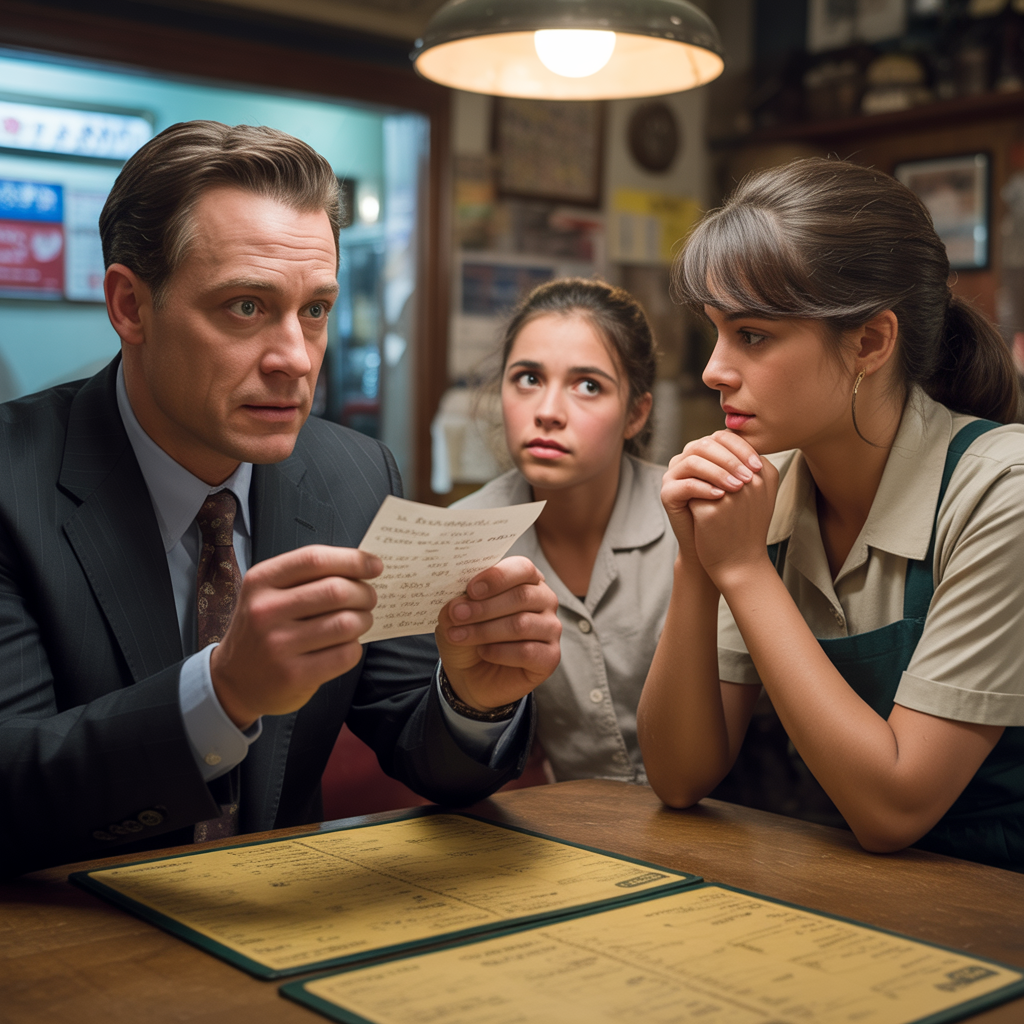
Marcos opened the envelope and found the bill alongside a folded, handwritten note on cheap paper. Curiosity overcame him, and he unfolded it. What he read made the world stop. The note was written in the clear but trembling hand of someone writing something deeply personal.
Dear Sir,
I would normally never do this, but something about you tonight made me feel that perhaps you would understand. My daughter, Valentina, is the most brilliant person I know. She has the potential to change the world, to save lives, to make a real difference. But she won’t get that chance because I cannot afford her education.
I have been saving for years, but it’s never enough. I work double shifts six days a week. I’ve sold everything of value I owned. I’ve taken out loans I know I’ll never be able to fully repay, and it is still not enough. Next month is the deadline for the university deposit. I need $15,000 that I simply do not have and will never have.
I am writing this because after hearing you speak tonight about your ‘awakening,’ I thought that maybe, just maybe, if genuine kindness exists in the world, you might know someone who could help. I expect nothing. I am not asking for charity. I just needed someone to know that there is an extraordinary young woman who deserves a chance she will never receive, for reasons that have nothing to do with her merit.
If you know someone who can help, or if you can share Valentina’s story with anyone, I would be eternally grateful. If not, please forgive my presumption.
Respectfully,
Elena Córdoba
Marcos’s hands trembled as he read and reread the note. Every word was a direct blow to his soul. The barely contained desperation, the dignity maintained even in the plea, the maternal love that permeated every line. He looked up and met Elena’s eyes from across the room. Her face was a mixture of shame, hope, and fear. Valentina stood beside her, clearly unaware of the note.
Tears formed in Marcos’s eyes as a devastating realization hit him. He spent more than $15,000 on trivial things every single month without a second thought. Watches he wore once, dinners at restaurants where the wine cost more than that amount, whimsical tips he left to impress others. And here was a woman working herself to the point of exhaustion, selling her possessions, destroying her health, all for a sum that was less than insignificant to him. The injustice of it all was so overwhelming it was physically painful.
He stood up slowly, walking toward where Elena waited. When he stood before her, he could see tears in her eyes as well.
“I… I shouldn’t have given you that,” Elena whispered. “It was inappropriate. Please, forget you read it.”
“Elena,” Marcos said, his voice breaking. “This note… it has changed everything.”
“I don’t want charity. I just thought maybe you knew someone.”
“I do,” Marcos interrupted gently. “I know someone who can help.”
The hope that illuminated Elena’s face was so pure, so vulnerable, that Marcos felt as if his heart were simultaneously breaking and healing. “Seriously? Truly?”
Marcos reached for his wallet, but Don Arturo stopped him with a hand on his arm. “Young man, if you’re about to do what I think you are, think carefully. Charity given on impulse can do more harm than good.”
“It’s not charity,” Marcos replied, looking directly at Elena. “It’s an investment. An investment in someone who is clearly going to change the world.” He pulled out a business card he kept in his wallet, one with his personal information that he rarely shared. On the back, he quickly wrote an address and a name. “Elena, I want you to go to this address tomorrow. Ask for this man. He will make sure Valentina has everything she needs for the university.”
Elena took the card with trembling hands, reading the printed name. Her eyes widened in absolute recognition. “This says… this says Marcos Valiente. The Marcos Valiente. Is this some kind of joke?”
The world stood still. Valentina quickly stepped closer, peering at the card over her mother’s shoulder. “Wait, you’re the millionaire Marcos Valiente? The owner of Valiente Enterprises?”
The silence that followed the revelation was so absolute that Marcos could hear his own heart pounding violently in his ears. Elena held the business card as if it were a radioactive object, her eyes darting between the printed name and the man standing before her.
“You… you’re Marcos Valiente,” Elena repeated, her voice a mere whisper laden with shock and something that felt like betrayal. “The man who owns half the buildings in this city? The billionaire who appears in business magazines?”
Valentina took a step back, her expression transforming from curiosity to something far more complex—a mixture of astonishment, confusion, and growing outrage. “You were here all this time… in disguise,” Valentina said, accusation thick in her voice. “Is this some kind of game for you? Coming to places like this to watch how ‘normal people’ live?”
“It’s not what you think,” Marcos began, but Don Arturo cut him off with a bitter laugh.
“Then what is it, exactly?” the old man asked, and for the first time since Marcos had entered the restaurant, there was a hardness in his voice. “Poverty tourism? A social experiment for the amusement of the rich?”
The words struck Marcos because they contained a truth he couldn’t completely deny. He had come here seeking validation for a theory, trying to prove a point to his brother, using the real lives of people as evidence in a philosophical debate.
“I wanted to understand,” Marcos said, knowing even as he spoke how inadequate it sounded. “I wanted to see if genuine kindness existed when I wasn’t protected by my name and my money.”
“And what did you find?” Elena asked, her voice charged with contained emotion. “That the poor are quaint? That our struggles are inspiring from a safe distance?”
“No, that’s not it at all.”
“Then explain it to us,” Valentina said, crossing her arms. Marcos could see tears forming in her eyes. “Explain why a man who could buy this restaurant with his pocket change came here pretending to be someone he’s not.”
Marcos realized he was at a critical juncture. He could defend himself, rationalize his actions, retreat behind the justifications he had mentally prepared. Or he could do something he had never truly done in his life: be completely, vulnerably honest about his own failings.
“You’re right to be furious,” he said finally, his voice cracking. “What I did was selfish. I came here looking for answers to my own questions, without considering that I was treating your lives like an experiment. That was wrong, and I am profoundly sorry.”
Elena looked down at the note she had written, the handwritten desperation that had exposed her most vulnerable soul, and she felt humiliation burn in her cheeks. “That note,” she whispered. “I wrote you that note thinking you were… thinking you were someone who might understand because you were struggling, too. And it turns out you’re someone for whom fifteen thousand dollars is probably what you spend on shoes.”
The accuracy of that statement was devastating. Marcos recalled the last pair of shoes he’d bought. Custom-made Italian designer. They had cost exactly $18,000.
“You’re right,” he admitted. “And that’s precisely why I came here. Because I realized I had completely lost perspective on how most people actually live.”
“And we’re your lesson in humility?” Valentina asked with sharp sarcasm. “Your moment of clarity, bought with our dignity?”
Don Arturo placed a hand on Valentina’s shoulder. “Calm down, child. Let him speak.”
“Why?” Valentina spun toward the old man. “Don Arturo, this man was lying from the moment he walked in here. It was all fake.”
“Not all of it,” Marcos interjected urgently. “My shock at seeing how that customer treated Elena was genuine. My admiration for your passion and brilliance was real. My emotion when I read your mother’s note was completely sincere.”
“But you were acting,” Elena said, pain lacing her voice. “The whole time, you were playing a role.”
“I was taking a role off,” Marcos corrected. “For decades, I’ve played the part of ‘Marcos Valiente, the tycoon.’ Tonight, I tried to be just Marcos, to see who that person was without all the rest.”
“And who is he?” Don Arturo asked, studying him intently.
Marcos paused, confronting the question with brutal honesty. “Someone who has been so insulated by wealth and power that he forgot what it meant to be human. Someone who treated people like Elena with casual contempt for years, without even realizing it. Someone who desperately needed to remember that there’s more to life than accumulating money.”
Elena was crying openly now, the emotional tension of the evening finally overwhelming her carefully constructed defenses. “Do you know what the cruelest part of all this is?” she asked between sobs. “That for a few hours, I thought I’d found someone who actually understood. Someone who saw beyond my uniform and my situation. And it turns out you were just a tourist.”
The words were like daggers, and Marcos felt them deeply because they contained a truth he could not refute. “Elena, I completely understand why you feel betrayed, and I have no right to ask you to forgive me.”
“So what do you want?” Valentina demanded. “Do you want us to thank you for deigning to spend time in our humble establishment? Do you want us to validate your millionaire’s existential crisis?”
“I want to help,” Marcos said simply. “I want Valentina to go to the university. I want to make sure Elena doesn’t have to work double shifts until her health is destroyed. I want to make up for years of being exactly the kind of person you have every right to hate.”
“We don’t want your charity,” Valentina shot back fiercely. “We are not your redemption project.”
Don Arturo held up a hand, silencing everyone. “Wait. We all need to calm down and think clearly.” He addressed Marcos directly. “Young Valiente, you’ve done a problematic thing by coming here under false pretenses. But you’ve also shown something important tonight. The capacity to listen, to learn, to genuinely feel the pain of others. That’s not common in men of your position.”
“Don Arturo,” Elena began, but the old man continued.
“Let me finish, Elena. I know you feel exposed and betrayed. Valentina, I know your sense of justice is outraged. And you both have valid reasons. But we also need to be practical.” He turned back to Marcos. “Is your offer to help with Valentina’s education genuine?”
“Completely genuine. No strings attached, no expectations of gratitude or publicity. No conditions whatsoever.”
Don Arturo looked between Elena and Valentina. “Then I suggest we all sleep on this. Emotions are too high right now to make clear decisions.”
“I don’t need to sleep on it,” Valentina said stubbornly. “I don’t want anything from someone who saw us as an experiment.”
“Valentina.” Elena put a hand on her daughter’s arm. “Don Arturo is right. We need to think clearly.”
“Mom, how can you even consider—?”
“Because I have to think about your future,” Elena interrupted, her voice firm despite her tears. “Because, as much as it pains me to admit it, I have no other way to pay for your university. And because refusing help out of pride when your future is at stake would be selfish of me.”
The acknowledgment of that brutal reality hung in the air like a sentence. Valentina looked at her mother, clearly torn between her justified outrage and a love for Elena that made her want to protect her from more suffering. “This isn’t fair,” Valentina whispered finally. “None of this is fair.”
“No, it’s not,” Marcos agreed. “And that’s exactly why it needs to change. Not just for you, but for the thousands of brilliant students who are blocked by economic barriers that are completely artificial.”
“Nice words,” Valentina replied, but there was less venom in her voice. “But words don’t change systems.”
“You’re right. Actions change systems. And I am committed to taking those actions.”
Elena wiped her eyes, recomposing her dignity with visible effort. “Mr. Valiente, I need you to understand something. If I accept your help, it is not because I forgive the deception. It is because I love my daughter more than I value my pride.”
“I understand completely.”
“And I need you to understand that this does not make us equals. You are still someone with the power to destroy our lives on a whim. That fundamental inequality doesn’t disappear because you have a moment of conscience.”
Elena’s brutal honesty was simultaneously refreshing and painful. “You are absolutely right. And I promise to be conscious of that power imbalance in every interaction we have.”
Don Arturo sighed deeply. “It’s late, and we are all emotionally exhausted. I suggest Marcos leaves now, and tomorrow, when heads are cooler, we can discuss practical details.”
Marcos nodded, understanding that his presence was causing more tension. He took out his wallet and placed several bills on the table, far more than the cost of the meal.
“Please, no,” Elena said, pushing the money back. “Not after all this.”
“It’s just payment for the meal. Nothing more.”
“The meal cost twelve dollars. This is five hundred.”
“Then consider it payment for the most important lesson I’ve received in years.”
The night after he left the restaurant was the longest Marcos had experienced in decades. He sat in his luxury penthouse, surrounded by objects that cost fortunes but suddenly seemed completely devoid of meaning. Every polished surface, every carefully curated piece of art, every symbol of his success reminded him of the abysmal gap between his world and Elena’s.
Julián arrived early that morning to find his boss still awake, staring out the window at a city that never slept. “Mr. Valiente, you’ve been up all night.”
“I couldn’t sleep,” Marcos replied without turning. “Every time I closed my eyes, I saw the look on Elena’s face when she realized who I was.”
Julián came closer, assessing the situation with the concern of one who knew his employer well. “What happened, exactly?”
Marcos told him the entire story. The desperate note, the revelation of his identity, the confrontation with Valentina, the pain in Elena’s eyes. With each detail, he felt the weight of his actions pressing more heavily on his shoulders. “So now I have to decide,” he concluded, “how to help without causing more harm. How to make up for the deception without it looking like I’m buying forgiveness.”
“Sir, if I may make an observation,” Julián said carefully. “Perhaps the problem isn’t how to help, but understanding that some things can’t be fixed with money.” The truth in that statement resonated deeply. His entire adult life, Marcos had solved problems by writing checks, but a breach of trust couldn’t be bought back.
“What do you suggest, then?”
“I suggest you do what you promised, without expectation. Pay for Valentina’s university. But don’t expect gratitude or redemption for doing so.”
Days later, Marcos found himself standing in front of “The Corner of Flavor” again. This time there was no disguise, no pretense. His designer suit was perfectly pressed, his luxury watch gleamed in the afternoon sun, and his chauffeured car waited down the street. He was completely himself, and that, somehow, was more terrifying than any costume.
Don Arturo was wiping down tables when Marcos entered. The old man looked at him without surprise, as if he’d been expecting this visit. “Mr. Valiente. Elena and Valentina are in the kitchen. Shall I call them?”
“Please.”
While he waited, Marcos noticed details of the restaurant he had overlooked during his first visit. The ceiling showed signs of water leaks, the chairs had been repaired multiple times, the kitchen equipment had clearly seen better days. It wasn’t just Elena and Valentina who needed help; the entire establishment was struggling to survive.
Elena emerged from the kitchen, followed by Valentina. Both had assumed professional expressions, masks of formal courtesy that created an emotional distance.
“Mr. Valiente,” Elena greeted him in a neutral voice. “Don Arturo said you wanted to speak with us.”
“Please, sit.” They settled at a table, and Marcos pulled out a folder he had meticulously prepared with Julián. “I’ve established an educational fund for Valentina,” he began directly, without preamble. “It will cover full tuition, books, lab materials, housing if she decides to live on campus, and a monthly stipend for personal expenses.”
Valentina looked at the folder without touching it, as if it were dangerous. “For how long?” she asked.
“For as long as you need. Bachelor’s, master’s, doctorate, medical specialization. It’s all covered.”
The silence that followed was tense. Elena stared at the folder as if it contained snakes. “And what do you expect in return?” she finally asked.
“Nothing.”
“People like you don’t give something for nothing,” Valentina said, bitterness in her voice.
“You’re right to be skeptical,” Marcos admitted. “But I genuinely expect nothing in return. I don’t want publicity, I don’t want my name mentioned, I don’t want gratitude. I just want you to have the opportunity you deserve.”
Elena took the folder with trembling hands, scanning the documents. Her eyes widened as she saw the figures. “This is… this is more than half a million dollars over the course of her entire education.”
“It’s an investment in someone who is going to change the world,” Marcos replied. “And honestly, it’s less than what I spent renovating my office last year.” The comparison was deliberately provocative, designed to highlight the obscenity of the inequality.
Valentina closed her eyes, clearly struggling with conflicting emotions. “I hate that we need this. I hate that my future depends on the generosity of someone who played games with us.”
“I know. And you have every right to hate that, and to hate me. But I’m going to accept it,” Valentina continued, opening her eyes. “Because my mother has sacrificed too much for too long, and because refusing this out of pride would be spitting on all of those sacrifices.” Elena placed a hand on her daughter’s, tears streaming silently down her cheeks.
“There’s something else.” Marcos pulled out another document. “I’ve spoken with Don Arturo about the restaurant. With his permission, I would like to invest in necessary renovations. New roof, updated kitchen equipment, structural repairs. Not as charity, but as a legitimate business investment.”
Don Arturo, who had been watching from a distance, approached slowly. “Why would you do that?”
“Because this place is special. It’s what a restaurant should be. A space where people are treated with dignity, where food is prepared with love, where community gathers. Places like this deserve to survive.”
“And what do you get out of it?” the old man asked with healthy skepticism.
“Honestly? The satisfaction of preserving something valuable. And maybe, eventually, the forgiveness for having been blind for so long.”
Elena stood abruptly, walking to the window. Her posture revealed the internal battle she was waging. “Do you know what bothers me the most?” she said without turning. “That a part of me wants to forgive you. That a part of me sees the sincerity in your eyes and wants to believe that change is possible. And I hate that part of me, because it feels like a betrayal of my own dignity.”
“Elena,” Marcos approached carefully. “You don’t have to forgive me. In fact, it’s probably healthier if you don’t. Forgiveness has to be earned, not bought.”
“Then what is all this?” Elena gestured toward the documents. “If it’s not buying forgiveness, what is it?”
“It’s an attempt to do the right thing, however late. It’s an acknowledgment that I’ve been on the wrong side of inequality my entire life. It’s the beginning of a change that should have happened decades ago.”
Valentina joined her mother by the window. “You know what would make a real difference? Not just helping us, but changing the system that makes stories like ours common.”
“You’re right. And I’ve been thinking about exactly that.” Marcos produced a third set of documents. “I’m establishing a foundation. It will be called the Valentina Fund, if you’ll allow me to use your name. It will provide full scholarships for brilliant students from working-class families who want to study medicine.”
“Why medicine specifically?”
“Because it’s a field where talent is desperately wasted due to economic barriers. And because you inspired me to see that problem clearly.”
Valentina took the documents, reading them with the meticulous attention she likely applied to all her studies. After several minutes, she looked up, her expression complex. “This would help fifty students per year.”
“That’s the initial plan. Hopefully, it will grow.”
“And who oversees that the money is used correctly?”
“I was hoping you would agree to be part of the selection committee. Not now, obviously, but after you finish your first year of university. Your perspective would be invaluable.”
The offer clearly stunned Valentina. “You want me to help decide who gets scholarships?”
“I want people like you, who truly understand what it means to struggle, to have a voice in how resources are distributed.”
Don Arturo sat down heavily, clearly overwhelmed by it all. “This is a lot to process.”
“I know. And I don’t expect immediate answers to everything.”
Elena finally turned from the window. “I need you to understand something, Mr. Valiente. If we accept all of this, it does not mean we forget the deception. It does not mean we trust you completely.”
“I understand perfectly.”
“But it does mean that we recognize the sincerity in your attempt to make amends, and that we value the opportunities you’re offering more than we value holding on to resentment.”
“That’s more than I deserve.”
Weeks after the conversation that had changed everything, Marcos found himself in entirely new territory—being constantly watched, evaluated in every action, questioned in every decision. He was no longer the all-powerful businessman whose orders were followed without question. He was now someone trying to prove that his change was real, and every step was scrutinized.
The first recipient of the Valentina Fund was sitting across from him in the foundation’s new office. Her name was Camila Torres, eighteen years old, the daughter of a cleaning lady in one of his own buildings. The irony was not lost on anyone.
“Mr. Valiente,” Camila said in a trembling voice, clearly intimidated. “I don’t know what to say. I never thought someone like me could study at the National University.”
“‘Someone like you’?” Marcos repeated the words carefully. “Camila, what exactly does ‘someone like you’ mean?”
The young woman looked down. “Someone poor. Someone whose mother cleans floors. Someone who’s never had anything handed to them.”
Valentina, who had agreed to join the selection committee on her weekends, spoke up from her chair beside Camila. “Camila has the highest math average in her entire school. She’s won three national science competitions, and she works thirty hours a week to help her family while maintaining those grades.”
Marcos felt a familiar pang of shame mixed with admiration. “Camila, you are not being handed anything. This scholarship is a recognition of extraordinary merit. The only reason students like you need scholarships while others don’t is because of a broken system that mistakes economic privilege for ability.”
“Exactly what I’ve always said,” Valentina added, but there was an evaluative look toward Marcos that suggested she was still deciding if he truly believed his own words.
Elena entered at that moment, carrying a tray of coffee. She had agreed to work part-time at the foundation’s office, coordinating communications with the students’ families. Don Arturo had insisted they needed her perspective, and Marcos had readily agreed.
“Camila, your mother is on the phone. She wants to speak with you,” Elena said, handing her cell phone to the young woman.
As Camila stepped out to take the call, Elena sat in the chair the student had vacated. The relationship between her and Marcos remained complex—professional on the surface, but fraught with the weight of all that had happened.
“How is the restaurant?” Marcos asked, an attempt at conversation that wasn’t entirely work-focused.
“The renovations are almost finished. Don Arturo is happier than I’ve seen him in years.”
“I’m glad.”
“But that’s not why I came over,” Elena said, her tone growing more serious. “I need to talk to you about something that’s been bothering me.” Valentina immediately became alert, her protective posture toward her mother activating.
“Of course, tell me.”
“Camila’s mother works as a cleaner in one of your buildings. According to the documents I reviewed, she earns minimum wage with no additional benefits. She’s worked for your company for five years.” The implicit accusation was clear. Marcos felt heat rise in his face.
“You’re right. It’s hypocritical to create a foundation while maintaining labor policies that perpetuate the very problems I’m trying to solve.”
“So what are you going to do about it?” Valentina asked directly.
“Julián is preparing a complete review of all our compensation policies for service staff. But I’d like your opinion, Elena. You understand what these workers need better than anyone.”
Elena studied him for a long moment. “Are you genuinely asking for my advice, or are you trying to make me feel included?”
“Both,” Marcos admitted honestly. “I need your expertise, but I also want you to know that your voice matters in these decisions.”
“Fine, then here’s my honest opinion. Minimum wage is not a living wage. Health benefits should not be a luxury. And dignity at work shouldn’t depend on the occasional generosity of enlightened employers.”
“I agree completely.”
“Then why haven’t you changed it before?” The question was simple but devastating. Marcos had no answer that didn’t make him look like exactly what he had been: someone indifferent to the suffering his pursuit of profit caused.
“Because I wasn’t paying attention. Because it was easier not to see. Because I operated under the assumption that if something was legal, it was acceptable.”
“And now?”
“Now I know that legal and moral are not the same, and that I have a responsibility not only for what I do actively, but for what I allow passively.”
Valentina pulled out her laptop, opening a document. “I’ve been researching compensation practices in companies similar to yours. There’s a model implemented by a company up north that tripled service staff salaries without a significant impact on profitability.”
Marcos leaned in to see the data Valentina had compiled. It was university-level research, meticulously documented and convincingly argued. “This is exceptional work, Valentina.”
“I didn’t do it for your approval,” she replied quickly. “I did it because if we’re going to be involved in this foundation, I need to know it’s not just performance—that you’re really willing to change systems, not just give out handouts that make you feel better.”
Valentina’s brutal honesty was both refreshing and painful. Marcos realized this sixteen-year-old had more moral integrity than he had shown in decades. “You’re right to be skeptical, and you’re right to demand real change. We will implement this model across all our properties.”
At that moment, Julián entered with a worried expression. “Mr. Valiente, I need to speak with you. It’s urgent.” They moved to a private office where Julián carefully closed the door. “The board of directors is unhappy with the changes you’re implementing, especially the proposed salary increase for service staff.”
“How much are they protesting?”
“Three members have threatened to resign. They say you’re putting idealism above fiduciary responsibility.”
Marcos had anticipated this resistance. The changes he was proposing challenged decades of established business practices. “And what do you think, Julián?”
His assistant looked at him with a complex expression. “I think you are doing the right thing for the right reasons. But I also think you need to be prepared for the consequences. Not everyone is having the awakening of conscience that you had.”
“I know. And I’m prepared for those consequences.”
“Even if it means losing control of your own company?” The question made Marcos pause. He hadn’t fully considered that his moral transformation could cost him everything he had built.
“Even then,” he said finally. “Because if keeping my company means perpetuating injustice, then it’s not worth keeping.”
When he returned to the main office, he found Elena and Valentina speaking in low tones with Camila, who had returned from her call with tears in her eyes. “What happened?” Marcos asked with genuine concern.
“My mother was just fired,” Camila said between sobs. “Her supervisor found out I received the scholarship and said I probably knew someone important. He accused her of using inappropriate connections.”
The injustice of the situation struck Marcos like lightning. A woman being punished because her daughter had demonstrated exceptional merit. “Which building does your mother work in?”
“The downtown business tower. Valiente Tower.” Of course it was one of his buildings. Of course.
“That dismissal will be reversed immediately, and that supervisor will be investigated for discrimination.”
“But the damage is already done,” Elena said softly. “Camila’s mother was humiliated in front of her colleagues. Her dignity was publicly attacked.”
Marcos realized that no matter how many policies he changed, no matter how much money he donated, he couldn’t undo years of toxic culture just by decreeing changes from on high.
“Camila, I want you to know this is not your fault, nor your mother’s. It’s a symptom of a system that needs to be completely rebuilt.”
“Nice words,” Valentina said, an edge to her voice, “but words don’t restore her mother’s dignity.”
“You’re right. Actions do.” Marcos picked up his phone, dialing a number he rarely used—the head of human resources for all his properties. “Roberto, I need you to come to my office immediately. And bring the personnel files for the downtown business tower.”
While they waited, Marcos sat beside Camila. “Your mother will not only get her job back, she will receive a formal apology, compensation for the lost day, and a written guarantee of no retaliation.”
“And what about the supervisor who fired her?” Elena asked.
“He will be removed from any position of authority until he completes extensive training on fair labor practices. If he’s found to have a history of similar behavior, he will be dismissed.”
Valentina watched him with an inscrutable expression. “Are you really going to do all that?”
“I’m going to do all that and more. Because every employee in my buildings deserves to work without fear of humiliation or arbitrary injustice.”
When Roberto arrived, Marcos handled the situation with a firmness that surprised even Julián. He wasn’t being the benevolent CEO granting favors; he was being the leader demanding basic standards of human decency. “I want a full audit of all supervisors across all our properties. I want confidential interviews with service staff. And I want Elena Córdoba to oversee that process, because she understands what these workers experience in ways we never can.”
Roberto looked at Elena with evident surprise. “Mrs. Córdoba will be evaluating our HR practices?”
“Exactly. Is there a problem with that?”
“No, sir. No problem.”
After Roberto left with clear instructions, Marcos turned back to Camila. “Your mother will receive a call within the hour offering a full apology and restitution.”
Camila looked at him, her eyes full of tears. “Why are you doing all this?”
“Because your mother doesn’t deserve to be treated like that. Because no worker deserves to be treated like that. And because I’ve spent too many years being part of the problem.”
Elena approached Marcos when the others were busy comforting Camila. “That was impressive.”
“But?”
“But one right action doesn’t erase a lifetime of inaction. You’re changing, Marcos. I can see it. But real change takes more than dramatic moments of justice.”
“I know. And I’m prepared for the long, difficult work ahead.”
Elena studied him, her expression hard to interpret. “You know, part of me still wants to hate you for the original deception. For coming to our restaurant in disguise, for treating our lives like an experiment.”
“You have every right.”
“But another part of me sees genuine sincerity in your actions. Sees someone truly trying to be better.”
“And which part wins?”
“Both,” Elena replied with a sad smile. “Because people are complicated. I can be angry about what you did and appreciate what you’re doing now, simultaneously.”
Weeks after the first transformations, Marcos faced the most critical meeting of his career. The boardroom of Valiente Enterprises was thick with palpable tension. Twelve majority shareholders watched him with expressions that ranged from deep disappointment to barely contained hostility. The changes he had implemented had not only caused controversy; they had shaken the foundations of everything the company stood for.
“Marcos, we need to speak frankly,” began Fernando Ruiz, a shareholder since the company’s inception. “You’ve spent twenty-three million dollars on what some might call social reforms—massive salary increases, costly HR audits, the education fund. The numbers are seriously worrying our investors.”
“The numbers also show a forty-two percent reduction in staff turnover and a seventeen percent increase in productivity,” Marcos countered, keeping his voice steady but feeling the pressure mount. “These are not whimsical expenses. They are investments generating measurable returns.”
“Returns that don’t offset the costs,” another shareholder, Gabriela Soto, intervened. “And more troubling, you’re alienating corporate partners who have worked with us for decades. Three major contracts were canceled last month because our clients feel we’ve become too ‘progressive.’”
Marcos felt the weight of those words. He had anticipated resistance, but not the scale of the economic consequences his decisions were generating. “If those partners canceled contracts because we treat our employees with basic dignity,” Marcos said slowly, “then they weren’t the kind of partners we should be keeping.”
“That sounds beautiful in theory,” Fernando retorted with evident frustration. “But in practice, you’re jeopardizing the jobs of thousands of people. If the company collapses because of idealism, who benefits?”
The question struck Marcos with unexpected force. He had been so focused on righting injustices that he hadn’t fully considered the potential for unintended consequences. Just then, the boardroom door opened. Elena entered with Julián, who carried a voluminous folder. Her presence visibly surprised several shareholders, who clearly didn’t expect someone of her position to interrupt a high-level executive meeting.
“Excuse the intrusion,” Elena said, her voice professional but firm. “But as Director of Human Resources, I have critical information this board needs to hear before making any decisions.”
Gabriela Soto looked at her with barely disguised skepticism. “And what information could a former waitress possibly have that is relevant to corporate financial decisions?”
Elena met her gaze without flinching. “Information about legal risks that could cost this company everything.” She placed documents in front of each shareholder. As they reviewed them, Marcos saw expressions gradually shift from disdain to growing alarm.
“I have completed exhaustive audits across all Valiente properties,” Elena explained methodically. “These documents show systematic violations of labor regulations, documented wage discrimination based on gender and ethnicity, cases of harassment that were deliberately ignored by supervisors, and working conditions that violate safety codes in thirty-eight percent of our facilities.”
Fernando paled as he read. “Why weren’t we informed of this before?”
“Because these practices have been normalized for years,” Elena answered. “No one questioned them because it was ‘how things have always been done.’” She produced another set of documents. “Three labor law firms are preparing class-action lawsuits against Valiente Enterprises. The estimated costs, including legal fees, compensation, and reputational damage, would exceed sixty million dollars.”
The silence in the room was absolute. “However,” Elena continued, “these lawsuits will be completely dropped if the reforms initiated by Marcos are continued and expanded. The lawyers have agreed that genuine, systemic change is preferable to prolonged litigation.”
Marcos stared at Elena in utter astonishment. He had known nothing about potential lawsuits. “How did you get this information?” he asked.
“I’ve been talking to the workers at all our properties. To their families, to labor organizations. It turns out that when you actually listen to people, they share truths they’ve been waiting years to be heard.” Elena addressed the shareholders directly. “You can see Marcos’s reforms as costly idealism. I see them as the only viable strategy to avoid complete legal and financial collapse.”
Gabriela Soto broke the silence. “Are you saying that if we reverse the changes, we’ll face massive lawsuits?”
“I’m saying the workers are organized, informed, and prepared to defend their rights. Marcos’s reforms are not generosity; they are an acknowledgment of a reality that can no longer be ignored.”
Fernando leaned back in his chair, clearly recalculating his entire position. “This changes the context of the discussion completely.”
“Exactly,” Elena agreed. “And there’s something else you need to understand.” She pulled out one last document. “I’ve been in contact with five competing firms. They are all facing similar issues. Workers across the entire industry are waking up to the fact that they have collective power. You can choose to be proactive, like Marcos, or be forced into change by external pressure that will be far more costly.”
The meeting continued for hours, each shareholder grappling with the instincts to protect short-term profits and the recognition of long-term systemic threats. Finally, with reluctant but pragmatic votes, they agreed to continue with the reforms, at least for the time being.
When the room emptied, Marcos and Elena remained alone. “I didn’t know about the lawsuits,” Marcos said softly.
Elena looked at him with a complex expression. “Because some battles are best fought without the leader knowing all the details. You needed to maintain your moral high ground. I handled the pragmatic politics.”
“Do those lawsuits actually exist?”
“The lawyers are ready to proceed if necessary. That’s real enough.”
Marcos felt a mix of admiration and discomfort. “You played that very strategically.”
“I learned by watching how the powerful operate for years,” Elena replied. “The difference is, I’m using those tactics to protect the vulnerable, not to exploit them.”
That night, Marcos visited “The Corner of Flavor,” needing the comfort of the space that had become his emotional anchor. Valentina was there, surrounded by medical textbooks, clearly deep into her first university semester. When she saw him enter, she closed her book and watched him with the characteristic intensity that always made him feel evaluated.
“I heard about the meeting,” she said without preamble. “Mom told me everything.”
“Your mother saved the company today.”
“Mom has always been the smartest person I know. It’s just that now she has a platform to prove it.”
Don Arturo appeared with coffee, sitting with them as he had started to do habitually. The old man had observed the entire transformation with a quiet wisdom, one of a man who had seen much in his seventy years. “Marcos, there’s something I’ve wanted to tell you for a while,” Don Arturo began.
“Tell me.”
“My wife, before she died, made me promise something important. She made me promise that I would never sell this restaurant to a corporate chain, no matter how much money they offered. That I would keep the spirit of what we built together alive.”
“What spirit was that?”
“A place where every person who walked in was treated with dignity. Where food was prepared with love. Where social hierarchies dissolved, even temporarily, into shared community.” Don Arturo pulled out an old, worn envelope. “These are my wife’s original recipes, handwritten over thirty years ago. I’ve never shared them with anyone outside the immediate family.” He pushed the envelope toward Marcos. “I want you to have them.”
Marcos felt tears forming. “Don Arturo, I can’t accept something so personal.”
“It’s not a gift,” the old man corrected gently. “It’s a responsibility. These recipes represent more than culinary instructions. They represent values: love, patience, attention to detail, respect for humble ingredients. I want you to carry those values with you when you face the hard decisions in your corporate world.”
Valentina had been watching the interaction in silence, but now she spoke up. “Marcos, I need to ask you something honestly.”
“Of course.”
“What will you do when the cost of doing the right thing becomes too high? When you risk not just profits, but the entire existence of your company?”
It was the question Marcos had been avoiding confronting head-on. “Honestly… I don’t know. I want to say I’ll stick to my principles no matter what, but reality is more complicated.”
“That honesty is more valuable than any grand promise,” Valentina replied. “Because real change requires navigating complexities, not just declaring absolute moral positions.”
Days later, as Marcos reviewed financial reports in his office, he received an unexpected call. It was the chancellor of the National University, requesting an urgent meeting. The request was unusual for its formality and the insistence that it be in person. When he arrived on campus, Marcos was led to a conference room where not only the chancellor awaited, but a full panel of five deans, three distinguished professors, and two student representatives. The atmosphere was serious but expectant.
“Mr. Valiente, thank you for coming,” the chancellor began, gesturing for him to take a seat. “We’ve been closely monitoring the impact of the Valentina Fund on our students. The results have been extraordinary—frankly, beyond our initial expectations.”
The dean of medicine, a middle-aged woman with a serious expression, continued. “The fifty-three students in the fund are not only maintaining exceptional grade averages; they are transforming the culture of the entire university. Their focus, their work ethic, their commitment to their home communities are setting new standards.”
“I’m glad to hear that,” Marcos replied, his curiosity about the meeting’s true purpose growing.
The chancellor placed a thick document on the table. “Mr. Valiente, we want to propose something we have never done in the one-hundred-and-twenty-year history of this institution. We want to establish a full program dedicated exclusively to students from working-class families, with a curriculum specifically designed to maintain a connection to their communities while they receive a world-class education.”
Marcos felt his heart quicken as he skimmed the document. It was ambitious, revolutionary, and precisely the kind of systemic change Valentina had demanded. “Why are you showing this to me?” he asked carefully.
“Because we want Elena Córdoba and Valentina Córdoba to be part of the permanent steering committee,” the dean of social sciences explained. “Their lived perspective is exactly what we need to ensure this program is authentic rather than performative.”
“I’m not the one who can make that decision. They are.”
“We know,” the chancellor smiled. “Which is why we’re asking you to arrange a meeting with them. We want to present the proposal directly.”
That afternoon, Marcos coordinated a meeting at “The Corner of Flavor,” the neutral space that had become the symbolic center of the entire transformation. Elena, Valentina, and Don Arturo were there when the university representatives arrived. The proposal was presented in its entirety: a program that would provide not just academic education but comprehensive support, including mental health, community mentorship, and real student leadership opportunities.
Valentina read every page with her characteristic intensity, making notes and asking questions that clearly surprised the academics with their sophistication and depth. After nearly an hour of review, she looked up. “This is impressive. But I have non-negotiable conditions.”
The chancellor leaned forward. “We’re listening.”
“First, students in the program must have a binding voice in policy, not just a consultative one. If they propose a change and the student committee votes in favor, the administration must implement it or provide a detailed written justification for why it’s not feasible. Second, the program must include mental health support specifically designed for the trauma of poverty, not generic therapy that assumes all students have the same issues. Third, there must be a mandatory component where graduates return to their home communities during summers to create mentorship cycles. This prevents the program from simply extracting talent from vulnerable communities without returning anything.”
The professors exchanged looks of evident astonishment. A sixteen-year-old was articulating more sophisticated policy than many proposals they’d seen from professional education consultants.
“Fourth, I want complete financial transparency. The program’s expenditures must be public to ensure resources are actually reaching students, not being absorbed by administrative bureaucracy. And fifth,” Valentina concluded, “the program must have an independent evaluation mechanism every two years. If it is not meeting its goals of equity and access, it must be restructured or eliminated. We will not perpetuate ineffective programs just because they sound good.”
The silence that followed was one of deep respect. The chancellor finally spoke. “All of those conditions are not only acceptable; they are fundamental improvements we should have included from the start. Are you willing to be part of the steering committee?”
“Yes. With one final condition: that my mother has an equally important role. Her experience navigating systems that were not designed for people like us is invaluable.”
Elena, who had remained silent throughout the presentation, felt tears forming. “Valentina, I don’t have formal academic credentials for—”
“You have something more valuable,” the dean of social sciences interrupted. “You have lived wisdom that no academic credential can replicate. Your participation would be an honor for us.”
Don Arturo clapped softly, tears running down his wrinkled cheeks. “My wife would be so proud to witness this moment. A humble restaurant becoming a place where the future of education is shaped.”
After the university representatives left with signed agreements, the group remained at the restaurant, processing the magnitude of what had just occurred. Marcos sat in silence, watching Elena and Valentina talk animatedly about the program, and felt something he hadn’t experienced in decades: genuine humility mixed with profound gratitude.
Valentina eventually turned to him. “Marcos, I need to tell you something I’ve been thinking about for weeks.”
“Tell me.”
“In the beginning, I hated you. I hated your deception. I hated that our future depended on your generosity. I hated everything you represented.”
“I know. And you had every right to.”
“But I’ve been watching. Not just the big, public actions, but the small, private ones. The way you listen when people talk, how you admit when you’re wrong, how you don’t expect constant gratitude or recognition.” She paused, choosing her words carefully. “And I’ve realized something important. Real change is possible. Not perfect, not painless, not without setbacks. But possible.”
Marcos felt an overwhelming emotion. “Valentina, that means more than you can possibly imagine.”
“I’m not saying it to make you feel good,” she clarified quickly. “I’m saying it because it’s true, and because you need to understand the responsibility that comes with it.”
“What responsibility?”
“The responsibility not to back down when it gets hard. Not to revert to old habits when the novelty wears off. To maintain this commitment when no one is watching and when you get no credit for it.”
Elena came closer, putting an arm around her daughter. “Valentina is right. Change isn’t a single event. It’s a commitment renewed every day, especially on the days when it’s hardest to keep.”
“I understand,” Marcos said solemnly. “And I promise—”
“Promises are just words,” Valentina interrupted. “Actions are what count.”
At that moment, the restaurant door opened, and in walked Camila Torres, along with five other fellows from the Valentina Fund. They carried a banner they had clearly made themselves, with carefully painted letters.
“We heard about the new university program,” Camila explained, her face radiant. “And we wanted you to know that you are not alone in this fight. There are fifty-three of us now, but there will be hundreds. And every one of us will carry this legacy forward.”
The banner read: FROM INVISIBLE TO UNSTOPPABLE: THE VALENTINA EFFECT.
Marcos looked at these brilliant young people, each with stories of struggle and triumph, each representing human potential that was nearly lost to artificial barriers, and he understood something fundamental that had been eluding his full comprehension. This had never been about him being a savior. It was about him finally getting out of the way and allowing existing brilliance to flourish, unhindered.
Don Arturo brought food for everyone, insisting that no celebration was complete without a shared meal. What followed was an impromptu party that perfectly captured the essence of what “The Corner of Flavor” had always represented: community without hierarchy, shared dignity, and mutually recognized humanity.
As the celebration continued, Marcos found a quiet moment with Elena in the same corner where they had had so many transformative conversations. “Was it worth it?” Elena asked softly. “Risking your company, losing friends, facing constant criticism?”
“Every single uncomfortable moment,” Marcos answered without hesitation. “Because I finally understand something it took me a lifetime to learn.”
“What’s that?”
“That real wealth isn’t in what you accumulate, but in the lives you touch. That true power comes not from controlling others, but from empowering them. And that human dignity is non-negotiable, under any circumstances.”
Elena pulled something from her pocket. It was the original note she had handed him that first night, now worn and creased from being read countless times. “When I wrote this, I was desperate and ashamed. I felt like I was begging.”
“You weren’t begging,” Marcos said firmly. “You were demanding justice. You were declaring that your daughter deserved a chance. That’s not a plea; it’s a statement of inherent worth.”
“It took a disguised millionaire for it to finally be heard.”
“No,” Marcos corrected. “It took a millionaire being forced to confront his own blindness to finally hear what was always there.”
Valentina joined them, and together they looked out onto the street where it had all begun. A street that now looked completely different, not because it had physically changed, but because they had changed how they saw it.
“Do you know what the most important part of this whole story is?” Valentina asked.
“What?” Marcos and Elena replied simultaneously.
“That the change began with a handwritten note on cheap paper. With a mother’s act of desperate courage. With one man’s decision to finally listen. With a community deciding that things could be different.”
Don Arturo came over, placing his hands on the shoulders of all three. “The most important lesson life teaches us is simple,” he said. “That we all deserve to be seen, to be valued, to be treated with dignity. That it is the birthright of every human being.”
Marcos looked around the restaurant that had become the epicenter of his complete transformation—at Elena, who had maintained unbreakable dignity through years of invisibility; at Valentina, whose passion for justice was inspiring systemic change; at Don Arturo, who had built a space where humanity always came first. And he finally, fully understood. The note Elena had given him that night hadn’t just shattered his old world; it had given birth to a new one. A world where people were seen in their full humanity, where talent was nurtured regardless of its origin, and where dignity was not a privilege, but a fundamental right. And that transformation, beginning with a disguised millionaire and a brave waitress, was now spreading in waves that would touch countless lives.