Part 1
The night my husband almost froze to death outside, my phone sat on the nightstand acting as if everything was perfectly normal, quietly flashing cheerful ads about home renovations. The world outside was locked in a deep Wisconsin freeze, the kind that hurts your lungs just to breathe, but inside, it was just another Tuesday night.
The clock said 2:41 a.m. when I reached out in the dark, expecting warmth, and touched nothing but a stretch of cold, empty blankets.
I didn’t scream. I didn’t shout his name immediately. I just… stopped breathing for a few seconds. The silence in the house suddenly felt heavy, suffocating.
Then something else registered, a secondary absence that made my blood run cold. The dog bed in the corner of our room was empty.
“Daniel?” I called softly, even though a tired, ragged voice inside me already knew I wouldn’t hear a reply.
My husband is seventy-eight now. There was a time he could finish a ten-hour shift at the paper mill, come home covered in dust and grease, and still make it to every baseball game our boy played. He was the strongest man I knew. But these days, some mornings he wakes up confused about which doorway leads to the kitchen, or he looks at the coffee pot like it’s an alien artifact.
Dementia didn’t arrive like a storm—it crept in like a slow-leaking faucet. First, a wrong date here and there. Then he started mixing up names of old friends. Then came moments that might’ve been funny if they didn’t hurt so much. Just last month, he tried spreading butter on his coffee cup, convinced it was toast.
We live right on the edge of a small Wisconsin town, where the cornfields meet the woods. Winters here aren’t simply cold—they can be deadly. That night, the temperature hovered around three degrees, with a wind chill pushing it below zero.
My heart hammering against my ribs, I walked down the hallway. The living room was dark. The kitchen was empty. Then I saw it.
The front door was cracked open an inch, leaking a thin ribbon of sharp, icy air into the house.
My stomach dropped. It felt like the floor had disappeared beneath me.
Daniel’s heavy winter boots were still neatly by the door. His heavy coat still hung from its hook. But his slippers were missing… and so was the faded blue robe he always wore before bed. A cotton robe against sub-zero temperatures.
And the dog bed remained empty.
“Scout?” I whispered, my voice trembling now.
Scout is our old yellow Lab—sixteen now, which is ancient for a big dog. He has gray around his muzzle and hips that creak audibly when he moves. His eyes have gone cloudy with age, and he walks slowly, each step deliberate and sometimes painful. He and Daniel have always had a quiet understanding between them, a bond forged over countless early morning walks and silent evenings on the porch.
Every day for the past few years, as Daniel faded, Scout got closer. He curls up beside Daniel’s leg. When Daniel rises, Scout rises, groaning with effort. When Daniel sits, Scout lowers himself to the floor beside him. He stays near him as if he somehow knows Daniel needs someone keeping watch, an anchor in a world that’s becoming untethered.
That night, Scout’s leash still hung by the door. Which meant Scout hadn’t waited to be taken out. He wasn’t chasing a rabbit. He had simply followed the man he’d loved all his life into the dark.
I grabbed my keys—no shoes, no jacket, nothing but cold, paralyzing fear—and bolted to the van. My bare feet screamed on the frozen driveway gravel. As I reversed out, the headlights swept across the yard and revealed two sets of tracks pressed into the thin layer of fresh snow.
Slow, uneven human footsteps, shuffling and confused.
And next to them, dog prints—one paw dragging slightly.
I followed the tracks in the van, easing along the shoulder of the quiet two-lane road. Ice glistened under the sparse streetlights like scattered diamonds. Cars fly down that road during the day, but at night it feels like an empty, dangerous stretch leading nowhere. Just beyond the shoulder is a deep drainage ditch that fills with water in spring and freezes rock solid in winter. It’s steep, and if you fall in, it’s hard to get out even if you’re young and healthy.
While I drove, memories played in my head like an old, damaged film reel, flashing between the man he was and the man he is becoming: The first time I saw Daniel leaning against a jukebox at the diner; our wedding day beneath a cheap string of lights in the VFW hall; the porch he built board by board with his own hands. And then the doctor quietly saying, “Lila, these are signs of Alzheimer’s.” And the night Daniel looked across the dinner table, his eyes vacant, and asked me, “Have we met before, miss?”
People often say to me, “You’re so strong, Lila. I don’t know how you do it.” But the truth is, I’m exhausted. I’m heartbroken every single day. And I love someone whose mind is slowly drifting away from me like a boat untied from the dock.
Half a mile from home, my headlights caught something in the ditch. A shape that didn’t belong there.
At first, it just looked like a heap of discarded clothing, dark against the snow.
Then the beams hit it squarely, and I saw the familiar faded blue cotton of his robe.
“Daniel!” I screamed, slamming the brakes. The van skidded on the black ice before coming to a halt. I threw the door open and slid down the icy bank, my knees hitting frozen ground so hard I felt the bruise forming instantly.
He was curled on his side in the bottom of the ditch. His slippers had half fallen off. His face was drained of color, a terrifying shade of gray-white against the snow, and his lips were blue. He wasn’t moving.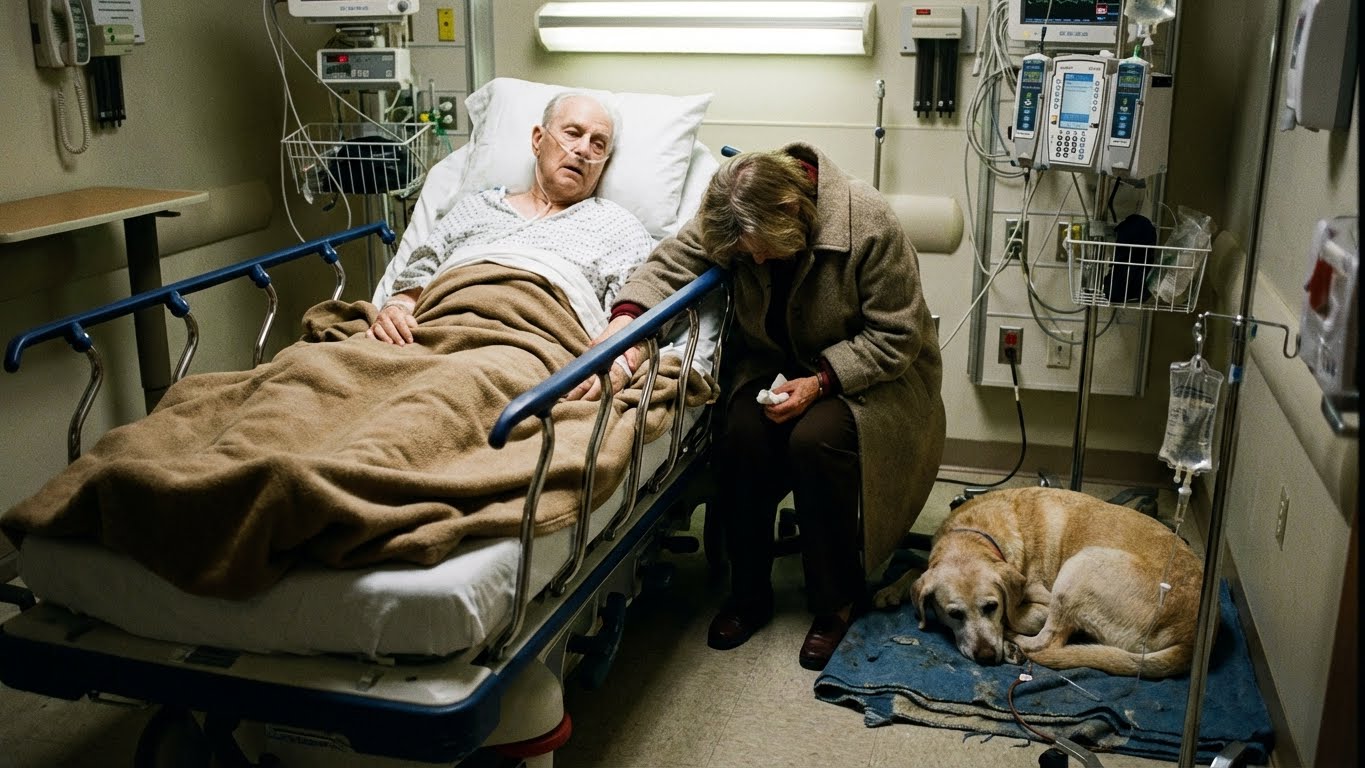
———–PART 2————-
The Longest Mile: A Battle Against the Ice
The silence of a Wisconsin winter night is not peaceful; it is predatory. It is a heavy, suffocating weight that presses down on the world, stripping away sound and warmth until there is nothing left but the wind and the dark. Standing on the edge of that ditch, looking down at the two shapes that defined my entire existence, I felt that silence try to swallow me whole.
I didn’t just step out of the van; I fell out of it. My legs, usually reliable despite my seventy years, felt like water. I scrambled toward the edge of the embankment, the frozen weeds crunching loudly under my bare feet like shattered glass. I had lost my slippers somewhere between the bedroom and the driveway, but my brain had severed the connection to my nerve endings. I couldn’t feel the snow. I couldn’t feel the biting wind that was currently registering three degrees below zero. I could only feel the terror clawing at my throat.
“Daniel!” I screamed, but the wind took the name and tore it to shreds before it could reach the bottom of the ditch.
I slid down the steep incline, my heels digging useless furrows into the ice-crusted mud. I hit the bottom hard, my knees colliding with something solid—a rock, or a frozen branch—but I crawled forward on all fours, an animal desperation taking over.
Up close, the scene was a nightmare frozen in time.
Daniel was curled into a tight fetal ball, his knees drawn up to his chin. He was lying on his side, his face turned toward the dirt wall of the ditch as if trying to hide from the wind. His skin… God, his skin. It wasn’t just pale; it was the color of old candle wax, a translucent, lifeless gray that made him look like a statue carved from the ice itself.
But it was what lay on top of him that stole the breath from my lungs.
Scout.
Our sixteen-year-old Labrador, who groaned when he stood up from his bed, who needed help getting up the three steps of our back porch, had somehow maneuvered himself into the ditch. He hadn’t just curled up next to Daniel. He had flattened his eighty-pound body, spreading himself out like a heavy, golden rug directly over Daniel’s chest and abdomen. He had positioned his broad head over Daniel’s neck, shielding the carotid arteries from the biting air.
Scout was no longer yellow. He was silver. A thick, crystalline layer of frost coated every inch of his fur. He looked like a ghost dog, a spirit made of mist and ice.
“No, no, no,” I sobbed, my hands shaking so violently I could barely control them. I reached out and touched Scout’s flank.
It was hard. Rigid.
The dog who had been warmth and softness for sixteen years felt like a block of wood. But then, under my palm, I felt it. A tremor. A tiny, vibrating shudder. He was alive. He was shivering with such ferocity that his muscles were locked in a spasm, vibrating at a frequency that hummed against my hand.
He opened one eye. It was cloudy, rimmed with ice, and filled with a pain so profound it made me gasp. He looked at me, and he didn’t wag his tail. He didn’t lift his head. He just let out a sound I will hear in my nightmares until the day I die—a low, whining creak, like a door hinge rusting shut.
I’m here, Mom. I’m holding him.
“I’ve got you, baby, I’ve got you both,” I cried, tears freezing instantly on my cheeks.
I knew I had to move Scout to get to Daniel. I gripped the loose skin around Scout’s shoulders and pulled.
He growled.
It wasn’t a growl of aggression. It was a growl of protest. He dug his claws into Daniel’s robe. He was refusing to break contact. He knew, in whatever deep, instinctual part of his brain governed his loyalty, that if he moved, the heat source would vanish. He was giving every calorie of heat his failing heart could generate to the man beneath him.
“Scout, please! I have to get him up!” I begged, my voice cracking. “You have to let go!”
I shoved my hands under the dog’s belly and heaved. He was dead weight, heavy with exhaustion and gravity. With a final, heartbreaking whimper, his legs gave out, and he rolled off Daniel, collapsing into the snow with a dull thump. As soon as he was off, the cold air rushed into the space between them, and Daniel let out a sharp, ragged gasp—a reflex, not a conscious breath.
I turned my attention to my husband.
“Daniel, wake up. Wake up right now.” I slapped his cheek. It felt like slapping a marble countertop.
His eyes fluttered open, but there was no one home. The pupils were blown wide, black holes absorbing the scant moonlight. He looked through me, past me, staring at some distant horizon only he could see.
“Cold,” he mumbled. The word was barely a whisper, formed by lips that were blue and stiff. “So… cold.”
“I know, honey. We’re going home. But you have to stand up.”
I grabbed his arm and pulled.
Nothing happened.
Daniel is a big man. Even at seventy-eight, even with the weight he’d lost, he was six feet of bone and frame. I am five-foot-four. I have arthritis in my hands. The physics were impossible.
Panic, cold and sharp, spiked in my chest. If I couldn’t move him, he would die here. I would watch him freeze to death ten minutes from our house.
“Help me!” I screamed at the empty road above. “Somebody help me!”
But there were no headlights. No sirens. Just the wind, mocking me.
I looked at the van, idling on the shoulder above us. It looked a mile away. The slope of the ditch was steep, covered in slick, frozen grass.
I realized then that I couldn’t pull him. I had to become the anchor.
I wedged my bare feet into the frozen mud, screaming as a sharp rock sliced into my heel. I ignored the pain. I grabbed Daniel by the lapels of his coat.
“On three, Daniel. You have to push. You have to try.”
He didn’t answer. His head lolled back.
I gritted my teeth so hard I felt a molar crack. “One. Two. Three!”
I hauled backward with everything I had. My spine shrieked. My shoulders felt like they were tearing out of their sockets.
We moved six inches.
“Again!” I yelled, more a primal roar than a word.
I dragged him another foot. He was dead weight, his heels dragging in the snow, leaving two long furrows. I slipped, my face smashing into the icy bank, tasting dirt and blood. I scrambled back up, spitting out mud.
“I am not losing you!” I hissed, grabbing him again. “I am not losing you to a damn ditch!”
It was a war of inches. Slip, pull, scream, repeat. My hands were numb claws, locked onto his coat. I don’t know where the strength came from. Maybe it was adrenaline. Maybe it was love. Maybe it was the sheer refusal to accept widowhood in a frozen wasteland.
Halfway up the slope, Scout tried to help.
I heard the scrabbling behind me. The old dog was clawing his way up the ice, his back legs useless, dragging his body with his front paws. He was panting, a wet, rattling sound. He nipped at Daniel’s trailing hand, trying to pull him, trying to do his job even while he was dying.
“Good boy, Scout,” I choked out. “Good boy.”
Reaching the top of the ditch took ten minutes that felt like ten years. When I finally dragged Daniel onto the flat gravel of the shoulder, I collapsed. My lungs were burning as if I’d inhaled fire. I lay there for five seconds, staring at the stars, gasping.
But I couldn’t rest.
I opened the passenger door of the van. The blast of heat from inside felt like a physical blow.
“Daniel, get in. Step up. Please.”
I lifted his leg, placing his foot on the running board. He groaned, a sound of deep, confused agony. I put my shoulder under his armpit and shoved. He stumbled, half-falling into the seat. I buckled him in, his head immediately slumping against the window.
I slammed the door and turned back to the ditch.
Scout was sitting at the edge of the road, looking up at me.
In the glow of the headlights, he looked ruined. His eyes were sinking into his skull. His breathing was a struggle, his ribcage heaving with every inhalation. He looked at the open sliding door of the van, then looked at me.
He couldn’t jump. He hadn’t been able to jump into the car for two years. And tonight, he could barely stand.
“I’m sorry, buddy,” I whispered, rushing to him. “I’m so sorry.”
I squatted down. My back was already in spasms from dragging Daniel. Lifting an eighty-pound, limp dog was a recipe for injury. I didn’t care.
I wrapped my arms around his chest and his rear. I lifted.
A bolt of lightning shot down my spine, white-hot and blinding. I cried out, my knees buckling. Scout yelped—a sharp, high-pitched cry of pain that tore my heart in two—as the pressure hurt his arthritic hips.
“I’ve got you,” I grunted through clenched teeth, tears streaming down my face. I stumbled to the open door and practically threw him onto the floorboard. He landed heavily, too weak to brace himself. He dragged himself toward the front seats, collapsing right behind Daniel’s legs.
He let out a long sigh and rested his chin on Daniel’s ankle.
I slammed the sliding door and limped to the driver’s seat. My hands were frozen into hooks. I couldn’t uncurl my fingers to grip the steering wheel properly. I had to use my palms to turn the wheel.
I slammed the car into drive and floored it. The tires spun on the ice, whining, before finding traction. The van fishtailed, and for a terrifying second, I thought we were going to slide right back into the ditch. But the tires caught, and we shot forward.
The drive to Mercy General Hospital is a blur of darkness and speed. I don’t remember stop signs. I don’t remember speed limits. I remember the sound of the heater fan roaring, trying to battle the chill radiating from the two bodies beside me.
I kept glancing over.
Daniel was silent. Too silent. His skin was waxy.
“Stay with me, Dan. Talk to me.”
“Mom?” he murmured, his mind lost in 1955.
“No, it’s Lila. It’s your wife.”
“Lila…” he whispered. “The dog… is the dog warm?”
I looked in the rearview mirror. Scout wasn’t moving. He wasn’t shivering anymore, which terrified me more than the shivering had.
“He’s warm, honey. He’s right here.”
I hit the town limits doing seventy miles an hour. I ran the red light at Main Street, honking my horn long and hard to warn anyone who might be awake.
When I pulled into the Emergency Room bay, I didn’t park. I abandoned the car. I threw the door open and ran toward the automatic doors, screaming before I even entered the lobby.
“Hypothermia! Severe hypothermia! I need a gurney!”
The triage nurse, a woman with a stern face that instantly softened when she saw my muddy, bloody appearance, vaulted over her desk.
“Code Blue, Trauma Room 1!” she yelled into a radio.
A swarm of people descended on the van. They were efficient, loud, and aggressive. They pulled Daniel out of the passenger seat. I saw them cut his shirt open right there on the gurney to attach defibrillator pads.
“Pulse is thready! BP is 60 over 40. Let’s move!”
They were wheeling him away. My Daniel. My husband of fifty years. He looked so small surrounded by the medical team.
I took a step to follow them, but then I stopped. I turned back to the van.
The driver’s side door was open. The interior light cast a yellow glow on the floorboard.
Scout hadn’t moved during the commotion. He was lying in the exact same spot, his eyes closed.
“Ma’am, you need to come with us for admission,” a nurse said, pulling gently on my arm.
“My dog,” I choked out, pointing at the van. “My dog is dying in there.”
The nurse looked at the van, then back at me. Her face was sympathetic but firm. “Ma’am, we are a human hospital. We can’t… we can’t treat the dog. You need to be with your husband. He’s critical.”
I stood there, paralyzed. It was the most impossible choice of my life.
Inside those doors, the love of my life was fighting to keep his heart beating. Inside that van, the soul who had saved him was fading away alone.
I looked at the nurse. “Is my husband breathing?”
“Barely. But yes.”
“Keep him alive,” I said, my voice trembling with a ferocity that surprised me. “Do not let him die. I will be right back.”
“Ma’am, you can’t—”
“I said I will be right back!” I screamed, turning on my heel.
I ran back to the van. A security guard was approaching, looking confused.
“Sir,” I said, grabbing his uniformed arm. “I need you to sit in this car. I need you to keep the engine running. I need you to turn the heat up to the maximum.”
“Lady, you can’t leave your car here—”
“My husband is dying inside that hospital!” I shouted, pointing a muddy finger at the ER. “And the dog who saved his life is dying in this van! If you turn this engine off, if you let him die cold and alone, I will sue this hospital for every penny it has! Just sit with him!”
The guard’s eyes went wide. He looked into the back of the van and saw Scout. He saw the frost still clinging to the dog’s whiskers. He saw the slow, shallow rise and fall of his ribs.
Something in his face changed. The bureaucratic mask fell away, replaced by human decency.
“Okay,” he said softly. “Okay, Ma’am. Go. I’ve got him. I won’t leave him.”
He climbed into the driver’s seat. I watched him reach back and gently rest a hand on Scout’s head.
I turned and ran toward the hospital doors, my bare feet slapping against the cold concrete, leaving bloody footprints behind me. I ran toward Daniel, carrying the weight of the one I had left behind in my heart.
The automatic doors slid open with a hiss, and the sterile smell of the hospital hit me. I was safe. Daniel was in good hands.
But as I ran down the corridor, all I could feel was the phantom sensation of soft, cold fur under my fingers, and the memory of that low, creaking whine.
I’m holding him, Mom.
I prayed to a God I hadn’t spoken to in years: If you take one, you have to save the other. You can’t take both. Please. Not tonight.
———–PART 3————-
The Living Blanket
Time in a hospital doesn’t move in a straight line. It stutters. It drags. It loops back on itself. Sitting in the waiting room of Mercy General, covered in a scratchy gray wool blanket a nurse had taken from a warmer, I felt suspended in a terrifying purgatory.
The adrenaline that had fueled my superhuman effort to drag Daniel out of that ditch had evaporated, leaving behind a physical crash so violent my teeth were chattering—not from cold, but from shock. My hands, resting on my knees, looked like they belonged to someone else. They were caked in dried mud, the knuckles swollen and purple, the fingernails torn. I stared at them, trying to stop them from shaking, but the tremors traveled all the way up my arms to my shoulders.
Every time the automatic doors at the ER entrance hissed open, I flinched, my eyes darting to the glass, terrified that someone was coming to tell me my husband was dead. Or worse, that the security guard was coming to tell me my dog was gone.
I was trapped. If I left to check on Scout, I might miss the doctor. If I stayed, Scout was alone in the freezing van. I sat there, paralyzed by the impossible choice, tearing my cuticles until they bled.
An hour passed. Then two.
The sun began to bleed into the sky outside, turning the pitch-black windows a bruised shade of navy blue. The world was waking up. People were starting their coffee pots, letting their dogs out into the yard, grumbling about the cold. They had no idea that just a few miles away, my entire universe was hanging by a thread.
Finally, the double doors to the trauma bay swung open.
Dr. Evans walked out. He looked impossibly young—a kid, really, with messy hair and scrubs that looked like they had been slept in. But his eyes were old. They were the tired, heavy eyes of a man who sees tragedy before breakfast every day. He pulled a surgical mask down around his neck and scanned the room until he found me.
He didn’t smile. That was the first thing I noticed. He didn’t frown, either. He just looked… puzzled.
“Mrs. Miller?”
I stood up. My knees popped loudly in the quiet room. “Is he…?” I couldn’t finish the sentence. The word dead felt like a curse I wasn’t allowed to speak.
“He is stable,” Dr. Evans said, the words rushing out of him as if he knew he needed to put me out of my misery instantly. “He’s in the ICU. We’ve got his core temperature up to 96 degrees. His heart rhythm is normalizing. He’s going to make it, Lila.”
I let out a sound that was half-sob, half-laugh, and collapsed back into the chair. “Oh, thank God. Thank God.”
Dr. Evans sat down in the chair next to me. This was unusual. Doctors usually stand; they hover, ready to leave. But he sat, leaning his elbows on his knees, clasping his hands together. He looked at the floor for a moment, then turned to me.
“Lila, I need to ask you something,” he said, his voice dropping to a confidential volume. “And I need you to be very specific.”
My stomach tightened. “About his dementia?”
“No. About how you found him.”
He pulled a folded piece of paper from his pocket—a printout of Daniel’s vitals.
“When patients come in with the level of exposure your husband had, we have charts that predict their survival rate. Based on the ambient temperature—which was three degrees—and the wind chill, and the fact that he was wearing thin cotton… Daniel should have been in cardiac arrest within forty-five minutes. You said he was missing for nearly three hours.”
I nodded, confused. “Yes. The tracks… they went a long way.”
“Mathematically, his body simply didn’t have the caloric energy to maintain heat for that long,” Dr. Evans continued, tapping the paper. “His extremities—his hands and feet—have severe frostbite. That’s expected. His body sacrificed blood flow to the limbs to keep the organs alive. But his torso? His chest and abdomen were significantly warmer than the rest of him. It’s the only reason his heart kept beating.”
He looked me dead in the eye.
“It’s like he was wrapped in an electric blanket out there in the snow. But you said he had no coat. So, I need to know: Was there something covering him?”
I closed my eyes, and the image seared itself onto the back of my eyelids. The silver frost on the yellow fur. The way Scout had flattened his body, spreading his ribs and belly out to maximize surface area. The way he had refused to move.
“It wasn’t a what,” I whispered, my voice trembling. “It was a who.”
Dr. Evans tilted his head. “Excuse me?”
“Our dog,” I said, the tears spilling over again. “Scout. He’s a Labrador. When I found them… Scout was lying on top of him. Right on his chest.”
Dr. Evans stared at me. His mouth opened slightly, then closed. He looked back at the chart, then at me. The realization washed over his face, a mixture of scientific understanding and pure, emotional awe.
“The dog,” he murmured. “Of course. Thermodynamics.”
“What?”
“The dog acted as a biological heat sink,” Dr. Evans said, his voice filled with a strange reverence. “Dogs have a higher body temperature than humans—usually around 101 or 102 degrees. By pressing his abdomen against your husband’s chest, he was actively transferring that heat directly into Daniel’s core. He wasn’t just blocking the wind, Mrs. Miller. He was essentially a living battery, pouring his own thermal energy into your husband.”
The words hit me like a physical blow. Pouring his own energy into him.
“He kept him warm,” I whispered.
“He did more than that,” Dr. Evans said softly. “He likely saved his life. If that dog hadn’t been there, shielding his heart and lungs, we wouldn’t be having this conversation. Your husband would be in the morgue.”
He paused, and his expression turned somber.
“But Mrs. Miller… for a warm-blooded animal to do that in sub-zero temperatures… to lie still on frozen ground and give away its body heat… that takes a toll. A massive toll. Where is the dog now?”
The question shattered the moment of relief. The reality of the transaction crashed down on me. Thermodynamics. Energy cannot be created or destroyed; it can only be transferred.
Scout hadn’t just shared warmth. He had given it away. He had drained his own life force to refill Daniel’s.
I stood up so fast the chair scraped loudly against the linoleum, drawing stares from across the room.
“He’s in the van,” I gasped.
Dr. Evans looked alarmed. “In the van?”
“The security guard… he wouldn’t let me bring him in. I had to choose.”
“Go,” Dr. Evans said, standing up with me. “Your husband is sedated. He won’t wake up for hours. Go take care of the hero.”
I didn’t say goodbye. I turned and sprinted.
My legs were stiff, my body aching, but I ran through the hospital corridors, ignoring the “Walk, Don’t Run” signs. I burst through the automatic doors into the biting cold of the dawn. The sun was just peeking over the horizon now, casting a cruel, beautiful pink light on the snow-covered parking lot.
My van was parked in the corner, a plume of white exhaust chugging steadily from the tailpipe.
I ran to it, ripping the driver’s side door open.
The blast of heat was suffocating. The security guard, a man named Mike whose name I hadn’t even asked earlier, was sitting in the driver’s seat. He jumped when I opened the door.
His eyes were red. He had been crying.
“He’s… he’s not doing good, Ma’am,” Mike said, his voice thick. He stepped out of the car, giving me space. “I kept talking to him. I kept the heat on full blast. But his breathing… it sounds like water.”
I climbed into the back, crawling over the seats to get to the floorboard where Scout lay.
He hadn’t moved an inch since I left him.
“Scouty?” I whispered.
He was lying on his side, his legs stiff and straight. His beautiful yellow coat, usually so soft, was matted with mud and melting ice. But it was his breathing that terrified me. It was a wet, gurgling rasp. Every breath was a battle. His chest heaved with a violent effort, ribs expanding to their limit just to pull in a thimbleful of air.
I placed my hand on his chest. His heart was hammering—a frantic, fluttering beat, like a trapped bird beating its wings against a cage. It was too fast. Way too fast.
“I’m here, buddy. Mom’s here,” I cooed, stroking his velvet ears.
Slowly, painfully, he lifted his head. Just an inch. His eyes, cloudy with cataracts and exhaustion, searched for me. When they locked onto my face, his tail—just the very tip of it—gave a single, weak thump against the floor mat.
That single thump broke me. Even now, dying on the floor of a dirty minivan, he was trying to comfort me.
“We’re going to Dr. Aris,” I told him, choking on the words. “She’ll fix it. She’ll fix you.”
I scrambled into the driver’s seat. Mike, the security guard, put a hand on my shoulder through the open window.
“Good luck,” he whispered. “He’s a good boy. The best I’ve ever seen.”
“Thank you,” I said. “Thank you for not leaving him.”
I drove.
The drive to the emergency veterinary clinic was usually a thirty-minute trip through the back roads. I did it in twenty.
The whole way, I talked to him. I filled the car with the sound of my voice, terrified that if I stopped talking, he would stop breathing.
“Remember the lake, Scout? Remember how you used to jump off the dock? You were so fast. You were faster than the ducks. And remember the time you ate the Thanksgiving turkey? Oh, Dad was so mad, but he couldn’t stay mad at you. You just gave him those big brown eyes.”
I glanced in the rearview mirror. Scout’s eyes were closed, his head resting heavily on his paws.
“Hang on, Scout. Just hang on.”
When I pulled into the vet clinic, the lights were on. It was a 24-hour emergency center, a place of high drama and quiet tragedies. I ran inside, screaming for help just as I had done at the hospital.
“My dog! He’s in heart failure! Please!”
Two vet techs, burly young men who looked like linebackers, rushed out with a stretcher. They lifted Scout out of the van with a gentleness that belied their size. Scout didn’t make a sound. He was limp, his head lolling over the side of the stretcher.
We rushed into a treatment room. The smell of the place hit me—rubbing alcohol, bleach, and the underlying, metallic scent of fear pheromones from a thousand animals before him.
Dr. Aris came in. She had treated Scout for his arthritis for years. She knew him. She knew us.
She took one look at Scout on the metal table and her face fell.
“Oxygen, stat,” she barked at the techs. “Get an IV line in. Furosemide, 4 milligrams per kilogram.”
They placed a plastic mask over Scout’s snout. He didn’t fight it. He just lay there, gasping, his tongue lolling out, pale and blue-tinged.
Dr. Aris put her stethoscope to his chest. She listened for a long time, moving the bell to different spots. She felt his abdomen. She checked his gums.
Then, she took the stethoscope out of her ears and hung it around her neck. She signaled the techs to step back, though they kept the oxygen flowing.
She turned to me. She didn’t need to speak. I saw it in her eyes. The same look the doctor at the hospital had given me, but flipped. There, it was survival. Here, it was the end.
“Lila,” she said softly. “Come here.”
I walked to the table and buried my face in Scout’s neck. He smelled like wet dog, pine needles, and the metallic tang of the hospital.
“His heart is failing,” Dr. Aris explained, her voice steady but compassionate. “He has fluid in his lungs—pulmonary edema. That’s the crackling sound you hear. His heart is enlarged, trying desperately to pump blood, but the muscle is exhausted.”
“Can’t we drain the fluid?” I asked, looking up at her, begging. “Can’t we give him pills?”
“We can try,” she said honestly. “We can put him in an oxygen cage. We can blast him with diuretics. It might buy him a few hours. Maybe a day.”
She placed a hand on my arm.
“But Lila… look at him. He’s sixteen. He just spent hours in sub-zero weather protecting Daniel. He pushed his body so far past its limit that there is no coming back. The adrenaline is gone. His organs are shutting down. If we keep him alive, he will be drowning. He will be terrified. He is suffering right now.”
I looked down at my boy.
I saw the puppy who had chewed my favorite heels. I saw the young dog who had barked at thunder, needing me to hold him. I saw the adult dog who had sat patiently while my grandson pulled his ears. And I saw the guardian who had walked into the darkness because his master did.
He was fighting for every breath. His eyes were wide, panicked, seeking mine. He wasn’t relaxed. He was drowning in air.
He had given his life to save Daniel. He had completed his mission. To ask him to stay now—to fight a battle he couldn’t win just so I didn’t have to say goodbye—would be the ultimate selfishness.
He had been selfless. I had to be selfless, too.
“No,” I whispered, the word tearing my throat apart. “No more suffering.”
Dr. Aris nodded. “It’s the right choice, Lila. It’s the kindest thing you can do.”
“Can I… can I hold him?”
“Of course.”
They lowered the table. I sat on the floor, and they moved Scout down so his head was in my lap. I wrapped my arms around his massive chest. I felt the rattle of his breath against my ribs.
Dr. Aris prepared the injection. “The first one is just a sedative,” she said. “He’ll just go to sleep. The pain will stop. The fear will stop. He’ll just feel like he’s taking a nap.”
I nodded, unable to see through the curtain of tears.
“Hey, buddy,” I whispered into his ear. “Hey, Scouty. You did it. You did such a good job.”
I rubbed the soft spot behind his ears, the place he always loved.
“Daniel is safe,” I promised him. “You saved him. You’re the best boy. You’re the Captain now.”
Dr. Aris administered the sedative.
Almost instantly, the tension left Scout’s body. The frantic heaving of his chest slowed. The panic in his eyes faded, replaced by a soft, heavy drowsiness. He let out a long sigh—not a gasp, but a true sigh of relief. His head grew heavy in my lap.
He looked up at me one last time. The clouds in his eyes seemed to clear for a fleeting second, and I saw the puppy I had brought home fifteen years ago. He licked my hand—one slow, deliberate, sandpaper lick.
It’s okay, Mom. I’m tired.
“I love you,” I sobbed. “Go run. Go find the birds.”
Dr. Aris gave the second injection.
I felt his heart under my hand. Thump-thump. Strong. Thump… thump. Slower. Thump……. thump. Thump.
And then, silence.
The room was quiet, save for the hum of the refrigerator in the corner. The struggle was over. The hero was at rest.
I sat there for a long time, rocking him back and forth, unable to let go of the empty shell of the creature who had taught me more about love and loyalty in one night than humans had taught me in seventy years.
Finally, I stood up. I kissed his broad, gray muzzle one last time.
“I’ll take care of him now, Scout,” I whispered to the empty air. “I’ll take the watch.”
I walked out of the clinic into the morning sun. The world looked exactly the same as it had yesterday. Cars were driving by. The radio in the lobby was playing a pop song.
It felt wrong that the world kept turning. It felt wrong that the sun dared to shine when the brightest light in my life had just gone out.
But then I remembered Daniel. Daniel, who was warm. Daniel, who was breathing. Daniel, who was alive because of the sacrifice I had just witnessed.
I got back into the van. The passenger seat was empty. The back was empty. But as I drove back toward the hospital to sit beside my husband, I swore I could feel a heavy, comforting warmth on the seat beside me, and the phantom weight of a big, blocky head resting on my shoulder.
He wasn’t gone. He was just part of the warmth now.
———–PART 4————-
The Notebook: A Voice from the Past
Coming home from a funeral is hard. Coming home from the vet with an empty collar in your purse is a different kind of quiet. But bringing a husband home to a house that feels like a tomb is a silence that screams.
Three days after the incident in the ditch, the ambulance brought Daniel back to us. We couldn’t manage the stairs anymore, so we transformed the living room into a makeshift hospital ward. A rented hospital bed took the place of the coffee table. An oxygen concentrator hummed rhythmically in the corner, a mechanical substitute for the breathing of a living, sleeping household.
Physically, Daniel was a miracle. The doctors were right; the frostbite on his toes was superficial and would heal with time. His heart, battered by the cold, had stabilized. But the trauma of that night had accelerated the dementia. It happens sometimes, the doctors told me—a physical shock can cause the mind to retreat further into the fog, burning bridges back to reality that can never be rebuilt.
He spent most of the day sleeping, lost in a medication-induced haze.
I spent most of the day waiting.
I found myself walking in circles around the kitchen island. I would make tea, forget to drink it, and find it cold three hours later. I would reach for the back door handle to let Scout out, only to freeze, my hand hovering over the cold metal, remembering that there was no one waiting on the other side.
The absence of a dog is a physical weight. It’s the lack of claws clicking on the hardwood. It’s the missing thump-thump of a tail against the sofa. It’s the fact that when you drop a crumb of toast, it just stays there on the floor, a tiny monument to the loneliness.
But the hardest part wasn’t the silence. It was the questions.
In his waking moments, Daniel was restless. He would pick at the sheets, his eyes darting around the room, searching for something his brain couldn’t name but his heart missed.
“Where is he?” Daniel would raspy, his voice thick with sleep.
I would sit beside him, holding a cup of water with a straw. “Who, Daniel?”
“The… the yellow one. The shadow.”
My heart would fracture, a fresh hairline crack every time. “Scout is gone, honey. Remember? He passed away.”
Daniel would frown, a look of genuine perplexity crossing his weathered face. “Gone? To the store?”
“No, honey. He went to heaven. He died saving you.”
“Oh,” Daniel would say softly. He would look sad for a moment, processing the grief. He would stare at the ceiling, and I would think we were past it.
Then, ten minutes later, he would look at the empty rug.
“Where is the dog?”
“He died, Daniel.”
“When?”
“Last week.”
“Oh.”
And then, twenty minutes later: Where is the shadow?
It was a cruel, relentless loop. I was living the grief of losing my best friend over and over again, fifty times a day, forced to break the news to the man who was responsible for it, yet innocent of it. I wanted to scream. I wanted to shake him. I wanted to run out into the snow and never come back.
But I stayed. Because that’s what love is. It’s staying when every fiber of your being wants to run.
A week after the funeral—which was just me, the vet, and a small wooden box in the backyard—I received a letter from the insurance company. They needed Daniel’s military discharge papers for the hospital billing.
I knew where he kept them. Or at least, where he used to keep them.
The garage.
I hadn’t stepped foot in the garage since that night. It was Daniel’s domain. A sanctuary of unfinished projects, the smell of sawdust, old oil, and the sharp tang of gasoline.
I opened the door and flipped the switch. The long fluorescent tube lights flickered, buzzed, and then bathed the room in a harsh, clinical white light.
It was exactly as he had left it. A half-sanded rocking chair sat on the workbench—a project for a grandchild we didn’t have yet. Jars of nails were screwed into the bottom of shelves, a trick he learned from his father.
I walked to the filing cabinet in the corner. It was cold in there, the concrete slab floor radiating the Wisconsin winter through the soles of my slippers. I found the papers quickly, filed under “M” for Military, because Daniel was nothing if not organized.
As I turned to leave, my hip bumped against his red metal toolbox. It was a massive, heavy thing, covered in stickers from union locals and paper mills.
It wasn’t closed all the way. Something was jamming the lid.
I don’t know why I stopped. I should have just grabbed the papers and went back to the warmth of the house. But grief makes you do strange things. It makes you look for pieces of the person you lost, even when they are still living in the next room.
I lifted the heavy lid.
Inside, amidst the wrenches and screwdrivers, sitting on top of a greasy rag, was a black notebook. A Moleskine.
It looked out of place. Daniel wasn’t a writer. He was a man of measurements and blueprints, not diaries and feelings.
I picked it up. The leather was worn, soft from being handled.
I opened the cover.
Property of Daniel Miller. If found, please return to my wife, Lila. She is the pretty one with the angry eyes when I leave my socks on the floor.
I let out a wet, choked laugh. That was him. That was the Daniel I married, the one who could make me laugh even when I wanted to strangle him.
I turned the page.
The first entry was dated five years ago. January 12, 2019.
The doctor called today. He used a lot of big words. Mild Cognitive Impairment. Early-onset something or other. I stopped listening after he said “progressive.” I didn’t tell Lila everything. She looks so scared lately. I hate making her scared. I told her it’s just old age. But I know. I feel it. It’s like walking into a room and forgetting why you’re there, but the room is my whole life.
I sank onto a plastic bucket, my legs suddenly unable to hold me. He had known. He had known how bad it was, and he had protected me from the terrifying details.
I flipped forward. The handwriting began to change. The sharp, angular script of his youth was becoming shaky, the letters larger, less controlled.
March 4, 2020. I got lost driving home from the hardware store today. I’ve driven that road a thousand times. I had to pull over and look at the GPS on my phone. I felt like crying. I’m losing the map, piece by piece. Scout was in the truck with me. He licked my hand when I started to panic. He knows. I swear to God, that dog knows I’m broken.
Tears were dripping off my nose, landing on the dusty concrete floor. I was reading the chronicle of a man watching his own erasure.
July 15, 2021. The dog follows me everywhere now. If I go to the bathroom, he waits by the door. If I go to the basement, he stands at the top of the stairs until I come back up. He doesn’t look at me like I’m stupid. He just looks at me like I’m his job. I think he’s worried I’ll wander off. Smart boy.
I remembered that year. I remembered being annoyed at Scout for always being underfoot, for tripping me in the kitchen because he refused to move from Daniel’s side. I had called him “clingy.” I hadn’t realized he was standing guard.
I turned to the end of the notebook. The entries became sporadic. The sentences were shorter, the grammar fracturing as his language centers began to fail.
And then, I found the entry dated October 2, 2023. Just three months before the snowstorm.
The writing was barely legible. It was scrawled in thick, heavy lines, as if he had to grip the pen with his entire fist to make it work.
Had a talk with Scout today on the porch. The sun was nice. My head feels like it’s full of cotton balls most days now. I know the big forgetting is coming soon.
I gave the dog a promotion. Told him he’s the Captain now.
I told him: “Buddy, Lila isn’t strong enough to carry me when I fall. She’s too little. And she worries too much. So you have to be the one.”
I gave him his orders. Military orders. I told him: “Your mission is to stay with me. If I wander, you follow. If I get cold, you make me warm. You are my backup generator.”
I made him shake on it. He gave me his paw. He understands. He’s a good soldier.
I gasped, the air rushing into my lungs with a sharp hiss.
If I get cold, you make me warm.
The medical explanation from Dr. Evans rushed back to me. The dog acted as a biological heat sink. He transferred his energy.
It wasn’t an accident. It wasn’t just instinct. It was a command. Daniel had trained him for this. In the twilight of his clarity, Daniel had realized he was a danger to himself, and he had appointed a guardian to ensure that his mistakes didn’t kill him.
I looked at the final paragraph on the page.
If you’re reading this, Honey, and I’m not myself anymore… please don’t be upset with Scout if something happens. I asked him to do it. Whatever he does, he’s just doing his job. He loves you, but he answers to me on this one.
P.S. If I wander off into the dark, tell him to STAY. He listens to “Stay.”
I closed the notebook and pressed it against my chest, curling my body around it as I sobbed into the silence of the garage. The sound of my own grief bounced off the metal tools and the cold concrete walls.
I had felt so alone carrying the burden of Daniel’s illness. I had felt like I was the only one watching him fade, the only one trying to keep him safe.
But I hadn’t been alone.
Daniel had been fighting, too. And when he realized he couldn’t fight anymore, he hadn’t just given up. He had recruited help. He had forged a pact with the only other soul in the house who loved him as much as I did.
Scout hadn’t just died. He had been killed in action. He had executed his final order with absolute, unwavering perfection. Make me warm.
I wiped my face with the sleeve of my sweater, smearing dust and tears across my cheeks. I stood up. My legs felt stronger now. The crushing weight of the guilt—the guilt of leaving Scout in the van, the guilt of choosing Daniel—lifted slightly.
Scout hadn’t been a victim of my choice. He had been a willing participant in Daniel’s rescue. He had fulfilled his purpose.
I walked out of the garage, turning off the buzzing lights. I walked back into the living room with the notebook in my hand.
The nurse, a kind woman named Sarah who came in the afternoons, looked up from her book.
“Everything okay, Mrs. Miller? You were in there a long time.”
“I’m fine, Sarah,” I said, my voice steady. “I’m better than fine.”
I walked over to the hospital bed. Daniel was awake. He was staring at the window, watching the snow fall—fresh snow, covering the scars of the old storm.
He turned his head slowly to look at me. His eyes were foggy, the medication making his pupils sluggish.
He looked down at the floor.
“Where…” he started.
I sat down on the edge of the mattress. I took his hand—the hand that had written those words, the hand that had shaken Scout’s paw.
“Where’s the dog?” he whispered.
I didn’t cry this time. I didn’t feel the crack in my heart. Instead, I opened the notebook to the last page. I knew he couldn’t read it—the words would just be shapes to him now—but I needed him to hear it.
“Daniel, look at me.”
He focused on my face.
“Scout isn’t lost,” I said clearly. “He finished the job. Do you remember the job you gave him?”
Daniel blinked. His brow furrowed. He looked at the notebook in my hand, and for a split second, a spark jumped across the synapse. A flash of the man who used to be.
“The… promotion?” he murmured.
“Yes. The promotion. You told him to keep you warm. You told him to bring you home.”
I squeezed his hand.
“He did it, Daniel. He brought you home. He completed the mission. So he got to go rest. Soldiers get to go home when the mission is done.”
Daniel stared at me. The confusion in his eyes began to settle, replaced by a deep, ancient calm. The frantic searching stopped. The tension in his shoulders released.
He looked at the empty spot on the rug where the dog bed used to be. He didn’t look sad anymore. He looked proud.
“Mission accomplished,” Daniel whispered.
“Yes,” I said, kissing his forehead. “Mission accomplished.”
He closed his eyes, and for the first time in a week, he fell into a peaceful sleep, untroubled by shadows or missing friends.
Epilogue
The winter eventually broke. The ice in the ditch melted, turning into a stream of muddy water that fed the wildflowers in the spring.
Daniel is still with me. He is fading a little more every day. Some days he knows my name; some days I am just the nice lady who brings him ice cream.
I still have the notebook. I keep it on the nightstand, right next to the picture of the three of us—Me, Daniel, and a goofy yellow dog with a tennis ball in his mouth.
We live in a world that is obsessed with the new. New phones, new cars, new relationships. We discard things when they get old. We treat aging like a disease to be cured or a shame to be hidden.
But I have learned that the most powerful things in this world are not the shiny, new ones.
The most powerful force on earth is the bond between old souls. It is the love that has been weathered by storms, worn down by time, and tested by fire and ice.
It is an old man trying to protect his wife from his own decaying mind. It is an old dog forcing his arthritic body to climb a frozen hill because he promised he would. It is an old woman finding the strength to carry them both.
So, if you have an old dog at home, the kind with a gray face and cloudy eyes who sleeps too much… don’t be annoyed when they get under your feet. Don’t be frustrated when they move slowly.
Look at them. Really look at them.
They are not just pets. They are the keepers of your secrets. They are the silent witnesses to your life. And if the day ever comes when the cold wind blows and the lights go out, they will be the ones standing between you and the darkness, holding the line until the very end.
Be worthy of them.
End.