THE GHOST OF SENTINEL RIDGE
PART 1
The dust in Afghanistan doesn’t just sit on the surface of things; it invades you. It works its way into the seams of your clothes, the creases of your skin, and the corners of your mind until you can’t remember what it feels like to be clean.
At Forward Operating Base Sentinel, the dust hung in the air like a permanent, suffocating haze, turning the sharp lines of the mountains into ghostly blurs and coating everything in a fine layer of grit. It turned our brown uniforms tan and made everyone’s eyes sting by noon.
I sat in the contractor pod—a prefabricated metal box that baked in the relentless sun like a convection oven—and stared at a monitor that flickered every time someone in the breakroom used the microwave. To the twenty-three Army Rangers stationed here, and to the command staff who ran the war from the air-conditioned Tactical Operations Center (TOC), I was just Joanna Hartley. The quiet, middle-aged civilian contractor. The woman who processed intelligence reports, tracked supply logistics, and barely made a sound in the Chow Hall.
I was invisible. And after what the Army had done to me six years ago, invisible was exactly how I wanted to be.
“Hartley, you got the overnight reports done?”
Curtis Brennan stuck his head through the door, not bothering to wait for an answer before his eyes started drifting to the next crisis. Curtis was my supervisor in title only—a former logistics officer who had realized civilian contracting paid three times what the Army did with half the rules. He didn’t know my background. Nobody here did.
“Finished an hour ago,” I said to his retreating back.
“Good. Upload them. Colonel Caldwell is twitchy today.”
Caldwell. Even hearing the name made a phantom ache flare behind my eyes. Colonel Rodney Caldwell. The man was a ghost from a past I had buried under layers of therapy and silence. I had almost turned down this contract when I saw his name on the manifest, but eight months of successful avoidance had made me complacent. To him, I was just a face in the crowd, older now, softer maybe. He didn’t recognize the woman he had helped destroy.
The pod was cramped, four desks jammed into two hundred square feet of recycled air. Veronica Lane sat across from me, her fingers a blur on her keyboard as she navigated network security protocols. She was younger than me by a decade, full of that manic energy that hadn’t been ground down by the desert yet.
“You hear about the Ranger op?” Brad Simmons asked from the desk by the door. He was always positioned to leave first. Second marriage, third combat deployment as a contractor, and he talked about both like they were terminal illnesses.
I didn’t look up from my screen. “What op?”
“They’re going out past Zaryi. Deep into bad guy country.”
My hands froze over the keys. The cursor blinked on the screen, a steady, rhythmic pulse.
“Zaryi District,” I repeated, the name tasting like ash in my mouth.
It wasn’t just a place on a map. Zaryi was a Taliban stronghold, a graveyard of empires where the terrain favored the ambush and the population had learned generations ago that trusting anyone in a uniform was a death sentence.
“Oh four-hundred tomorrow,” Brad continued, oblivious to the ice forming in my stomach. “Captain Ford’s team. Recon mission. But you know how that goes.”
I did know. I knew exactly how that went. Recon missions in sectors like Zaryi had a nasty habit of turning into firefights when you ventured into areas where the enemy felt safe enough to mass their forces.
I minimized my logistics spreadsheet and pulled up the classified intelligence summary for Zaryi. I shouldn’t have been looking at tactical data—my job was pattern analysis for supply routes—but old habits die hard. My eyes scanned the heat maps and the SigInt (Signals Intelligence) chatter logs.
My stomach dropped.
Taliban activity in that sector had increased forty percent in the last two weeks. Three IED strikes on Afghan National Army patrols. Two ambushes that had wiped out local police checkpoints. It wasn’t random violence; it was a pattern. It was the kind of silence that happens right before the hammer drops. They were clearing the board, making room for something bigger.
I typed a note into the report template, my fingers moving with a speed I usually tried to hide. I flagged the sector as ‘High Risk/imminent Massing of Forces’ and sent it up the chain.
“Some analyst at Bagram is just going to glance at that and throw it on the pile,” I whispered to myself.
That’s how it worked. Intelligence informed operations, but it rarely stopped them. The mission was a go. The Rangers were walking into a meat grinder, and I was just the data entry clerk watching the gears turn.
The afternoon bled into evening, the sun turning the jagged mountains a deceptive shade of purple and orange. It was the kind of beauty that made you forget, for a split second, that this landscape had been killing people for thousands of years.
I walked to the Chow Hall—the DFAC, in Army speak. It smelled like every military cafeteria I’d ever known: overcooked vegetables, mystery meat swimming in gravy, and industrial coffee strong enough to strip paint from a Humvee. I filled a tray with food I wouldn’t taste and found a corner table.
Eating alone had become a ritual. The contractors sat together, usually swapping war stories or complaining about pay schedules. The soldiers ate by rank and unit, invisible hierarchies governing every seat. I existed in the gap between them. Belonging nowhere.
“Mind if we join you?”
I looked up. Specialist Nicole Fletcher stood there with her tray, a hesitant smile on her face. Behind her, Private First Class Miles Chapman looked like a lost puppy. They were both painfully young—early twenties, with that wide-eyed eagerness that hadn’t been shattered yet.
“It’s a free country,” I said. It wasn’t really true in a combat zone, but they took it as an invitation.
Nicole sat down with the confidence of someone who had fought for every inch of space she occupied. Female combat medics were rare enough to draw attention, and I had seen how the older NCOs watched her, waiting for her to stumble. Miles was different—fresh-faced, probably on his first deployment, still experiencing everything as an adventure rather than a tedious waiting game punctuated by sheer terror.
“You’re the contractor who does the intel reports, right?” Nicole asked. “One of them. I read your analysis on the IED patterns near Route Silver.”
I stiffened slightly. “That wasn’t light reading.”
“Really detailed stuff,” she pressed, stabbing a fork into her mashed potatoes. “Probably saved lives. The way you predicted the shift in emplacement tactics? That was smart.”
I shrugged, keeping my eyes on my tray. “Just dots on a map.”
“Yeah, but you connected them. That takes skill.” She paused, studying me. “You prior service?”
The question was casual, but I felt it like a physical probe.
“Long time ago,” I said, my voice flat. “Different life.”
Miles jumped in, the silence making him anxious. “We’re heading out tomorrow. Big recon push into Zaryi. Captain Ford says it’s going to be routine, but…” He trailed off, maybe realizing that ‘routine’ was something you prayed for but never counted on.
“You’ll be fine,” I lied. I forced a note of confidence into my voice that I didn’t feel. “Ford is solid. He knows what he’s doing.”
“You know the Captain?” Nicole’s eyes sharpened.
“I read his file. Part of the job.”
We ate in silence for a moment. I watched them—Nicole eating with the controlled efficiency of a soldier, Miles still loose, unguarded. In six months, if he survived, that looseness would be gone. He would move like Nicole, coiled and watchful.
“My mom was Army,” Nicole said suddenly. “Supply Corps. She always said the hardest part wasn’t the danger. It was feeling like you had to prove yourself twice as hard because of the uniform.”
I stopped chewing. I understood that truth in my bones. It was a scar tissue I carried every day.
“What did you tell her when you enlisted?” I asked.
Nicole smiled, but there was steel underneath it. “That I’d prove it three times as hard.”
I looked at her, really looked at her. She wasn’t happy about the burden, but she accepted it.
“Sometimes,” she added softly, “you gotta show people what you’re capable of.”
Miles shifted uncomfortably. “My dad was Air Force. He said joining the Rangers was crazy, but he was proud.”
“Parents usually are,” I said, staring into my black coffee. “Even when they’re terrified.”
After they left, I sat alone in the noise of the Chow Hall, thinking about my own father. Albert Hartley. He had driven me to the recruiter twenty years ago, walked me to the door of that strip-mall office in Montana, and said exactly seven words.
Show them what Montana girls are made of.
He hadn’t asked me not to go. Hadn’t questioned my choice. He just gave me permission to be dangerous.
I walked back to my quarters as the base settled into its nighttime rhythm. Generators hummed like a hive of angry bees. Guard towers cast pools of harsh halogen light. Somewhere, someone laughed—that specific, hysterical laugh that comes from surviving another day.
My room was eight by ten feet. A cot, a locker, a folding chair. Pictures tacked to the plywood wall: Dad standing next to a horse, the ranch at sunrise, my mother’s grave marker.
No military photos. Those lived in a box under my bunk, taped shut. I hadn’t looked at them in two years.
Sleep came in fragments. It always did. The medication Dr. Stokes had prescribed helped drive the nightmares back, but tonight, my brain refused to quiet down.
I dreamed of Fort Benning. The rifle range at dawn. The smell of gun oil and cordite. The voice of Lieutenant Brian Maxwell calling adjustments to my scope. The profound, addictive satisfaction of a center-mass hit at a distance that made other shooters shake their heads in disbelief.
Breathe. Pause. Squeeze.
I woke up at 0300, sweating despite the rattle of the air conditioner unit. Outside, I heard the crunch of boots on gravel.
The Rangers were staging.
I pulled on pants and a shirt and stepped outside. The base was alive with controlled chaos. Twenty-three Rangers were loading into four MRAPs (Mine-Resistant Ambush Protected vehicles). The massive armored trucks growled in the dark.
Captain Preston Ford moved among his men, checking equipment with the calm focus of a man who had done this a hundred times. I shouldn’t have been watching. I shouldn’t care. I was a civilian logistics contractor.
But my eyes cataloged the details automatically. Ammunition distribution. Radio gear. Medical supplies.
Ford noticed me standing in the shadows. He walked over, the gravel crunching under his boots. Up close, I could see the exhaustion that command carved into a man’s face. He couldn’t have been more than thirty-two, but his eyes were ancient.
“You’re the contractor who flagged the Zaryi patterns,” he said. It wasn’t a question. “Joanna Hartley. Your report was good. Detailed.” He paused, looking toward the dark outline of the mountains. “You think we’re walking into something?”
I could have lied. I could have given him the sanitized, bureaucratic answer that contractors were supposed to give. Intelligence indicates elevated risk, Sir.
Instead, I looked him in the eye.
“I think the Taliban has been preparing something in that sector for two weeks,” I said, my voice low. “I think they’ve let smaller patrols pass to make you confident. And I think they’re waiting for a target worth the ammunition.”
Ford absorbed this. His expression didn’t change, but his posture tightened.
“Then I’ll make sure we’re not worth it,” he said. “Keep our profile small. Move fast. Get out before they can mass forces.”
“Good hunting,” I said. The old phrase slipped out before I could stop it.
He gave me a sharp look, a flicker of recognition or confusion crossing his face, but then one of his NCOs called his name. The moment broke. Ford returned to his men.
I watched them roll out the gate, red taillights fading into the swallowing darkness of the desert.
At 0900 hours, the world fell apart.
I was at my desk, staring at satellite imagery that hadn’t updated in twenty minutes, drinking terrible coffee. The radio traffic in the pod was usually just background noise—a low hum of logistics checks and perimeter updates.
But then the tone changed.
Certain words cut through the filter of my brain, sharp and jagged.
Contact. Troops in contact.
I reached over and turned up the volume on the squawk box.
“Sentinel, this is Saber One Actual!” Captain Ford’s voice filled the small room. It was controlled, but tight—the voice of a man trying to keep panic from bleeding into his command. “We are under effective fire from multiple positions! Three casualties, one urgent surgical! Requesting immediate QRF and air support!”
The atmosphere in the room shattered. Veronica stopped typing. Brad looked up, his face pale.
“Oh god,” Veronica whispered.
I didn’t speak. I closed my eyes and listened.
“Sentinel, this is Saber One Actual. Taking heavy machine gun fire from the ridgeline to our North! They have us bracketed!”
I pulled up the grid coordinates Ford transmitted. Zaryi District. Exactly where I had predicted. The map on my screen showed the terrain—a natural bowl surrounded by high ground on three sides. It was a defender’s dream and an attacker’s nightmare. A kill box.
Curtis was on the phone, shouting at someone. He slammed the receiver down and looked at us, his face slick with sudden sweat.
“They’re pinned down bad,” he said. “The TOC is scrambling.”
“What about air support?” Brad asked.
“Weather is turning,” Curtis said grimly. “Dust storm moving in from the west. Massive front. Aviation is grounded until it passes.”
“How long?” Veronica asked.
“Four to six hours. Minimum.”
My hands clenched into fists under the desk. My fingernails bit into my palms.
Six hours.
Six hours with three wounded and an enemy that knew exactly where they were. Six hours for the Taliban to bring in reinforcements, to close the neck of the bag, to turn containment into annihilation.
I stood up abruptly. The chair screeched against the floor.
“I need air,” I said.
I walked out before they could answer. I didn’t just need air; I needed to move. My heart was hammering a frantic rhythm against my ribs. I walked to the perimeter, staring out at the mountains that held twenty-three Americans who were currently wondering if they would ever see the sun rise again.
“Didn’t figure you for the nervous type.”
I froze.
Colonel Rodney Caldwell stood ten feet away. He was fifty-two now, gray at the temples, but he still carried himself with the absolute, arrogant certainty of an officer who believed his own press. He was looking out at the horizon, his uniform crisp.
“Sir,” I said, keeping my voice neutral.
“You’ve been here eight months, Hartley. Done good work.” He stepped closer, studying my face with a frown. “You look familiar. We ever cross paths before?”
Every muscle in my body tensed, locking up like a rusted bolt. “I don’t think so, Sir.”
“Hmm. Well, you seem concerned about the Ranger element. That’s good. Shows you care about the mission.”
“The QRF won’t get there for three hours minimum,” I said, ignoring his praise. “Air support is down for six. That’s a long time to hold a bad position.”
“You sound like you have experience with this kind of situation,” he noted.
“I read a lot.”
Caldwell nodded slowly. “Well, reading is good. But trust the system. We train for this. Ford knows what he’s doing. If he can’t extract, we’ll do everything possible to bring him home. That’s the job.”
He walked away, calm, collected. He probably believed his own words. He probably slept fine at night.
I didn’t.
I returned to the contractor pod, but I couldn’t sit. The radio chatter was getting worse.
“Sentinel, we’ve got movement on our western flank! Estimate twenty to thirty fighters moving into position! They’re going to try to overrun us!”
I did the math in my head. Thirty fighters against twenty-three Rangers, three of whom were bleeding out. Ammunition was finite. At the rate of fire I could hear in the background of the transmission, they would be dry in three hours. Maybe four.
They didn’t have four hours.
“Sentinel, Saber One Actual! We’ve got wounded needing immediate evacuation! Specialist Fletcher is doing what she can, but Private Daniels took shrapnel to the femoral artery! He is losing blood faster than we can replace it!”
Nicole. The girl who wanted to prove herself three times as hard. Now she was trying to plug a hole in a boy who was dying in the dirt.
I looked at the topographical map on my screen again. The elevation data showed a ridgeline fifteen-hundred meters northeast of their position.
If someone could get there…
If someone could set up properly…
It offered clear sightlines into the bowl. It would cover the approaches.
Fifteen-hundred meters.
It was a long shot. A very long shot. The kind of shot you talk about in bars but rarely see in the field.
But I had made longer. In another life.
I stood up again. This time, I grabbed my ID lanyard.
“Where you going?” Curtis snapped.
“I need to talk to Colonel Caldwell.”
“You’re a contractor, Hartley. The Colonel is managing a crisis. He doesn’t take tactical advice from the logistics lady.”
“He’ll take it from me.”
Something in my voice—some jagged edge of the old me, the Sergeant Hartley who didn’t tolerate fools—made Curtis pause. He blinked, really looking at me for the first time in eight months.
“TOC is in Building Seven,” he said quietly. “If you get fired for this, don’t drag me down with you.”
I walked to the Tactical Operations Center. I didn’t run. Running attracted attention. I walked with purpose, with the cadence of a soldier on mission.
The specialist at the door tried to stop me. “Ma’am, restricted area—”
“I need to see Colonel Caldwell. Now.”
“Ma’am, the Colonel is—”
“Tell him Joanna Hartley is here. Tell him it’s about the Rangers.”
Thirty seconds later, Caldwell appeared at the door. He looked annoyed, his face flushed.
“Miss Hartley, this really isn’t the time. I have a situation—”
“You have twenty-three Rangers pinned down with no air support and no sniper coverage,” I cut him off. My voice was steady, cold. “I can fix one of those problems.”
He stared at me, his brain trying to process the audacity. “Excuse me?”
“I’m a sniper, Sir. Former Army. I can get to an overwatch position and provide covering fire until your QRF arrives.”
Caldwell looked at me—really looked at me. He looked at the way I stood, feet shoulder-width apart, hands loose but ready. He looked at the hard line of my jaw.
And then, I saw it happen. The tumblers in his memory clicked into place. The face from the file. The scandal. The record.
“Hartley,” he whispered, the name escaping him like a curse. “Jesus Christ. Joanna Hartley. Fort Benning. You were…” He trailed off.
“I was a lot of things, Sir,” I said. “Right now, I’m the only qualified sniper on this base who isn’t six hours away. So you can either let me help those kids, or you can watch them die while we wait for assets that won’t arrive in time.”
Behind him, the TOC buzzed with the chaotic noise of failure.
“Come inside,” he said.
We stood in the corner of the room, away from the radio operators.
“Six years,” he said, shaking his head. “You’ve been on my base for eight months.”
“Would you have wanted me to introduce myself, Sir?”
“Are you still qualified?” he asked, his eyes darting to the tactical map where red icons swarmed the blue ones.
“I haven’t touched a rifle since my discharge.”
“That’s not what I asked.”
I looked at the screen. I saw the terrain. I felt the old calculation firing up in my brain—windage, elevation, coriolis effect.
“The skills don’t disappear,” I said. “But I need gear. An M2010. Match-grade ammo. Spotter scope. And a ride to Grid November-Whiskey-Seven-Three-Four-Nine.”
Major Henderson, the Ops Officer, stepped in. “Colonel, with respect, we can’t send a civilian into a hot zone. The liability—”
“She’s not untrained,” Caldwell snapped, not looking at him. “She’s former military. Sniper qualified.”
“Former doesn’t mean current,” Henderson argued. “When was the last time you ran a combat op, Ma’am?”
“2019,” I said.
Captain Grayson, the Intel Officer, looked up from her console. Her eyes went wide. “Hartley? Wait… The Hartley? You held the longest confirmed kill record until that Marine broke it in ’21.”
The room went silent. Even the radio operators seemed to lower their voices.
“Twenty-two hundred meters,” I confirmed. “Kandahar Province. Different war, same enemy.”
Caldwell rubbed his face. He was trapped. He was a by-the-book officer, but the book had no pages for this.
“Saber One, this is Actual,” Ford’s voice crackled over the speakers, desperate now. “Enemy is massing for an assault! We are at forty percent ammo! We need options!”
Caldwell looked at the speaker, then at me.
“If I authorize this—and that is a massive if—it is strictly overwatch. You are not to engage unless Ford’s position is in immediate danger of being overrun.”
“Sir,” I said, “that is exactly what is happening.”
“I know,” he said softly. “Master Sergeant Norris is at the range. He’ll get you set up. You go out with the QRF as security. Once in position, you provide cover.”
He grabbed my arm as I turned to leave.
“Hartley. This goes wrong… it’s both our careers. Mine for authorizing it, yours for whatever federal charges apply.”
I pulled my arm away. The anger I had suppressed for six years flared hot and bright.
“I stopped having a career six years ago, Sir. You made sure of that.”
I walked out of the TOC.
I didn’t run to the armory. I strode. My heart wasn’t racing anymore. It had slowed down. The fear was gone, replaced by a cold, crystalline focus.
I was going back to the one thing I was better at than anyone else in the world.
I was going to hunt.
PART 2
Master Sergeant Ralph Norris was exactly where Caldwell said he would be: at the edge of the base’s firing range, methodically cleaning an M4 carbine with the tenderness of a man tending to a wound.
He looked like every Range Master I’d ever known—mid-fifties, skin like tanned leather, and eyes that had seen too many accidents caused by careless children with automatic weapons.
“Colonel called,” he said without looking up. “Said you need an M2010 setup for long-range interdiction.”
“That’s right.”
“Also said you’re the Hartley who made that Kandahar shot six years ago.”
He finally looked at me. His eyes were pale blue, assessing. He was looking for the rust. He was looking for the shake.
“Distance doesn’t change,” I said. “Wind does. Pressure does. But the math? The math stays the same.”
Norris stood up slowly, wiping his hands on a rag. He walked to a locked metal cabinet and pulled a key from a chain around his neck.
“Fundamentals don’t fade if you learned them right,” he muttered.
He pulled out the rifle. The M2010 Enhanced Sniper Rifle. It was a beast compared to the older M24s I had trained on—a chassis system, adjustable stock, detachable magazine. He handed it to me.
The weight hit my hands, and something primitive in my brain stem lit up. Seven pounds of rifle, another two for the optic and suppressor. It felt heavy, but it felt… correct. Like a limb I had forgotten I had.
“Chambered in .300 Winchester Magnum,” Norris said, placing three boxes of ammunition on the bench. “Match grade. Sixty rounds. Should be enough.”
“Should be.”
He grabbed a spotting scope, a laser rangefinder, and a tactical pack pre-loaded with magazines. “You remember your wind calls? Every two miles per hour of crosswind moves the round approximately one Minute of Angle (MOA) at distance.”
“I remember.”
“You better hope so,” he said, handing me the pack. “The QRF leaves in twenty minutes. Sergeant Dylan Cross is the team lead. He knows you’re coming, but not who you are. Try to keep it that way until you’re in position.”
I slung the rifle over my shoulder. The strap dug into my muscle, a familiar bite.
“Why are you helping me?” I asked. “You could have stalled. Said the weapon wasn’t ready.”
Norris picked up his cleaning rag again. “Because I was at Benning when Barrett tried to take credit for training you after he spent eight months trying to wash you out. And because those Rangers out there don’t care about politics. They care about going home.”
He looked me dead in the eye.
“Don’t thank me, Hartley. Just don’t miss.”
The staging area for the Quick Reaction Force (QRF) vibrated with the roar of engines. Four MRAPs were idling, their exhausts pumping heat into the already sweltering air.
Sergeant Dylan Cross was twenty-six but looked forty. Three deployments had stripped the youth right off his face. He spotted me approaching, and his expression cycled through confusion, annoyance, and resignation.
“You’re the sniper,” he stated flatly.
“I am.”
“No offense, Ma’am, but you look like a contractor.”
“That’s what I am.”
“Contractors don’t shoot.”
“This one does.”
He eyed the rifle case on my back. He didn’t like it. He didn’t like taking a civilian outside the wire, let alone one who looked like she should be filing tax returns, not dropping bodies at a mile out. But he had his orders.
“Vehicle Three,” he barked. “You ride with Corporal Holden’s team. Once we hit the rally point, you move independently to your overwatch. We provide security until you’re set, then we push to link up with Ford. You take a shot, you call it. I don’t want my guys thinking they’re taking fire from a new sector.”
“Understood.”
Vehicle Three smelled like diesel, stale sweat, and fear. Corporal Holden’s team—four Rangers who barely looked old enough to vote—squeezed together to make room for me. They stared. I was an alien species in their ecosystem. A middle-aged woman in cargo pants and a polo shirt, carrying a weapon system worth more than their cars.
“Ma’am, you ever done this before?” a private named Ellis asked.
“Once or twice,” I said.
The MRAP lurched forward. The ride was brutal. Armored vehicles aren’t designed for comfort; they’re designed to deflect blast waves. Every rock in the road transmitted a shockwave up my spine. I closed my eyes and visualized the map.
Grid November-Whiskey. The ridge.
Fifteen minutes later, Cross’s voice crackled in my earpiece. “Rally point in five mikes. Dismount and establish perimeter.”
The convoy halted in a depression between two jagged hills. I climbed out, the sudden brightness of the sun blinding me for a second. The heat pressed down like a physical weight.
Holden pointed northeast. “Your overwatch is that ridgeline. Eight hundred meters up. We’ll escort you halfway.”
We moved. The terrain was unforgiving—loose scree that shifted underfoot, sharp rocks that tore at boots. My breath came harder than it should have. Eight months of desk work had cost me my conditioning. My lungs burned, and my legs screamed in protest.
Age is a thief, I thought bitterly, forcing my legs to pump. It takes and it takes.
At the halfway point, Holden stopped. “We split here. You good?”
I looked up at the final four hundred meters of the climb. It was exposed, steep, and dangerous.
“I’m good,” I lied.
“Good luck.”
They peeled off to the left, heading toward the sound of gunfire that was growing louder by the second. I turned right and started to climb.
The sounds of the battle were distinct now. The crack-crack-crack of American M4s. The deeper, rhythmic thump-thump-thump of the .50 caliber machine guns on the Rangers’ trucks. And underneath it all, the terrifying, chaotic chatter of AK-47s.
Ford’s team wasn’t conserving ammo anymore. They were shooting to survive.
I scrambled over the final boulder, gasping for air, sweat stinging my eyes. I threw myself behind a ridge of rock and unzipped the rifle case.
My hands moved on autopilot. Scope mounted. Suppressor threaded. Bipod extended. I loaded a magazine, the metallic click of the round seating in the chamber sounding louder than the wind.
I pulled the spotting scope to my eye and scanned the valley below.
It was worse than I thought.
The Rangers were clustered in a natural depression, taking cover behind a cluster of large rocks. I counted eighteen men fighting. Five were down—bodies lying still or being worked on by the medic. I saw Nicole Fletcher, her movements frantic as she applied pressure to a wound on a soldier’s leg.
The Taliban were everywhere. They had the high ground on the opposite side. I saw muzzle flashes from the rocks, movement in the shadows. They were closing the noose.
I checked my wind. Three to five miles per hour, full value left-to-right. Range: 1,630 meters.
I dialed the elevation into the scope turret. Click-click-click.
I keyed my radio.
“Saber One, this is Overwatch. I am in position. Grid November-Whiskey. I have eyes on.”
Silence. Then Ford’s voice, ragged.
“Overwatch? Who the hell is this?”
“Does it matter, Captain?”
“It does when someone claims they can shoot at this distance!”
Through my scope, I saw a Taliban fighter break cover on the western flank. He was carrying an RPG, moving to a position where he could fire down into the Ranger’s cover.
“Saber One, I have a hostile with an RPG moving on your western flank. Range 1,700 meters. Permission to engage?”
“Overwatch, I need to know who you are before I authorize—”
The fighter raised the RPG tube. In three seconds, he would fire. He would kill half a dozen men.
“Breaking protocol,” I said calmly. “Engaging.”
I settled the crosshair.
My world shrank to a circle of glass. I didn’t hear the battle anymore. I didn’t feel the heat. There was only the reticle, the target, and the rhythm of my own blood.
Breathe in. Breathe out. Pause.
The target was moving. I led him by two body widths.
I squeezed the trigger.
The rifle bucked against my shoulder, the suppressor turning the explosion into a sharp, heavy cough.
The flight time at this distance was nearly two and a half seconds. It felt like a lifetime. I watched through the scope.
The bullet struck the fighter in the chest. He dropped like a marionette with cut strings. The RPG tube clattered uselessly against the rocks.
“Target neutralized,” I said. “I have additional hostiles in sight. Requesting authorization to clear the board.”
There was a stunned silence on the net.
Then, Colonel Caldwell’s voice cut in from the TOC, clear and sharp.
“Saber One, this is Sentinel Actual. You are authorized to accept fire support from Overwatch. Ford, stop questioning her credentials and let her work.”
“Copy,” Ford said, sounding dazed. “Overwatch… you are cleared hot. Engage at will.”
“Copy that.”
I cycled the bolt. The brass casing ejected with a ping.
“Okay,” I whispered to the dust. “Let’s go to work.”
I scanned. Two fighters in a wadi to the north. They were setting up a machine gun. Range: 1,800 meters. Uphill angle.
I adjusted. Fired.
The gunner collapsed backward. His loader froze, confused by the death that had arrived from nowhere.
My second shot took him before he could run.
“Two down,” I reported.
“Jesus,” someone whispered on the radio.
I found a third target. A sniper, trying to crawl into position to pick off the medic. He was good, using the shadows, but he moved too fast.
Range: 1,950 meters. Pushing the limits of the round. Pushing the limits of me.
The wind gusted. I felt it on my cheek. I waited. Patience is the weapon; the rifle is just the tool. The wind died down.
Squeeze.
The fighter stopped moving.
“Three for three,” I said.
For the next twenty minutes, I became a machine. I methodically dismantled the Taliban assault. I targeted the leaders, the heavy weapons teams, the flankers. I forced them to keep their heads down. I turned their aggressive assault into a terrified stalemate.
I fired fourteen rounds. I confirmed thirteen hits.
My shoulder ached. My eyes burned from staring through the glass. But down in the valley, the Rangers stopped dying.
“Overwatch, this is Saber One,” Ford said. “I don’t know who you are, but you’re the best thing that’s happened to us all day.”
“Save the thanks, Captain. Your QRF is ten mikes out. Get your wounded ready to move.”
When the QRF finally rolled into view, their heavy guns driving the remaining Taliban back, I watched through the scope. I saw them load the bodies. I saw Nicole wipe her forehead, her hands stained red. I saw Ford do a headcount.
Only then did I safe the weapon.
I leaned back against the rock and exhaled, a long, shuddering breath. The adrenaline crash hit me like a physical blow. My hands started to shake.
I looked at the rifle. It was just metal and polymer. But in my hands, it was a judgment.
I had saved them. But I had also opened the door I had spent six years trying to lock.
PART 3
The ride back to base was silent. The Rangers in the vehicle looked at me differently now. The skepticism was gone, replaced by a wary kind of awe. They looked at me like I was a dangerous object they had found in the attic—something valuable, but sharp.
When we rolled through the gates of Forward Operating Base Sentinel, the sun was setting, bleeding crimson across the sky.
Captain Ford was waiting as I climbed out of the MRAP. He looked like he had aged a decade in six hours. His uniform was caked in dust and dried blood—not his own.
He walked up to me, stopped, and extended a hand.
“Joanna Hartley,” he said.
I took his hand. His grip was iron. “Captain.”
“My Rangers are alive because of you,” he said. “Thirteen shots. Variable wind. Extreme range. I’ve never seen anything like it.”
“It’s just geometry, Sir.”
“Don’t,” he said sharply. “Don’t downplay it. You saved my unit. I don’t care that you’re a contractor. I don’t care about the regulations. You saved them.”
“How are the wounded?” I asked.
His face darkened. “We lost one. Private Daniels. He bled out before the bird could get there.”
The number hit me. Twenty-two saved. One lost.
“I’m sorry,” I said.
“Fletcher did everything she could,” Ford said, rubbing his eyes. “But we needed time. You bought us time. Just… not enough for everyone.”
“I should debrief,” I said, pulling away. I couldn’t handle his gratitude. Not when I could feel the weight of the one life I hadn’t saved pressing on my chest.
That night, I couldn’t stay in my room. The walls felt like they were closing in. I walked to the medical facility at 0200 hours.
The nurse at the desk recognized me—everyone recognized me now—and nodded toward the back room.
“She won’t leave,” the nurse whispered. “Been sitting there for hours.”
I walked in. Specialist Nicole Fletcher was sitting in a plastic chair next to a bed where Miles Chapman lay sleeping, concussed but alive. Nicole looked shattered. She was staring at her hands, which were scrubbed raw but still seemed to hold the memory of blood.
“You should sleep,” I said softly.
Nicole’s head snapped up. Her eyes were red-rimmed. “I’m fine.”
“You’re not fine. You’re exhausted.”
“I lost him,” she whispered. “Daniels. I couldn’t stop the bleeding. I clamped the artery, I packed the wound, but it just…” She choked on the words. “He was twenty-one. He asked me to tell his mom he was sorry. Who apologizes for dying?”
I slid down the wall and sat on the floor next to her chair.
“My first KIA was a Staff Sergeant named Webb,” I said into the quiet room. “Afghanistan, 2017. I was providing overwatch. He took a hit to the neck. I watched through my scope for four minutes while he died. I was a thousand meters away. I had the most powerful rifle in the Army, and I couldn’t do a damn thing to help him.”
Nicole looked at me. “How do you live with it?”
“You don’t,” I said. “You just carry it. You realize that you can be perfect—you can make every shot, you can tie every tourniquet right—and the world will still break your heart. Excellence doesn’t guarantee survival. It just improves the odds.”
“Ford told me about you,” she said. “About why you left. The harassment. The investigation.”
I stiffened. “Ford talks too much.”
“He said you were a legend. And that the Army pushed you out because you threatened a Major’s career.” She looked at me with a mix of anger and admiration. “Why did you help us? After everything they did to you… why did you pick up that rifle?”
I looked at Miles sleeping in the bed. I thought about the twenty-two men sleeping in their barracks tonight because I had climbed that ridge.
“Because the system is broken,” I said. “But the people aren’t. And I wasn’t fighting for the Army today, Nicole. I was fighting for you.”
The bureaucracy came for me three days later.
I was summoned to Bagram Airfield for a Review Board. It sounded official and terrifying. I sat in a conference room facing three officers—a Colonel, a Lieutenant Colonel, and a Major. They had my file. They had Ford’s after-action report.
“Miss Hartley,” Colonel Brennan began, opening a thick folder. “This board has been convened to review your actions at FOB Sentinel. You are a civilian contractor who engaged in direct combat operations. That is a violation of international law and Department of Defense regulations.”
“I am aware, Sir.”
“However,” he continued, looking over his glasses, “Captain Ford’s report states that your actions directly prevented the total loss of his unit. And Colonel Caldwell has submitted a sworn statement authorizing your engagement.”
He closed the folder.
“We have also reviewed the circumstances of your discharge in 2019. The investigation into Major—now Lieutenant Colonel—Barrett.”
My heart hammered. “Sir?”
“The Army made a mistake, Miss Hartley,” Colonel Brennan said. The words hung in the air, heavy and rare. “We failed you. We protected an officer who should have been court-martialed, and we lost a soldier who defined excellence.”
The Lieutenant Colonel leaned forward. “We are reopening the investigation into Barrett. New evidence has come to light. But more importantly… we want you back.”
I blinked. “Excuse me?”
“We are offering you full reinstatement,” the Major said. “Restoration of rank. A position at the marksmanship school. You belong in uniform, Joanna. You proved that on the ridge.”
It was everything I had wanted six years ago. Vindication. Acceptance. A return to the brotherhood.
I looked at the flag in the corner of the room. I thought about the adrenaline of the kill. I thought about the easy fit of the rifle in my shoulder.
And then I thought about my father’s voice. Show them what Montana girls are made of.
I stood up.
“Thank you, Sir. Truly. It means a lot to hear that.”
“So, you accept?” Brennan smiled, picking up a pen.
“No, Sir.”
The smile vanished. “I don’t understand. This is… this is redemption.”
“No,” I said firmly. “This is you trying to fix a broken asset. You’re reopening the investigation because I’m useful again. Because I saved lives and made news. If I hadn’t climbed that ridge, Barrett would still be safe, and I would still be the crazy woman who got discharged.”
I took a deep breath.
“I don’t need the uniform to know who I am anymore. And I don’t need your permission to be valuable.”
I finished my contract two weeks later.
I packed my bags. I said goodbye to Nicole, who hugged me so hard I thought my ribs would crack. I shook hands with Ford, who told me he had recommended me for a civilian award that I would probably never receive.
I flew home.
Montana was covered in snow when I arrived. The air was sharp and clean, smelling of pine instead of dust. My father was waiting on the porch, looking older but sturdy as an oak tree.
“Heard you had some excitement,” he said as I climbed out of the truck.
“You could say that.”
“Heard they asked you back.”
“They did.”
“And?”
“I told them no.”
He smiled, and the lines around his eyes deepened. “Good. You’re done fighting other people’s wars.”
“I’m done fighting,” I corrected him. “But I’m not done working.”
Six Months Later
The sun was setting over the Elkridge Ranch, turning the snow-capped peaks a brilliant gold.
I stood on the firing line of the range we had built behind the barn. It wasn’t a tactical range. It was simple. Wooden benches, paper targets.
Lying prone on the mat next to me was Sarah Wong, a fifteen-year-old girl from town who had been bullied so badly she stopped speaking in class. She was small, trembling, terrified of the .22 caliber rifle in her hands.
“I can’t do it,” she whispered. “I’m shaking too much.”
I knelt beside her. I didn’t see a weak kid. I saw potential waiting to be unlocked.
“The shake is normal, Sarah,” I said softy. “It means you’re alive. You don’t fight the shake. You breathe through it.”
I placed a hand on her shoulder.
“Breathe in. Pause. Squeeze.”
She inhaled. Her shoulders dropped. The barrel steadied.
Crack.
A hole appeared in the center of the paper target, fifty yards away.
Sarah gasped. She looked up at me, her eyes wide, a sudden, fierce pride breaking through the fear. “I hit it.”
“You did,” I smiled. “Now do it again.”
I looked out at the line. Twelve girls. Twelve young women learning that they were strong, that they were capable, that they didn’t need anyone’s permission to take up space in the world.
I wasn’t saving Rangers anymore. I wasn’t hunting Taliban fighters in the mountains.
I was building something better. I was teaching them that they didn’t have to be three times as good to be equal. They just had to be themselves, and that was dangerous enough.
I looked at the mountains, finally at peace. The ghost of Sentinel Ridge was gone.
I was home.
News
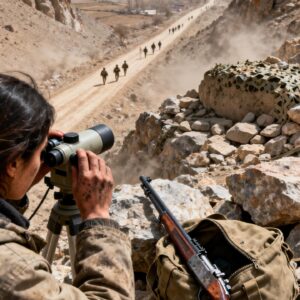
THE EXILED SNIPER: WHEN THE WORLD BRANDED ME A TRAITOR, I BECAME THE GHOST THAT SAVED THEM FROM THE SHADOWS
PART 1: THE SILENT WATCHER The wind at eleven thousand feet doesn’t just blow; it bites. It carries the metallic taste of snow and the ancient, dusty scent of stone that has been baking and freezing for millennia. I lay…
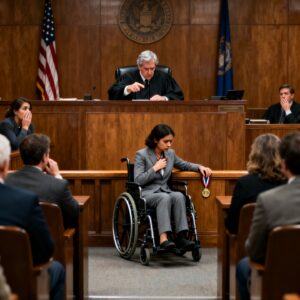
The Judge Called Me a Fraud and Demanded My Medal. He Had No Idea I Was the Reason His Son Was Still Alive.
PART 1: THE HUMILIATION The phantom rhythm of rotor blades was the first thing I heard. Thump. Thump. Thump. It wasn’t real, of course. It was just the ceiling fan in my San Diego apartment, slicing through the warm October air….

I Was Shackled in a Courtroom as a Homeless Thief, Ignored by Everyone—Until the Clerk Read My Service Number, the Judge Stood Up in Dead Silence, and the Man I Saved from Hell Recognized the Ghost He Thought Died in Fallujah.
PART 1: THE GHOST IN THE ORANGE SUIT The holding cell smelled of bleach and urine—a chemical cocktail meant to sanitize misery, but it only made it sting the back of your throat. I sat with my back pressed against…
I Was Supposed to Be Dead: The Day a SEAL Admiral Froze Mid-Speech, Saw the Forbidden Tattoo on My Wrist, and Exposed the Classified Secret I’d Hidden from My Son for Twenty Years.
PART 1: THE GHOST IN THE BACK ROW You learn to be invisible. That’s the first rule of survival when you’re walking around with a grave that already has your name on it. You learn to take up less space,…
The Ghost of Flight 227: She Was Supposed to Be Dead, But When the Captain Collapsed and the Plane Screamed toward Earth, the Woman in Seat 14C Revealed a Secret That Would shake the Pentagon to Its Core
PART 1: THE INVISIBLE PASSENGER The smell of economy class is always the same. It’s a cocktail of stale coffee, recycled air, and the sour, metallic tang of human exhaustion. I was breathing it in, four counts in, four counts…
THE GHOST OF KANDAHAR: They Buried My Career and Mocked My Name, But When The Admiral Saw My Sealed File, He Unleashed A War Machine They Never Saw Coming
PART 1: THE INVISIBLE WOMAN The Alabama heat at 0530 didn’t just hit you; it strangled you. It was a physical weight, a wet, suffocating blanket that smelled of JP-8 jet fuel, heated asphalt, and the stale, recycled air of…
End of content
No more pages to load