PART 1: The Echo of the Blast
The sun hit the courtyard like a sledgehammer. It wasn’t just heat; it was a physical weight, pressing down on the back of my neck, turning the air into something you didn’t breathe so much as swallow. Dust hung suspended in the golden haze, coating my tongue with the taste of grit and diesel fuel. It was the taste of Afghanistan. It was the taste of survival.
I took a step. My left leg screamed.
It wasn’t a sharp pain, not anymore. It was a dull, thrumming roar, a bass line vibrating through my femur and settling deep in my hip. I grit my teeth, forcing my jaw to lock so I wouldn’t make a sound. Left. Right. Left. The rhythm was broken, a jagged cadence that betrayed me with every yard I crossed.
I could feel the bandage beneath my trousers. It was wet. Sticky. The wound I’d taken three days ago was weeping again, the gauze surrendering to the relentless friction of movement. I should have been in a bed. I should have been elevating the limb, popping the painkillers the PA had shoved into my hand with a scowl. But the medical tent was across the compound, and I had forms to sign, supplies to inventory, and a stubbornness that was currently the only thing holding my skeleton together.
Around me, the base moved at the speed of war. Generators throbbed—a low, relentless heartbeat beneath the clatter of tools and the distant, rhythmic thwump-thwump-thwump of rotor blades cutting the sky. People moved fast. They carried crates, they checked manifests, they swapped out radio batteries. Speed meant efficiency. Speed meant survival.
I was the only thing moving slow.
I kept my eyes forward, fixed on the canvas flap of the comms building in the distance, treating it like a finish line. I didn’t look left. I didn’t look right. But I didn’t have to look to feel them.
A knot of men stood in the sliver of shade cast by the command center. Even from twenty yards away, they radiated that specific frequency of energy that screams “Elite.” Navy SEALs. They were new to the base, their gear cleaner than ours, their beards perfectly groomed, their boots crossed with that easy, untouchable confidence that comes from knowing you are the predator, not the prey.
I tried to suppress the limp. I tightened my core, trying to force a normal gait, but my body revolted. My boot dragged. Scrape.
One of them watched me pass. I could feel his eyes behind his sunglasses, dissecting the weakness. I saw the smirk crawl across his face before I heard the voice.
“Look at that,” he said. The voice was smooth, bored, and loud enough to cut through the hum of the generators. “Can’t even walk straight.”
I didn’t turn. I focused on the gravel crunching under my good boot.
“Guess she’s done playing soldier,” someone else said.
A laugh followed. It wasn’t a warm laugh. It was sharp, jagged, the sound of flies buzzing over something dead. It floated across the courtyard, lazy and cruel.
Then, a third voice tossed a rumor into the heat, casual as a grenade. “Probably running the wrong way when it blew. You know how the support staff gets.”
Heads turned. A few mechanics near a Humvee snickered. The heat seemed to spike, prickling against my skin. My hands curled into fists at my sides, my fingernails digging into my palms until I felt the pinch of it.
Keep walking, Emily, I told myself. Just keep walking.
I didn’t owe them a story. I didn’t owe them an explanation of why my leg felt like it was being chewed on by a wolf. I had eight years in uniform. I had filed the edges off my voice a long time ago, leaving behind something quieter, steadier. I learned early—back when I was a Private terrified of my own shadow—that there is a difference between loud courage and lasting courage.
Loud courage burns fast. It shouts in the bar. It brags in the mess hall.
Lasting courage holds the line when it’s 0300 hours, the world is dirt and fear, and there is no one there to clap.
I was a medic. And I refused to let the word “just” precede my title. Just a medic. “Just a medic” doesn’t drag a two-hundred-pound man with shattered femurs through choking diesel smoke. “Just a medic” doesn’t find a pulse with fingers shaking from shock and continue working anyway.
They didn’t see the two Bronze Stars tucked away in my file. They didn’t see the Purple Heart that was currently bleeding into my cargo pants. They saw a girl with a limp, and to men like Petty Officer Mark Davies—I recognized him now, the leader of the pack, the one with the swagger worn like body armor—a limp was an offense. It was an imperfection in their perfect world of warfare.
I passed them. I felt the judgment slide off my back like sweat.
But I wasn’t the only one who heard it.
Corporal Ryan Brooks was standing near the comms building, a coil of coaxial cable in his hand. He stopped dead. I saw his jaw tighten. Ryan knew. He’d been a Private when I talked him through his first firefight on a radio channel that crackled like rain. Breathe once. Now talk. That’s what I’d told him. He obeyed, and a platoon lived because the coordinates he read out were right the first time.
And Sergeant Dana Reeves, Military Police, was watching from her patrol route. Her eyes were hidden behind shades, but I saw her head tilt. She knew what the bandages meant. She had seen me crawl into the fire.
The SEALs didn’t know it yet, but this courtyard remembered things. The dust remembered.
As I rounded the corner, finally out of their line of sight, the adrenaline that had kept my spine straight began to drain away, leaving only the wreckage. I stumbled, catching myself against the rough wooden wall of a supply shed. A gasp tore out of my throat, ragged and wet.
I closed my eyes, and instantly, the courtyard vanished. The heat remained, but the sound changed. The generators faded, replaced by the roar of an engine and the crunch of tires on loose sand.
Flashback. Three days ago.
The convoy had hit loose sand with the kind of bad luck you only understand if you’ve driven here. One moment, the road was a ribbon of hard-packed dirt, predictable and safe. The next, it wasn’t.
I was in the back of the second MRAP, sitting opposite Specialist Miller and Private Gomez. We were joking about the chow hall spaghetti—whether it was actually pasta or just red-dyed rubber bands. Miller was laughing, his head thrown back, his teeth white against the grime on his face.
Then the world lifted.
It didn’t start with a sound. It started with a punch. A massive, invisible giant slammed its fist into the bottom of the truck. The vehicle, twelve tons of armored steel, was tossed into the air like a child’s toy.
Gravity reversed. I was on the ceiling. Then the wall. Then the floor.
Then came the noise.
A crack so loud it wasn’t sound—it was pressure. It blew out the air in the cabin, replacing it with a vacuum that sucked the breath from my lungs. The world turned black, then red, then a hazy, choking gray.
I landed hard. My left leg crumpled against a munitions crate, and I heard the snap before I felt it. A scream ripped through the air, high and thin. It took me a full three seconds to realize it was my own voice.
“Sound off!” I choked out, the training kicking in before my brain could process the pain. “Status! Sound off!”
Silence.
“Miller! Gomez!”
The interior of the MRAP was a nightmare. We were on our side. The air was thick with dust, the smell of ozone, and the sharp, metallic tang of blood. The distinct, terrifying acrid scent of burning rubber began to creep in.
I tried to move. My leg refused. It felt like it had been pinned to the chassis with a railroad spike. I looked down. A jagged piece of metal plating had buckled inward, slicing through my trousers and into the calf.
“Move,” I hissed at myself. “Move or die.”
I grabbed the handhold above me—which was now beside me—and hauled. Agony, white-hot and blinding, arced up my spine. I screamed again, a guttural sound, but I pulled. I ripped my leg free from the snag, feeling the skin tear, feeling the warm rush of blood soak my boot.
I crawled. The angle was all wrong. The floor was a slide.
I found Miller first. He was slumped over his harness, unconscious, a gash on his forehead weeping blood into his eyes.
“Miller,” I slapped his cheek. “Wake up.”
He groaned. “Doc?”
“Yeah, it’s Doc. We gotta go. Now.”
“My legs…”
“I got you. Come on.”
I hit the release on his harness. He fell onto me, a dead weight of body armor and muscle. My injured leg buckled, sending a fresh wave of nausea through me, but I shoved him toward the rear hatch.
The hatch was jammed. Of course it was jammed.
“Gomez!” I yelled into the gloom.
Gomez was in the front, trapped behind the driver’s seat. He wasn’t moving.
I grabbed the emergency pry bar from the wall. My hands were shaking so bad I almost dropped it. The adrenaline was a drug, making everything sharp and blurry at the same time. I jammed the bar into the hatch mechanism and threw my entire body weight against it.
screech-CLANG.
The door popped open, daylight flooding in. It wasn’t the welcoming sun; it was the harsh, blinding glare of the kill zone.
“Miller, get out!” I shoved him. He tumbled out onto the sand.
I turned back. The smell of smoke was stronger now. Dark, oily smoke. The fuel tank.
“Gomez!”
I scrambled back up the slanted floor. My leg was useless, dragging behind me like a dead thing. I clawed my way to the front. Gomez was awake, his eyes wide, fixed on nothing. Shock.
“Private! Look at me!” I grabbed his vest.
“I can’t… I can’t feel my hands, Sergeant.”
“You don’t need your hands to walk. Move!”
I grabbed his drag handle. I planted my good foot against the dashboard and pulled. He moved an inch. I pulled again. He moved two.
Then the ammo started to cook off.
Pop. Pop-pop. POP.
Small arms fire, detonating inside the crushed hull of the vehicle. It sounded like popcorn, if popcorn could kill you. A bullet whizzed past my ear, ricocheting off the steel wall.
“We are leaving!” I screamed.
I didn’t carry him. I didn’t have the strength to carry him. I dragged him. I became a creature of leverage and desperation. I hooked my arm under his, digging my heels into the debris, ignoring the blood that was now pooling in my boot. I dragged him over the seats, over the crates, down the slope of the floor.
The heat from the fire beneath us was radiating through the metal. It was cooking us.
We hit the open air and I fell, tumbling out of the hatch and hitting the asphalt hard. My injured leg took the impact, and my vision went white. I almost passed out right there. It would have been so easy. Just close my eyes. Just let the dark take me.
No.
“Get clear!” I grabbed Gomez’s collar again.
I dragged him ten yards. Twenty. The sand was biting into my elbows. My lungs were burning.
Then, the truck went up.
A whump of sound, deeper than the first. A fireball rolled into the sky, orange and black and furious. The heat washed over us, singeing the hair on my arms.
I collapsed into the dirt, chest heaving, staring at the burning wreckage.
I rolled over to check Gomez. He was blinking now. He looked at me, eyes focusing slowly. He reached out and squeezed my wrist. His grip was weak, but it was there.
“Doc…”
“I’m here,” I whispered. “I’m here.”
I checked his pulse. I checked his airway. I did the work because the work is what keeps the panic in the box. Only when the QRF (Quick Reaction Force) arrived, when I saw the boots of the rescue team running toward us, did I look down at my own leg.
The trouser leg was shredded. The blood was dark and steady.
“Sergeant Carter!” A medic from the relief bird was over me. “Don’t move.”
“Check Gomez first,” I rasped. “Check Miller.”
“They’ve got them. Let me see that leg.”
He cut the pant leg. He swore softly.
“You walked on this?” he asked, looking at me like I was a ghost. “You dragged a man on this?”
“Had to,” I said. And then the lights went out.
End Flashback.
“Sergeant?”
The voice brought me back to the present. I opened my eyes. I was still leaning against the supply shed. The wood was rough against my cheek.
A young Private, a kid who looked barely old enough to shave, was staring at me. He was holding a clipboard, looking terrified.
“Sergeant Carter? Are you… do you need a medic?”
I laughed. A dry, brittle sound. “I am the medic, Private.”
I pushed myself off the wall. The pain was still there, a faithful companion, but the memory of the fire had cold-welded my resolve.
“I’m fine,” I lied. “Just catching my breath.”
“Yes, Sergeant.” He didn’t look convinced. He looked at my leg, then back at my face. He had seen the limp. He had probably heard the laughter from the courtyard, too.
“Carry on, Private,” I said, my voice dropping into that command tone that brooks no argument.
“Hooah, Sergeant.” He scurried away.
I adjusted my uniform. I checked the bandage—still seeping, but holding. I turned toward the medical tent.
The distance between the supply shed and the tent was maybe two hundred yards. It felt like two hundred miles. But I would walk it. And I would walk it straight.
The insults from the SEALs echoed in my head. Can’t even walk straight. Done playing soldier.
They thought they knew what a soldier looked like. They thought it looked like bulging biceps, clean gear, and a confident stride. They didn’t know that sometimes, a soldier looks like a woman holding her breath to keep from screaming, putting one foot in front of the other because stopping isn’t an option.
I didn’t know it then, but the war wasn’t over. The IED had failed to kill me. The fire had failed to burn me. But the laughter in the courtyard? That was a different kind of shrapnel. It had lodged itself in the air of the base, infecting the morale, poisoning the brotherhood.
And as I limped toward the tent, unaware of the eyes of Lieutenant Colonel Morales or the simmering rage of Corporal Brooks, I didn’t realize that my walk hadn’t just been a struggle for survival.
It had been a testimony.
And the trial was about to begin.
PART 2: The Silence Before the Scream
The medical tent smelled of iodine, rubbing alcohol, and the stale, refrigerated air that always feels unnatural in the desert. I sat on the edge of the cot, my left boot off, the blood-soaked sock lying in a metal basin like a dead thing.
Major Henderson, the Physician Assistant, wasn’t happy. He was peeling back the gauze with the kind of aggressive delicacy that told me I was in trouble.
“You walked on it,” Henderson said. It wasn’t a question. It was an accusation.
“The tent was this far away,” I replied, staring at a stain on the canvas wall. “I didn’t have a choice.”
“You always have a choice, Carter. You could have called a transport. You could have radioed for a pick-up.” He ripped the last layer of gauze free. I hissed, my hand gripping the edge of the cot until my knuckles turned white. “Look at this. You’ve torn the sutures. It’s bleeding again. If this gets infected, I’m not just grounding you; I’m evacuating you to Germany.”
“Don’t you dare,” I snapped, my eyes snapping to his. “My team is here. My work is here.”
“Your leg is hamburger!” He grabbed a bottle of saline and began to irrigate the wound. The sting was sharp and cold. “You know, for a medic, you’re a terrible patient. You treat nineteen-year-olds with more compassion than you treat yourself.”
“They need it,” I said softly. “I don’t.”
“Everyone needs it.” He began to re-wrap the wound, his hands moving with practiced speed. “I heard about the courtyard, Emily.”
I stiffened. “I don’t know what you’re talking about.”
“Don’t give me that. This base is a small town with high fences. News travels faster than a bullet.” He secured the bandage with a metal clip. “Some of the new SEALs decided to run their mouths. Made a joke of it.”
“It doesn’t matter,” I lied.
“It matters to Ryan,” Henderson said, looking up at me over his spectacles. “It matters to Dana Reeves. I saw her patrol log. She’s been circling the Comm building like a shark for the last two hours. She’s not hunting insurgents, Emily. She’s collecting evidence.”
I sighed, rubbing my temples. “I don’t want a scene, Major. I don’t want a pity party. I just want to do my job until this heals.”
“You might not want a scene,” Henderson said, standing up and stripping off his gloves. “But you’re going to get justice. Whether you ask for it or not.”
He handed me a fresh pack of painkillers. “Take them. Elevate that leg for at least two hours. If I see you walking on it before chow, I’ll have you court-martialed for insubordination.”
“You’re not funny.”
“Only on days when I’m vertical.”
I took the pills but didn’t take them. I pocketed them. Pain is information. It tells you what’s wrong. If I numb it, I might make a mistake. I grabbed my crutch—a hateful aluminum thing that rattled when it hit the floor—and pushed myself up.
Outside, the afternoon had turned the base into a kiln. The heat was a physical weight. I made my way back toward the supply sheds, keeping to the shadows. I could feel the eyes on me again. But this time, the texture of the gaze was different.
It wasn’t mockery. It was something heavier.
I passed a group of mechanics working on a Stryker. They stopped talking as I approached. One of them, a grizzled Sergeant with grease up to his elbows, nodded at me. A sharp, respectful nod. I nodded back, confused.
I didn’t know that Ryan Brooks had already filed his statement. I didn’t know that Sergeant Reeves had pulled the security cam footage from the corner of the Comm building—grainy video that showed the SEALs laughing, and me walking with my head high. I didn’t know that Lieutenant Colonel Janet Morales, the Deputy Base Commander, was currently sitting in her office with a folder that was rapidly growing thicker.
All I knew was that the air felt charged, like the sky before a thunderstorm.
I reached the supply shed. It was my sanctuary. Rows of shelves, organized chaos, the smell of cardboard and metal. I had promised the Quartermaster I would inventory the trauma kits. It was busy work, sit-down work, exactly what I needed to keep my mind off the throbbing in my calf.
Inside, Private First Class Jenkins was struggling. He was a supply specialist, barely twenty, with a frame that hadn’t quite filled out his uniform. He was standing on his tiptoes, trying to pull a heavy crate of IV fluids off a top shelf. He was inches short, his fingers slipping on the cardboard.
“Don’t,” I said.
He jumped, startled, and the box teetered. He flailed, knocking a stack of clipboards to the floor with a clatter.
“Sergeant! I—I didn’t hear you come in.”
“Clearly.” I hobbled over, leaning the crutch against a workbench. “You’re going to drop that on your head, Jenkins. Then I’ll have to stitch you up, and Major Henderson will yell at both of us.”
“Sorry, Sergeant. The ladder is… someone took the ladder.”
“Improvise, adapt, overcome,” I muttered. “But don’t be stupid.”
I moved next to him. My leg protested, sending a spike of fire up my hip, but I ignored it. I reached up with my good side. I wasn’t taller than him, but I knew leverage. I tilted the box, slid my hand underneath to find the center of gravity, and guided it down to the counter in one smooth motion.
I didn’t grunt. I didn’t wince. I just did the work.
Jenkins looked at me, his eyes wide. He looked at the bandage on my leg, then at my face.
“Sergeant… is it true?” he asked, his voice small.
“Is what true?” I opened the box and started counting saline bags.
“That you… that you saved Miller and Gomez? That you dragged them out while the ammo was cooking off?”
I paused. My hand hovered over a bag of fluid. “Miller and Gomez are alive, Jenkins. That’s the only part of the story that matters.”
“The SEALs…” he started, then stopped, looking angry. “I heard what they said. In the courtyard. Corporal Brooks told us.”
I looked at him sharply. “Ryan needs to learn to keep his mouth shut.”
“No, Sergeant,” Jenkins said, and for the first time, he looked like a soldier. “He said they laughed at you. He said they called you weak. They don’t know, do they?”
“They don’t need to know.”
“They should,” he said fiercely. “They walk around here like they own the sand. But I never saw them crawl into a burning truck.”
I softened. “Hand me that clipboard, Jenkins. Let’s get these numbers right. Anger doesn’t inventory supplies.”
We worked in silence for an hour. The rhythm of the count was soothing. Ten tourniquets. Check. Five chest seals. Check. Three packs of combat gauze. Check. It was order in a world of disorder.
But outside, the order was unraveling.
In the command tent, Lieutenant Colonel Morales was holding court. I learned this later, piecing it together from the whispers. She had summoned Commander Porter, the SEAL team lead. Porter was a good man, a hard man, respected. He didn’t know about the incident. When Morales played the audio tape—recorded by a nearby security post—Porter didn’t make excuses. He listened to his men mocking a wounded soldier, and his face went the color of stone.
“This is a violation,” Morales had said, her voice like a blade. “Not just of conduct, but of the code. We fight for each other. We do not eat our own.”
“I will handle it,” Porter had promised.
“We will handle it,” Morales corrected. “0700 hours tomorrow. All of them. In here.”
The sun began to dip, painting the sky in bruises of purple and orange. I finished the inventory and picked up my crutch.
“Good work, Jenkins,” I said.
“Sergeant?”
“Yeah?”
“If… if anyone says anything to you again. You tell me. I’m just supply, but… I got your back.”
I smiled, a genuine, tired smile. “I know you do, Jenkins. Keep your head on a swivel.”
I stepped out into the twilight. The heat had broken, replaced by a dry, cooling breeze. I needed to get to the mess hall, grab a tray, and get back to my bunk before my leg gave out completely.
I was halfway across the base, near the very spot where the insult had happened hours earlier, when the world tilted again.
“MEDIC!”
The scream tore through the evening air. It wasn’t a drill. You learn to hear the difference. A drill has a cadence. Real fear has a pitch that scrapes against your bones.
“MEDIC! MAN DOWN! I NEED A MEDIC!”
I turned. Fifty yards away, near the generator banks, a Humvee had skidded to a halt. The door was open. Two soldiers were dragging a third man out onto the gravel. Blood was everywhere. Bright, arterial red, spraying in a rhythmic jet.
My brain shut off the pain. My brain shut off the exhaustion. It switched to the only mode that mattered: Fix it.
I dropped the crutch.
I didn’t think about it. I just dropped it. And I ran.
It wasn’t a pretty run. It was a loping, hobbling sprint, my left leg screaming with every impact, my teeth gritted so hard I thought they’d shatter. But I was moving fast.
I saw the crowd forming. And I saw them.
The SEALs. Davies and his crew. They were closest.
Davies was already there. He was kneeling over the wounded soldier—a kid from the engineering corps who had taken a jagged piece of shrapnel from a blown tire rim straight to the brachial artery in his arm.
Davies looked panicked. He was a warrior, a shooter, a door-kicker. He knew how to take a life. But looking at the blood spurting onto his pristine uniform, he froze. He was pressing down, but his hands were slipping. The blood was too slick. The kid was thrashing, screaming, his eyes rolling back.
“Hold him still!” Davies roared at his men, but his voice had a tremor in it. “I can’t get a grip! I need a tourniquet!”
He reached for his belt, fumbling with his kit. His fingers were covered in blood. He dropped the TQ.
The kid was dying. Right there on the gravel. I could see the color draining from his face, turning from tan to gray to wax.
I hit the circle of men like a linebacker.
“MAKE HOLE!” I screamed.
The SEALs scrambled back, startled by the ferocity of the voice. I didn’t stop. I slid into the gravel beside the wounded boy, ignoring the agony that shot up my leg as my knees hit the rocks.
I didn’t look at Davies. I looked at the wound.
“Let go,” I ordered Davies.
“He’s bleeding out, I can’t—”
“I said let go! You’re pressing on the muscle, not the artery!”
I shoved Davies’s hands away. I jammed my thumb into the boy’s armpit, high up, digging deep into the soft tissue, pinning the artery against the bone.
The fountain of blood stopped instantly.
“TQ!” I barked, not looking up. “Give me a TQ! Now!”
Davies blinked, stunned. He looked at his bloody hands, then at me.
“NOW, SAILOR!” I snapped, using a tone that could strip paint.
Davies snapped out of it. He grabbed the tourniquet from the dirt where he’d dropped it and handed it to me.
“High and tight,” I said, my voice dropping to that calm, mechanical cadence that Ryan Brooks knew so well. “Put it on. High and tight. Crank it until he screams.”
Davies obeyed. He slid the strap over the arm, cinched it down, and twisted the windlass. The wounded engineer screamed, a guttural sound of agony.
“Keep twisting,” I said, watching the blood flow. “Twist until I tell you to stop.”
Davies twisted. His face was pale, sweat beading on his forehead.
“Stop,” I said. “Lock it.”
He locked the rod in the clip. I checked the distal pulse at the wrist. Nothing. Good.
“Time,” I said aloud. “20:14 hours. TQ applied.”
I looked up then. I was kneeling in a pool of blood. My trousers were soaked. My left leg was throbbing with a violence that made my vision swim.
I looked straight at Petty Officer Mark Davies.
He was staring at me. He was staring at the scar on my cheek. He was staring at the bandage on my leg that was now wet with new blood. And he was staring at my hands—steady as stone—holding the life of a stranger.
His eyes widened. Recognition hit him like a physical blow.
He knew who I was. He knew I was the “cripple” he had laughed at. And he knew that without me, the boy beneath us would be dead.
“Doc…” he whispered.
“Get me a pressure dressing,” I said, my voice ice cold. “And don’t speak. Just work.”
PART 3: The Weight of Honor
(Approx. 2,000 Words)
The gravel dug into my knees, but I didn’t feel it. The world had narrowed down to the triangle of space between me, the wounded engineer, and the hands of the man who had mocked me.
“Dressing,” I repeated.
Davies moved. The arrogance was gone. The swagger had evaporated in the heat of the crisis. He ripped open his med-kit with trembling fingers and handed me the Israeli bandage.
“Wrap it,” I told him. “Tight. Over the wound. I’m going to hold pressure.”
He wrapped. I watched his hands. They were strong hands, capable of violence, but clumsy with care. I guided him, tapping his wrist to adjust the angle. “Pull. Reverse. Lock the bar. Good.”
The engineer, a kid named Sullivan, was conscious now, his breathing shallow and rapid. “Am I dying? Sarge, am I dying?”
I leaned over him, putting my bloody hand on his forehead. I forced a smile I didn’t feel. “Not today, Sullivan. You just sprang a leak. We plugged it. You’re going to get a nice helicopter ride and a story to tell girls at the bar.”
“My arm hurts…”
“That means it’s still there. Pain is good. Pain is life.”
The base medical team arrived in a swirl of dust and noise. The stretcher came out. Major Henderson was there, barking orders. They loaded Sullivan up. Henderson looked at the tourniquet, checked the time written on Sullivan’s forehead in marker, and looked at me. He nodded. A professional acknowledgment. Good save.
As they lifted the stretcher, the adrenaline crashed.
The pain in my leg returned with a vengeance, a tidal wave that turned my stomach inside out. I tried to stand, but my left knee buckled.
I would have hit the ground. I should have hit the ground.
But a hand caught me.
I looked up. Mark Davies had me by the elbow. His grip was iron-hard, stabilizing me. He wasn’t looking at me with pity. He was looking at me with something that looked a hell of a lot like fear—the fear of a man realizing he has committed a sin against his own code.
“I got you,” he said. His voice was rough.
I pulled my arm away. “I can walk.”
“Sergeant, please. Your leg…”
“My leg is fine,” I said, gritting my teeth. “Find my crutch.”
He scrambled to find it in the dust. He picked it up and held it out to me like it was a holy relic. I took it, settled it under my arm, and straightened my spine.
The courtyard was silent. A circle of soldiers had formed—SEALs, MPs, mechanics. They had seen it all. They had seen the insult earlier, and now they had seen the redemption.
I looked at Davies. He was covered in Sullivan’s blood. I was covered in Sullivan’s blood.
“You twist a good windlass, Davies,” I said quietly. “For a shooter.”
He flinched. “Sergeant, I…”
“Don’t,” I said. “Not here.”
I turned and limped toward the medical tent. I didn’t look back.
The next morning, the summons came.
0700 hours. Command Tent.
I didn’t want to go. I wanted to stay in my bunk and pretend the world didn’t exist. But an order is an order. I put on my fresh uniform. I polished my boots. I wrapped my leg tight.
When I walked into the tent, the air was heavy enough to choke on.
It was a full house. Lieutenant Colonel Morales stood at the head of the table. Commander Porter stood beside her. And seated in two rows of folding chairs were the SEALs. All of them.
Davies was in the front row. He looked like he hadn’t slept. His eyes were red-rimmed.
“Sergeant Carter,” Morales said. “Report.”
I hobbled to the center of the room and saluted. “Sergeant First Class Carter reporting as ordered, Ma’am.”
“At ease, Sergeant. Take a seat.”
“I prefer to stand, Ma’am.” Standing hurt, but sitting felt like weakness.
“Very well.” Morales picked up a folder. “We are here to address an incident regarding conduct unbecoming of this force. But before we get to the discipline, we need to establish the facts.”
She turned to Davies. “Petty Officer Davies. Stand up.”
Davies stood. He stood at attention, rigid as a board.
“Yesterday afternoon,” Morales said, her voice echoing in the silence, “you made a comment regarding Sergeant Carter’s gait. You implied she was unfit. You implied she was… ‘done playing soldier.’ Is that correct?”
“Yes, Ma’am,” Davies said. His voice didn’t waver, but it was hollow.
“Do you know why Sergeant Carter limps?” Commander Porter asked. His voice was quieter, more dangerous.
“I do now, Sir,” Davies said.
“Humor me,” Porter said. “Tell the room.”
Davies swallowed. “Three days ago, her convoy hit an IED. Her vehicle rolled. She took shrapnel to the left calf. Despite the injury, she extracted two soldiers from the burning vehicle while ammunition cooked off. She refused evacuation until her men were safe.”
“And yesterday?” Porter pressed. “When you froze?”
Davies looked down at his boots, then up at me. “Yesterday, she ran on that same injured leg to save a man I couldn’t save. She took command. She saved the life of Private Sullivan while I was fumbling with a tourniquet.”
The room was so quiet you could hear the wind flapping the canvas walls.
Morales stepped forward. She placed a photo on the table. It was a picture of my arm. The tattoo. An arrow with the number 26 beneath it.
“Twenty-six,” Morales said. “That is the number of men and women who are alive today because Sergeant Carter put her hands on them. Twenty-six families who got their sons and daughters back.”
She looked at the SEALs. “You gentlemen are the tip of the spear. You are elite. But being elite isn’t about how fast you run or how straight you shoot. It is about who you protect. When you mocked this soldier, you didn’t just mock a woman with a limp. You mocked the very concept of sacrifice.”
She turned to me. “Sergeant Carter, do you have anything to say?”
I looked at Davies. I looked at the men behind him—Hart, the one who had laughed, and the others who had stayed silent. They looked ashamed. Not just caught, but deeply, fundamentally ashamed.
“Ma’am,” I said. “I don’t need an apology.”
“You deserve one,” Porter said.
“Maybe,” I said. “But apologies are words. Words are cheap. Yesterday, in the dirt, Petty Officer Davies helped me save a life. He listened. He followed orders. He got his hands dirty.”
I paused, shifting my weight on the crutch.
“If they want to make it right,” I said, looking Davies in the eye, “then let them learn. Send them to the rehab center. Let them sit with the guys who lost legs and eyes. Let them change bedpans and listen to the nightmares. Let them see what the cost of ‘playing soldier’ actually looks like.”
Davies nodded. A sharp, jerky movement. “I’ll go. Today. I’ll go every day.”
Morales looked at Porter. Porter nodded.
“Petty Officer Davies,” Morales said. “You are demoted one grade. You are removed from the active roster pending a full retraining on unit culture. And you will report to the Rehabilitation Clinic at 0800 hours every day for the next month. You will work under the supervision of the nursing staff. You will learn humility.”
“Yes, Ma’am.”
“Dismissed.”
The aftermath wasn’t loud. It wasn’t a movie ending with cheering crowds. It was quiet. It was the quiet of a bone setting properly.
Davies kept his word.
I saw him a week later at the clinic. I was there for a dressing change. He was pushing a wheelchair for a corporal who had lost both legs. Davies was leaning down, listening to the man talk, laughing at something the corporal said. He saw me.
He stopped pushing. He walked over. He looked different. The swagger was gone, replaced by a kind of weary gravity.
“Sergeant Carter,” he said.
“Davies.”
He reached into his pocket and pulled out a folded piece of paper. “I wrote this. I didn’t know if I should give it to you. But… here.”
I took it. I didn’t open it then. I waited until I was back in my bunk, alone with the hum of the AC unit.
I unfolded the paper. His handwriting was blocky, all caps.
SERGEANT, I THOUGHT STRENGTH WAS NEVER SHOWING WEAKNESS. I THOUGHT A LIMP WAS A FAILURE. YOU TAUGHT ME THAT A LIMP IS PROOF THAT YOU DIDN’T RUN AWAY. I AM SORRY. NOT JUST FOR THE JOKE, BUT FOR BEING BLIND. THANK YOU FOR TEACHING ME WHAT A SOLDIER ACTUALLY IS. – M. DAVIES
I folded the note and tucked it into my footlocker, right next to the Bronze Star I never wore.
A month later, my leg was healed enough to walk without the crutch. The limp was still there—a hitch in my step that would probably never go away entirely. But I didn’t try to hide it anymore.
I walked across the courtyard. The sun was setting, casting long shadows across the dust.
A group of new replacements was standing near the Comm building. They were watching me. I braced myself for a comment, for a look.
But as I passed, they didn’t laugh. They didn’t sneer.
They stopped talking. They stood up straighter. One of them, a young kid, touched the brim of his cap.
“Evening, Sergeant,” he said.
“Evening,” I replied.
I kept walking. Left. Right. Left. The pain was there, but it was just noise now. I walked past the spot where the laughter had happened, and I walked past the spot where the blood had spilled.
I realized then that the desert hadn’t stripped me down to nothing. It had stripped me down to the truth.
Strength isn’t about being unbreakable. It’s about breaking, and then pulling yourself together to drag someone else out of the fire. It’s not the roar of the gun; it’s the silence of the hand holding yours when the world goes dark.
I am Sergeant Emily Carter. I have a limp. And I have never stood taller.
News
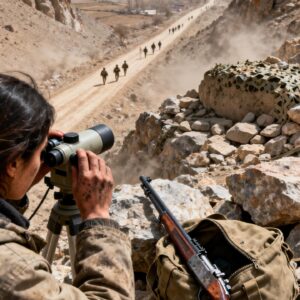
THE EXILED SNIPER: WHEN THE WORLD BRANDED ME A TRAITOR, I BECAME THE GHOST THAT SAVED THEM FROM THE SHADOWS
PART 1: THE SILENT WATCHER The wind at eleven thousand feet doesn’t just blow; it bites. It carries the metallic taste of snow and the ancient, dusty scent of stone that has been baking and freezing for millennia. I lay…
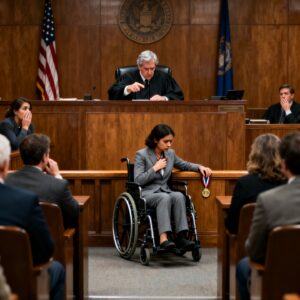
The Judge Called Me a Fraud and Demanded My Medal. He Had No Idea I Was the Reason His Son Was Still Alive.
PART 1: THE HUMILIATION The phantom rhythm of rotor blades was the first thing I heard. Thump. Thump. Thump. It wasn’t real, of course. It was just the ceiling fan in my San Diego apartment, slicing through the warm October air….

I Was Shackled in a Courtroom as a Homeless Thief, Ignored by Everyone—Until the Clerk Read My Service Number, the Judge Stood Up in Dead Silence, and the Man I Saved from Hell Recognized the Ghost He Thought Died in Fallujah.
PART 1: THE GHOST IN THE ORANGE SUIT The holding cell smelled of bleach and urine—a chemical cocktail meant to sanitize misery, but it only made it sting the back of your throat. I sat with my back pressed against…
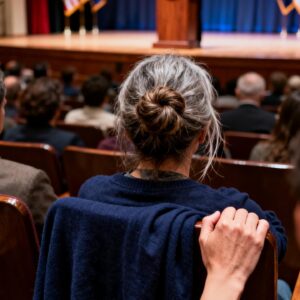
I Was Supposed to Be Dead: The Day a SEAL Admiral Froze Mid-Speech, Saw the Forbidden Tattoo on My Wrist, and Exposed the Classified Secret I’d Hidden from My Son for Twenty Years.
PART 1: THE GHOST IN THE BACK ROW You learn to be invisible. That’s the first rule of survival when you’re walking around with a grave that already has your name on it. You learn to take up less space,…
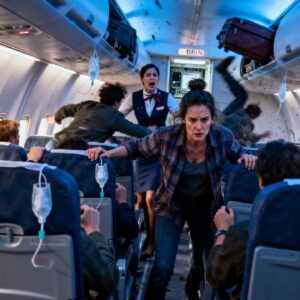
The Ghost of Flight 227: She Was Supposed to Be Dead, But When the Captain Collapsed and the Plane Screamed toward Earth, the Woman in Seat 14C Revealed a Secret That Would shake the Pentagon to Its Core
PART 1: THE INVISIBLE PASSENGER The smell of economy class is always the same. It’s a cocktail of stale coffee, recycled air, and the sour, metallic tang of human exhaustion. I was breathing it in, four counts in, four counts…
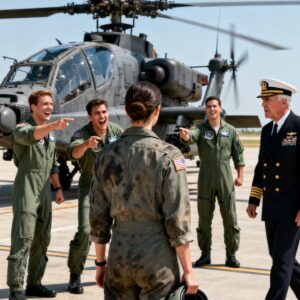
THE GHOST OF KANDAHAR: They Buried My Career and Mocked My Name, But When The Admiral Saw My Sealed File, He Unleashed A War Machine They Never Saw Coming
PART 1: THE INVISIBLE WOMAN The Alabama heat at 0530 didn’t just hit you; it strangled you. It was a physical weight, a wet, suffocating blanket that smelled of JP-8 jet fuel, heated asphalt, and the stale, recycled air of…
End of content
No more pages to load