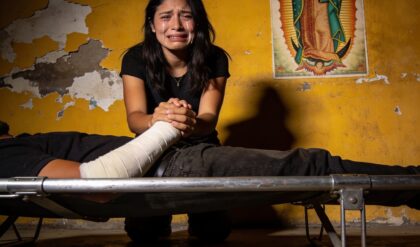
The Serpent and The Eagle: The Ghost of Ravenwood
Introduction: Camp Ravenwood wasn’t designed to train soldiers; it was designed to shatter souls. Rain didn’t just fall here; it felt like it was being fired from a suppression hose, cold enough to freeze the marrow in your bones. We were the latest batch of hopefuls—or “fresh meat,” as Staff Sergeant Thaddeus Braxley liked to call us—thinking we had what it took to join the elite. Eighty percent of us would wash out. That was the statistic. But looking at the man pacing in front of us, I had a feeling the number was going to be higher.
Braxley was a legend, but not the good kind. He was a shark in fatigues, a man who had been breaking spirits for fifteen years. He didn’t look for strength; he hunted for weakness. And on day one, minute one, his predator eyes locked onto a target that seemed almost too easy.
Recruit Vada Novak.
Standing third from the end of the formation, she looked like she’d been blown into the camp by a stiff breeze. Five-foot-seven, wiry, with a face that gave away absolutely nothing. She was standing next to Riker, a former college linebacker who took up enough space for two people, and the contrast was almost comical. Riker was twitching, adrenaline pumping, eager to prove he was the alpha. Novak was… still.
Too still.
“What are you doing here, Novak?” Braxley’s voice was a low growl, cutting through the sound of the rain. He was inches from her face, the brim of his hat dripping water onto her nose. She didn’t blink.
“Training to serve, Staff Sergeant,” she replied. Her voice was soft, steady, completely devoid of the fear that was currently making my knees knock together.
Braxley stepped back, a cruel smile twisting his lips. He turned to the rest of us. “Training to serve,” he mimicked, pitching his voice high. “Did you hear that, ladies? Novak thinks she’s going to serve. Tell me, Novak, what makes a librarian think she belongs in my mud?”
He waited for the flinch. He waited for the stutter. It never came. She just stared through him, her posture perfect, her eyes fixed on the horizon as if she were watching something none of us could see.
“I asked you a question, recruit!” Braxley roared.
“Permission to continue, Staff Sergeant,” she said.
That was it. No defense. No anger. Just a polite request to keep suffering.
It infuriated him. I could see the vein in his neck pulse. Silence is the one thing bullies can’t stand; it’s a mirror they don’t want to look into.
“Drop,” Braxley screamed, spit flying. “Twenty burpees. All of you. Because Novak here thinks she’s special.”
We dropped. The mud was slick, smelling of rot and diesel. My arms burned by the tenth rep, my lungs heaving against the cold air. Beside me, Laurelai—a girl whose family money practically oozed out of her pores—was groaning with every jump. Zephyr, a lean, calculating recruit who looked like she’d knife you for a protein bar, was moving with mechanical efficiency.
But I watched Novak. I couldn’t help it. I’ve always been the guy who notices details—it’s a curse, really. I watched how her hands hit the mud. Flat, fingers splayed for maximum stability. I watched her breathing. It wasn’t the ragged gasping of a rookie; it was a rhythm. In, out. In, out.
She wasn’t struggling. She was pacing herself. It was like watching a Ferrari drive at ten miles an hour in a school zone. She was performing mediocrity with terrifying precision.
“Novak, front and center!”
We scrambled to our feet. Novak marched forward, mud caked on her uniform, her face still a blank slate.
“Your file says Logistics,” Braxley sneered, holding a clipboard like a weapon. “Inventory. Supply chains. Pencil pushing. Why does a box-kicker think she’s qualified for Special Operations?”
“I want to go where I am needed most, Staff Sergeant.”
“Where you’re needed most is a desk in Nebraska,” Braxley laughed, and Riker joined in, a loud, sycophantic guffaw. “But since you’re here, you can be my demo doll. The Crucible. Now.”
The Crucible. A nightmare of walls, barbed wire, and ropes stretching across the field. It was designed to make grown men cry. Novak didn’t hesitate.
“Begin!”
She took off. Again, that strange, measured pace. She didn’t sprint. She flowed. She hit the twelve-foot wall and scaled it with a technique I’d only seen in training manuals—efficient, energy-conserving. She crawled under the barbed wire, ignoring the mud sliding into her eyes.
“Not bad for a pencil pusher,” I heard someone mutter. It was Callaway—me. I realized I’d said it out loud.
“Watch the mud pit,” Riker whispered, stepping up beside me, a nasty grin on his face. “No way she handles the ropes. She doesn’t have the upper body strength.”
The mud pit was twenty feet across, a soup of brown sludge with three slick ropes suspended above it. You had to dangle and shimmy across. Novak grabbed the first rope. She moved methodically, testing the weight, swinging her legs to generate momentum. She made it halfway. She was doing it.
Then, she stopped.
I squinted through the rain. She was holding the middle rope. Her grip looked solid. Her forearms weren’t shaking. But then, I saw her eyes flick toward Braxley, who was watching her with his arms crossed.
For a split second, her hand loosened. It wasn’t a slip. It was a release.
She plunged into the mud with a sickening squelch.
Laughter erupted from the line. Riker was practically bent over. “Told you! Weak!”
Braxley smirked, his point proven. “Pathetic. Get out of my pit, Novak.”
I watched as she pulled herself out of the sludge. She was coated head to toe, looking like a swamp creature. But as she wiped the muck from her eyes, I saw it again—that calm, distant focus. She hadn’t fallen because she was weak. She had fallen because she wanted to fail.
Why? Who comes to Special Forces selection just to fail on purpose?
The rest of the day was a blur of torture. Riker crushed the course, finishing first and making sure everyone knew it. Laurelai and Zephyr did well enough. I finished middle of the pack, which is exactly where I like to be—invisible. Novak finished last.
“Congratulations, Novak,” Braxley announced as the sun began to dip, casting long, blood-red shadows across the compound. “Your incompetence has earned the platoon night drills. Two hours. Move it!”
The groans were audible. If looks could kill, Novak would have been dead before she hit the showers.
The barracks that night were a pressure cooker. The air smelled of wet wool, sweat, and resentment.
“Why are you even here?” Laurelai cornered Novak by her footlocker. Laurelai was used to getting answers, and Novak’s silence was driving her crazy. “This isn’t an equal opportunity charity case. You’re going to get us all washed out. Or worse.”
Novak didn’t look up. She was folding her socks. But “folding” is an insult to what she was doing. She was engineering them. Every crease was geometrically perfect. Her footlocker looked less like a recruit’s box and more like a surgeon’s tray.
“I asked you a question, Logistics,” Laurelai snapped.
Novak stepped around her, smooth as water. “Excuse me.”
Zephyr, sitting on the top bunk, dangled her legs. “Where were you stationed before this, Novak? You never say.”
“I didn’t,” Novak replied, closing her locker with a soft click.
That night, sleep was impossible. My body ached, but my mind was racing. Something about the rope. The way she fell. It gnawed at me.
Around 0200 hours, I heard a noise. A soft, metallic creak.
I cracked one eye open. The barracks were dark, lit only by the moonlight filtering through the rain-streaked windows. Novak was sitting up. She scanned the room, her head moving slowly from left to right. Satisfied everyone was asleep, she slipped out of her bunk.
She moved like a ghost. No sound. Her boots didn’t scuff the floor. She vanished out the door.
Curiosity is a dangerous thing in the military, but I couldn’t help myself. I waited thirty seconds, then grabbed my jacket and followed.
Outside, the rain had stopped, leaving a heavy, damp mist clinging to the ground. I crept along the shadow of the mess hall, peering toward the equipment shed.
There she was.
In a small clearing behind the shed, hidden from the main camp lights, Novak was moving. But she wasn’t doing jumping jacks. She was shadowboxing.
I froze. I had taken martial arts in college. I knew the basics. This… this was not basics. This was violence refined into art.
She was executing a sequence of strikes—elbow to the throat, knee to the liver, a sweeping takedown—so fast my eyes struggled to track it. It was Krav Maga mixed with something else, something brutal and efficient. Her face, usually so blank, was twisted in a mask of pure, lethal intensity.
She spun, executing a mid-air kick that would have taken a man’s head off, and landed silently in a crouch.
Then, she stopped.
She didn’t turn around. She didn’t look at me. She just froze.
“You’re breathing too loud, Callaway,” she whispered.
My heart hammered against my ribs. I was fifty feet away, hiding behind a dumpster. How the hell did she know?
I stepped out, hands up. “I… I just couldn’t sleep.”
She turned slowly. The moonlight hit her face, and for the first time, I saw the exhaustion. Not physical—her body was a machine—but deep, soul-weary exhaustion in her eyes.
“Go back to bed,” she said. Her voice wasn’t soft anymore. It had an edge like a razor blade.
“What was that?” I asked, nodding toward the clearing. “They don’t teach that in Logistics.”
She walked toward me, closing the distance until she was inches away. “They teach a lot of things in Logistics, Callaway. Like how to count. And how to keep your mouth shut.”
She brushed past me, heading back to the barracks. As she reached up to adjust her collar against the chill, her sleeve rode up.
I saw it. Just for a second.
On her forearm, running up toward her elbow, was a scar. It wasn’t a clean surgical line. It was jagged, ugly, purple-white tissue that looked like burn marks mixed with shrapnel wounds. That wasn’t an accident from moving crates. That was combat. Up close and personal.
I stood there in the cold for a long time before following her back inside.
Week two brought the firearms qualification, and the mystery of Recruit Novak only deepened.
We were at the range. Colonel Ambrose Blackwood, the camp commander, was watching from the observation tower. That was rare. Blackwood was a spook—rumor had it he used to run Black Ops in South America. Having him watch basic marksmanship was like having a Michelin-star chef watch you boil water.
Braxley was nervous. He paced behind us, barking orders. “Standard qualification. Failure means you pack your bags. Don’t embarrass me.”
Riker went first. Eight out of ten. Solid. He grinned, looking up at the tower.
Laurelai and Zephyr got seven. I surprised myself with nine—I grew up hunting, so shooting was the one thing I didn’t suck at.
Then it was Novak’s turn.
She stepped up to the line. She checked the chamber of her M4 with that same fluid efficiency I’d seen behind the shed. She shouldered the weapon.
I watched her stance. It was perfect. Taught, balanced, aggressive.
Bang. Hit. Center mass. Bang. Hit. Center mass.
She fired six shots. Six bullseyes. The grouping was so tight you could cover it with a quarter.
Then, on the seventh shot, I saw her trigger finger hesitate. Just a micro-tremor. She shifted her weight on her back foot, just a millimeter, unbalancing herself right as she squeezed.
Bang. Miss. Wide right.
She did it again. A subtle shift of the shoulder.
Bang. Miss. High left.
She missed four shots in a row. All of them deliberate. She finished with a six out of ten. Passing, but barely. Mediocre. Forgettable.
“Sloppy, Novak!” Braxley yelled. “You got lucky on the first few. You handle a rifle like a broomstick.”
“Yes, Staff Sergeant,” she droned.
I looked up at the tower. Colonel Blackwood was leaning forward against the glass, his binoculars fixed squarely on Novak. He wasn’t writing anything down. He was just… watching.
“Why are you doing this?” I whispered to her as we collected our brass casings.
She didn’t look at me. “Doing what, Callaway?”
“You’re throwing the game. You’re a sharpshooter, Novak. I saw that grouping. You missed on purpose.”
She paused, holding a handful of hot brass. She turned her head slightly, her eyes locking onto mine. “You have a vivid imagination. It’s dangerous.”
“It’s not imagination if it’s true.”
“Callaway,” she said, her voice dropping so low I had to lean in. “There are eyes everywhere. Stop looking at me, and start looking at them.”
“Them who?”
She didn’t answer.
The afternoon was a navigation exercise. Teams of two. Of course, the universe has a sense of humor, so Riker got paired with Novak. I got Laurelai.
We were dropped in the dense forest surrounding the camp with a map and a compass. The objective: find three waypoints and get back before sunset.
“Great,” I heard Riker groan as they set off. “I’m stuck with the anchor. Try not to get lost, Logistics.”
I kept an eye on them as long as I could. About two miles in, we reached a stream crossing. The water was fast-moving, swollen from the rain.
I saw Riker and Novak crossing a fallen log. Riker was in front. He turned, said something I couldn’t hear—probably an insult—and then, “accidentally” swung his heavy pack around.
It hit Novak square in the chest.
She went over the side, splashing into the freezing water. She went under, dragged down by her gear.
“Novak!” I yelled, starting to run toward the bank.
But before I could get there, she surfaced. She wasn’t thrashing. She had already unbuckled her pack underwater, shoved it to the bank, and was hauling herself out.
Riker stood on the log, feigning shock. “Whoops. My bad. Slippery log, huh?”
Novak stood up, dripping wet, shivering. Her compass was in her hand—cracked. The lens was shattered, the needle stuck.
“Your compass is toast,” Riker laughed. “Guess we’re failing. Hope you like night drills again.”
Novak looked at the broken compass. Then she looked at the sun, filtering through the trees. She looked at the moss growing on the north side of the oaks. She sniffed the air.
“We’re not failing,” she said calmly. “Move out.”
“You can’t navigate without a compass, idiot,” Riker spat.
“I can,” she said. “And unless you want to explain to Braxley why you’re alone, you’ll follow me.”
She walked past him. And the crazy part? Riker followed.
When we got back to camp, Riker and Novak were already there. Second best time. Riker looked confused, like he couldn’t figure out how she’d done it.
“How?” I asked her later in the chow line. “Your compass was busted.”
“The sun. Wind direction. Terrain association,” she listed, poking at her mystery meat.
“They teach that in Logistics?”
“No,” she said, a ghost of a smile touching her lips for the first time. “They don’t.”
The climax of the week came during medical processing. Dr. Olympia Frost, the Chief Medical Officer, was running routine checks. We were lined up in the hallway.
I was leaving the exam room as Novak was going in. The door didn’t close all the way. I lingered, tying my bootlace, straining to hear.
“Sit still,” Dr. Frost’s voice. Professional, detached. “Look into the scanner. Retinal check.”
A beat of silence. Then the hum of the machine. Then… a sharp intake of breath.
“What is this?” Dr. Frost asked. The detachment was gone. She sounded stunned.
“Is there a problem, Doctor?” Novak’s voice. Calm. Too calm.
“This… this scan keeps flagging a restricted file. But the encryption is…” I heard the sound of typing, frantic keys clacking. “Who are you, recruit? Your medical history implies injuries that aren’t in your file. You have healed fractures in your ribs, shrapnel scarring on your back… this is a combat map, not a civilian chart.”
“I fell down a lot as a kid,” Novak said.
“Don’t lie to me.”
“Doctor,” Novak said, and her tone changed. It became commanding. “The scan is a glitch. Clear the cache and run it again. You’ll find it matches Recruit Novak, Vada. Logistics.”
A long silence.
“Get out,” Frost whispered. “Before I report this.”
Novak walked out. She saw me kneeling by my boot. She didn’t look surprised. She just looked disappointed.
“Eavesdropping is a bad habit, Callaway.”
“So is lying to a medical officer.”
She stopped. She reached into her pocket and pulled out a folded piece of paper. She held it between two fingers.
“Curiosity killed the cat, Callaway.”
“But satisfaction brought it back,” I countered.
She dropped the paper. It fluttered to the floor between us. Then she turned and walked away, disappearing into the barracks.
I picked it up. My hands were shaking slightly. I unfolded the note. It wasn’t a note for me. It looked like something she had found, or maybe something she had written to remind herself.
It was just one sentence, scrawled in black ink:
“I know what happened in Kandahar.”
I looked up, but the hallway was empty. Kandahar? That was Afghanistan. That was the Graveyard of Empires. What did a “Logistics specialist” have to do with Kandahar? And who wrote the note? Was she threatening someone? Or was someone threatening her?
I pocketed the note. The game had just changed. We weren’t just recruits being hazed anymore. We were walking on top of a landmine, and Vada Novak was the trigger.
PART 2: THE GHOST IN THE MACHINE
The Tactical Anomaly
The note about Kandahar burned a hole in my pocket for three days. I watched Novak closer than ever, but she was a fortress. She ate quietly, polished her boots, and endured Braxley’s torment without a flicker of emotion. But the dynamic in the platoon was shifting. Riker was getting louder, more aggressive, desperate to assert dominance. Laurelai was fraying at the edges, the physical toll of the camp breaking down her aristocratic defenses. And Zephyr… Zephyr was just there. Always competent, always watching, her eyes cold and calculating like a reptile sunning itself on a rock.
The break came during the Hostage Rescue Simulation.
It was Week Three. We were tired, hungry, and operating on caffeine fumes. Braxley led us to the “Kill House”—a ply-wood maze designed to simulate a terrorist compound.
“Scenario: Two friendlies held by four hostiles in a reinforced structure,” Braxley barked, checking his stopwatch. “Explosives rigged. Ten-minute timer. You trigger a tripwire, you die. You take too long, you die. Team Leader is Riker.”
Riker puffed up his chest. He picked his team immediately—all the biggest guys, leaving me, Novak, and Zephyr as the leftovers on the support team.
Riker’s plan was blunt force: kick the door, throw flashbangs, shoot anything that moved. It went as well as you’d expect. They breached the front door and tripped a laser wire. Buzz. Dead. Simulation over in forty-five seconds.
“Pathetic!” Braxley screamed. “You just killed the hostages and yourselves. Next team! Callaway, you’re up. You’ve got Novak and Zephyr.”
My stomach dropped. I’m an analyst, not a breacher. I looked at the kill house. “Okay,” I stammered, looking at the blueprints. “We… uh… we should split up?”
“Incoming!” Braxley shouted suddenly, throwing a curveball. “Intel update! The explosives are on a dead-man switch. If you breach the front, they detonate. You have three minutes.”
My mind went blank. Three minutes? No front entry?
“We need to breach the windows,” Zephyr argued, her voice rising. “Gas them out.”
“Too risky,” I countered. “Gas triggers panic. Panic triggers the switch.”
“Then what? We ask them politely?” Zephyr snapped.
I froze. The clock was ticking. 2:45… 2:44…
Then, a hand touched my shoulder. It was Novak.
“Permission to suggest an alternative vector, Team Leader,” she said. Her voice was barely a whisper, but it cut through the panic like a knife.
“Go,” I said, desperate.
“Thermal imaging suggests the hostiles are concentrated in the main atrium,” she said, pointing to a blind spot on the blueprint that I hadn’t even noticed. “The northwest corner has a ventilation maintenance hatch. It feeds directly into the secondary room. We breach there. Silent entry. We secure the secondary room, then flank the main atrium from the rear. They’re expecting a front assault. We hit them from inside their own perimeter.”
I stared at her. “How do you know about the maintenance hatch? It’s not on the standard schematics.”
She didn’t blink. “I read the building code manual for this facility.”
There was no time to argue. “Do it,” I ordered. “Novak, take point.”
What happened next was a masterclass. Novak didn’t just walk; she flowed. She picked the lock on the maintenance hatch in six seconds flat. We slipped inside, moving through the dark corridors. She signaled with hand gestures I’d never seen—sharp, precise, universally understood.
We breached the main room. The “hostiles” (instructors in padded suits) were facing the front door, weapons trained on the entrance. Novak moved like a shadow. Pop. Pop. Pop. Three shots with her simulation rounds. Three “kills” before they even turned around.
“Clear,” she said calmly.
Total time: 2 minutes, 12 seconds. Hostages secured. No casualties.
We walked out into the sunlight to find Braxley staring at us with his mouth slightly open. Colonel Blackwood was there again, standing by the humvee, a strange half-smile on his face.
“Who designed that entry?” Braxley demanded, recovering his composure.
I hesitated. Credit is currency in boot camp. “Novak did, Staff Sergeant.”
Braxley turned to her, his eyes narrowing. “And where exactly did a logistics clerk learn Close Quarters Battle tactics usually reserved for Delta operators?”
Novak stood at attention. “Common sense, Staff Sergeant. And… the manual.”
“The manual,” Braxley repeated, disbelief dripping from his voice. “You’re telling me you learned a synchronized silent breach from a book?”
“I read very fast, sir.”
Braxley looked like he was about to explode, but Colonel Blackwood stepped forward. “Dismissed,” the Colonel said softly. “Novak, a word.”
As she walked away with the Colonel, I saw Zephyr watching her. The cold calculation in Zephyr’s eyes had shifted to something else: Threat assessment.
The Storm and the Snake
Two days later, the sky opened up. A massive storm system rolled in, turning Camp Ravenwood into a swamp. Braxley, naturally, saw this as an opportunity.
“Endurance course!” he announced over the thunder. “Ten miles. Full combat load. Pairs. Move!”
The pairings were randomized. I got a guy named Pharaoh. Laurelai was paired with Zephyr. And Novak? She got Riker.
Riker was furious. “I’m dragging an anchor!” he complained loudly as we checked our gear.
The course was brutal. Mud slides, ravine crossings, vertical climbs. The rain was blinding. By mile six, people were breaking. I saw Pharaoh limping, and I had to practically carry him.
Ahead of us, disaster struck. Laurelai slipped on a ridge descent. It was a bad fall. She twisted her ankle, hard. She tried to stand and collapsed, crying out in pain.
“Get up!” Zephyr yelled at her, checking her watch. “We’re losing time! You’re going to fail us both!”
“I can’t,” Laurelai sobbed, clutching her boot.
Zephyr looked at her with pure disgust. “Useless.” She adjusted her pack. “I’m not failing because of you.”
And then, Zephyr did the unthinkable. She started to jog away. She was leaving her partner behind.
“Hey!” I shouted, but I was too far back.
Then, a figure emerged from the mist. It was Novak. She was already carrying her own 50lb ruck. Riker was nowhere to be seen—he had probably sprinted ahead to secure a good time, leaving Novak in the dust.
Novak knelt beside Laurelai. She didn’t say a word. She checked the ankle—a quick, professional assessment. Then, without a grunt of effort, she grabbed Laurelai’s pack and swung it onto her front. So now Novak was carrying 100lbs of gear.
“Can you walk if you lean on me?” Novak asked.
“I… I think so,” Laurelai stammered, looking at Novak like she was an alien. “Why are you helping me? Zephyr left me.”
“Zephyr is a liability,” Novak said simply. “Grab my shoulder.”
For the last four miles, Novak was a mule. She carried two packs and half-carried a woman, trudging through knee-deep mud. She didn’t slow down. If anything, her pace became more rhythmic, more determined.
When they crossed the finish line, Braxley was waiting. Riker had finished twenty minutes earlier and was drinking coffee, looking smug. Zephyr had finished alone, claiming she “got separated.”
When Novak dragged Laurelai across the line, collapsing into the mud, silence fell over the group.
“Novak!” Braxley barked. “Did you carry recruit Delacroix’s gear?”
Laurelai tried to speak up. “Staff Sergeant, she saved me! Zephyr left me and—”
“Silence!” Braxley roared. “Novak, carrying another recruit’s gear is unauthorized assistance. Drop and give me fifty.”
It was unjust. It was insane. Riker snickered.
Novak didn’t argue. She didn’t point out that Riker had abandoned her or that Zephyr had violated the core code of “leave no man behind.” She just dropped into the mud and started pumping out pushups.
One. Two. Three.
I watched her arms. They were shaking, muscles spasming from the ten-mile haul. But she didn’t stop.
As she pushed herself up, her wet t-shirt clung to her back. I saw the outline of something dark underneath. Ink. A lot of it.
That night, Laurelai came to my bunk. She looked shaken. “Callaway,” she whispered. “Novak isn’t normal. When she was carrying me… she was humming.”
“Humming?”
“Yeah. A lullaby. Or… maybe a funeral dirge. And she kept checking the perimeter. Like we were being hunted.”
The Night of Fire
The climax of the week wasn’t a test. It was real.
We were 12km out, on an overnight survival exercise. Just me and Novak this time. We were sitting in a small cave, waiting out the rain, chewing on MRE crackers.
“Why do you stay?” I asked her. “You’re better than Riker. You’re better than Zephyr. You’re better than Braxley. Why let them treat you like dirt?”
She looked at the fire we had built. “Dirt is useful, Callaway. It hides things.”
“Like what?”
“Like the truth.”
Before she could elaborate, the ground shook. A low thump echoed through the valley, followed by a flash of orange light in the distance—back toward the main camp.
“That wasn’t thunder,” I said, standing up.
Novak was already moving. She kicked dirt over the fire. “High-yield explosive. Ammunition depot. That’s not a drill.”
“We need to radio in,” I reached for my comms.
“No,” she stopped my hand. Her grip was iron. “Listen.”
Silence. No alarms. No sirens. Just the crackle of the burning forest in the distance.
“Why aren’t the alarms sounding?” I asked.
“Because someone disabled them,” Novak said. Her voice changed. The recruit was gone. The soldier was back. “Grab your gear. We’re going in.”
“Going in? We’re ordered to stay here until 0600!”
“Callaway,” she looked me dead in the eye. “This is what I was waiting for. Operation Kingmaker is compromised. Are you coming, or are you staying in the cave?”
I grabbed my pack. “I’m coming.”
We ran. Not the jog we did in PT. This was a tactical sprint. Novak led me through the woods, bypassing the trails. We hit the camp perimeter in forty minutes.
She stopped at the fence line. “Sensors,” she whispered. She pulled a small device from her boot—that thing I’d seen her with on the first night. She pressed a button. A tiny light turned green. “Gap created. Move. You have ten seconds.”
We slipped through. The camp was chaotic, but strangely silent. Smoke billowed from the ammo depot, but Novak turned the other way.
“The fire is a distraction,” she hissed. “Look at the Command Center.”
We crept through the shadows of the motor pool. The Command Center was dark. Too dark.
“There,” she pointed.
A figure was slipping out of the side door of Colonel Blackwood’s office. They were dressed in black fatigues, moving with practiced stealth.
It was Zephyr.
She was holding a hard drive.
“She’s stealing the personnel files,” I realized. “She’s the mole.”
“She’s not just a mole,” Novak said grimly. “She’s a recruiter. She’s stealing the profiles of the washouts. The ones angry enough to turn.”
Zephyr moved toward the perimeter. Novak tensed to spring, but suddenly, floodlights blinded us.
“FREEZE!”
Braxley’s voice.
We were surrounded. MPs with rifles drawn. Braxley stepped out of the glare, looking furious.
“Novak! Callaway! On the ground! Now!”
“Staff Sergeant!” I yelled, pointing. “Zephyr! She has the files!”
I looked toward where Zephyr had been.
She was gone. Vanished into the night.
“Save it!” Braxley shouted. “You two are in a restricted zone during a lockdown. You’re done. Both of you. To the brig. Now!”
As they cuffed us, I looked at Novak. She wasn’t fighting. She wasn’t panicking. She was looking at Braxley, and then at the empty spot where Zephyr had been. And she smiled. A cold, terrifying smile.
“What are you smiling about?” I hissed as they dragged us away.
“She took the bait,” Novak whispered. “Now we have her.”
PART 3: THE SERPENT AND THE EAGLE
The Inspection
The brig was cold, but our stay was short. At 0500 hours, the door opened. It wasn’t an MP. It was Colonel Blackwood himself.
“Get up,” he said. His face was unreadable. “Formation on the parade deck. Ten minutes.”
“Sir,” I started. “Zephyr—”
“Formation,” he repeated.
We walked out into the gray morning light. The rain had finally stopped, leaving the air crisp and freezing. The entire platoon was assembled. Riker looked sleepy. Zephyr was there, standing in the front row, looking perfectly innocent, as if she hadn’t just robbed the command center blind.
Braxley was pacing, looking more agitated than I’d ever seen him. He stopped when he saw us.
“Into formation!” he barked. “Novak, Callaway. You’re lucky the Colonel wants a public execution instead of a private court-martial.”
We fell in. I stood next to Zephyr. She smelled of ozone and sweat. She didn’t look at me.
“Last night,” Braxley began, his voice trembling with rage, “we had a security breach. Two recruits decided the rules didn’t apply to them. They left their survival zone. They infiltrated the base.”
He stopped in front of Novak.
“You have been a thorn in my side since day one, Novak. Weak. Quiet. Pathetic. You don’t belong in my Army. And today, I’m going to strip you of everything before I kick you out the gate.”
He got right in her face. “Uniform inspection. Now. Remove your blouse.”
A gasp went through the line. It was cold—barely forty degrees.
“Staff Sergeant?” Novak asked calmly.
“Take it off!” Braxley screamed. “Let’s see if you shiver then!”
Riker snickered. “Show us what you got, Logistics.”
Novak didn’t flinch. She looked at Colonel Blackwood, who gave a microscopic nod.
She reached for her buttons. Her movements were slow, deliberate. She unbuttoned the heavy camo jacket and let it slide off her shoulders. It hit the mud with a wet slap.
She was wearing a black tank top underneath.
The silence that followed was deafening.
It wasn’t her muscles that stopped the hearts of everyone on that field—though she was ripped, corded with lean, dangerous strength.
It was her back.
Covering her entire upper back, from shoulder to shoulder, was a tattoo. A masterpiece of ink. A massive, Golden Eagle, its wings spread wide in a posture of attack. And wrapped around the eagle, squeezing it, biting at its neck, was a black Serpent.
Underneath the image were numbers: 11 – 5 – 22. And a single word: GHOST.
Braxley froze. His face went pale, then gray. He took a stumble step backward, as if he’d been punched in the gut.
“My God,” he whispered.
Riker stopped laughing. His mouth hung open. Even Zephyr stiffened, her eyes widening for the first time.
Every soldier knows the legends. But seeing one? That’s different.
“Turn around,” Colonel Blackwood ordered. His voice wasn’t angry. It was respectful.
Novak turned. She stood there, in her tank top, the cold wind biting her skin, but she looked like she was made of stone.
“Staff Sergeant Braxley,” Novak said. Her voice was different now. Deeper. Commanding. It echoed across the field. “Do you recognize the insignia of the Ghost Unit?”
Braxley couldn’t speak. He nodded, swallowing hard.
“Good,” she said. “Then you know that I outrank you.”
“Major…” Braxley choked out the word. “Major Novak.”
“Major,” she corrected. “Recruit Novak is dead. She died in Kandahar three years ago.”
The Kingmaker Reveal
“At ease!” Colonel Blackwood shouted, stepping forward. “This platoon will listen, and you will listen well.”
He gestured to Novak. “Major Vada Novak is the sole survivor of Operation Kingmaker. A classified extraction mission in the Kandahar province. Her team—eight Tier-One operators—was ambushed. They were betrayed. Their extraction coordinates were sold to the enemy.”
Blackwood walked down the line, looking each of us in the eye. “Seven men died. Major Novak survived. She took three bullets and walked forty miles through hostile terrain to bring back the intelligence her team died for.”
He stopped in front of Zephyr.
“The intelligence proved that the leak wasn’t in Afghanistan. It was here. In our training camps. An organization called ‘Lazarus’ has been recruiting our washouts, our disgruntled soldiers, turning them into mercenaries for the highest bidder.”
Novak stepped forward. She walked straight to Zephyr.
“Lazarus recruits the arrogant,” she said, glancing at Riker. “They recruit the desperate,” she looked at Laurelai. “And they recruit the greedy.”
She stopped inches from Zephyr’s face. “You accessed the personnel files last night, Zephyr. You were looking for candidates. You triggered the explosion to cover your tracks.”
Zephyr laughed. It was a cold, brittle sound. “You have no proof. I was in my zone all night.”
“Were you?” Novak pulled the hard drive from her own pocket.
Zephyr’s face crumbled.
“You dropped this when you ran,” Novak lied smoothly. (I knew she hadn’t dropped it—Novak must have pickpocketed her during the chaos, or found it later). “It’s encrypted, but I bet your fingerprints are all over it.”
Zephyr lunged. It was a desperate, animal move. She pulled a ceramic knife from her boot—contraband—and slashed at Novak’s throat.
It happened so fast Riker screamed.
But Novak didn’t scream. She moved.
She caught Zephyr’s wrist in mid-air, twisted it with a sickening crack, and swept her legs out from under her. Zephyr hit the mud hard. Before she could breathe, Novak had her knee on Zephyr’s neck, the knife secured in her own hand.
“Game over,” Novak whispered.
MPs swarmed the field. They hauled a screaming Zephyr away.
The Aftermath
An hour later, we were in Blackwood’s office. Me, Riker, Laurelai, and Braxley.
Braxley looked like a broken man. He wouldn’t look Novak in the eye. She was wearing a fresh uniform now, with the oak leaves of a Major on her collar.
“Sir,” Braxley stammered. “I… the way I treated you. The burpees. The mud pit. I had no idea.”
“I know,” Novak said, leaning against the desk. “That was the point, Staff Sergeant. I needed to be the victim. I needed to see who would prey on the weak. That’s how Lazarus identifies their recruits. They look for the bullies, and they look for the ones who break.”
She turned to Riker. “You, Riker. You’re strong. But you’re arrogant. Lazarus would have recruited you in a week. They would have offered you money and power, and you would have taken it.”
Riker looked down at his boots, ashamed. “I… I don’t know, Ma’am.”
“You would have,” she said firmly. “But you have potential. If you can learn to check your ego.”
She looked at Laurelai. “And you. You have heart. You refused to leave me when I was ‘weak’. Loyalty is expensive, Laurelai. Don’t spend it cheaply.”
Finally, she looked at me.
“Callaway.”
“Ma’am.”
“You noticed everything. The missed shots. The broken compass. The breathing techniques. You have the eyes of an analyst.”
“I just like puzzles, Ma’am.”
“Lazarus is a big puzzle,” she said. “Zephyr was just one head of the hydra. There are others. Other camps. Other recruiters.”
Colonel Blackwood slid a file across the desk toward me. “Major Novak is requesting a new team. A counter-intelligence unit designed to hunt Lazarus from the inside. She requested you specifically.”
I looked at the file. Operation Ghost Protocol.
“What about boot camp?” I asked.
“You graduate today,” Novak smiled. “Field promotion. Pack your bags, Callaway. We’re going to Fort Benning.”
The Departure
We walked her to the chopper. The sun was fully up now, burning off the mist. The camp looked different—less like a prison, more like a proving ground.
Riker shook her hand, looking terrified. Laurelai hugged her. Braxley gave her a salute so crisp it practically vibrated.
“Major,” Braxley said. “It was an honor. Even if I was an ass.”
“You were a convincing ass, Thaddeus,” she said, using his first name. He blushed.
She turned to me last.
“Why the tattoo?” I asked quietly. “The numbers?”
“November 5th, 2022,” she said. “The day my team died. The snake is the betrayal. The eagle is the memory.”
“And the Ghost?”
“Ghosts are scary, Callaway,” she said, pulling on her sunglasses. “Because you can’t kill what’s already dead. And you never see them coming until it’s too late.”
She climbed into the bird. The rotors spun up, whipping dust into our faces. As the helicopter lifted off, banking sharp against the blue sky, I realized something.
The weak, quiet librarian was gone. In her place was a legend.
I touched the folder in my hand. The game hadn’t ended. It had just begun. And for the first time in my life, I knew exactly where I belonged.
Hunting snakes.
News
THE EXILED SNIPER: WHEN THE WORLD BRANDED ME A TRAITOR, I BECAME THE GHOST THAT SAVED THEM FROM THE SHADOWS
PART 1: THE SILENT WATCHER The wind at eleven thousand feet doesn’t just blow; it bites. It carries the metallic taste of snow and the ancient, dusty scent of stone that has been baking and freezing for millennia. I lay…
The Judge Called Me a Fraud and Demanded My Medal. He Had No Idea I Was the Reason His Son Was Still Alive.
PART 1: THE HUMILIATION The phantom rhythm of rotor blades was the first thing I heard. Thump. Thump. Thump. It wasn’t real, of course. It was just the ceiling fan in my San Diego apartment, slicing through the warm October air….

I Was Shackled in a Courtroom as a Homeless Thief, Ignored by Everyone—Until the Clerk Read My Service Number, the Judge Stood Up in Dead Silence, and the Man I Saved from Hell Recognized the Ghost He Thought Died in Fallujah.
PART 1: THE GHOST IN THE ORANGE SUIT The holding cell smelled of bleach and urine—a chemical cocktail meant to sanitize misery, but it only made it sting the back of your throat. I sat with my back pressed against…
I Was Supposed to Be Dead: The Day a SEAL Admiral Froze Mid-Speech, Saw the Forbidden Tattoo on My Wrist, and Exposed the Classified Secret I’d Hidden from My Son for Twenty Years.
PART 1: THE GHOST IN THE BACK ROW You learn to be invisible. That’s the first rule of survival when you’re walking around with a grave that already has your name on it. You learn to take up less space,…
The Ghost of Flight 227: She Was Supposed to Be Dead, But When the Captain Collapsed and the Plane Screamed toward Earth, the Woman in Seat 14C Revealed a Secret That Would shake the Pentagon to Its Core
PART 1: THE INVISIBLE PASSENGER The smell of economy class is always the same. It’s a cocktail of stale coffee, recycled air, and the sour, metallic tang of human exhaustion. I was breathing it in, four counts in, four counts…
THE GHOST OF KANDAHAR: They Buried My Career and Mocked My Name, But When The Admiral Saw My Sealed File, He Unleashed A War Machine They Never Saw Coming
PART 1: THE INVISIBLE WOMAN The Alabama heat at 0530 didn’t just hit you; it strangled you. It was a physical weight, a wet, suffocating blanket that smelled of JP-8 jet fuel, heated asphalt, and the stale, recycled air of…
End of content
No more pages to load