THE GHOST IN THE MISSILE BAY
PART 1
The smell of a submarine is something you never truly scrub from your pores. It’s a cocktail of recycled air, ozone, hydraulic fluid, and the nervous sweat of a hundred and thirty sailors living in a steel tube four hundred feet beneath the surface. To them, the USS Independence was the Navy’s newest Virginia-class predator, a marvel of nuclear propulsion and stealth. To me, it was just another cage. And I was the ghost haunting its bars.
I stood in the missile bay, my sleeves rolled up to my elbows, grease staining my fingertips. To the rest of the crew, I was Specialist Sorrel Vega—a transfer from the Naval Support Facility at Indian Head, a thirty-six-year-old technician whose career seemed to have flatlined into mid-level mediocrity. I kept my head down. I did my job. I made sure my eyes never lingered too long on the officers, and I made sure my answers were always just dull enough to be forgettable.
“Check the hydraulic pressure on Tube 4, Vega. And don’t take all day.”
The voice belonged to Lieutenant Commander Thaddius Blackwell. He was a man who wore his rank like a bludgeon, compensating for a lack of true instinct with an overabundance of volume. He stood behind me, clipboard in hand, his shoes polished to a mirror shine that looked ridiculous in a working bay.
“Already done, sir,” I said, my voice flat. I didn’t look up from the guidance system I was calibrating. “Pressure is stable at 3,000 PSI. Guidance loop is green.”
Blackwell stepped closer, invading my personal space. I could smell his aftershave—something expensive and musky that clashed with the industrial scent of the bay. “You’re the new weapons specialist from Indian Head, right?”
“Yes, sir.”
“They sent us their best, huh?” His sarcasm was thick, designed to draw a laugh from the two junior sailors polishing the deck nearby. They snickered on cue. “Heard you were demoted twice before landing here. Paperwork errors, they say. Looks more like a walking disaster to me.”
I tightened a bolt on the access panel, my hand steady. “Just doing my job, sir.”
“We’ll see about that,” he sneered. “Admiral Hargrove is touring the boat tomorrow. If a single warning light blinks on this console, Vega, I will personally see to it that you spend the rest of your career scrubbing toilets in Guam.”
“Understood, sir.”
He moved on, looking for someone else to terrorize. I let out a breath I hadn’t realized I was holding. It wasn’t fear—I hadn’t felt fear in a way that mattered in seven years—it was the exhaustion of maintaining the mask. Every muscle in my body wanted to move with the lethal efficiency I had been trained for, but I had to force myself to be clumsy, to be slow, to be ordinary.
I returned to the Tomahawk missile’s guidance system. My fingers flew across the keypad, inputting a calibration sequence that wasn’t in any standard Navy manual. It was a shortcut, a way to bypass the bloated diagnostic loop and talk directly to the weapon’s brain. It shaved forty seconds off the launch prep time.
“Those aren’t standard protocols.”
I froze, my fingers hovering over the ‘Enter’ key. I hadn’t heard her approach. Lieutenant Nazia Lockheart, the ship’s Weapons Systems Officer, was standing at my shoulder. She was sharp, observant—too observant.
“They’re more efficient, ma’am,” I said, keeping my voice neutral. “Less room for human error.”
Lockheart narrowed her eyes, watching the code cascade down my screen. “I’ve seen those algorithms before. But not in the fleet manual. That’s… that’s theoretical coding. Where did you learn that?”
“Self-study, ma’am. I read a lot.”
“We follow standard protocols on this vessel, Specialist,” Blackwell barked from across the room, sensing a disturbance. “You aren’t here to innovate. You’re here to turn a wrench.”
“Aye, sir,” I said, immediately deleting the string of code and reverting to the clunky, standard interface.
Lockheart didn’t move immediately. She held my gaze for a second longer than was comfortable. She saw something. Not the whole truth, but a crack in the veneer. “Keep it standard, Vega,” she said quietly, effectively saving me from Blackwell’s wrath, before walking away.
As the bay settled back into its rhythmic hum, I felt the ship vibrate—the nuclear heartbeat of the vessel. Most sailors tuned it out, but I felt it in my teeth. It was a living thing. And right now, it felt tense.
Later, in the mess hall, the air was thick with the clatter of trays and the low murmur of gossip. I sat alone in the corner, my back to the bulkhead—a habit I couldn’t break. I arranged my food with unconscious precision: fork parallel to the knife, cup at a forty-five-degree angle to the tray.
“Heard she used to be a janitor at the Pentagon before she scammed her way into tech school,” a voice whispered from two tables over.
“No, I heard she was Section 8. Mental discharge, then reinstated because they’re short on bodies,” another replied.
I took a bite of the tasteless mashed potatoes, staring at a rivet on the far wall. Let them talk. Gossip was good camouflage. If they thought I was incompetent or crazy, they wouldn’t look for the predator underneath.
“Mind if I join you?”
I looked up. A kid—no, an Ensign—was standing there with a tray and a hopeful smile. Raphael Kincaid. He couldn’t have been more than twenty-two, still possessing that golden retriever energy that the Academy hadn’t beaten out of him yet.
“Free country, Ensign,” I muttered, gesturing to the empty seat.
He sat down, seemingly oblivious to the social suicide of sitting with the ship’s pariah. “Don’t mind them,” he said, nodding toward the gossipers. “They’re just keyed up about the inspection. Hargrove eats junior officers for breakfast.”
“I don’t mind,” I said. “Silence makes the work easier.”
“I’m Kincaid,” he offered his hand.
I hesitated, then took it. His grip was firm but lacked the calluses of hard labor. “Vega.”
“So, Vega, what made you choose subs? Most techs kill for a carrier slot. Sun, fresh air, actual internet…”
“I go where I’m needed,” I recited, the standard line.
He studied me, tilting his head. “You don’t talk much, do you? My dad was like that. He was in the service too. Said the ones who talk the least have seen the most.”
I stopped chewing. For a second, the mess hall faded, replaced by the burning wreckage of a safehouse in Karachi, the smell of cordite and betrayal. I blinked, forcing the memory back into its box. “Your dad sounds like a wise man.”
“He was,” Kincaid said, his smile fading slightly. “So, are you worried about tomorrow? Admiral Hargrove?”
“An inspection is just a show, Ensign. Polish the brass, hide the dust, say ‘yes sir.’ It’s theater.”
“I don’t know,” Kincaid lowered his voice, leaning in. “This feels different. We took on a weird resupply package right before we left port. heavy crates, unmarked. And the course corrections… we’re drifting further east than our patrol grid allows.”
My internal radar pinged. “Is that so?”
“Yeah. Navigation is getting updates directly from the Admiral’s staff, bypassing the Captain. It’s… unusual.”
Before I could probe further, the intercom screeched. “ALL HANDS PREPARE FOR EMERGENCY DIVE DRILL. THIS IS NOT AN EXERCISE. REPEAT, NOT AN EXERCISE.”
The mess hall exploded into chaos. Sailors abandoned their trays, scrambling over benches, rushing for the hatches. It was a stampede of blue coveralls.
I stood up slowly, taking a final sip of my water.
“Vega! Move!” Kincaid yelled, adrenaline spiking in his voice. “We have to get to stations!”
“Relax, Ensign,” I said, my voice cutting through the noise. “Panicking wastes oxygen.”
I moved through the chaos not with speed, but with fluidity. I slipped between rushing bodies like water through stones. By the time we reached the missile bay, the ship was already tilting, the deck angling sharply as we dove.
“Report!” Commander Raindran, the Executive Officer (XO), barked as he entered the bay.
“Tube 1 through 4 secure, sir!” I called out, my hands flying across the console. “Vents shut, pressure equalized. Ready for depth.”
Raindran stopped, looking at me. The other technicians were still fumbling with their checklists, their hands shaking. I was already done, standing at attention.
“Impressive response time, Specialist,” Raindran noted, his eyes narrowing. He was a smart man, dangerous in his own right. “Especially for someone new to the boat.”
“Muscle memory, sir,” I lied smoothly. “A torpedo is a torpedo.”
“Indeed.” He didn’t look convinced. “Carry on.”
The drill lasted forty minutes. When the “all clear” finally sounded, the adrenaline dump left most of the crew exhausted. But for me, the night was just beginning.
I waited until the chaotic change of shift at 0200 hours. The missile bay emptied out, leaving only a skeleton crew monitoring the essential systems. I sat at my station, the glow of the monitor illuminating my face in the dim red tactical lighting.
I needed to know what Kincaid was talking about. Unmarked crates. Course deviations. Direct orders from an Admiral bypassing the Captain. It smelled like a black op, the kind I used to run. But I wasn’t running this one. I was just cargo.
I minimized the maintenance log and brought up the command prompt. My fingers moved instinctively, typing in a syntax that hadn’t been used since the early 2000s—a backdoor left by the original developers of the fire control system. It was my secret garden.
ACCESS GRANTED.
I slipped into the navigation logs. Kincaid was right. We weren’t just drifting; we were charging. The USS Independence was making a beeline for the South China Sea, moving into a strike position that was highly aggressive.
I switched to the manifest. The “unmarked crates” weren’t supplies. They were hardware upgrades for the Tomahawk cruise missiles. New guidance chips.
Why would an Admiral hand-deliver guidance chips?
I dug deeper, accessing the restricted targeting matrices. I needed a password. I tried standard command codes. Denied. I tried the Captain’s override. Denied.
Then, on a hunch, I tried a code that should have been dead and buried. A code from a ghost program.
USER: SPECTRE_ACTUAL PASSWORD: STILLWATER_ECHO_7
The screen flickered. PROCESSING…
My heart hammered against my ribs. It shouldn’t have worked. That code belonged to a dead man. It belonged to the operation that killed my team.
ACCESS GRANTED.
I stared at the screen, the blood draining from my face. The target coordinates weren’t a military base. They weren’t a shipyard. They were a city. A civilian port city. Millions of people.
“Working late, Specialist?”
I snapped the window shut, bringing up a routine diagnostic screen in less than a second. I spun my chair around.
Lieutenant Lockheart was there again, emerging from the shadows of the missile tubes. She crossed her arms, looking at my screen, then at me.
“Pre-inspection checks, ma’am,” I said, my voice steady. “I found some anomalies in the targeting matrices. wanted to clear them before the Admiral arrives.”
“Anomalies?” She stepped closer, the suspicion etched deep in her features. “Show me.”
I hesitated. If I showed her nothing, she’d know I was lying. If I showed her the truth, I’d be court-martialed—or worse. I decided to give her a half-truth.
I pulled up the diagnostic layer, pointing to a string of data. “Here. The timing sequence on the launch triggers. It’s off by three milliseconds. It looks like… like someone patched the system manually.”
Lockheart leaned in, her eyes scanning the data. Her breath hitched. “That’s impossible. These systems are air-gapped. You can’t patch them without a physical key.”
“Exactly,” I whispered.
She looked at me, really looked at me, stripping away the rank and the uniform. “Who are you, Vega? You find things experienced officers miss. You move like a shadow. And you type faster than any tech I’ve ever seen.”
“I’m just—”
“Don’t,” she cut me off. “Don’t give me the ‘just a specialist’ line. Something is wrong on this boat. I can feel it. And I think you know what it is.”
“Lieutenant,” I said softly, dropping the act for just a fraction of a second. “If you value your career, and your life, you will file your report on the timing delay and leave the rest alone.”
She stared at me, stunned by the sudden shift in my tone. The air between us crackled with unspoken tension. Finally, she nodded slowly. “I’ll file the report. But this isn’t over.”
She walked away, her boots echoing on the metal deck. I turned back to the screen, opening a hidden directory. I typed one more command, querying the origin of the “Stillwater” code.
The response flashed on the screen: AUTHORIZATION: ADMIRAL Z. HARGROVE.
I closed my eyes. It was him. The man coming to inspect us tomorrow wasn’t just a hard-assed Admiral. He was the traitor who had sold out my team seven years ago. And now, he was using my ship to start World War III.
“So it begins,” I whispered to the empty bay.
The next morning, the USS Independence was polished to a sterile shine. The crew stood at attention in their dress blues, a sea of white hats and nervous energy.
Admiral Zenith Hargrove boarded with the pomp of a Caesar entering Rome. At sixty-two, he was a granite block of a man, his uniform heavy with ribbons. But his eyes were what I remembered. Cold. Calculating. Dead.
He moved down the line, inspecting the sailors. He stopped at Kincaid, adjusting the Ensign’s collar with a rough tug. “Stand tall, son. You represent the United States Navy, not a boy scout troop.”
“Yes, Admiral!” Kincaid squeaked.
Hargrove moved on. He entered the missile bay, his entourage trailing behind him like pilot fish on a shark. Commander Raindran and Captain Marshall looked tense.
“This bay is the teeth of the Navy,” Hargrove announced, his voice booming. He stopped at my station. I stood at rigid attention, staring straight ahead at a point on the bulkhead.
“Specialist Vega,” Blackwell introduced me, his voice trembling slightly. “Our new transfer.”
Hargrove turned to me. He stepped into my personal space, just as Blackwell had, but the effect was different. This was predatory. He sniffed the air, as if he could smell the secrets on me.
“Walk me through your pre-launch verification sequence, Specialist,” he commanded.
“Sir?”
“You heard me. Do it.”
I stepped to the console. My hands hovered over the controls. I had to be careful. If I was too slow, I’d be incompetent. If I was too fast, I’d be exposed. I aimed for the middle ground—competent, but mechanical.
I ran the sequence. Hargrove watched my hands, not the screen. He was watching my fingers.
“Stop,” he said.
I froze.
He reached out and grabbed my right hand, twisting it palm up. The skin was rough, callused. “Trigger calluses,” he noted, running a thumb over the hardened skin on my index finger. “And scarring on the knuckles. Inconsistent with a keyboard warrior.”
The bay went silent. Captain Marshall stepped forward. “Admiral, Specialist Vega transfers heavy equipment. It’s rigorous work.”
Hargrove didn’t let go of my hand. He looked at my shoulder, where the uniform bunched slightly over an old shrapnel wound—a souvenir from the ambush that “killed” me.
“You compensate for an injury to your right rotator cuff,” Hargrove said softly, his voice meant only for me. “And you stand with your weight on your left leg, ready to pivot. That’s close-quarters combat stance.”
I met his eyes. I couldn’t help it. For a split second, the technician vanished, and Spectre 1 looked back at him.
His eyes widened slightly. A flicker of recognition? Or just suspicion?
“Who trained you?” he demanded.
Before I could answer, the ship lurched. The red alert klaxon screamed, shattering the tension.
“GENERAL QUARTERS! GENERAL QUARTERS! ALL HANDS MAN YOUR BATTLE STATIONS!”
Captain Marshall grabbed the intercom. “Bridge, report!”
“Contact, sir!” the voice from the bridge yelled. “Multiple sonar contacts closing fast! We have active pinging! It’s a Chinese hunter-killer group!”
“This isn’t a drill,” Raindran shouted.
“No,” Hargrove said, releasing my hand. A small, cruel smile touched his lips. “It’s not a drill. It’s history in the making.” He turned to the Captain. “Captain Marshall, I am assuming direct command of this vessel under the Omega Contingency.”
“The what?” Marshall blinked. “Admiral, that contingency is for—”
“Total war,” Hargrove finished. He looked back at me, his eyes gleaming. “Arm the Tomahawks, Specialist. We have a mission to complete.”
I stood there, the alarms blaring, the red light bathing the bay in blood. The Admiral knew. He knew I was a threat, or he knew I was a tool he could use. Either way, the game had changed. We weren’t just inspecting a ship anymore. We were about to fire the first shot of a war that shouldn’t happen.
And I was the only one on board who knew the target wasn’t the enemy ships hunting us. It was the innocent millions in the city beyond them.
I looked at the launch key on the console.
“I said arm them, Specialist!” Hargrove roared.
PART 2: THE SIEGE WITHIN
“I said arm them, Specialist!” Hargrove’s voice wasn’t just a command; it was a detonation in the confined space of the missile bay.
I looked at the launch key. It was a simple piece of machined brass, cold and heavy. To anyone else, turning it was a mechanical action. To me, it was pulling the pin on a grenade in a crowded room.
“Aye, sir,” I said, my voice betraying nothing.
I inserted the key into the console. But as I turned it to the ‘ARM’ position, my left hand, obscured by the console’s housing, keyed a sequence into the secondary keypad: CTRL+ALT+D-7.
It wasn’t a stop command. If I stopped the sequence, the system would flag an error, and Hargrove would replace me with a technician who didn’t know better. No, I initiated a “Diagnostic Loop.” The system would look like it was arming—lights would flash, progress bars would fill—but the firing solution would infinitely recalculate, stalling at 99%.
“Missiles arming,” I announced. “Targeting solution downloading.”
“Good,” Hargrove growled. He turned his back to me, facing the bay doors. “Security, seal the bay. No one enters or leaves without my direct authorization. That includes Captain Marshall.”
My stomach dropped. This wasn’t just a rogue operation; it was a hostile takeover. Hargrove wasn’t assuming command; he was hijacking the boat. The two ‘security’ officers with him—men I didn’t recognize from the crew roster—drew their sidearms and took positions at the hatch. They held their weapons with the relaxed, low-ready grip of private military contractors, not Navy sailors.
“Sir,” Lieutenant Lockheart stepped forward, her face pale but her jaw set. “With respect, we need Captain Marshall’s authorization to release nuclear-capable ordnance. The Omega Contingency requires dual-key verification.”
Hargrove turned on her slowly. “I am the verification, Lieutenant. And if you quote regulations to me one more time, I will have you removed for insubordination. Do you want to be responsible for this ship’s destruction when those Chinese torpedoes hit?”
Lockheart flinched but stood her ground. “I want to follow the chain of command, Admiral.”
“I am the chain of command!”
While they argued, I worked. My fingers danced across the keyboard, moving so fast they were a blur. I wasn’t just stalling; I was hunting. I needed to know why the Chinese subs were attacking. The Chinese Navy is aggressive, but they don’t fire on US submarines in international waters without provocation.
I accessed the ship’s electronic warfare suite, bypassing the firewall Hargrove’s team had likely installed.
There it was.
The Independence wasn’t running silent. For the last two hours, our active sonar had been blasting out a frequency signature that mimicked a specific class of Taiwanese attack submarine. And not just any signal—it was an attack frequency, a digital “lock-on” warning.
Hargrove wasn’t defending us. He was broadcasting a fake identity, screaming “I am an enemy” to the Chinese fleet to bait them into firing first. He needed a Casus Belli—a cause for war. And once they fired, he would “return fire” with a nuclear-tipped Tomahawk into a civilian city, claiming it was a military target in the heat of battle.
Smart. Evil. And terrifyingly effective.
“Specialist!” Hargrove snapped, turning back to me. “Why is the solution stuck at 99%?”
“Atmospheric interference, sir,” I lied smoothly. “The satellite link is degrading due to our depth. I’m manually bridging the connection.”
“Faster,” he hissed.
I caught Lockheart’s eye. She was standing by the comms panel, looking defeated. I couldn’t speak freely, but I could signal. I tapped the side of my console in a rhythmic pattern—tap-tap-tap-pause-tap.
Morse code. L-I-A-R.
She frowned, looking at my hand.
T-R-A-P.
C-I-T-Y.
Her eyes widened. She understood. She looked from me to the Admiral, then down at her own console. She began typing furiously. She was checking the target coordinates herself.
Suddenly, the ship shook violently. The sound of a massive hammer striking steel reverberated through the hull.
“Torpedo in the water!” The intercom screamed. “Countermeasures deployed! Evasive maneuvers!”
The deck tilted thirty degrees. I grabbed the console to keep from sliding. Loose tools clattered across the deck. The groan of the hull under pressure was a terrifying sound, like a dying whale.
“They fired,” Hargrove shouted, a triumphant manic gleam in his eyes. “Return fire! Launch the Tomahawks! Now!”
“I can’t, sir!” I shouted back over the klaxons. “The solution is still verifying!”
“Override it!”
“It’s a safety hard-lock! If I bypass it without the checksum, the missile could detonate in the tube!”
That was a lie, but a plausible one. No submarine commander wants a warhead going off inside the pressure hull.
“Fix it!”
Lockheart moved. She left her station and walked toward me. “Admiral, let me assist Specialist Vega. Two sets of hands will clear the buffer faster.”
Hargrove hesitated, eyeing her. “Make it happen, Lieutenant.”
Lockheart slid in next to me. “What is going on?” she whispered, her hands pretending to manipulate the controls.
“The target is Shanghai,” I whispered back, not looking at her. “Civilian port. Millions of people. And the Chinese are firing because he’s broadcasting a false flag signal.”
“God,” she breathed. “What do we do?”
“I need time. Go to the weapons locker. There’s a breaker panel behind the racks. Pull the circuit for the outer hatch doors. Physically cut the power.”
“That’s sabotage. It’s treason.”
“Launching these missiles is genocide,” I said, locking eyes with her for a split second. “Choose, Nazia.”
She swallowed hard, sweat beading on her forehead. Then she nodded. “I’m on it.”
“Lieutenant, where are you going?” Hargrove barked as she moved away.
“Checking the hydraulic redundancy, Admiral. If the Specialist clears the software, we need the hardware ready.”
He grunted, turning his attention back to the tactical display on the wall. “Bridge, this is Hargrove. Status of enemy torpedo?”
“Decoys effective, sir,” the Captain’s voice came over the comms, sounding strained. “But they are reloading. Admiral, I strongly suggest we disengage and run silent. We cannot win a shootout with a hunter-killer group at this depth.”
“Negative, Captain. Maintain position. We are the tip of the spear.”
I watched the progress bar. The “loop” I created was degrading. The system was smart; it was realizing the calculations were redundant. I had maybe two minutes before the computer bypassed my sabotage and gave Hargrove a green light.
I needed a weapon.
I reached down to my boot. Hidden inside the heel was a micro-transmitter and a small, ceramic blade—non-metallic, undetectable by standard scans. It wasn’t much against two armed mercenaries and an Admiral, but it was all I had.
“Specialist,” Hargrove was standing right behind me again. “The light is green.”
I looked at the screen. The loop had failed. The words FIRING SOLUTION: ACQUIRED blinked in ominous green text.
“Launch,” he commanded. “Tube 1 and 2.”
My hand hovered over the button. The red plastic cover was flipped up. One press. That’s all it took to end the world as we knew it.
“I… I can’t do that, sir.”
The silence in the bay was absolute.
“Excuse me?” Hargrove’s voice dropped to a dangerous whisper.
“The coordinates are illegal, Admiral. Under the Uniform Code of Military Justice, I am obligated to refuse an unlawful order.”
Hargrove stared at me. Then he laughed—a dry, barking sound. “Unlawful? History is written by the victors, Specialist. Security!”
The two mercenaries stepped forward, raising their weapons.
“Remove this technician from the bay. Throw her in the brig. And get me someone who knows how to push a button.”
“Wait!”
The voice came from the hatch. It was Ensign Kincaid. He was out of breath, his uniform disheveled. He held a tablet in his hand.
“Admiral, stop! I just analyzed the targeting data from the Nav station. These aren’t military targets. These are… this is a population center!”
Hargrove’s face twisted. “Ensign, get off this deck.”
“No, sir!” Kincaid’s voice cracked, but he stood firm. He looked terrified, shaking like a leaf, but he planted his feet. “I took an oath. We don’t kill civilians.”
“You took an oath to obey orders!” Hargrove pulled a sidearm from his waistband—a non-regulation .45 caliber pistol. He pointed it at Kincaid.
“That’s enough,” I said.
My voice had changed. The submissive, flat tone of Specialist Vega was gone. In its place was the cold, steel timbre of Commander Ara Voran.
Hargrove swung the gun toward me. “You want to die first, Specialist?”
“You’re not going to shoot me, Zenith,” I said, using his first name. “Because if you do, you’ll never get those missiles out of the tubes.”
“I’ll launch them myself.”
“Try it.”
He glanced at the console. The screen had gone black.
“What did you do?” he screamed.
“I initiated a system-wide lockout,” I said, stepping away from the console, my hands held slightly out to the sides, palms open. The classic ‘I am unarmed’ pose—which is also the best stance to launch a counter-attack. “Omega Protocol requires a biometric override to reset. And you don’t have the clearance.”
“I have the codes!”
“You have the codes for Admiral Hargrove,” I said, circling slowly to the right, drawing the mercenaries’ eyes away from Kincaid. “But you don’t have the codes for the Spectre program.”
Hargrove froze. The blood drained from his face, leaving it the color of old ash. “That… that’s a myth.”
“Is it?”
“Kill her,” Hargrove ordered the mercenaries. “Shoot her now!”
The mercenary on the left adjusted his aim.
Time slowed down. It always does. I saw the tension in his trigger finger. I saw Kincaid gasping for air. I saw the red emergency lights reflecting off the cold steel of the missile tubes.
I didn’t think. I moved.
PART 3: THE RESURRECTION
The distance between me and the first mercenary was six feet. I closed it in less than a second.
As his finger tightened on the trigger, I dropped my weight, sliding across the polished deck on my knees. The bullet sparked against the bulkhead where my head had been a microsecond before.
I drove my shoulder into his kneecap. The joint shattered with a sickening crunch. He screamed, crumbling forward. I rose with him, grabbing the barrel of his rifle and using the leverage to swing it—hard—into the face of the second mercenary.
The impact sounded like a bat hitting a melon. The second man went down, unconscious before he hit the floor.
The first mercenary, despite his shattered knee, clawed for his sidearm. I stepped on his wrist, applying just enough pressure to make him drop the gun, then delivered a precise kick to his temple. Silence.
It took four seconds.
I stood up, adjusting my uniform. I was breathing heavily, but my heart rate was controlled.
“Jesus Christ,” Kincaid whispered, staring at the bodies.
I turned to Hargrove. The Admiral was backed against the missile tube, his pistol raised, but his hand was shaking uncontrollably. He wasn’t looking at a technician anymore. He was looking at a ghost.
“Put the gun down, Zenith,” I said calmly.
“You’re dead,” he stammered. “Stillwater… everyone died. I saw the report.”
“You wrote the report,” I corrected him. “You sold the coordinates of my team to the highest bidder to cover your gambling debts in Macau. Then you buried the operation.”
“Who are you?”
I didn’t answer him. I walked to the console. The screen was still black. I placed my palm on the scanner.
“System,” I spoke clearly, my voice authoritative. “Authorization Override. Identity: Spectre One.”
The bridge fell silent. For a long, agonizing moment, nothing happened.
Then, the blackened screens flared to life—not with the standard Navy blue interface, but with a stark, black-and-white command terminal. The seal of the Department of Naval Intelligence appeared, overlaid with a phantom skull.
VOICE PRINT CONFIRMED. WELCOME BACK, COMMANDER VORAN. COMMAND AUTHORITY: RESTORED.
“Spectre One,” the ship’s AI announced, its synthetic voice echoing through the entire submarine. “Omega Contingency canceled. Fire control returned to local command.”
Hargrove lowered the gun, the strength leaving his arm. The weapon clattered to the deck. He looked at the screen, then at me, defeated by a ghost story he thought he had erased.
“Commander Voran,” Kincaid whispered, testing the name.
The bay doors hissed open. Captain Marshall and Commander Raindran burst in, flanked by a squad of actual Navy Masters-at-Arms. They stopped, taking in the scene: the unconscious mercenaries, the disarmed Admiral, and the “technician” standing in command of the ship.
“What is the meaning of this?” Marshall demanded, his eyes darting from the bodies to me.
“Admiral Hargrove is under arrest for high treason, Captain,” I said, picking up Hargrove’s discarded pistol and clearing the chamber. I placed it on the console. “He falsified the threat signals and attempted to launch a nuclear strike on a civilian population.”
“She’s lying!” Hargrove shouted, finding a shred of his bravado. “She’s a mutineer! She attacked my security detail!”
Captain Marshall looked at me. “Specialist Vega… explain yourself.”
“There is no Specialist Vega, sir,” I said. I tapped the console. The screen displayed a dossier—Hargrove’s dossier. Bank transfers, encrypted communications with foreign agents, the unaltered targeting data. “My name is Commander Ara Voran. Office of Naval Intelligence, Special Operations Division. I’ve been deep cover for seven years.”
Marshall stepped forward, looking at the screen. He scrolled through the data. His face hardened. He looked at Raindran. “XO, confirm this data.”
Raindran checked the files. “It’s valid, sir. The digital signatures match. And… sir, Stratcom just pinged us. They’re asking why the Spectre Protocol was activated.”
Marshall turned to Hargrove. The respect was gone from his eyes, replaced by cold fury. “Master-at-Arms, take the Admiral into custody. Confine him to his quarters. Double guard.”
“You can’t do this!” Hargrove screamed as they grabbed him. “I am an Admiral of the United States Navy!”
“You’re a disgrace to the uniform,” Marshall said quietly.
As they dragged Hargrove out, he locked eyes with me one last time. “You should have stayed dead, Voran.”
“I tried,” I said. “But the work wasn’t done.”
The next hour was a blur of damage control. With the “attack” signal deactivated, the Chinese hunter-killer group backed off, confused by the sudden cessation of hostilities. We surfaced to periscope depth and established a secure link to the Pentagon.
I sat in the Captain’s mess, a cup of coffee in front of me. My hands were finally shaking—the adrenaline crash.
The door opened. Lieutenant Lockheart and Ensign Kincaid entered. They looked at me differently now. The familiarity was gone, replaced by a mixture of awe and distance.
“Is it true?” Kincaid asked, sitting opposite me. “About your team?”
“Yes,” I said softly. “Seven years ago. We were betrayed. I was the only one who made it out.”
“And you came back,” Lockheart said. “knowing he might kill you.”
“Someone had to stop him.” I took a sip of the coffee. It was terrible, just like all Navy coffee. It tasted like home.
“They’re going to bury this, aren’t they?” Kincaid asked bitterly. “The Navy. They won’t want the world to know an Admiral tried to start World War III.”
“Probably,” I admitted. “They’ll call it a training accident, or a mental breakdown. Hargrove will disappear into a dark hole in Leavenworth.”
“And you?” Lockheart asked. “What happens to Specialist Vega?”
“Vega is burned,” I said. “She doesn’t exist anymore.”
“So you leave,” Kincaid said, looking down at his hands. “Just like that.”
I reached across the table and placed my hand on his. “Ensign, today you stood in front of a loaded gun because you knew it was the right thing to do. You didn’t do it for a medal. You didn’t do it because you were ordered to. You did it because of who you are.”
He looked up, tears stinging his eyes.
“That’s what matters,” I said. “Not the rank. Not the uniform. It’s what you do when no one is watching. Or when everyone is watching and telling you you’re wrong.”
The intercom clicked. “Commander Voran. Transport is inbound. Topside in five minutes.”
I stood up, smoothing out the coveralls that I would never wear again.
“Commander,” Lockheart stood up and saluted. It wasn’t a regulation salute; it was deeper, filled with genuine respect. Kincaid scrambled to join her.
I returned the salute slowly. “Watch your six, Lieutenant. Ensign.”
The helicopter ride deck was windy and loud. The Seahawk’s rotors chopped the humid air of the Pacific. A winch lowered a harness.
I hooked in. As I was lifted off the deck of the Independence, I looked down at the sleek black shape of the submarine cutting through the dark water. It looked small from up here.
I thought about the crew down there. They would go back to their drills, their maintenance, their long patrols in the dark. They would tell stories about the “Ghost in the Missile Bay,” the technician who turned out to be a superspy. The story would grow, change, become a legend.
But the truth was simpler.
I wasn’t a superhero. I was just a sailor who remembered her oath.
The winch pulled me into the belly of the helicopter. An agent from the CIA was waiting, handing me a headset.
“Welcome back to the land of the living, Commander,” he said over the comms. “We have a new assignment for you. If you’re ready.”
I looked out the window at the endless horizon, the sun just beginning to crest over the ocean, turning the water from black to gold.
“I’m ready,” I said.
Because the oath doesn’t expire. And as long as there are shadows where men like Hargrove can hide, there needs to be someone willing to stand in the dark to stop them.
News
THE EXILED SNIPER: WHEN THE WORLD BRANDED ME A TRAITOR, I BECAME THE GHOST THAT SAVED THEM FROM THE SHADOWS
PART 1: THE SILENT WATCHER The wind at eleven thousand feet doesn’t just blow; it bites. It carries the metallic taste of snow and the ancient, dusty scent of stone that has been baking and freezing for millennia. I lay…
The Judge Called Me a Fraud and Demanded My Medal. He Had No Idea I Was the Reason His Son Was Still Alive.
PART 1: THE HUMILIATION The phantom rhythm of rotor blades was the first thing I heard. Thump. Thump. Thump. It wasn’t real, of course. It was just the ceiling fan in my San Diego apartment, slicing through the warm October air….

I Was Shackled in a Courtroom as a Homeless Thief, Ignored by Everyone—Until the Clerk Read My Service Number, the Judge Stood Up in Dead Silence, and the Man I Saved from Hell Recognized the Ghost He Thought Died in Fallujah.
PART 1: THE GHOST IN THE ORANGE SUIT The holding cell smelled of bleach and urine—a chemical cocktail meant to sanitize misery, but it only made it sting the back of your throat. I sat with my back pressed against…

I Was Supposed to Be Dead: The Day a SEAL Admiral Froze Mid-Speech, Saw the Forbidden Tattoo on My Wrist, and Exposed the Classified Secret I’d Hidden from My Son for Twenty Years.
PART 1: THE GHOST IN THE BACK ROW You learn to be invisible. That’s the first rule of survival when you’re walking around with a grave that already has your name on it. You learn to take up less space,…

The Ghost of Flight 227: She Was Supposed to Be Dead, But When the Captain Collapsed and the Plane Screamed toward Earth, the Woman in Seat 14C Revealed a Secret That Would shake the Pentagon to Its Core
PART 1: THE INVISIBLE PASSENGER The smell of economy class is always the same. It’s a cocktail of stale coffee, recycled air, and the sour, metallic tang of human exhaustion. I was breathing it in, four counts in, four counts…
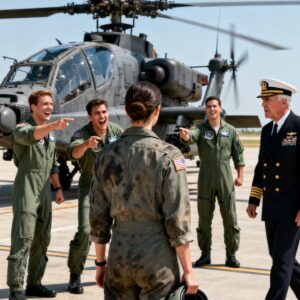
THE GHOST OF KANDAHAR: They Buried My Career and Mocked My Name, But When The Admiral Saw My Sealed File, He Unleashed A War Machine They Never Saw Coming
PART 1: THE INVISIBLE WOMAN The Alabama heat at 0530 didn’t just hit you; it strangled you. It was a physical weight, a wet, suffocating blanket that smelled of JP-8 jet fuel, heated asphalt, and the stale, recycled air of…
End of content
No more pages to load