THE GHOST IN FORMATION
PART 1: The Art of Disappearing
The Pacific Ocean doesn’t care about your rank. It doesn’t care about your clearance level, your kill count, or how many governments have denied your existence. At 0400 hours, in fifty-degree water, the ocean only cares about heat transfer. It wants to take the warmth from your blood and scatter it into the black tide.
I stood in the surf, arms linked with strangers, the salt spray stinging eyes that I forced to remain wide open. My teeth chattered. Not because I was freezing—though I was—but because shivering is what a recruit does. Shivering is a physiological response to hypothermia. If I didn’t shiver, if I stood there with the metabolic control I’d spent a decade perfecting, the thermal regulation techniques I’d learned in mountains that didn’t appear on civilian maps, I would stand out.
And rule number one of this purgatory was simple: Do not stand out.
“Lock it up, ladies!” The voice boomed over the crashing waves. Senior Chief Garen Tove.
I didn’t need to look at him to know exactly where he was. I could track him by the crunch of his boots on the wet sand and the displacement of air as he paced. He was a predator. A shark in a frogman’s uniform. Twenty-three years of Naval Special Warfare had carved him out of granite and beef jerky. He smelled of stale coffee and aggression.
“Assessment Day Seven,” Tove roared, his voice cutting through the wind. “And you make me sick. You look like wet rats. You look like weakness.”
I lowered my head, mimicking the defeated posture of the recruit to my left, a kid named Vidal who was built like a tank but was currently sobbing quietly into the foam.
My name, according to the clipboard Tove held like a weapon, was Ren Kale. My background: Redacted. My previous unit: Redacted. My reason for being here: Late administrative entry. Proceed as standard.
That was the lie. The truth was buried under so many layers of black ink that even I sometimes had trouble finding it. I wasn’t here to become a Navy SEAL. I wasn’t here to earn a trident. I was here because I needed to remember what it felt like to be human before the machine finished eating the rest of my soul. I was here for “rehabilitation.”
But looking at Senior Chief Tove, I realized he didn’t see a rehabilitation project. He saw a anomaly. And anomalies in his world were targets.
The sun hadn’t even thought about rising when we hit the Grinder—the asphalt courtyard that served as our altar of pain. My uniform was heavy with water and sand. The chafing had started three days ago, raw red lines rubbing against skin, but I compartmentalized the pain. It was just a signal. A neurological impulse. You acknowledge it, and then you mute it.
“Drop!” Tove barked.
Thirty-two bodies hit the asphalt.
“Push!”
We pushed. The rhythm was hypnotic. Down. Up. Down. Up.
I watched the ground. I watched the ants crawling near my thumbs. I counted the vibrations of the passing trucks on the highway miles away. My body moved on autopilot. The danger wasn’t the exercise; the danger was the efficiency.
Three days ago, during a three-mile run, I had accidentally zoned out. I slipped into a flow state, my breathing syncing with my stride, my heart rate dropping to a resting forty-five beats per minute. I had floated past the front runners without breaking a sweat, moving with the silent, predatory gait of an operator. I caught myself only when I saw the confused look on a heavy-set instructor’s face. I had to fake a stumble, force a gasp, and drag my feet for the last mile just to blend back into the mediocrity.
I couldn’t make that mistake with Tove.
“Kale!”
The name snapped like a whip. I froze at the top of a push-up, my arms locked.
“Senior Chief,” I responded. My voice was hoarse. That was a nice touch.
Boots appeared in my peripheral vision. Mud-caked, standard-issue Bates. He squatted down, his face invading my personal space. I could see the broken capillaries in his nose, the sheer disdain in his eyes.
“You bored, Kale?” he whispered. It was a dangerous whisper. The kind that usually preceded a funeral.
“No, Senior Chief.”
“Then why aren’t you shaking?” He poked my tricep. It was rock hard. “Everyone else is shaking. Everyone else is dying. But you… you look like you’re waiting for a bus.”
“I’m just focused, Senior Chief.”
“Bullshit.” He stood up, towering over me. “You’re holding back. I see it. You think you’re too good for my Grinder? You think because you slipped in here with a fancy redacted file that you get a pass?”
He didn’t know the half of it. If I let go, if I actually engaged the explosive power coiled in my muscles, I could clear this Grinder in half the time of his best recruit. If I let go, I could snap the bone in his shin before his brain even registered the movement.
But I wasn’t allowed to let go. Restraint, I told myself. The mission is humility.
“No, Senior Chief,” I said, injecting a tremor into my voice that wasn’t there.
“Recover!” he shouted to the group.
The platoon groaned as they stood up. I moved slowly, favoring my left leg, faking a cramp. Tove watched me. He didn’t blink. He was studying me like a bomb disposal technician looks at a suspicious wire. He knew something was wrong, but he couldn’t prove it.
And that was going to make him escalate.
By the time we hit the Chow Hall, the adrenaline had faded, leaving behind the dull ache of exhaustion that covered the platoon like a wet blanket. The other recruits moved like zombies, their eyes glazed, trays shaking in their hands.
I sat at the far end of the table, alone.
Isolation wasn’t a punishment for me; it was a habitat. I ate methodically. Twelve minutes. Protein first, then carbs, then hydration. I didn’t taste the food. Taste was a luxury. Fuel was a necessity.
“Who is she?”
The whisper traveled from three seats down. It was a kid from Arkansas, barely eighteen.
“I heard she’s a spook,” another whispered back. “CIA maybe?”
“Look at her hands,” a third voice joined in. “My uncle worked at a slaughterhouse. He had hands like that. Scarred up but steady.”
I didn’t look up from my tray. I turned my hands over slightly, inspecting them. They were right. My hands were a map of violence. The thin white line across my knuckles from a knife fight in Yemen. The burn mark on my wrist from a flash-bang that went off too close in a hallway in Belgrade. The discoloration on my fingertips from years of handling chemically treated explosives.
I hid them under the table.
“Hey.”
The voice was close. I looked up.
Petty Officer Jace Orin stood there with his tray. He was older than the rest—prior fleet Navy, maybe thirty years old. He had kind eyes, which was a liability in this line of work.
“Seats taken?” he asked.
“Free country,” I said. My voice was clipped. Detached.
He sat down, not too close, but close enough to break the forcefield of solitude I’d erected. He ate in silence for a minute, then looked at me.
“Tove’s gunning for you,” Orin said quietly. “You know that, right?”
I chewed a piece of dry chicken. “He’s doing his job.”
“No,” Orin shook his head. “I’ve seen DIs break people. This is personal. He hates that he can’t read you. He thinks you’re mocking him.”
I finally looked him in the eye. Orin saw too much. That made him dangerous, but also… interesting. “I’m not mocking anyone.”
“Then why don’t you struggle?” Orin asked. The question hung in the air between us. “We’re all drowning out there, Ren. But you… you’re just holding your breath.”
I felt a flicker of something I hadn’t felt in a long time. Panic? No. Concern. My cover was slipping, not because I was failing, but because I was succeeding too effortlessly. The mask of mediocrity is heavy, and it takes more energy to pretend to be weak than to actually be strong.
“I’m exactly where I need to be, Orin,” I said.
He frowned, processing the phrase. It wasn’t something a recruit said. It was something a monk said. Or a soldier on a suicide mission.
“Just watch your back,” he murmured, standing up. “Tove isn’t going to stop until you break. And if you don’t break, he’s going to try to shatter you.”
I watched him walk away. He was right. Tove was an apex predator in this ecosystem. He wouldn’t accept an anomaly. He would poke and prod until the truth bled out.
And the truth was the one thing that could get us both killed.
Assessment Day Eight and Nine were a blur of calculated suffering.
Tove tightened the screws. While the platoon ate, he had me doing flutter kicks in the mud pit. While the platoon slept for their allotted four hours, he had me folding and unfolding uniforms until my fingers bled. He was trying to induce a stress reaction. He wanted tears. He wanted rage. He wanted quit.
He didn’t get it.
I did the flutter kicks. I folded the uniforms. I stared at a point on the wall and retreated into my “Mind Palace”—a mental technique I learned during SERE school (Survival, Evasion, Resistance, and Escape). While my body did push-ups, my mind was walking through a quiet art gallery in Florence, admiring the brushstrokes of a Caravaggio.
Dissociation is a tool, my old handler used to say. Use it, but don’t get lost in it.
On the night of the twelve-mile ruck march, the moon was hidden behind a thick layer of marine layer clouds. It was pitch black. We were moving through the soft sand dunes, fifty-pound packs strapped to our backs.
I was at the rear, sweeping the formation. It was a habit I couldn’t break. The rear guard protects the flank.
My legs burned, but it was a distant burn. I adjusted my pack, feeling the familiar bite of the straps. This—the darkness, the weight, the silence—this was where I felt most alive. For a moment, I forgot to limp. I forgot to pant. I moved with the fluid grace of a hunter, my boots finding purchase in the shifting sand without making a sound.
I closed my eyes for a second, inhaling the salt air.
Snap.
A twig broke to my right.
My eyes snapped open. In a fraction of a second, my brain processed the sound. Distance: ten meters. Elevation: three feet above ground level. Weight distribution: heavy.
It wasn’t a recruit. Recruits stumbled. This was a stalker.
I didn’t turn my head. I kept walking, but I shifted my center of gravity, preparing to pivot. I visualized the strike: drop the pack, sweeping leg kick, throat punch, control the weapon.
“You move like a ghost, Kale.”
The voice came from the darkness. It was Tove. Of course. He was shadow-walking the platoon, looking for stragglers.
I let out a breath I didn’t know I was holding. I forced my posture to slump. “Just trying to keep up, Senior Chief.”
He stepped out of the shadows, falling into step beside me. I could feel his gaze burning a hole in the side of my head.
“I checked your file again,” he said. His voice was conversational, which was far more terrifying than his yelling. “Called a buddy of mine at the Bureau of Personnel. Asked about Ren Kale.”
My heart rate didn’t jump. I knew exactly what he found. Nothing.
“He told me that name doesn’t exist in the fleet database,” Tove continued. “He said if I have a recruit by that name, I should check her ID tags because she’s a ghost.”
“Administrative error, Senior Chief,” I recited. “Paperwork gets lost.”
Tove laughed. It was a dry, humorless sound. “Paperwork gets lost. People don’t. You’re not a recruit. I don’t know who you are—maybe you’re Internal Affairs, maybe you’re some politician’s kid on a joyride—but you are insulting my Navy.”
He stopped walking. He grabbed the strap of my ruck and yanked me back. I stumbled, playing the part, and fell onto one knee in the sand.
“Tomorrow is Combatives,” Tove hissed, leaning down. “Hand-to-hand. No hiding in the back. No running. Just flesh and bone.”
He smiled, and the moonlight caught the white of his teeth.
“I’m going to put you on the mat, Kale. And I’m going to beat the truth out of you. Do you understand?”
I looked up at him. I saw a man who believed in his world, who believed in the hierarchy, who believed that he was the hammer and I was the nail. He had no idea he was threatening a nuclear warhead with a ball-peen hammer.
A dark, cold part of me—the part I was trying to suppress—wanted to show him. It wanted to stand up, dislocate his shoulder, and whisper the clearance code that would end his career into his ear.
Don’t do it. Remember why you’re here. Remember the sunset.
“Understood, Senior Chief,” I whispered.
“Good.” He shoved me away. “Catch up. You’re lagging.”
He jogged off into the dark.
I stayed on one knee for a moment, my hands burying themselves in the cold sand. My fingers curled into fists, tight enough to make the knuckles crack. The restraint was physically painful. It felt like holding back a scream that had been building for ten years.
I stood up, adjusted my pack, and began to run.
Assessment Day 10. The day the dam would break.
The morning air was crisp, the sky a bruised purple as the sun struggled to rise. The Grinder was cleared. Mats were laid out. The air smelled of sweat and anticipation.
This was the “Combatives” evolution. It was supposed to test aggression. It was supposed to see if a recruit could take a punch and keep moving.
Tove stood in the center of the mats, looking energized. He looked like a kid on Christmas morning, if the kid asked for violence instead of toys.
“Circle up!” he barked.
The platoon formed a ring around the mats. I stood in the back, trying to make myself small. It didn’t work. Tove’s eyes found me immediately.
“Warm-up,” he announced. “Vidal. Center.”
Vidal, the linebacker-sized recruit, trotted to the center. He looked nervous but ready.
“Kale. Center.”
The platoon went deadly silent. Normally, recruits were paired by weight class. Vidal outweighed me by a hundred pounds. He had reach, mass, and strength. This wasn’t a sparring match; it was an execution.
I walked onto the mat. I felt the soft foam compress under my bare feet. I took my stance—not my actual stance, which was a compact Muay Thai guard, but a sloppy, wide-footed recruit stance.
“Rules are simple,” Tove said, circling us. “Vidal, you are the aggressor. Kale, you are the hostile. Vidal, I want you to take her down and restrain her. Use full force. If you go easy on her, I will drop you from this course. Am I clear?”
“Yes, Senior Chief!” Vidal shouted. He looked at me, apology in his eyes. “Sorry, Ren.”
“Just do it,” I murmured.
“Fight!” Tove blew the whistle.
Vidal came at me like a freight train. He lowered his shoulder, shooting for a double-leg takedown. It was telegraphed, slow, and clumsy.
In my mind, time slowed down. I saw six different ways to end this.
-
Knee to the orbital bone. (Permanent blindness).
-
Elbow to the cervical spine. (Paralysis).
-
Strike to the throat. (Tracheal collapse).
I rejected them all.
Instead, I stood there. I let him hit me.
His shoulder slammed into my gut. The air rushed out of my lungs—real pain this time. He wrapped his arms around my legs and drove me into the mat. I hit the ground hard, my head bouncing off the foam. He pinned me, his weight crushing my chest.
“Stop!” Tove yelled.
Vidal scrambled off me. I lay there for a second, blinking.
“Pathetic,” Tove spat. He wasn’t looking at Vidal. He was looking at me. “Get up.”
I stood up, wiping sweat from my forehead.
“You’re not trying,” Tove said, his voice rising. “Vidal is slow. You saw him coming a mile away. Why did you let him hit you?”
“He was… too fast, Senior Chief.”
“Liar!” Tove screamed. The sound echoed off the barracks walls. “I’ve watched you run. I’ve watched you climb. You have reflexes. Use them!”
He turned to Vidal. “Again. Harder. Hurt her, Vidal. Make her react.”
Vidal looked hesitant. “Senior Chief, I don’t—”
“Did I give you a choice, Recruit?”
Vidal hardened his jaw. He looked at me, and the apology was gone. It was survival now. Him or me.
“Fight!”
Vidal charged. This time, he swung a haymaker, a wild right hook aimed at my head.
My body reacted before my brain could vet the decision. It was instinct. Pure, unadulterated survival instinct honed in the alleys of Kabul and the safehouses of Damascus.
I didn’t block. I slipped.
I shifted my weight three inches to the left. The fist sailed past my ear, the wind of it brushing my cheek. As Vidal stumbled forward, carried by his own momentum, I didn’t strike him. I simply placed my hand on his passing shoulder and gave a gentle, helpful push.
Physics did the rest.
Vidal’s feet tangled. He pirouetted in the air and slammed face-first into the mat with a sickening thud.
Silence. Absolute, terrified silence.
I stood over him, my hands instantly returning to a neutral position at my sides. I hadn’t thrown a punch. I hadn’t kicked. I had just… redirected.
Vidal groaned, rolling over.
I looked up. Tove was staring at me. His face wasn’t red anymore. It was pale.
He walked onto the mat, stepping over Vidal as if he wasn’t there. He stopped two feet from me.
“That,” Tove said softly, “wasn’t a recruit move. That was a redirection throw. Aikido? Judo?”
“Luck, Senior Chief,” I lied. “He tripped.”
“Stop lying to me!” Tove roared, losing his composure completely. He got in my face, spit flying. “You are making a mockery of my training! You are holding back! Who are you?”
“I am Recruit Kale, Senior Chief.”
“I’m going to ask you one last time,” Tove said, his voice dropping to a low, trembling growl. “Who. Are. You?”
I looked at him. Really looked at him. I saw the desperation. He needed to know. He needed to classify me so he could control me.
“Someone you shouldn’t push, Senior Chief,” I said.
The words slipped out. A mistake. A massive, tactical error.
Tove’s eyes went wide. The challenge hung in the air, vibrating with tension. I had just threatened a Senior Chief in front of thirty witnesses.
Tove’s hand came up. It was fast. An open-palm strike aimed at my chest—a “check,” meant to assert dominance, to startle, to disrespect.
“Let’s see if you flinch,” he snarled, swinging his arm.
Time stopped.
The hand was coming. I had a choice. Option A: Take the hit. Let him humiliate me. Keep the cover. Option B: End the charade.
I looked at his palm. I looked at his exposed wrist. I looked at the vulnerable nerve cluster in his forearm.
Screw it.
I didn’t flinch. I didn’t blink. I opened my mouth and spoke two words that would change everything. Two words that carried the weight of a classified clearance and a license to kill.
“I’m Task Force.”
PART 2: THE SHADOW AND THE SALUTE
“Task Force.”
The words hung in the salt air like a detonated grenade.
Senior Chief Tove’s hand was inches from my chest. He heard me. I saw the micro-expression in his eyes—the widening of the pupil, the sudden, terrifying recognition of a term that wasn’t supposed to be spoken on an open frequency, let alone a training grinder.
But momentum is a law of physics, and physics doesn’t care about classified designations. His body was committed to the strike. His weight was forward. He was past the point of no return.
So, I helped him get there.
I didn’t block. Blocking is force against force. I stepped into his personal space, slipping inside the arc of his arm. My left hand ghosted up, catching his wrist—not grabbing, just guiding. My right hand swept low, tapping the inside of his knee.
It required less than five pounds of pressure.
Tove, a man who had survived deployments in three combat zones, a man who was built like a vending machine full of concrete, simply evaporated. His feet left the earth. He rotated in the air, a confused expression frozen on his face, and slammed onto his back with enough force to rattle the teeth of everyone watching.
Wham.
I was already standing over him before his lungs could hunt for air. My hands were behind my back. My chest was heaving, not from exertion, but from the adrenaline of a mistake. I shouldn’t have done that.
The silence on the Grinder was absolute. It was the silence of a bomb squad watching the timer hit 00:01.
Tove lay there, gasping, staring up at the sky. He wasn’t hurt—I’d taken care to land him flat so the impact was distributed—but his reality was shattered. He looked at me. He looked at the way I was standing—relaxed, balanced, lethal.
He pushed himself up to a seated position. He rubbed his wrist where I had touched him.
“Task Force,” he whispered. It wasn’t a question anymore.
I stared at a point a thousand yards away. “Permission to return to formation, Senior Chief.”
Tove stood up slowly. He dusted off his pants. The rage was gone from his face, replaced by something that looked disturbingly like fear. He knew what “Task Force” meant. It meant units that didn’t have names. It meant operators who didn’t exist until the shooting started and ceased to exist the moment it stopped. It meant he had just tried to physically assault a ghost.
He straightened his uniform. He looked at the platoon, thirty-one recruits standing with their jaws on the floor. Then he looked at me.
And he did the unthinkable.
He brought his hand up. Rigid. Sharp.
He saluted me.
It wasn’t the salute of a superior to a subordinate. It was the salute of a soldier to a symbol. A recognition of a hierarchy that wasn’t written on any collar device.
I didn’t return it. I couldn’t. I was still a recruit in this play. I just nodded, a microscopic dip of the chin.
“Fall out,” Tove croaked. His voice was broken glass. “Chow in fifteen. Dissapear.”
The locker room was a mausoleum.
Usually, after a session like that, there would be chatter. Adrenaline dumps. Laughter. Today, there was only the sound of zippers and boots hitting the floor.
I changed quickly, keeping my back to the room. I could feel their eyes on my spine. I was a contagion now. Before, I was just the weird loner. Now, I was a danger.
“Ren.”
Vidal was standing next to me. He was holding an ice pack to his cheek where he’d hit the mat earlier. He looked at me with a mixture of awe and betrayal.
“What the hell was that?” he whispered.
“Judo,” I said, tying my boot.
“That wasn’t Judo,” Orin said. He was leaning against a locker, watching me. “I’ve seen Judo. That was… surgical. That was ‘I can kill you in three seconds but I chose not to.'”
I stood up and slung my bag over my shoulder. “Drop it, Orin.”
“Who are you?” Vidal asked, his voice trembling. “Really?”
I looked at them. These kids. They wanted to be SEALs. They wanted the trident. They wanted the glory of the brotherhood. They had no idea that the further you went up the pyramid, the colder it got. They didn’t know that the prize at the finish line wasn’t a medal, but a lifetime of silence and a thousand-yard stare that never went away.
“I’m a recruit,” I said. “Just like you.”
Orin laughed, a short, sharp sound. “Lady, you haven’t been ‘just like us’ since the day you were born.”
The suits arrived an hour later.
I was cleaning my rifle in the courtyard when the black SUV rolled through the gates. Two men got out. Civilian clothes, off-the-rack suits that didn’t hide the bulges of sidearms under their jackets. They didn’t look at the recruits. They walked straight into the Commanding Officer’s building.
Five minutes later, the PA system crackled.
“Senior Chief Tove. Report to the CO’s office immediately.”
I kept scrubbing the carbon off my bolt carrier group. Scrub. Wipe. Oil. The rhythm calmed me. I knew what was happening in that office.
The CO was getting read into the program. The suits were flashing badges that didn’t have agency names on them. They were explaining that Candidate Kale was a Tier One asset on a psychological reset rotation, and that Senior Chief Tove had nearly compromised a national security asset by trying to slap her.
Tove walked out of that office twenty minutes later. He looked five years older. He walked past the cleaning tables. He didn’t look at me. He didn’t look at anyone. He walked like a man carrying a heavy secret across a minefield.
That night, Tove found me.
I was by the pull-up bars, doing dead-hangs under the moonlight, stretching out my lats.
“You could have told me,” he said. He was standing in the shadows, smoking a cigarette. I’d never seen him smoke before.
I dropped from the bar, landing silently. “I wasn’t allowed to.”
“Task Force,” he muttered, shaking his head. “I thought that was a myth. Something the guys at the bar made up to scare the new guys.”
“It’s better if you think that.”
He took a long drag. The cherry of the cigarette glowed bright red. “Why are you here, Kale? If you can do… that… why are you playing sandbox with these kids?”
I walked over to him. The bravado was gone. We were just two soldiers now.
“Because I forgot,” I said quietly.
“Forgot what? How to shoot? How to fight?”
“No,” I said. “I forgot what it feels like to not be a weapon. I forgot what it feels like to be scared of a drill instructor. I forgot what it feels like to rely on the person next to me.” I looked at the barracks where the recruits were sleeping. “I needed to go back to the beginning. To see if there was anything human left inside the machine.”
Tove stared at me for a long time. Then he dropped the cigarette and crushed it under his boot.
“Well,” he said, his voice gruff but respectful. “You act the part real good. But you fight like a demon.”
“I’m sorry about the throw, Senior Chief.”
He smirked. “Don’t be. It was the most impressive thing I’ve seen in twenty years. Just… next time? Give me a warning before you defy gravity.”
He turned to walk away, then stopped.
“Orders came down,” he said, his back to me. “You’re cleared to finish the cycle. But the suits said you’re gone the second it’s over. Ghost in the wind.”
“I know.”
“Get some sleep, Kale. You’ve got a long swim tomorrow.”
PART 3: THE GHOST LEAVES A TRACE
The last three days of assessment were strange.
The hazing stopped. Not just for me, but for the whole platoon. Tove still pushed us—we ran until we vomited, swam until our muscles seized—but the malice was gone. He treated us with a hard, professional distance. He looked at me sometimes, across the grinder, and there was a knowing look in his eye. A shared secret.
The recruits sensed the shift. They stopped avoiding me. They started following me.
During the Obstacle Course on Day 12, Senvey, a girl from the Midwest who was barely holding on, panicked at the top of the ‘Slide for Life’ tower. She froze.
Before Tove could yell, I was up the ladder.
“Don’t look down,” I told her, my voice low. “Look at me.”
“I can’t,” she sobbed. “I’m going to fall.”
“You won’t fall,” I said. “I’ve got you. Physics has got you. Gravity is just a suggestion, Senvey. Ignoring it is a choice.”
She looked at me, confused by my weird calmness. “Who are you?” she whispered.
“I’m the person who’s going to make sure you finish this,” I said. “Now, grab the rope.”
She grabbed the rope. She slid. She survived.
When we hit the ground, she hugged me. It was brief, awkward, and sweaty. But I felt it. A connection. A spark of simple, uncorrupted humanity. It wasn’t a mission objective. It wasn’t a target acquired. It was just… help.
This, I thought. This is what I came for.
The final evening.
We had “secured” from training. The sun was setting, painting the Pacific in bruised purples and bloody oranges. The rest of the platoon was in the barracks, taping up blisters and writing letters home.
I went to the climbing wall.
It was a fifty-foot slab of wood and resin. I didn’t use a harness. I didn’t need one. I climbed slowly, deliberately, feeling the texture of the holds against my calloused fingers.
When I reached the top, I sat on the platform, legs dangling over the edge.
From up here, the base looked like a toy set. The Grinder, the barracks, the flag pole. It was all so structured. So black and white. Pass or fail. Live or die.
My world—the real world—was gray. It was compromises and lesser evils. It was doing bad things to bad people so good people could sleep. It was lonely.
“Nice view.”
I didn’t turn. “It’s peaceful, Orin.”
Orin climbed up the last few rungs and sat next to me. He wasn’t winded. He was solid. If I had my own team, I’d draft him.
“You’re leaving tomorrow,” he said. It wasn’t a question.
“How do you know?”
“I saw your bag. It’s packed. And you have that look. The ‘mission complete’ look.”
I sighed, leaning back against the wooden post. “Yeah. I’m leaving.”
“You never told us your real name.”
“Ren is my real name,” I said. “The rest… the rest is just paperwork.”
Orin pulled a small, folded piece of paper from his pocket. He handed it to me.
“What’s this?”
“The guys… and Vy. We wrote something. In case you just vanished like a ninja in the night.”
I unfolded the paper. It was a page torn from a field notebook. On it, in scrawled handwriting, was a message:
Some people are meant to be legends. Others are meant to be ghosts. You get to choose which one you become. Thanks for showing us that quiet strength is still strength.
I read it twice. My throat felt tight. I had medals in a box somewhere—Commendations, Silver Stars—that meant nothing to me. This crumpled piece of paper meant everything.
“We know you’re not one of us, Ren,” Orin said softly. “But for a week… you were the best of us.”
I looked at him, and for the first time in years, the mask slipped completely. I smiled. A real, tired, human smile.
“Keep your head down, Orin,” I said. “And keep moving.”
0500 Hours.
The barracks were silent, filled with the rhythmic breathing of thirty exhausted souls. I slipped out of my bunk like smoke.
My gear was already staged. I placed my training uniform on the perfectly made bed. On top of it, I left my boots, polished to a mirror shine.
I stopped at the door. I looked back at the rows of bunks. I looked at Vidal, sleeping with his mouth open. I looked at Senvey, curled up in a ball. I looked at Orin, who shifted in his sleep as if sensing my departure.
I wanted to say goodbye. I wanted to tell them that they had saved me just as much as I had scared them. But ghosts don’t say goodbye. We just cease to haunt.
I walked out into the cool morning mist.
The black SUV was waiting at the gate, engine idling, exhaust pluming white in the chill air.
Tove was standing next to the driver’s door.
He didn’t salute this time. He just extended his hand.
I took it. His grip was iron.
“You found what you were looking for?” he asked.
“I think so,” I said. I patted the pocket where Orin’s note sat against my chest.
“Good hunting, Task Force,” Tove said.
“Take care of them, Senior Chief,” I replied. “They’re good kids.”
“They’re not kids anymore,” Tove said, watching me climb into the back seat. “You showed them what the ceiling looks like. Now they want to reach it.”
I closed the heavy door. The lock engaged with a solid thud—the sound of a vault closing.
The interior smelled of leather and recycled air. The driver, a man with no neck and dark sunglasses, didn’t look at me. He just put the car in gear.
As we pulled away, I watched through the tinted glass. I saw Tove standing at the gate, watching me go. I saw the sun just beginning to crest over the horizon, hitting the ocean, turning the black water into liquid gold.
I touched the scar on my knuckle. I touched the paper in my pocket.
I was going back to the gray. Back to the shadows. Back to the silence. But this time, I wasn’t going back empty. I was bringing a piece of the light with me.
The SUV accelerated, turning onto the highway. The base disappeared behind us.
I closed my eyes, and for the first time in a decade, I didn’t dream of war. I dreamed of climbing a wall, not to escape, but just to see the view.
News
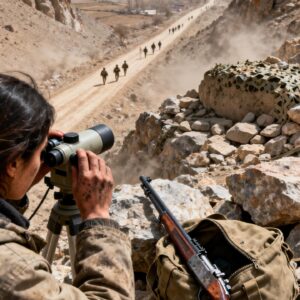
THE EXILED SNIPER: WHEN THE WORLD BRANDED ME A TRAITOR, I BECAME THE GHOST THAT SAVED THEM FROM THE SHADOWS
PART 1: THE SILENT WATCHER The wind at eleven thousand feet doesn’t just blow; it bites. It carries the metallic taste of snow and the ancient, dusty scent of stone that has been baking and freezing for millennia. I lay…
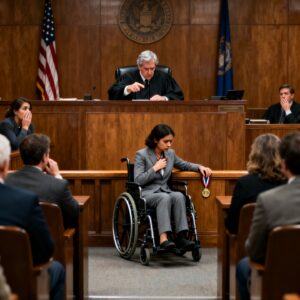
The Judge Called Me a Fraud and Demanded My Medal. He Had No Idea I Was the Reason His Son Was Still Alive.
PART 1: THE HUMILIATION The phantom rhythm of rotor blades was the first thing I heard. Thump. Thump. Thump. It wasn’t real, of course. It was just the ceiling fan in my San Diego apartment, slicing through the warm October air….

I Was Shackled in a Courtroom as a Homeless Thief, Ignored by Everyone—Until the Clerk Read My Service Number, the Judge Stood Up in Dead Silence, and the Man I Saved from Hell Recognized the Ghost He Thought Died in Fallujah.
PART 1: THE GHOST IN THE ORANGE SUIT The holding cell smelled of bleach and urine—a chemical cocktail meant to sanitize misery, but it only made it sting the back of your throat. I sat with my back pressed against…
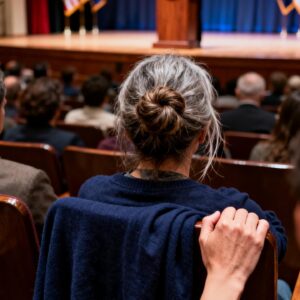
I Was Supposed to Be Dead: The Day a SEAL Admiral Froze Mid-Speech, Saw the Forbidden Tattoo on My Wrist, and Exposed the Classified Secret I’d Hidden from My Son for Twenty Years.
PART 1: THE GHOST IN THE BACK ROW You learn to be invisible. That’s the first rule of survival when you’re walking around with a grave that already has your name on it. You learn to take up less space,…
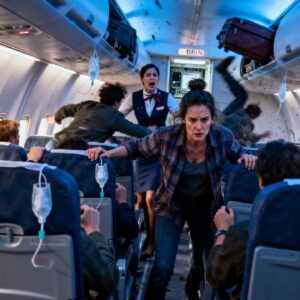
The Ghost of Flight 227: She Was Supposed to Be Dead, But When the Captain Collapsed and the Plane Screamed toward Earth, the Woman in Seat 14C Revealed a Secret That Would shake the Pentagon to Its Core
PART 1: THE INVISIBLE PASSENGER The smell of economy class is always the same. It’s a cocktail of stale coffee, recycled air, and the sour, metallic tang of human exhaustion. I was breathing it in, four counts in, four counts…
THE GHOST OF KANDAHAR: They Buried My Career and Mocked My Name, But When The Admiral Saw My Sealed File, He Unleashed A War Machine They Never Saw Coming
PART 1: THE INVISIBLE WOMAN The Alabama heat at 0530 didn’t just hit you; it strangled you. It was a physical weight, a wet, suffocating blanket that smelled of JP-8 jet fuel, heated asphalt, and the stale, recycled air of…
End of content
No more pages to load