PART 1
The air in the briefing room didn’t just feel cold; it felt pressurized, like we were already five hundred feet deep and the hull was starting to groan.
I stood at rigid attention, my spine a steel rod, my eyes fixed on a rivet six inches above Admiral Wesley Calder’s head. I was the only woman among twenty naval officers, a speck of difference in a sea of identical dark blue uniforms. But it wasn’t my gender that made the air thick with tension. It was my history.
“Lieutenant Commander Davenport,” Calder said, his voice sliding through the silence like oil on water. He paced in front of the holographic display, the blue light casting skeletal shadows across his face. “Care to explain that tactical hesitation to your colleagues?”
He didn’t want an explanation. He wanted a show.
On the display, the replay of the Operation Blackwater simulation looped. It showed my tactical team moving through an urban extraction zone. Efficient. Clean. And then, at extraction point Charlie, a thirty-seven-second pause. A lifetime in combat.
“Sir,” I said, my voice steady, stripped of any emotion that he could latch onto. “Satellite imagery showed potential hostiles in Sector 4 that weren’t accounted for in the briefing parameters. The thermal signatures were inconsistent with civilian patterns.”
“Potential hostiles?” Calder repeated. He stopped pacing and turned to face me. He was shorter than me by several inches, but he projected an authority that seemed to suck the oxygen out of the room. “And did these phantoms materialize, Lieutenant Commander?”
“No, sir. But standard protocol dictates—”
“I know what the protocols dictate, Davenport!” His shout was sudden, a crack of thunder that made the junior officers jump. “I wrote half of them.”
He stepped closer, invading my personal space, smelling of expensive cologne and stale coffee. “Perhaps if you spent less time overthinking worst-case scenarios and more time executing decisive action, you wouldn’t be the… cautionary tale of this fleet.”
A ripple of laughter moved through the room. It was muted, respectful of rank, but unmistakable. It was the sound of a wolf pack acknowledging the alpha’s bite. They looked at me—the woman who froze, the woman who broke, the woman who had redacted black bars across her service record where her courage should have been.
I didn’t blink. I didn’t swallow. I let the humiliation wash over me like rain on armor.
“Your record shows a peculiar gap during Operation Kingfisher three years ago,” Calder continued, turning back to the group but keeping me in his peripheral vision. He was circling now, a shark that had scented blood in the water. “Convenient timing for a medical leave, wasn’t it?”
The room went deathly silent. Kingfisher. The word hung there, heavy and toxic. Even the junior officers stopped smirking. Kingfisher wasn’t just an operation; it was a graveyard. A classified disaster that had claimed the life of Captain Zachariah Byrne, a hero of the fleet.
My jaw tightened. Just a fraction. But Calder saw it.
“Since you’re so fond of protocol,” he said softly, stepping back into my line of sight, forcing me to look him in the eyes. They were glittering with malice. “Remind everyone of your official call sign, Lieutenant Commander.”
My heart slammed against my ribs. He knew. He knew exactly what he was doing. He was daring me to say it. Daring me to drag the truth out into this sterile room and destroy myself.
“Or have you forgotten that, too?” he goaded.
I hesitated. For a split second, my eyes flicked to Commander Elijah Ravenscroft, a veteran officer with salt-and-pepper hair sitting in the front row. Elijah knew. He was the only one in this room, besides Calder, who had an inkling of the weight I carried. Elijah’s eyes were wide, a silent warning: Don’t do it, Astrea. Don’t take the bait.
“Your call sign, Davenport,” Calder demanded, his voice bouncing off the steel walls.
I opened my mouth, the taste of ash on my tongue.
screeeeeech
The ship’s intercom shrieked, saving me. “All tactical officers report to stations. Surveillance drill commencing in fifteen minutes.”
Calder’s mouth tightened into a thin, angry line. He had been robbed of his kill. “Dismissed,” he spat. Then, darker: “Davenport. Report to my office at 1800 hours.”
The room emptied fast. Officers filed out, giving me a wide berth, eyes darting sideways. I was a contagion. I stood there until the last bootstep faded, exhaling a breath I felt like I’d been holding for three years.
“He’s never going to let it go, is he?”
I turned. Commander Ravenscroft was still sitting there, packing his tablet.
“Would you?” I asked, my voice softer now, the professional mask slipping just enough to reveal the exhaustion underneath.
“I wouldn’t have done what he did in the first place,” Ravenscroft replied grimly. He stood up, his joints popping. “We all make choices, Commander.”
I gathered my things, my hands shaking slightly. I clenched them into fists to stop it. “Some choices cost more than others, Elijah.”
He paused at the door, looking back at me with a sadness that always made my chest ache. “Some things are worth any cost.”
The mess hall at 1300 hours was a study in social dynamics.
I moved through the line, collecting my protein and vegetables with mechanical precision. I could feel the eyes on me. Twenty pairs of them tracking my movement, then deliberately snapping away the moment I looked in their direction. It was an invisible force field, a zone of exclusion that followed me wherever I went on the USS Sentinel.
I chose an empty table near the viewport. Outside, the Pacific was an endless, churning blue. It looked peaceful from here, but I knew better. The ocean was like the Navy: beautiful on the surface, crushing in the depths.
I ate methodically. Posture perfect. Uniform spotless. I was the ice queen, the robot, the woman who followed the book because she was too scared to improvise. That was the narrative Calder had crafted. It was a good cover. It kept people away.
Until one didn’t stay away.
“Commander Davenport? Mind if I join you?”
I looked up, genuine surprise flitting across my face. It was Ensign Thaddeus Ren. He was new, fresh out of Annapolis, with the kind of open, eager face that was a liability in poker and a death sentence in war. He stood there clutching his tray, looking like he was about to pet a tiger.
I gestured to the seat opposite me. “Free country, Ensign.”
He sat, his knees knocking against the table leg. “I… I wanted to ask about the Blackwater simulation parameters. Ma’am.”
I paused with my fork halfway to my mouth. “Go on.”
“Your approach in Sector 4,” he started, rushing the words. “It was unorthodox. But I ran the numbers. It maintained security protocols while minimizing time constraints. You waited exactly thirty-seven seconds.”
“Is that a question, Ensign?”
“I just…” He leaned in, lowering his voice. “I looked at the raw data log. There were ghost signals. You saw them, didn’t you? That’s why you waited.”
I studied him. He was sharp. Sharper than he looked. “Questions through proper channels, Ensign. File a formal request for tactical training guidance.”
Ren’s face fell, his enthusiasm wilting under my coldness. “Yes, ma’am. I just thought… thinking is good.”
“Thinking is dangerous,” I interrupted, not unkindly, but firmly. “Especially when you’re thinking about things that aren’t in the briefing.”
I looked meaningfully around the room. Several officers were watching us, whispering. Ren followed my gaze, and understanding dawned on his face. He was sitting with the pariah. He was tarnishing his own reputation just by breathing the same air.
“Of course,” he murmured. “Sorry to disturb your lunch, Commander.”
I stood up to leave, eager to end the interaction before he dug any deeper. As I grabbed my tray, it slipped from my sweaty palm, clattering loudly against the table. Utensils scattered across the deck.
“I’ve got it,” Ren said, dropping to his knees immediately to help.
I knelt down, frustration spiking. As I reached for a spoon, something slipped from the hidden inner pocket of my utility jacket. It hit the floor with a heavy clink.
It wasn’t a spoon. It was a data chip. But not just any chip—it had a distinctive red edge and a holographic seal.
Omega Level Clearance.
Ren froze. His hand hovered over the chip. His eyes widened, darting from the chip to my face. Omega clearance was a myth to most junior officers. It was reserved for Black Ops, for the highest levels of naval intelligence. Most Admirals didn’t even have it.
I snatched the chip up, palming it with the speed of a magician.
“Thank you for your assistance, Ensign,” I said, my voice dropping an octave. A clear warning.
Ren stood up slowly, looking at me with a new expression. The pity was gone. The confusion was gone. Replaced by something else. Genuine, burning intrigue.
“My pleasure, Commander,” he whispered.
I walked away without looking back, but I could feel his eyes boring into my spine. I had made a mistake. And on a ship like this, mistakes were ammunition.
At 1700 hours, I was walking down Corridor C, mentally preparing for my meeting with Calder, when I heard running footsteps behind me.
“Commander Davenport!”
I turned. It was Ren again. He was holding a tablet, breathless.
I checked my watch. “Ensign, if this is about the lunch menu, I’m not interested.”
“It’s about the Blackwater simulation,” he said, holding the tablet out like a shield. “I couldn’t let it go. I reviewed the original programming code.”
I stopped. The corridor was empty, the hum of the engines vibrating through the floorplates. “And?”
“The hostiles you detected in Sector 4,” he said, his voice trembling with the weight of his discovery. “They weren’t in the simulation parameters. I checked the source code. Those signals were added manually during the exercise. Someone injected them into the feed in real-time.”
I felt a cold chill that had nothing to do with the ship’s AC. “What are you saying, Ensign?”
“I’m saying someone was testing you. specifically. They wanted to see if you’d spot them, or maybe…”
“Maybe they wanted to make me freeze,” I finished softly. “To create a delay they could mock in a briefing.”
Ren nodded vigorously. “Exactly. It’s a setup, Ma’am. It’s harassment.”
“That is a serious accusation, Ensign.”
“It’s not an accusation. It’s data.” He thrust the tablet at me. “See for yourself.”
I scanned the code. He was right. The injection timestamp matched the briefing start time. It was Calder. It was petty, vindictive, and brilliant. He knew I was too good a tactician to ignore a thermal signature, even a ghost one. He used my own competence to paint me as hesitant.
“Who else has seen this?” I asked, handing the tablet back.
“No one, Ma’am.”
“Delete it.”
Ren blinked, stunned. “But Commander… this proves it! It proves you were right!”
“It proves nothing except that you’ve been digging where you shouldn’t,” I snapped. My voice was steel wrapped in silk. I stepped closer to him. “Focus on your assigned duties, Ensign. Not everything is as it appears.”
I turned on my heel and walked away.
“Is that why you have Omega clearance, Commander?” he called out after me.
I froze mid-step. My heart hammered.
“Because things aren’t what they appear?” he continued, his voice echoing in the corridor.
I didn’t turn around. I couldn’t let him see the fear in my eyes. “Careful, Ensign. Curiosity has consequences on this ship.”
Admiral Calder’s office was a shrine to his own ego.
Artifacts from naval victories adorned the walls—swords, antique pistols, framed commendations. Behind his massive mahogany desk hung a painting of the USS Sentinel cutting through stormy seas, triumphant against nature’s fury.
He made me wait standing at attention for five minutes while he pretended to read a report on his screen. It was a power move, old as time.
“Your service record makes for interesting reading, Davenport,” he said finally, not looking up. “Exemplary training scores. Tactical innovations that have become standard protocol. Multiple commendations.”
He finally met my eyes. “And then… there’s Kingfisher.”
I said nothing. My face was a mask of stone.
“Three years,” he mused, leaning back in his leather chair. “And still not a word from you about what really happened. Your silence has been admirable. If misguided.”
“Is there a question in there, Sir?”
Calder smiled, but it didn’t reach his eyes. It was the smile of a man holding a knife. “I’m offering you an opportunity, Lieutenant Commander. Your transfer request to the USS Meridian has been approved.”
My composure slipped. “I didn’t request a transfer.”
“No, you didn’t.” He slid a document across the polished desk. “I did it for you. Consider it a fresh start. Away from the… memories.”
I stared at the paper. The Meridian. It was a supply vessel. A glorified cargo hauler. It was a career coffin.
“The Meridian is non-tactical,” I said slowly.
“Yes. I thought a less stressful environment might suit your temperament better. Given your history of… freezing under pressure.”
“My record speaks for itself, Sir.”
“Parts of your record speak volumes, Davenport. Other parts…” He gestured vaguely to the air. “Well, silence can be deafening.”
My hands tightened behind my back. “Permission to speak freely, Sir.”
“Denied.” He stood up, towering over the desk. “You ship out next week. Until then, you are relieved of tactical duties. Consider it paid leave.”
“With respect, Sir, I decline the transfer.”
Calder’s artificial pleasantness evaporated. His face flushed. “This isn’t a request! It’s an order!”
“Then I formally challenge the order under Regulation 7-29,” I said, my voice rising to match his intensity. “Arbitrary reassignment without cause or due process.”
The room temperature seemed to drop ten degrees. Calder looked at me like I had just slapped him.
“You dare cite regulations to me?” he hissed. “I’m following protocol, Admiral. As you instructed this morning.”
He came around the desk until we were face to face. I could see the veins pulsing in his neck.
“Listen carefully, Davenport,” he whispered, his breath hot on my face. “One word from me about what really happened during Kingfisher… about the order you disobeyed… and your career isn’t just over. It’s radioactive. No one will touch you. Not even the Reserves.”
“Are you threatening me, Sir?”
“I’m giving you a way out. Take it.”
The standoff was broken by a sharp knock at the door.
Commander Ravenscroft entered without waiting for permission, looking flustered. “Admiral. Urgent communication from Pacific Command.”
Calder glared at me one last time. “This isn’t over. Dismissed.”
As I walked out, I heard Ravenscroft’s low voice. “Sir, it’s about Operation Kingfisher. They’re reopening the investigation.”
I didn’t look back, but a small, grim smile touched my lips as the door closed. The ghost wasn’t just haunting me anymore. It was coming for him, too.
Sleep was a stranger to me that night.
At 0200 hours, I sat at the small desk in my quarters, the only light coming from the digital clock. In front of me sat a small, battered metal box. I had pulled it from a hidden compartment beneath the floorboards of my bunk.
My fingers trembled as I undid the latch.
Inside lay a simple object. A heart, crudely fashioned from scrap metal. It was rough, heavy, the edges jagged. It was attached to a beaded chain like a dog tag.
Next to it was a folded piece of paper, worn soft at the creases. I unfolded it. A list of names. Forty-two of them.
And at the bottom, in handwriting I would recognize anywhere—Captain Byrne’s—a simple message: Iron Heart saved us all. We won’t forget.
“Iron Heart,” I whispered to the empty room. The name tasted like blood and smoke.
A soft knock at my door made me jump. I slammed the box shut and shoved it into the drawer. I composed myself, smoothing my features, before opening the door.
It was Ensign Ren. Again.
“Ensign, it is 0200 hours,” I hissed. “This had better be a matter of national security.”
“It is, Ma’am.” He looked past me into the room, then back at my face. His eyes were wide, frantic. “I know about Captain Byrne. And about your connection to Kingfisher.”
I stepped into the corridor and closed the door behind me, crowding him against the bulkhead. “You know nothing, Ensign.”
“I know your initials are in his file!” he whispered fiercely. “I know you attempted an emergency extraction. And I know that something about that operation has the Admiral trying to ship you off this vessel!”
“This conversation is over. Return to your quarters.”
“Commander, please! I’m trying to help!”
“I don’t need your help!” My voice cracked, loud in the silent hallway. “What I need is for junior officers to respect the chain of command and operational security!”
“Even when the chain of command is corrupt?” Ren challenged.
I grabbed his arm, my fingers digging into his bicep. “Listen to me. You are dealing with matters far beyond your clearance. Real lives were lost and saved during Kingfisher. Stirring up the past won’t change that.”
“But justice—”
“Justice?” I laughed, a hollow, bitter sound. “There is no justice in war, Ensign. Only survivors and casualties.”
“Then why did you try to save them?” he asked softly.
The question hit me like a physical blow. I released his arm and stepped back.
“If you believe that… why risk everything?” he pressed.
“Go to bed, Ensign. That’s an order.”
He turned to leave, then paused. “I found something else in the archives. A call sign. It doesn’t appear in any current roster, but it’s mentioned in sealed reports from Kingfisher.” He looked at me over his shoulder. “Iron Heart. That was you, wasn’t it?”
My face drained of color.
“You’re walking a dangerous path, Ren.”
“So were you, three years ago,” he said. “But you walked it anyway.”
He disappeared around the bend, leaving me standing alone in the red emergency lighting of the corridor. I touched the pocket where the metal heart lay hidden. The past was catching up. Fast.
The next morning, 0700 hours. The tactical briefing room.
The mood was darker than the previous day. Calder looked like he hadn’t slept. He unveiled a new training operation on the main screen: Operation Red Flag.
“This is a rescue simulation with elevated stakes,” Calder announced, his voice raspy. “Hostile territory. Multiple extraction points. Strict time limit.”
He looked directly at me. “Lieutenant Commander Davenport will lead Team Bravo.”
It was a trap. I could see it in the parameters. The extraction route through Sector 6 left the team exposed to hostile fire with zero cover. It was designed to fail.
“Sir,” I said, pointing at the map. “These parameters create unnecessary risk. The extraction route is a kill box.”
“Questioning orders again?” Calder’s smile was razor-sharp. “Perhaps you’d prefer that desk assignment on the Meridian.”
Before I could respond, the room was bathed in crimson light.
ALARM. ALARM. ALARM.
The klaxons screamed—a different pitch than the drill alarm. This was the real deal.
“This is not a drill,” the shipwide intercom bellowed. “Hostile forces have engaged the USS Peregrine. All tactical officers report for immediate briefing. Repeat: This is not a drill.”
Controlled chaos erupted. Officers scrambled to battle stations. Calder barked orders, his earlier pettiness masked by professional panic.
“Satellite feed online!” a comms officer shouted. “USS Peregrine under fire from unmarked vessels! They’ve lost propulsion!”
I moved to my station, my fingers flying over the controls. I pulled up the topographical maps of the region where the Peregrine was drifting. I knew this water. I knew the thermal layers, the currents, the underwater ridges.
“Status report!” Calder yelled.
“Hostile vessels closing in,” the sensor officer reported. “Three fast attack craft. Heavily armed.”
It was a nightmare scenario. A disabled American vessel. Hostiles closing in. Limited extraction options.
It was Kingfisher all over again.
I stared at the screen. The standard extraction protocols flashed red. FAILURE PROBABLE.
“Standard protocols won’t work,” Calder announced grimly. “If we don’t extract the crew within three hours, we risk an international incident. We need a direct intervention.”
“That’s suicide,” Ravenscroft argued. “The attack craft have a crossfire zone established.”
Calder turned. His eyes locked onto mine. There was fear there now. Genuine fear. He was out of his depth.
“Lieutenant Commander Davenport seems to have all the answers lately,” he sneered, though his voice wavered. “Perhaps she’d like to suggest an approach.”
The room went silent. Every eye turned to me. The woman who froze. The cautionary tale.
I looked at the map. I saw the underwater ridge. I saw the tidal surge patterns. I saw a path that no manual would ever recommend, a path that required insane precision and nerves of steel.
I looked at Calder.
“Nothing to offer?” he pressed.
I straightened my spine. The hesitation was gone. The fear was gone.
“There is an approach vector,” I said, my voice cutting through the noise like a blade. “Through the southern corridor. Subsurface.”
“Subsurface?” Calder blinked. “That’s impossible. No one has ever coordinated a subsurface extraction in hostile territory.”
“It was done during Kingfisher,” I stated quietly.
The Admiral’s face went white.
“That operation is classified,” he hissed.
“Yes, Sir. It is.”
I stepped forward, taking command of the room not by rank, but by sheer force of will.
“But if you want those men to live, Admiral, you’re going to let me do it again.”
PART 2
The silence on the bridge following my challenge was heavy enough to crush a submarine.
Admiral Calder’s face was a kaleidoscope of emotions: rage, humiliation, and the cold, creeping realization that he had no other choice. The Peregrine was dying. He knew standard protocols would result in a massacre, and if that happened on his watch, his career was over anyway.
“Fine,” he spat, the word tasting like bile. “You have the con, Davenport.” He stepped back, crossing his arms over his chest, his eyes narrowing. “Let’s see if you can back up your arrogance with action. If this fails, it’s not just the Peregrine’s crew at risk. It’s your court-martial.”
“I’m aware of the stakes, Admiral.”
I didn’t look at him. I turned to the tactical team, my voice dropping into that strange, hyper-focused calm that only descended when lives were on the line.
“Prepare two SEAL teams for immediate deployment,” I ordered, my hands moving across the holographic display, drawing lines of attack that made the junior officers gasp. “Team Alpha creates a diversion to the north—high altitude flares, electronic noise. Make them look like an entire carrier group.”
“And Team Bravo?” Ren asked, his fingers poised over his console.
“Team Bravo goes wet,” I said, tracing the underwater ridge. “Subsurface approach. They ride the thermal layer beneath the hostile sonar. They don’t surface until they are physically touching the Peregrine’s hull.”
“Ma’am,” the Communications Officer hesitated. “That ridge requires navigating a trench less than fifty meters wide with zero visibility. If they drift even three degrees…”
“They won’t drift,” I said, locking eyes with him. “Because I’m guiding them.”
The next ninety minutes were an eternity compressed into heartbeats.
I stood in the tactical control room, the blue glow of the monitors reflecting in my eyes. I was no longer on the Sentinel. In my mind, I was in the water with Team Bravo. I could feel the crushing pressure, the cold, the darkness.
“Team Alpha in position,” the radio crackled. “Diversion in three… two… one… Execute.”
On the main screen, the northern sector lit up like a Christmas tree. False radar signatures, heat blooms, electronic screaming. It was a masterpiece of deception.
“Hostiles reacting,” Ren called out, his voice tight. “Two vessels are breaking formation to investigate the northern sector. It’s working!”
“Wait,” I whispered.
My eyes were fixed on the third hostile vessel. It hadn’t moved. It sat like a spider in a web, guarding the Peregrine.
“Team Bravo is approaching the choke point,” I said. “Prepare for thermal masking.”
Suddenly, the third hostile vessel shifted. It didn’t take the bait to the north. Instead, it began a slow, deliberate turn to the south—directly into the path of my submerged team.
“Contact alert!” the sensor officer yelled. “Hostile vessel adjusting course! They’re going to run right over Team Bravo!”
“They’ve detected them,” Calder shouted from behind me, stepping forward with a triumphant, panicked look. “I told you! Abort the extraction! Get them out of there!”
“Belay that order!” I barked, not breaking my gaze from the screen.
“You are insubordinate—”
“They haven’t detected anything!” I spun on him, my eyes blazing. “Look at the speed. Four knots. That’s a standard patrol loop. If we abort now, the cavitation from a hard turn will give them away. We have to thread the needle.”
I turned back to the mic. “Team Bravo, hold course. Adjust depth to one-zero-zero meters. You are going to pass directly beneath them.”
“Captain,” the Team Leader’s voice came through, distorted by the water. “That gives us a clearance of twelve feet.”
“I know the math, Chief. Trust the thermal layer. Hold your breath.”
The room stopped breathing. On the screen, the red dot of the enemy ship moved slowly over the blue dot of our team. They merged into a single purple bruise on the tactical map. Seconds ticked by like hours.
If the enemy turned on their active sonar now, my men would be jelly.
Then, the red dot continued its path. The blue dot emerged on the other side.
“Clear,” Ren breathed, slumping in his chair. “They’re clear.”
“Surface and breach,” I ordered, my hands finally unclenching from the console. “Get our people home.”
Twenty minutes later, the radio crackled with the sweetest sound in the world: static clearing into a voice.
“Command, this is Bravo. Package secured. Casualties stabilized. We are putting wind in our sails. We are coming home.”
The tactical room erupted. Cheers, handshakes, the release of tension that was palpable. Even the officers who had mocked me yesterday were exchanging relieved glances.
I didn’t cheer. I leaned back against the console, feeling the adrenaline crash.
Calder stood alone in the corner. He wasn’t celebrating. He was watching me with a look of pure, unadulterated hatred. I had just saved thirty-seven lives. And in doing so, I had proven that his version of history—the version where I was incompetent—was a lie.
The hangar deck three hours later was a scene of controlled jubilation.
Medical teams rushed the injured from the Peregrine to the sickbay. The SEAL teams were offloading gear, their faces smeared with camo paint and exhaustion, but alive. All of them.
I stood by a stack of crates, watching. I didn’t want to intrude. This was their moment.
“A successful extraction, Lieutenant Commander,” a voice said stiffly.
I turned to see Admiral Calder, flanked by Commander Ravenscroft and a few other senior officers. He had regained his composure, his uniform crisp, his mask back in place.
“Though your methods were… reckless,” he added, loudly enough for the nearby crew to hear. “We got lucky.”
“Luck is for gamblers, Sir,” I replied evenly. “We prepared.”
“Yes, well.” He sniffed. “I’m curious how you anticipated that patrol pattern so accurately. That information wasn’t in any intelligence briefing.”
“Pattern recognition, Sir. Similar vessels operated in comparable formations during previous encounters.”
“Previous encounters,” Calder repeated slowly. “You mean Kingfisher.”
The air around us grew still.
“You’re obsessed with the past, Davenport. Maybe because you’re trying to atone for your failure there.” He stepped closer, his voice dropping to a venomous hiss. “You abandoned your post during Kingfisher. You left your team vulnerable. Your recklessness cost Captain Byrne his life. And today? You risked these men just to prove a point.”
“That is not true,” I said, my voice shaking with suppressed rage.
“Isn’t it? The official record says—”
“Excuse me, Admiral.”
The interruption came from a towering figure in wet tactical gear. It was Chief Petty Officer Mercer, the leader of Team Bravo. He had walked over, dripping seawater onto the deck, ignoring the breach of protocol.
He stopped in front of me and snapped a salute so crisp it could have cut glass.
“Commander Davenport,” he said, his voice gravelly. “I wanted to thank you for the tactical guidance. That underwater approach… it saved our hides.”
“Just doing my job, Chief,” I murmured.
“With respect, Ma’am,” Mercer said, turning his cold gaze toward Calder. “That was more than a job. That ridge approach? It brought back memories. Reminded me of another extraction a few years back.”
Calder’s face flushed. “Chief, you are dismissed.”
Mercer didn’t move. He reached into his tactical vest. “The team leader from the Peregrine asked me to give this to you. Said he recognized the strategy.”
He held out his hand. In his palm lay a crude, jagged piece of metal.
A metal heart.
Calder stared at it, his eyes bulging. “Where did you get that?”
“It’s a token, Admiral,” I said, taking the heart. It was warm from Mercer’s hand. “From someone who knows the truth.”
“The truth?” Calder laughed nervously, looking around at the gathering crowd of sailors and officers. “The truth is you’re a liability!”
“The truth,” Mercer interrupted, his voice booming across the hangar, “is that this officer is the only reason forty-two of us came home from Kingfisher.”
Mercer reached into his own uniform, pulling a chain from around his neck. dangling from it was an identical metal heart.
“What is this?” Calder demanded, stepping back. “Mutiny?”
“No, Sir,” Ravenscroft said, stepping forward from Calder’s side. He reached into his pocket and pulled out a small, shiny pin—a miniature metal heart. He pinned it to his collar. “This is acknowledgment.”
Then, it started.
Ensign Ren stepped forward, holding a heart he must have fashioned from scrap in the machine shop. A medical officer pulled one from her pocket. A mechanic on the upper gantry held one up.
One by one, silent and solemn, the crew of the Sentinel revealed them. Metal hearts. Washers twisted into shape. Wire bent into loops.
“Iron Heart,” Mercer said. “That’s the call sign, Admiral. Not ‘Davenport.’ Iron Heart.”
Calder looked around, spinning slowly. He was surrounded by a sea of silent judgment. His authority was evaporating like mist.
“You… you are all insubordinate!” he screeched, his voice cracking. “I will have you all court-martialed! I am the Admiral! I write the history!”
“Not anymore, Wesley.”
The new voice cut through the hangar like a whip.
We all turned toward the main bay doors. Captain Vega, the head of Naval Intelligence for the Pacific Fleet, stood there. He was flanked by two Shore Patrol officers in dress whites, armed with sidearms.
Vega walked forward, the crowd parting for him like the Red Sea. He stopped in front of Calder, his face unreadable.
“Captain Vega,” Calder stammered, sweating profusely. “I… I wasn’t expecting you. These officers are staging a—”
“Save it,” Vega said. He held up a tablet. “We’ve been monitoring the Peregrine situation. And while we were watching Commander Davenport’s brilliant extraction, we received some interesting decrypted files.”
Vega looked at me, a flicker of respect in his eyes, before turning back to Calder.
“Admiral, I am relieving you of command, effective immediately.”
The words hung in the air.
“On what grounds?” Calder whispered, pale as a sheet.
“Falsification of official records. Dereliction of duty. And,” Vega paused, his eyes hard, “conspiracy to conceal the events of Operation Kingfisher.”
The Shore Patrol officers stepped forward. Calder slumped, the fight draining out of him instantly. He looked small. Pathetic.
“Commander Davenport,” Vega said, turning to me. “Commander Ravenscroft. I need you both in the secure conference room. Now.”
As they led Calder away, stripped of his dignity, the hangar deck erupted—not in cheers, but in a slow, rhythmic applause. It started with Mercer, then Ren, then spread to every soul on the deck.
I stood there, clutching the metal heart, tears finally stinging my eyes. The wall of silence had fallen.
PART 3
The secure conference room felt less like an office and more like a tomb. The soundproofing was so effective that the hum of the ship’s engines—a constant companion at sea—was reduced to a vibration in the soles of my boots.
Captain Vega sat at the head of the table. Commander Ravenscroft was to my right. Across from us, Admiral Calder sat alone. He had been stripped of his sidearm and his comms, but he was still trying to wear his rank like a shield.
“This is a witch hunt,” Calder muttered, his eyes darting between us. “Kingfisher was a high-risk operation. Difficult decisions had to be made. I followed protocol.”
“We’re not here to debate protocol, Mr. Calder,” Vega said, deliberately omitting his rank. “We’re here to listen to the ghosts.”
Vega tapped his tablet. A holographic waveform appeared in the center of the table.
“We recovered these files from your personal encrypted server,” Vega explained. “You thought deleting them from the main archive was enough. You forgot that the NSA backs up all flag-officer communications.”
He pressed play.
Static filled the room, followed by a voice screaming over the sound of gunfire. It was the Kingfisher tactical feed.
“Command! We are pinned down in Sector 4! Taking heavy fire! We need immediate extraction!”
Then, Calder’s voice. Calm. Detached. “Negative, Team Leader. Hold position. You are drawing their fire effectively.”
“Drawing their fire? Sir, we’re getting chewed up! Where is the extraction team?”
“There is no extraction team coming for you,” Calder’s recording said. “You are the distraction. Package Alpha is being secured by the secondary unit. Your objective is to hold until they are clear.”
“Sir, we can’t hold! We’re dying out here!”
“Then die with dignity, Lieutenant. Command out.”
The recording cut to static.
Silence stretched in the room, thick and suffocating. I stared at the table, my hands clenched so tight my knuckles were white. I had suspected incompetence. I had suspected cowardice. But this… this was a slaughter. He had used forty-three men and women as live bait.
“You sent us in to die,” I whispered. My voice was low, but it carried the weight of three years of nightmares. “We weren’t soldiers to you. We were ammunition.”
“It was for the greater good!” Calder snapped, slamming his hand on the table. “That intelligence package prevented a war! Sacrifice is part of the uniform, Davenport!”
“And what about the second recording?” Vega asked coldly.
He played another file. This one I knew. I had lived it.
“All teams, this is Command. Pull back. Abandon remaining personnel. Repeat: Abandon personnel.”
Then, my voice. Younger, terrified, but steady. “Negative, Command. I can still reach them.”
“That is a direct order, Lieutenant! Withdraw now!”
“Sir, with respect, I cannot comply. Not while our people are still breathing.”
Vega stopped the playback. He looked at Calder. “You ordered her to leave them. And when she refused, when she went back into that hell and dragged forty-two people out while you were already halfway to safety… you decided to destroy her career to cover your own crimes.”
“She was insubordinate,” Calder spat, though he was shrinking in his chair. “And Captain Byrne? If she had followed orders, he would have extracted with me.”
“If I had followed orders,” I said, standing up slowly, “Zachariah Byrne would have died alone in the mud, thinking his country had forgotten him. Instead, he died fighting to save his crew. He died a hero.”
I leaned over the table, looking Calder in the eye.
“You erased the truth. You redacted the files. You mocked me for three years to keep anyone from looking too closely. But you forgot one thing, Admiral.”
“What?” he whispered.
“You can burn the files. You can silence the witnesses. But you can’t kill the story. Not when forty-two people are alive to tell it.”
Vega stood up. “Wesley Calder, you are under arrest for conspiracy, falsification of records, and forty-three counts of reckless endangerment. Shore Patrol will escort you to the brig.”
As the guards hauled him away, he didn’t look like an Admiral anymore. He looked like exactly what he was: a small man who had cast a long shadow, finally exposed to the light.
Vega turned to me. “The Naval Board has already reviewed the evidence, Commander. The record will be corrected. All of it.”
“That’s not why I did it,” I said, feeling the adrenaline finally drain away, leaving me exhausted.
“I know,” Vega smiled softly. “That’s why you’re the one who’s going to fix it.”
USS Sentinel Memorial Wall. 0900 Hours. The next day.
The corridor was packed. It wasn’t just the officers; it was the enlisted crew, the mechanics, the cooks. They lined the walls, shoulder to shoulder. The air was solemn, but it wasn’t heavy. It felt charged with something electric.
Honor.
I stood at the front, no longer hiding in the back row. Beside me stood Rear Admiral Chen from Naval Special Warfare and Vice Admiral Reeves.
“Three years ago,” Reeves began, his voice booming without a microphone, “Operation Kingfisher was recorded as a tragedy. Today, we rewrite that entry as a triumph of the human spirit.”
He turned to the memorial wall. A black cloth covered a section of the brass plaques.
“Captain Zachariah Byrne’s sacrifice was hidden by lies,” Reeves said. “Today, we give him his name back.”
He pulled the cloth.
The new plaque gleamed under the halogen lights.
OPERATION KINGFISHER In honor of the fallen and the 42 souls saved through the extraordinary courage of Captain Zachariah Byrne and Captain Astrea ‘Iron Heart’ Davenport. “Greater love hath no man than this…”
I stared at the name. Captain Astrea Davenport.
“The Board has approved your promotion, effective immediately,” Reeves said, turning to me. “And for your actions on that day… and yesterday…”
He opened a velvet box. Inside lay the Navy Cross.
I stood rigid as he pinned it to my uniform. The weight of it pressed against my chest, right over my heart. But it wasn’t the medal that made my throat tight.
“There is someone who wanted to be here,” Reeves said, stepping aside.
From the crowd, a young woman emerged. She was in civilian clothes, clutching a handbag with white-knuckled force. She had his eyes. The same dark, intense eyes that had looked at me in the mud three years ago and said, “Go. Get them out. I’ll hold the line.”
“Captain Davenport,” she said, her voice trembling. “I’m Elliana Byrne.”
I broke protocol. I stepped forward and took her hands. They were ice cold.
“Elliana,” I whispered. “He spoke of you. Every day.”
“They told me,” she said, tears spilling over. “They told me the truth. That he didn’t die because of a mistake. He died saving you. And you… you came back for them.”
“He was the bravest man I ever knew,” I told her, and I meant it. “He saved as many lives that day as I did. Maybe more.”
“He would want you to have this,” she sniffled, reaching into her bag.
She pulled out a small wooden box. Inside was a jagged, rusted piece of metal. It was the original heart. The one Byrne had made while we were pinned down, waiting for an extraction that wasn’t coming, trying to keep morale up.
“He made it for you,” she said. “He said you had an iron heart. Not because you were cold… but because you wouldn’t break.”
I took the rusted metal, my vision blurring. I held it up.
“This,” I said, turning to address the silent corridor. “This isn’t mine. This belongs to the Sentinel.”
I looked at the faces of the crew. Ren. Mercer. Ravenscroft. They were all wearing their makeshift pins.
“Rank is what you wear on your collar,” I said, my voice steady now. “But this… this is who we are. We don’t leave people behind. We don’t sacrifice lives for convenience. We do the hard thing. We do the right thing.”
I placed the rusty heart on the small shelf beneath Byrne’s plaque.
“Welcome home, Zach,” I whispered.
USS Sentinel. Captain’s Ready Room. One week later.
The room looked different. Calder’s trophies were gone. The painting of the ship fighting the storm remained, but the desk was covered in tactical charts and navigation logs.
I sat in the chair—my chair—reviewing the transfer requests. There were none. In fact, there was a waiting list of officers from other ships requesting transfer to the Sentinel.
A knock at the door.
“Enter.”
Commander Ravenscroft stepped in, looking more relaxed than I had ever seen him.
“We’ve cleared the harbor pilot, Captain,” he said. “We are ready for open ocean.”
“Thank you, Elijah. How is the crew?”
“Morale is… unprecedented,” he smiled. “They’re calling us the ‘Iron Fleet’ now. I tried to discourage it, citing regulations on uniform modification, but…” He tapped the small metal heart pin on his own collar. “It seems to have caught on.”
“As long as they keep their boots polished, I think we can overlook a little unauthorized jewelry,” I said.
Ensign Ren popped his head in behind Ravenscroft. He looked older, more settled. The frantic eagerness was replaced by a quiet confidence.
“Captain, the bridge requests orders for our heading.”
I stood up, grabbing my cover. I walked to the viewport and looked out at the gray expanse of the Pacific. It didn’t look frightening anymore. It looked like a challenge.
“Let’s go tell them,” I said.
USS Sentinel Command Bridge.
“Captain on the deck!”
The call rang out, and the snap of boots hitting the deck was simultaneous. I walked to the center of the bridge. It was bathed in the golden light of the late afternoon sun.
I looked at them. The men and women who had watched me eat alone for months. The people who had laughed when Calder mocked me. They weren’t looking at a cautionary tale anymore. They were looking at their leader.
I sat in the command chair. It fit.
“Lieutenant Morris,” I said. “Status.”
“All systems green, Captain. Reactor is at ninety percent. Weapons are cold but ready.”
“Navigation?”
“Course plotted for Sector 117, Ma’am. Patrol and humanitarian aid route.”
I took a deep breath. For three years, I had been holding my breath, waiting for the other shoe to drop, waiting to be found out, waiting to be destroyed.
Now, I could breathe.
“Communications,” I ordered. “Open a ship-wide channel.”
“Channel open, Captain.”
I leaned toward the mic.
“This is Captain Davenport. We are departing Pearl Harbor. Our mission is simple. We protect those who cannot protect themselves. We stand the watch so others can sleep. We follow orders, but we follow our conscience first.”
I paused, touching the Navy Cross on my chest, and the small, jagged lump of metal in my pocket.
“We are the Sentinel. And we are Iron Heart. All ahead full.”
“All ahead full, aye!” the helm officer repeated, a grin splitting his face.
The ship surged forward, the deck vibrating with power. We cut through the waves, leaving a white wake behind us, washing away the past.
As I watched the horizon, I realized something. Calder was wrong. He thought the quietest person in the room was weak. He thought silence was submission.
He never understood that the ocean is quietest just before the tsunami.
I wasn’t the woman who froze. I was the woman who waited. And now, the wait was over.
News
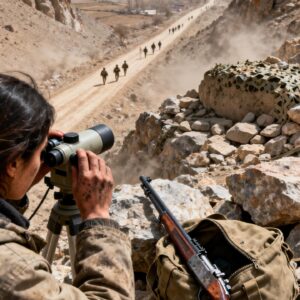
THE EXILED SNIPER: WHEN THE WORLD BRANDED ME A TRAITOR, I BECAME THE GHOST THAT SAVED THEM FROM THE SHADOWS
PART 1: THE SILENT WATCHER The wind at eleven thousand feet doesn’t just blow; it bites. It carries the metallic taste of snow and the ancient, dusty scent of stone that has been baking and freezing for millennia. I lay…
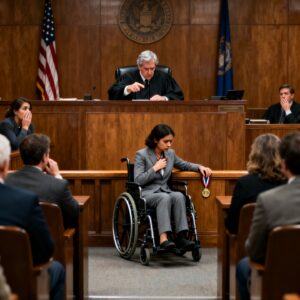
The Judge Called Me a Fraud and Demanded My Medal. He Had No Idea I Was the Reason His Son Was Still Alive.
PART 1: THE HUMILIATION The phantom rhythm of rotor blades was the first thing I heard. Thump. Thump. Thump. It wasn’t real, of course. It was just the ceiling fan in my San Diego apartment, slicing through the warm October air….

I Was Shackled in a Courtroom as a Homeless Thief, Ignored by Everyone—Until the Clerk Read My Service Number, the Judge Stood Up in Dead Silence, and the Man I Saved from Hell Recognized the Ghost He Thought Died in Fallujah.
PART 1: THE GHOST IN THE ORANGE SUIT The holding cell smelled of bleach and urine—a chemical cocktail meant to sanitize misery, but it only made it sting the back of your throat. I sat with my back pressed against…

I Was Supposed to Be Dead: The Day a SEAL Admiral Froze Mid-Speech, Saw the Forbidden Tattoo on My Wrist, and Exposed the Classified Secret I’d Hidden from My Son for Twenty Years.
PART 1: THE GHOST IN THE BACK ROW You learn to be invisible. That’s the first rule of survival when you’re walking around with a grave that already has your name on it. You learn to take up less space,…
The Ghost of Flight 227: She Was Supposed to Be Dead, But When the Captain Collapsed and the Plane Screamed toward Earth, the Woman in Seat 14C Revealed a Secret That Would shake the Pentagon to Its Core
PART 1: THE INVISIBLE PASSENGER The smell of economy class is always the same. It’s a cocktail of stale coffee, recycled air, and the sour, metallic tang of human exhaustion. I was breathing it in, four counts in, four counts…
THE GHOST OF KANDAHAR: They Buried My Career and Mocked My Name, But When The Admiral Saw My Sealed File, He Unleashed A War Machine They Never Saw Coming
PART 1: THE INVISIBLE WOMAN The Alabama heat at 0530 didn’t just hit you; it strangled you. It was a physical weight, a wet, suffocating blanket that smelled of JP-8 jet fuel, heated asphalt, and the stale, recycled air of…
End of content
No more pages to load