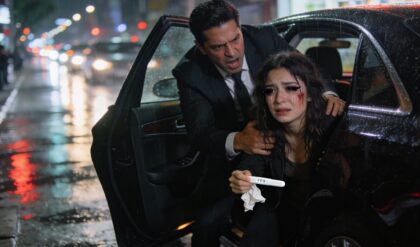
The call ended. A one-hundred-million-dollar deal, evaporated. Just like that.
My PA, Maria, was standing in the doorway of my office, her face pale. She was waiting for me to yell, to throw something, to shatter the floor-to-ceiling glass that separated me from the rest of the world.
I did nothing.
I just stared out at the skyline, so sharp against the smog-lit sky it looked fake. One hundred million. Ten years ago, that number would have given me a heart attack. Today, it was just… a rounding error. An annoyance. It meant three more meetings, four more brutal phone calls, and a fractional dip in a stock price I hadn’t personally checked in months.
“Clear my schedule for the next 48 hours, Maria,” I said, my voice flat, sterile. “Sir? But the London summit…” “Clear it.”
She vanished. I was left alone in the silence. My office was a minimalist cage of steel, glass, and expensive, uncomfortable furniture. It was less a room and more a statement. It said, “I am a man who has conquered all emotion.”
It was a lie.
I was 45 years old. I was Sebastián Ferrer, the architect of a tech and finance empire that spanned continents. I had apartments in Hong Kong, New York, and London. I dated models I had no connection with. I drove cars that cost more than most people’s homes. I was the subject of magazine articles that praised my “ruthless vision.”
And I was utterly, profoundly empty.
The 48-hour void in my meticulously planned life felt… wrong. It was an unstructured gap, a vacuum. And in that vacuum, a familiar, dull ache started to throb behind my eyes.
Guilt.
I hadn’t seen my parents in six years.
Manuel and Carmen Ferrer. They were still in the small, damp, forgotten town in the Pacific Northwest where I’d grown up. The town I had clawed my way out of with bloody fingernails, promising myself I would never, ever go back.
We spoke twice a month. A scheduled, 10-minute call, precisely wedged between my market-open analysis and my afternoon strategy sessions. “We’re fine, mijo,” my mother would always chirp, her voice thin over the line. “Don’t you worry about us. You’re so busy.” “How is the new house?” I’d ask, tapping an email on my third monitor. “Oh, it’s… it’s coming along, mijo. Javier is working so hard on it.”
Javier. My cousin. The only family I had left back there. The one who had stayed.
I’d done what I always do. I’d thrown money at the problem. Six years ago, after a particularly guilty call where I could hear the drip… drip… drip of a leak in their old house, I’d wired Javier half a million dollars. “Build them a palace, Javi,” I’d instructed. “The best house in town. Heated floors. Big windows. Whatever they want. I want them comfortable. I want everyone to see how well they’re doing.”
It was a consciousness-clearing transaction. I was outsourcing my role as a son. It was easier than visiting. It was cleaner.
Javier had sent a few blurry photos of a concrete foundation being laid, then had asked for more money a year later. “Materials are expensive, Seb,” he’d said, his voice a little too slick. “Imported tile. German appliances. You want the best, right?”
I’d wired another hundred thousand without blinking. I hadn’t spoken to him since.
I looked at the empty 48-hour slot in my calendar. An impulse struck me. It was so alien, so spontaneous, that it almost scared me. Go. *Go see the house. Go see them.
I didn’t call. I didn’t warn anyone. I wanted the surprise. I wanted to see their faces when I rolled up, the prodigal son returned, the hero who had built them their palace. I wanted, just for a second, for my success to feel real. To see the tangible proof of my wealth, not just numbers on a screen.
I went to my private garage, a sterile white cavern beneath my building. I bypassed the chauffeured Maybach. I took the keys to my personal indulgence: a matte-black Mercedes G-Wagon. A $200,000 luxury tank, designed to conquer mountains, though it had never seen anything rougher than a speed bump.
I punched the name of my hometown into the GPS. A tiny dot in the sprawling green of the coastal range. I began to drive north.
The 12-hour drive was a violent transition. The eight-lane superhighways of the city dissolved into four-lane freeways, which then bled into two-lane state highways, which finally devolved into pockmarked asphalt roads that snaked through endless forests of fir and pine.
The crisp, dry air of the city turned heavy, humid, and smelled of rust and wet earth. And then, the rain started.
This wasn’t city rain. This was the temporal. A cold, violent, relentless curtain of water that seemed to fall from a sky of solid iron. The wind howled, a grieving wolf, slamming the side of the G-Wagon with gusts that would have terrified me in a lesser car. The Mercedes, with its massive all-terrain tires and two tons of German steel, barely noticed.
But I felt that cold. I felt it in my bones. It was the cold of my childhood.
I remembered it instantly. The smell of wet wool and damp wood. The mildew. The constant, agonizing drip… drip… drip… of a leaking roof into a collection of metal buckets and plastic tubs. I remembered my mother, her hands raw and red from scrubbing clothes in icy water because the old heater was broken again. I remembered my father, a proud, strong man, sitting at the kitchen table, staring silently at the rain, his shoulders slumped, his pride eroded by the constant, inescapable damp.
I’d made a promise to myself, shivering in that wet bed 30 years ago: I would never be cold again. I would build a fortress of wealth so thick that the rain could never touch me.
A smug smile touched my lips. I was about to see the proof of that promise fulfilled. My parents were, right now, sitting in their brand-new, perfectly insulated mansion. They were probably watching this very storm from behind a massive, thermal-pane picture window, a central heating system—paid for by me—humming quietly in the walls.
I had kept my promise. I had saved them.
The rain was so thick I almost missed the turnoff. The wooden sign for my town, Population: 834, was rotted, one hinge broken, hanging at a drunken angle. The town itself was… smaller. Grayer. More defeated than I remembered. The “brightly painted” wooden storefronts of my memory were now just… rotting. The paint was peeling in long, leprous strips. The mud was everywhere, a thick, brown slurry that covered the sidewalks and oozed into the street. It was a town drowning in neglect and poverty.
I felt a pang of disdain. How had I ever come from this? My success felt even more miraculous, more godlike. I drove down the main street. The G-Wagon’s tires, built for conquering the Serengeti, threw up waves of brown water. People stared from the windows of the one sad diner. Faces like pale, curious fish in a forgotten aquarium.
I turned onto my old street. The street where the new, magnificent residence was supposed to be.
My stomach tightened. I didn’t see it. I saw no new construction. No grand gate. No imported tile. I saw… nothing. Nothing but the same row of defeated, sagging, moss-eaten houses.
“The GPS must be wrong,” I muttered, my heart starting a low, heavy drumbeat against my ribs. I drove slowly, peering through the wall of water. And then I saw it.
At the end of the block. My childhood home. It was still standing. Barely. It looked like a rotting tooth, sagging, the porch roof collapsed on one side, the paint long since surrendered to the black-green moss.
And in front of it, under the relentless, horizontal assault of the rain, I saw them.
It wasn’t a illusion. It wasn’t a mistake. It was Manuel and Carmen. My parents.
They were standing on the sidewalk. Or what passed for one. A strip of broken concrete beside the river of mud. They were standing next to a pile of… furniture. Their furniture. The old, worn-out velvet sofa with the cigarette burn on the arm, now black and saturated with water. A wooden dresser, the one from my old bedroom, with a broken top drawer. Cardboard boxes, so soaked they were disintegrating, revealing a heartbreaking collage of clothes, old photographs, and kitchenware.
My brain refused to process the scene. The contradiction was too violent. Me, in a $200,000 truck, sealed in perfect, climate-controlled luxury. Them, standing next to their entire life, dumped in the mud.
They were being evicted.
I hit the brakes. The G-Wagon stopped dead in the middle of the street. I couldn’t move. I couldn’t breathe. My brain was screaming, ERROR. ERROR. DOES NOT COMPUTE. This was impossible. The half-million dollars. The new house. The German appliances.
I saw my mother, Carmen, a woman so small and frail she looked like a child, trying uselessly to cover an old box-style television with a torn black plastic bag. The wind ripped it from her hands. I saw my father, Manny, the man who had taught me how to be strong, just… standing. Immobile. His face was blank, his eyes lost, staring at the front door of his own home. Two men I didn’t recognize were changing the lock on that door. One of them hammered a bright orange “NO TRESPASSING” sign into the wet lawn.
The armor of arrogance, the entire crystal palace of my life, didn’t just crack. It vaporized. It shattered into a billion pieces, leaving me naked, exposed, and trembling. The $100 million deal I lost this morning was nothing. This was loss.
A new emotion, one I hadn’t felt in 20 years, surged up from my stomach. It was a fury so cold, so deep, so absolute, that it made me nauseous. I fumbled for the door handle, my hands shaking. I stepped out of the truck.
I forgot the umbrella. I forgot my $4,000 cashmere coat. The second I stepped out, the storm hit me. It was like being punched. The rain was icy, and the wind stole my breath. I was soaked to the skin in seconds. I didn’t feel it. I felt nothing but the fire in my chest.
“Dad! Mom!” I yelled. My voice sounded alien, thin and reedy against the howl of the wind.
They both turned. Their faces. I will never forget their faces. It wasn’t relief. It wasn’t “Oh, Sebastián, thank God!” It was shame. Pure, absolute, gut-wrenching shame.
My mother let out a small, strangled gasp and covered her face with her hands. My father, Manny, physically recoiled. He straightened his back, a pathetic, reflexive attempt to find a dignity that had just been stolen from him. “Sebastián,” he said, his voice a broken whisper. “Mijo… no. You shouldn’t be here. It’s… it’s not a good time.”
“Not a good time?” I repeated, my voice rising to a roar. “NOT A GOOD TIME? What is happening?!” I stormed past them, straight to the two men at the door. One was a burly guy in a yellow slicker, the other a weaselly man holding a clipboard. “What the hell do you think you’re doing?” I snarled. “Who are you? This is my parents’ house!”
The weaselly man looked me up and down, taking in my soaked, expensive coat and the monster of a truck I’d just emerged from. He wasn’t impressed. He tapped his clipboard. “We’re from the bank, sir. Property’s been foreclosed. Mortgage non-payment. Today’s the scheduled eviction. We’re just doing our job. You need to clear the premises.”
I felt like I’d been shot. “Mortgage?” I laughed, a raw, bitter sound. “This house was paid off 40 years ago! I know. I was here.” “Not according to this,” he said, bored, holding up the clipboard. “There’s a half-million-dollar lien against it. Defaulted. Property’s been sold at auction.” “A… what?” I turned to my father. The blood had drained from my face. “Dad? What is he talking about? Where is the half-million dollars I sent you? Where is the new house? Dad… where is Javier?”
The mention of his name made my mother sob, a high, thin wail that was swallowed by the storm. My father’s face crumpled. He looked down at the mud. Defeated. “There is no new house, Sebastián,” he whispered. “What?” “There’s no money,” he said, his voice cracking. “Javier… he… he came to us. He said you wanted to build us the house. He… he had papers. He said they were for the building permits. For the county.” My mother stepped forward, her hands twisting. “We… we signed them, mijo. We thought… we trusted him. He’s family.” “He kept asking for more,” my father continued, his voice monotone, as if he were in shock. “He said the materials were expensive. The permits. The soil tests. Then… then the letters started. From the bank.” “Why didn’t you call me?” I screamed. “WHY?” “We did!” my mother cried. “We asked Javier! He said it was just a mistake. A bank error. He said he would handle it! He said you were too busy… that we shouldn’t… we shouldn’t be a burden.”
Burden.
The word hit me like a physical blow. They were being swindled, terrorized, and ultimately thrown from their home, and their primary concern was not being a burden to me. The world tilted. My cousin. My own blood. He hadn’t just stolen the $500,000 I’d sent for their future. He had used their trust—used my negligence—to get them to sign a reverse mortgage. He’d mortgaged their past. He’d taken all the equity out of their paid-off home and stolen that, too. He had stolen everything.
My arrogance. My lazy, check-writing, delegating arrogance. I had been so busy conquering the world, I had left the two most important people in my life completely undefended. I had outsourced their safety to a wolf, and I hadn’t even bothered to make a single follow-up call. This wasn’t Javier’s fault. This was mine.
The shame was so profound, so total, it was a physical weight. I could barely breathe. And in that precise, horrific moment, as if summoned by a dark god, a rusted-out blue sedan pulled up behind my G-Wagon. My cousin Javier got out. He was holding a cup of coffee from the diner. He had a satisfied, almost smug look on his face. He hadn’t come to help. He had come to watch. He had come to see the final, pathetic end of the two old people he had ruined.
He took a sip of his coffee. He looked at the scene. The bank agents. The furniture in the mud. My parents, weeping. And then… he saw me. His face. It was a mask of comedy and horror. The color drained from it instantly. The coffee cup slipped from his fingers, splashing onto the muddy ground. “Seb… Sebastián?” he stammered. “What… what are you doing here? You’re supposed to be in… London?” He knew my schedule. He had planned this. He started to backpedal, to get back into his car. “Oh, no,” I said, my voice a low, glacial whisper. I was across the street in three strides. I grabbed the front of his jacket, twisting the cheap fabric in my fist. “WHERE IS IT?” I roared, my face inches from his. “I… I… it was a bad investment, Seb! The market…” “WHERE IS MY PARENTS’ MONEY, JAVIER?” “It’s gone! It’s gone, okay!” he shrieked, terror in his eyes. “You don’t know what it’s like! You, in your palace! You just send your money! You just throw it! You never come! You never see! I was here! I was the one… I deserved…”
I let go of him. I was too disgusted to even touch him. “You’re right,” I said, my voice terrifyingly calm. The rage had cooled, focused into a diamond-hard point. “I wasn’t here. But I am now.” I pulled out my phone. My $10,000 satellite phone, which worked even in this forgotten hellhole. The bank agent, the weaselly one, stepped forward. “Sir, this is a civil matter. You need to step away…” I held up one finger to silence him. He stopped. I made one call. “David,” I said. My private banker in New York. “I’m looking at a foreclosure notice. Western Regional Bank. Account number…” I read the number off the clipboard. “I need you to tell me the full payoff amount. Now.” David was good. I heard typing. “It’s… $542,819.12, Mr. Ferrer. It’s at auction.” “Not anymore,” I said. “Wire the full amount. Right now. From my personal account. And then… I want you to call the CEO of Western Regional. I don’t care what time it is. Tell him Sebastián Ferrer just bought this debt, and if his eviction agents aren’t off this property in five minutes, I’m buying his bank on Monday and firing him personally.” I hung up. I looked at the weaselly man. He was pale. “How much is the debt?” I asked, though I already knew. He stammered the number. “It’s paid,” I said. “You have one minute to put your tools down and get off my property.” “I… I can’t just… I need confirmation…” His phone buzzed in his pocket. He looked at it. His eyes went wide. It was, I assumed, his boss, his boss’s boss, or God. “Mr. Ferrer,” he said, his voice now shaking. “My deepest apologies. There’s… there’s been a terrible mistake.” “Yes, there has,” I said. “Get out.” They practically ran to their truck, threw their tools in the back, and spun out, spraying mud.
I turned to Javier. He was shaking, trying to open his car door. “You’re not going anywhere,” I said. I made a second call. To my chief legal counsel. “Michael. I need you to file a criminal complaint. Now. My cousin, Javier Ferrer. In… ” I gave him the town name. “Charges are fraud, theft, and elder abuse. I want him arrested. I’m sending you the details. And I want the best private investigator you can find. I want you to find every penny he stole. I want you to seize every asset. I want him to spend the rest of his life in a concrete box. Use whatever resources you need. Handle it.” I hung up. Javier was crying now. “Seb… please… family…” “Family?” I said. “You did this to our family.” A local police cruiser, no doubt called by the bank agents, rolled up. I pointed at Javier. “Officer. That man just confessed to stealing over half a million dollars from my parents and defrauding them of their home. I’d like him arrested.”
Ten minutes later, it was over. Javier was in the back of the police car, sobbing. The bankers were gone. The street was quiet, save for the incessant, miserable sound of the rain. It was just me. My parents. And their ruined life, soaking in the mud. The adrenaline was gone. The fury had passed. And I was left with the wreckage. My money had “solved” the immediate problem. But it hadn’t fixed anything. It hadn’t erased the terror, the shame, the years of fear they must have lived with. My mother was staring at the sofa. “It’s… ruined,” she whispered. “My mother’s sofa…” My father was just staring at me. Not with pride. Not with gratitude. With… fear. I was a stranger. An alien who had descended in a black spaceship, spoken a language of unimaginable wealth and power, and made the world bend to my will. I hadn’t saved them. I had just demonstrated, in the most brutal way possible, how vast the gulf between our worlds had become.
I walked away from them, toward the pile of their life. I saw the chest of drawers. The one I remembered from my childhood. The top-left drawer had always stuck. I’d kicked it shut a thousand times. Now, it was lying on its side, the veneer peeling away in the wet. Beside it, half-buried in the mud, was a small, warped picture frame. I bent down, my knees cracking. My $4,000 cashmere coat dipped into the filth. I didn’t care. I picked it up. The glass was cracked. Behind it, a faded photograph. It was me. I was maybe ten years old, skinny, with oversized front teeth, holding up a small, silvery fish I’d caught in the local stream. My father was beside me, his hand on my shoulder, his face split by a proud, beaming smile. I had forgotten that smile. I had forgotten that feeling. The pride. The simplicity. The love.
I stared at that photo, and the entire artifice of my life—the glass tower, the private jets, the armor of success—crumbled into dust. I hadn’t just failed them. I had failed him. The boy in the picture. The boy who just wanted to make his father proud. I turned back to my parents. My mother flinched, as if expecting another explosion. “Perdónenme,” I whispered. The word was rough, unfamiliar in my own mouth. Forgive me. “Mijo, no,” Carmen whispered, taking a hesitant step toward me. “It is not your fault.” “It is!” My voice cracked. “It is all my fault. I thought… I thought money was the answer. I thought if I just threw enough money at this… at you… I could make the cold go away. I could buy you warmth. I could buy you safety.” I held up the muddy photograph. “I forgot what this felt like. I was so busy building an empire… I let my own family… I let our home… be stolen.” My mother rushed forward then, her small, frail body colliding with my chest. She wrapped her arms around my waist, and for the first time since I was that boy in the picture, I held onto her. I mean, I really held her. I buried my face in her damp, gray hair, and the great Sebastián Ferrer, the titan of industry, the architect of empires, broke down and sobbed in the middle of a muddy street, in the pouring rain, clinging to his mother like a lost child. My father put his hand on my back. It was trembling. “It’s okay, mijo. You are here now. You are home.”
You are home. The words hit me harder than the eviction notice. This place. This wreck. This failure. This was home. Not the penthouse. Not the steel-and-glass box in the sky.
I pulled back, wiping my face with the back of my hand, smearing mud across my cheek. A new feeling was rising through the grief. Not anger. Not shame. It was… purpose. A white-hot, clarifying purpose. I looked at the house. The sagging porch. The moss-eaten shingles. “This house is poison,” I said, my voice thick. “Sebastián, it is our home,” my father said weakly. “We can fix it.” “No,” I said. “We can’t. It’s full of bad memories. It’s full of my failure.” I looked at him. “Tomorrow, a demolition crew will be here. They’re tearing it down.” “Mijo, where will we live?” Carmen cried, her panic returning.
“With me,” I said. “For now. In a rented house. The best one in the area. But… that’s not the plan.” I turned. I looked down the street. The other houses. They were in similar states of decay. Rotted wood, sagging roofs. I saw curtains twitching. The whole neighborhood had been watching. They were probably just as poor, just as desperate, just as forgotten as my parents had been. “You said you didn’t want to be a burden,” I said to my father. “You were worried. You and mom. Living in this town… getting older. You were worried about who would take care of you. Weren’t you?” My father looked down, shuffling his feet in the mud. He nodded. “We are old, Sebastián. Javier… he said the new house would have… ramps. A place for a nurse, if we needed one. That’s why we signed the papers.” The con was deeper and more venomous than I could have imagined. He hadn’t just preyed on their trust; he’d preyed on their fear of aging.
“Okay,” I said, my voice hardening with resolve. “Okay.” I looked at the G-Wagon, my absurd tank. I looked back at the mud. “I’m not building you a house,” I announced, loud enough for the twitching curtains to hear. “I’m buying this entire street. I’m buying the whole block. And I am building the Manuel and Carmen Ferrer Foundation.” They stared at me, dumbfounded. “Not a mansion. A community. Dozens of brand-new, warm, dignified homes. For all the retired people in this town. People like you. A state-of-the-art medical clinic on that corner. A community dining hall. Gardens. A place where nobody ever has to be afraid of getting old. A place where nobody feels like a burden ever again.” “Sebastián,” my mother whispered, her hand over her mouth. “That is… that is impossible.” “Is it?” I laughed, a raw, bitter sound. “I lost a deal this morning worth ten times that. I move markets. I build data centers the size of stadiums. Trust me, I can build a few warm houses.” I looked at the muddy street, at the weeping sky. “And I’m not sending a check,” I said, the most important part clicking into place. “I’m not delegating. I’m not flying back to my glass tower.”
I pulled my $10,000 phone from my pocket. It was buzzing incessantly. Maria. London. New York. I looked at the frantic messages. ‘Mr. Ferrer, London is on Line 1. Urgent!’ I held the power button. The screen went black. I slipped it back into my pocket. “I’m staying,” I said. “I’m running my empire from here. From this muddy, forgotten town. My new office is going to be a construction trailer, and I’m going to watch every single nail go into every single board. I’m going to build something that actually matters.”
Six months later, the street was unrecognizable. The sound of the rain had been replaced by the roar of bulldozers, the whine of saws, and the rhythmic thwack of hammers. The rotten old houses were gone. In their place, the foundations of modern, ecological, beautiful buildings were rising. I hadn’t seen my penthouse since that day. My headquarters was, indeed, a double-wide trailer with a satellite uplink that cost more than my first car. I wore steel-toed boots and jeans every day. My hands, once soft from keyboards and boardrooms, were calloused and rough. I was in meetings with architects and plumbers, not hedge fund managers. I was negotiating the price of lumber, not corporate bonds. And I had never been happier. Javier was in prison, facing a long sentence. My legal team had found he’d done this to three other families. He was a ghost, a lesson learned in the most brutal way possible. My parents? They were thriving. They lived in a comfortable rented home nearby, but they were on the construction site every single day. My mother, Carmen, had organized a coffee and food station for the entire construction crew. She knew every worker by name, knew their families, and treated them like her own sons. She was the heart of the project. My father, Manny, was its foreman. Unofficially, of course. But he was there at dawn, dressed in a new work coat, pointing, arguing with the engineers, checking the level of a concrete pour with a practiced eye. He was telling the architects their angles were wrong, that they didn’t understand how the wind hit this valley. And the architects, after initially dismissing him, had learned to listen. The man was alive again. His pride, which I had seen shattered in the mud, was now the very foundation of the entire project. We had dinner together every night. We didn’t talk about stock prices. We talked about the drainage problem in building C. We talked about the color of the paint for the clinic. One evening, my father and I were standing on the hill overlooking the project, watching the sunset paint the new framework in gold. “It’s beautiful, Sebastián,” he said quietly, sipping his coffee. “But… your work. Your empire. You are losing touch, mijo. All this… for us.” I looked at the skeleton of the new community. “Dad,” I said. “For thirty years, I built things that were invisible. Code. Financial models. Companies that existed only on paper. I was rich, yeah. But I was… empty. I was building a monument to myself.” I pointed down at the busy site. “This is the first real thing I have ever built. It’s not for me. It’s not for you. It’s for that boy in the photograph. The one who just wanted to make you proud.” He put his arm around my shoulder, just as he had in the picture. “He did, mijo. He always did.” I had learned the hardest lesson of my life in that storm. I had learned that you can’t send love. You can’t delegate family. Money is just a tool. It’s leverage. But time? Presence? That’s the only currency that truly matters. I had flown into this town a billionaire. But I had become wealthy, truly wealthy, standing in a muddy street, in the ruins of my past, finally ready to build a future.
News
THE EXILED SNIPER: WHEN THE WORLD BRANDED ME A TRAITOR, I BECAME THE GHOST THAT SAVED THEM FROM THE SHADOWS
PART 1: THE SILENT WATCHER The wind at eleven thousand feet doesn’t just blow; it bites. It carries the metallic taste of snow and the ancient, dusty scent of stone that has been baking and freezing for millennia. I lay…
The Judge Called Me a Fraud and Demanded My Medal. He Had No Idea I Was the Reason His Son Was Still Alive.
PART 1: THE HUMILIATION The phantom rhythm of rotor blades was the first thing I heard. Thump. Thump. Thump. It wasn’t real, of course. It was just the ceiling fan in my San Diego apartment, slicing through the warm October air….

I Was Shackled in a Courtroom as a Homeless Thief, Ignored by Everyone—Until the Clerk Read My Service Number, the Judge Stood Up in Dead Silence, and the Man I Saved from Hell Recognized the Ghost He Thought Died in Fallujah.
PART 1: THE GHOST IN THE ORANGE SUIT The holding cell smelled of bleach and urine—a chemical cocktail meant to sanitize misery, but it only made it sting the back of your throat. I sat with my back pressed against…
I Was Supposed to Be Dead: The Day a SEAL Admiral Froze Mid-Speech, Saw the Forbidden Tattoo on My Wrist, and Exposed the Classified Secret I’d Hidden from My Son for Twenty Years.
PART 1: THE GHOST IN THE BACK ROW You learn to be invisible. That’s the first rule of survival when you’re walking around with a grave that already has your name on it. You learn to take up less space,…

The Ghost of Flight 227: She Was Supposed to Be Dead, But When the Captain Collapsed and the Plane Screamed toward Earth, the Woman in Seat 14C Revealed a Secret That Would shake the Pentagon to Its Core
PART 1: THE INVISIBLE PASSENGER The smell of economy class is always the same. It’s a cocktail of stale coffee, recycled air, and the sour, metallic tang of human exhaustion. I was breathing it in, four counts in, four counts…

THE GHOST OF KANDAHAR: They Buried My Career and Mocked My Name, But When The Admiral Saw My Sealed File, He Unleashed A War Machine They Never Saw Coming
PART 1: THE INVISIBLE WOMAN The Alabama heat at 0530 didn’t just hit you; it strangled you. It was a physical weight, a wet, suffocating blanket that smelled of JP-8 jet fuel, heated asphalt, and the stale, recycled air of…
End of content
No more pages to load