THE GHOST IN THE MACHINE
PART 1: The Mask of Nobody
The air inside the Iron Horse Saloon tasted like stale beer, bad decisions, and the kind of desperation that clings to the edge of the Mojave Desert.
I sat at the far end of the bar, my back against the wall—always against the wall—and watched the room through the reflection of a dirty mirror. To everyone here, I was Samantha Wheeler, a GS-11 Logistics Contractor. A “paper pusher.” A civilian tourist in their world of camouflage and combat boots. I was nobody.
And that was exactly what I needed them to believe.
If they knew the truth—that I was a Commander in the Naval Special Warfare Development Group, that my hands were registered as lethal weapons in three databases they didn’t have clearance to access, or that I was currently hunting a traitor operating out of their base—I would be dead. And worse, the mission would fail.
So, I sat. I ordered water. I let the condensation drip down the glass, counting the seconds between the beats of the jukebox.
The bartender, a man named Stone, watched me. He was sixty-one, built like a slab of granite that had weathered too many storms. I saw the faded ink on his forearms—the anchor, the eagle, the trident. He was old Teams. Vietnam or Grenada era. He moved with the efficiency of a man who had killed people and made peace with it.
My right hand rested on the scarred oak of the bar. Without looking at him, my index finger tapped a rhythm against the wood.
Tap. Tap. Tap. Pause. Tap. Tap. Pause. Tap. Tap. Tap. Tap.
D. T. S.
Delta. Tango. Sierra.
It was the old code. Underwater Demolition Teams. Deep. Tango. Silent. It was a whisper from one ghost to another.
Stone stopped wiping a glass. He didn’t look at my face. He looked at my hands. His eyes narrowed, a microscopic shift in his demeanor. He recognized the rhythm. He knew I wasn’t a contractor. But he also knew the game. He turned away, busying himself with the taps, keeping my secret. That was professional courtesy.
But professional courtesy was in short supply at the corner booth.
“I’m telling you, this new generation doesn’t get it.”
The voice boomed across the room, abrasive and thick with alcohol. Staff Sergeant Reed Harper.
I didn’t need to turn around to know what he looked like. I had his file memorized. Thirty-two years old, 14 months in Ramadi, heavily decorated, and currently suffering from a dangerous surplus of ego. He was holding court with his squad—Patterson, Knight, and the kid, Murray. Harper was the kind of Marine who thought volume equaled leadership.
“Back in ’91, we kicked Saddam’s ass in a hundred hours,” Harper shouted, slamming a bottle down. “Clean. Surgical. That’s how you fight a war.”
I took a sip of water. Clean. There is no such thing as a clean war. There is only survival and the things you lose along the way.
“Hey, Reaper,” Patterson said, his voice lower. “You see her?”
I felt their eyes on me. It was a physical sensation, like a laser grid sweeping across my skin.
“Contractor,” Harper scoffed. The word dripped with venom. “Probably pushing papers for some defense company. Making six figures to do what a Lance Corporal could do for thirty grand.”
“She doesn’t look like a paper pusher,” Patterson noted.
“They never do.”
I heard the scrape of a chair. Heavy boots thudding against the floorboards. Harper was coming over.
My heart rate didn’t spike. My breathing didn’t change. But my threat assessment matrix lit up. Distance: ten feet. Threat level: Low to Moderate. Intoxication: High.
He leaned against the bar next to me, invading my personal space. He smelled of cheap whiskey and unwashed desert fatigues. He was crowding me, a tactic designed to intimidate.
“You look thirsty,” he drawled. “Let me buy you a real drink. Something that ain’t water.”
I turned my head slowly. I made my eyes flat. Dead. I stripped every ounce of intelligence and lethality out of my expression, leaving only the bland, confused look of a civilian out of her depth.
“I’m fine, thank you,” I said. My voice was Midwestern neutral. Soft.
He grinned, showing teeth. It wasn’t a friendly smile; it was a predator testing a fence. “Don’t be like that. We’re all on the same team out here, right? What do you do? Logistics?”
“Supply chain management,” I lied.
“Whatever it is, you look like you could use some fun. Loosen up.”
“I’m waiting for my ride.” I turned back to my water.
The dismissal was absolute. In his world, he was the apex predator. He was the war hero. I was the help. I wasn’t supposed to turn him away.
From the booth, the kid, Murray, laughed. “Yo, Reaper! She turning you down? A paper pusher turning down a Marine?”
The laughter hit Harper like a slap. I saw his reflection in the mirror—his neck flushed red. His ego was bruising, and for men like Harper, a bruised ego was a call to arms.
“Look,” he said, the friendly facade vanishing. “I’m trying to be nice here. A little respect is all I’m asking.” He jabbed a finger at his own chest, tapping the Combat Action Ribbon. “I earned my stripes in Ramadi. You know what that means? It means I bled for this country while you were probably in some air-conditioned office learning about… supply chains.”
I stared at the warped glass. “Your service is noted, Sergeant. Now, please step back.”
“You think you’re better than me?” His voice dropped to a growl. The bar went silent. The music seemed to fade. “You’re just another civilian tourist. We’re the ones with boots in the dirt. You sit in your office and shuffle papers while men like me keep you safe. You wouldn’t last five seconds outside the wire.”
Five seconds, I thought. In five seconds, I could crush your larynx, shatter your knee, and dislocate your shoulder before you hit the floor.
But I couldn’t. I was Samantha Wheeler, logistics contractor. Samantha Wheeler would be scared. Samantha Wheeler would freeze.
“Please,” I said, keeping my voice trembling slightly.
He reached out. It wasn’t a grab; it was a shove. He pushed my shoulder, hard.
It was a blow meant to humiliate, to unseat me from the stool, to show the room who held the power.
The impact jarred me. My body wanted to react. My muscle memory screamed to deflect, trap the arm, and drive his face into the bar top. It took every ounce of my willpower to override ten years of SEAL training.
I let myself rock on the stool. I let my foot slide on the grimy floor. I absorbed the force, turning it into a stumble rather than a stance.
I straightened up, adjusting my black tank top. I looked at him. For one micro-second, I let the mask slip. Just a fraction. I let him see the cold, dead calculation in my eyes. I let him see the Ghost.
He blinked, a flicker of confusion crossing his drunk face. He saw something ancient and dangerous looking back at him, but his brain couldn’t process it.
I slid off the stool. My hands were steady. I placed five dollars on the bar.
“Have a good night, Sergeant,” I whispered.
I walked to the exit. I forced myself to walk like a civilian—heavy steps, shoulders hunched. But I could feel Stone watching me. I could feel the silence of the room.
“Yeah, walk away!” Harper shouted behind me, desperate to reclaim his victory. “That’s right! Go back to your office!”
I pushed through the door into the blast of desert heat.
The parking lot was bathed in the sickly yellow glow of sodium lights. I walked to my dusty Ford F-150 and leaned against the door. My hands were shaking now—not from fear, but from the adrenaline of suppressed rage. The desire to violence is a drug, and withdrawal is painful.
“That was Harper,” a voice said.
I spun around. A woman in Air Force fatigues stood in the shadows. Lieutenant Colonel Margaret Ellis. Intelligence.
“He’s usually not that bad,” Ellis said, lighting a cigarette. “If you need anything… I can file a report. Get witnesses. That was assault.”
I smoothed my shirt. “I appreciate that, Ma’am. But I’m fine. Just a misunderstanding.”
Ellis studied me. Her eyes were sharp, intelligent. She was looking at the way I stood—balanced, ready. “Where did you learn to move like that?”
“Like what?”
“Like someone who knows exactly what they’re doing. Like someone who’s had training.”
I opened my truck door. “I don’t know what you mean.”
“Right,” she said, exhaling smoke. “Sure you don’t.” She flicked a card toward me. “If you change your mind. Or if you just need someone to talk to who isn’t a drunk Marine.”
I took the card. “Thank you.”
I watched her walk away. Another complication. I was drawing attention. The one thing a Ghost cannot afford is eyes on the target.
I climbed into the truck and drove. The silence of the cab was deafening. I looked down at my wrist, at the silver bracelet engraved on the inside.
Kandahar 09.
“Mission first,” I whispered to the empty desert. “We are nothing.”
I drove back to my quarters—a converted shipping container on the edge of the logistics compound. It was sparse. A cot, a desk, a laptop.
I sat in the dark for five minutes. I allowed myself to replay the scene in the bar. I visualized breaking Harper’s arm. I visualized the snap of bone. I let the anger burn white-hot, and then, like flipping a switch, I turned it off.
I opened my laptop.
The screen glowed blue. I bypassed the standard logistics interface and entered a 16-character encryption key. The screen shifted. Satellite imagery. Encrypted comms. Financial tracking algorithms.
For six weeks, I had been hunting Major Scott Daniels. On paper, he was a hero. In reality, he was a arms trafficker selling American hardware to Russian cartels. He was moving Javelins—anti-tank missiles. The kind that could blow up a convoy or bring down an airliner.
He was moving the shipment in 72 hours.
My phone buzzed. A secure text from Chief Warrant Officer Donald Fletcher. My handler. My mentor. The man who brought my father home in a flag-draped box.
FLETCHER: Package arriving 1800 tomorrow. Be ready.
ME: Confirmed. Maintaining position.
FLETCHER: How are you holding up?
I stared at the screen. How was I holding up? I had just let a man assault me to protect a cover that felt heavier every day.
ME: Mission first.
FLETCHER: Always. But you’re still human, Sam. Don’t forget that.
I deleted the message. I wasn’t human. Not right now. Right now, I was a weapon waiting to be deployed.
The summons came at 06:15 the next morning.
Report to Colonel Crawford’s office. Building 12. 0900 hours.
I knew what this was. Harper had filed a report. He had gotten ahead of the narrative. He was the hero; I was the instigator.
I dressed in civilian business casual—khaki slacks, white button-down. I pulled my hair back into a severe bun. I looked harmless. I looked like a bureaucrat.
Building 12 was a shrine to the Marine Corps. The walls were lined with photos of brave men doing violent things in foreign lands. I respected them. I had bled alongside them. But the man sitting behind the mahogany desk didn’t know that.
Colonel Philip Crawford was old school. Fifty-six years old, rigid, and tired. He looked at me like I was a stain on his carpet.
Reed Harper was already there, standing at parade rest. He was in his Dress Blues, looking immaculate. The perfect soldier. When I walked in, he smirked. It was subtle, but it was there. I won, his eyes said. You’re nothing.
“Sit,” Crawford barked.
We sat. Harper was rigid. I folded my hands in my lap.
“I have a complaint,” Crawford began, opening a file. “Regarding an incident at the Iron Horse Saloon. Staff Sergeant Harper?”
Harper snapped to attention in his chair. “Sir. Last night, approximately 2115 hours, my fire team and I were on authorized liberty. The contractor…” He didn’t use my name. “…was present. She was behaving in a manner that I felt disrespected the service members in the establishment. When I attempted to engage in normal social interaction, she became hostile.”
He paused for effect. A masterclass in manipulation.
“I may have made incidental physical contact while gesturing to emphasize a point. There was no assault, Sir. No intent to harm. I was merely attempting to bridge the civilian-military divide.”
It was a lie. A beautiful, polished, tactical lie.
Crawford looked at me. His eyes were cold. “Miss Wheeler. Your version.”
“Staff Sergeant Harper was intoxicated,” I said, my voice clinical. “He approached me. I declined his offer. He became aggressive. He struck me on the shoulder with force. I left immediately.”
Crawford sighed. He rubbed his temples. He looked at me with an expression of profound disappointment—not in Harper, but in me.
“Miss Wheeler,” he said, his tone dripping with condescension. “This is Fort Maverick. This is a Forward Operating Base in everything but name. The men here… they operate under tremendous stress. They have seen things you cannot imagine.”
Try me, I thought. I’ve pulled shrapnel out of my own legs in a cave in Yemen.
“I served in Beirut,” Crawford continued, puffing out his chest. “I know what warriors need. Sometimes, there is friction when civilians… when people who haven’t served… intrude on their space.”
The implication was clear. You provoked him by existing.
“I’m going to be clear with you,” Crawford said, leaning forward. “One more incident. One more report crossing my desk with your name on it, and your contract is terminated. You will be escorted off this base. Am I clear?”
He was threatening to fire me for being assaulted. If I were a civilian, I would be crying. I would be outraged. I would be calling a lawyer.
But I wasn’t a civilian. I was an operative on a timeline. If I got kicked off the base, Daniels would move the missiles, and I would lose him.
I swallowed my pride. It tasted like bile.
“Yes, Colonel,” I said softly. “I understand completely.”
“Good.” Crawford turned to Harper. “Sergeant, you and your team are restricted to base for 72 hours. Cooling off period. Dismissed.”
Harper saluted. “Crystal clear, Sir.”
He stood up. As he walked past me, he paused. He looked down at me, his blue eyes filled with triumph.
“Stay in your lane,” he whispered.
I didn’t look up. I waited until the door closed.
I walked out of Building 12 into the blinding sun. The heat hit me like a hammer. I walked to the parking lot, where a tan Toyota Tacoma was idling.
Fletcher was behind the wheel. He saw my face and knew exactly what had happened.
I climbed in.
“That bad?” he asked.
“Crawford sided with Harper. Threatened to terminate my contract.”
Fletcher gripped the steering wheel. “Crawford sees a liability. He doesn’t know he’s talking to a Ghost.”
“I could have handled him, Fletcher.”
“I know. But you didn’t. And that’s why you’re the best.” He handed me a secure tablet. “It’s happening. Daniels is accelerating. The shipment moves tonight. 0200 hours. Warehouse 7.”
I looked at the map. Warehouse 7. The kill box.
“We have one shot at this,” Fletcher said. “If we miss him, those missiles disappear into the black market. If we get caught… your cover is blown, and we’re both in federal prison.”
“What about Harper?” I asked, looking back at the headquarters building.
“Harper is a distraction. Forget him.”
I touched the bruise forming on my shoulder. “I can’t forget him. But he’ll have to wait.”
“Tonight, you’re not a contractor,” Fletcher said, his voice dropping an octave. “Tonight, the leash comes off.”
I looked out the window at the base that despised me. At the flags snapping in the wind. At the Marines drilling in the dust, completely unaware that a traitor was selling their lives for a paycheck.
“Tonight,” I said, “we hunt.”
PART 2: THE KILL BOX
The transformation took exactly twelve minutes.
Inside the converted shipping container, the air conditioner rattled against the desert silence. I stripped off the civilian costume—the slacks, the blouse, the vulnerability. In their place, I pulled on the second skin of my trade: black tactical pants, a moisture-wicking combat shirt, silent-tread boots.
I braided my hair tight against my skull. No loose strands. Nothing for an enemy to grab in close quarters.
From the false bottom of my footlocker, I retrieved the tools of my profession. A suppressed Sig Sauer P226. A Heckler & Koch MP7, compact and devastating, with three spare magazines. A Ka-Bar knife, the blade non-reflective matte black.
Finally, I strapped the bracelet on. Kandahar 09. It was cold against my skin.
I checked my reflection in the dark window. Samantha Wheeler, the logistics contractor, was gone. The Ghost was back. My eyes were different now. The softness I forced into them for the past six weeks had evaporated, replaced by the predator’s focus.
0147 Hours.
I slipped out into the Mojave night. The heat had broken, leaving a chill that bit at exposed skin. I moved through the shadows of the maintenance compound, avoiding the pools of sodium light, timing my movement with the rotation of the guard tower cameras.
Warehouse 7 loomed ahead—a concrete relic from the Cold War, isolated on the western perimeter. It was a black void against the starry sky.
I reached the chain-link fence. Twelve feet high, topped with razor wire. I didn’t climb it; I flowed up it. Three seconds to the top, a silent vault over the wire, a crouched landing on the other side. My breathing didn’t even hitch.
I activated my earpiece.
“Overwatch, this is Ghost. In position.”
Fletcher’s voice crackled in my ear, crisp and devoid of anxiety. “Copy, Ghost. Thermal shows three heat signatures inside. Two vehicles behind the structure. One civilian SUV, one panel van.”
“Moving to entry.”
I circled to the ventilation duct I’d identified weeks ago. It was tight, smelling of rust and dead insects. I crawled through, feeling the vibrations of the building. Below me, through the grate, the warehouse floor was a cavern of shadows and stacked crates.
Three men stood in a pool of harsh work lights.
Major Scott Daniels looked nervous. He was pacing, checking his watch, sweating through his uniform. Beside him was Captain Bradford, looking like he might vomit.
And then there was the third man.
He didn’t fit the profile. He wasn’t a scruffy arms dealer or a cartel heavy. He was tall, silver-haired, wearing an expensive leather jacket. He moved with a terrifying economy of motion. He was inspecting a Javelin missile tube with the tenderness of a father holding a newborn.
“These are FGM-148F variants,” the man said. His voice echoed slightly, carrying a heavy Russian accent. “Latest generation. How did you acquire them?”
“That’s not your concern,” Daniels snapped, his voice cracking. “You’re paying for the product, not the history.”
“I am paying 1.5 million dollars,” the Russian said calmly. “That makes everything my concern.”
I zoomed in with my monocular. The Russian’s hand hovered near his waist. He was checking sightlines. He wasn’t a buyer. He was an operator.
“Ghost,” Fletcher whispered. “Something’s wrong. We have a second convoy approaching the perimeter. Heavy movement. This isn’t a buy. This is an extraction.”
Below me, the Russian turned to Daniels. “You said the contractor was handled. The woman.”
“She is!” Daniels insisted. “The Colonel threatened to fire her. She’s nobody. A paper pusher.”
The Russian smiled. It was a smile that promised graveyards. “My name is Colonel Victor Petrov. Formerly GRU. And that ‘paper pusher’ is Commander Samantha Wheeler, United States Navy SEAL. And she is in this building right now.”
My blood ran cold. Burned. They knew.
“That’s impossible!” Daniels stammered.
“Your sloppiness drew attention, Major.” Petrov drew a Makarov pistol. The movement was a blur. “And attention is the one thing we cannot afford.”
CRACK.
A single shot. Major Daniels crumpled, a neat hole in his forehead.
Bradford turned to run. One of Petrov’s men stepped out of the shadows—tactical gear, AK-104—and fired a suppressed burst. Bradford hit the concrete, dead before he landed.
“Find her!” Petrov roared in Russian. “Kill her and we extract! The assault team is breaching now!”
Assault team?
“Fletcher!” I hissed. “Did you copy? They’re breaching the base!”
“I see them, Ghost! Multiple breaches on the south perimeter. This is a full-scale assault disguised as a drug deal. You need to get out of there!”
“Negative. I’m engaging.”
I kicked the grate out. It clattered to the floor 30 feet below, drawing every eye in the room.
I dropped.
I fell through the air, MP7 up. I didn’t wait to land. I fired mid-fall. Thwip-thwip-thwip. Controlled bursts.
The guard with the AK took two rounds to the chest plate, one to the throat. He went down gargling blood.
I hit the ground in a roll, absorbing the impact, springing up behind a stack of crates. Bullets chewed up the concrete where I had been a microsecond before. The sound was deafening in the enclosed space—the sharp crack of supersonic rounds, the scream of ricochets.
“Suppressing fire!” Petrov shouted.
I moved. Never stay in the same spot twice. I flanked left, sliding under a forklift. I popped up, fired two rounds, dropped another hostile.
Four down. Three to go.
But the warehouse doors were rolling open. More men were pouring in. Not thugs. Soldiers. Professional, coordinated, deadly.
“Fletcher, I’m pinned! Status on base defenses?”
“Chaos,” Fletcher replied, his voice tight. “They hit the comms tower. Marines are scattered. Harper’s squad is pinned down near the motor pool. They’re getting chewed up.”
Harper.
I had a choice. I could hunt Petrov, end the HVT (High Value Target), and potentially die in this warehouse. Or I could break out, link up with the Marines, and save the base.
My father’s voice echoed in my head. The mission is everything.
“I’m moving to support Harper,” I shouted over the gunfire.
I pulled the pin on a flashbang and hurled it over the crates. BANG. A blinding white light seared the shadows.
I sprinted. I ran straight at the back door, MP7 tucked tight, firing one-handed. A shadow loomed—a guard blocking the exit. I didn’t stop. I slammed the muzzle into his sternum, fired twice, and shoved his collapsing body aside as I burst into the night.
The desert was no longer silent. It was screaming.
Tracers cut green and red lines across the sky. Sirens wailed, a mournful, panicked sound. Explosions thumped in the distance—mortars hitting the runway.
I ran toward the motor pool. My lungs burned. My legs pumped like pistons.
I saw them.
Harper’s squad was pinned behind a line of Humvees. They were taking heavy fire from a PKM machine gun nest established on a rooftop two hundred meters away. The heavy 7.62 rounds were punching through the vehicle armor like it was cardboard.
Harper was screaming orders, but he was losing control. The kid, Murray, was down, clutching his leg. Patterson was firing blindly. They were minutes away from being wiped out.
They needed a miracle. They got the Ghost.
I didn’t join their line. I flanked. I moved through the drainage ditch, muddy water soaking my boots, until I was forty degrees offset from the machine gun.
I braced the MP7 on the edge of the concrete. Range: 180 meters. Stretching the limits of the weapon.
I exhaled. Center the reticle. Squeeze.
Thwip-thwip.
On the roof, the gunner jerked back, his head snapping. The machine gun went silent.
I vaulted out of the ditch and sprinted toward the Marines.
Harper saw me coming. He raised his rifle, eyes wide with panic.
“Friendly!” I roared. “Check your fire!”
He froze. He recognized me. Even in the tactical gear, even with the blood smeared on my cheek, he recognized the woman he had shoved in the bar. His jaw dropped.
I slid into cover beside him.
“Status!” I barked. It wasn’t a question; it was a command.
Harper stared at me, his brain short-circuiting. “You… you’re the contractor.”
I grabbed his vest and yanked him close. “I am Commander Wheeler, and right now I am the only thing keeping you alive. Status, Staff Sergeant!”
The snap of authority broke his trance. Training took over. “We’re pinned! Murray’s hit! Unknown size force flanking East!”
“We’re not pinned anymore,” I said, checking my mag. “I cleared the roof. We need to move to Building 12. The Colonel is exposed.”
“But… how?” Harper stammered. “Who are you?”
“We can talk about my resume later. Right now, pick up your weapon and fight.”
I stood up. Bullets snapped past my head. I didn’t flinch. I raised the MP7 and laid down a base of fire.
“Move!” I screamed. “Go! Go! Go!”
Harper looked at me. For a second, I saw the shame burn in his eyes. Then, he nodded. He grabbed Murray by the drag handle.
“Patterson! Knight! On me! We’re moving!”
We moved as a unit. Me on point, the Marines in a wedge behind me. We cut through the smoke and the chaos. Every time a threat appeared, I dropped it. A runner on the left—double tap. A sniper in a window—suppressive fire.
I was a whirlwind of violence. I wasn’t thinking; I was flowing.
We reached the command building. It was under siege. A squad of Petrov’s men was preparing to breach the main doors.
“Harper,” I said, pointing. “Flank right. Lay down fire. I’m going up the middle.”
“That’s suicide,” Harper said.
“No,” I pulled my knife. “That’s a distraction.”
I sprinted into the open. I drew their fire. I let them see me. As they turned their weapons, Harper’s squad opened up from the flank. The crossfire was brutal. We cut them down in seconds.
I kicked the doors of Building 12 open.
Colonel Crawford was inside, holding a 9mm pistol with shaking hands. When he saw me—bloodied, geared up, terrifying—he lowered the gun.
“Wheeler?” he whispered.
“Secure the building, Colonel,” I said, my voice flat. “Perimeter is stabilizing.”
I turned to leave.
“Wait!” Harper called out. He was standing over a dead Russian, his chest heaving. He looked at me, really looked at me, for the first time. “Where are you going?”
“Petrov is still out there,” I said. “He’s mine.”
“I’m coming with you,” Harper said.
I looked at him. I saw the fear, but I also saw the resolve. He wanted to make it right.
“No,” I said. “Protect your men. That’s the job.”
I turned and ran back into the darkness.
PART 3: THE COST OF SILENCE
The final confrontation happened in the airfield hangar.
Petrov was trying to reach a stolen Blackhawk. He was limping, favoring his left leg where a stray round had grazed him. He was alone. His team was dead or scattered.
I stepped out of the shadows. My MP7 was dry. My pistol had two rounds left.
“It’s over, Victor,” I said.
He turned. He laughed, a wet, rattling sound. “Over? No, Commander. The game never ends. We just change the board.”
He raised his weapon.
I didn’t shoot. I charged.
I closed the twenty feet between us before he could line up the shot. I batted his arm aside, hearing the bone snap as I drove my knee into his gut. We hit the concrete hard.
He was strong, desperate. He clawed at my face, trying to gouge my eyes. I headbutted him. Once. Twice. I felt his nose shatter against my forehead.
I rolled on top of him, my forearm crushing his windpipe.
“Yield,” I hissed.
He gasped, his face turning purple. He tapped the ground.
I zip-tied his hands. I dragged him to his knees.
Minutes later, a real extraction team arrived—Fletcher’s people. Black SUVs swarmed the tarmac. Men in suits took custody of Petrov. He looked at me as they shoved him into a car.
“You are a ghost,” he spat. “But even ghosts can bleed.”
“Get him out of here,” I told Fletcher.
Fletcher handed me a bottle of water. I washed the blood out of my mouth.
“Base is secure,” Fletcher said. “Casualties are… lighter than they should have been. Thanks to you.”
“Fourteen dead,” I said, looking at the smoke rising from the motor pool. “That’s not light.”
“It would have been a hundred if you hadn’t intervened.”
I sat on the tarmac, the adrenaline crash hitting me like a freight train. My hands started to shake. I gripped my knees, willing them to stop.
Mission complete.
Three days later, I was in a debriefing room in Washington D.C.
The lights were fluorescent and humming. The coffee was terrible.
I had spent 72 hours answering questions from the FBI, the CIA, and the DoD. I had given them every detail. The network was rolled up. Daniels was dead. Petrov was singing in a black site somewhere.
Fletcher walked in. He looked tired.
“It’s done,” he said. “Your cover is scrubbed. You’re officially dead as far as the civilian world is concerned. Next assignment is Germany. We leave in 48 hours.”
“Germany,” I repeated. “Okay.”
“There’s something else.” He slid a thick envelope across the table. “From Fort Maverick.”
I opened it.
Inside was a letter on official command stationery.
Commander Wheeler,
I have written this letter six times. Words are insufficient. I sided against you to protect a system I was too comfortable to question. I threatened your career because your presence made me uncomfortable. And in return, you saved my command. You protected men who failed to protect you.
I am implementing immediate reforms on base. Mandatory bias training. Review of all assault protocols. It is not enough, but it is a start.
With profound regret, Col. Philip Crawford.
I put the letter down. I felt… nothing. No vindication. No joy. Just the exhaustion of being right.
“There’s one more thing,” Fletcher said.
He handed me a small box.
I opened it. Inside lay a Challenge Coin. Heavy brass. On one side, the Marine Corps emblem. on the other, crudely scratched into the metal with a knife tip:
FOR THE GHOST. THANK YOU.
Underneath, initials were scratched. R.H. L.P. M.K.
Reed Harper. Luke Patterson. Mason Knight.
I ran my thumb over the rough engraving.
“Harper tried to see you,” Fletcher said softly. “Before we flew you out. He waited outside the med-bay for six hours. He wanted to apologize. He said… he said he finally understood what a warrior actually looks like.”
“He doesn’t need to apologize,” I said, closing the box. “He just needs to be better.”
“Do you think he will be?”
I thought about the fear in Harper’s eyes when he saw me, and then the resolve that followed. I thought about him standing over that dead Russian, ready to follow me into hell.
“Yeah,” I said. “I think he might.”
I stood up. My shoulder throbbed where the bruise from the bar had turned a sickly yellow-purple.
“I’m ready for Germany,” I said.
Fletcher looked at me. “You don’t want to take a week? Go see your mom?”
“No,” I said. I touched the bracelet. Kandahar 09. “If I stop, I start thinking. And if I start thinking, I might not go back.”
Fletcher nodded. He understood. He had the same ghosts.
We walked out to the waiting car. The sun was shining on the capital, on the monuments to dead heroes, on the people walking their dogs and drinking their lattes, completely unaware of how close the darkness had come.
That was the deal. That was the job.
We live in the shadows so they can stand in the sun. We are the nightmares that fight other nightmares.
I checked my reflection in the car window. Samantha Wheeler, the contractor, was gone forever.
I put on my sunglasses.
“Let’s go,” I said.
The engine purred. We merged into traffic. And just like that, the Ghost disappeared into the machine, waiting for the next war to begin.
News
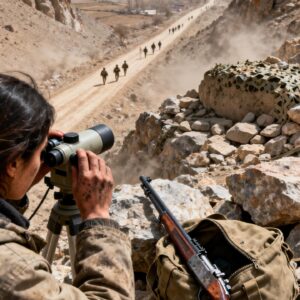
THE EXILED SNIPER: WHEN THE WORLD BRANDED ME A TRAITOR, I BECAME THE GHOST THAT SAVED THEM FROM THE SHADOWS
PART 1: THE SILENT WATCHER The wind at eleven thousand feet doesn’t just blow; it bites. It carries the metallic taste of snow and the ancient, dusty scent of stone that has been baking and freezing for millennia. I lay…
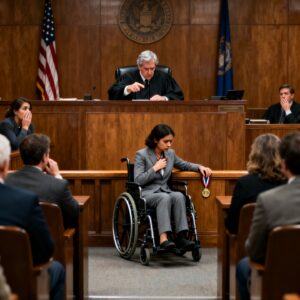
The Judge Called Me a Fraud and Demanded My Medal. He Had No Idea I Was the Reason His Son Was Still Alive.
PART 1: THE HUMILIATION The phantom rhythm of rotor blades was the first thing I heard. Thump. Thump. Thump. It wasn’t real, of course. It was just the ceiling fan in my San Diego apartment, slicing through the warm October air….

I Was Shackled in a Courtroom as a Homeless Thief, Ignored by Everyone—Until the Clerk Read My Service Number, the Judge Stood Up in Dead Silence, and the Man I Saved from Hell Recognized the Ghost He Thought Died in Fallujah.
PART 1: THE GHOST IN THE ORANGE SUIT The holding cell smelled of bleach and urine—a chemical cocktail meant to sanitize misery, but it only made it sting the back of your throat. I sat with my back pressed against…
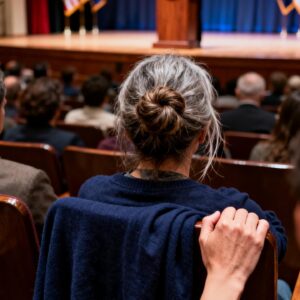
I Was Supposed to Be Dead: The Day a SEAL Admiral Froze Mid-Speech, Saw the Forbidden Tattoo on My Wrist, and Exposed the Classified Secret I’d Hidden from My Son for Twenty Years.
PART 1: THE GHOST IN THE BACK ROW You learn to be invisible. That’s the first rule of survival when you’re walking around with a grave that already has your name on it. You learn to take up less space,…

The Ghost of Flight 227: She Was Supposed to Be Dead, But When the Captain Collapsed and the Plane Screamed toward Earth, the Woman in Seat 14C Revealed a Secret That Would shake the Pentagon to Its Core
PART 1: THE INVISIBLE PASSENGER The smell of economy class is always the same. It’s a cocktail of stale coffee, recycled air, and the sour, metallic tang of human exhaustion. I was breathing it in, four counts in, four counts…
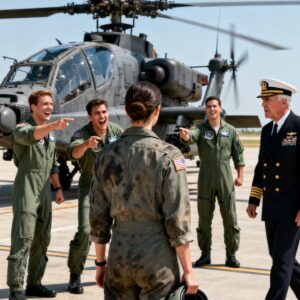
THE GHOST OF KANDAHAR: They Buried My Career and Mocked My Name, But When The Admiral Saw My Sealed File, He Unleashed A War Machine They Never Saw Coming
PART 1: THE INVISIBLE WOMAN The Alabama heat at 0530 didn’t just hit you; it strangled you. It was a physical weight, a wet, suffocating blanket that smelled of JP-8 jet fuel, heated asphalt, and the stale, recycled air of…
End of content
No more pages to load