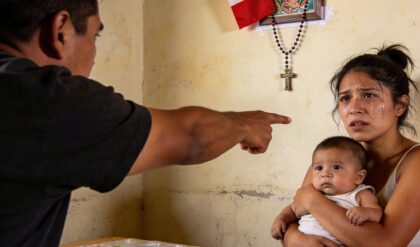
“Get out! You’re not my child! Don’t you ever, ever come back!”
The sound of my own voice was something I didn’t recognize. It was raw, animalistic, a guttural tear in the fabric of the night. It was barely audible above the relentless, drumming assault of the October rain against the windowpane. It was a cold night, the kind of deep, wet cold that sinks straight into your bones, but I didn’t feel it. The heat of my betrayal and the searing rage of my grief was a consuming furnace inside me. I was a man possessed, a widower whose sorrow had curdled into a vicious, unforgiving hatred.
She was only fourteen.
Her name was Lily. A thin, pale girl clutching an old, overstuffed neon pink backpack—a horribly childish color that only twisted the knife deeper. She stood in the foyer of our home in Portland, Oregon, her small body trembling. I told myself it was from the cold air rushing in the open door, but I knew. It was from me. It was from the sudden, terrifying venom of the only man she had ever called ‘Dad.’
This was the house that had been her home since she was a toddler, the house now choked with the suffocating silence left by her mother, Laura.
Lily didn’t fight back. She didn’t shout. She didn’t plead or bargain or make excuses. Most agonizingly, she didn’t say a single word. She just looked at me with wide, terrified eyes.
They were her mother’s eyes. The exact, soft, whiskey-brown of Laura’s. And in that moment, seeing them—seeing her in my daughter’s face—only fueled my self-righteous, whiskey-soaked fury. They were the eyes of a stranger, a living, breathing reminder of the lie that had built my entire life.
I watched, frozen in a toxic cocktail of grief, whiskey, and blind rage, as she turned away. Her small shoulders hunched against the torrent. The storm and the absolute darkness of the street swallowed her whole in an instant.
The heavy front door slammed shut, the click of the lock echoing in the empty house. It was the final sound, sealing my fate as much as hers, cutting off the last sound I would hear from her for a decade: the soft, sickening thud of a child’s backpack hitting the wet pavement.
My name is Michael Carter. I was forty-two then. I was a construction supplier, a man who thought I had everything figured out—a steady job, a comfortable home, and a wife I loved more than the air I breathed.
Laura.
My wife died three weeks earlier. She was killed on a night just like this one, on a rain-slicked road that wrapped her car around an oak tree. Her loss was the catastrophic event that had first collapsed my world. The grief was a physical weight, a pressure on my chest that made it impossible to breathe. I was drowning.
But the true, final shattering—the thing that pulverized the foundation of my life into dust—came three weeks later.
The betrayal wasn’t a whisper. It was a scream discovered on a brittle piece of paper.
It was part of the agonizing task of clearing out her things. Her smell was still on the pillows, her favorite mug still by the sink. I was in our bedroom, sorting through her bedside drawer, my hands shaking. I hated this. I hated touching her things, making her absence real. At the bottom of the drawer, beneath old receipts and paperback novels, I found a hidden bundle of letters, tied with a faded blue ribbon.
Letters written years before she even met me.
They were love notes. Intimate, passionate, messy confessions to a man named David.
I almost threw them away. I almost dismissed them as ancient history, a ghost from a life that didn’t involve me. My fingers fumbled with the ribbon, and one of the letters fell open. My eyes caught a line, scrawled in Laura’s familiar, elegant script, a line that turned my blood to ice.
“David, I don’t know how to tell him. He’s a good man, but he’ll never understand. He’ll never know the truth… For our daughter, Lily—may she always know she is loved by us both.”
Our daughter.
Our.
The word hammered into my skull. It repeated, over and over, a relentless, sickening drumbeat. Our. Our. Our.
Lily. The girl I had raised. The girl I had protected. The girl I taught to ride a bike, whose scraped knees I had bandaged, whose bedtime stories I had read until my voice was hoarse. The shy, clever young woman I had watched grow… wasn’t mine.
The world outside my window—the familiar streets, the rain-slicked trees, the comforting glow of the porch light—it all tilted, becoming alien and hostile. Every memory, every laugh, every “I love you, Dad” I had ever received from her suddenly felt like a monstrous, elaborate lie. I was the fool. I was the cuckold who had dedicated his life, his love, his entire future, to raising another man’s child. Laura hadn’t just died; she had betrayed me. She had made my whole life a joke.
I drowned the rage in a bottle of cheap whiskey I found under the sink. I tore our wedding photo from the wall and smashed the frame, the sound of shattering glass a brief, satisfying release. I swept every picture of her deceitful, beautiful smile from the mantle. The house was a scene of wreckage, but the greater devastation was within me.
When Lily found me hours later, I was trembling by the broken fireplace, the bottle empty at my feet. Her voice was small, hesitant, and it cut through the fog of my rage like a knife.
“Dad? Are you okay? You didn’t eat dinner.”
I looked up. The sight of her innocent face, her mother’s eyes—a face I now saw as a constant, living reminder of my shame—was the final trigger. Something in me didn’t just snap. It shattered.
“Pack your things,” I roared, the whiskey stripping away any last vestige of reason or humanity. “Pack your things and get out!”
Her face crumpled in confusion. “What? Dad, what are you talking about?”
“I’m not your dad!” I screamed, the words tearing from my throat. “I know what you are. I know what she did. You’re not my daughter. You’re her mistake! You are his!”
I expected tears. I expected an argument, a plea, a denial. Anything that would make her fight for her place.
But she did nothing. She just stood there, the color draining from her face, as silent tears began to stream down her cheeks. Her silence was a heavier accusation than any cry could have ever been. She didn’t defend herself. She didn’t defend her mother.
She just turned, walked to her room, and came back five minutes later with that stupid pink backpack.
And then she walked out the door, disappearing into the rain, taking the last light of the house with her.
From that night forward, my life was silence.
The hangover the next morning was a physical manifestation of my new reality: a pounding headache, a sour stomach, and an empty, hollow house. The laughter that once echoed through the halls was gone, replaced by a vacuum that sucked the life out of every room. Her toothbrush was still in the holder. A pair of muddy sneakers was still by the back door.
I threw them in the trash.
When the nosy neighbors asked, I forced a flat, emotionless reply: “She ran away.” It was a lie I told to protect my wounded pride, a truth too hideous to admit: I had thrown my own child out onto the street. When the school called, I said the same. “She’s troubled. She left.”
I told myself I had done the right thing. I told myself I had surgically purged the betrayal from my life. But the truth was a persistent, crippling infection. Every night, I’d wake up drenched in cold sweat, my heart pounding, swearing I heard phantom sobs from the hallway. The sickening tap-tap-tap of the rain on the window sounded exactly like her small, retreating footsteps on the pavement.
Years passed, dragging by like heavy, rusted chains.
I didn’t live. I existed. I went to work. I paid the bills. I came home. I sat in the dark. The house became a tomb, a monument to my bitterness. I aged not in years, but in grief and regret. At fifty-two, I was a hollowed-out old man, living in an empty house filled with the ghosts of what-ifs. My health had begun its slow, inevitable failure. My back ached constantly, my hands had a persistent tremor, and my heart—though still technically beating—felt like a dry, brittle husk.
Sometimes, on my lunch break, I would drive past the familiar brick buildings of the high school Lily once attended. I’d park across the street, under the same maple trees, and let my imagination conjure her there. I’d see her running across the parking lot, her backpack bouncing, her face bright as she called out, “Dad, wait for me!”
But when I’d blink, there was only the cold, empty wind, mocking my delusion. I had no idea if she was alive or dead. And the not knowing was a special kind of hell, one I had built for myself.
Ten years. Ten years of self-imposed purgatory, of silent, nightly confession to a God I no longer believed in. I was fifty-two and resigned to die alone in my self-made mausoleum of regret.
Then, one unremarkable Tuesday afternoon, a young woman came to my door.
I was trying to fix the leaking gutter, my back screaming in protest. The knock was sharp, professional. I limped to the door and opened it, annoyed.
She was dressed in a white lab coat and carried a clipboard. She was young, maybe thirty. But her eyes—soft brown with a hint of sadness and a piercing intelligence—reminded me so much of Laura that the breath caught in my throat. I stood there, leaning heavily on the doorframe, my voice a dry rasp.
“Mr. Carter,” she said. Her voice was gentle, professional, yet possessed a strange, intimate familiarity that set my teeth on edge. “Michael Carter?”
“Yeah. What do you want?”
She took a small breath. “My name is Dr. Emma Collins, from the Northwest Genomics Center. I’m here… I’m here about your daughter. Lily.”
The world stopped. The sound of the traffic on the street, the buzzing of a fly, the pounding in my own chest—it all ceased. My heart didn’t just skip a beat; it simply stopped functioning.
“My… what?” I whispered, leaning forward, convinced my mind was finally, truly breaking. Convinced this was a new, cruel hallucination.
The woman offered a faint, almost mournful smile. “I was assigned to a genetic identity case. We had a DNA sample from you, from an old health physical ten years ago. We were running it against a patient. The case involved… Lily.”
I stumbled backward, the clipboard and the white coat blurring into a single, terrifying vision. “You mean… she’s alive?” The words were barely a puff of air.
She nodded, her expression softening with genuine pity. “Yes. She’s alive. But Mr. Carter, she’s very sick. She has end-stage kidney failure. She needs a transplant. We ran a donor match against your sample as a last resort.”
She paused, taking a slow, heavy breath. Her next words struck me like a lightning bolt, a celestial judgment delivered at my own front door.
“Mr. Carter… you are a perfect match.”
My legs gave out from under me. I slumped against the wall, sliding down to the floor, my eyes wide and unseeing, the roaring in my ears drowning out everything else.
“Wait,” I stammered, my mind unable to connect the pieces. “A match? But… she’s not… I’m not her…”
“Yes, you are,” Dr. Collins said softly, kneeling down to look me in the eye, her clinical demeanor gone, replaced by something deeply human and sad. “The identity test was conclusive. 99.999%. Lily is your biological daughter.”
The world didn’t just tilt. It shattered. It exploded into a million silent, screaming pieces.
The lie. The lie that had fueled my rage, the foundation of my decade-long self-pity and cruelty… that was the lie.
Laura’s letter. It wasn’t a confession of infidelity. It was… something else. A desperate, veiled expression of love? A reference to a “David” who was a friend? A metaphorical father? I would never know. But the one, central, catastrophic “fact” I had built my broken life upon was a fiction.
I had been blind. Blind, cruel, and foolish. I had thrown my own flesh and blood—my daughter—out into the street on a stormy night, driven by a ghost of a betrayal that never existed. I had cast her away, left her to suffer and starve, all because of my own drunken, self-pitying, arrogant rage.
I don’t remember the drive to the hospital. Dr. Collins must have driven me. I remember the metallic smell of the sterile hallway, the relentless, quiet beeping of machines, and the oppressive silence of lives hanging in the balance.
I found myself standing before a glass window, staring through it at a pale, small figure lying on a bed. Tubes ran from her arms. A mask covered her face. Her chest rose and fell with an agonizing, shallow effort.
It was her. My Lily.
She was twenty-four. A woman. A stranger. And yet, beneath the sickness, I saw the same face I had last seen in my doorway, streaked with tears.
The nurse beside me, a kind older woman with a face etched with quiet sorrow, whispered the facts I couldn’t bear to hear. “She was found homeless at a bus station, just a kid. A kind couple in Eugene took her in, raised her, helped her finish school. She became a literature teacher.”
I choked back a sob. A teacher. She had made it. Despite me.
“She’s been sick for two years now,” the nurse continued, her voice dropping. “The couple who raised her weren’t a match. No one was. She didn’t want to contact anyone from her past… she just said, ‘If I die, please try to find my father. Just to tell him.'”
My throat closed. The shame was a physical chokehold, suffocating me. Tears, hot and blinding, finally blurred my vision after a decade of dry, bitter grief.
When I finally walked into the room, my legs felt like lead. I was walking to my own execution. She was awake. Barely. Her eyes, those same soft brown eyes, flickered open and found mine.
For a long, silent moment, ten years of unspoken regret and unimaginable pain hung in the air between us. Then, she smiled. A weak, faint, heartbreakingly familiar curve of her lips.
“Dad,” she whispered, her voice fragile as glass. “I knew you’d come.”
I dropped to my knees beside her bed. I didn’t just cry; I broke. My head bowed low, I clutched her frail, cool hand to my face.
“I’m so sorry, sweetheart,” I choked out, the words tearing me apart. “I’m sorry. I was blind. I was cruel, and foolish, and I’m so, so sorry. Please forgive me. Please.”
She shook her head, just a fraction of an inch, her soft brown eyes filling with a love I had never, ever deserved.
“Don’t cry, Dad,” she said, her voice barely a breath. “I just wanted to see you one more time.”
I couldn’t bear it. There was no time for penance. There was no time for long explanations of my monstrous mistake. There was only time for action.
I found the surgeon. I signed the transplant consent immediately, without reading a single word of the risks. “Take it,” I commanded the doctors. “Take whatever you need. Take both kidneys if you have to. Just save her. She is my world.”
The surgery lasted seven agonizing hours. Each minute that ticked by on the waiting room clock was an eternity spent in silent, frantic prayer and relentless self-recrimination. I relived that rainy night, that slammed door, a thousand times.
When I woke up, I was in a different room. A sharp pain seared my side, but it was a good pain. It was a cleansing pain. The surgeon was standing over me, his mask off, a relieved, tired smile on his face. “It went well, Mr. Carter. The kidney is a perfect match. Both of you made it.”
For the first time in years, I cried openly—not tears of guilt, but tears of purest relief. Tears of profound, unearned repentance. Tears for a second chance I absolutely did not deserve.
But fate wasn’t done with me. The universe demanded a steeper price for my sins.
A week later, complications struck. My remaining kidney, stressed from years of neglect and alcohol, began to falter. A fierce rejection sent my body into shock. And worse, in the room down the hall, Lily’s fragile body began to fight the new organ, a relentless infection setting in. She slipped into a coma.
They moved me into the same room as her. Two beds, side-by-side, fighting two different battles. I was too weak to stand, so I just sat in my bed, hour after hour, and watched her. I whispered my apologies into the still, unresponsive air, begging her to fight, to forgive me, to come back.
Then, one quiet morning, sunlight spilled through the hospital blinds, painting the sterile room in hues of soft gold. A faint voice broke the silence.
“Dad…”
I turned. She was awake. Her face was ghostly pale, but a soft, beatific smile was playing on her lips. I scrambled out of my bed, ignoring the pain, and collapsed into the chair by her side, holding her close. A wave of desperate, healing love washed over me.
“I promise,” I whispered, burying my face in her hair. “I’ll never let you be alone again, Lily. I promise.”
She smiled, weak but radiant. “Just live well, Dad. That’s all I ever wanted.”
For three more weeks, we recovered together in that room—side by side, like two shipwrecked souls who had finally found a safe harbor. I fed her soup. I helped her sit up. I carefully brushed her long brown hair, the way Laura used to. The nurses would peek in and smile, whispering about how love like ours could heal anything.
But some wounds run deeper than the body can repair. Some prices are non-negotiable.
One dawn, as the first pale rays of sun filtered into the room, I reached over to hold her hand, as I did every morning.
And I felt only a profound, chilling stillness.
She was gone.
Lily had passed away quietly in her sleep. The infection, the doctors said, had been too strong for her newly-mended, fragile body. The second chance I was given had come with a devastating, final expiration date.
I sat there for hours, holding her lifeless hand, unable to speak, unable to move, unable to let go. The doctors spoke words—time of death, cause, condolences—but I heard only the crushing, absolute silence of my own shattered heart.
I brought her ashes home. I buried them beside Laura’s grave in Willamette Memorial Park. On the small, simple headstone, I engraved the simple, agonizing truth of my life:
LILY CARTER. My Beloved Daughter. The One Who Taught Me What Love Truly Means.
Now, I live alone in that same, empty house. The rain still taps on the windows, and the laughter is permanently gone. But it is no longer a mausoleum of regret. It’s a place of penance.
I planted a pink rose vine by the porch—the same kind Lily loved, a flower that symbolized gentleness and admiration. Every morning, when the sunlight hits those blossoms, I see her smile in their soft, delicate glow.
I spend my days volunteering. Local shelters, orphanages, centers for children from broken homes. I don’t do it to seek forgiveness; I know some sins can never, ever be undone. I do it because I want to live the way Lily would’ve wanted me to—a life of service, a life of love.
Ten more years have passed since her death. My hair is entirely white now, and my body is frail. But sometimes, when the wind rustles through the pink roses, I swear I hear her voice—gentle, forgiving, breaking the silence of my conscience.
“It’s okay, Dad. I was never angry.”
And I smile, looking up at the morning sky, feeling—for the first time in decades—something I thought I’d lost forever: peace
News

THE EXILED SNIPER: WHEN THE WORLD BRANDED ME A TRAITOR, I BECAME THE GHOST THAT SAVED THEM FROM THE SHADOWS
PART 1: THE SILENT WATCHER The wind at eleven thousand feet doesn’t just blow; it bites. It carries the metallic taste of snow and the ancient, dusty scent of stone that has been baking and freezing for millennia. I lay…
The Judge Called Me a Fraud and Demanded My Medal. He Had No Idea I Was the Reason His Son Was Still Alive.
PART 1: THE HUMILIATION The phantom rhythm of rotor blades was the first thing I heard. Thump. Thump. Thump. It wasn’t real, of course. It was just the ceiling fan in my San Diego apartment, slicing through the warm October air….

I Was Shackled in a Courtroom as a Homeless Thief, Ignored by Everyone—Until the Clerk Read My Service Number, the Judge Stood Up in Dead Silence, and the Man I Saved from Hell Recognized the Ghost He Thought Died in Fallujah.
PART 1: THE GHOST IN THE ORANGE SUIT The holding cell smelled of bleach and urine—a chemical cocktail meant to sanitize misery, but it only made it sting the back of your throat. I sat with my back pressed against…

I Was Supposed to Be Dead: The Day a SEAL Admiral Froze Mid-Speech, Saw the Forbidden Tattoo on My Wrist, and Exposed the Classified Secret I’d Hidden from My Son for Twenty Years.
PART 1: THE GHOST IN THE BACK ROW You learn to be invisible. That’s the first rule of survival when you’re walking around with a grave that already has your name on it. You learn to take up less space,…

The Ghost of Flight 227: She Was Supposed to Be Dead, But When the Captain Collapsed and the Plane Screamed toward Earth, the Woman in Seat 14C Revealed a Secret That Would shake the Pentagon to Its Core
PART 1: THE INVISIBLE PASSENGER The smell of economy class is always the same. It’s a cocktail of stale coffee, recycled air, and the sour, metallic tang of human exhaustion. I was breathing it in, four counts in, four counts…

THE GHOST OF KANDAHAR: They Buried My Career and Mocked My Name, But When The Admiral Saw My Sealed File, He Unleashed A War Machine They Never Saw Coming
PART 1: THE INVISIBLE WOMAN The Alabama heat at 0530 didn’t just hit you; it strangled you. It was a physical weight, a wet, suffocating blanket that smelled of JP-8 jet fuel, heated asphalt, and the stale, recycled air of…
End of content
No more pages to load