That night, the storm wasn’t just a storm; it was a warning. The rain hammered against the bay doors of Fire Station #14 like it was trying to get in, and the wind howled with a grief I hadn’t yet learned to recognize. It was 03:00, the dead middle of a long shift, and I was staring into a cup of coffee so black and sludgy it was basically poison.
My partner, Joe, walked in, shaking the rain from his coat. “Dude, you’re gonna melt your stomach lining with that stuff,” he said, pointing at my mug. Joe was the kind of guy who found a reason to laugh even when a roof was caving in.
“It’s just caffeine,” I joked back, my voice gravelly from exhaustion. “Don’t expect a miracle.”
The station was quiet—too quiet. That’s the thing you learn in this job. It’s never the noise that gets you; it’s the silence before it.
And then we heard it.
It was faint, so faint I thought I was imagining it. A high-pitched, thin cry, almost swallowed by the roar of the wind.
I looked at Joe. His smile was gone. “Did you hear that?”
“I heard it,” I said, already on my feet, my heart suddenly pounding a new rhythm against my ribs.
We pushed open the heavy side door and stepped out into the frigid, whipping air. The crying was louder now, sharp and desperate. It was coming from the front of the station, near the main doors.
“Sounds like a kitten,” Joe said, but his voice was tight.
“No,” I said, my gut twisting. “It’s not.”
We rounded the corner, our flashlights cutting through the sheeting rain. And there, tucked into a corner to shield it from the worst of the wind, was a small wicker basket.
“This can’t be real,” Joe whispered, stopping dead.
I couldn’t speak. I just moved forward, my boots heavy with dread. I knelt, my flashlight beam wavering.
When I peered in, my breath hitched. A baby. A newborn, so new his skin was still red and blotchy. He was wrapped in a single, thin, and soaking wet blanket. His little cheeks were chapped from the cold, but he was alive. And he was crying his lungs out.
“Oh my God,” Joe whispered, his hand on his radio, but he wasn’t calling it in yet. He was just frozen. “What are we going to do?”
I didn’t answer. I just knelt in the puddle, my own jacket getting soaked, and gently, so gently, I picked him up. He couldn’t have been in this world for more than a few days. He was so light he felt like nothing. The second I lifted him, his cries quieted into a small, hiccuping sob. He was just cold.
When his tiny, perfect hand uncurled and instinctively clung to my finger, something inside my chest—a place I thought was long since calloused over—cracked wide open.
“I’m going to call Child Protective Services,” Joe said, his voice finally finding its footing, though it trembled.
“Yeah,” I replied, but I couldn’t take my eyes off the child. I pulled him close, zipping him inside my own heavy jacket, trying to give him my warmth. “Yeah. Call them.”
For the next few days, I was a ghost. I couldn’t sleep. I couldn’t eat. I couldn’t stop thinking about him. CPS had taken him, named him “Baby Boy Doe,” and put him in temporary foster care. But I called. I called the social worker every single day. “Just checking in,” I’d say. “Just want to know if he’s okay.”
Joe noticed. He found me staring at the wall during a 24-hour shift. “You gonna do it, aren’t you?” he asked, not unkindly.
“Do what?”
“You’re thinking about adopting the boy.”
“I don’t know,” I lied. But deep in my gut, in that place that had cracked open in the storm, I knew. I already had.
The process was a nightmare. I was a 29-year-old, single firefighter. I lived in a small apartment. I worked a dangerous job with chaotic hours. The paperwork was mountains high. The interviews were invasive. The home inspections were humiliating. “A single man?” one evaluator asked, her skepticism a tangible thing. “Do you even know how to raise a child?”
“I know how to save one,” I told her, my voice harder than I intended.
I didn’t give up. Joe had my back, offering to be the emergency contact, the babysitter, the “I-swear-he’s-normal” reference.
After a few months, with no one coming forward to claim the baby, the social worker called. Her voice was different this time. Warmer. “Well, Mark,” she said, “it’s official. No one’s looking for him. The judge signed the papers.” She paused. “Congratulations, Dad.”
I named him Leo. Strong, brave, like a little lion.
The first time I held him, really held him as mine, I walked him over to the window of my apartment. “Well, Leo,” I whispered, my voice thick. “It’s just the two of us now, son. We can do this.”
He smiled. A gummy, perfect, brand-new smile. And I knew, I just knew, I had made the right decision.
Our life for the next five years was a beautiful, chaotic mess. Every morning was a race against the clock, a blur of cartoons, spilled cereal, and a frantic search for matching socks.
“Daddy, they don’t have to match,” Leo would insist, standing there with one Spider-Man sock and one green one. “It’s my style.”
Every night was a negotiation over bath time, followed by a bedtime story that I usually got wrong.
“Daddy, a T. rex doesn’t chase cars! A T. rex lived in the Cretaceous period, but the car was invented in 1886. That doesn’t make any sense!”
“My bad, little man. How about… a T. rex chases a… very fast horse?”
“No! Horses didn’t evolve until…”
I’d just laugh and kiss his forehead. Joe was his “Uncle Joe,” the guy who showed up on my late-shift days with pizza, a new dinosaur model, and endless patience.
It wasn’t easy. I was exhausted, all the time. There were nights when Leo would wake up screaming from a nightmare—a deep, terrified cry that felt like it came from a place he couldn’t remember. I’d lie in his little bed with him, my arm draped over his small chest, until his breathing evened out again. He had only me. And I had only him. We were a team.
Then, five years after that storm, on a bright Saturday afternoon, there was a knock on the door.
It was so… normal. A simple, polite knock. Leo and I were on the living room floor, surrounded by cardboard boxes and markers, building what he called “Jurassic Park: Fire Station Edition.”
“I got it!” I said, wiping marker off my hands. “Probably just Uncle Joe.”
I opened the door, a smile on my face.
The smile died.
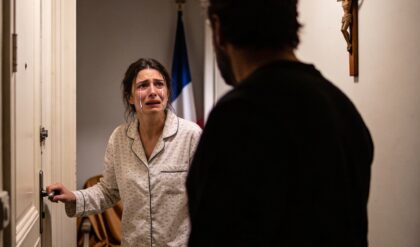
A woman was standing on my porch. She was pale, her eyes wide and haunted, her hands twisted together so tightly her knuckles were white. She looked like she was going to be sick.
“Can I… can I help you?” I asked, my voice already cautious. I instinctively put my arm across the doorframe.
She looked past me, into the house. Her eyes landed on Leo, who was peeking out from behind the sofa. Her breath hitched.
“Please,” she said, her voice a reedy whisper, “please bring him back. He’s my son.”
Time stopped. The sound of the cartoons, the hum of the fridge, the traffic outside—it all went dead silent.
“What did you say?” I asked, my voice dangerously low.
“He’s… Leo,” she said, her name for him a question. Her eyes filled with tears, which began streaming down her pale cheeks. “He’s my son. I’m his mother.”
My blood went cold. Pure, cold rage washed over me. I stepped outside and pulled the door closed behind me, my heart hammering against my ribs like it wanted to escape.
“You can’t just show up here,” I hissed, my voice trembling. “It’s been five years. Five. Years. Where were you? Where were you when he was freezing to death in a basket? Where were you when he had a fever of 104? Where were you when he cried all night?”
“I couldn’t,” she sobbed, collapsing against the porch railing. “You don’t understand. I had nothing. I was sixteen. I had no home, no money, no one. I was terrified. I… I left him in the one place I knew he’d be safe. I left him where I knew someone good would find him.”
“And now you want him back?” I said, the words feeling like stones in my mouth. “Just like that? You think you can just ring the bell and take him?”
“No!” she cried, looking up at me, her face a mask of desperation. “No, I won’t take him. I can’t. I just… I just wanted to see him. To know he was okay. To… to know his name.”
I was about to tell her to leave. To get a lawyer. To never come near my son again. But the door opened.
Leo stood there, holding his T. rex. “Daddy, who is she?”
I knelt, my body shaking. My mind was screaming, Get him away from her! But I couldn’t move.
“Son,” I said, my voice thick. “This… this is Emily. She’s… she’s the person who brought you into this world.”
Leo looked at her, his head tilted. He wasn’t scared. He was just curious. “Why is she crying?”
Emily smiled through her tears, a broken, watery mess of a smile. “Because I’m so happy to see you,” she whispered.
Leo stepped forward and tucked himself behind my leg, his hand gripping my jeans. He looked up at me, his eyes wide. “Daddy… do I have to go with her?”
That question shattered the last of my rage. “No, son,” I answered immediately, my voice firm, my hand on his head. “No. You’re not going anywhere. You stay right here.”
“Thank you,” Emily whispered, wiping her face. “I don’t… I don’t want to bother you. I just wanted to see him. Just once.”
That night, I didn’t sleep. I sat in the dark, watching Leo breathe. I was torn. I wanted to pack our bags and move, change our names, run. But I also saw the pain in her eyes. It was a pain I recognized. It was the same desperate, all-consuming love I felt for my son.
Weeks passed. Emily… she didn’t disappear. But she didn’t push, either. She just… existed. Quietly.
I was at Leo’s first soccer game, watching him mostly trip over the ball, when I saw her. At the very end of the bleachers, sitting alone, holding a book, just… watching. She didn’t wave. She didn’t cheer. She just watched.
A few days later, a package arrived. No return address. Inside was a set of new, highly detailed dinosaur models and a pop-up book about pterodactyls.
Leo was hesitant at first. “Who is the sad lady, Daddy?” he asked.
“She’s… she’s Emily, bud. She’s your birth mom.”
He absorbed that. “Does she like dinosaurs, too?”
“I think so,” I said.
The turning point came a month later. It was the last game of the season. Leo actually scored a goal—mostly by accident, it bounced off his knee and into the net. He ran toward me, screaming with excitement. He hugged my legs, and then he stopped. He looked over my shoulder.
Emily was there, at the end of the bleachers, her hands over her mouth, her eyes shining.
Leo looked at me, then at her. “Daddy… can… can she come with us for pizza? We always get pizza.”
My first instinct was “No.” A hard, fast, protective “No.” I looked at Emily. She looked terrified, as if she was afraid to even hope. I looked at my son, who was just… being a kind kid.
I took a deep breath. “Okay, son. Go ask her.”
It was the most awkward pizza dinner of my life. I sat there, a silent, glaring bodyguard. But Emily didn’t talk to me. She talked to him. She asked him about the T. rex. He asked her if she’d ever seen a real fossil. I just watched, my gut in knots.
“What if she disappears again?” I asked Joe later that week. “What if he gets attached, and she just… bails? It’ll break him.”
Joe put his hand on my shoulder. “Then you’ll be there to pick him up. Just like you’ve always been. But, Mark… what if she doesn’t?”
It wasn’t easy. It took years. Years of me learning to unclench my fists. Emily became a quiet part of our lives. She never overstepped. She never called herself “Mom.” She was just… Emily.
She came to Thanksgiving. She helped with the dishes. She sat with Leo and helped him with a school project on volcanoes. I slowly stopped seeing her as a threat, and started seeing her as… just… a person. A person who loved my son.
“You’re a great dad, Mark,” she told me once, while we were watching Leo sleep in the car after a long day at the museum.
“And you’re not a bad… well, you’re not bad either,” I replied, and she laughed.
Years passed. The three of us—me, Leo, and Emily—formed a strange, new, modern family. Not a rivalry. Just… more.
Leo’s high school graduation day came. He was wearing a gown, a tall, confident, amazing young man, towering over me. My heart was so full of pride I thought it might burst.
Emily was standing next to me in the audience. When Leo’s name was called—”Leo Carter!”—and he walked across the stage, she grabbed my hand, tears streaming down her face. When he looked at us in the crowd and waved, we both waved back, smiling.
That night, we all ate together, laughing as Leo told stories about his teachers and his plans for college.
“We did good,” Emily said, looking at me over her pizza.
I smiled, raising my glass. “Yeah, Em. We did.”
From that stormy, terrifying night to this loud, peaceful home, I’ve learned that family doesn’t always start with blood. Sometimes it starts with a storm, or a choice, or a desperate act of love. Sometimes, it’s forged in a fire station. It’s built through embracing, forgiving, and loving someone unconditionally.
Because real family isn’t perfect. But they are always there—loving, failing, and, most importantly, growing. Together.