In the sun-drenched courtyard of Grant Industries, the polished marble reflected a cold, blue sky, and the air hummed with the silent arrogance of extreme wealth. Fountains threw shimmering arcs of water, their splashing a sound ignored by the man striding across the patio, a phone pressed hard against his ear.
Lucas Grant, a titan of the tech world, moved with a purpose that saw nothing but the next objective. “I don’t care about the projections,” he snapped into the receiver. “Just close the deal.”
He didn’t see the small boy sitting on a stone bench, watching the water with a stillness that ached. Oliver, his ten-year-old son, had lived in a muffled world since he was two. For him, life was a silent movie—just moving lips, hands that sometimes fluttered with meaning, and the deep, dull echo of a heart that had learned not to expect.
Then, she appeared. Laya. She was barefoot, thin as a reed, her clothes—frayed jeans and a paper-thin t-shirt—looking like hand-me-downs from a ghost. A small, wooden tray in her hands held a few bunches of withered street-corner flowers. Security usually moved her along before she ever reached the glass doors, but today, fate had looked the other way.
Their eyes met. His, full of an ancient, weary silence; hers, wild and impossibly wise, as if they knew secrets the world wasn’t ready for.
Laya raised a tentative hand, not to beg, but to speak in the language no one else there understood. Hello, her fingers signed.
For the first time in years, Oliver’s expression flickered. Someone was speaking his language. He signed back, and then something strange happened. The boy frowned, his small hand rubbing at his right ear. It itches, he signed, his face tight with confusion.
Laya moved closer, her eyes bright with a sharp, sudden focus that was part curiosity, part fear. “Hold still,” she whispered, though she knew he couldn’t hear the sound.
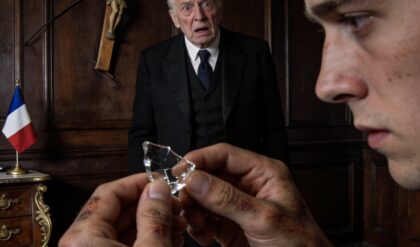
Her finger, surprisingly gentle, slipped into the boy’s ear canal. When she pulled it back, something dark, chitinous, and impossibly alive fell writhing into her palm.
Oliver opened his mouth to cry out, but what escaped wasn’t just air. It was sound.
At that exact instant, a siren wailed on the street below. The world exploded. The sound was violent, raw, and overwhelming. It tore through Oliver’s chest—brutal, real, beautiful.
His hands flew to his ears, trembling. He looked at the fountains, his eyes wide with terror and wonder at the roar of the water. And then, he turned toward the man frozen on the patio and screamed a word he had only ever felt as a vibration.
“Dad!”
The voice was weak, cracked from disuse, but it was real.
Lucas stopped breathing. The top-of-the-line smartphone slipped from his grasp, clattering onto the marble. Everything froze. The water in the fountain, the murmurs of the staff, even the wind seemed to hold its breath. The man who had built an empire on logic and control was suddenly flattened by a miracle he could never have coded, funded, or bought.
But what came next wasn’t gratitude. It was terror. It was rage.
He lunged, grabbing Oliver by the arm and yanking him away from the girl. “Get away from him!” he roared, pointing a trembling finger at Laya. “Security!” His voice, a whip-crack used to commanding boardrooms, echoed off the glass walls.
The guards were already moving, but before they could touch her, Oliver spoke again. His voice, rough and shaky, cut through the air.
“Don’t. Don’t hurt her.”
Lucas went cold. That sound—his son’s voice—hit him harder than any physical blow. Eight years. Eight years of specialists in Zurich, of experimental devices, of signed checks that led to sympathetic shrugs. And now, this barefoot girl had done the impossible.
For the first time in his adult life, Lucas Grant, the man who had an answer for everything, had absolutely no idea what to say.
The chaos arrived with the flashing lights. The hospital smelled of bleach, metal, and anxiety. Lucas paced behind the glass of the emergency room bay, watching as a team of doctors surrounded his son’s gurney. Oliver was awake, his eyes wide, taking in the painful, overwhelming cacophony of the ER—the beeping monitors, the squeak of rubber soles, the clipped voices. He was clinging to Laya’s hand, as if she were the only anchor in this new, terrifyingly loud world.
Lucas didn’t know if he was shaking from relief or from something darker. A question was eating him alive: How could a girl from the streets do what eight years of science, money, and the best doctors in the world could not?
The chief specialist, Dr. Matthews, entered the waiting room, his white coat an immaculate shield, his voice precisely controlled. “Mr. Grant,” he said, all professional calm. “Your son’s case is… remarkable. The obstruction has been removed. It was organic in nature.” He cleared his throat. “It’s possible we’ll see a temporary recovery.”
Lucas looked up, his eyes bloodshot. “Temporary?” he repeated, his voice barely a thread. “A girl pulled a living… thing… from his ear with her bare hands. And you… you and your entire staff… you called his condition ‘incurable.'”
The doctor stiffened, avoiding his gaze. “We followed all established protocols, sir. His scans were conclusive.”
“Protocols!” Lucas exploded, his voice rattling the sterile hallway. “You took my money, you billed my foundation, you promised results, and you never even looked!”
Laya, standing silently by the door, spoke. Her voice was soft, but it cut through his rage like a knife. “They didn’t look,” she said, “because they didn’t care to see.”
Lucas stared at her.
“They saw the name on the building,” she continued, “not the boy.”
Those words opened a wound in him that had been festering for years.
Dr. Matthews, visibly uncomfortable, slid a tablet across the table. “Perhaps… perhaps you’ll want to review his file again,” he murmured, before making a hasty exit.
Lucas grabbed the tablet. He scrolled past the scans, the audio-grams, the endless reports stamped ‘DIAGNOSIS: IRREVERSIBLE.’ And then, buried in the administrative logs, he found it. A single line in an internal email chain.
RE: Grant, O. (Patient #402). Maintain ‘irreversible’ dx to ensure continuity of specialized funding. Grant Foundation account active. Approved.
The tablet trembled in his hands. The letters blurred. Continuity of funding. They hadn’t been treating his son. They had been billing him. They had done business with his son’s silence.
It wasn’t nature. It wasn’t an accident. It was a line item.
His body tensed, his fists clenching until his knuckles turned white. “Monsters,” he whispered, his voice breaking. “They sold my son’s silence.” The sound of the tablet cracking as he gripped it echoed in the white room.
Laya didn’t move. She just watched him with eyes full of a sorrowful, shared rage.
In that instant, Lucas understood something his money had never taught him: There is a deafness far more profound than the physical, the deafness of a heart that has stopped listening. And for the first time, the powerful Lucas Grant felt what it was to be truly, utterly deaf.
The hospital corridor was too white, the fluorescent lights too bright for the noise inside Lucas’s head. The hum of the ballasts, the distant, rhythmic beep of a monitor—sounds he’d always filtered out—now felt like accusations. He had spent years buying solutions, trusting in polished clinics and experts with impeccable resumes, but he had never once stopped to truly listen to his son. Not really.
Behind the glass, Oliver was finally resting. His breathing was slow, his eyes closed. Lucas sat beside the bed, his head in his hands, unsure how to speak to a child who had just regained what he, the father, had so thoroughly lost: the ability to feel.
Laya stood in the doorway, her hands still smudged, a silent testament to the impossible.
Lucas looked up at her, his face haggard. “How?” he whispered. “How did you know what to do?”
She held his gaze. “Because I saw him,” she answered simply. “Everyone else was looking at the money. I looked at the boy.”
Her words pierced him. It was so simple, so brutally true. Lucas scrubbed his hands over his face, unable to bear the weight of his guilt. “You’re just a kid,” he said, a clumsy attempt to rationalize the moment. “How can you talk like you’ve lived a hundred years?”
Laya shrugged, a small, weary motion. “When you live on the street, you hear things nobody else does,” she replied. “You learn to hear the shape of people’s pain, even when it doesn’t make a sound.”
The silence returned, but it was no longer empty. It was full of truth. Lucas looked at his son, and for the first time, he understood. He had been the one living in silence all this time. Not deaf in the ears, but in the soul.
He leaned toward Oliver, his hand trembling as he brushed the hair from his son’s forehead. “It was me,” he whispered. “It was me who wasn’t listening. I was deaf, too.”
Laya watched them, and in that moment, the three of them shared the same quiet. It was a quiet that no longer ached, but began to heal.
That night, the city seemed to hold its breath. From the penthouse hospital suite, the lights of other buildings flickered like weary stars. Oliver was sleeping, and Lucas watched him with a mix of relief and a sharp, physical pain in his chest. He had spent a decade believing love was demonstrated with checks, with state-of-the-art facilities, with progress reports. He had confused provision with presence. Now, staring at his son, he understood the real price of that mistake.
Laya was still there, leaning against the far wall, her gaze fixed on the boy.
Lucas broke the silence, his voice rough. “I’ll fix this,” he said, as if swearing an oath. “I swear to you, Oliver, I will fix this.”
As if summoned by the words, Oliver’s eyes fluttered open. His pupils moved, searching for his father’s face. His lips trembled, forming syllables that were still foreign and clumsy.
“Not… your… fault,” he said.
Lucas broke. Those three words shattered the armor he had worn for a lifetime. He gripped his son’s hand, his shoulders shaking. “I promise you,” he choked out, “you will never be alone in the quiet again. Never.”
Laya watched from the corner. She didn’t speak. She didn’t need to. Her presence was enough, a silent flame of humanity in a room that had seen too much clinical despair. Outside, the rain began to tap against the glass, each drop a tiny, distinct sound. The world was still out there, waiting to be heard.
Lucas took a deep, shuddering breath. He was no longer the same man. That night, as the clock on the wall clicked past three, he leaned over his sleeping son and whispered, “I’m done paying for hope. From now on, I fight for the truth.”
The next morning, the sky was a bruised, heavy gray. Lucas walked beside Oliver and Laya toward the hospital’s revolving doors. For the first time in memory, he wasn’t in a hurry. Oliver clutched his hand, flinching at every new sound: the thump of a closing car door, a distant siren, the rumble of a bus. The noise of the world was new, and it was overwhelming. And yet, in the middle of it all, he was smiling.
When they arrived at Lucas’s home—a glass-and-steel mansion overlooking the city—Oliver wouldn’t leave Laya’s side. He followed her to the kitchen, through the cavernous living room, and out onto the terrace. Laya didn’t treat him like a patient, or a miracle. She treated him like a boy, one who could finally exist out loud.
Lucas watched them from the doorway, not daring to interrupt. There was something sacred in their quiet understanding. Each of Oliver’s laughs—still rough and uneven—was like a chisel, cracking open his own calloused heart.
That evening, Laya stood gazing out the floor-to-ceiling window, a look of profound sadness and peace on her face.
Lucas approached her slowly. “Why did you do it?” he asked, his voice low. “Why help my son? You didn’t even know us.”
Laya didn’t turn. “Because no one helped my brother,” she said, her voice a near-whisper. “He got an infection, in his ear. We waited eight hours at the county clinic. They told us we weren’t a priority. By the time they saw him…” She paused, swallowing. “He just… faded. Day by day, the silence just… ate him. I know what it looks like when the world decides your pain isn’t worth listening to.”
Lucas closed his eyes, the words a physical blow.
“Then help me,” he said finally. “Help me do this right. Not with money. With the truth.”
Laya turned to him, her eyes holding that same impossible calm. “Start by listening,” she whispered. “To him. And to all the ones you never see.”
Later, Lucas knelt by his son’s bed. “What do you hear, Ollie?” he asked.
Oliver smiled, tilting his head toward the open window. “Everything,” he replied.
Lucas pulled him into an embrace, the tears coming freely now, tears not of guilt, but of gratitude. “Then you’ll never hear silence again,” he vowed. “Not as long as I’m breathing.”
The next days brought noise. Not the noise of traffic, but the roar of the truth. Lucas Grant, armed with the hospital’s own internal memos, met with the board of the medical foundation his family had funded for generations.
It wasn’t in a hospital. It was in a sterile, high-rise boardroom. The directors arrived with empty smiles and tailored suits.
“Mr. Grant,” one began, “a terrible medical misunderstanding. We are prepared to offer a most generous settlement…”
Lucas cut him off, his voice quiet, cold steel. “It wasn’t a misunderstanding,” he said. “It was a business model.” He slid the printout of the email onto the polished mahogany table. “You weren’t treating a patient. You were managing a revenue stream. You monetized my son’s silence.”
The room was tomb-quiet, save for the ticking of a clock.
“You silenced a child for profit,” Lucas said, his voice low and dangerous. “And now, the entire world is going to hear all about it.”
The lawsuit was filed an hour later. The scandal erupted. The media, the medical boards, the federal investigators—they descended. Names were named, careers ended, and the gleaming facade of the prestigious clinic cracked wide open.
Through it all, Lucas didn’t think of his company’s stock or his reputation. He thought of Oliver’s laugh.
That evening, he returned home to that very sound. Laya was standing at the front door, her small bag over her shoulder. Her bare feet were on the cold marble.
“You’re leaving,” Lucas stated. It wasn’t a question.
She nodded. “He can hear you now. He doesn’t need me.”
“How…” Lucas struggled, the words catching in his throat. “How do I thank you for the impossible?”
Laya offered a small, luminous smile. “You don’t thank it,” she said. “You share it.” She met his gaze. “Listen, Mr. Grant. Just… always listen.”
He watched her walk down the long drive. Her bare feet left faint, damp prints on the stone, until the evening mist swallowed her whole, as if the city had simply taken her back.
Lucas stood there for a long time, the weight of the silence settling around him. For years he had thought hearing was a function of the ears. He knew now it was an act of the soul.
He turned and went back to the garden. Oliver was there, sitting in the grass, holding a drawing. It was three stick figures, hand in hand, under a bright blue sky.
“Us,” Oliver said, pointing proudly.
Lucas knelt, pulling his son into an embrace, breathing in the smell of his hair, of the damp earth. The sun was beginning to set, painting the city in gold and shadow. He closed his eyes, and for the first time in his life, he truly heard everything: the rustle of leaves, a distant bicycle bell, and the strong, steady beat of his son’s heart next to his. He finally understood that true wealth wasn’t what you owned; it was what you were willing to listen to.
News

Mes beaux-parents m’ont méprisée car je venais de “la campagne”, mais quand ils ont tout perdu, ils ont rampé jusqu’à ma porte.
Le karma n’oublie jamais personne. Je n’oublierai jamais le regard de ma belle-mère la première fois que je suis entrée dans leur villa à Neuilly. Elle m’a scannée comme on inspecte un produit défectueux. Pas assez riche. Pas assez “bien…

J’ai découvert que ma mère léguait tout à mon frère gâté, alors j’ai coupé les ponts définitivement.
L’Héritage de la Trahison Le testament était posé là, sur la vieille table en chêne du salon, une feuille de papier qui allait changer ma vie à jamais. Mon cœur battait à tout rompre, non pas de chagrin, mais d’une…

J’ai dépensé 4 500 € pour l’anniversaire de ma belle-mère à Aix-en-Provence, elle m’a interdit de venir, alors j’ai tout annulé à la dernière minute !
L’humiliation de trop Je tenais l’invitation à deux mains, le cœur battant à tout rompre. C’était du papier épais, texturé, avec une calligraphie dorée que j’avais choisie moi-même. 4 500 €. C’est ce que j’avais investi pour prouver à Valérie,…

Mon mari a ramené sa secrétaire enceinte dans notre villa de Saint-Tropez : Ma réponse a coûté sa carrière.
Le dîner de la trahison Je pensais connaître la loi de la vie aussi bien que le Code civil. Jusqu’à ce soir-là, dans ce restaurant étoilé face à la mer, où mon mari n’est pas venu avec des fleurs… mais…

Mon mari a vidé mes 230 000 € pour sa famille à Lyon — Ma vengeance lors de notre dîner à Nice les a laissés sans voix et sans un sou.
Le Dîner des Adieux Je portais sa robe préférée, en soie bleu saphir, et je souriais comme la femme parfaite qu’il pensait avoir épousée. Nous étions à Nice, sur une terrasse privée face à la mer, les bougies vacillant doucement…

Mon mari m’a abandonnée sous un orage sans un sou, mais il ignorait que j’allais récupérer ses 11 millions d’euros.
LA VENGEANCE SOUS LA PLUIE La pluie ne tombait pas, elle fouettait le sol comme pour effacer ma présence. Je me tenais là, seule, sous le néon grésillant d’une station-service déserte de l’autoroute A6, trempée jusqu’aux os. Je venais de…
End of content
No more pages to load