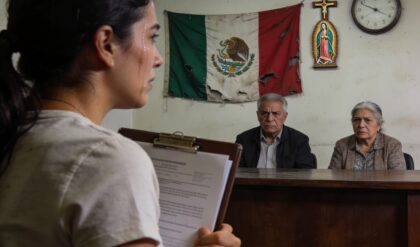
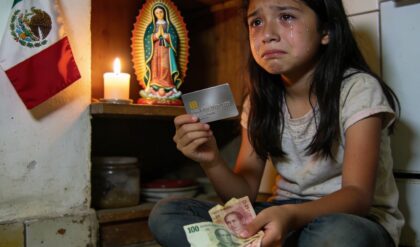
The notary’s office was suffocatingly quiet, smelling of stale paper and old wood. The only sound was the scratching of Don Melchor’s pen. He signed the last document, his hand steady, but his heart hollow. The house, the only home his children had ever known, the place where his wife had taken her last breath, was gone.
He took the certified check, folded it once, and put it in his pocket. He didn’t count the money. It didn’t matter.
He walked to the post office and bought a money order for exactly half the amount. He slipped it into an envelope with a small, folded note. “For your future. I am so proud. -Papa.” He addressed it to Rosa, at her university dormitory overseas. The ink blurred as a single tear hit the paper. He wiped it away, sealed the envelope, and slid it into the mail slot. The first part of his plan was done.
The walk back to the house was the longest of his life. Every crack in the sidewalk, every peeling facade of the neighboring adobes, felt like a judgment. Santa Esperanza. Holy Hope. What a bitter joke.
He entered the small house. It was already empty to him. Nicolás was, as always, not there. Probably at the cantina, spending money Melchor no longer had, with friends who would abandon him the second the money was gone.
Melchor went to the kitchen drawer and pulled out a piece of paper and a pen. His hand hovered. What do you say to the son who is ashamed of you? What do you say to the boy you carried on your shoulders, who now looks at you with such profound disgust?
“Hijo,” he began.
He stared at the word. Son.
“I’m leaving. Forgive me for what I am doing…”
He paused, the words catching in his throat. Forgive me? A surge of anger, cold and sharp, surprised him. But it vanished as quickly as it came, replaced by the familiar, crushing weight of failure.
“I have done everything I could for you. I have failed. Do not look for me. This house is no longer mine.”
He couldn’t bring himself to sign it “Papa.” He just left it on the table, weighting it down with a salt shaker.
He went to his bedroom. He packed one small, battered suitcase. A change of clothes. The razor his wife had given him. A small, framed photo of her, smiling, from a time before the mine had taken her and begun its slow work on him. He zipped the bag. The sound was final, like a coffin closing.
He stood at the door and looked back one last time. He saw the ghosts of his children running through the hall. He heard his wife’s laughter. He smelled the rice and potatoes he had cooked a thousand times.
Then, he saw his son’s face, twisted in a drunken sneer. “Me da vergüenza ser hijo.”
“I’m ashamed to be your son.”
Melchor closed the door. He didn’t lock it. It wasn’t his to lock anymore. He walked to the bus station at the edge of town, his body aching, his lungs burning in the cold pre-dawn air. He bought a one-way ticket to the capital city, a place he had never been. As the sun began to rise, painting the desolate mountains in shades of blood and gold, the bus pulled away. Don Melchor did not look back.
Nicolás woke to the pounding in his head. The sun was high and brutal, stabbing through the dirty window. The house was silent. Too silent.
“Viejo?” he croaked. “Old man! Where’s breakfast?”
No answer. Only the buzzing of a fly against the glass.
He staggered into the kitchen, his stomach churning. He saw the note on the table. He read it once. Twice.
“He’s bluffing,” he muttered, crumbling the paper. “He’ll be back. He always comes back.”
He went to the cantina. His friends were there, and the first drink silenced the growing unease.
But Melchor didn’t come back. Not that night. Not the next day.
After three days, the cantina owner cut Nicolás off. “Your father’s tab is closed, kid. Pay up or get out.”
His “friends” vanished, melting away like shadows. The hunger started. The shaking. Panic, cold and raw, began to set in. He stumbled back to the house.
A week after Melchor left, a truck pulled up. Two men got out. They knocked on the door. Nicolás, weak and bleary-eyed, answered.
“Can I help you?”
“You can help us by getting out,” the larger man said, not unkindly. “We bought this house. It’s ours now. You have one hour to clear your personal items.”
The world tilted. “Bought…? No. My father… this is my father’s house.”
“Not anymore, son,” the man said, holding up the deed. “It was sold to us by a Don Melchor. Now, get your things.”
Nicolás was thrown onto the street with nothing but the clothes on his back. The note, which he had thrown away, now echoed in his mind. This house is no longer mine. It was real. He was homeless. He was alone. The shame he had always projected onto his father now consumed him.
Two years.
Two years can feel like a lifetime or a heartbeat. For Melchor, it was a slow, gray eternity. He had found a state-run asylum in the sprawling, noisy city. It was clean, sterile, and smelled of bleach and quiet despair. He had given them the last of his money, the half he hadn’t sent to Rosa, as a donation. “Just a bed,” he’d whispered. “Until the end.”
He was a ghost. The nurses were kind, but he rarely spoke. He just sat by the window, watching a city he didn’t know, as his lungs turned to stone. The city doctor had confirmed what the town doctor had said. It was end-stage silicosis. A miracle he was still breathing at all.
Soon, he couldn’t sit by the window. He was confined to the bed. An oxygen tank hissed beside him, a constant companion, forcing air into lungs that no longer wanted it. He was just waiting.
For Rosa, two years was a blur of libraries, exams, and late-night study sessions. Her father’s money order had arrived with that brief, proud note. It had paid for her final year, her books, her graduation robes. She wrote him letters every week, filled with her triumphs and her worries. They were always returned. “Address unknown.” She tried calling the mine, the post office. No one had seen him. She assumed he was working a distant project, saving money, too proud to tell her he’d moved.
The day she graduated, she held her medal for first-place honors and her professional certificate. She cried. “I’m coming home, Papá,” she whispered. “I’m coming home to take care of you.”
The bus ride back to Santa Esperanza was electric with anticipation. She saw the familiar mountains, the dusty main street. It was all smaller than she remembered. She walked briskly to the little adobe house, her suitcase rattling behind her.
She stopped.
The house was painted blue. There were new curtains in the window. A bicycle she didn’t recognize lay in the yard.
A woman she had never seen before came out, holding a baby.
“Can I help you, miss?”
Rosa’s heart hammered. “I… I’m looking for Don Melchor. This is his house.”
The woman’s face softened with pity. “Oh, honey. We bought this place almost two years ago. From a Mr. Melchor. Haven’t seen him since.”
“No,” Rosa whispered. “No, that’s impossible.” She backed away, shaking her head. “Where is he? Where is my brother, Nicolás?”
The woman pointed toward the center of town. “You… you might want to try the cantina. But… be prepared.”
Rosa ran. She found Mr. Santiago, their elderly next-door neighbor, sitting on his porch. He had worked in the mine with her father for forty years. When he saw her, his eyes, cloudy with age, filled with tears.
“Rosita,” he choked out, standing on shaking legs. “Child, you’re back.”
“Mr. Santiago, where is Papa? What happened? Who are those people?”
The old man wept. He told her everything. He told her about Nicolás’s drinking. He told her about the endless trips to the cantina. And then, his voice dropping to a broken whisper, he told her what he had overheard that night, two years ago.
“Your brother… he said such cruel things. He… he told his friends your father disgusted him. That he was ashamed.”
Rosa felt the blood drain from her face.
“Your father… he heard it, Rosita. I saw him. He just stood there in the shadows. He looked… broken. The next day, he was gone.”
The story spilled out—the sale, the disappearance, Nicolás’s eviction, his descent into a town vagrant.
The grief in Rosa’s chest mutated, boiling into a white-hot rage she had never known. It wasn’t just sadness. It was a need for justice. For vengeance.
She didn’t walk to the cantina. She stormed.
She kicked the saloon doors open. The music stopped. Every eye turned to her. In the darkest corner, slumped over a table, was a filthy, emaciated man. She barely recognized him.
“Nicolás.”
He looked up, his eyes unfocused. “Rosa? Is that… is that you?”
She crossed the room in three strides and slapped him, the sound echoing like a gunshot.
“How could you?” she screamed, her voice tearing. “How could you do this to him? He gave you everything! He worked in that poison pit, coughing up his lungs for us! For you! And you… you treated him like garbage! You disgusted him?”
Nicolás, drunk and bewildered, just stared. “He left me! The old man left me with nothing!”
“He left you because you broke him!” she shrieked, tears of fury streaming down her face. “He is gone because of you! Where is he, Nicolás? WHERE IS MY FATHER?”
But Nicolás didn’t know. He just sobbed, a pathetic, drunken wail.
Rosa looked at the shell of her brother. The hate was so strong it made her dizzy. She turned and walked straight to the small police station. In a cold, clear voice, she reported her brother for theft—for all the years he had stolen her father’s meager wages. It was an impulsive act of justice, a way to contain the monster he had become. Nicolás, too drunk to resist, was arrested and thrown in the town’s single holding cell.
With her brother locked away, Rosa began the real search.
She started with the town doctor. “He was dying, Rosa,” the doctor admitted sadly. “His lungs… they were like cement. To be honest, after two years… I don’t think he’s alive.”
Rosa refused to accept it. She went to the notary’s office. She pleaded, she cried, she threatened. Finally, moved by her desperation, the old notary bent the rules. “He didn’t say where he was going. But the check… he sent a money order from the city post office the same day.”
The city. It was a needle in a haystack. But it was a start.
She tracked the bank transfer she had received two years ago. It had originated from a branch in the capital. She took the bus, the same bus her father had taken, and began her hunt. She went to hospitals, shelters, morgues. Nothing.
Finally, she tried the asylums. The long-term care facilities for the poor and the dying.
At the fourth one, a large, grim building on the edge of the city, she showed the receptionist her father’s picture.
The woman looked at the photo, then at her files. “One moment.”
Rosa’s heart felt like it would explode.
“Yes,” the woman said, looking up. “Mr. Melchor is a resident here. Room 3B. But… you should speak to the doctor first.”
He was alive.
The doctor met her in the hallway. His face was kind but exhausted. “Miss, your father is here. But his condition is… it’s the very final stage. His lungs have failed. The oxygen is all that’s keeping him here. We’re talking days. Perhaps only hours.”
Rosa nodded, a strange calm washing over her. The rage was gone. There was only a deep, profound ache. “Please. Can I see him?”
She pushed open the door to Room 3B.
The man in the bed was not her father. This man was a skeleton, draped in pale, thin skin. His eyes were closed. A clear mask covered his face, hissing quietly.
She crept to the bedside. “Papá?” she whispered.
His eyes fluttered open. They were cloudy, but they focused on her. Recognition flickered. A weak, trembling hand rose from the sheets.
“Rosa…?” His voice was a dry rattle, muffled by the mask. “My… my daughter… you came.”
Rosa collapsed to her knees, clutching his hand. “I’m here, Papá. I’m here.”
She fumbled in her bag, pulling out her medal and her certificate, the paper now crumpled. “I did it, Papá. I graduated. First in my class. It’s all because of you. It’s all for you.”
Tears streamed from Don Melchor’s eyes, tracing paths through the wrinkles on his face. “No, hija,” he whispered, a faint smile touching his lips. “No. I was happy… because of you. My pride… my joy… it was always… you.”
They sat in silence for a long time, Rosa just holding his hand, memorizing the feel of his skin.
Then, his eyes opened again, this time with a strange, urgent light.
“Rosa… there is one last thing.”
“Anything, Papá. Anything.”
He took a ragged breath. “Nicolás. I want… to see Nicolás. Please. Bring him to me. I need to see my son. Before I go.”
Rosa stiffened. The blood in her veins turned to ice. “Papá… he… he’s the reason you’re here. He’s… in jail.”
Don Melchor’s grip tightened, his knuckles white. “Please… Rosa. My family. Together. One last time. Please.”
She looked at her father, this man who had sacrificed his body, his home, his pride… and even now, all he wanted was the son who had destroyed him. The love was so total, so illogical, it shattered the last of her resentment.
“Okay, Papá,” she choked out, tears blurring her vision. “I’ll get him. I’ll do it for you.”
It was a frantic, desperate ordeal. Rosa raced to the city courthouse, hiring a lawyer with the last of her savings to file an emergency compassionate release. She called the Santa Esperanza police, pleading, faxing the doctor’s affidavit. Miraculously, the bureaucracy moved. Nicolás, shaking from withdrawal and utterly bewildered, was released into her custody.
The ride back to the asylum was suffocatingly silent. Nicolás, now sober for the first time in years, was pale and trembling. “Where are we going? Rosa, what is this?”
“You’re going to see him,” she said, her voice flat and dead. “You’re going to see what you did.”
When they walked into Room 3B, Don Melchor was awake. His eyes found Nicolás.
A look of pure, serene joy spread across the dying man’s face. “Al fin,” he breathed. “At last.”
He motioned them closer. “My children. My… family.”
With a monumental effort that seemed to take every last spark of his life, Melchor reached under his pillow. He pulled out a small, lumpy package wrapped in old newspaper.
His trembling hands held it out to Nicolás.
“Hijo…”
Nicolás, shaking so hard he could barely stand, slowly took the package.
The moment his fingers brushed his father’s, Don Melchor let out a long, final sigh. The tension left his body. His hand fell to the bed. His eyes closed.
The hissing of the oxygen mask was the only sound. Then, the long, unbroken beep of the heart monitor.
“No,” Rosa whispered. “No, Papá, no!” She collapsed onto his chest, her sobs echoing in the sterile room.
Nicolás just stood there, paralyzed, the package in his hands. He looked at his father. He looked at his sister. He looked at the strange object.
With desperate, fumbling fingers, he tore the newspaper away.
Inside was a small, cloth-bound bag and a single, folded letter.
He opened the letter. The handwriting was faint and shaky.
“Te quiero mucho, hijo…”
I love you so much, son. And forgive me if I wasn’t the father you wanted, and for disgusting you. For years I stopped caring about myself to give you both everything… My clothes and my shoes didn’t matter, because what I always wanted was your happiness. I love you both… I love you, son. Take care of your sister and get ahead. Get away from those bad friends… Please, son, change, and use this money to get ahead. I know you will succeed because I believe in you. With love, your father.
Nicolás opened the small bag. It was full of cash. The other half of the money from the house.
For a long second, he didn’t breathe. The letter fell from his hand. He understood. His father had never hated him. His father had never stopped believing in him. Even after everything, his last act was to give him a future.
A sound tore from Nicolás’s throat, a sound that wasn’t human. It was the sound of a soul breaking apart and reforming all at once. He crashed to his knees by the bed, grabbing his father’s lifeless hand.
“¡Perdóname, papá!” he screamed, the words ripping him apart. “Forgive me! Forgive me! I promise I’ll change! Papá, please, forgive me!”
Rosa, her own face soaked in tears, looked up. She watched her brother, this man she had hated, completely undone by a love he never deserved but had received all the same. The anger was gone. There was nothing left but a vast, shared emptiness.
Slowly, she moved toward him. She knelt on the floor beside him and, without a word, she wrapped her arms around his shaking shoulders.
Nicoldás clung to her, and the two siblings, marked forever by pain and regret, held each other. They wept for the father they had lost, for the time they could never get back, and for the man whose sacrifice had, in his very last breath, finally brought his broken family together.
News
I Hid 20 Freezing Bikers From a Blizzard. The Next Morning, I Woke Up to a Roar That Shook My Entire House.
Chapter 1: The Invisible Woman The wind didn’t just blow that night; it screamed. It was a sound that tore through the cracks in the walls and settled deep in your bones. I stood by the kitchen window, watching…

I Fixed A Billionaire’s Broken Prototype With A Wrench. The Next Morning, A Black Hawk Helicopter Landed In My Trailer Park.
Chapter 1: The Ghost in the Machine The copper-colored sun was dying behind the thick clouds, casting long, bruising shadows across Woodbury Meadows. It was the kind of light that made everything look old. The trailer park smelled of…
They Thought She Was Just A Lonely Customer. When The Biker Touched The Waitress, The Navy Commander Broke Her Silence—And His Arm.
Chapter 1: The Ghost in the Corner The morning fog rolled thick off the Atlantic, blanketing the streets of Port Haven in a ghostly shroud. It was the kind of heavy, wet mist that muffled sound and made the…
They Mocked A Paralyzed Veteran And Kicked Her Wheelchair, Unaware They Just Woke Up The Most Dangerous Assassin The Military Ever Created.
CHAPTER 1: THE GHOST OF PINE VALLEY The phantom pain was bad today. It felt like fire was licking at ankles that hadn’t been there for three years. Alex Winters adjusted her position in the wheelchair, her face remaining…
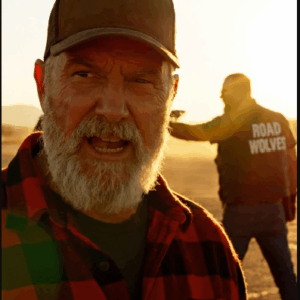
They Thought He Was Just A Frail Old Man Alone At A Truck Stop. But When The Gang Leader Spat In His Coffee, He Didn’t Flinch—He Just Made One Phone Call That Unleashed A Trap 20 Years In The Making.
Chapter 1: The Wolf at the Door The evening sun cast long, amber shadows across the cracked pavement of the Crossroads Truck Stop. It was a place out of time, situated on a lonely stretch of Interstate 40 where…

Navy Admiral Mocked A Single Dad Janitor In Front Of Everyone—Then He Learned The Man’s “Call Sign” And The Whole Base Froze.
Chapter 1: The Ghost of Coronado The morning fog still clung to the coastline of Coronado, a thick gray blanket that muffled the roar of the Pacific Ocean. Inside the primary administrative building of the Naval Base, the silence…
End of content
No more pages to load