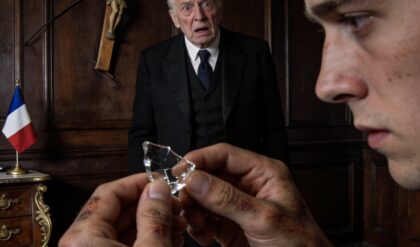
Part 1
Do you mind? Some of us are trying to win a war here.
The voice was sharp, sterile, and cold—matching the room perfectly. Captain Eva Rostova didn’t look up from her screen. She never did. To her, and to the dozen other prodigies in the Strategic Operations Center, I wasn’t a person. I was a texture. I was background noise. I was the old man who kept the caffeine flowing.
At 78, I’ve learned that invisibility is a kind of armor. I moved through the “Cool Blue” room—a cavern of glowing screens and holographic maps—with a quiet economy they mistook for slowness. They saw a stooped figure in a gray cardigan. They didn’t see the muscle memory in the legs that had once hiked fifty miles through the A Shau Valley with a rucksack full of C-4.
“Just leave the pot,” Rostova snapped, her eyes glued to a drone feed of a mountain range I knew better than the back of my own hand. “We’ll serve ourselves. It’s faster.”
Lieutenant Mark Chen, a kid fresh out of MIT with an ego bigger than the defense budget, smirked from the next console. “Algorithms wait for no man, Captain. Especially not one running on dial-up speed in a fiber optic world.”
They shared a look. A smirk. A joke at the expense of the relic.
I felt no sting. You don’t get offended by children when you’ve seen what I’ve seen. I just placed the thermal carafe on the coaster, careful not to disturb the ecosystem of their war games. My shoes, soft-soled and worn, made no sound on the polished concrete. That silence used to keep me alive. Now, it just made me easy to ignore.
As I reached for the empty sugar packets, Chen leaned back, stretching arms that had never lifted anything heavier than a tablet. “You know, the intel is good, but we need real-time human assets. The old school stuff.”
Rostova scoffed. “Human intel is messy. It bleeds. It lies. It gets killed. Why send a person when a satellite can read a license plate from orbit? The only thing we need a person for is to pull the trigger when the AI tells them to.”
“Still,” Chen mused, his eyes flickering toward me for a second, dead and empty of recognition. “You have to wonder what it was like back then. Guys with muddy faces and a compass, wandering around the jungle. Probably why it took them twenty years to do what we do in twenty minutes.”
I paused. Just for a heartbeat. My hand hovered over a crumpled napkin.
Inside my chest, a distant drum began to beat. A rhythm of rain, of rotors, of a heart pounding against ribs in the dark. They thought history was a data point to be optimized. To me, history was the mud I could still feel under my fingernails.
I turned to leave, my face a mask of calm service. But as I passed Rostova’s station, her eyes caught something. Not me. Just my wrist.
I wear a simple leather band. It’s dark with age, cracked like a drought-stricken riverbed, absorbed with sweat and oil. It smells of earth.
“What is that, anyway?” she asked, her voice dripping with that casual, unintentional cruelty of the young. “Some kind of retro fitness tracker?”
Chen leaned over, laughing. “Looks like something my grandpa would wear. A relic from the Stone Age. What does it track, Thomas? Your nap times?”
I stopped. I looked down at the leather.
The sterile blue light of the war room flickered in my vision. For a split second, I wasn’t standing on concrete. I was standing on a landing zone in 1968. The air wasn’t recycled AC; it was thick, hot, and smelled of jet fuel and rot.
I felt the weight of a hand on that wrist. David. He was nineteen. He was terrified. He pressed the leather into my hand as the mortar rounds started walking toward us. “You make it back, Tom. You tell them.”
The vision vanished. I was back in the AC.
“It’s just an old bracelet,” I said softly.
“Right,” Rostova muttered, losing interest instantly. “Well, try not to get it caught in the equipment. We’re dealing with classified hardware here, not a weaving loom.”
I nodded and turned away. I was going to let it go. I always let it go.
But someone else hadn’t.
General Marcus Thorne.
The man was a statue at the head of the room. A four-star General, the kind of man who commanded gravity just by standing still. He had been silent for twenty minutes, staring at the map. But as I turned to walk to the door, I saw his head snap up.
He wasn’t looking at the map anymore. He wasn’t looking at the Captain or the Lieutenant.
He was looking at me.
And for the first time in three years, someone in this room wasn’t looking at the janitor. He was looking at the scar through my left eyebrow. He was looking at the way I held my shoulders.
He was looking at a ghost.
Chapter 1: The Zeroes and the Ones
The room hummed. It was a sound I had grown used to over the last three years—the sound of a million calculations per second. It was the sound of a war being fought without sweat.
To the people in this room, I was Thomas Whitfield, civilian contractor, grade G-2. Job description: Sanitation and Refreshment Logistics. I wiped the tables, I emptied the classified shredder bins, and I made the coffee. The coffee had to be strong, hot, and constant.
That was the extent of my existence to them.
I continued my circuit of the room, collecting the debris of their genius. Empty energy drink cans, candy wrappers, napkins stained with grease. It was a strange contrast. These young men and women held the power of gods in their fingertips. With a keystroke, they could redirect a drone swarms or jam a radar network halfway across the globe. Yet, they couldn’t remember to use a coaster.
I moved past Sergeant Miller’s station. Miller was different. He was older than the rest, maybe forty. A career NCO who had seen the tail end of the desert wars. He looked up as I took his empty cup.
“Thanks, Thomas,” he murmured. He didn’t look at his screen. He looked at me. There was a kindness in his eyes, but also a weariness. He heard what Rostova and Chen had said. He always heard.
“Rough day, Sergeant?” I asked quietly.
“Just loud,” he replied, glancing at the two officers who were now laughing about a glitch in the enemy’s encryption. “Loud and fast. Sometimes I miss the quiet.”
I nodded. “Quiet is good. Quiet keeps you alive.”
Miller paused, looking at my hands. My knuckles were swollen with arthritis now, the skin papery. But the hands were still steady. “You okay, Thomas? They… they don’t mean anything by it. They’re just…”
“Young,” I finished for him. “They’re just young, Sergeant. Youth is a disease that time cures.”
I walked away before he could say more. I didn’t want pity. Pity was heavier than a rucksack.
I retreated to the kitchenette in the corner, a small alcove separated from the main floor by a glass partition. From here, I could see the entire theater of operations. The holographic map in the center of the room was pulsing red and gold. They were tracking an insurgent cell moving through a valley I knew well.
The Zargon Valley.
I washed a mug in the sink, the warm water running over my hands. I closed my eyes and the map in the room changed in my mind. The blue holograms disappeared. The sterile air vanished.
I smelled wet earth. I smelled cordite.
1969. Operation Silent Talon.
I was alone then. No drones. No satellite feeds. Just me, a compass, and a silence so deep it felt like it was screaming. I had been in that valley for three weeks, tracking a ghost battalion. I learned to walk so softly that the jungle didn’t even know I was there. I learned to listen to the birds—when they stopped singing, you froze.
“Hey! Coffee guy!”
The shout shattered the memory. I turned off the tap, my hands dripping.
It was Rostova. She was waving her empty mug in the air without looking back, like she was summoning a waiter at a bad diner.
“We’re running a new simulation,” she called out. “We need more fuel. And check the pot, the last batch was a little bitter.”
I dried my hands on a paper towel. Slowly. Deliberately.
“Coming, Captain,” I said.
I wasn’t angry. Anger is a waste of energy. But as I walked back out onto the floor, I felt a shift in the air. The General, Marcus Thorne, had moved.
He was no longer at the head of the table. He was pacing. Slowly. Like a predator circling the perimeter. He stopped behind Chen’s chair, watching the young Lieutenant tap furiously at his keyboard.
“We’ve got the predictive model up, General,” Chen said, beaming. “Based on the terrain analysis, we predict the insurgents will move north, toward the pass. It’s the logical route. The algorithm gives it a 98% probability.”
“Logical,” General Thorne repeated. His voice was deep, gravelly. It sounded like tank treads on asphalt. “And if they don’t follow logic, Lieutenant?”
Chen blinked. “Sir? The terrain mandates it. The southern route is impassable. Dense jungle, steep cliffs. No vehicle could make it.”
“Who said they are in vehicles?” Thorne asked softly.
“The heat signatures imply—”
“Imply,” Thorne cut him off. He looked up, his eyes scanning the room, scanning the faces of his brilliant, blind officers. “You are fighting a war of math, Lieutenant. The enemy is fighting a war of survival. Survival isn’t logical. It’s desperate.”
Thorne’s gaze drifted. It went past the map. It went past the screens.
It landed on me again.
I was ten feet away, pouring coffee into Rostova’s mug. I kept my head down, but I could feel his eyes. They felt like a physical weight.
Chapter 2: The Crash
The tension in the room was rising. I could smell it, sharper than the coffee. The simulation wasn’t going well. The red dots on the map were defying the “logical” algorithms Chen was so proud of.
“It doesn’t make sense,” Rostova muttered, tapping her screen violently. “They’re disappearing. The heat signatures just… vanished. Are the sensors down?”
“Sensors are green,” Chen argued. “Maybe they went underground?”
“There are no tunnels there. The geological survey says it’s solid granite.”
“Well, they didn’t just fly away, Eva!”
I was standing right behind them, holding the pot. I knew exactly where they had gone. I knew about the limestone fissures in the southern cliffs. I knew because I had slept in them. I knew because I had hidden in them for three days while an entire NVA regiment walked right over my head.
The urge to speak was a physical ache in my throat. The fissures, I wanted to say. Scan for cold pockets in the rock face. They mask the thermal bloom.
But I was the coffee guy.
I stepped forward to refill Chen’s mug. He was agitated, flailing his hands as he argued with the screen.
“It’s a glitch!” he shouted, throwing his hands up.
His elbow caught the bottom of the carafe.
It happened in slow motion. The pot flew from my hand. It hit the edge of the console. Hot, black liquid exploded outwards.
It splashed across the keyboard. It splashed onto the data pad Rostova was holding. It splashed onto the pristine, polished floor.
“Damn it!” Rostova shrieked, jumping back.
The silence that followed was absolute. The hum of the servers seemed to vanish.
“My pad!” Rostova yelled, frantically wiping the device with her sleeve. “This has the encryption keys! You stupid old—” She stopped herself, breathless with rage. She glared at me. “Look what you did!”
“I… I apologize, Captain,” I said, reaching for a towel from my belt. “I’ll clean it—”
“Don’t touch it!” Chen barked, standing up. He towered over me, or he tried to. “You’ve done enough damage. God, this is exactly what I was saying. Why do we even have him here?”
He turned to the room, looking for validation. “He’s a liability! We’re trying to execute a Tier-One operation, and we’re being sabotaged by… by geriatrics!”
I stood there, the towel in my hand. The coffee was soaking into my shoes. I felt a familiar stillness settle over me. It was the stillness of the sniper. The stillness of the ambush.
“It was an accident, Lieutenant,” I said, my voice steady. “You moved your arm.”
“I moved my arm?” Chen laughed, a harsh, incredulous sound. “Oh, so it’s my fault? You’re shuffling around here like a zombie, getting in the way of actual work, and you blame me?”
“That’s enough,” Rostova said, her voice icy. “Thomas, just… get out. Go get a mop. And then stay in the break room until we’re done. Honestly, maybe we should just have you replaced with a vending machine. At least a machine doesn’t have shaky hands.”
The insult hung in the air. It was cruel. It was unnecessary.
It was the spark.
I looked at Rostova. I looked at Chen. I saw their soft hands. I saw their clean uniforms. I saw the arrogance that comes from never having been truly afraid.
I slowly folded the towel.
“My hands,” I said, very quietly, “are not shaky, Captain.”
“Excuse me?” she snapped.
“I said, my hands aren’t shaky. And if I were you, I’d check the limestone cliffs on the southern ridge. The heat sensors won’t pick them up because the rock stays cold. That’s where they are.”
Rostova stared at me. Her mouth opened slightly. “What did you just say to me?”
“You’re looking in the wrong place,” I repeated. “And you’re treating your support staff like the enemy. That’s a bad habit. It gets people killed.”
“You…” Chen stepped forward, his face turning red. “You are a civilian janitor. You do not give tactical advice. You do not speak unless spoken to. You are out of line, old man. Way out of line.”
“Actually,” a new voice rumbled. “He’s right on target.”
The voice came from the shadows at the back of the room. It wasn’t loud, but it stopped Chen dead in his tracks.
General Thorne stepped into the light.
He walked slowly toward us. His boots clicked on the floor with a rhythmic precision that sounded like a countdown. He didn’t look at the mess on the floor. He didn’t look at the ruined keyboard.
He stopped three feet from me. He towered over me, a giant in green.
Rostova straightened up, looking nervous. “General, I’m sorry about the disruption. The… the staff was being clumsy. We’ll handle it. I’ll have him removed.”
“Removed?” Thorne repeated the word like he was tasting it, and found it sour.
He turned his head slowly to look at Rostova. His eyes were cold enough to freeze jet fuel.
“You want to remove him?” Thorne asked.
“Well, yes, sir. He’s distracting the team. He’s…”
“He just gave you the answer to the tactical problem you’ve been failing to solve for an hour,” Thorne said.
“Sir?” Chen stammered. “He… he just guessed. He’s the coffee guy.”
Thorne ignored him. He turned back to me. He looked me up and down. He looked at the gray cardigan. He looked at the worn shoes.
And then, he looked at the leather band on my wrist.
His eyes widened. Just a fraction.
He took a breath. A deep, shaky breath.
“It’s been a long time,” the General said. His voice was no longer the voice of a commander. It was softer. Respectful.
I looked up at him. I recognized the eyes now. Not from this room. But from a file I had seen a lifetime ago. A young Lieutenant who had studied the reports.
“Yes, sir,” I said. “It has.”
“I didn’t believe it,” Thorne said, shaking his head slightly. “When I saw the personnel roster… Thomas Whitfield. I thought it had to be a coincidence. I thought… surely not him. Surely he’s not… here.”
“I like the quiet, General,” I said.
Thorne smiled. It was a sad smile. “The quiet.”
He turned to the room. Every eye was on us. Rostova looked confused. Chen looked annoyed. Miller looked like he was holding his breath.
“Captain Rostova,” Thorne said, his voice hardening again. “Lieutenant Chen.”
“Yes, General?”
“You called him a relic. You called him a zombie. You asked what that bracelet was.”
Thorne reached out. His hand, large and calloused, gently took my wrist. He lifted my arm up, displaying the worn, cracked leather band to the room.
“Do you know what this is?” Thorne asked them.
“It’s… leather, sir,” Chen said, his voice trembling slightly.
“It’s a remembrance band,” Thorne said. “From Operation Twisted Snake. 1968.”
The room went deadly silent. Even the servers seemed to quiet down.
“But… that’s classified,” Rostova whispered. “That operation… it doesn’t exist in the public record.”
“No,” Thorne said. “It doesn’t. Because out of the twelve men who went into that jungle, only one walked out.”
Thorne dropped my hand gently. He stepped back. He squared his shoulders. He adjusted his uniform jacket.
And then, the four-star General, the commander of the entire theater, did the unthinkable.
He snapped his heels together. He raised his right hand.
And he saluted me.
It wasn’t a casual salute. It was slow. Crisp. Perfect. A salute reserved for the highest honor.
“Nightwolf,” the General said.
The name hit the room like a physical blow.
Rostova gasped. She physically stumbled back, her hand flying to her mouth. Chen went pale, his eyes bulging.
“Nightwolf?” Chen squeaked. “The… the ghost? The one from the textbooks?”
“The man who wrote the book you’re failing to read,” Thorne said, not breaking his salute. “Sergeant Major Whitfield. It is the honor of my life to stand in your presence.”
Part 2
Chapter 3: The Echo of a Name
“Nightwolf.”
The word hung in the air, heavier than the humidity of the jungle I had left behind half a century ago. In the climate-controlled sterility of the Strategic Operations Center, it sounded foreign. Dangerous.
Thomas. That was my name now. I was Thomas, the guy who knew which creamer Lieutenant Chen preferred. I was Thomas, the shadow who buffed the floors. Nightwolf was a ghost I had buried in a box in my attic, wrapped in oilcloth and silence.
But General Thorne had dug him up.
I looked at the General. His hand was still raised in that perfect, unwavering salute. His eyes were locked on mine, burning with an intensity that stripped away the years, the gray cardigan, and the stooped posture I had adopted as camouflage.
Slowly, instinctively, my body reacted. The muscle memory that had been dormant for decades fired like a spark plug.
My spine straightened. The phantom weight of the ruck sack lifted. My chin rose. The tremors in my hands—the ones Chen had mocked just moments ago—vanished completely.
I shifted my weight, bringing my heels together. It wasn’t the loud click of a dress shoe; my soft soles made a dull thud. But the stance was unmistakable.
I raised my hand. It cut through the air, precise and sharp.
“At ease, General,” I said.
My voice had changed. The rasp of the old janitor was gone. This was the voice that had called in airstrikes over the roar of a firefight. It was a voice that expected to be obeyed.
Thorne held the salute for a second longer, a silent conversation passing between us—I see you, soldier—before sharply dropping his hand.
The sound of his hand hitting his thigh was like a gunshot in the silent room.
“Sir,” Thorne said, his voice thick with emotion. “I didn’t think… I didn’t think you were still with us.”
“I’m hard to kill, Marcus,” I replied, using his first name. “You know that better than most. Your father wrote the after-action report on the A Shau extraction.”
Thorne nodded, a look of reverence on his face. “He did. He said you were the only reason any of them came home.”
A gasp came from the side. It was Rostova. She looked like she had been slapped. Her face was drained of color, her mouth slightly open. She looked from the General to me, and back again, her brain struggling to reconcile the data points.
“General?” she stammered, her voice trembling. “I don’t understand. Nightwolf? That’s… that’s a myth. It’s a call sign from the black ops case studies. It’s not… him.”
She pointed a shaking finger at me. At my gray sweater. At my mop bucket in the corner.
“He’s the janitor,” she whispered, as if saying it aloud would make the world make sense again.
Thorne turned on her. The warmth he had shown me evaporated instantly. He looked at her with the cold, hard stare of a predator looking at prey.
“The janitor,” Thorne repeated, his voice low and dangerous.
He walked over to the main tactical table. He punched a command into the console. The holographic map of the Zargon Valley flickered and vanished. In its place, a file appeared.
It was redacted heavily. Black bars covered lines of text. Top Secret stamps were faded and crooked. But the photo at the top was clear.
It was a young man. Twenty years old. Face smeared with camo paint. Eyes that looked a thousand years old. A scar cutting through his left eyebrow.
It was me.
“You read the summaries, Captain,” Thorne said, his voice echoing off the walls. “You read the sanitized versions in your textbooks at the Academy. You played the simulations. But you didn’t read the source material.”
He tapped the screen.
“Subject: Thomas Whitfield. Rank: Sergeant Major. Unit: MACV-SOG. Designation: Nightwolf.”
Chen, who had been paralyzed near his chair, finally found his voice. “SOG? Studies and Observations Group? But… sir, those records were burned. Most of those guys didn’t exist officially.”
“Exactly,” Thorne snapped. “They didn’t exist. So when they did things that were impossible, nobody could write it down.”
The General turned back to me, his expression softening.
“Tell them, Thomas. Tell them why you’re wearing that leather band.”
I touched the wristband. The leather felt warm against my pulse.
“It’s not a story for a strategy room, General,” I said quietly. “It’s not data.”
“They don’t need data,” Thorne said, gesturing to the young officers. “They have terabytes of data. What they need is wisdom. And they are severely lacking in it.”
He looked at Rostova and Chen.
“You mocked him,” Thorne spat. “You laughed at him. You thought because he cleans up your trash that he is beneath you. You have no idea of the giant whose shoulders you are standing on.”
Chapter 4: The Black File
Thorne paced the room now, commanding the space like a revival preacher, his voice rising and falling with the rhythm of a lecture.
“1968,” Thorne began. “Operation Iron Shadow.”
He looked at Chen. “You know the name, Lieutenant?”
Chen nodded, swallowing hard. “Yes, sir. It’s the foundational case study for asymmetrical jungle warfare. A single operative infiltrated the enemy supply chain and redirected an entire division.”
“Correct,” Thorne said. “And how did the operative do it? What does the textbook say?”
“The text says he used… advanced signals intelligence and localized psychological warfare assets,” Chen recited robotically.
Thorne laughed. It was a dry, harsh bark.
“Fancy words,” Thorne said. “Bullshit words. ‘Advanced signals intelligence’? He had a stolen radio and a coil of copper wire. ‘Psychological warfare assets’? He had a knife and a bag of rice.”
Thorne walked over to me, placing a hand on my shoulder.
“Thomas Whitfield went into the valley alone. He stayed there for thirty days. No resupply. No extraction. He learned the enemy’s schedules better than they knew them themselves. He tapped into their landlines by digging them up with his bare hands in the middle of the night.”
Thorne looked at Rostova.
“He didn’t use an algorithm to predict where the enemy was going, Captain. He tracked them by the smell of their tobacco and the depth of their boot prints in the mud. And when he found their command center, he didn’t call in a drone strike.”
The General paused for effect. The room was so quiet you could hear the hum of the cooling fans in the servers.
“He walked into the enemy commander’s tent, stole the operational maps while the man was sleeping, and then reversed the road signs at the main junction five miles back.”
Chen’s eyes went wide. “He… he moved the road signs?”
“He sent two thousand enemy soldiers marching into a swamp,” I said softly.
They all turned to look at me.
“It was a simple solution,” I explained, shrugging. “Technology fails. Batteries die. But confusion? Confusion always works. If you can make the enemy doubt his own eyes, you’ve already won.”
Thorne nodded. “He bought the 101st Airborne three days. Saved roughly four hundred lives. Including my uncle.”
Rostova stared at me, her arrogance crumbling like a sandcastle in the tide. I could see the gears turning in her head, re-evaluating everything she thought she knew about the ‘old man.’
“But that’s not why I saluted him,” Thorne continued. “That was just Tuesday.”
The General swiped the holographic screen. A new file appeared.
Operation Silent Talon. 1969.
“This one,” Thorne said, his voice dropping to a whisper, “isn’t in your textbooks. It’s too classified for the Academy.”
He looked at me. “Do you want to tell them, Sergeant Major?”
I shook my head. “No, sir. I don’t.”
Thorne respected that. He took a deep breath and turned to the officers.
“An American pilot was shot down. An experimental stealth prototype. The pilot, Captain David Miller, was carrying encryption codes that could have compromised the entire Pacific fleet. He crashed five miles deep in enemy territory. The area was swarming with Hunter-Killer teams.”
I closed my eyes. I could hear the rain. I could hear David screaming.
“Command wrote him off,” Thorne said. “Calculated risk. The probability of rescue was zero. The probability of losing the rescue team was 100%. So, they decided to bomb the crash site. Erase the codes. And the pilot.”
Rostova gasped. “They were going to kill their own man?”
“It was the logical decision,” Thorne said, throwing her own words back at her. “The algorithm said it was the only choice. Just like your algorithm said the insurgents couldn’t be in the cliffs.”
He stepped closer to Rostova.
“But Thomas Whitfield didn’t listen to the algorithm. He was already on the ground. He turned off his radio so he couldn’t hear the order to stand down.”
Thorne’s voice grew fierce.
“He ran six miles through triple-canopy jungle, in the dark, with a shattered ankle. He got to the crash site three minutes before the enemy. He pulled Miller out of the burning wreckage.”
I looked down at my hands. I could still feel the heat of the fire. The smell of burning aluminum and flesh.
“He couldn’t walk,” I murmured. “David… his legs were crushed.”
“So you carried him,” Thorne said. “For two days.”
The General looked around the room.
“He carried a 180-pound man on his back, through a swamp, while being hunted by dogs. He didn’t sleep. He didn’t eat. He killed six enemy soldiers who got too close—hand to hand, so he wouldn’t give away his position with a gunshot.”
Thorne pointed to the wristband again.
“That leather band? That belonged to the pilot. Captain Miller gave it to him on the extraction chopper. He died two minutes before they landed. But he died free. And the codes never fell into enemy hands.”
Silence. Absolute, heavy silence.
Sergeant Miller, the older NCO who had been kind to me earlier, stood up slowly. He looked at me with tears in his eyes.
“Captain Miller?” the Sergeant asked, his voice cracking. “Captain David Miller? From Ohio?”
I looked at him. Really looked at him. I saw the jawline. The eyes.
“Yes,” I said softly. “He talked about his son. Little Mikey. Said he loved baseball.”
Sergeant Miller let out a choked sob. “I’m Mike. I’m his son.”
The revelation hit the room like a thunderclap. The Sergeant walked out from behind his console. He didn’t care about protocol. He walked straight up to me and grabbed my hand, gripping it with both of his.
“My mother…” Miller choked out. “She always said… she said an angel brought him back so we could bury him. She never knew who it was. The report just said ‘unidentified asset.'”
He looked at the General, then back at me.
“Thank you,” Miller wept. “Thank you for bringing my dad home.”
I squeezed his hand. “He was a good man, Mike. He fought hard.”
Chapter 5: The Weight of Brass
The emotional gravity in the room was immense. But General Thorne wasn’t finished. He had a mission to complete. A correction to make.
He turned his attention back to Rostova and Chen. They were shrinking, physically trying to make themselves smaller. The shame radiating off them was palpable.
“You asked what he does here,” Thorne said to them. “You asked why we employ a ‘relic’.”
Thorne gestured to the massive supercomputer behind them.
“That machine? The predictive software you use? It’s called the Thorne Doctrine. They named it after me because I wrote the manual. But I didn’t invent the tactics.”
He pointed at me.
“I digitized him.”
Thorne walked over to Rostova’s console. He tapped the screen where the “glitch” had been.
“The Nightwolf Protocol. That’s the core code of your AI. It’s based on his patterns. His intuition. His ability to see what isn’t there. You are literally running a simulation of Thomas Whitfield’s brain.”
He leaned in close to Rostova.
“And you just told the original that he was getting in the way.”
Rostova looked down at her boots. “I… I didn’t know, General. I’m so sorry. Sir, I…” She looked at me, her eyes wet. “Mr. Whitfield, I had no right.”
“No,” Thorne said, his voice hard as granite. “You didn’t. And that’s the problem. It’s not about knowing he was a war hero. It’s about how you treat the man pouring your coffee.”
Thorne straightened up and buttoned his jacket.
“Intelligence is not wisdom, Captain. You have high IQs. You have degrees from the best universities. But you lack the fundamental discipline of a soldier: Respect. You look at a man and you see rank, or utility. You don’t see the human. And because of that blind spot, you almost blew this operation.”
He looked at the spill on the floor.
“If he hadn’t told you about the limestone cliffs, you would have sent that drone squadron into the wrong valley. You would have missed the target. And three weeks from now, those insurgents would have blown up a marketplace.”
Thorne turned to his aide, who was standing by the door with a clipboard.
“Lieutenant Chen. Captain Rostova.”
“Yes, General?” they answered in unison, voices weak.
“You are relieved of duty on the active strategic floor. Effective immediately.”
Chen’s jaw dropped. “General? Sir, please. This is my career. One mistake…”
“It wasn’t a mistake, Lieutenant,” Thorne said. “It was a character flaw. Mistakes can be trained out. Arrogance cannot.”
Thorne ripped the velcro unit patches off their shoulders. It was a symbolic, brutal gesture.
“You are reassigned to the Archives,” Thorne ordered. “Basement level. You will spend the next six months digitizing the handwritten field reports from the Vietnam and Korean wars. You will read every single word. You will learn what real sacrifice looks like. Maybe, by the time you’re done, you’ll understand the value of the ‘old school’.”
“Dismissed!” Thorne barked.
Rostova and Chen didn’t argue. They couldn’t. They gathered their things with trembling hands, avoiding my gaze, and walked out of the room. The silence that followed their exit was heavy, but clean. The toxicity was gone.
Thorne turned back to me. The hard edge left his face, replaced by a deep, weary kindness.
“I apologize for them, Sergeant Major,” he said. “We raise them on screens, not in the dirt. They forget.”
“They’re just kids, Marcus,” I said, picking up the mop bucket. “They’ll learn. Or they won’t.”
Thorne watched me dip the mop into the water.
“Thomas,” he said. “Leave the floor.”
“Sir?”
“You’re done serving coffee. I’m not having the architect of modern special ops warfare mopping up spills.”
“I need the work, General,” I said simply. “Pension doesn’t stretch as far as it used to. And… I like being useful.”
Thorne smiled. A genuine, warm smile.
“Oh, you’ll be useful,” he said. “I have a new position for you. Starting now.”
He walked over to the empty seat at the head of the strategic table—the seat right next to his own.
“Senior Strategic Advisor,” Thorne said. “Civilian status, but with G-14 clearance. You answer only to me. Your job is to sit in this room, drink your coffee, and tell these kids when their machines are lying to them.”
I looked at the chair. It was leather. High-backed. It looked comfortable.
“Does it come with a raise?” I asked, a twinkle in my eye.
“Triple your current pay,” Thorne laughed. “And you get your own coffee pot. Nobody touches it but you.”
I looked at the mop one last time. Then I looked at Sergeant Miller, who was smiling through his tears. I looked at the map, where the red dots were now flashing in the limestone cliffs—exactly where I said they would be.
I dropped the mop into the bucket. It made a splashing sound that felt like a period at the end of a long, long sentence.
“Alright, General,” I said, walking toward the table. “Let’s win a war.”
Part 3 (Final Part)
Chapter 6: The Ghost in the Command Chair
Sitting in the leather chair next to General Thorne felt unnatural. For three years, my body had been conditioned to shrink, to make myself smaller, to occupy the negative space of the room. Now, I was center stage.
The leather creaked as I settled in. It was soft, expensive—a far cry from the canvas seats of a Huey or the wet mud of a foxhole.
“Comfortable?” Thorne asked, not looking up from the main screen.
“It’s a little too soft, General,” I grunted. “Keeps you awake if you’re uncomfortable.”
Thorne chuckled. “We’ll get you a wooden stool if you prefer. But right now, I need your eyes.”
The room was silent. The chaos of the earlier argument had been replaced by a razor-sharp focus. The young analysts, the ones who hadn’t been kicked out, were stealing glances at me. They weren’t looking at the coffee pot anymore. They were looking at the man who had walked out of the A Shau Valley when no one else did.
“Target area is the limestone ridge,” Thorne announced, his voice booming. “Coordinates locked based on… human intelligence.”
On the massive screen, the drone feed zoomed in. The jagged gray teeth of the cliffs filled the wall. It looked empty. Just cold, dead rock.
“Sensors are still reading negative, sir,” a young Captain said nervously. “Thermal is flat. If we strike and there’s nobody there… we waste a two-million-dollar Hellfire.”
Thorne turned to me. He didn’t say a word. He just raised an eyebrow.
I leaned forward. I narrowed my eyes, studying the high-definition image. I wasn’t looking for heat. I was looking for shadow.
“There,” I pointed a gnarled finger at a fissure near the base of the cliff. “See that vegetation? The vines are brown. Withered.”
“So?” the Captain asked.
“It’s the rainy season,” I said, my voice raspy but projecting clearly. “Everything should be green. Those vines are brown because they’ve been cut and replanted to cover an opening. The roots are dead. It’s camouflage.”
The Captain typed furiously. “Zooming in on sector four.”
The resolution sharpened. Sure enough, the texture of the vines was wrong. They were limp.
“And there,” I traced a line up the cliff. “The bird droppings on those rocks. There aren’t any.”
“Sir?”
“Birds roost on high ground,” I explained. “Unless there’s constant foot traffic disturbing them. That ledge is a sentry point. They’ve scrubbed it, but the birds don’t lie.”
Thorne smiled. It was a wolfish grin.
“You heard him,” Thorne barked. “Strike package Alpha. Target the fissure behind the dead vines. Fire for effect.”
” firing in three… two… one.”
On the screen, a silent puff of smoke appeared, followed seconds later by the violent bloom of an explosion. The missile punched straight through the camouflage.
For a second, nothing happened. Then, the ground seemed to vomit fire. Secondary explosions rippled through the cliffside—ammo caches cooking off. The heat sensors suddenly lit up like a Christmas tree as dozens of enemy combatants scrambled out of the hidden tunnel network, right into the open.
“Target confirmed!” the Captain shouted, his voice cracking with adrenaline. “Multiple secondary detonations! We hit their main supply dump! Insurgents flushing into the open… engaging!”
The room erupted. Not with cheers—professionals don’t cheer until the job is done—but with a collective release of tension. A murmur of awe rippled through the rows of computers.
“Dead vines,” I heard someone whisper. “He saw it from dead vines.”
Thorne leaned back, crossing his arms. “Not bad for a coffee boy.”
I didn’t smile. I watched the screen, watched the small digital figures running for their lives. I felt no joy in it. Only the grim satisfaction of a job done right. It was necessary work, but it was never happy work.
“It’s not magic, General,” I said quietly, rubbing the leather band on my wrist. “It’s just paying attention.”
Chapter 7: The Archives
The fallout was swift. The story of what happened in the “Cool Blue” room didn’t stay there. It leaked out, as stories always do on a military base.
By the next morning, I couldn’t walk to the mess hall without soldiers stopping to snap to attention. Young privates would hustle to open doors for me. The new Lieutenant assigned to the coffee machine looked terrified every time I walked by, as if I were going to court-martial him for a weak brew.
I didn’t want the fame. I wanted the coffee.
But the most significant change wasn’t in the Command Center. It was in the basement of Building 4. The Archives.
It was a punishment detail, yes. But Thorne was a smart leader. He didn’t just want Rostova and Chen to suffer; he wanted them to learn.
Building 4 was the antithesis of the Ops Center. It smelled of old paper, dust, and decaying glue. There were no holograms here. No air conditioning. Just rows and rows of metal filing cabinets and boxes that hadn’t been opened since the Berlin Wall fell.
I didn’t go down there. I didn’t want to gloat. But Sergeant Miller, who had taken to having lunch with me every day, gave me the updates.
“They’re miserable,” Miller told me one afternoon, biting into a sandwich. “Rostova is scanning flight logs from the Korean War. Chen is transcribing hand-written patrol reports from the Mekong Delta.”
“Good,” I said, sipping my black coffee. “Reading handwriting takes patience. They need that.”
“It’s changing them, though,” Miller said thoughtfully. “The first week, they were just angry. Complaining to anyone who would listen. But lately… the complaints stopped.”
“Oh?”
“Yeah. I went down there to drop off some files. Rostova was reading a citation for a Medal of Honor. One of the posthumous ones. She was crying, Thomas.”
I paused, the cup halfway to my mouth.
“She wasn’t looking at her phone,” Miller continued. “She was just sitting there, holding this yellowed piece of paper, staring at the wall. I think she finally gets it. She’s realizing that the ‘data’ she used to move around on a screen used to be people. People with families. People who bled.”
I nodded slowly. “That’s the lesson. Technology makes war feel like a video game. It creates distance. But war is intimate. You need to smell the fear to understand the cost.”
“General Thorne says he’s going to leave them down there for another month,” Miller said.
“Good,” I replied. “Let them marinate in the history. It’s the only way to wash off the arrogance.”
I thought about them often, down in the dark. I didn’t hate them. I had been young and cocky once, too. Not that cocky, but I had thought I was invincible. The jungle had beaten that out of me. The Archives would have to do the same for them.
The base instituted a new training module shortly after: “The Living Legends Program.” It required all intelligence officers to spend five hours a month interviewing a retired veteran. Not for data, but for perspective.
It was a small victory. But in the military, you take the ground you can get.
Chapter 8: The Bridge Between Worlds
Three months later.
The seasons had changed outside, the scorching summer giving way to a crisp autumn. I was sitting in the base library on a Saturday. It was my day off, but I liked the quiet of the library. I was reading a western, enjoying the silence.
“Mr. Whitfield?”
The voice was hesitant. Soft.
I marked my page and looked up.
Standing at the end of the table was Captain Eva Rostova.
She looked different. The crisp, tailored perfection of her uniform was the same, but her posture had changed. The rigid, haughty tilt of her chin was gone. Her shoulders were relaxed. Her eyes were clearer, less frantic.
She wasn’t holding a tablet. She was holding a book. Street Without Joy by Bernard Fall. A classic text on the French war in Indochina.
“Captain,” I said, nodding my head. “Or is it Archivist now?”
She managed a weak, self-deprecating smile. “General Thorne reinstated me to active duty yesterday. Junior Analyst grade. I have to earn my console back.”
“That sounds fair,” I said.
She took a step closer, her hands gripping the book tight.
“I wanted to… I’ve been looking for you. I wanted to say it properly. I know General Thorne made us apologize before we left, but that was an order. This… this is me.”
She took a deep breath, steeling herself.
“I am sorry, Thomas. Truly. I was… I was a fool. I treated you like furniture. I treated history like it was just raw data to be mined.”
She placed the book on the table.
“I’ve spent the last ninety days reading about your war. And the wars before it. I read the casualty reports. I read the letters home that were never sent.” Her voice trembled. “I read the full file on Operation Silent Talon.”
She looked at my wrist. The leather band was still there.
“I know about David Miller now,” she whispered. “I know what you did for him. I know what this bracelet costs.”
I looked at her. Really looked at her. The arrogance was gone. Burned away by the truth. In its place was something stronger: humility.
“We all make mistakes, Captain,” I said softly. “The trick is not to let them define you. You were looking at the future so hard you tripped over the past. It happens.”
“It won’t happen again,” she vowed. “I promise you. When I look at those screens now… I don’t see icons. I see men. I see David.”
I closed my book and stood up. My knees popped—a reminder of the miles I’d walked.
“Then the punishment worked,” I said. “You’re a better officer now than you were three months ago. And a better human being.”
I extended my hand. My rough, scarred hand.
She didn’t hesitate. She took it. Her grip was firm. It was the handshake of a soldier, not a bureaucrat.
“Thank you, Sergeant Major,” she said.
“Call me Thomas,” I smiled. “I’m just the advisor.”
She smiled back, and this time, it reached her eyes.
“Can I… can I buy you a coffee?” she asked. “I promise I won’t spill it.”
I laughed, a dry rasping sound. “Sure, Captain. But let’s go to the mess hall. The coffee in the Ops Center is terrible. I should know, I used to make it.”
We walked out of the library together. The old ghost and the young prodigy.
As we walked into the sunlight, I touched the leather band on my wrist one last time. I felt a warmth there, a subtle pressure.
You told them, Tom, the voice in my head whispered. You told them, and they finally listened.
The war never really ends for men like me. But for the first time in fifty years, as I walked alongside the future generation, the pack on my back felt a little bit lighter.
[END OF STORY]
News
I Hid 20 Freezing Bikers From a Blizzard. The Next Morning, I Woke Up to a Roar That Shook My Entire House.
Chapter 1: The Invisible Woman The wind didn’t just blow that night; it screamed. It was a sound that tore through the cracks in the walls and settled deep in your bones. I stood by the kitchen window, watching…
I Fixed A Billionaire’s Broken Prototype With A Wrench. The Next Morning, A Black Hawk Helicopter Landed In My Trailer Park.
Chapter 1: The Ghost in the Machine The copper-colored sun was dying behind the thick clouds, casting long, bruising shadows across Woodbury Meadows. It was the kind of light that made everything look old. The trailer park smelled of…
They Thought She Was Just A Lonely Customer. When The Biker Touched The Waitress, The Navy Commander Broke Her Silence—And His Arm.
Chapter 1: The Ghost in the Corner The morning fog rolled thick off the Atlantic, blanketing the streets of Port Haven in a ghostly shroud. It was the kind of heavy, wet mist that muffled sound and made the…
They Mocked A Paralyzed Veteran And Kicked Her Wheelchair, Unaware They Just Woke Up The Most Dangerous Assassin The Military Ever Created.
CHAPTER 1: THE GHOST OF PINE VALLEY The phantom pain was bad today. It felt like fire was licking at ankles that hadn’t been there for three years. Alex Winters adjusted her position in the wheelchair, her face remaining…
They Thought He Was Just A Frail Old Man Alone At A Truck Stop. But When The Gang Leader Spat In His Coffee, He Didn’t Flinch—He Just Made One Phone Call That Unleashed A Trap 20 Years In The Making.
Chapter 1: The Wolf at the Door The evening sun cast long, amber shadows across the cracked pavement of the Crossroads Truck Stop. It was a place out of time, situated on a lonely stretch of Interstate 40 where…

Navy Admiral Mocked A Single Dad Janitor In Front Of Everyone—Then He Learned The Man’s “Call Sign” And The Whole Base Froze.
Chapter 1: The Ghost of Coronado The morning fog still clung to the coastline of Coronado, a thick gray blanket that muffled the roar of the Pacific Ocean. Inside the primary administrative building of the Naval Base, the silence…
End of content
No more pages to load