The Taste of Poisoned Anticipation
Arseny Gradov, a fortress of a man whose name was synonymous with a vast construction empire, stood by the towering window of his twenty-fifth-floor office. The heavy crystal glass in his hand, containing amber whiskey, was cool against his skin. The city below was a sprawling, darkening galaxy, sinking into the velvet of a Moscow twilight. He felt a tension familiar to a predator before a hunt—thick, insistent, like the foretaste of a storm mixed with the sweet, illicit poison of anticipation.
That evening was not just about the Charity Ball, one of the most exclusive and pompous society events of the year; it was about the declaration he was about to make by crossing its threshold. And not alone.
At the back of the office, by the black Steinway, stood Emilia. She was his beautiful defiance, the embodiment of a fiery present against a heavy past. Her black velvet dress, with a neckline that dared the world to look away, framed the delicate line of her shoulders. Her fiery red hair was gathered into a perfect, seemingly careless bun.
“Are you absolutely sure you want to appear there with me?” Her voice, soft and melodic, held an echo of profound self-doubt. “I’m not the kind of person they usually welcome in those gilded halls. My soul doesn’t wear a tuxedo.”
Arseny crossed the room. He needed her reality against the masks he was about to face. “That’s exactly why I can’t imagine the evening without you,” he whispered, his thumb tracing the high curve of her cheek. “You’re the only reality in a world woven of ghosts. You breathe, you feel, you live. You are real.”
He loved her honesty, her lack of pretense, but it was an honesty that served as a clean wound, allowing him to bypass the heavy, granite weight of his past—a past that contained a woman whose name he had effectively banished from his lips.
“And what if they see nothing in me but your mistress?” Emilia whispered.
“Let them read,” he snapped, the sound a sharp crack of a whip against the silence. “I stopped paying other people’s bills a long time ago. My life belongs to me alone.”
He was lying to her. Not with his words, but with his deliberate omission. He had been to that very mansion before. Many years ago. Back then, its walls had held his first, brightest happiness, his deepest faith. And his ex-wife.
The Thud of a Shut Door
The mansion on Prechistenka Street was a tomb of high society history, its walls breathing a vanished era. Lofty, painted ceilings, giant Venetian mirrors—everything steeped in muted, unfeigned luxury. Arseny’s dark limousine rolled silently up to the carpet, and a doorman in flawless white livery opened the door with ceremonial deference.
Emilia stepped out first, an indomitable night angel on foreign ground. Her fingers, cold and gripping, pressed into his palm. As they crossed the threshold, the massive oak door thudded shut behind them, sealing them into a world where reality was merely a suggestion.
The air inside was thick with expensive perfume and the languid, sorrowful melody of a string quartet. Guests glittered with silk and diamonds, their smiles flawless, their eyes empty.
“You’ve been here before, haven’t you?” Emilia asked quietly, studying the familiar details of the interior.
“Yes,” he answered curtly, and the single syllable was an entire, untold story.
He didn’t say that in a life faded almost to sepia, this house had been his home. That in this very drawing room, beneath the light of that very crystal chandelier, he had knelt and proposed to Veronika. That they had once been young, ardent, and stupidly certain of their shared future. He didn’t want to resurrect ghosts.
But Fate had a particular fondness for cruel irony.
The Fallen Angel’s Absolute Power
As they neared the dark marble bar, a sudden, physical change in the atmosphere struck Arseny. The air grew dense, viscous, and his heart, the organ he thought had been encased in iron, bolted into a wild gallop.
He raised his gaze—and froze.
In the arched doorway, beneath the shadow of a heavy velvet curtain, stood she. Veronika.
His ex-wife. His unhealed wound.
She wore a gown the color of ivory, severe yet stunning, with a long train and a deep, defiant plunge at the back. Her ash-blond hair was swept into an intricate, impeccable style, baring a neck circled by the same string of pearls—his gift for their tenth anniversary. It glinted coldly, like tears turned to jewels.
She looked straight at him, and in her fathomless gray eyes there was no anger, no reproach, no pain. Only icy, all-understanding calm. And something more: undivided, absolute power.
The corners of her lips lifted into that polished smile of the social world, and she took a light, weightless step forward. The crowd parted respectfully, their hushed murmurs giving way to her presence.
“Welcome to my home, Arseny,” her voice, clear and ringing as crystal, swept through the hall. “We are all so glad to see you here.”
“We”? The word struck him like a physical blow.
Arseny felt Emilia’s hand clutch his elbow, her fingers digging in. He could only stare at Veronika, trying to decipher the impossible riddle of her composure.
“Yes, this is my home,” she went on, as if replying to his silent question. “I bought it exactly a year ago. Shortly after our paths finally parted.”
He hadn’t known. He had been so sure the mansion was untouchable, like a museum piece. But apparently, nothing in this world is untouchable if the price is high enough.
“My congratulations,” he managed, each word scorching his throat.
Veronika gave a queen’s nod, and then her gaze—heavy and appraising—slid to Emilia.
“And this must be your companion? Would you favor me with an introduction, my dear?”
“Emilia,” she replied, and Arseny felt a surge of pride that his mistress’s voice did not waver, though he saw the fine gold chain at her wrist tremble.
“A charming name. Very… poetic.” There was no open sarcasm in her tone, but every word was honed like a blade, carrying an invisible charge of venom. “Please, make yourselves at home. The champagne, I assure you, is the best to be found within the Garden Ring.”
She gave them one last radiant yet utterly lifeless smile, turned, and dissolved into the crowd, leaving behind the intoxicating, haunting scent he remembered better than his own name: lavender, vanilla, and cold steel.
The Shot Aimed at the Heart
Arseny was paralyzed, hurled back ten years to the distant life he had chosen to abandon—the life he ruined because his pride was heavier than his love. He hadn’t forgiven her single fatal mistake, choosing to leave and slam the door rather than stay and try to mend things.
Later, as the guests moved to the dining room, he watched Veronika step lightly onto a small marble dais and take a microphone. Her figure in the pale dress was a shining, inescapable beacon.
“Dear friends,” her amplified voice commanded the ear of every guest. “We are gathered not only for a good cause, but to remind ourselves that true life is sincerity. Honesty with ourselves and with others. And, of course, love. The kind that forgives. The kind that waits. The kind that does not die even when it is denied the right to exist.”
She paused, a masterful silence, and her gaze—heavy and piercing—found Arseny in the crowd and held him fast.
“Sometimes we lose what is most precious through our own foolishness or pride. But sometimes the Universe, as if mocking us, gives us a second chance—to see, to understand, and perhaps to set things right. The main thing is to find in ourselves the courage to admit: I was blind. I was wrong. I caused pain.”
The hall erupted in applause. Arseny gripped the edge of the table, his knuckles white. This was not a pretty speech for the press. It was a shot. Calculated. And the bullet was meant for him.
The Conversation on the Balcony
After dinner, unable to breathe the air thick with wine and hypocrisy, he slipped onto an empty balcony. He pressed his forehead to the cold stone, trying to quiet the chaos in his head.
“Do you still prefer running away to speaking plainly?” came a voice behind him.
He didn’t turn. He didn’t need to see her to feel her presence, a taut, vibrating string in the night air.
“I’m not running. I’m simply refusing to take part in your elaborate performance, Veronika.”
“This isn’t a performance, Arseny. I didn’t buy this house to manipulate you. But since you’re here… perhaps it isn’t mere coincidence. Perhaps it’s a sign. A chance that comes once in a million.”
“Do you really think everything can be turned back as if nothing ever happened?” he spun around, anger and hurt blazing in his eyes.
“I think anything can be forgiven,” she said, her words falling slowly, like drops that wear away stone. “Even the bitterest betrayal. Even the deepest wound. Especially a wound.”
He felt the old, familiar rush of memory: the night he found her not alone, the shame, her begging, his unyielding, crushing pride. He had chosen to erase her.
“And you?” she parried, folding her arms. “Who are you, Arseny Gradov? The man who brings his young mistress to a society gala to prove he’s moved on? Or are you simply taking revenge on me, flaunting our old pain dressed in velvet?”
“I’m just trying to live on,” he whispered, but even he knew how hollow the denial sounded.
“Then live honestly. Start with yourself. And then—with her.”
She stepped closer, the maddening aroma of lavender, vanilla, and wormwood wrapping around him.
“I don’t want you back, Arseny,” she said, and for the first time her voice held genuine warmth. “I just want you to be truly happy. Even if my place in that happiness is nothing at all.”
She left as silently as she had come, leaving him alone with the weight in his heart.
The Final, Irrevocable Choice
When Arseny returned to the hall, Emilia was gone. He found her in the vestibule, dressed in her simple black coat, ready to leave.
“I don’t belong here,” she said without looking at him. “And it seems I never did.”
“Why? What happened?”
“I feel out of place in your life, Arseny. Because… you still belong to her shadow, which covers you completely. You still love what you two once had. The love you buried.”
She looked at him with tears unshed in her eyes. “I don’t want to be your cure for loneliness, Arseny. Or your instrument of revenge. I want to be your conscious, free choice. And you… you’re still choosing your past. You live in it like in a crypt.”
He wanted to object, to deny it all, but his voice failed him.
The drive back was a desolate silence. When they stopped by her modest house, she asked the question that had hung in the air all this time.
“Tell me the truth. Honestly. Do you still love her?”
He sifted through the shards of his feelings. “I don’t know what I feel,” he finally breathed, and it was the first truly honest phrase of the entire evening. “But I know this: I don’t want to lose you. Your smile. Your laughter. Your gaze.”
“That… is not an answer,” she whispered, and her voice held final, irrevocable emptiness.
She looked at him for a long, farewell moment, then opened the door and stepped into the drizzling rain. She didn’t look back.
The next morning, Arseny woke with the certainty of a granite slab on his chest. Something had finally broken within him. His iron certainty, his impenetrable armor—turned out to be tinsel.
He called Veronika.
“I don’t want to come back to you,” he said, sitting in her elegant living room an hour later. “But I can’t just cross you out. You’re part of my story. Its brightest and most painful chapter.”
“That’s normal, Arseny,” she said gently. “Some people remain in us forever, like scars on the soul. You shaped me. And I shaped you.”
“I love you,” she confessed, stirring her coffee. “But not the way a woman loves a man. I love you as someone who has gone through fire and water loves her companion on that journey. I want you to be truly happy. Even if I’m not its source.”
“Go, Arseny. Think. About everything. And if you realize your happiness is with Emilia, go back to her. But go back changed. Whole. Free. Not out of duty or guilt. But at your heart’s call.”
He left. And this time, he gave himself time. He walked through autumn parks, talked to himself, and slowly, painstakingly, dismantled the prison of his pride. He understood he loved Emilia not because she filled a void, but because with her, he felt alive. Real.
He came to her house a week later with a huge bouquet of white roses.
“I won’t ask forgiveness for my past,” he said when she finally opened the door. “But I want to ask you for a chance. A chance to build a future with you. Something real. Without ghosts. Without shadows. Just you and me.”
She looked at him for a long, long time. Her eyes were clear and bright. Then she silently stepped back and opened the door wider.
“Come in. You’re soaked.”
Arseny and Emilia built their future not on a stamp in a passport, but on the conscious, daily choice to be together. And Veronika? She sold the mansion on Prechistenka, moved to Paris, and opened a successful contemporary art gallery, finally finding her own peace.
One morning, he received a postcard of the Eiffel Tower from her. On the back, in her familiar elegant hand, it said:
“Sometimes, to find your own happiness, you have to have the courage to let someone else’s go forever. Thank you for once letting me let you go. And thank you for, in the end, finding your own. Where it was hidden all along—not in the past, but in the present.”
He smiled, a gentle gratitude in his heart. The past was closed. He put the card away, went to the window, and looked at Emilia. Their present, their future, was right there. And it was worth all the past storms and wounds.
News
I Hid 20 Freezing Bikers From a Blizzard. The Next Morning, I Woke Up to a Roar That Shook My Entire House.
Chapter 1: The Invisible Woman The wind didn’t just blow that night; it screamed. It was a sound that tore through the cracks in the walls and settled deep in your bones. I stood by the kitchen window, watching…

I Fixed A Billionaire’s Broken Prototype With A Wrench. The Next Morning, A Black Hawk Helicopter Landed In My Trailer Park.
Chapter 1: The Ghost in the Machine The copper-colored sun was dying behind the thick clouds, casting long, bruising shadows across Woodbury Meadows. It was the kind of light that made everything look old. The trailer park smelled of…
They Thought She Was Just A Lonely Customer. When The Biker Touched The Waitress, The Navy Commander Broke Her Silence—And His Arm.
Chapter 1: The Ghost in the Corner The morning fog rolled thick off the Atlantic, blanketing the streets of Port Haven in a ghostly shroud. It was the kind of heavy, wet mist that muffled sound and made the…
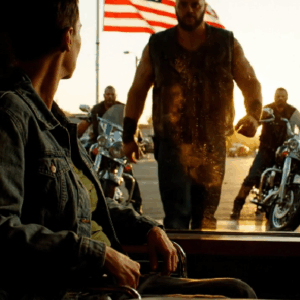
They Mocked A Paralyzed Veteran And Kicked Her Wheelchair, Unaware They Just Woke Up The Most Dangerous Assassin The Military Ever Created.
CHAPTER 1: THE GHOST OF PINE VALLEY The phantom pain was bad today. It felt like fire was licking at ankles that hadn’t been there for three years. Alex Winters adjusted her position in the wheelchair, her face remaining…

They Thought He Was Just A Frail Old Man Alone At A Truck Stop. But When The Gang Leader Spat In His Coffee, He Didn’t Flinch—He Just Made One Phone Call That Unleashed A Trap 20 Years In The Making.
Chapter 1: The Wolf at the Door The evening sun cast long, amber shadows across the cracked pavement of the Crossroads Truck Stop. It was a place out of time, situated on a lonely stretch of Interstate 40 where…

Navy Admiral Mocked A Single Dad Janitor In Front Of Everyone—Then He Learned The Man’s “Call Sign” And The Whole Base Froze.
Chapter 1: The Ghost of Coronado The morning fog still clung to the coastline of Coronado, a thick gray blanket that muffled the roar of the Pacific Ocean. Inside the primary administrative building of the Naval Base, the silence…
End of content
No more pages to load