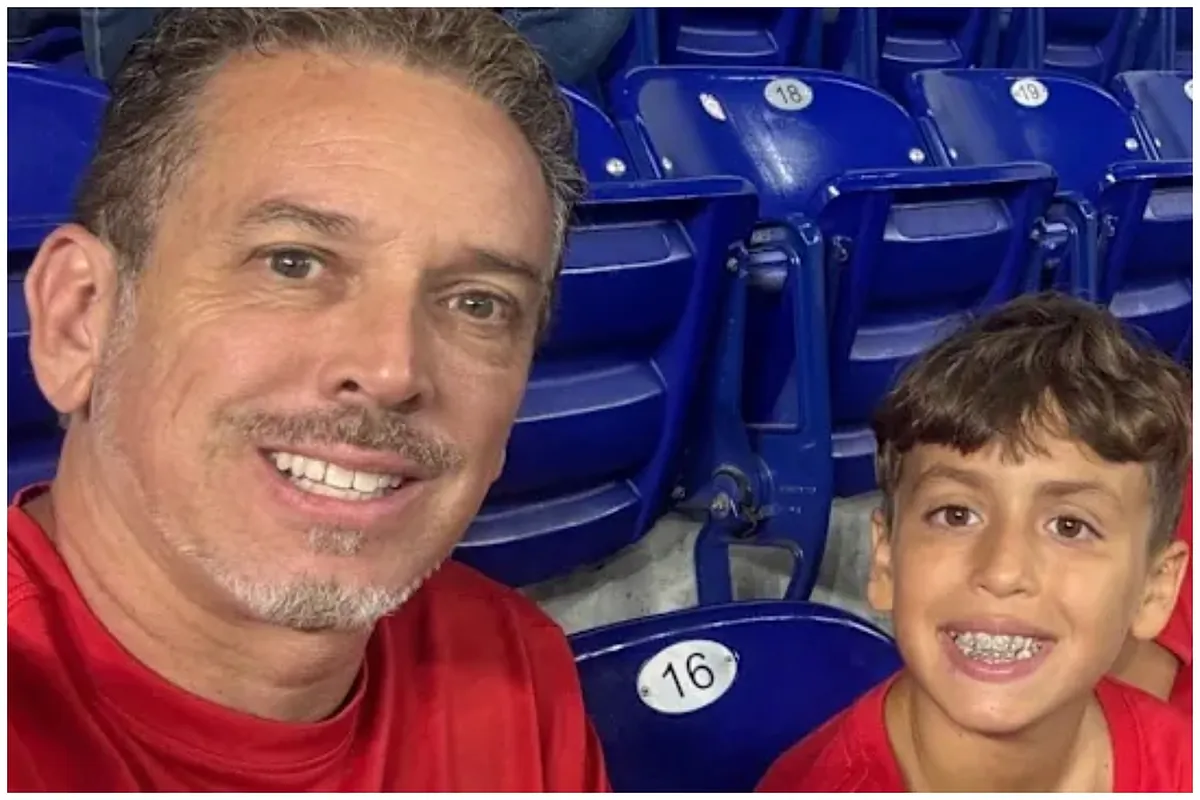
It’s one of the purest moments in all of sports. The sharp crack of the bat, the collective gasp of thousands as a baseball soars through the air, and the magical, chaotic scramble in the stands. For a father and his son, it is the backdrop of a lifelong memory in the making. On September 5, 2025, at loanDepot Park in Miami, that perfect scene played out for Drew Feltwell and his son, Lincoln. Philadelphia Phillies center fielder Harrison Bader launched a home run, and in a feat of timing and luck, Drew snagged the ball from the sky and placed it securely in his son’s glove. The boy’s face lit up with the kind of unadulterated joy that defines childhood.

And then, that perfect moment was shattered. From a few rows away, a woman descended upon them. Her name, the world would soon learn, was Cheryl Richardson Wagner, but she would be forever immortalized by a different, more notorious title: “Phillies Karen.” In an act of staggering entitlement, she confronted the family, jabbing her finger and claiming, “That was in my hands.” A tense, uncomfortable argument ensued until, to de-escalate the situation in front of his son, Drew Feltwell made a difficult choice. He reached into his son’s glove, removed the priceless souvenir, and handed it over.
Wagner walked away with her prize, but the victory was hollow. In that moment, she had not just taken a $15 leather ball from a child; she had committed a cardinal sin against the unspoken religion of baseball fandom. And in doing so, she woke up the next morning as America’s public enemy number one.
To understand the sheer scale of the outrage, one must first understand that baseball is governed by two sets of rules. The first is the official rulebook, a dense tome of regulations concerning infield flies and balks. The second, and arguably more important, is the unwritten code of conduct that governs the fans. This code is a living document, passed down through generations, that dictates the etiquette of the ballpark. It covers everything from not blocking someone’s view to knowing when it’s appropriate to start “the wave.” But its most sacred, inviolable commandment is this: if an adult catches a foul ball or a home run, and there is a child nearby, you give the ball to the kid.
This isn’t just a nice gesture; it is the lifeblood of the sport’s future. It is a ritual of passage, a way of transforming a young spectator into a lifelong fan. The ball itself is merely a token. The true gift is the story, the tangible connection to a hero on the field, the proof that magic can, and does, happen. For Wagner to so flagrantly disregard this tradition was not merely rude; it was a deep and profound transgression against the spirit of the game itself. She saw a baseball as a possession to be won, while everyone else in the stadium, and the millions who would later watch the clip online, saw it as a memory to be given.
The incident was a perfect storm for viral infamy. In Cheryl Richardson Wagner, the internet found its perfect villain: a clear aggressor exhibiting the trademark entitlement of the “Karen” archetype. In Lincoln Feltwell, it found its perfect victim: an innocent child whose joy was stolen in plain sight. And in his father, Drew, it found a relatable figure facing an impossible dilemma. His later explanation that he gave up the ball “to keep the peace” resonated with parents everywhere who have had to swallow their pride to protect their children from an ugly public scene. Do you stand your ground and risk escalating a confrontation, or do you concede to preserve your child’s sense of safety and calm? It’s a thankless choice with no right answer.
As Wagner retreated with the ball, the ballpark’s collective conscience roared to life. The initial stunned silence gave way to a cascade of boos. Chants of “Karen! Karen!” echoed through the section. The immediate, organic response from the crowd was a powerful display of community policing, an enforcement of the unwritten rules that Wagner had so selfishly broken.
What happened next is what separates a sad story from an uplifting one. Seeing the boy’s dejection, the sports community mobilized. First, the Miami Marlins staff quickly approached the family with a gift pack, a gesture of goodwill to soothe the sting of the incident. But the true redemption came from the Philadelphia Phillies and the man at the center of it all, Harrison Bader. After the game, Bader met with Lincoln, posed for photos, and presented him with a signed bat. The Phillies’ social media proudly shared the image, a powerful counter-narrative to the ugliness that had transpired.

In that moment, the story’s true winner became clear. Cheryl Richardson Wagner may have walked out of the stadium with the baseball, but she also walked out with a tarnished reputation, becoming a national symbol of selfishness. Lincoln Feltwell, on the other hand, left with something far more valuable. He received a lesson in grace and generosity, a personal interaction with his hero, and a story he will tell for the rest of his life. He went home with a signed bat from Harrison Bader, an object far more unique and meaningful than a random home run ball.
The tale of “Phillies Karen” is a modern parable. It’s a story about how a single, selfish act can make you infamous overnight, but also how a community’s kindness can triumph over ugliness. It reaffirmed that while one person can try to hoard a moment of joy for themselves, the true spirit of sports will always find a way to share it. Wagner may have the ball, but the boy, his father, and Harrison Bader have the victory.