They said my sister was missing, but I knew she wasn’t.
Emily didn’t run away. She didn’t get lost, or get snatched by a stranger, or just wander off into the pines like the flyers said.
My sister was in the garage. She had been there since the night it snowed so hard the entire world went quiet.
I didn’t tell anyone, not at first. I didn’t think they’d believe me. I was only 10 years old. But I saw everything. It’s a strange and terrible thing, what kids notice. We don’t understand all of it, not the why of it, but we see it. And sometimes, we remember better than the adults want us to.
Fairbrook was a small town tucked between the deep, dark pines of Oregon. It was the kind of place where everyone waved at each other in their cars but still locked their doors at night. The winters were long, cold, and heavy with secrets. Our house sat at the very edge of town, just beyond the reach of the last street lamp, where the trees grew thick and the shadows grew thicker.
I remember the way the cold crept into our house. It wasn’t just in the floorboards or the rattling windows. It was in the walls. It was in our bones. It was always cold, even when the heater rattled and hissed, promising a warmth that never came.
Emily used to say the house was haunted. She said it like it was a game. “Tommy,” she’d whisper, her voice conspiratorial as we huddled under my blankets, “if you listen, really listen, you can hear the ghosts whispering in the vents.”
She had this magic way of turning fear into something fun. That was Emily. She was brave. She was funny. She was loud. She sang all the time, constantly, even when she wasn’t supposed to. Her voice was bright and a little off-key, and it filled up the rooms like sunlight. She was thirteen, three whole years older than me, and she was my best friend.
We had a game we played, a secret radio show. Emily would set up a flashlight in the hall closet, pointing it up at her face like a microphone, and broadcast to me from behind the wall of winter coats. She called it “Radio Ghost.” We’d make up stories about haunted houses and talking cats and pencils that could draw things into life. But sometimes, she’d just talk. She’d talk about school, about the kids she hated, about Mom and Dad. About how she couldn’t wait to leave Fairbrook and become a singer somewhere warm, somewhere with an ocean.
I didn’t want her to leave. I never told her that.
Dad didn’t like the singing. He said it gave him headaches. He worked long, greasy hours at the auto shop on the highway and came home smelling like gasoline and silence. Mom always said he wasn’t always like that, that something changed in him after the big factory laid him off five years ago. I never knew the man he was before. To me, he was always the same. Tall, quiet, with eyes that never seemed to look at you for long enough. He moved through the house like he was waiting for something to fall apart.
Mom, she was different. She was small, soft-spoken, and always seemed tired. I think she tried to be strong for us, but it was hard. She seemed to fold into herself more and more each winter. She’d drink cups of tea that smelled like flowers and just stare out the kitchen window for hours, watching the snow fall on the pines. Sometimes I’d find her holding an old photograph in her lap. It was a picture of us at the beach, a long time ago. Emily was laughing, I was covered in sand, and Dad was smiling. He looked like a stranger.
That picture stayed on the fridge until the magnet broke. Then, like everything else, it just disappeared.
The night Emily disappeared, it was snowing. Not a light dusting, but a heavy, suffocating snow that muffled every sound and made the world feel like a dream. I remember it because we had built a tiny snowman on the porch rail earlier that day. She gave it button eyes from her coat. That was the last time I saw her smile.
That night, I woke up to the sound of yelling. Not loud, angry yelling, just low and tense. The kind of sound that tries not to wake a sleeping baby. I crept out of bed and down the stairs, my feet freezing on the wood. I peeked around the corner.
The kitchen light was on, casting long, sick shadows. I could see their shapes moving.
I heard her say, “You promised you’d stop.”
I heard him say, “Keep your voice down.”
Then something slammed. A drawer, a cabinet… or maybe something else.
The next morning, Emily was gone.
Dad said she must have left early, maybe for school. But her backpack was still in her room. Her coat, too. And her boots, the brown ones with the pink laces. Mom didn’t say anything. She just stood at the sink, washing the same dish over and over until the water turned cold.
That afternoon, Dad called the school. I listened from the stairs. He told them Emily was sick, that she’d be out for the rest of the week. His voice was flat, mechanical. The same tone he used when ordering car parts.
The next day, he told us she’d run away.
“She must have snuck out during the night,” he said, not looking at me. He didn’t sound upset. He sounded annoyed, like someone had lost a set of keys.
I asked where Emily would go without her coat or her shoes. Dad said maybe she planned it, left them on purpose to make us worry. But Emily wasn’t like that. She wouldn’t leave me. Not like that.
The police came later that afternoon. Two officers, one old and tired, the other young and nervous. They stood in our living room and asked questions. Dad did all the talking. He said Emily had been “distant” lately, “moody.” He used that word—dramatic. As if teenage girls just vanished into thin air when they didn’t get their way.
Mom sat beside him, her hands folded so tightly in her lap her knuckles were white. She nodded when they looked at her, but she never said a word. When they asked to see Emily’s room, Dad hesitated for just a second. Then he led them upstairs. They didn’t find anything. Not unless they looked under the floorboards. They didn’t.
After they left, Dad went out to the garage. I watched from my bedroom window. He just stood there for a long time, staring at the door. Guarding it. Like the garage wasn’t just a building, but a secret.
That night, I couldn’t sleep. The house felt colder, emptier. I got up to get a glass of water, and that’s when I saw him.
Dad. Standing in the backyard near the garage. He was holding something large over his shoulder. A black plastic bag. No, bigger. A tarp. It was wrapped around something heavy, something that made him move slowly.
I ducked behind the curtain, my heart hammering. I watched him go inside the garage. He turned on the light. It flickered once, then stayed on. I saw his shadow move back and forth, back and forth. The shadow looked like it was digging.
I wanted to scream, but the sound was frozen in my throat. I ran back to bed and pulled the covers over my head. My heart was pounding so loud I was afraid it would wake Mom.
The next morning, the little snowman on the porch was gone. Just two buttons left melting in the slush.
That’s when I started writing everything down.
The flyers went up a few days later. MISSING. Emily’s school photo, printed in black and white. Her name in bold letters. At school, kids whispered. Some said she ran off with a boy. Others said she was kidnapped. I didn’t say anything. I just watched.
I watched Dad come home late, check the new, heavy padlocks on the garage, and then sit in the living room and stare at nothing.
I watched Mom cry in the laundry room when she thought no one was looking.
I watched the door to Emily’s room stay closed like a tomb.
I started to notice other things. The sharp, clean smell of bleach in the hallway. The garbage bags, which were suddenly heavier. And the garage, always locked, always off-limits.
One night, I crept downstairs after I was sure they were asleep. I went to the garage, just to look. The new locks were shiny and cold. I pressed my face to the frosted window. The light was off, but the moon was bright enough to see shapes. Boxes, shelves, a workbench. And in the corner, something large covered by a tarp.
I stared, holding my breath, trying to see what it was.
And then the tarp moved.
I fell backward, hitting the ground so hard the breath left my lungs. I scrambled to my feet and ran, my heart trying to escape my chest. I didn’t sleep that night. I just stared at the ceiling and waited for morning.
The next day, I told my teacher I was sick. She sent me to the nurse, who called home. No one answered. I walked home early. The house was empty. Quiet. Too quiet.
I went to Emily’s room. Nothing had changed. But on her desk, under a pile of school papers, was a notebook. Her diary. I had never touched it before. It felt wrong, but my hands were already opening it.
The last entry was dated the day she disappeared.
He promised. He swore he wouldn’t hurt her again. I don’t know what to do. If anything happens to me, tell Tommy I’m sorry.
I read it three times. I sat there in the cold, dusty room, holding that notebook, and I felt something inside me break. Emily hadn’t run away. She had been taken. And whatever happened to her had started long before that night in the snow.
The house started to forget her. That was the worst part. Her scent faded from her pillows. Her shoes gathered dust. The picture frames that held her smile were quietly turned facedown. Her absence became a part of the furniture. Silent, settled, and ignored.
But I couldn’t forget. My nightmares got worse. I dreamed of Emily standing in the garage, curled up under the tarp, her mouth sewn shut. I dreamed of digging, of cold hands clawing at wet soil. I dreamed of music playing from underground, muffled and wrong.
I stopped trusting my father. I stopped hoping my mother would do anything. I was alone with it.
One night, I tried to bring her back in the only way I knew how. I rebuilt Radio Ghost.
I went to the hall closet, set up my flashlight on a crate, and sat cross-legged with the door closed. I had the old tape recorder we used to use, the one with the red record button that always stuck.
“Broadcasting live,” I whispered, my voice shaking. “From the haunted hills of Fairbrook… it’s Radio Ghost. Tonight’s episode… The Girl Who Never Left.”
I waited, listening to the static. I closed my eyes and tried to imagine her voice. “Emily,” I whispered into the recorder. “If you’re out there… I miss you.”
And then I heard it.
From the other side of the house. A sound. A single, faint note, like a piano key being struck once. Then silence.
I froze. I crept out of the closet and down the hall. I passed my parents’ room. Dark, quiet. The sound hadn’t come from there. I followed it to the end of the hallway, to the closed door of Emily’s room.
It was cracked open. I was sure I hadn’t opened it.
I pushed it open. The room was freezing. The window was open an inch. Her hairbrush lay in the center of the floor. And her notebook, the diary, was open on her desk. But it was open to a new, blank page.
Except for one word, scrolled in the center.
Listen.
That night, I dreamed she was in my room, holding the notebook. “You’re getting close,” she said, her voice echoing like it was coming through a long tunnel. “But he hears you, too.”
I woke up sweating. I went to my window. The garage light was off.
But the new padlocks were gone. Not broken. Just gone. The garage door stood slightly ajar.
I didn’t even think. I pulled on my sweatshirt and crept downstairs. I slipped out the back door. The snow crunched under my feet. The moon was high, watching me. I reached out a shaking hand and pushed the garage door open.
The smell hit me first. Earth, oil, and something sour. The tarp in the corner was gone. The floor had been swept too clean. And on the workbench, sitting in the exact center, was Emily’s tape recorder.
The red record button was pressed down.
I reached out and picked it up. It was warm. My thumb hovered over the play button. That’s when I heard it. Footsteps in the house. Slow, cautious.
I sprinted back to my room, dived under the covers, my heart racing. And in the dark, I finally hit play.
Static at first. Then a soft click. A breath.
Then a voice. My father’s voice. “I told you to stop.” Silence. “You said you wouldn’t tell.” Another pause. “You make me do this.”
I stopped the tape. My hands were shaking so hard I could barely hold the recorder. It was real. I had proof.
The next morning, I hid the recorder inside my big red robot, the one Emily got me for my eighth birthday. I pulled the batteries out so no one could turn it on by accident. I wasn’t just a little brother anymore. I was the last witness.
I started writing everything down. I made a timeline. I drew maps of the house, the garage, the yard. I wrote a letter, sealed it, and hid it behind my bookshelf. If something happens to me, my dad did it. The tape is inside the red robot. My name is Tommy.
I waited for the right moment. It came on a Thursday. Dad had to leave early for a service call. Mom was asleep, the pills on her nightstand. I stayed home sick.
When the house was quiet, I went back to the garage. This time, I had gloves and a flashlight. I went straight to the floor. The patch of concrete was newer than the rest. I tapped it with a wrench. It sounded hollow. I tried to pry at the edges with a screwdriver, but it was no use.
I was about to give up when something on the shelf caught my eye. Behind the paint cans. A folded tarp. Stained dark red. And beneath it, a small piece of torn fabric. White, with a single music note stitched near the hem.
It was from Emily’s dress.
I stuffed it into my backpack and ran. I didn’t go to the police. Not yet. I went to Mrs. Weatherbee’s house, our elderly neighbor. She used to babysit us. She always said Emily had a voice like spring.
She opened the door, saw my face, and pulled me inside without a word.
I told her everything. I showed her the dress. I showed her my notebook. I told her about the robot. She didn’t say, “Are you sure?” She didn’t say, “Maybe you imagined it.” She just picked up the phone and called the police.
When the officers came, I handed them everything. The notebook. The dress. And the red robot. One of them looked sick when he pressed play and listened to the tape. The other one knelt down and asked if I felt safe going home.
I shook my head.
They told me to stay with Mrs. Weatherbee. Then they went to my house. I watched from her window. I saw them talking to my father on the porch. I saw him shrug, then stiffen, then start to yell.
Then I saw them put him in handcuffs. He didn’t fight. He just stared across the street. Right at me. His eyes were empty.
Later that night, they brought tools to the garage. They spent hours digging. I heard one of them say, “We’re through. There’s something here.”
They found bones wrapped in the tarp. A necklace. And a cassette tape labeled, “Emily, Choir Solo.”
I thought it was over. I thought the worst had passed. But the thing about horror is that sometimes it doesn’t end. Sometimes it just whispers, waiting to come back.
The phone started ringing at Mrs. Weatherbee’s house. When I answered, there was just silence. Breathing. Then came the letters. No return address, only my name in uneven black ink. Inside, the pages were blank.
One night, I heard footsteps outside my window. Crunching in the snow. In the morning, there were bootprints leading from the road right up to my window, and nowhere else.
He was in jail, waiting for trial. But he hadn’t confessed.
One evening, I came home from school to find Mom packing a bag, her hands shaking. “I got a call,” she whispered. “They’re transferring him. They… they said he might be out on bail soon. Not enough evidence. Not yet.”
“What do you mean, out?”
“I’m taking you to your aunt’s,” she said. “Tonight. It’s not safe.”
“No,” I said. “We have to finish it.”
I ran to my room and grabbed my backpack. But then I made a mistake. I went into the garage. One last time. I don’t know why. I just had to see.
The door was ajar. Inside, it was dark. The light bulb had been unscrewed. I turned on my flashlight. The floor was clean, the hole refilled with dirt.
But the red robot was gone.
“Looking for this?”
I spun around. My father was standing in the doorway. No cuffs, no guards. Just him, holding the red robot by its arm.
“How?” I whispered.
“You lied, Tommy,” he said, stepping into the garage. The door clicked shut behind him. “You told them things that weren’t true.”
I backed away. “I didn’t.”
“You think you understand, but you don’t. She didn’t listen,” he said, his voice quiet. “Just like you. Always pushing. Always asking. Always… singing.”
He crushed the robot in his hand. Plastic cracked. Gears and tape spooled onto the floor.
I ran.
He grabbed my backpack, yanking me off my feet. I kicked and twisted, broke free, and bolted for the back door, fumbling with the knob, screaming for Mom.
She appeared at the top of the stairs, her face white, phone in her hand. “He’s here!” I cried. “He got out! He’s in the garage!”
She didn’t hesitate. She was already talking to the detective, locking the doors, pulling me close. She didn’t let go until we heard the sirens.
This time, they didn’t ask questions. They arrested him on the spot. They found the broken robot. And in his car, under the seat, they found another tape. One I had never heard.
On it was Emily’s voice. Recorded without her knowing. Crying. Begging. That was the final piece. That was enough.
The trial was fast. The evidence was overwhelming. DNA, the audio, his journals. His lawyer tried an insanity defense. But the jury saw what I had seen: not a man who fell apart, but a man who was in control. Life without parole.
I moved in with my aunt. Mom went into a treatment center. The house was sold. The town tried to forget.
But I didn’t. I couldn’t.
Years have passed. I’m a journalist now. I learned how to ask the right questions, how to listen to the voices that people try to silence.
I went back to Fairbrook once. The house is still there. Different paint, a new family. The garage is a workshop. I sat at the memorial bench they built at the school. “Emily Harland,” the plaque reads. “A voice that will never be silenced.”
That night, I recorded one final episode of Radio Ghost. I sat in my closet, just like we used to, and pressed the red button.
“My name is Tommy Harlon,” I said. “This isn’t about me. This is about my sister. Her name was Emily. She was thirteen. She loved to sing. She loved ghost stories. And she loved me.”
I paused. “There are days I still feel her. Not in a haunted way. But in moments when I choose to speak. When I tell kids not to keep secrets that hurt. Your voice matters. Even when it shakes. Even when it’s ignored. Especially then.”
I ended it the way she always did. “Good night, Fairbrook. And remember… some ghosts are only waiting to be heard.”
News
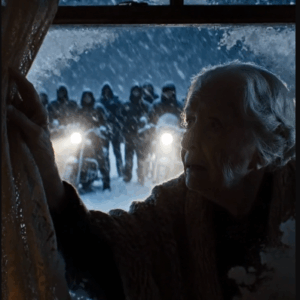
I Hid 20 Freezing Bikers From a Blizzard. The Next Morning, I Woke Up to a Roar That Shook My Entire House.
Chapter 1: The Invisible Woman The wind didn’t just blow that night; it screamed. It was a sound that tore through the cracks in the walls and settled deep in your bones. I stood by the kitchen window, watching…

I Fixed A Billionaire’s Broken Prototype With A Wrench. The Next Morning, A Black Hawk Helicopter Landed In My Trailer Park.
Chapter 1: The Ghost in the Machine The copper-colored sun was dying behind the thick clouds, casting long, bruising shadows across Woodbury Meadows. It was the kind of light that made everything look old. The trailer park smelled of…
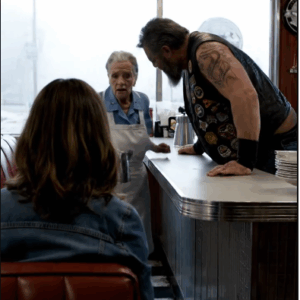
They Thought She Was Just A Lonely Customer. When The Biker Touched The Waitress, The Navy Commander Broke Her Silence—And His Arm.
Chapter 1: The Ghost in the Corner The morning fog rolled thick off the Atlantic, blanketing the streets of Port Haven in a ghostly shroud. It was the kind of heavy, wet mist that muffled sound and made the…
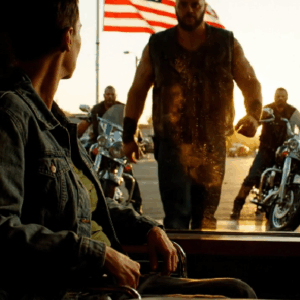
They Mocked A Paralyzed Veteran And Kicked Her Wheelchair, Unaware They Just Woke Up The Most Dangerous Assassin The Military Ever Created.
CHAPTER 1: THE GHOST OF PINE VALLEY The phantom pain was bad today. It felt like fire was licking at ankles that hadn’t been there for three years. Alex Winters adjusted her position in the wheelchair, her face remaining…
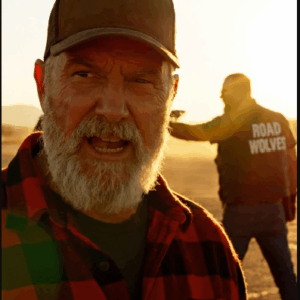
They Thought He Was Just A Frail Old Man Alone At A Truck Stop. But When The Gang Leader Spat In His Coffee, He Didn’t Flinch—He Just Made One Phone Call That Unleashed A Trap 20 Years In The Making.
Chapter 1: The Wolf at the Door The evening sun cast long, amber shadows across the cracked pavement of the Crossroads Truck Stop. It was a place out of time, situated on a lonely stretch of Interstate 40 where…

Navy Admiral Mocked A Single Dad Janitor In Front Of Everyone—Then He Learned The Man’s “Call Sign” And The Whole Base Froze.
Chapter 1: The Ghost of Coronado The morning fog still clung to the coastline of Coronado, a thick gray blanket that muffled the roar of the Pacific Ocean. Inside the primary administrative building of the Naval Base, the silence…
End of content
No more pages to load