Part 1
Chapter 1: The Sound of the Storm
The silence of the house was always louder in the winter.
That’s something they don’t tell you about widowhood. It’s not just the absence of a person; it’s the amplification of everything else. The creak of the floorboards, the hum of the refrigerator, the rattling of the windowpanes. But tonight, the silence was being murdered by the wind.
My name is Evelyn, and I have lived in this farmhouse outside of Billings, Montana, for forty-five years. For thirty of them, I lived here with Henry, a man who could fix a tractor with a wrench and a curse word, and who held me like I was made of spun glass. For the last fifteen, I have lived here with nothing but his ghost and a pile of bills that seemed to multiply like rabbits.
It was a Tuesday night, late November. The weatherman on the radio had called it an “Arctic Clip,” but out here, we just called it a killer. The thermometer on the back porch had bottomed out at ten below zero three hours ago. The wind was gusting at fifty miles per hour, turning the snow into horizontal needles that stripped the paint right off the siding.
I sat in Henry’s old armchair, the one with the velvet upholstery worn smooth on the arms. A single lamp was on, casting long, dancing shadows against the floral wallpaper. In my lap, I held the letter.
Final Notice.
Two words. Red ink. They were going to take the house. The bank didn’t care about the blizzard. They didn’t care that the crop yield had been garbage for three years running. They didn’t care that this house was the only place on God’s green earth where I could still smell Henry’s tobacco smoke in the curtains.
I folded the letter and placed it on the side table, next to my cold cup of tea. I pulled my shawl tighter. It was a ratty old thing, knit from gray wool, but it kept the draft off my neck.
“Well, Henry,” I whispered to the empty room. “Looks like we’re finally beaten.”
The house groaned in response. A shutter banged against the siding somewhere upstairs—a rhythmic, violent thud-thud-thud. I needed to go fix it, but my knees were aching something fierce tonight.
I was just about to turn off the lamp and resign myself to a sleepless night when I heard it.
It wasn’t the wind. The wind shrieked. The wind howled. This was a rumble. A low, baritone vibration that I felt in the soles of my slippers before I heard it with my ears.
I froze.
Out here, you know the sounds of the road. You know the rattle of the mail carrier’s jeep. You know the heavy chug of a diesel pickup. This was neither. It was a swarm. A mechanical growl that grew louder and louder until the glass in the windows began to buzz in their frames.
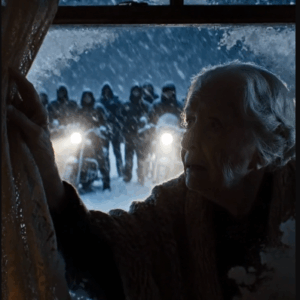
Panic, cold and sharp, spiked in my chest. I stood up, ignoring the protest of my joints, and moved to the window. I pressed my face against the icy glass, shielding my eyes from the reflection of the room.
At first, I saw nothing but the swirling white void. Then, the lights appeared.
One. Then two. Then ten. Then twenty.
Headlights. Single beams cutting through the storm like lasers. They were weaving, struggling against the drifts on the long gravel driveway.
Motorcycles.
“Lord have mercy,” I breathed.
Who in their right mind rides a motorcycle in a Montana blizzard?
The roar was deafening now, drowning out the wind. They pulled up to the gate, a chaotic cluster of chrome and black iron. I watched as the figures killed the engines. The silence that followed was heavy, instantaneous, and terrifying.
Twenty men. I could tell by the size of them even from here. They were bulky, clad in leather that was surely frozen stiff. They swung their legs over their bikes, their movements sluggish and uncoordinated.
My heart hammered a frantic rhythm against my ribs. I was an old woman alone in the middle of nowhere. My nearest neighbor was three miles away, and with this snow, nobody was coming to help me.
I watched them gather at the gate. They weren’t moving toward the house aggressively. They were huddled together, stamping their feet, arms wrapped tight around their chests. They looked like a herd of bison caught in a drift, waiting to die.
I stepped back from the window, my mind racing. I had Henry’s old 12-gauge in the hall closet. I knew how to use it. But looking at those men, stumbling in the snow, I didn’t feel the urge to fight. I felt a sickening pit of dread.
They were walking up the path now. Twenty strangers. Twenty desperate men.
Chapter 2: The Decision
The knock was heavy. It wasn’t a polite tap; it was the sound of a fist that couldn’t quite feel the wood it was hitting.
Thud. Thud. Thud.
I stood in the middle of the living room, clutching the ends of my shawl so tightly my knuckles turned white. The hallway seemed to stretch out for miles.
“Hello?” A voice called out. It was muffled by the thick oak door and the storm, but it sounded ragged. “Please!”
I looked at the phone on the wall. The line was probably down; it usually was in storms like this. Even if it worked, the Sheriff was forty minutes away on a clear day. Tonight? He might as well be on the moon.
Thud. Thud. Thud.
“We’re freezing out here!”
I closed my eyes. I saw Henry’s face. He had been a big man, intimidating to some, but he had a heart that bled for the underdog. He’d brought stray dogs home. He’d brought hitchhikers home. “Fear makes you small, Evie,” he used to say. “Kindness makes you tall.”
“Well, Henry,” I muttered, my voice shaking. “I hope you’re right, because I’m about to do something incredibly stupid.”
I walked to the door. My hand hovered over the brass deadbolt. I could feel the cold radiating through the wood, seeping into my fingertips.
I took a deep breath, unlocked the bolt, and turned the knob.
The wind didn’t just enter; it invaded. It slammed the door back against the wall with a crack that sounded like a gunshot. Snow swirled into the foyer, instantly coating the floorboards in white powder.
Standing there, filling the frame, was a mountain of a man.
He had to be six-foot-four. He was wearing a leather vest over a thick jacket, covered in patches I couldn’t read in the dark. His beard was long and gray, but right now, it was a solid mass of ice. Icicles hung from his mustache over his lips. His face was a raw, blistered red.
Behind him, the others were a blur of shivering misery. They were shaking so hard I could hear the leather creaking.
The big man looked down at me. His eyes were dark, rimmed with red, exhausted beyond measure. He took off his helmet, his hands clumsy and stiff.
“Ma’am,” he said. His voice was like gravel grinding together. “I… we…” He couldn’t finish the sentence. He just gestured helplessly to the men behind him. One of them had fallen to his knees in the snow, his head hanging low.
All my fear vanished, replaced instantly by the instinct that every mother, every grandmother, possesses. These weren’t monsters. They were boys. Big, scary, stupid boys who had gotten themselves into a mess nature was about to punish them for.
“Get in,” I said. My voice was surprisingly firm.
He blinked, as if he hadn’t understood.
“I said get in!” I shouted over the wind. “Before you freeze to death on my porch! Move!”
The big man nodded, a jerky motion, and stumbled over the threshold. The others followed. It was like a clown car of frozen leather. They just kept coming. Five. Ten. Fifteen. Twenty.
The smell hit me first. Wet wool, gasoline, stale tobacco, and the ozone scent of the freezing cold. They filled my small foyer and spilled into the living room, a dripping, shivering mass of humanity.
I struggled to push the door shut against the wind, finally managing to click the deadbolt back into place. The silence returned, but it wasn’t empty anymore. It was filled with the heavy, wheezing breaths of twenty men.
They stood there, dripping slush onto my hardwood floors, looking around with wide, dazed eyes. They looked at the floral wallpaper. They looked at the ceramic cats on the mantelpiece. They looked at me.
I pulled myself up to my full height of five-foot-three.
“Alright,” I said, clapping my hands together. The sound made a few of them jump. “Boots off. Jackets on the rack or the floor, I don’t care. But nobody walks on my rug with mud.”
The leader, the giant with the ice beard, looked at me. He looked at his men. Then, slowly, painfully, he bent down and started unlacing his heavy engineer boots.
“Do as she says,” he growled.
And just like that, twenty of the scariest men I’d ever seen started hopping around on one foot, tugging at frozen laces, piling their leather cuts in the corner.
“I’m Evelyn,” I said, pointing toward the kitchen. “I’m going to put on a pot of coffee. And soup. I hope you boys like tomato soup, because that’s all I’ve got.”
The leader straightened up. He was in his socks now. He looked terrifyingly large in my small living room, but his eyes were soft.
“I’m Bear,” he said.
“Well, Bear,” I said, turning my back on him to hide the fact that my hands were shaking uncontrollably. “Get your men near the fire. And don’t break anything.”
I walked into the kitchen, my heart pounding in my ears. I had just invited a motorcycle gang into my house.
I grabbed the big soup pot from under the sink. As I filled it with water, I realized I was smiling. A nervous, hysterical smile.
Henry, you old fool, I thought. You better be watching this.
Part 2
Chapter 3: The Feast of Saint Evelyn
The kitchen was a war zone of steam and frantic movement. I had four burners going on the old gas stove, every pot I owned bubbling with whatever canned goods I could scavenge from the pantry.
Tomato soup. Kidney beans. A can of corn. Some frozen peas from the bottom of the icebox. It wasn’t gourmet. It was survival sludge. But to the twenty men filling my living room, the smell drifting down the hallway must have been ambrosia.
I moved with a speed I hadn’t possessed in a decade. My arthritis was screaming, a dull, throbbing ache in my knuckles, but adrenaline is a powerful painkiller. I sliced two loaves of stale sourdough bread—the ones I’d been saving for the birds—and slathered them with the last of the butter.
Bear appeared in the doorway.
He had shed his leather vest and heavy jacket. Underneath, he wore a black t-shirt that strained against arms the size of tree trunks. His tattoos were a map of ink—skulls, daggers, names I didn’t know, dates I couldn’t guess the meaning of. But it was his hands that caught my attention. They were raw, red, and shaking slightly as he gripped the doorframe.
“Ma’am,” he rumbled. “You don’t have to do this. We can eat rations. We’ve got jerky.”
I didn’t look up from the bread. “You’ll eat hot food, and you’ll like it. Jerky won’t bring your core temperature up. I’m not having a bunch of hypothermic bikers dying on my rug. It’s an antique.”
A low sound came from his throat. It took me a second to realize he was chuckling.
“Yes, ma’am,” he said.
He stepped into the kitchen. The room suddenly felt very small. He reached for the stack of bowls I’d pulled down—my good china, the stuff with the little blue flowers on the rim.
“Careful,” I warned. “Those were a wedding gift.”
“I’ll handle ’em like they’re nitro,” he said solemnly.
We worked in a strange, silent rhythm. I ladled the stew; he carried the bowls out two by two.
When I finally walked into the living room with the basket of bread, the sight stopped me cold.
My house, usually so empty it echoed, was transformed. Leather jackets were draped over every surface—the lampshades, the banister, the back of the sofa—steaming as they dried. Boots were lined up by the door like a regiment of soldiers.
And the men.
They were sitting everywhere. On the floor, on the stairs, on the hearth of the fireplace. They held the delicate floral bowls in their scarred, grease-stained hands with a reverence that was almost comical.
The silence was absolute, save for the scraping of spoons and the crackle of the fire. They ate with a ferocity that spoke of true hunger, of miles eaten up on the asphalt with nothing but wind for dinner.
One of them, a man with a spiderweb tattooed on his neck, looked up as I entered. He had a face that looked like it had been carved out of granite with a dull chisel, but his eyes were surprisingly young.
“This is good,” he said, his voice raspy. “Real good. Thank you.”
A murmur went through the room. “Thank you, ma’am.” “Thanks.” “Bless you.”
I felt a lump form in my throat. I nodded, setting the bread down on the coffee table. “It’s just beans and tomatoes,” I deflected, waving a hand. “Eat up. There’s more in the pot.”
I retreated to Henry’s armchair. Bear sat on the floor near my feet, his back against the wall, positioning himself between me and the rest of the room. A guardian. Or a warden. I wasn’t sure which yet.
As the warmth of the soup and the fire began to seep into their bones, the tension in the room began to uncoil. Shoulders dropped. Fists unclenched. The shivering stopped.
I watched them. Really watched them.
Henry had always told me not to judge a book by its cover, but he also told me not to pick up hitchhikers because “some books are poorly written and dangerous.” These men were dangerous. I could see it in the way they scanned the room, noting the exits. I could see it in the knives clipped to their belts.
But I also saw the way they checked on each other.
“You good, T-Bone?” one whispered.
“Yeah. Fingers are burning, though. Thawing out.”
“Drink the soup. It helps.”
They were a pack. A family. Dysfunctional, perhaps, and scary to the outside world, but the bond between them was thick enough to cut with a knife.
Bear turned his head slightly toward me. “You live here alone, Evelyn?”
The question was heavy. It was the question I had feared.
“I do,” I said, keeping my voice steady. “My husband, Henry, passed away fifteen years ago.”
Bear nodded slowly. “He must have been a good man.”
“He was the best,” I said. “He would have liked you boys. He had a soft spot for… strays.”
The corner of Bear’s mouth twitched. “Strays. That’s a polite way of putting it.”
“I’m too old to be polite,” I said. “I’m just honest. You look like trouble on two wheels.”
“We are,” Bear admitted. He looked into the fire, his expression darkening. “Usually.”
“Not tonight,” I said firmly. “Tonight, you’re just guests.”
The wind howled outside, shaking the windowpane behind me. The lights flickered once, twice, then steadied.
“Why?” Bear asked, turning to face me fully. “Why’d you open the door? You saw the cuts. You saw the bikes. You know what people say about us.”
I looked at his hands, resting on his knees. Knuckles scarred from fights I didn’t want to imagine.
“Because it’s ten below zero,” I said simply. “And because I looked at you and didn’t see a gang. I saw twenty mothers’ sons who were cold.”
Bear stared at me for a long time. The firelight danced in his eyes, revealing a depth of sorrow I hadn’t expected.
“My mother,” he said softly, “would have locked the door and called the cops.”
The room went silent. The other men had stopped eating. They were listening.
“Well,” I said, leaning back in my chair. “Then I suppose I’m glad I’m not your mother.”
A ripple of laughter went through the room. Genuine laughter. The ice wasn’t just melting on their beards; it was melting in the room.
But the peace was fragile. And just as I was beginning to relax, the sound of a ragged, wet cough tore through the air like a serrated blade.
Chapter 4: The Fever
It came from the corner, near the drafty spot by the bookshelf.
Cough. Hack. Wheeze.
It sounded like rocks rattling in a tin can.
I sat up straight. I knew that sound. That was the sound of fluid in the lungs. That was the sound of pneumonia knocking on the door.
“Jax?” one of the bikers asked sharply.
A young man—he couldn’t have been more than twenty-two—was slumped against the wall. He was the one who had fallen in the snow earlier. His face was a terrifying shade of gray, but his cheeks were blazing with unnatural red spots.
He tried to wave his hand, to brush off the concern, but another coughing fit doubled him over. He gasped for air, a high-pitched whistling sound escaping his lips.
“I’m… I’m good,” he wheezed. “Just… chest tight.”
Bear was on his feet in an instant, moving with surprising grace for a man of his size. He crossed the room and knelt beside the boy. He placed a hand on Jax’s forehead and cursed under his breath.
“He’s burning up,” Bear announced. The room instantly shifted from relaxed to high alert. Men stood up, crowding around. The tension was back, sharp and electric.
“Get him water!” someone shouted.
“No, he needs air, give him space!”
I pushed myself out of the armchair. My knees popped, but I ignored them. I walked right into the center of the huddle.
“Move,” I ordered.
The men looked at me, then at Bear. Bear looked at me, his eyes wide with worry.
“He’s bad, Evelyn. He’s really bad.”
“I said move,” I repeated, pushing past a biker who was wide as a refrigerator. “I was fixing up sick calves and feverish husbands before half of you were born. Let me see him.”
The circle parted. I knelt beside Jax.
Up close, he looked like a child. His eyes were glassy and unfocused. He was shivering violently, but his skin was radiating heat like a furnace.
“Can you hear me, son?” I asked, taking his wrist. His pulse was thready and racing like a trapped bird.
“Cold,” he mumbled. “So cold.”
“I know,” I said softly. I turned to Bear. “I need my kit. Bathroom cabinet, second shelf. White box. And grab the rubbing alcohol and the towel from the rack.”
Bear didn’t argue. He didn’t question. He ran.
“You,” I pointed to another biker, the one with the spiderweb tattoo. “Help me get his jacket off. We need to cool him down slowly, but keep his core warm. It’s tricky.”
We worked together. The leather jacket was heavy and stiff. Underneath, his t-shirt was soaked with sweat.
“He’s going into shock,” I murmured. “Hypothermia triggered a fever spike. His body doesn’t know what to do.”
Bear returned with the box. I snapped it open. Vicks VapoRub, aspirin, a thermometer, and a bottle of peppermint oil. Old remedies, but they were all I had.
“Lift him up,” I instructed.
Bear supported Jax’s shoulders against his massive chest. I rubbed the Vicks onto the boy’s chest, my hands moving firmly over his ribs. I could feel every bone. He was too thin.
“Breathe,” I commanded. “Deep breath, Jax.”
He struggled, panic setting in as his airways constricted.
“Look at me,” I said, grabbing his face with both hands. “Look at me!”
His eyes found mine. They were terrified.
“You are not going to die in my living room,” I told him fiercely. “I just cleaned the floors. Do you hear me?”
A faint, delirious smile touched his lips. “Yes… ma’am.”
I crushed two aspirin into a powder and mixed it with a little water, forcing him to swallow the paste. Then I soaked the towel in cool water and alcohol, draping it over his forehead.
“Blankets,” I said. “Not too many. Just one wool one. We need to regulate him.”
For the next hour, the farmhouse was silent except for the storm and Jax’s breathing. I sat beside him, changing the cloth, monitoring his pulse, whispering to him when the fever dreams made him thrash.
The bikers watched me. They stood in a silent ring, like a Praetorian Guard. They looked helpless. These were men who could fix engines, break jaws, and outrun the law. But against a fever? They were useless.
And they knew it.
I saw the way they looked at me. The suspicion was gone. In its place was something else. Awe.
Around 2:00 AM, Jax’s breathing deepened. The whistling stopped. His pulse slowed to a steady, rhythmic beat. The fever broke with a heavy sweat.
He opened his eyes, clear this time.
“Thirsty,” he croaked.
I let out a breath I felt like I’d been holding since 1995. “Bear, get him water. Room temperature. Sip, don’t chug.”
Bear handed the cup to the boy, his hand trembling slightly. Jax drank. He looked at Bear, then he looked at me.
“Thanks, Ma,” he whispered.
He froze, realizing what he’d said. He looked away, embarrassed.
I reached out and patted his cheek. “You’re welcome, son. Now sleep.”
I stood up. My back screamed in protest. I swayed slightly, dizziness washing over me.
A large hand steadied my elbow. It was Bear.
“You okay?” he asked quietly.
“I’m fine,” I lied. “Just old.”
He looked at Jax, sleeping peacefully now, wrapped in my favorite quilt. Then he looked at me.
“You saved him,” Bear said. The gravel in his voice was gone. It was just a man speaking. “He wouldn’t have made it through the night out there. Or even just sitting here without… without you knowing what to do.”
“He’s young,” I said. “He’s got fight in him.”
“We owe you,” Bear said. He said it like a vow. Like a blood oath. “We don’t forget debts, Evelyn.”
“You don’t owe me anything,” I said, waving him off. “Just keep the fire going. I need to sit down.”
I collapsed back into Henry’s chair. I was exhausted. But sleep wouldn’t come. Because now, with the adrenaline fading, the reality of my own life was creeping back in.
The letter. The foreclosure notice. It was still there, sitting on the side table, right next to where Bear was standing.
Chapter 5: The Confession
The fire had burned down to glowing embers, casting a deep, orange light across the room. The snoring of twenty men was a surprisingly comforting sound—a human rhythm against the chaotic noise of the blizzard outside.
Most of the men were asleep, sprawled out on the rug or leaning against the walls. Jax was sound asleep, his color returning.
Only Bear and I were awake.
He was standing by the fireplace, feeding a log into the dying flames. He moved quietly, respectful of the sleepers.
“You should sleep,” he said, not turning around.
“Can’t,” I said. “Old habits. Henry used to snore like a chainsaw. I got used to staying up.”
Bear turned and leaned against the mantel. He crossed his arms. He looked like a statue in the dim light.
“He’s in the pictures,” Bear said, gesturing to the photos lined up on the shelf. “The man in the uniform?”
“That’s him,” I said, a sad smile touching my lips. “Vietnam. 1968. He came back different, but he came back. That’s more than some.”
“I served,” Bear said. “Gulf War. First one.”
“I figured,” I said. “You stand like a soldier.”
“I stand like a man waiting for an ambush,” he corrected.
“Sometimes that’s the same thing,” I replied.
He looked at me, really looked at me. His gaze drifted down to the side table. To the envelope.
I saw his eyes track the red text. Final Notice.
I instinctively reached out to cover it, but my hand stopped. What was the point? Pride? I was past pride.
Bear didn’t pick it up. He didn’t ask what it was. He didn’t have to.
“Bad year?” he asked.
“Bad decade,” I corrected. “Farming isn’t what it used to be. And medical bills… Henry’s cancer took everything we had. The savings, the retirement, the life insurance. It ate it all.”
I stared at the letter.
“This house,” I whispered, my voice trembling for the first time that night. “It’s all I have left of him. The bank is coming for it on Monday. Or, well, whenever the snow clears.”
“How much?” Bear asked.
“Too much,” I said. “More than I can make selling eggs and knitting scarves.”
I looked out the window. The snow was still falling, piling up against the glass.
“I don’t know why I’m telling you this,” I said, wiping a tear from my cheek before it could fall. “Maybe because I’ll never see you again. It’s easier to tell a stranger that you’re a failure.”
Bear pushed himself off the mantel. He walked over to my chair and crouched down so he was eye-level with me.
“You ain’t a failure, Evelyn,” he said fiercely. “You stood in that door and faced down twenty Wolves without blinking. You brought a kid back from the edge with a jar of VapoRub and sheer will. You ain’t a failure. You’re a warrior. You just ran out of ammo.”
I looked at him. This terrifying man, this outlaw, was looking at me with more respect than the banker who had sat in this very room last week and told me to “downsize.”
“Wolves?” I asked.
He pointed to the patch on his vest lying on the floor. It was a snarling wolf head.
“The Iron Wolves,” he said. “That’s us. We’re not… nice men, Evelyn. We do things. We live outside the lines. But we have a code.”
He stood up.
“What’s the code?” I asked.
“We protect the pack,” he said. “And we pay our debts.”
He walked over to the window and looked out at the storm. The wind was finally dying down. The roar was fading to a whimper.
“Storm’s breaking,” he said.
“That’s good,” I said, though my heart sank. “You boys can get on the road come morning.”
“Yeah,” Bear said. He turned back to the room, his eyes scanning his sleeping brothers, then resting on me. A strange look crossed his face—something calculating, determined.
“Morning is going to be interesting,” he said.
He walked back to his spot on the floor, sat down, and closed his eyes.
“Get some sleep, Evelyn,” he said into the darkness. “You’re going to need it.”
I didn’t know what he meant. I thought he just meant I’d need energy to clean up the mud they’d tracked in.
I leaned my head back and closed my eyes. I drifted off to the sound of the fire and the rhythmic breathing of twenty strangers, clutching the arm of Henry’s chair like a lifeline.
I slept deeper than I had in years.
I didn’t hear Bear wake up before dawn. I didn’t hear him whisper into his radio. I didn’t hear the command he gave.
I slept right through the beginning of the invasion.
When I opened my eyes, the sun was shining. The storm was gone.
And the world was shaking again.
Part 3
Chapter 6: The Army
Sunlight.
That was the first thing I registered. Bright, blinding sunlight streaming through the window, hitting me square in the face.
The second thing was the silence inside the house.
I sat up with a start. The living room was empty. The blankets were folded into neat squares. The bowls were stacked by the door. The mud on the floor had been wiped up—imperfectly, but wiped nonetheless.
Panic surged. Had they robbed me? Had they taken the silver?
Then I heard it.
A rumble. Not the erratic roar of the storm, and not the desperate growl of twenty bikes.
This was a drone. A constant, low-frequency vibration that rattled the teacups in the cupboard. It sounded like the earth itself was humming.
I stood up, my joints stiff, and shuffled to the front door. I unlocked it and pushed it open.
The cold air hit me, crisp and clean. But I didn’t feel it.
My breath caught in my throat. My knees gave out, and I had to grab the doorframe to keep from falling.
The world had turned to chrome.
My driveway, which was a quarter-mile long, was gone. It was replaced by a river of motorcycles. Black iron, gleaming steel, polished handlebars catching the morning sun like a thousand mirrors.
They weren’t just in the driveway. They were on the lawn. They were on the road. They stretched as far as the eye could see, a sea of leather and denim rippling all the way to the horizon.
There were hundreds of them. Maybe a thousand.
I stood there, a small old woman in a gray cardigan, staring at an army.
And standing right at the front, at the foot of my porch steps, was the pack.
Bear stood in the center. He looked different in the daylight. Bigger. Stronger. He was wearing his helmet under his arm. Jax was next to him, looking pale but standing upright.
The twenty men I had fed stood in a V-formation, like a spear tip aimed at my house.
My heart was hammering so hard I thought it might burst. Was this it? Had I offended them? Was this a raid?
Neighbors were peeking out from behind their curtains down the road. I could see the Sheriff’s cruiser parked about a mile back, lights flashing, but he wasn’t moving. He couldn’t move. There were too many of them.
Bear stepped forward. He walked up the first step of the porch. The wood creaked under his weight.
The hum of the engines died down instantly. One thousand machines cut their power at the same second. The silence that followed was heavy, pregnant with expectation.
“Good morning, Evelyn,” Bear said. His voice carried in the thin, cold air.
“Bear,” I squeaked. I cleared my throat. “Bear, what is this?”
He turned and swept his arm across the vista of bikers.
“I made a call,” he said simply. “Told ’em we got stuck. Told ’em about the soup. Told ’em about Jax.”
He looked back at me.
“Told ’em about the letter,” he added softly.
My hand flew to my mouth. “You… you didn’t.”
“I did,” he said. He reached into his vest pocket.
He pulled out a thick envelope. It wasn’t a bank letter. It was a manila envelope, stuffed to bursting.
“We passed the hat around,” Bear said. “Iron Wolves. Mongols. Outlaws. Even some weekend warriors who just heard the call on the radio. Turns out, nobody likes a bank taking a widow’s home.”
He held the envelope out to me.
“What… what is inside?” I whispered, though I knew.
“Enough,” Bear said. “Enough to kill the debt. Enough to fix the roof. Enough to keep the heat on for the rest of your life.”
I stared at the envelope. I couldn’t take it. It was too much. It was impossible.
“I can’t,” I said, tears spilling over. “I just gave you soup. It was just soup.”
Bear smiled. It was a genuine smile this time, broad and brilliant in his beard.
“It wasn’t just soup, Evelyn,” he said. “You gave us shelter when the world wanted us dead. You treated us like men, not animals.”
He took my hand—my wrinkled, arthritic hand—and pressed the envelope into it. His palm was rough, warm, and calloused.
“We protect our own,” he said. “And as of last night, you’re pack.”
He turned back to the crowd. He raised his fist in the air.
“FOR EVELYN!” he roared.
“FOR EVELYN!”
One thousand voices screamed my name. The sound hit me like a physical wave. It washed over the farmhouse, over the snow, over the years of loneliness and silence.
I stood on my porch, weeping openly. Not out of sadness, but out of an overwhelming, crushing joy.
Bear looked back at me one last time.
“We fixed the shutter on the way out,” he said. “And Jax chopped some firewood. It’s stacked round back.”
He put his helmet on. He swung a leg over his massive bike.
“See you around, Ma,” he said.
He kicked the engine to life. The roar returned, louder than ever.
The V-formation turned and began to roll out. The sea of chrome parted to let them through, and then, like a great iron snake, the army began to move.
I watched them go. I stood there until the last taillight faded over the hill, clutching the envelope to my chest, breathing in the smell of exhaust and winter air.
The silence returned to the farmhouse. But it wasn’t the lonely silence of before. It was a peaceful silence. A safe silence.
I walked back inside. I looked at the empty bowl on the table. I looked at Henry’s picture.
“You were right, Henry,” I whispered. “Kindness makes you tall.”
I sat down in his chair, opened the envelope, and for the first time in fifteen years, I didn’t worry about tomorrow.
Part 3
Chapter 6: The Chrome Sea
I woke up before the sun. That was a habit the farm had beaten into me decades ago, and not even a house full of sleeping outlaws could break it.
For a moment, lying in the dim gray light of dawn, I forgot. I forgot the storm, the foreclosure, the twenty leather-clad men scattered across my living room floor. But then I heard the breathing—the heavy, rhythmic chorus of deep sleep coming from downstairs—and it all came rushing back.
I swung my legs out of bed. My joints popped, a familiar morning protest, but today the ache felt distant. I pulled on my robe, tightened the sash, and crept downstairs.
The fire had burned down to white ash and a few glowing embers. The room was a landscape of sleeping giants. They were sprawled everywhere—on the rug, propped against the walls, one even curled up under the dining table. Bear was near the door, sleeping sitting up, his arms crossed over his chest, his chin resting on his chest. Even in sleep, he looked like a sentry.
I stepped carefully over a pair of heavy engineer boots and made my way to the kitchen. I needed coffee. Strong coffee.
As the percolator began to bubble, the first rays of sunlight pierced the kitchen window. The blizzard had broken. The sky was a piercing, brilliant blue, the kind that only happens after a winter storm scrubs the atmosphere clean. The snow outside was blinding, a pristine white sheet covering the scars of the land.
I poured a cup and stood by the window, watching the steam rise. It was peaceful.
And then, the china cabinet rattled.
It was subtle at first. A tiny clink of a teacup against a saucer. I frowned, placing my hand on the counter. I could feel it—a vibration. Low, steady, and growing.
Was it a plow? No, the county plow didn’t shake the foundation like that.
The vibration intensified. It moved from the floor into my bones. The coffee in my mug began to ripple.
“Bear,” I whispered, turning toward the living room.
But Bear was already awake. He was standing in the doorway, his eyes clear and sharp, listening. The other men were stirring too, waking with the instant alertness of men who are used to sleeping with one eye open.
“Is that…?” Jax asked, rubbing his face, looking much better than the gray ghost he’d been the night before.
“Yeah,” Bear said. A small, grim smile tugged at the corner of his mouth beneath that frozen-thawed beard. “That’s the cavalry.”
I followed Bear to the front door. He didn’t hesitate. He unlocked the deadbolt and threw it open.
The sound hit us before the sight did. It wasn’t just a roar; it was a physical force. A baritone thunder that rolled over the hills and filled the valley, drowning out the chirping birds and the distant hum of the highway.
I stepped out onto the porch, clutching my robe tight against the morning chill.
My mouth fell open.
The road to my farmhouse is a narrow, winding two-lane strip of asphalt that dead-ends at my property. Usually, it’s empty. Today, it was a river of steel.
They were cresting the hill, a quarter-mile away, and flowing down toward us like molten lava made of chrome and black leather. Sunlight glinted off thousands of polished surfaces—handlebars, exhaust pipes, helmet visors.
There weren’t just a few dozen. There were hundreds. Maybe a thousand.
“Good Lord,” I breathed, my hand flying to my throat.
They filled the horizon. A massive, thundering phalanx of motorcycles. The noise was deafening, a synchronized growl of engines that shook the icicles off the eaves of the porch.
My neighbors, the Johnsons, who lived a half-mile down, were standing on their lawn. I could see curious faces pressed against the windows of the Miller place across the field. To them, this must have looked like the apocalypse. An invasion.
The lead riders reached my gate. They didn’t stop. They turned in, their tires crunching over the packed snow, filing into my long driveway with military precision.
They parked in rows, distinct and orderly. Engine after engine cut out, the silence falling in waves from the front of the yard to the back, until the only sound left was the ticking of cooling metal and the crunch of boots on snow.
A thousand men (and women, I saw now) stood on my lawn. They wore cuts from different chapters, different states. Iron Wolves. Hells Angels. Mongrels. Bandidos. Groups that I was pretty sure weren’t supposed to get along.
But here they were, standing shoulder to shoulder, a sea of patches and denim.
The twenty men who had slept in my house walked out past me. They didn’t run. They didn’t look afraid. They looked proud.
Bear walked down the steps. The crowd parted for him, a respectful lane opening up right to the front.
I stood alone on the porch, feeling very small and very exposed. I saw the neighbors retreating into their houses, locking doors. They thought I was dead. They thought this was a siege.
Bear stopped in front of a man who had just dismounted a massive touring bike. This new man was older, with a white ponytail and a face that looked like old saddle leather. He wore a patch that simply said PRESIDENT.
They clasped arms. They spoke in low tones.
Then, the President turned and looked up at me.
One thousand pairs of eyes followed his gaze.
The silence stretched, heavy and terrifying. I gripped the railing, my knuckles white. I remembered the shotgun in the closet and realized how laughable that thought was.
The President took a step forward. He took off his sunglasses.
“Mrs. Evelyn?” his voice boomed, deep and gravelly, carrying easily across the yard.
“Yes,” I managed to squeak. I cleared my throat and tried again, louder. “Yes. That’s me.”
“I’m King,” he said. “Bear tells us you had a full house last night.”
“I did,” I said. “They were cold.”
King nodded slowly. “Cold. Hungry. And one of them was dying.”
He looked at Jax, who was standing by the porch railing, looking sheepish but alive.
“You didn’t ask for ID,” King continued. “You didn’t call the cops. You didn’t turn off the lights and pretend you weren’t home.”
“No,” I said. “I didn’t.”
“Why?”
The question hung in the air.
“Because my husband, Henry, always said the road changes a man,” I said, my voice gaining strength. “He said nobody deserves to freeze at the gate. Not even… well, not even you.”
A ripple of laughter went through the crowd. It wasn’t mocking. It was warm.
King smiled. “Well, ma’am. We appreciate the hospitality.”
He raised a hand.
“And around here,” he shouted, addressing the army on my lawn, “we pay our debts!”
Chapter 7: The Restoration
I expected them to leave. Maybe pass a hat around, drop a few dollars in a jar, and roar off into the sunset.
I was wrong.
At King’s signal, the sea of bikers didn’t retreat. It transformed.
Two large pickup trucks, which I hadn’t noticed parked at the rear of the column, rumbled up the driveway, pushing through the snow. They backed up right to my front walk.
“What is this?” I asked, stepping down from the porch.
“Shift change,” Bear said, appearing beside me. He was grinning. “You might want to stand back, Evelyn. It’s gonna get busy.”
Men began unloading the trucks. They weren’t unloading weapons. They were unloading tools.
Ladders. Crates of shingles. Buckets of paint. Lumber. Rolls of insulation.
“Wait,” I said, reaching out to grab Bear’s arm. “What are you doing? I can’t pay for this. I can’t pay for any of this!”
Bear looked down at me, his expression soft. “You already paid, Evelyn. You paid with a pot of soup and a warm fire when nobody else gave a damn.”
“But—”
“No buts,” he interrupted gently. “We saw the roof leaking in the hallway upstairs. We saw the rot on the barn door. And we saw that empty pantry.”
Before I could protest further, the hive swarmed.
It was the most efficient, chaotic, beautiful thing I had ever seen. Fifty men were on my roof within ten minutes, stripping away the old, curled shingles that had been leaking since 1998. Another team was at the barn, their hammers ringing out like a percussion section against the wood.
A group of women in leather vests took over my kitchen. They didn’t ask permission; they just walked in with grocery bags. Endless grocery bags.
I stood in the yard, dazed.
“Excuse me, ma’am?”
I turned to see a young biker holding a toolbox. “The porch railing is loose. Mind if I secure it?”
“I… go ahead,” I stammered.
I wandered toward the barn. My husband Henry had loved this barn. It had been his pride and joy, but since he died, it had leaned further and further to the south, like a tired old man.
Now, there were twenty men inside. They had jacks. They were lifting the main beam.
“Heave!” someone shouted.
The barn groaned, then straightened.
“Lock it!”
I watched as they reinforced the structure with fresh timber, moving with the coordination of a crew that had done this a thousand times.
“We got a lot of contractors in the club,” Bear said, walking up beside me. He handed me a fresh cup of coffee. “Carpenters, plumbers, electricians. Even a few dentists, though I wouldn’t let them near the barn.”
I laughed. A sound that bubbled up from my chest, unfamiliar and bright.
“Why?” I asked him again, watching a man painting my fence posts a brilliant, clean white. “This is… this is too much.”
Bear pulled an envelope from his vest. It was thick.
“Open it,” he said.
My hands trembled as I took it. inside, there were papers. Official papers.
Bank of Montana. Mortgage Release. County Treasurer. Property Tax Receipt – Paid in Full.
I stared at the numbers. The red “PAID” stamps.
“How?” I whispered. “This is… this is thousands of dollars.”
“We passed the helmet,” Bear said with a shrug. “There’s a lot of us. Twenty bucks here, fifty bucks there. It adds up fast.”
I looked at the papers, then at the roof, where men were currently nailing down high-grade asphalt shingles that would last thirty years.
“My Henry,” I choked out, tears finally spilling over. “He worried so much about this house. He worried about leaving me with the debt.”
“Debt’s gone, Evelyn,” Bear said. “House is yours. Forever.”
I wept. I stood there in the snow, surrounded by outlaws and criminals, and wept the kind of relief that only comes after carrying a mountain on your back for fifteen years.
Bear put a massive arm around my shoulders. He didn’t say anything. He just let me cry.
“Hey!” a voice shouted from the truck. “We got the live cargo!”
I wiped my eyes. “Live cargo?”
They lowered the tailgate of the second truck. A ramp slid out.
And down walked two horses.
They weren’t thoroughbreds. They were sturdy, shaggy-coated Quarter Horses, their breath puffing in the cold air.
“You told me last night you missed hearing hooves in the stable,” Bear said quietly. “These two needed a home. Rescue cases. Like us.”
“You bought me… horses?”
“We adopted them for you. We stocked the loft with hay, too. Enough for the winter.”
I walked over to the animals. The mare, a chestnut with a white blaze, lowered her head and blew warm air against my frozen palm. The smell—horse hair, hay, life—filled my nose. It was the smell of my past, returned to me.
“I don’t know what to say,” I whispered into the mare’s mane.
“Don’t say anything,” King’s voice came from behind me. “Just keep the coffee coming.”
By noon, the house was unrecognizable. The peeling paint was gone. The roof was new. The fence was straight. The pantry was stocked with enough flour, sugar, and canned goods to survive a nuclear winter.
The neighbors had finally come out. Mrs. Higgins, the town gossip who hadn’t spoken to me in three years because of a dispute over a property line, was standing at the edge of the driveway, holding a casserole dish, looking terrified and confused.
A biker named “Tiny”—who was at least seven feet tall—walked over to her. I tensed, but he just bowed slightly.
“Is that tuna casserole, ma’am?” Tiny asked.
Mrs. Higgins nodded, mute.
“My favorite,” Tiny beamed. “Bring it on in.”
I watched as my judgmental neighbor was escorted into my kitchen by a Hells Angel, and I knew that nothing in this town would ever be the same again.
Chapter 8: The Thunder Fades
The sun began to dip toward the western hills, casting long, purple shadows across the snow. The work was done.
The tools were packed away. The ladders were strapped back onto the trucks. The paint cans were sealed.
My farmhouse, which had looked like a dying skeleton yesterday, now glowed. It looked loved. It looked alive.
The men and women began to mount up. The casual chatter died down, replaced once again by the solemn ritual of the road.
King stood on the porch with me.
“We’ll check in,” he said. “Couple of the boys from the local chapter will ride by every now and then. Make sure the roof holds. Make sure the driveway is plowed.”
“You don’t have to,” I said.
“We want to,” he replied. “You’re Pack Mother now, Evelyn. You’re stuck with us.”
He handed me a card with a phone number on it. “Any trouble—bankers, storms, or just a jar you can’t open—you call.”
He walked down the steps.
Bear was the last to leave. He stood by his bike, looking at the house, then at me.
He took off his gloves. He walked back up the path and placed one of them—a heavy, worn black leather glove—on the railing of the newly fixed porch.
“Why one?” I asked.
“So you know we’re coming back for it,” he said. “It’s a promise.”
He winked. “Besides, can’t ride with one cold hand. Gives me a reason to stop for coffee.”
He walked back to his machine, swung his leg over, and kicked it to life.
The roar returned. But this time, it didn’t sound like a threat. It sounded like a hymn. A mechanical symphony of pistons and pipes.
King raised his hand.
One thousand bikers revved their engines in unison—three sharp blasts. VROOM. VROOM. VROOM.
A salute.
Then, they began to move.
I stood on the porch, wrapped in my shawl, watching the river of steel flow backwards out of my driveway. They waved. Every single one of them. Burly men with face tattoos, women with braided hair, young kids trying to look tough. They waved at the old woman on the porch.
I waved back until my arm ached.
I watched until the last taillight disappeared around the bend, leaving only the smell of exhaust and the silence of the evening.
But the silence wasn’t empty anymore.
I looked at the driveway, churned up by tires. I looked at the new shingles gleaming in the twilight. I looked at the barn, standing straight and proud.
I walked to the railing and picked up Bear’s glove. It was still warm from his hand. I held it to my cheek.
The letter from the bank was burning in the fireplace inside. The horses were chewing hay in the stable. The pantry was full.
My neighbors were already calling my phone—I could hear it ringing through the open door—dying to know what had happened.
I smiled.
“Let it ring,” I said to the empty air.
I stayed on the porch for a long time, watching the first stars appear in the darkening sky. Henry was there, I felt him. He was in the smell of the new wood, in the warmth of the glove, in the peace that had finally settled over his land.
The storm had brought fear, yes. But it had also brought the Wolves. And in the end, they hadn’t devoured the sheep. They had rebuilt the fold.
I went inside and closed the door. It clicked shut with a solid, secure sound. The draft was gone.
I wasn’t just a widow in a farmhouse anymore. I was Evelyn. And I had a debt of kindness to pay forward.
The End.
News
I Hid 20 Freezing Bikers From a Blizzard. The Next Morning, I Woke Up to a Roar That Shook My Entire House.
Chapter 1: The Invisible Woman The wind didn’t just blow that night; it screamed. It was a sound that tore through the cracks in the walls and settled deep in your bones. I stood by the kitchen window, watching…
I Fixed A Billionaire’s Broken Prototype With A Wrench. The Next Morning, A Black Hawk Helicopter Landed In My Trailer Park.
Chapter 1: The Ghost in the Machine The copper-colored sun was dying behind the thick clouds, casting long, bruising shadows across Woodbury Meadows. It was the kind of light that made everything look old. The trailer park smelled of…
They Thought She Was Just A Lonely Customer. When The Biker Touched The Waitress, The Navy Commander Broke Her Silence—And His Arm.
Chapter 1: The Ghost in the Corner The morning fog rolled thick off the Atlantic, blanketing the streets of Port Haven in a ghostly shroud. It was the kind of heavy, wet mist that muffled sound and made the…
They Mocked A Paralyzed Veteran And Kicked Her Wheelchair, Unaware They Just Woke Up The Most Dangerous Assassin The Military Ever Created.
CHAPTER 1: THE GHOST OF PINE VALLEY The phantom pain was bad today. It felt like fire was licking at ankles that hadn’t been there for three years. Alex Winters adjusted her position in the wheelchair, her face remaining…
They Thought He Was Just A Frail Old Man Alone At A Truck Stop. But When The Gang Leader Spat In His Coffee, He Didn’t Flinch—He Just Made One Phone Call That Unleashed A Trap 20 Years In The Making.
Chapter 1: The Wolf at the Door The evening sun cast long, amber shadows across the cracked pavement of the Crossroads Truck Stop. It was a place out of time, situated on a lonely stretch of Interstate 40 where…

Navy Admiral Mocked A Single Dad Janitor In Front Of Everyone—Then He Learned The Man’s “Call Sign” And The Whole Base Froze.
Chapter 1: The Ghost of Coronado The morning fog still clung to the coastline of Coronado, a thick gray blanket that muffled the roar of the Pacific Ocean. Inside the primary administrative building of the Naval Base, the silence…
End of content
No more pages to load