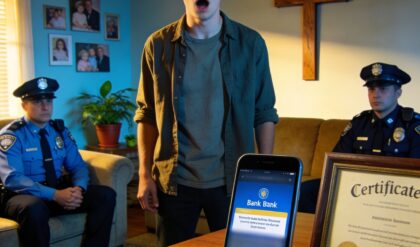
For a full minute, I just stared at the sliver of darkness.
My hand, still holding the warm coffee mug, was shaking so badly I had to set it down. The house was silent again. The storm had passed, the old man was gone, and the only sound was the frantic pounding in my chest.
I locked that door.
I knew I did. It was part of my nightly ritual. Since the divorce, since moving into this place alone, I’d become meticulous about security. Front door, back door, kitchen window, and the basement door. The old, heavy bolt was always thrown.
But now, it was open. Just a crack.
The man’s words echoed in my ears, no longer sounding like the ramblings of a confused senior, but like a prophecy.
“I’m not joking. You have to leave right away.”
My first instinct was to run. To grab my keys, get in my truck, and drive until this house was just a speck in the rearview mirror. But where would I go? And why? Because a barefoot old man gave me a dollar?
No. I was a rational man. There was a logical explanation.
I walked to the basement door, my feet heavy, as if I were wading through wet cement. I pushed it open.
The smell hit me first. That familiar odor of damp concrete, rust, and something else… something earthy and cold. It was the smell of a place that had been sealed for too long.
“Hello?” I called out, my voice sounding weak, pathetic.
Only the echo answered.
I grabbed the heavy-duty flashlight from the kitchen drawer and clicked it on. The beam cut through the darkness, illuminating the wooden steps leading down.
I descended, one step at a time. Each creak of the old wood sounded like a gunshot in the silence.
“Hello?” I tried again, stronger this time.
Nothing.
The beam panned across the room. It was exactly as I’d left it. Old shelves sagging with paint cans, a rusty tool bench, cardboard boxes left by the previous owner that I still hadn’t touched.
But then the light found the floor.
Footprints.
Clear, distinct, muddy footprints. They weren’t mine. They were too large, the tread too deep. They led from the bottom of the stairs, straight across the concrete floor, to the far wall.
My heart hammered against my ribs.
The old man had been down here. While I slept, he had been in my basement.
I followed the tracks, the beam of light trembling. They stopped abruptly at the back wall, a solid expanse of cinder block painted a peeling, sickly gray. But as I got closer, I saw what the footprints were pointing to.
Behind an old, dust-covered cabinet, the concrete was… wrong.
It was a different color. A lighter, smoother patch, about three feet square. It looked like it had been poured much, much more recently than the rest of the floor.
I pushed the cabinet aside. It screeched in protest, the sound grating on my nerves.
There it was. A new slab of concrete, poorly hidden.
I remembered the inspector who’d walked me through the house. “Solid foundation. Good bones.” He’d never mentioned this.
I went back upstairs, my mind racing. I grabbed a hammer and a chisel from the utility drawer. Back in the basement, I knelt by the strange patch. My hands were slick with sweat.
I tapped the center of the slab with the hammer.
Thud.
Solid.
I tapped the edge.
Thwack.
Hollow.
A cold dread, sharper than the basement air, washed over me. I wasn’t just curious anymore. I was terrified.
I jammed the chisel into the seam and struck it hard with the hammer. A crack spiderwebbed out. I hit it again, and again, adrenaline surging through me. Concrete dust filled my lungs.
After ten minutes of frantic work, a large piece broke loose. I tossed it aside and shone the flashlight into the cavity.
It wasn’t deep. Just a small, dark hole. And inside, something glinted.
A metal box.
It was small, like an old recipe box, and rusted at the hinges. I reached in and pulled it out. It was heavier than it looked.
I carried it upstairs, my whole body vibrating. I sat at the kitchen table, the man’s crumpled dollar bill still lying where he’d left it.
With a screwdriver, I pried the locked hinge open. The lid creaked, and a puff of musty air escaped.
Inside were papers.
They were yellowed, the edges damp and brittle. I carefully unfolded the first one. It was a property record. A deed of sale for this house.
I unfolded another. And another.
Property records, purchase histories, bills of sale. All for this address.
But that wasn’t the scary part.
I spread them across the table. The first one was from 1995. A couple, the Hendersons. They bought the house in March. They sold it in September of the same year. Six months.
The next owner, a man named Mark Jepsen, bought it in October 1995. The file on him was different. It wasn’t a bill of sale. It was a foreclosure notice, dated May 1996. Stapled to it was a small, faded newspaper clipping.
“Local Man Found Deceased.”
I read the short article, my blood turning to ice. Mark Jepsen, 34, had been found dead in his home by a coworker. Cause of death was listed as a “sudden, massive aneurysm.”
Thirty-four years old.
My hands were trembling so hard I could barely pick up the next file. The Garza family. They bought the house from the bank in 1997. They sold it in 1998, at a financial loss so massive it made my stomach hurt.
The pattern continued. Owner after owner. Nobody stayed longer than a year. Some sold at huge losses. Others… the file just ended. Abruptly. Marked “Deceased” or “Missing.”
This wasn’t a house. It was a conveyor belt.
I scrambled for my laptop and started searching the names, one by one.
The Hendersons were alive, thank God. They ran a bed and breakfast in Vermont.
Mark Jepsen. The aneurysm.
The Garzas. I couldn’t find them. They seemed to have vanished after selling.
The next owner. A single woman. Sarah Kline. Bought in 1999. A police report from 2000 stated she was “missing, presumed runaway.” Her car was still in the driveway.
And then, the final file before the one I had signed. A couple in their fifties. The news clip was more recent. “Tragic Accident Claims Local Couple.” A house fire. But the article was strange. It said the fire department was “baffled” by the blaze, which seemed to have “started and extinguished itself” in the basement, leaving the rest of the house with only smoke damage. The couple had died of smoke inhalation.
I pushed back from the table, my chair screeching on the linoleum. I was breathing in short, sharp gasps.
I had to get out.
I grabbed my keys, but paused. I had to know why. What was happening in this house?
I looked at the real estate agent’s card still pinned to my corkboard. Denise. She’d been so nice, so cheerful.
I called her. My voice was hoarse.
“Hello, Denise? This is… this is Michael Stone. I bought the house on 214 Pine Creek Road.”
There was a pause. A long, heavy silence that stretched for an eternity. When she spoke again, all the cheerfulness was gone, replaced by a flat, professional tone.
“Oh,” she said. “That place.”
“What do you mean, ‘that place’?” I demanded, my voice rising. “Denise, what’s wrong with this house?”
She sighed, a long, weary sound. “Look, Michael, I sold you the house in good faith. We disclosed everything we were legally required to.”
“What weren’t you required to disclose?”
Another pause. “You should… you should talk to the county inspector. A man named Clark. He’s retired now, but he handled that property for decades. He knows things.”
She gave me the number. I thanked her and hung up, my mind a whirlwind of fire, missing persons, and aneurysms.
I dialed Clark’s number. A gruff, older voice answered.
“Yeah?”
“Mr. Clark? My name is Michael Stone. Denise at the real estate office gave me your number. I… I’m the new owner of 214 Pine Creek Road.”
Silence. Again. This was becoming a theme.
“Figured I’d be getting this call sooner or later,” he grumbled. “What is it? Lights flickering? Smell something funny in the basement?”
“An old man showed up here last night,” I blurted out. “He… he warned me. He told me to leave.”
Clark went very quiet. Then, almost reluctantly, he said, “What’d he look like?”
“Old. Silver-white beard. Looked terrified. He left this morning.”
“That’s… not possible,” Clark muttered, more to himself than to me. “I know who you’re talking about. Harold Pierce. He built that house. But he’s been in a nursing home in Medford for the last year. Advanced dementia. Barely knows his own name.”
“No, this man was sharp,” I insisted. “Scared, but sharp. He knew exactly what he was saying.”
Clark’s voice hardened. “Then you’d better come see me. Now. There’s a diner off Highway 97, The Rusty Spoon. I’ll be there in twenty minutes. And son?”
“Yeah?”
“Bring those papers you found.”
I froze. “How did you know I found papers?”
“Because every owner finds the papers,” he said, and hung up.
I met Clark at the diner. He was exactly as his voice suggested—thin, stooped, with watery eyes behind thick glasses. He looked like a man who had spent his entire life looking at things people tried to hide.
I spread the papers and the faded newspaper clippings across the Formica table. He didn’t even look at them. He just nursed his black coffee.
“So, Harold Pierce,” I started.
“Harold built that place in ’74,” Clark said, staring into his cup. “Built it with his own hands. Him and his boy, Ethan.”
He finally looked up, his eyes locking on mine. “Ethan died in that basement. He was ten.”
A chill that had nothing to do with the diner’s air conditioning crawled down my neck. “How?”
“Official report said it was an accident. Kid was… handy. Liked to tinker. Harold taught him. The report said the boy was trying to fix a light fixture and… well. He got careless.”
Clark shook his head. “Harold was never the same. His wife left him. He just… stayed in that house. Became a recluse. Finally sold it thirty years ago. But he never really left. People would see him, wandering the property, muttering. Always coming back.”
“But why?” I asked. “Why all the… the other…?” I pointed at the obituaries.
Clark leaned in, his voice dropping to a whisper. He pointed at a copy of the house’s original floor plan, one I hadn’t even noticed was in the box.
“That basement wall,” he said, tapping the far wall where I’d found the footprints. “The one in the back?”
“Yeah?”
“It’s not supposed to be there.”
“What do you mean?”
“When Harold built that house, the original blueprints show the basement extended another six feet. That wall you saw? Harold added it later. Illegally. No permits, no inspection.”
He leaned back, his gaze dark. “He poured concrete over something.”
“Something?”
“Or… somewhere,” Clark said. “After the boy died, Harold sealed that section of the basement off. He told the county it was unstable, but we all knew. He was burying a memory. The problem is, you don’t just pour concrete over a room with active electrical. It’s against every code in the book. It’s a death trap.”
My mouth was dry. “The fire… the aneurysm… the…?”
“You get enough ungrounded, corroded wiring in a damp space, all sealed up? You create a high-voltage nightmare,” Clark said flatly. “A ‘sudden aneurysm’ could be a massive electrical jolt to the heart. Faulty wiring could spark a fire that burns itself out. A person goes ‘missing’ because they were in the wrong place at the wrong time and… poof. The house just… eats them.”
He looked at me. “The old man wasn’t warning you about a ghost, son. He was warning you about his mistake.”
I drove home in a daze, my stomach in knots. The world seemed too bright, the colors too sharp.
I parked the truck but didn’t go inside right away. I just stared at the house. It looked so peaceful. A cute little fixer-upper on two acres of pine.
A tomb.
I went to the shed and got the sledgehammer.
I didn’t bother with the chisel this time. I went into the basement, to that illegal, horrifying wall, and I swung.
The first hit just bounced off, stinging my hands. The second cracked the cinder block.
The third one punched through.
A smell wafted out. Not just damp and rust. It was the sharp, metallic tang of ozone. The smell of burning wires.
I choked, my eyes watering, but I kept swinging. I smashed block after block, pulling them loose, tossing them aside.
Behind the false wall was a space. A narrow, dark void, no bigger than a closet.
I shone my flashlight inside.
It was exactly as Clark had described. The original foundation wall. And mounted on it, a huge, ancient electrical panel. The wires running from it were corroded, their plastic insulation chewed away by time and moisture. Some were sparking, faintly, a soft fzzzt in the darkness.
But it was what was on the floor beneath it that made me drop the flashlight.
In the dirt, caked with mold, was a small, tin lunchbox. It was red, with a faded picture of Superman on the front.
My hands were shaking so hard I could barely pick it up. The latch was rusted shut. I forced it open with the claw of the hammer.
Inside…
A photograph. A boy with a gap-toothed grin, maybe ten years old, holding a model airplane. Ethan Pierce.
A newspaper clipping, different from the others. “Local Boy Wins Science Fair.”
And beneath it all, a single, folded document. It wasn’t a copy. It was the original.
The coroner’s report.
I unfolded it.
Cause of Death: Electrocution.
But it was the handwritten note at the bottom, signed by the coroner, that stopped my heart.
“Massive trauma consistent with high-voltage shock. Father, Harold Pierce, was first on scene. Mr. Pierce had sealed the main circuit box himself before we arrived. Evidence of faulty, non-code-compliant wiring found at scene. Case ruled accidental, but further investigation into the father’s unpermitted work is recommended.”
He hadn’t just covered up a memory. He had covered up his guilt. He had sealed the evidence of his own shoddy work that had killed his son.
And in doing so, he had created a time bomb. A trap that had been killing and killing and killing for thirty years.
The old man hadn’t come back to haunt me. He’d come back to save me. Maybe the storm, the failing light… maybe it reminded him of that day. Or maybe, in a moment of lucidity from his fog of dementia, he remembered the monster he had built and knew, somehow, that someone else was living with it.
He couldn’t explain. He couldn’t make me believe him. All he could do was offer a symbolic payment—a dollar for a life—and beg me to run.
I called Clark. Then I called the county.
Within an hour, the house was swarming. Clark. The electrical safety authority. The police.
They condemned the wiring. They condemned the entire house. The lead inspector, a woman with a face as hard as concrete, looked at me, her eyes wide.
“Mr. Stone,” she said, “if you had turned on the wrong combination of lights… if you’d gone down there during the storm when the ground was saturated… you wouldn’t have been electrocuted. You would have been incinerated.”
I moved out that day. I left everything. I took my wallet, my laptop, and the Superman lunchbox.
When I was walking out the front door for the last time, I paused.
The crumpled dollar bill was still on the kitchen table, right where he’d left it.
I picked it up. I folded it carefully and put it in my wallet.
I have it framed now, in my new apartment in the city. It sits on my desk, right above my computer.
It’s not a payment. It’s not a souvenir.
It’s a reminder. A reminder that some warnings don’t come from ghosts. They come from men who are haunted. And that sometimes, a man’s last-ditch effort to buy back his own soul isn’t madness.
It’s mercy.
News
I Hid 20 Freezing Bikers From a Blizzard. The Next Morning, I Woke Up to a Roar That Shook My Entire House.
Chapter 1: The Invisible Woman The wind didn’t just blow that night; it screamed. It was a sound that tore through the cracks in the walls and settled deep in your bones. I stood by the kitchen window, watching…

I Fixed A Billionaire’s Broken Prototype With A Wrench. The Next Morning, A Black Hawk Helicopter Landed In My Trailer Park.
Chapter 1: The Ghost in the Machine The copper-colored sun was dying behind the thick clouds, casting long, bruising shadows across Woodbury Meadows. It was the kind of light that made everything look old. The trailer park smelled of…
They Thought She Was Just A Lonely Customer. When The Biker Touched The Waitress, The Navy Commander Broke Her Silence—And His Arm.
Chapter 1: The Ghost in the Corner The morning fog rolled thick off the Atlantic, blanketing the streets of Port Haven in a ghostly shroud. It was the kind of heavy, wet mist that muffled sound and made the…
They Mocked A Paralyzed Veteran And Kicked Her Wheelchair, Unaware They Just Woke Up The Most Dangerous Assassin The Military Ever Created.
CHAPTER 1: THE GHOST OF PINE VALLEY The phantom pain was bad today. It felt like fire was licking at ankles that hadn’t been there for three years. Alex Winters adjusted her position in the wheelchair, her face remaining…
They Thought He Was Just A Frail Old Man Alone At A Truck Stop. But When The Gang Leader Spat In His Coffee, He Didn’t Flinch—He Just Made One Phone Call That Unleashed A Trap 20 Years In The Making.
Chapter 1: The Wolf at the Door The evening sun cast long, amber shadows across the cracked pavement of the Crossroads Truck Stop. It was a place out of time, situated on a lonely stretch of Interstate 40 where…

Navy Admiral Mocked A Single Dad Janitor In Front Of Everyone—Then He Learned The Man’s “Call Sign” And The Whole Base Froze.
Chapter 1: The Ghost of Coronado The morning fog still clung to the coastline of Coronado, a thick gray blanket that muffled the roar of the Pacific Ocean. Inside the primary administrative building of the Naval Base, the silence…
End of content
No more pages to load