Christmas Eve had always been a performance at the Morgan house. This was my 11th year, and I still felt like I was auditioning for a part I was never going to get. Eli’s parents, Deborah and Walter, hosted it every year in their oversized, sterile two-story home just outside Columbus. It was the kind of house where everything looked perfect, but nothing felt warm. The 7-foot artificial tree in the front window was decorated with color-coded, shatterproof ornaments—gold and burgundy, never a single homemade or mismatched piece. The garland on the staircase was precisely draped, held with velvet ribbons. The buffet table was lined with store-bought platters from an upscale market Deborah loved to name-drop. Everything was for show.
I knew the rhythm. I knew which casserole to bring (and that it would be immediately transferred to her “guest-worthy” porcelain dish). I knew which cousin would arrive late and which uncle would drink too much. And I knew, the second I walked through the door, that Deborah would give me her signature once-over, a subtle, invasive scan from head to toe that always found something lacking.
“You wore flats again this year?” she asked, smiling as she kissed the air beside my cheek. Her smile never, ever reached her eyes. “Comfort first, I suppose.”
I smiled back, the polite, laminated one I had perfected over a decade. “Happy holidays, Deborah.” I didn’t flinch. I had stopped letting her barbs draw blood a long time ago.
Eli squeezed my hand, a silent “I’m here,” a familiar apology for things he couldn’t change. Our daughter, Lena, held tightly to my other hand. She was nine, and the magic of Christmas hadn’t yet been dimmed by complex family dynamics. Not yet. She wore a red velvet dress I’d spent too much on, and she’d insisted on a white bow clipped into her dark, bouncy curls. She was practically vibrating with excitement, clutching the Christmas card she had made for Deborah.
She had spent three nights on that card. Three nights at the kitchen table with glitter glue and gold markers, meticulously drawing a fireplace, a tree, and a little stick figure of Deborah holding a tray of cookies. In her absolute best, most careful handwriting, she had written, “To Grandma, Merry Christmas! Love, Lena.”
The night before, she had held it up for Eli to see. “Do you think she’ll really like it, Daddy?”
“I think,” Eli had said, his voice a little thick, “that it’s the best card anyone will get this year, sweetheart.”
“Mommy, can I give Grandma my card now?” she whispered the moment we stepped inside, her eyes bright and her cheeks flushed from the cold.
“Maybe wait until after presents, sweetheart,” I told her, steering her toward the coat closet. “She might be busy right now.”
The living room was already full. Eli’s sister, Melissa, was there with her kids, plus a dozen cousins and extended relatives I saw precisely once a year. They all greeted each other with loud, booming laughs and inside jokes, a tight-knit clan I’d never been able to penetrate. I stood at the edges, helping Lena out of her coat and hanging it next to the others. There’s a strange, specific kind of loneliness that comes from being surrounded by people who treat you like a guest in a life you married into.
Eli felt it too, I knew he did. But he was a peacemaker. He loved his family, even the complicated parts, and he didn’t want to pick sides. I never asked him to.
Lena settled onto the rug with the other kids, her card placed neatly in her lap, ready to go. I stayed behind her, sinking into the couch between Eli and an empty space no one ever filled. The smell of cinnamon and pine plug-ins hung thick in the air, masking the scent of real food. On the surface, it was a picture-perfect holiday.
But I felt something ripple beneath the surface. It was subtle, but I’d been trained over 11 years to notice. Deborah hadn’t said a single word to Lena. No compliment on her dress, no hug, no “I’m so glad you’re here.” Just a quick, distracted glance and an, “Oh, hi, sweetie,” before she turned to fix the bows on the presents under the tree.
I watched Lena’s face. She noticed it, too. Her smile faltered for just a second before she dutifully turned her attention to her cousin Abby. The tension in my chest, that familiar “Morgan House” ache, began to build. I told myself to stay calm. Maybe I’m reading too much into it. She’s busy. It’s not about Lena.
Then, Deborah stood near the fireplace and clapped her hands, a sharp, managerial sound. “Let’s do presents before dessert! Kids first!”
Eli leaned back beside me, rubbing his hands together in a forced show of good cheer. I tried to match his energy. On the floor, Lena looked up, her whole body straightening with anticipation, her glittery card held reverently in her lap.
“Let’s see,” Deborah said, picking up a large, gold-foil gift from the pile. “This one’s for Connor!”
One by one, children’s names filled the room. Laughter. The rip and tear of paper. “Thank yous” tossed across the room. The mountain of gifts began to shrink.
“Emma!” “Ava!” “Tyler!” “Jasmine!”
Lena clapped for every single one, her eyes fixed on the tree, her smile unwavering, a perfect, polite little girl waiting her turn. I kept my eyes on the pile, counting what was left. Only a handful. It’s fine, I told myself. Maybe hers is small. Maybe it got buried. Maybe it’s a gift card.
Deborah reached for a small, plush-wrapped package. “And this one is for Lexi! Her first Christmas!” Lexi was barely six months old, half-asleep in her mother’s arms. Everyone clapped and cooed. Lena clapped, too.
Three gifts left. I sat up straighter, my smile feeling stiff. “Owen!” A silver box. Two gifts left. “Abby!” Melissa’s daughter. One gift left.
My heart started to pound, a low, dull thud against my ribs. It was a long, thin box wrapped in blue paper with a white ribbon. Deborah squinted at the tag and smiled. “Ah! For Logan.”
Logan. A cousin’s stepson. A child who didn’t even share the family name.
Logan took the gift. Everyone watched him unwrap a remote-controlled car. And that was it. The space under the tree was empty. A void of pine needles and discarded ribbon.
Deborah turned to her husband, Walter, and said, “All right, that’s the last one for the kids.”
The music was turned back up. People started chatting again, the spell broken. One of Eli’s uncles reached for another drink. The kids began playing with their new toys in the corner.
And Lena sat still.
Cross-legged on the rug, her glittery, hand-drawn card still clutched in her hands. She looked up at me, not with tears, not with questions, just a small, tired smile that tried way too hard to look fine. Then she looked down at her hands, folded neatly in her lap.
She didn’t cry. She didn’t ask why. She just… sat there.
I saw the way her fingers twisted the edge of the card, bending the gold glitter. The way her foot tapped silently against the leg of the coffee table. That was how I knew she was shattered.
And no one said a word.
Not one person. Not Melissa, her aunt. Not Walter, her grandfather. Not a single cousin or uncle looked at the only child left empty-handed and acknowledged it. My heart was pounding so hard I could feel it in my throat. I looked at the people around us. Eli’s family, all of them, moved on like nothing had happened. Like a child hadn’t just been surgically and publicly excluded.
I leaned forward, a hot, sharp rage building inside me. I was going to say something. I was going to stand up and demand an explanation. “Deborah, I think you forgot one.” I didn’t care about the scene. I didn’t care about the 11 years of forced smiles.
But before I could speak, Eli put his hand on my knee. “Wait,” he whispered.
“For what?” I hissed back, my voice trembling.
He didn’t answer. He just stood up.
My husband doesn’t make scenes. He’s the quiet one. The de-escalator. The one who smooths over conflict with quiet phrases and calm glances. But this time, he didn’t look calm. His jaw was set. He walked over to the fireplace, past the perfectly arranged stockings, and reached behind one of them, pulling out a single, plain white envelope.
He turned around to face the room.
“This,” he said, his voice quiet but cutting through the entire room. “Was supposed to be opened last.”
The entire room froze. Conversation stopped mid-sentence. Deborah narrowed her eyes.
Lena looked up from her lap.
Eli walked the envelope over to her. He didn’t say anything else. He just handed it to our daughter and nodded. And for the first time all night, every single person in that room was looking at Lena.
Lena looked at the envelope, confused. It was unmarked. No ribbon, no tag, no glitter. She held it delicately, like it might break.
“Go ahead, sweetheart,” Eli said gently.
She glanced at me, as if asking permission. I nodded, my throat too tight to speak. “It’s okay. Open it.”
Around us, the silence was deafening. People were watching, but trying not to make it obvious. Deborah crossed her arms, her mouth pressed into that thin, irritated line.
Lena carefully tore the envelope open. She reached inside and pulled out two things. The first was a stack of white papers, neatly folded. The second was a handwritten note on blue stationery. She opened the note first, her lips moving as her eyes scanned the words.
When she finished, she looked up at her dad, her eyes wider than I’d ever seen them.
“What does it say, honey?” I asked.
She looked back down and read it aloud, her voice small but clear in the silent room. “To my daughter, Lena. For the girl who brings light wherever she goes. Let’s chase the northern lights this year. Iceland awaits. Love, Dad.”
A collective, quiet “whoosh” of air left the room. Lena, confused, unfolded the other papers. They were printed tickets. Two of them. Chicago to Reykjavik. Round trip. First class.
I looked at Eli, stunned. “You planned this?” I whispered.
He nodded, not taking his eyes off Lena. “Weeks ago. I booked it the same night she told me she wanted to see the stars somewhere that didn’t have street lights.”
I remembered. A random drive, Lena staring out the window, asking about the stars. Eli had told her about places where the sky was so clear it looked like spilled diamonds. She’d asked if we could go. He had said “someday.”
He had made “someday” now.
Lena stood up, still holding the tickets. “We’re really going?”
Eli bent down to her level. “We are. You and me. Northern lights, hot cocoa, snowmobiles, the whole thing.”
She threw her arms around him and hugged him so tight her red bow pressed into his shoulder. She buried her face in his neck, and for the first time all evening, she wasn’t pretending to be okay. She didn’t have to. I felt hot tears well up, but I didn’t wipe them away. This was a correction. A declaration. She had been made invisible, and her father had just made her the center of the world.
Across the room, Deborah’s expression had tightened into a mask of controlled fury. She picked up a discarded piece of wrapping paper and folded it, her movements sharp and angry. Walter cleared his throat and looked at the floor.
“That’s… that’s incredible, Eli,” Melissa said, her voice strained.
Eli stood up, one arm around me, the other around Lena. “It’s her dream. I figured Christmas was the right time to give her something unforgettable.”
Deborah didn’t say a word. She stood slowly, smoothed the front of her sweater, and walked toward the kitchen. I watched her go. For the first time in 11 years, I didn’t care what she thought. She had made her choice. And Eli had made his.
Lena stayed glued to Eli’s side for the rest of the evening, holding the envelope. The other kids, drawn by the magic of “Iceland,” gathered around her. For the first time all night, Lena was at the center of the conversation, not because she was invited, but because she was undeniable.
I walked into the kitchen to grab Lena a bottle of water. Deborah was there, arranging sugar cookies on a tray with violent precision.
“That was quite the announcement,” she said, not looking at me.
I pulled the water from the fridge and shut the door. “It was quite the lead-up.”
She turned, her eyes flashing. “You know, it would have been nice to know about that ahead of time, so we could avoid this kind of scene.”
“This kind of scene?” I asked, my voice dangerously calm. “A scene where your granddaughter is the only child you deliberately ignore?”
“It wasn’t intentional,” she snapped. “We had so many to keep track of this year. Melissa’s kids, the cousins… things slip through the cracks.”
“She’s not a slip,” I said, and my voice was shaking, but not from fear. “She’s your granddaughter. And you’ve always meant to keep us just outside the circle, Deborah. You’ve never been subtle. Tonight was just the first time you were brave enough to do it in front of the whole family.”
She opened her mouth, then closed it. I waited for an apology, an explanation, anything. Nothing came. I walked out and left her in the kitchen with her perfect, store-bought cookies.
Back in the living room, I sat next to Eli. “You knew,” I whispered. “You knew this would happen.”
He nodded, his eyes on Lena, who was describing the Blue Lagoon to her cousins. “I saw the gift list on her counter last week. Lena wasn’t on it. I asked her about it. She said it was just a draft, that she hadn’t finished. I knew she was lying.”
He hadn’t just saved the moment. He had anticipated the wound and prepared a better memory.
As we were packing up to leave, Lena came up to me, her glittery card still in her hand. “Should I still give this to Grandma?”
I looked at the card, at the love she’d poured into it. “You can, baby. But you don’t have to.”
She stared at it for a long moment. Then she folded it carefully and tucked it into the pocket of her backpack. “I want to keep it,” she said.
We drove home in silence. Lena fell asleep in the back seat, the white envelope tucked under her arm.
“I hated watching that,” Eli said, his voice thick. “I know,” I replied. “Did I handle it right?” I looked at my husband, the peacemaker who had just quietly declared war for his daughter. “You showed up for her when it mattered. That’s always right.”
The next morning, Deborah called. Eli looked at the screen, then silenced the call and put his phone face-down on the counter. “She’ll probably say it was an accident,” I said.
“I know,” he replied. “But it wasn’t.”
We both knew it. And for the first time, I didn’t feel the need to fix it.
Family isn’t just blood. It’s not about forced invitations or pretending love is present when it’s not. Family is a choice. It’s in the people we stand beside, in how we show up when it would be easier to stay silent.
That night, as I tucked Lena into bed, she pulled out the card she’d made. “Do you think Grandma will be mad I didn’t give her this?”
“I think Grandma will wonder where it went,” I said. “And maybe that’s okay.”
Lena looked down at the glittery edges. “Can I keep it? Just for me?”
“Yes,” I said. “You can always keep what you make with love.”
She smiled, a real, genuine smile. “I think I’ll keep it in my suitcase. For Iceland. So I remember this Christmas. All of it.”
That was when I knew she’d be okay. She wouldn’t just remember the silence or the empty space under the tree. She would remember the moment her dad handed her the world in a plain white envelope. She wasn’t overlooked. Not in the way that matters. She was chosen.
News
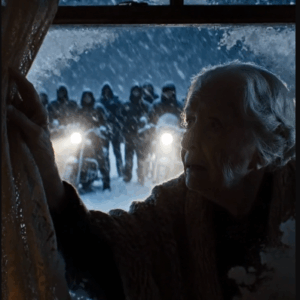
I Hid 20 Freezing Bikers From a Blizzard. The Next Morning, I Woke Up to a Roar That Shook My Entire House.
Chapter 1: The Invisible Woman The wind didn’t just blow that night; it screamed. It was a sound that tore through the cracks in the walls and settled deep in your bones. I stood by the kitchen window, watching…

I Fixed A Billionaire’s Broken Prototype With A Wrench. The Next Morning, A Black Hawk Helicopter Landed In My Trailer Park.
Chapter 1: The Ghost in the Machine The copper-colored sun was dying behind the thick clouds, casting long, bruising shadows across Woodbury Meadows. It was the kind of light that made everything look old. The trailer park smelled of…
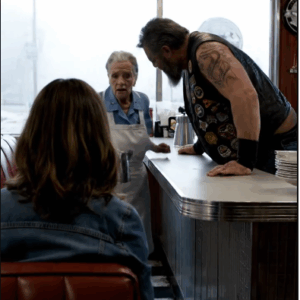
They Thought She Was Just A Lonely Customer. When The Biker Touched The Waitress, The Navy Commander Broke Her Silence—And His Arm.
Chapter 1: The Ghost in the Corner The morning fog rolled thick off the Atlantic, blanketing the streets of Port Haven in a ghostly shroud. It was the kind of heavy, wet mist that muffled sound and made the…
They Mocked A Paralyzed Veteran And Kicked Her Wheelchair, Unaware They Just Woke Up The Most Dangerous Assassin The Military Ever Created.
CHAPTER 1: THE GHOST OF PINE VALLEY The phantom pain was bad today. It felt like fire was licking at ankles that hadn’t been there for three years. Alex Winters adjusted her position in the wheelchair, her face remaining…

They Thought He Was Just A Frail Old Man Alone At A Truck Stop. But When The Gang Leader Spat In His Coffee, He Didn’t Flinch—He Just Made One Phone Call That Unleashed A Trap 20 Years In The Making.
Chapter 1: The Wolf at the Door The evening sun cast long, amber shadows across the cracked pavement of the Crossroads Truck Stop. It was a place out of time, situated on a lonely stretch of Interstate 40 where…

Navy Admiral Mocked A Single Dad Janitor In Front Of Everyone—Then He Learned The Man’s “Call Sign” And The Whole Base Froze.
Chapter 1: The Ghost of Coronado The morning fog still clung to the coastline of Coronado, a thick gray blanket that muffled the roar of the Pacific Ocean. Inside the primary administrative building of the Naval Base, the silence…
End of content
No more pages to load