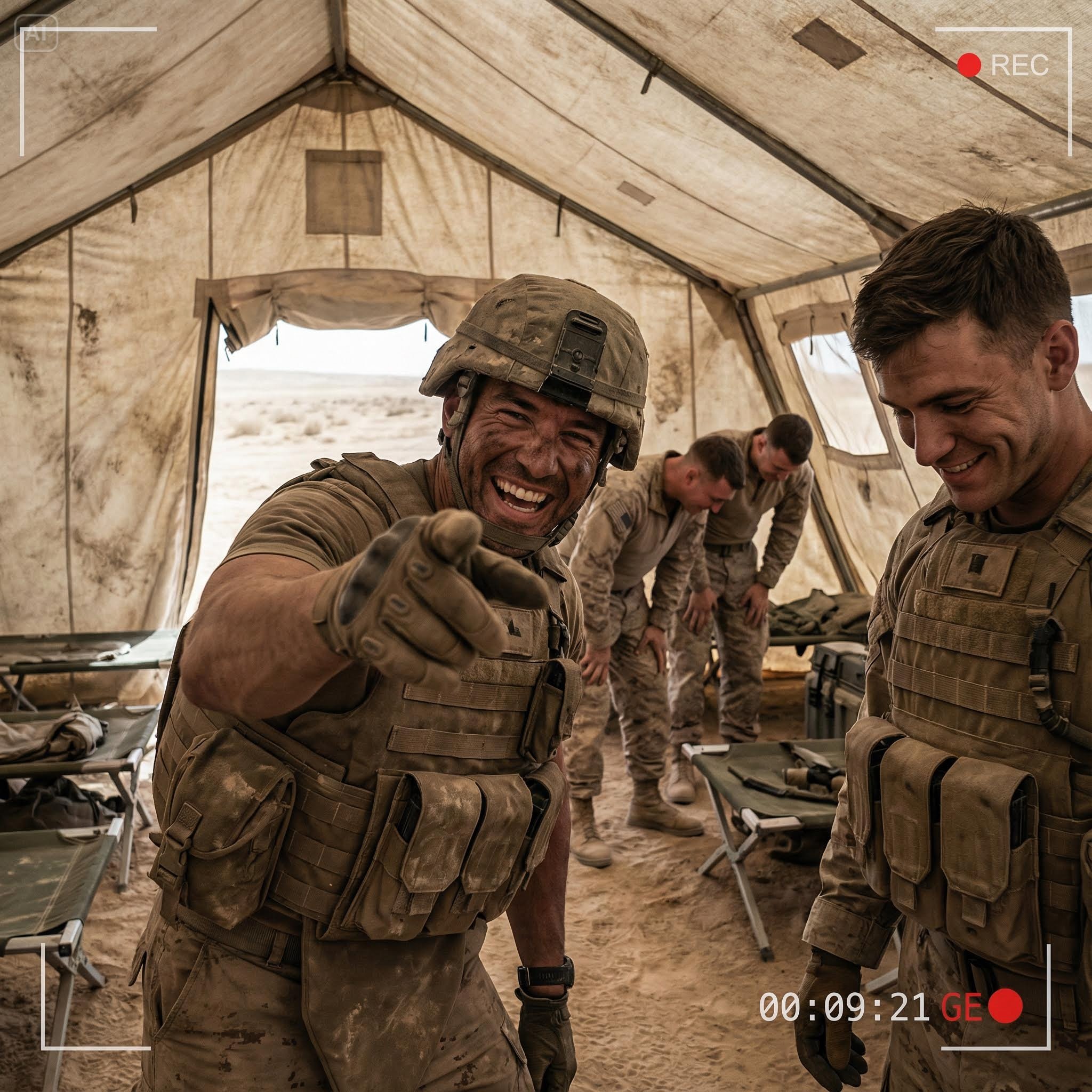
CHAPTER 1: THE INVISIBLE WOMAN
Dawn cracks over the Arizona desert like a bruised knuckle—purple, orange, and violent.
Captain Emily Brooks woke without an alarm at 0400. She always did. Her body was tuned to a rhythm that didn’t exist for normal people.
32 years old. Medium height. Brown hair twisted into a tight, severe knot that pulled at her scalp. Nothing about her screamed “special operator.” Nothing about her screamed “hero.” That was the point. In her world, if you stood out, you died.
She rolled out of her bunk, her feet hitting the icy linoleum of the barracks floor. The room was sparse. A bed, a locker, a desk. No photos of family. No posters.
She brewed black coffee in a dented steel pot. No sugar, no cream. Just fire and fuel.
While the dark liquid dripped, she dropped to the floor. Fifty push-ups. Fast, explosive, perfect form. Then sit-ups. Then a series of stretches that tugged at old, silver scars crisscrossing her back—scars nobody on this base had ever asked about.
From under her bunk, she dragged out a battered hard-shell rifle case.
It wasn’t government issue. It was personal. Inside lay an M2010 Enhanced Sniper Rifle, a weapon technically retired from her official books three years ago.
It didn’t matter what the books said.
Every morning, she broke it down. Her fingers moved with a blurring speed, stripping the bolt, checking the firing pin, wiping down the barrel. She cleaned every part and put it back together in four minutes flat. Blindfolded.
Muscle memory never sleeps. It just waits.
She drank her coffee standing at the window, watching the sun begin to gild the jagged Chocolate Mountains in the distance. The rifle gleamed on her cot, a silent metal predator.
“Not today,” she whispered to the gun.
She locked it away, sliding the case back into the shadows.
By 0600, she was dressed in her standard OCPs and striding across the gravel training yard to the logistics office. This was her life now. Supply chains. Ammo counts. Spreadsheets.
It wasn’t sexy. It wasn’t combat. It was just… necessary.
A squad of young soldiers jogged past her, fresh fades and loud jokes echoing in the morning air. They were Rangers, pumped up on testosterone and pre-workout.
One of them, a Corporal with a cocky grin, whistled. “Hey, Coffee Girl! Any donuts in the supply tent today?”
Another chimed in, laughing. “Careful, man. That’s the Inventory Princess. She might papercut you to death.”
Emily kept walking. Her boots crunched rhythmically on the gravel. Her face remained a mask of boredom.
But if anyone had been paying attention—really paying attention—they would have seen her eyes track them like a hawk.
She clocked the tiny hitch in the third guy’s left knee; he was favoring it. She noticed the way the fourth guy held his right shoulder stiffly; rotator cuff injury, likely from improper lifting. She calculated their speed from the flutter of the flags on the poles. She estimated the distance to the range from the echo of their boots.
She saw it all. She processed it all. She said nothing.
She reached the ammo depot just as a rookie private dropped a heavy wooden crate.
CRASH.
Brass spilled everywhere. Thousands of rounds. It was chaos. Mixed calibers, different grains, rolling into the dirt.
“Damn it!” the kid muttered, dropping to his knees, panic rising in his chest. “Sarge is gonna kill me.”
Emily knelt beside him. She didn’t speak. Her hands moved.
It was a blur. She sorted the bullets by caliber, grain, and manufacturer. 5.56mm green tip here. 7.62mm match grade there. .300 Win Mag in a separate pile.
She did it in under thirty seconds.
Each round was placed exactly where it lived. It was mechanical. It was terrifyingly fast.
The rookie gawked at her, his mouth hanging open.
“Ma’am… how did you…?”
“Physics,” Emily said simply.
She stood up, brushed the dust off her palms, and walked away toward her office.
Staff Sergeant Lopez, a combat veteran with eyes like flint, was watching from the doorway. He squinted as she passed. He had seen hands move that fast before, but never on a supply clerk. That wasn’t luck. That was schooling. Deep schooling.
He filed it away, but he stayed quiet.
CHAPTER 2: THE IMPOSSIBLE STANDARD
The morning’s disrespect didn’t end with a whistle.
As Emily finished her rounds at the restricted ordinance cage, she found a crucial manifest—the daily log of all 7.62mm and .338 Lapua precision rounds—crumpled and stuffed into a barrel of cleaning rags.
The paperwork was soaked through with gun oil. It had been deliberately ruined just moments before Major Powell required it for his morning sign-off.
She straightened her face, a mask of practiced neutrality, and looked toward the far end of the depot. Two junior armorers—the same ones who had called her “Coffee Girl”—were conspicuously wiping down equipment, failing to meet her eye.
It wasn’t just lazy. It was intentional sabotage. They wanted the female officer to miss her deadline. They wanted her to look incompetent in a non-combat role.
Without saying a single word, Emily walked to the nearest workbench. She didn’t look for a computer backup. She didn’t panic.
She pulled out a fresh manifest sheet and grabbed a black ballpoint pen.
She began rewriting the entire inventory. From memory.
Scratch. Scratch. Scratch.
The rapid, rhythmic sound of her pen against the paper was the only noise in the depot. She didn’t check notes. She didn’t consult the physical stock.
Batch numbers. Expiration dates. Total weight. Grain counts.
The data flowed from her brain to the paper, accurate down to the last digit.
When the armorers finally sidled past, pretending to leave for chow, she simply placed the completed, spotless manifest exactly where the ruined one had been. She was five minutes ahead of schedule.
The silence that followed her action was heavy. It was a grudging, resentful acknowledgment of competence that was far more potent than any shouted argument.
Later that morning, Emily sat in the back of a briefing room with fifteen other officers. The air conditioning was broken, and the room smelled of sweat and stale coffee.
Major Powell stood at the front, clicking through a PowerPoint presentation.
“The 4,000-meter trial,” he declared, his voice booming. “Experimental extreme range program. We are picking shooters for elite training. This is the Phantom Program.”
Names flashed on the screen. Top-tier snipers. Match winners. Combat vets.
Emily’s name never showed.
“Captain Brooks,” Powell said, not even glancing her way. “This is a combat billet only. No supply officers. You’re just here to coordinate the ammo logistics.”
She nodded once. “Understood, sir.”
No pushback. No whine. But under the table, her hands tightened for half a heartbeat.
Just outside the briefing room, Staff Sergeant Lopez intercepted her. He was a barrel-chested man, his uniform straining over hard muscle.
“Brooks,” he rumbled. His voice was low, tight with professional condescension.
“You think that nod sold anyone? Look, I saw you sort those rounds. Good logistics skill. Good for a support role.”
He stepped closer, his shadow falling over her.
“But this is combat. The 4,000-meter trial isn’t about counting boxes. It’s about being built different. It’s about the killer instinct. You don’t have the stomach for the math when the wind tries to rip the barrel off your shoulder, Captain.”
He paused, letting his words land like brass slugs.
“Don’t embarrass the command by even thinking about stepping outside your lane. Go count boxes. Leave the impossible to the professionals.”
Emily didn’t flinch. She simply tilted her head, her gaze penetrating and utterly devoid of fear.
“Sergeant,” she said, her tone cool and level. “The stomach for the math is the only thing that separates a shooter from a gambler. And my math is perfect.”
She moved to walk past him, then stopped and whispered, “If the range opens up, I’ll see you on the mat.”
She left the senior sniper standing alone, a vein ticking visibly in his temple. He wasn’t sure if he’d just been threatened or promised a public humiliation.
CHAPTER 3: THE PHYSICS OF FAILURE
Two days later, the entire base packed the extreme range lane. It was a spectacle.
General Ryan Carter stood in front of hundreds of personnel, his uniform sharp despite the furnace heat. Behind him, a giant digital screen displayed the feed from the target drone.
The target was 4,000 meters out. Almost 2.5 miles.
“This isn’t ego!” Carter shouted, his voice carrying over the troops without a microphone. “This is stretching what humans can do. The Phantom training program needs shooters who can thread impossible shots under impossible conditions.”
He swept an arm toward the endless expanse of brown scrub and heat haze.
“4,000 meters. Wind. Heat Mirage. A bullet drop of over 800 feet. One round. Whoever rings steel earns the slot.”
Before the first shooter even touched the rifle, a nervous Colonel approached General Carter. He looked sick. “General, sir, we need to scrub this. The atmospheric data from the tower shows a 14-degree temperature inversion over the second mile. It’s creating an unpredictable oscillating mirage. It’s physics, sir. It’s impossible.”
Carter reached into his breast pocket. He touched the edge of a worn photograph of his old Kandahar fire team, then tucked it back.
“Impossible is exactly what Phantom needs, Colonel,” Carter rasped. “If they can’t face this range, they can’t face the threat. The distance stays.”
The Colonel retreated. The trial began.
Thirteen elite snipers stepped up. These were men with metal racks on their chests and trophy cases back home. The crowd watched in hushed respect as the first shooter, a legend from the 75th Ranger Regiment, settled in.
He was meticulous. He checked the wind with a Kestrel meter. He logged the humidity. He dialed the turret on his rifle with surgeon-like clicks. He breathed. He fired.
BOOM.
Four seconds of silence as the bullet traveled.
Then the spotter called out: “Miss. Left 20 meters.”
20 meters. It wasn’t just a miss; it was an embarrassment.
The shooter stood up, annoyed but cool. “Wind shifted,” he grunted.
The second sniper took the mat. A Marine scout with ice in his veins. He fired.
“Miss. Right 30 meters. High 10.”
The snipers weren’t simply missing the steel. They were failing to even hold the same zip code. The spotters called out a dizzying pattern of dispersion.
Captain Diaz, watching from the periphery, muttered to Lieutenant Parker. “They’re fighting a kaleidoscope. Look at the mirage on the 3,000-meter mark. It’s not just bending the light; it’s making the target jump. You can’t dope for that.”
A renowned competitive shooter threw his logbook onto the ground in frustration. “It’s the Coriolis effect,” he whispered, defeated. “The density shift is throwing the vertical plane. The target might as well be on Mars.”
Third shooter. Fourth. Fifth.
Each man brought different gear. Custom barrels. Hand-loaded ammunition. Prayer.
Each man missed.
By the tenth shooter, the crowd’s buzz had faded to a nervous, awkward quiet.
By the thirteenth miss, the whispers started. Conditions are rigged. Target is busted. This is a psych-out.
Captain Diaz, the final shooter, lowered his rifle. He was pissed. He had rung steel at 3,200 meters before. This should be doable. But it wasn’t.
General Carter scanned the formation. His face was stone.
“Anyone else?”
Nobody breathed. The best trigger pullers on the post just ate dirt. Who would step up now?
Silence dragged on.
Then, from the back row, that calm voice returned.
“May I try, sir?”
CHAPTER 4: THE INTERVENTION
Heads swiveled. Confusion spread like wildfire.
Emily Brooks threaded through the crowd. She was in everyday utilities. No plate carrier. No helmet. No tricked-out rifle.
Lieutenant Parker actually laughed out loud. “You for real right now?”
Captain Diaz smirked, wiping sweat from his forehead. “She doesn’t even rate a combat badge. Maybe she’ll shoot the moon.”
Someone snorted. Chuckles spread. Emily kept walking, eyes locked forward.
As she reached the firing line, Captain Diaz stepped in her path.
“Wait a minute, General,” Diaz said, a malicious edge to his voice. “If she’s going to make a spectacle, let’s at least make it fair. That CheyTac has a fresh zero. Brooks, the supply clerk, hasn’t fired a precision round in three years. She probably couldn’t tell the difference between a mil-dot and a donut.”
He gestured toward his heavily customized rifle. “I demand she use my rifle. It’s tuned.”
General Carter started to intervene, but Emily cut him off. Her voice sliced through the tension like cold steel.
“No, sir,” she stated, addressing Carter while keeping her eyes fixed on Diaz. “His rifle is doped to his breath control and his ocular bias. It’s his equation. I brought my own.”
She reached into a small canvas pouch she carried. Not a journal. A kit.
From it, she produced a single high-tolerance micrometer and a miniature spirit level.
She walked to the waiting range gun—the CheyTac Intervention. She carefully placed the level on the scope rail. Then, with uncanny speed, she used the micrometer to check the exact distance of the locking lugs on the rifle’s bolt.
She glanced at Diaz. “I know this weapon to 0.00001 of an inch,” she said. “If I miss, it won’t be the rifle’s fault.”
The raw, undeniable competence of her physical inspection—the way she treated the foreign weapon like an extension of her own nervous system—snapped the laughter out of the crowd’s lungs.
General Carter studied her. Something scratched at his memory. Her face rang a bell, but he couldn’t place it.
“Captain Brooks,” he said slowly. “You get that this is 4,000 meters? In shifty wind? With mirage screwing ballistics?”
Emily answered calmly. “Yes, sir. I get it.”
Carter held her stare a long beat. “One round, Captain. Don’t waste it.”
CHAPTER 5: THE SOUND OF SILENCE
Emily stepped to the line.
The rifle waiting was a beast. A .408 CheyTac. It wasn’t her old M2010, but she knew its soul.
She hefted it. Felt the balance. Cycled the bolt. The action was glass-smooth.
Around her, the troops whispered. This will be rich. A supply clerk out-sniping gods?
Emily tuned them out. She pulled a small leather journal from her pocket. It wasn’t an official logbook. It was crammed with scribbled dope, wind formulas, density tables, and charts that looked like madness to the untrained eye.
She eyed the wind flags. Then she looked at the heat ripples dancing over the berm. Her gaze traced invisible rivers in the air.
She drew one bullet from her pocket. She rolled it in the sunlight, checking the runout. Custom loaded. Perfectly balanced. She seated it into the chamber with ritual care.
Emily dropped prone. She snugged the stock into her shoulder.
The sun scorched. Sweat beaded everywhere except on her.
Her heart rate dropped. 58 BPM.
The desert noise—the murmuring crowd, the thrum of generators—coalesced into a loud buzzing backdrop that most snipers tried to eliminate. But Emily didn’t eliminate it. She processed it.
She felt the micro-vibrations of the concrete slab through her cheek rest. She felt the faint wub-wub-wub of a helicopter engine miles away, telling her the pressure gradient was dropping north of the range.
The dry, papery rattle of a tumbleweed snagged on the fence behind her indicated a new, lower ground-level gust not visible on the flags.
This wasn’t observation. It was communion.
“Wind 12 mph, gusting 15,” she whispered to herself. “Northeast veering. That means right push, but gust adds vertical string.”
She reached for the turret. Click. Click. Click.
“Left 1.8 mils. Down 0.4.”
“Temp 96 degrees. Barometer 30.12. Humidity 18%.”
No instruments. Her skin read the world like Braille.
“Drop at 4,000 meters is roughly 819 feet. 3.8 seconds flight time.”
Mind racing. Numbers faster than fingers.
“Coriolis. Earth spin nudges right at this latitude. Call it six inches. Counter left. Spin drift. Rifling twist nudges right. Adjust again.”
All in under ten seconds.
Her finger found the trigger. She didn’t yank. She caressed it.
Half exhale. Pause. Heart thumps. Once. Twice.
On the third beat, in the silence between the pulses, she sent it.
CRACK.
The report was like Judgment Day. The recoil was familiar, almost kind.
The bullet leaped at 3,000 feet per second, spinning at 200,000 RPM. A copper-jacketed prayer arcing 2.5 miles into the sky.
The crowd froze.
The round climbed, peaked, and fell. Wind shoved, but her dope held. Gravity tugged, but she had called it.
Time stretched like taffy. 3.8 seconds is an eternity.
Then… TING.
Faint. But pure. Metal kissing metal.
The spotter whispered into his radio, disbelief choking him. “Hit.”
Then he shouted, his voice cracking.
“HIT! BULLSEYE!”
CHAPTER 6: VIPER 1
The formation exploded. Men were screaming, high-fiving, gasping.
But Emily stayed ice.
She engaged the safety. She set the rifle down gently. She removed her ear protection. Her hands were rock steady. Her face was serene.
General Carter stepped up, staring at the jumbo screen. There was a dead-center hole in the black steel.
“How?” he muttered, his voice carrying in the sudden silence that followed the cheer. “How did you dope that?”
Emily met his eyes. “Physics, sir. Wind right to left. Mirage at 600 meters compensated left. Standard ballistics.”
Lieutenant Parker looked sick.
“Nothing standard about that.”
“Where did you get the reps?” Carter asked, stepping closer.
“You’re supply.”
Emily paused. A flicker of pain crossed her eyes.
“Afghanistan, sir. 2016. Operation Silent Guardian.”
General Carter froze. The blood drained from his face.
“I was your overwatch,” Emily added softly.
The General’s eyes blew wide. The memory slammed home.
Kandahar Province. His platoon pinned in a mud-walled maze, eating fire from three rooftops. They were done. Dead men walking.
Then, from nowhere, enemy gunners started dropping. One. Two. Three. Perfect dome shots from a ghost they never spotted. A mile out. Command later said it was a Phantom unit. Call sign: Viper 1.
They never said it was a female. They never said it was her.
“You…” Carter breathed.
“You pulled us out of the fire.”
Emily nodded once.
“I did what was required.”
The crowd had gone church-quiet. But now, it wasn’t awkward. It was reverence.
Carter did something rare. He smiled—real, warm, earned. He snapped a crisp salute.
“Welcome back, Viper 1.”
Emily returned it, razor sharp.
Around them, slowly, soldiers started to clap. One, then ten, then hundreds. Not mockery. Not shock. Respect. The sound rolled like artillery across the sand.
CHAPTER 7: THE GHOSTS WE CARRY
Three days later, the post felt shifted.
Emily still clocked in at logistics. She still ran ammo spreadsheets. But when she crossed the grinder, troops nodded. Some threw salutes even outside her chain of command. The jokes had died overnight.
Lieutenant Parker found her at the depot later that day. He stood with his hands clasped behind his back, sheepish.
“Captain Brooks,” he said.
“I owe you an apology.”
Emily looked up from her tablet.
“For what?”
“For doubting you. For laughing.”
She weighed it, then nodded. “Apology accepted. You didn’t know.”
“Could I ask you something?” Parker shifted his boots.
“How do you shoot like that? I’ve trained ten years. I’ve never seen dope that fast.”
Emily set the tablet down.
“You trained ten years. I calculated fifteen. Every shot is an equation. But the feel? That isn’t magic. It’s volume. Ten thousand hours reading grass. Ten thousand hours knowing bullet souls.”
“Is there a secret?”
“No secret,” Emily said.
“Just sweat. Most people want the trophy, not the grind.”
That afternoon, General Carter called her to his office.
He opened a drawer and lifted out a small cedar box. He placed it between them.
“I dug,” he said.
“Phantom Cell, 2014 to 2017. 47 confirmed kills past 1,500 meters. 17 missions. Zero friendly KIAs while you were on scope.”
Emily stayed quiet.
“Then the unit folded after the Kabul screw-up,” Carter continued gently.
“Most operators went to other teams. But you… you asked for supply. Why?”
Emily studied her boots.
“I was done, sir. Done with the math of who lives and who dies.”
“I get it. But that shot three days ago? That wasn’t cobwebs. That was surgical.”
He opened the cedar box. Inside lay a Silver Star. No ribbon. No fanfare.
“This isn’t official,” he said.
“Phantoms don’t get parades. But I wanted you to have it.”
He pinned it himself.
“For lives saved in the dark.”
“Thank you, sir.”
“One more thing.” He slid a folder over.
“We’re rebooting the Phantom program. New rules. New missions. We need someone to mold them.”
Emily opened the folder. Dossiers of fresh faces. Hungry eyes.
“You want me to teach?”
“I want you to command. Train them. Forge them into something the military has never fielded.”
She studied the photos. So young. So sure.
“When do I start?”
“0600. Tomorrow.”
CHAPTER 8: THE LEGACY
One week later, dawn was cold and clean over the memorial wall on the east fence.
Black granite drank the sunrise. Names were etched deep—troops who never rotated home.
Emily stood alone, her breath fogging. Her fingers traced letters she knew by heart.
Sgt. Tyler Reed. Spc. Mia Wong. Cpl. Jacob Holt. Lt. Ryan Quinn.
Her Phantom squad. Her family. The ones lost in Kabul.
Three years ago, bad intel walked them into a kill box. Emily, on overwatch a mile out, watched her friends die through her scope. She dropped twelve tangos that day. She cooked her barrel cherry-red. But she couldn’t save them all.
“I’m sorry,” she whispered to the stone.
“So damn sorry.”
General Carter stepped up beside her.
“I read the after-action,” he said softly.
“You held that ridge for 43 minutes solo against a battalion. Four died. Fourteen would have died without you.”
Emily’s jaw locked.
“Math doesn’t numb the ache, sir.”
“No. It doesn’t.”
They stood shoulder to shoulder.
“Why come back?” Carter asked.
“You had quiet in supply. You were safe.”
Emily finally met his eyes.
“Because those four up there didn’t get a vote. They’d want the mission to keep breathing. I need to train the next ones. Keep the wall shorter.”
Carter nodded.
“That’s why I tapped you.”
An hour later, on the parade deck, Emily stood before five new candidates. Three men, two women. All elite. All cocky.
She wore her new patch. VIPER LEADER.
“I’m no hero,” she told them, her voice carrying without shouting.
“I’m a troop who learned to aim. The real heroes are carved on the wall behind us.”
She paused, looking at each of them.
“If I teach you one thing, it’s this: Precision is mercy. Every round you place perfectly is a life you don’t have to mourn. Yours or theirs.”
She stepped back.
“We start at dawn. Be ready to sweat. Be ready to miss. Be ready to outgrow every limit you brought with you.”
The candidates straightened up, fear and respect warring in their eyes.
That night, Emily packed her gear. Two duffels and the rifle case.
She boarded a C-130 as the sun bled out of the sky. The turboprops howled.
From her pocket, she pulled a single spent casing—silver, etched with coordinates. She held it to the dying light.
The bird climbed into the black. Somewhere ahead, a new mission waited. And Emily Brooks, Viper 1, was going to burn the lesson into their bones.
Phantoms aren’t real. But their bullets never miss.
News
They Called Her “De3d Weight” And Mocked Her “PTSD” — But When The Commander Whispered Two Words, The “BROKEN” Soldier Didn’t Just Wake Up… She Became The Most Dangerous Person In The Room
Chapter 1: The Dead Weight The brake lights of the transport van burned red against the bleaching sun of the Nevada desert. Staff Sergeant Olivia Harper stepped onto the cracked asphalt, her boots crunching on the grit. She favored her…

MY FATHER ACCUSED ME OF BEING A TRAITOR AND HE TOASTED HIS GLASS FOR IT. BUT UNFORTUNATELY HE CELEBRATED TOO SOON, BECAUSE RIGHT THERE, MY SEAL TEAM BURST IN SAYING, “ADMIRAL, WE’VE ARRIVED”
PART 1: THE ACCUSATION Chapter 1: The Sound of Steel The applause was polite, measured, the kind of sound that fills a room but never actually reaches the heart. It was the sound of Charleston high society pretending to care…
THEY LAUGHED AT THE “OFFICE GIRL” WHO SAID SHE COULD DISARM THE NUKE… UNTIL SHE TYPED IN A CODE THAT DOESN’T EXIST?
PART 1: THE INVISIBLE WOMAN Chapter 1: The Dead Man’s Switch The radio crackles with the sound of a man dying. Then, static. Then, the terrified voice of a corporal screaming into the void. “All units, code black! I repeat,…

THEY RIPPED HER FACE APART TO “SAVE THE UNIVERSE” — The horrifying truth about ancient Egypt’s most terrifying, censored fears that they hid from textbooks that you never knew existed.
PART 1: THE PURIFICATION Chapter 1: The Weight of the Placard The year is 1473 Before Christ. The location is the west bank of the Nile, just outside the sprawling, golden city of Thebes. Dawn is breaking, but it brings…

Jon Stewart SLAMS Desk, Calls Out 25 Hollywood Names on Live TV; The One Line That Sent Panic Across Los Angeles Studios
THE NIGHT THE DAILY SHOW STOPPED LAUGHING: How Eight Heavyweights, One Line, and Twenty Minutes Ignited a National Reckoning On most nights, late-night television functions as America’s unofficial cultural therapy, an escape valve where comedy dilutes the severity of the…

CUSTODY WAR EXPLODES: Erika Kirk Stunned as In-Laws SUE Widow for VISITATION, Revealing Bitter Rift Over Millions and Political Legacy
Charlie Kirk’s Parents File Explosive Court Motion Against Grieving Widow Erika Kirk, Seeking Control of Children Amid Bitter Financial and Political Rift The personal tragedy surrounding the assassination of conservative figurehead Charlie Kirk has descended into a devastating public legal…
End of content
No more pages to load