In the modern media landscape, the lines separating comedy, news, politics, and corporate maneuvering have not merely blurred; they have dissolved entirely, leaving behind a volatile new hybrid where a single punchline can trigger an international incident. Nowhere was this reality more dramatically exposed than in the public, highly-personal war of words that erupted between President Donald Trump and the Walt Disney Company’s television flagship, ABC, over the controversial, and ultimately triumphant, return of late-night host Jimmy Kimmel.
The context of the fight is critical: Kimmel was pulled from the air indefinitely following a highly-charged monologue commenting on the aftermath of a political activist’s murder. The move by Disney-owned ABC was widely interpreted as an act of corporate self-preservation, a preemptive surrender to mounting pressure from powerful political figures and FCC warnings. When ABC reversed course a week later, reinstating Jimmy Kimmel Live! after what it vaguely termed “thoughtful conversations” with the host, the relief from free speech advocates was immediate. But so was the furious, decisive counter-strike from the White House.

President Trump, a man who has long positioned himself as the ultimate arbiter of media talent and network loyalty, took to his social media platform, Truth Social, to launch a scathing attack hours before Kimmel’s return broadcast was set to air. His words were a direct corporate threat, a declaration of war against one of the nation’s largest media conglomerates.
A Digital Blitzkrieg: The ‘True Bunch of Losers!’ Declaration
Trump’s initial reaction to ABC’s decision to bring Kimmel back was one of incredulous fury. He questioned the network’s competence and suggested a corporate conspiracy at the highest levels.
“I can’t believe ABC Fake News gave Jimmy Kimmel his job back,” the President wrote. He claimed that the White House had been given a different, more decisive message during the period of the suspension, writing, “The White House was told by ABC that his Show was cancelled!”
This explosive claim of a broken promise—a supposed deal to permanently remove one of his most relentless critics—set the stage for his subsequent attacks. He then proceeded to dismantle the professional reputation of the host, reiterating his long-held view that Kimmel was a failure, a notion that would be comically debunked hours later by the show’s decade-high ratings surge.
“Something happened between then and now because his audience is GONE, and his ‘talent’ was never there,” Trump asserted, concluding his critique of the host’s worth with a scathing line intended to do maximum damage to the show’s commercial value: “Let Jimmy Kimmel rot in his bad Ratings.”
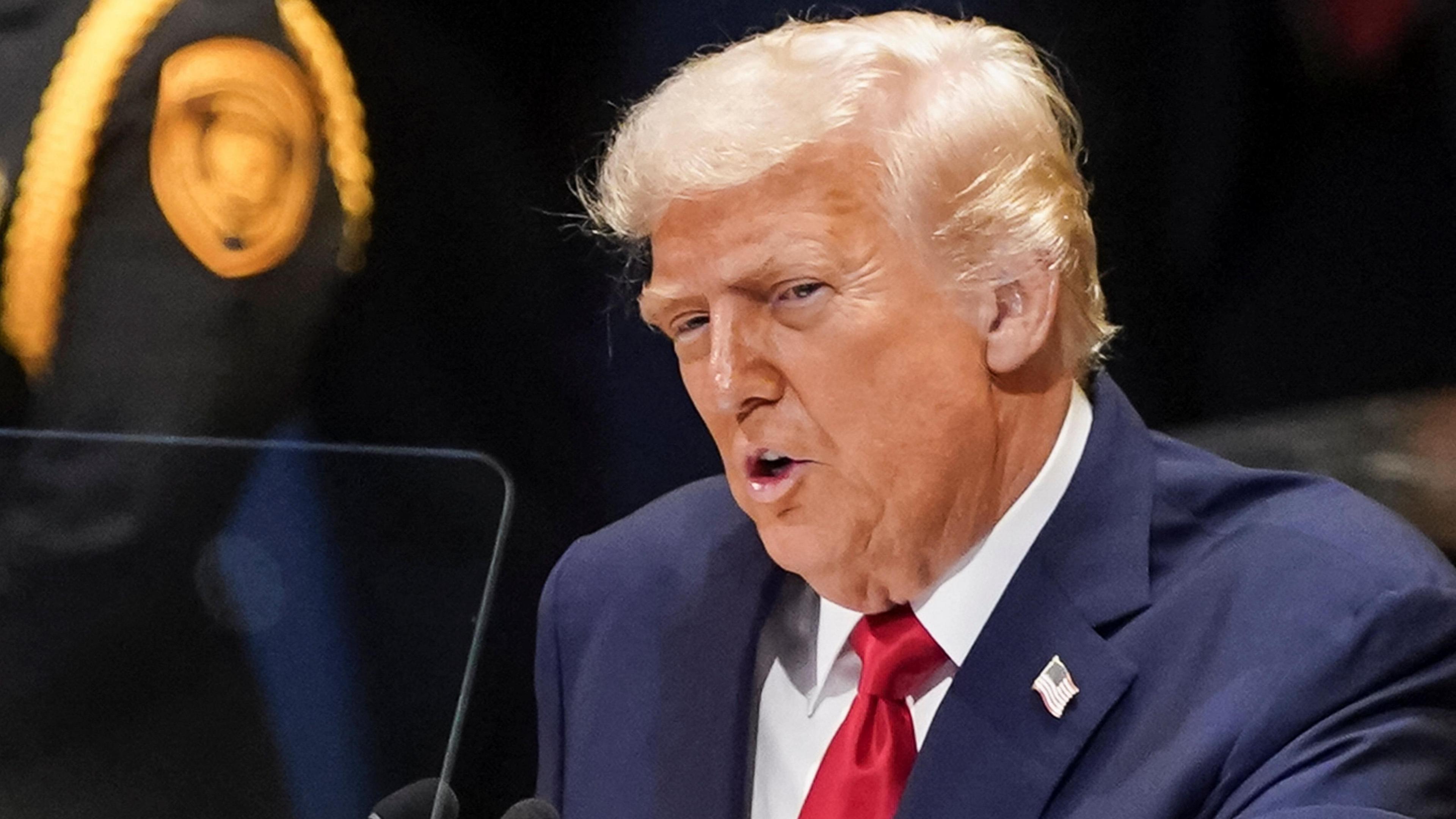
But the most critical part of the President’s attack was not directed at Kimmel’s jokes, but at ABC’s balance sheet and legal standing. Trump escalated the argument from a media skirmish to a political funding controversy, accusing the network of corporate malfeasance.
“He is yet another arm of the DNC and, to the best of my knowledge, that would be a major Illegal Campaign Contribution,” Trump claimed, suggesting that ABC’s willingness to employ a critic was tantamount to illicit political funding.
Then came the explicit legal threat—a direct challenge to Disney’s corporate power and an ominous warning of forthcoming legal battles. Trump referenced a past, undisclosed settlement with a media entity (which he has previously claimed was ABC), asserting a precedent for financial compensation in disputes with the network.
“I think we’re going to test ABC out on this. Let’s see how we do. Last time I went after them, they gave me $16 Million Dollars,” the President posted. “This one sounds even more lucrative. A true bunch of losers!”
The phrase “A true bunch of losers!” became the immediate flashpoint, turning a corporate media decision into a high-stakes, personal grudge match that captivated the cable news cycle and dominated online discourse.
The Host’s Counter-Punch: Using Ratings as Ammunition
Kimmel, who had spent the week in forced silence, did not miss the opportunity to address the President’s threat head-on. In his opening monologue, the host not only defended the value of comedy as a check on power but used the President’s own words—and the record ratings surge that followed—as the ultimate rebuttal.
He sarcastically thanked his “special friend,” the “mad red hatter,” before directly reading the President’s post to the millions who had tuned in. When he got to the part where Trump called the show’s audience “GONE,” Kimmel paused, then delivered his perfect, self-referential retort: “Well, I do tonight!” He then turned the President’s attack into a joke about a political opponent’s incompetence, saying, “He tried his best to cancel me. Instead, he forced millions of people to watch the show. That backfired bigly.”
The host’s ability to parlay the crisis into a ratings victory only intensified the fury, highlighting the precarious nature of using government pressure to silence a comedian. Kimmel correctly pointed out the chilling hypocrisy of the threat, saying, “Only Donald Trump would try to prove he wasn’t threatening ABC by threatening ABC.”
The Stakes: Free Speech and the FCC’s Long Arm
The saga has transcended the typical political circus to raise grave concerns about regulatory capture and the freedom of the press. Trump’s threats followed a clear and distinct pattern: the Chairman of the Federal Communications Commission (FCC), Brendan Carr, an appointee of the Trump administration, had publicly suggested in a podcast appearance that the network faced a choice: “We can do this the easy way or the hard way.” This statement, widely viewed as a thinly veiled threat to a network that relies on government-issued licenses for its local affiliates, immediately preceded the initial decision to suspend the show.
For critics, the President’s subsequent threats—especially his explicit mention of testing ABC and alluding to financial penalties—serve as powerful evidence of an administration attempting to leverage the regulatory power of the FCC to silence dissent on the airwaves.
Furthermore, the episode has exposed the tremendous vulnerability of networks like ABC, who are beholden to large affiliate groups like Nexstar and Sinclair (which owns approximately 25% of all ABC local stations). When these powerful groups sided with the President’s critique and temporarily preempted the show, they gave an explicit demonstration of their power to act as local censors, putting Disney in a devastating no-win situation.
The Jimmy Kimmel Live! crisis is no longer a simple late-night news story. It is a corporate, political, and First Amendment battle of the highest order, where a major media company is being directly challenged by the White House. The unprecedented ratings surge proved that the public is watching every move, but the escalating rhetoric and legal threats from the White House suggest the battle for control over the American airwaves has only just begun.
News
THEY LAUGHED WHEN THE “COFFEE GIRL” ASKED TO SHOOT — BUT WHEN SHE TOUCHED THE GUN OF THAT DIFFICULT RIFLE, A GENERAL CAME UP AND SALUTED HER.
CHAPTER 1: THE INVISIBLE WOMAN Dawn cracks over the Arizona desert like a bruised knuckle—purple, orange, and violent. Captain Emily Brooks woke without an alarm at 0400. She always did. Her body was tuned to a rhythm that didn’t exist…
They Called Her “De3d Weight” And Mocked Her “PTSD” — But When The Commander Whispered Two Words, The “BROKEN” Soldier Didn’t Just Wake Up… She Became The Most Dangerous Person In The Room
Chapter 1: The Dead Weight The brake lights of the transport van burned red against the bleaching sun of the Nevada desert. Staff Sergeant Olivia Harper stepped onto the cracked asphalt, her boots crunching on the grit. She favored her…
MY FATHER ACCUSED ME OF BEING A TRAITOR AND HE TOASTED HIS GLASS FOR IT. BUT UNFORTUNATELY HE CELEBRATED TOO SOON, BECAUSE RIGHT THERE, MY SEAL TEAM BURST IN SAYING, “ADMIRAL, WE’VE ARRIVED”
PART 1: THE ACCUSATION Chapter 1: The Sound of Steel The applause was polite, measured, the kind of sound that fills a room but never actually reaches the heart. It was the sound of Charleston high society pretending to care…
THEY LAUGHED AT THE “OFFICE GIRL” WHO SAID SHE COULD DISARM THE NUKE… UNTIL SHE TYPED IN A CODE THAT DOESN’T EXIST?
PART 1: THE INVISIBLE WOMAN Chapter 1: The Dead Man’s Switch The radio crackles with the sound of a man dying. Then, static. Then, the terrified voice of a corporal screaming into the void. “All units, code black! I repeat,…
THEY RIPPED HER FACE APART TO “SAVE THE UNIVERSE” — The horrifying truth about ancient Egypt’s most terrifying, censored fears that they hid from textbooks that you never knew existed.
PART 1: THE PURIFICATION Chapter 1: The Weight of the Placard The year is 1473 Before Christ. The location is the west bank of the Nile, just outside the sprawling, golden city of Thebes. Dawn is breaking, but it brings…
Jon Stewart SLAMS Desk, Calls Out 25 Hollywood Names on Live TV; The One Line That Sent Panic Across Los Angeles Studios
THE NIGHT THE DAILY SHOW STOPPED LAUGHING: How Eight Heavyweights, One Line, and Twenty Minutes Ignited a National Reckoning On most nights, late-night television functions as America’s unofficial cultural therapy, an escape valve where comedy dilutes the severity of the…
End of content
No more pages to load