The air around the Indiana Fever franchise has been thick with a palpable tension, a blend of hope and fear as the team fights for its playoff life without the singular force of nature that is Caitlin Clark. But as the season ticks toward its final days, the drama has moved from the court to the press conference room, where head coach Stephanie White has reportedly drawn a firm, unyielding line in the sand. Her stark declaration of a “no regression” policy for Clark’s return from injury has set off a firestorm of speculation, putting the WNBA’s biggest star in the middle of a high-stakes standoff with her own team.

On the surface, the statement seems straightforward and even responsible. White has said she wants to see Clark in multiple live, full-contact practices, handling the kind of physical stress and fatigue she will face in a real game, before clearing her to play. The priority, she says, is to ensure there is “no regression” in her recovery. But for a player of Clark’s competitive fire, who has been sidelined for over 16 straight games, this isn’t just a physical test; it’s a mental and emotional one. It’s a test of wills, and it raises a pivotal question that is echoing through every boardroom and broadcast booth in the league: Is White’s policy a strategic move to protect Clark’s future, or is it a sign of a deeper conflict over her immediate return?
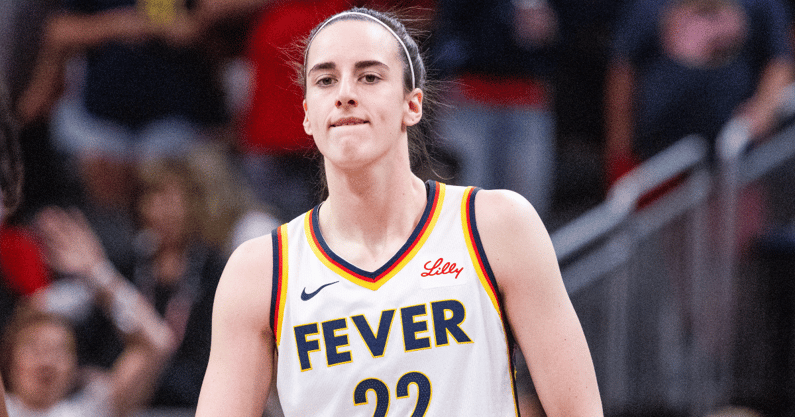
The backdrop to this unfolding drama is a season that has been nothing short of a rollercoaster for Clark. After a historic rookie campaign that saw her shatter records and transform the WNBA’s popularity, her sophomore season has been plagued by a series of devastating muscle injuries. This is her third such issue, with a right groin injury sidelining her since mid-July. With the team fighting to hold on to a playoff spot in a competitive league, the pressure to get their franchise player back on the court is immense. Every fan, every commentator, and every member of the front office is looking at the clock, wondering if she can return in time to make a difference.
“I want to see her in practice, live in practice. I want to see her continue to work to not just build endurance, but to be able to handle contact 94 feet as it’s going to be in-game, and to be able to do that and sustain it from an endurance standpoint, and that’s going to take multiple practices to make sure that there’s no regression,” said White in a report from Indianapolis Star’s Chloe Peterson. “As most of us know, when we get fatigued, we look different, and see how she plays through fatigue.” Peterson noted that “practice opportunities are running low” for the two-time All-Star since the Fever have been prioritizing rest as the regular season comes to a close.

This is where the conflict becomes so compelling. While Clark has been seen participating in non-contact drills, White’s demand for “multiple practices” with full-contact scenarios is a significant hurdle. WNBA teams rarely have extended periods of full-speed, full-contact practice during the final, grueling stretch of the regular season. The tight schedule, constant travel, and physical toll of games make it a difficult, if not impossible, request to fulfill. This has led some to speculate that White’s statement is a strategic move to either buy time or, in a more sinister interpretation, to subtly sideline Clark for the rest of the season without having to make a public announcement that would infuriate fans.
This theory gains traction when you consider the advice of other prominent figures in the sport. WNBA legend Lisa Leslie has been publicly vocal, advising the Fever to resist the urge to play Clark the rest of the season. Leslie, a former player who understands the severity of a groin injury, has stressed that rushing a return could lead to a permanent, career-altering setback. “I would not put Caitlin Clark back on the floor this season,” Leslie stated on CBS Sports, a comment that has added fuel to the fire. Her perspective, rooted in the long-term health of the player, provides a stark contrast to the immediate, desperate need of a team fighting for the postseason.
The Fever’s recent on-court performance without Clark adds another layer of complexity. While they have struggled at times, the team has shown a surprising level of resilience, managing to stay in the playoff race despite missing not only Clark but also several other key players to season-ending injuries. This resilience, while admirable, could be a double-edged sword. It allows the team to survive without their star, but it also creates a narrative that the team can win without her, a narrative that could subtly or not-so-subtly impact the relationship between the coach and the player.
The “no regression” policy is far more than a simple medical update. It’s a test of faith and a battle of wills. It’s a challenge to Clark to prove not just that she can play, but that she can endure. It’s an unyielding demand for a level of physical readiness that may be difficult to achieve under the current circumstances. For a player who has given everything to the game, and who has single-handedly elevated the profile of the WNBA, the idea that she must now prove herself to the same degree as any other player is a controversial one. It puts a microscope on every single one of her movements in practice and every moment of her physical therapy.
As the final games of the regular season draw near, all eyes will be on the Indiana Fever. Not just to see if they can secure a playoff spot, but to see if Caitlin Clark steps back on the court. White’s firm stance, whether it is a protective measure or a calculated gamble, has made the road to her return a difficult and dramatic one. It has turned a medical update into a public standoff, one that could define the legacy of a coach and the long-term future of the league’s biggest star.