The silence in our apartment that night was louder than Carolina’s insults. Carlos paced the living room, his jaw still tight, his hands balled into fists.
“I’m going to call her,” he said for the tenth time.
“And say what, Carlos?” I finally asked, my voice exhausted. I sat on the sofa, still in my dinner dress, feeling the weight of the evening pressing down on me.
“She won’t listen. You know she won’t.”
“I can’t let her talk to you like that, Eliza. ‘Wrong hands’? ‘Not earned’? I know what she meant.”
“I know, too,” I said softly.
“But fighting with her only gives her what she wants. She wants you to choose. She wants to prove I’m dividing the family.”
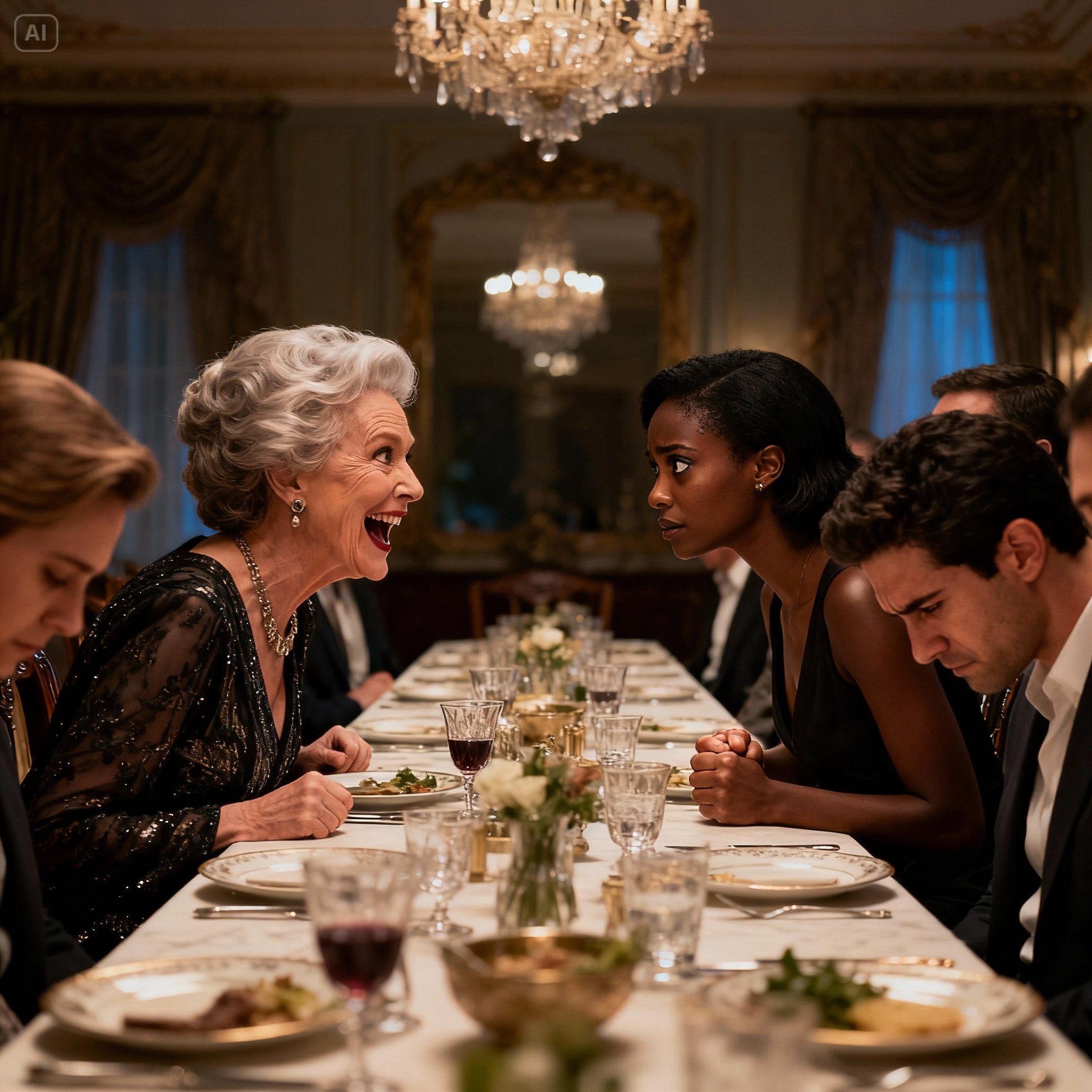
He ran his hands through his hair, his face a mask of frustration and pain. This was the part I hated most—not the insults, but the wedge she relentlessly tried to drive between us. He was a good man, caught between the woman he loved and the mother he, for reasons I struggled to understand, still felt a duty toward.
“It’s not your fault,” I said, walking over and taking his hands.
“You can’t control her. But we can control whether we let her break us. And we won’t.”
He pulled me into a hug, burying his face in my hair.
“I’m so sorry,” he whispered.
“You deserve so much better.”
“I have you,” I said.
“That’s all I need.”
But forgetting wasn’t easy. That dinner was just the opening shot. Over the next few weeks, Carolina’s campaign against me escalated. She called Carlos daily, fabricating stories about me, warning him I was manipulative, that I was isolating him. She spread rumors through their social circle, painting me as a conniving opportunist who had “trapped” her son.
Then came the private investigator.
Carlos found out through a family friend who worked at the security firm Carolina had hired.
“She’s digging into your past, Eliza,” he told me, his face pale with fury.
“She’s looking for dirt. Anything she can use to force an annulment.”
A cold dread settled in my stomach. Not because I had anything to hide, but because of the violation. The sheer, calculated malice of it.
“What did she find?” I asked.
Carlos let out a dry laugh. “Nothing. That’s what’s driving her crazy. The PI’s report was ‘frustratingly clean.’ No debt. No criminal record. No history of… whatever she was imagining.”
“Of course not,” I said.
“I’m just a person who fell in love with your son.”
“She can’t accept that,” Carlos said.
“To her, there has to be an angle. Because in her world, everything is a transaction. She can’t comprehend someone like you loving someone like me for any reason other than money.”
The irony was so thick I could barely breathe. While Carolina was paying a PI to find evidence of my “gold-digging,” I was at my office, my real office, finalizing a deal that would make the entire Peterson fortune look like pocket change.
“The Peterson deal is on the table.”
My CFO, James Chen, slid the prospectus across the glass expanse of my conference table. We were 30 floors above the city, looking down on the very financial district the Petersons had dominated for a century.
“Peterson Company,” I read aloud, my voice betraying nothing.
“As in, Peterson Real Estate Development?”
“That’s the one,” James said, oblivious to the bomb he’d just dropped. “Old money, old-world model. They never diversified, never adapted. Their last three quarters have been a bloodbath. They’re leveraged to the hilt and desperate for a capital injection. They need modernization, and they need it yesterday.”
I stared at the name. Peterson Company. Carolina’s family legacy. The thing she was so determined to “protect” from me. And it was failing.
“What’s our angle?” I asked, flipping through the financials. The numbers were even worse than James had described.
“We need their commercial real estate portfolio for our data center expansion,” he said.
“They have prime locations we can’t get otherwise. It’s a perfect match. We absorb their debt, inject the capital to stabilize them, and leverage their assets for our next-gen infrastructure. They get to survive, we get the real estate. Win-win.”
My mind was racing. The irony. Oh, the delicious, terrible irony. Carolina, who looked at me like I was something she’d scraped off her shoe, was about to have her entire legacy saved by the very woman she despised.
“Do they know who ‘EliTech Innovations’ is?” I asked carefully.
“Do they know who the CEO is?”
James shook his head.
“We’ve been working through intermediaries. Standard procedure for an acquisition of this sensitivity. They just know a major tech fund is interested. The first face-to-face is next week. Why?”
A slow smile spread across my face.
“No reason, James. Just… do your due diligence. Make sure the offer is fair. More than fair. I don’t want this to look hostile.”
“Got it, boss.”
That night, I told Carlos. He sat on the edge of our bed, staring at me as I laid out the prospectus.
“My mother’s company?” he said, stunned.
“You’re… you’re EliTech Innovations? The Eliza Peterson?”
I nodded. “I didn’t want to tell you. Or rather, I didn’t want her to know. I wanted her to like me for me, Eliza. Not for my company, not for my net worth. I wanted her to see that I loved you for you.”
“My God,” he said, running his hands through his hair.
“She’s been accusing you of trying to steal our ‘family legacy,’ and you’ve been… you…” He started to laugh, a wild, incredulous sound.
“You could buy and sell my family ten times over.”
“It’s not about that, Carlos,” I said gently.
“This is just business. A really, really complicated piece of business.”
“Does she know?” he asked, his eyes wide.
“When you meet, will she know it’s you?”
“She has no idea,” I said.
“She just knows a CEO is coming to hear their pitch.”
“Oh, this is… this is going to be a nightmare,” he said, but he was grinning.
“A beautiful, terrible nightmare.”
“It’s purely business,” I repeated, trying to convince myself.
“Whatever personal issues she and I have, I won’t let them interfere with a sound decision. Her company needs help. My company needs assets. It’s simple.”
“Nothing about my mother is simple, Eliza,” he said, his smile fading.
“Be careful. When she’s cornered, she’s vicious.”
“This time,” I said, closing the prospectus, “I’m not the one who should be worried.”
The week before the meeting, Carolina made her final, desperate move. She organized a “small family dinner” and invited Bethany Whitmore, the daughter of an old-money family, a blonde, blue-eyed Wellesley graduate she had clearly picked as Carlos’s ideal replacement wife.
I went. I sat there, nursing a club soda, while Carolina sang Bethany’s praises.
“Bethy’s family owns the Whitmore Gallery,” Carolina gushed, every word a poisoned dart aimed at me.
“Such prestige. Her mother and I were at Wellesley together, you know. Real breeding, a real education. That’s what matters in these circles.”
Bethany looked mortified. “Mrs. Peterson, please…”
“Nonsense, dear!” Carolina waved her hand dismissively, then turned that false, sweet smile on me.
“Where did you attend university, Eliza? You’ve never actually said.”
The table went quiet. Carlos tensed beside me, ready to jump in. I placed a calming hand on his knee and met my mother-in-law’s gaze.
“MIT,” I said simply.
The silence stretched. Carolina’s smile froze.
“I’m sorry, dear?”
“MIT,” I repeated.
“Computer Science and Business Administration. Double major. Then I did my MBA at Stanford.”
Bethany’s eyes lit up.
“MIT? That’s incredible. What year did you graduate?”
“Summa cum laude, class of 2015,” I replied, taking a sip of my soda.
Carolina recovered, her expression hardening.
“How… fascinating. And yet you’ve never worked for any notable companies. One would think with such credentials…”
“Perhaps I was busy building my own path,” I said mildly.
“Yes, in ‘technology,'” Carolina said, the word dripping with disdain.
“So delightfully vague.”
I just smiled. “Soon enough, Carolina, I think you’ll find it’s all very specific.”
The day of the meeting arrived. I dressed with purpose. A deep navy-blue power suit that was all clean lines and quiet authority. The diamond earrings Carlos gave me for our first anniversary—a reminder of why I endured this.
“Are you sure about this?” Carlos asked at the door. He was a wreck, pacing our lobby.
“I’m sure,” I said, kissing him.
“This is just business. Whatever happens, we deal with it together.”
The Peterson Company headquarters was a monument to a bygone era. Marble columns, brass fixtures, portraits of stern-looking Peterson men lining the walls. It smelled of old money and decay.
My team—James and Sarah, our Chief Strategy Officer—flanked me. They felt the nervous energy of a big deal, but they had no idea of the personal drama. As we rode the elevator up, I felt a strange calm settle over me.
“Remember,” I said as the elevator dinged.
“We’re here to present a fair offer. Professional, courteous, firm. Nothing more.”
The boardroom doors opened.
They were all there, the entire Peterson board, a row of grim-faced, gray-suited men. And at the head of the massive, polished table sat Carolina John Peterson.
I watched her face as I walked in. It was a slow-motion cascade of emotions. Confusion. Annoyance at the interruption. And then, dawning, sickening realization.
The color drained from her face. Her perfectly painted-red mouth opened, then closed, then opened again. No sound came out. She looked like she’d seen a ghost.
I walked to the opposite head of the table, placed my briefcase down, and extended my hand to the man beside her, Richard Hayes, the COO.
“Good morning,” I said, my voice clear and pleasant, echoing in the stunned silence.
“I’m Eliza Peterson, CEO of EliTech Innovations. Thank you for meeting with us today.”
“You,” Carolina finally choked out, her voice a strangled whisper.
“Yes, me,” I confirmed, turning my gaze to her. I gestured to my team.
“This is James Chen, our CFO, and Sarah Martinez, our CSO. Shall we begin?”
Carolina was speechless. Utterly, completely speechless. She stared at me, her mind visibly shattering, trying to reconcile the “social-climbing gold digger” she’d insulted at dinner with the woman in the power suit holding the multi-billion-dollar lifeline to her company.
“Carolina?” Richard Hayes asked, looking between us.
“Is there a problem? Do you know… Mrs. Peterson?”
“She’s… she’s my daughter-in-law,” Carolina said, the words sounding like ash in her mouth.
The room exploded in shocked murmurs. Richard Hayes’s eyebrows shot into his hairline.
“Your daughter-in-law? Is the CEO of EliTech? Carolina, why on earth didn’t you mention this?”
“Because,” Carolina whispered, her eyes locked on mine, “I didn’t know.”
I took my seat.
“Gentlemen, Mrs. Peterson. Shall we discuss the merger proposal? I understand you’ve all had a chance to review the terms.”
For the next two hours, I commanded that room. I was no longer Carlos’s wife, no longer the target of her prejudice. I was the CEO. I laid out the financial realities, the strategic advantages of the merger, the path forward. I answered complex questions on data infrastructure, on market integration, on asset leverage. My team was flawless.
Through it all, Carolina just sat there. She was pale, shrunken, silent. She watched me as if I were a stranger, which, I realized, I was. She had never seen me. She had only seen the color of my skin and the lies she’d invented. Now, she was seeing the truth, and it was breaking her.
When the presentation finished, Richard Hayes leaned back, a look of profound relief on his face.
“This is an… exceptional proposal, Mrs. Peterson. Your terms are more than generous. Your vision is exactly what this company needs to survive.”
“I’m glad you agree,” I said.
“We believe this partnership will be mutually beneficial.”
“Partnership?” Carolina finally spoke, her voice hoarse.
“You’re… you’re not taking over?”
“That’s correct,” I said, looking her directly in the eye.
“Despite what you might think, Carolina, I’m not interested in destroying your family’s legacy. I’m interested in helping you save it. While building something greater, together.”
The subtext hung in the air: Despite everything you accused me of.
She understood. Oh, she understood.
“I… I need some air,” she said abruptly, pushing back from the table so fast her chair almost fell. She fled the room.
The rest of the board looked after her, baffled. Richard Hayes turned to me, apologetic.
“My apologies, Mrs. Peterson. Carolina has been under… immense stress. This is all a lot to process.”
“I understand completely,” I said graciously.
“Why don’t we take a fifteen-minute break? Give everyone time to process.”
My team filed out, buzzing with the weird energy, but I stayed, walking to the window. I looked out over the city I had worked so hard to conquer, a city I had built my empire in, while she had been sitting in her marble tower, rotting from the inside.
The door opened. It was Carolina. She looked… small. Defeated. The arrogance was gone, replaced by a deep, hollow shame.
“How long?” she asked quietly.
“I founded EliTech six years ago,” I said, not turning around.
“Right out of Stanford. We went public three years ago.”
“And you never said anything. You let me…” Her voice broke.
“You let me call you…”
“A gold digger? A social climber? A woman who hadn’t ‘earned’ anything?” I finished for her, finally turning to face her.
“Why didn’t you, Carolina? Why didn’t you ever ask me what I did? Why did you just… assume?”
“Because,” she whispered, tears welling in her eyes, “I saw what I wanted to see. I saw a Black woman marrying my son, and I assumed… God, I assumed the worst.”
It was the first time she had ever acknowledged my race out loud.
“You accused me of chasing your son’s money,” I said, my voice cold and even.
“When, as the financials in that prospectus show, my company is currently worth about ten times what your family’s is.”
She flinched. “Why didn’t you tell me? Why didn’t you throw it in my face that night at dinner?”
“Because that would have made me just as petty as you,” I said.
“And because I didn’t want our relationship to be about money. I wanted it to be about family. I wanted you to see me. The real me. But you never gave me a chance.”
“And now I do,” she said bitterly.
“Now I see. And I’ve been a complete and utter fool.”
“Yes,” I said.
“You have. You let your fear and your prejudice turn into cruelty. You didn’t just misjudge me, Carolina. You actively tried to hurt me. To destroy my marriage.”
The tears were streaming down her face now, ruining her perfect makeup.
“I… I don’t know how to fix this. What you must think of me…”
“I think,” I said, taking a breath, “that you are a woman who has been blinded by privilege her entire life. And I think you need to do better. A lot better.”
“I will,” she choked out.
“I swear, I will. Can you… can you ever forgive me, Eliza?”
I looked at her for a long moment. The broken, humbled woman before me.
“I don’t know,” I said honestly.
“Forgiveness isn’t a word, Carolina. It’s an action. You’ve hurt me, and you’ve hurt your son, deeply. You can’t undo that with tears. You can only fix it with work.”
“I’ll do anything,” she pleaded.
“Then start by going back in that room and signing the merger agreement,” I said, my voice shifting back to business.
“Your company is dying. My offer is the only thing that saves it. Can you put aside your pride and your prejudice and do what’s best for your legacy?”
She actually let out a watery laugh.
“You’d still do the deal? After… this?”
“Business is business,” I said, offering a small, tight smile.
“And unlike you, I don’t let personal feelings interfere with a sound financial decision.”
She wiped her eyes, took a deep, shaky breath, and nodded.
“Okay. Okay. Let’s… let’s save my company.”
The year that followed was… complicated. The merger went through. I placed two of my best people on the Peterson board and began the long, hard work of modernizing their operations.
Carolina did the work. She started therapy, real, intensive therapy, to unpack her racism and classism. She wrote me a long, painful letter of apology. She wrote Carlos an even longer one. She stopped trying to explain her behavior and started trying to change it.
She started volunteering. She, Carolina John Peterson, started mentoring young, inner-city entrepreneurs. Women of color, mostly. She used her connections not for status, but to open doors for them. She was, as she’d told me, “humbled” every single day.
We had dinners. Tentative ones at first. Just the three of us. No audience. The conversations were stilted, then slowly, they became real. She asked me about my work, and this time, she actually listened.
It wasn’t forgiveness, not all at once. It was a slow, deliberate rebuilding of something new. Something better.
A year after the boardroom meeting, I stood on the stage at the Women in Technology Leadership Conference, the keynote speaker.
“When I started EliTech Innovations,” I said, my voice filling the ballroom, “I faced every barrier you can imagine. Investors who assumed I was the assistant. Men who called me ‘aggressive’ for having an opinion. A world that constantly told me, in a thousand different ways, that I did not belong.”
I scanned the crowd, 500 powerful women looking back at me.
“Your worth is not determined by other people’s perception of you,” I continued.
“You define yourself. And when people underestimate you… you let that be your fuel. You prove them wrong. Not with words, but with excellence. You build something so remarkable that it simply cannot be ignored.”
In the front row, Carlos squeezed his mother’s hand. Carolina was watching me, her eyes bright with tears, but she was smiling. A real, proud smile.
“I learned that lesson from many places,” I said, my gaze finding hers.
“Including from someone who judged me more harshly than anyone. Someone who had to confront their own biases in the most public, painful way possible. And she taught me that change is possible. That prejudice can be unlearned. That we are all capable of growth, if we are brave enough to do the work.”
I smiled. She smiled back.
As I walked off stage, Carlos hugged me so tight I could barely breathe. And then Carolina stepped up.
“Thank you,” she whispered, pulling me into a hug.
“For not destroying us when you could have. For… giving me a chance to be better.”
“Thank you,” I whispered back, “for actually doing it.”
We left the ballroom together—my husband, my mother-in-law, and me. It wasn’t perfect. It wasn’t a fairy tale. But it was real. We were a family, not one based on old blood or old money, but one forged in fire, rebuilt on a foundation of honesty, respect, and the hard, necessary work of change.
News

THEY LAUGHED WHEN THE “COFFEE GIRL” ASKED TO SHOOT — BUT WHEN SHE TOUCHED THE GUN OF THAT DIFFICULT RIFLE, A GENERAL CAME UP AND SALUTED HER.
CHAPTER 1: THE INVISIBLE WOMAN Dawn cracks over the Arizona desert like a bruised knuckle—purple, orange, and violent. Captain Emily Brooks woke without an alarm at 0400. She always did. Her body was tuned to a rhythm that didn’t exist…

They Called Her “De3d Weight” And Mocked Her “PTSD” — But When The Commander Whispered Two Words, The “BROKEN” Soldier Didn’t Just Wake Up… She Became The Most Dangerous Person In The Room
Chapter 1: The Dead Weight The brake lights of the transport van burned red against the bleaching sun of the Nevada desert. Staff Sergeant Olivia Harper stepped onto the cracked asphalt, her boots crunching on the grit. She favored her…

MY FATHER ACCUSED ME OF BEING A TRAITOR AND HE TOASTED HIS GLASS FOR IT. BUT UNFORTUNATELY HE CELEBRATED TOO SOON, BECAUSE RIGHT THERE, MY SEAL TEAM BURST IN SAYING, “ADMIRAL, WE’VE ARRIVED”
PART 1: THE ACCUSATION Chapter 1: The Sound of Steel The applause was polite, measured, the kind of sound that fills a room but never actually reaches the heart. It was the sound of Charleston high society pretending to care…

THEY LAUGHED AT THE “OFFICE GIRL” WHO SAID SHE COULD DISARM THE NUKE… UNTIL SHE TYPED IN A CODE THAT DOESN’T EXIST?
PART 1: THE INVISIBLE WOMAN Chapter 1: The Dead Man’s Switch The radio crackles with the sound of a man dying. Then, static. Then, the terrified voice of a corporal screaming into the void. “All units, code black! I repeat,…

THEY RIPPED HER FACE APART TO “SAVE THE UNIVERSE” — The horrifying truth about ancient Egypt’s most terrifying, censored fears that they hid from textbooks that you never knew existed.
PART 1: THE PURIFICATION Chapter 1: The Weight of the Placard The year is 1473 Before Christ. The location is the west bank of the Nile, just outside the sprawling, golden city of Thebes. Dawn is breaking, but it brings…

Jon Stewart SLAMS Desk, Calls Out 25 Hollywood Names on Live TV; The One Line That Sent Panic Across Los Angeles Studios
THE NIGHT THE DAILY SHOW STOPPED LAUGHING: How Eight Heavyweights, One Line, and Twenty Minutes Ignited a National Reckoning On most nights, late-night television functions as America’s unofficial cultural therapy, an escape valve where comedy dilutes the severity of the…
End of content
No more pages to load