PART 1: THE ACCUSATION
Chapter 1: The Sound of Steel
The applause was polite, measured, the kind of sound that fills a room but never actually reaches the heart. It was the sound of Charleston high society pretending to care about service while checking their watches.
I smiled for the cameras and stepped onto the stage, my heels clicking against marble that gleamed like ice beneath the massive crystal chandelier. The ballroom was a sea of black tuxedos and shimmering evening gowns, punctuated by the stark, crisp white of naval dress uniforms.
The cello swelled somewhere behind me—a soft, graceful melody I barely heard. My pulse was steady. I had stood under missile fire in the Persian Gulf and guided destroyers through hurricanes in the Atlantic. I had stood under searchlights that blinded you and heat that melted the rubber soles of your boots. I could handle a chandelier in the front row.
Or so I thought.
I adjusted the microphone stand. The light pressed down, heavy and golden. In the front row, reserved for immediate family, my father sat.
Harold Porter.
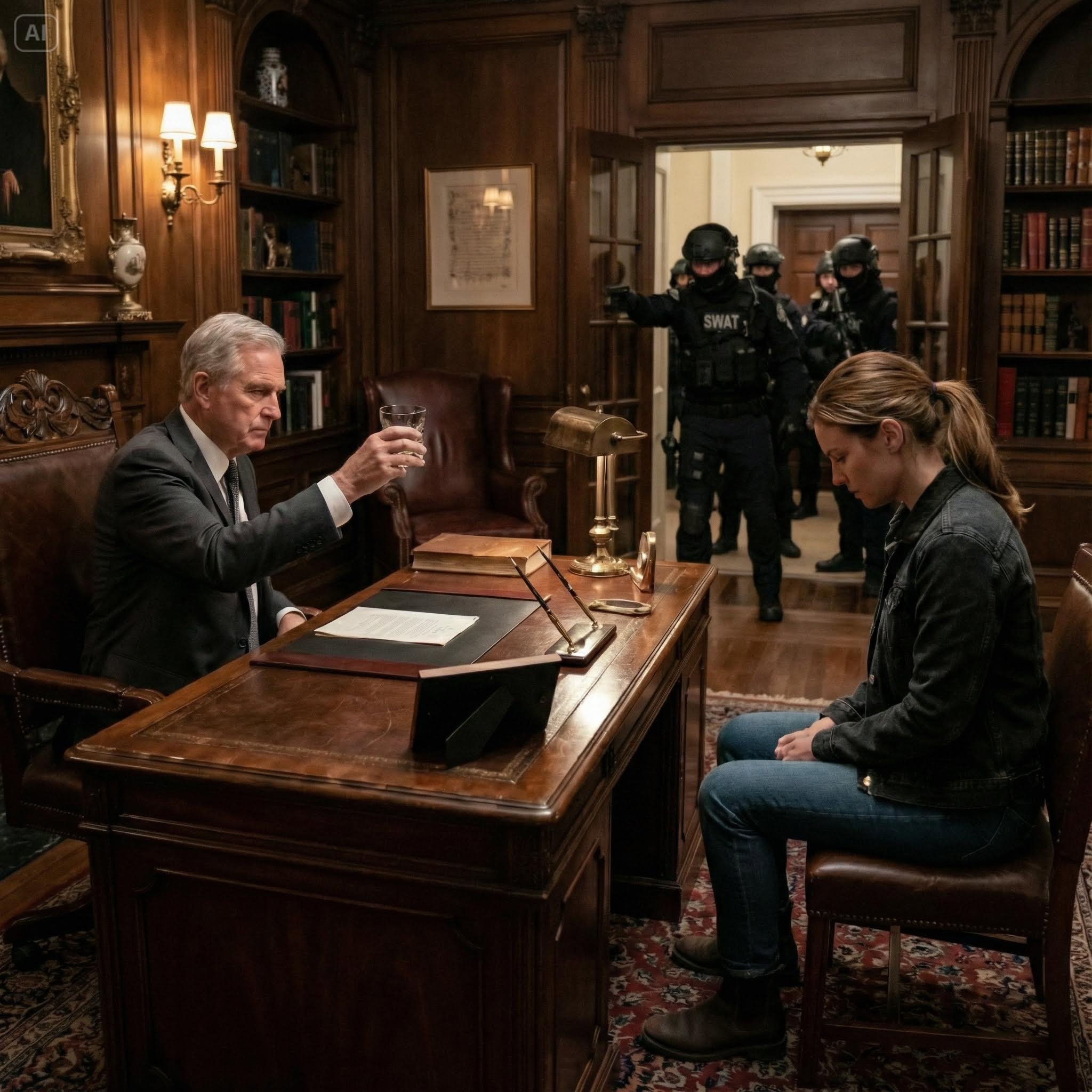
He was watching me, but not with the pride you would expect from a parent seeing their daughter promoted to Admiral. His eyes were sharp, glittering with something colder than pride. Something that looked a lot like hunger. He held a glass of whiskey in his hand, the amber liquid tilting dangerously as he leaned forward.
My mother sat two tables away, refusing to look at him, staring at her hands folded in her lap. She knew. She always knew when his storms were brewing, even if she didn’t know the category yet.
The Master of Ceremonies, a Senator with a smile too big for his face, leaned into the podium.
“And now, we honor Admiral Evangeline Porter, for her unwavering dedication to—”
The microphone cracked. It wasn’t a feedback squeal. It was a hard, static pop. Then silence.
The cello stopped.
From the side aisle, two men in dark suits appeared. They didn’t walk; they cut through the crowd like blades through silk. They weren’t hotel security. They weren’t local police. They were Federal Agents. I recognized the walk. I recognized the lack of hesitation.
They climbed the stairs to the stage. The Senator stepped back, confused.
The first agent spoke. His voice didn’t need a microphone. It carried through the hall, metallic and final.
“Evangeline Porter. You are under arrest for treason against the United States.”
The word hung in the air like smoke. Treason.
Every sound in the room vanished. The glasses froze halfway to lips. The expensive perfume in the air suddenly turned bitter. I didn’t move. I couldn’t. It felt like the floor had opened up and swallowed the world I knew.
“Turn around,” the agent commanded.
I did as I was told. I had given orders my whole life; I knew how to take them. I placed my hands behind my back. The cold metal of the handcuffs clicked shut. Click. Click. Cruel and perfect. The sound echoed off the marble.
I had been saluted in war zones. I had been given medals by Presidents. But I had never been handcuffed in a ballroom.
And then came his voice.
“I am the one who reported her!”
It came from the front row. My father stood up. He lifted his whiskey glass high, catching the light so the cameras could see the toast. A ripple of gasps moved through the room. Camera flashes burst like mortar fire, blinding me.
“I reported her,” he said again, louder this time, making sure the reporters in the back got the sound bite.
“No one stands above the flag. Not even my daughter.”
I froze. I stared at him. This was the man who had taught me how to salute. The man who had taught me that honor was the only currency that mattered. And I watched him spend me like loose change to buy himself a moment of attention.
I didn’t cry. I didn’t speak. I simply stared at him.
As the agents led me away, gripping my biceps with bruising force, someone in the crowd shouted, “Traitor!”
I didn’t look back. But as we marched down the long corridor toward the service exit, I heard a faint rhythm. Boots. Moving in an even cadence. Familiar. Deliberate. It wasn’t the police. It was a sound I hadn’t heard in years, a specific weight of step that belongs to operators.
For a moment, I thought I knew who they belonged to. But I dismissed it. Hope is a dangerous thing when you’re wearing cuffs.
Outside, beneath the marble arch of the hotel entrance, the night air hit me—cold and clean. It smelled of the Charleston salt marsh. Behind me, I heard my father’s laughter floating through the open doorway. It was quiet, satisfied laughter.
It wasn’t the first time he had enjoyed seeing me fall.
Chapter 2: The Knot and the Anchor
Humiliation isn’t defeat. It’s the heat that forges you—or melts you. And my father had been turning up the heat since I was sixteen years old.
The smell of salt and engine oil still clings to my memories of that old wooden house by the Charleston Harbor. It was a place held together by termites and resentment. My father’s medals, tarnished and dusty, hung crookedly on the living room wall like ghosts of a life that had slipped away from him.
I remember being sixteen, barefoot on the dock, the wood slick with algae. My hands were raw, bleeding from the hemp rope as I tried to tie a line around the boat cleat against a chopping current.
The rope slipped. The boat drifted three inches.
“Useless!” he barked from the porch.
I flinched. “I’m trying, Dad.”
“You’ll never make it in the Navy if you can’t tie a knot,” he sneered, taking a swig from his flask.
“You don’t have the hands for it. You don’t have the stomach.”
He wasn’t teaching me a skill. He was testing how much humiliation I could take before I broke. He wanted me to quit. He wanted me to be weak, because if I was weak, his own failures wouldn’t look so stark by comparison.
Years later, the sound of his temper stayed sharper than any drill sergeant’s whistle.
In 1988, when the rescue vessel went down off Cape Romain, I was home from college on break. I listened from behind a cracked door as he shouted into the phone.
“They’re framing me because I wouldn’t play their game!” he screamed.
“I’m a hero, dammit!”
The newspaper he threw hit the wall and slid down like a defeated flag. One of his old medals—a commendation for bravery—fell from its nail and hit the floor with a dull metallic ring. Clink.
That sound followed me into adulthood.
At my graduation from Annapolis, the Naval Academy, the chair marked “Family” sat empty. My mother was there, weeping silently in the back, but his seat was a void. Later, she mailed me a photo of that vacant seat with a note scrawled in her soft, trembling handwriting: I’m proud of you. He is too, in his own way.
It was a lie. We both knew it.
I should have been proud of him, too. Every daughter wants to view her father as a titan. But when I finally got my security clearance, years later, I pulled his old personnel file. I wanted to prove he was the hero he claimed to be.
I learned the truth in black and white type.
He hadn’t been framed. He hadn’t been a martyr for the truth. He had been caught selling Navy rescue equipment for cash to pay off gambling debts. He was stripped of his commission and discharged.
To his neighbors, he said he was punished for “speaking truth to power.” It was the first lie I knew he would die believing. He had built a fortress out of that lie, and he lived inside it, bitter and angry at a world that refused to acknowledge his imaginary greatness.
When I came home after my first deployment, wearing my dress whites, he greeted me with that same familiar bitterness.
“You think you’re better than me because you wear white?” he asked, not even looking up from his TV program.
“I think I’m just doing the job you taught me to love, Dad,” I said quietly.
He turned then, his eyes narrowing. “I taught you obedience, Evangeline. Not ambition.”
That was the night our bond turned into a border. He measured every success of mine as another failure of his. My promotions were insults. My medals were accusations.
I didn’t know then that he would someday try to even the score. I didn’t know that his jealousy would eventually find a partner with deep pockets.
The setup started with an email. It came early one morning, a local headline flashing across my tablet screen while I drank my coffee.
FROM CORRUPT FATHER TO DECORATED DAUGHTER: THE PORTER LEGACY.
I clicked it before I could think. The article was cruel in its accuracy. It recounted things only someone inside our house would know—the arguments, the drinking, the specific nature of his discharge. It painted him as a monster and me as the saint who survived him.
My stomach twisted between anger and pity. I hadn’t sanctioned this. I hadn’t spoken to a reporter.
The story might have cleared my name by exposing his, but it left him naked to the world. I said nothing. Silence felt safer than truth.
He read it that afternoon. I could hear the fury through the phone before I even picked up.
“You think you can wash me off your uniform?” he shouted. I could hear him slamming something heavy in the background—maybe a bottle, maybe a fist. “You think you’re untouchable?”
“Dad, I didn’t write that,” I tried to explain.
“Liar!” he screamed. His rage sounded younger than his years, almost desperate. “You want to be the hero? Fine. But heroes have to fall eventually.”
A week later, a friend of mine in the MPD told me he’d seen my father in a dim bar by the docks. He was half-drunk, telling a stranger how his daughter had turned against him for a headline.
The stranger was nodding, buying him another drink. Top shelf.
“Let me help you tell your side,” the stranger said, his voice smooth, practiced, serpentine.
My father, craving redemption like a starving man craves bread, believed him.
I didn’t learn until much later that the man worked for Atlantic Forge—the massive defense conglomerate that had just lost a billion-dollar contract because I refused to sign off on their faulty radar systems. They needed me gone. And they found the perfect weapon to destroy me.
A weapon that lived in my childhood home.
One night, with the rain coming down sideways, I drove past his house. The porch light burned bright through the thin, yellowed curtains. I saw him on the phone, pacing, gesturing, alive with a purpose he hadn’t felt in years.
I rolled down my window slightly. The wind carried his voice.
“Yes, I have access. She tells me things. I was in the service, too,” he said, pride tightening his throat. “I know where she keeps the files.”
I didn’t get out of the car. I sat there until the rain blurred everything into one gray sheet.
Some wars start at home before they ever reach a battlefield.
The next morning, an email waited in my secure government inbox. No subject line. No sender’s name. Just one attachment.
I opened it without thinking.
That was the moment the trap began to close.
PART 2: THE EVIDENCE OF BETRAYAL
Chapter 3: The Digital Fingerprint
The rain in Washington was the color of gunmetal, streaking the reinforced windows of the Pentagon as I walked through security. I had walked these halls a thousand times. The polished floors, the smell of floor wax and old paper, the hushed conversations of men and women deciding the fate of nations.
Usually, I walked with the stride of an Admiral—purposeful, greeted by salutes. Today, the air felt different. The salutes were hesitant. Eyes darted away.
I had been called in for an “emergency summons.” In my world, that usually meant a rogue state had launched a missile or a submarine had gone dark. It didn’t usually mean me.
A uniformed officer I didn’t recognize met me at the checkpoint. He didn’t salute. He handed me a sealed envelope marked FOR YOUR EYES ONLY.
“Admiral,” he said, his voice flat. “You are to report to Internal Investigations immediately. Room 304.”
Room 304. The room where careers go to die.
I opened the envelope. Inside was a single printed email. It was a transfer of classified coordinates regarding the Atlantic Defense Route—the exact radar blind spots I had been fighting to keep out of Atlantic Forge’s hands.
At the bottom of the page, there was a digital timestamp and a user ID.
USER: ADM. E. PORTER. IP ADDRESS: [REDACTED]
For a moment, I couldn’t breathe. The hallway spun. I hadn’t sent this. I hadn’t even accessed those files in six months. But the metadata was there.
In my world, betrayal is measured in keystrokes, not bullets.
Someone had built a shadow of me. They had created a perfect clone of my digital identity and used it to commit treason. And they had done it from a device that traced back to a civilian IP address in Charleston, South Carolina.
My father’s house.
The realization hit me harder than any physical blow. He hadn’t just “reported” me. He had allowed someone to use his home, his internet connection, perhaps even his own computer, to frame me.
Chapter 4: The Signature
The interrogation room smelled like recycled air and stale anxiety. There were no windows. Just a steel table, three chairs, and a red light blinking on the recording device between us.
Two agents from the Naval Criminal Investigative Service (NCIS) sat across from me. They looked tired. They didn’t look like enemies; they looked like men doing a job they hated.
One slid a manila folder across the cold metal table.
“Admiral Porter,” the lead agent said. “We have received sworn testimony regarding your handling of classified materials.”
“Testimony from whom?” I asked, though I already knew the answer. My voice was steady, but my hands, hidden under the table, were clenched so tight my nails were cutting into my palms.
“Your father, Harold Porter.”
The words cracked something deep inside my chest. It wasn’t just the betrayal; it was the intimacy of it.
“What exactly did he say?” I asked.
The agent opened the folder. “He stated that you have been working beyond your clearance level. He claims you brought classified drives to his home. He claims you were… frantic. Paranoid. That you were trying to hide files from oversight committees.”
I almost laughed. It was a projection. A perfect mirror image of his own past crimes. He never understood the difference between secrecy and shame.
“He is lying,” I said. “He is a discharged officer with a history of fraud. You know this.”
“We know his record, Admiral,” the agent said gently. “But he isn’t just offering words. He provided the physical drive. He said he found it in your bag during your last visit.”
My blood ran cold. I hadn’t brought a bag to his house in years. I kept my distance precisely to avoid this kind of entanglement.
“Show me the statement,” I demanded.
They pushed a photo across the table. It was a “Citizen Witness Statement.” At the bottom, in shaky but certain blue ink, was his signature. Harold Porter.
It was the first written proof that my father had turned against me. He had signed his name to my destruction.
“He didn’t find a drive,” I said quietly. “Someone gave it to him. Someone from Atlantic Forge.”
The agents exchanged a look. “That’s a serious accusation, Admiral. Do you have proof?”
“No,” I said. “But I will.”
In the hallway afterward, stripped of my badge and placed on administrative leave pending the investigation, a young officer saluted me as I walked toward the elevator.
“I only told them what I found on the server logs, Ma’am,” she whispered as she passed.
It was Sarah Quinn. One of my own subordinates. A bright girl I had mentored. I had once reprimanded her for leaving her terminal unsecured. Now, she was the one who had flagged the “breach.”
The irony stung like salt in a wound. Even my own team was being turned against me.
The elevator mirrors threw my reflection back at me. My uniform was immaculate. My ribbons were straight. But my eyes were hollow.
A uniform can protect you from bullets. It can protect you from the cold. But it cannot protect you from your own blood.
Chapter 5: The Patriot and the Pariah
That night, in my government-assigned quarters, the phone rang. It was the landline—the one I rarely used.
“Evangeline?”
My mother’s voice trembled through the static. She sounded small, terrifyingly fragile.
“Mom,” I said. “Tell me you aren’t part of this.”
“I… I didn’t know until today,” she wept. “Your father… he’s on TV again, Evie. He’s on the news. He says you’ve shamed the flag.”
I walked to the window. I watched the Potomac River roll by, dark and indifferent.
“He’s confused, Mom. He’s being used.”
“No,” she whispered. “He isn’t confused. He’s happy. He feels important again. He says… he says he’s saving the Navy from you.”
I hung up. I couldn’t bear to hear it. I turned on the television.
There he was.
My father sat under studio lights that were far too bright for honesty. He was sitting next to a man introduced as an “Independent Investigative Journalist.” I recognized the journalist immediately—he had written three hit pieces on me in the last month. And his tie bore the discreet silver pin of Atlantic Forge.
“No one stands above the flag,” my father declared to the camera, his chest puffed out. “Not even my daughter. It broke my heart to turn her in. But duty comes first.”
He didn’t need to look into the camera. He already knew the country was watching. Truth was never his audience. Applause was.
I turned off the TV. I sat in the darkness of my apartment. The silence was heavy, suffocating.
My computer screen lit up. A message appeared on my secure line—the one that was supposed to be monitored by NCIS, the one I shouldn’t have been able to access.
No subject. No sender. Just six words.
THEY’RE WATCHING THE WRONG TERMINAL. – E.
My heart jumped. E.
Ethan Graves.
Ethan was a ghost. Former SEAL Team 6, then moved to darker work. We had worked together in Syria when I was an intelligence officer. He was the only man I knew who could hack a satellite while taking fire.
My phone buzzed. An unlisted number.
“Ma’am,” Ethan’s voice came through, low and steady. “Don’t speak. Just listen.”
“Ethan, they took my clearance. I’m—”
“I know,” he cut me off. “The leak wasn’t an accident. And it wasn’t just your father. You’re the target, not the enemy. Atlantic Forge is buying senators, and they’re buying headlines. You are the audit they can’t afford.”
“My father gave them the drive,” I said.
“Your father gave them the distraction,” Ethan corrected. “They planted a ghost code in the NATO system two weeks ago. It mimics your signature. It’s been routing contracts to Forge subsidiaries automatically.”
“How long do I have?”
“Two weeks,” Ethan said. “Long enough for them to bury you in a court-martial. Long enough for the ink to dry on the new contracts.”
“What do we do?”
“We go to Charleston,” Ethan said. “The source of the rot is in that house. And the proof is in the payment.”
“Payment?”
“Your father didn’t do this for free, Evangeline. Even patriots have a price.”
The line went dead.
I packed a bag. I left my uniform in the closet. I drove south, through the rain, back to the city that raised me. Back to the harbor where I learned to tie knots.
I had survived wars overseas. Now I was fighting one built from emails, egos, and the broken pieces of my family history.
And I was done playing by the rules.
PART 3: THE RECKONING
Chapter 6: The Price of a Soul
Charleston smelled of pluff mud and old money. I met Ethan in a diner off King Street. He looked like every other tourist—baseball cap, t-shirt—but his eyes scanned every entrance.
“We need the money trail,” he said, sliding a laptop across the table. “We know Forge paid him. We need to prove where it went.”
My father wasn’t a digital man. He didn’t use Bitcoin. He didn’t use offshore accounts. He used a local bank where the tellers knew his name.
I walked into the branch an hour later. The manager, a woman named Mrs. Gable who had known me since I was a girl, looked pale when she saw me. She knew the news. She knew I was a “traitor.”
“I need to see the transaction history for the joint account,” I said softly. My name was still on it, a relic from when I handled his finances during his first rehab stint.
She hesitated, then turned her screen. She whispered, as if the walls were listening.
“Your father withdrew thirty thousand dollars in cash yesterday. He said it was for… legal fees.”
I looked at the deposit that had preceded the withdrawal. It wasn’t from a law firm. It was a wire transfer from a shell company: AF SYSTEMS LLC.
Atlantic Forge.
The smell of the ink on the receipt felt like betrayal. He hadn’t just turned on me for principle. He had sold me. He had finally found the price of his pride: thirty thousand dollars. It was cheap.
That evening, I went to my mother’s house. She met me at the door, her face gray with exhaustion.
“He told me it was for a documentary,” she wept, holding onto the doorframe. “He said they were paying him for the rights to his story. To tell the world how he raised an Admiral.”
“He knew, Mom,” I said, my voice shaking. “He knew who they were.”
“He wanted to believe them,” she whispered. “He’d rather see you in prison than see himself as wrong. He’d rather be the father of a traitor than the father of a hero who outshined him.”
I drove to the pier that night. The wind was whipping off the harbor. I stared at his old boat, the Redemption. It was listing to the side, neglected.
“You left more than a rope loose, Dad,” I whispered to the dark water. “You left the truth untied.”
My phone buzzed. It was Ethan.
“I found the ghost code,” he said. “It’s embedded in the NATO logistics server. It’s mimicking your digital signature, approving shipments of faulty radar tech from Forge. If we don’t kill it, the fleet goes blind in the Atlantic.”
“How do we stop it?”
“We don’t,” Ethan said. “We let it run. We let them think they’ve won. And then we catch them holding the smoking gun.”
Chapter 7: The Trap
The next morning, a black SUV pulled up alongside me as I was walking near the Battery. The window rolled down.
It was the “journalist.” The man who had interviewed my father on TV.
“Admiral Porter,” he said, smiling like a shark. “You look tired.”
“I’m surprised you’re this close to a military installation,” I said. “Isn’t your handlers’ leash shorter than this?”
He laughed. “We can make this go away, Evangeline. Just resign. Plead guilty to a lesser charge—mishandling of information. We’ll clear your name eventually. We just need you out of the contract review board.”
“And my father?”
“He gets to be the hero,” the reporter said. “The Citizen Patriot of the Year. Everyone wins.”
“Leak the truth,” I said, staring him down. “Or I will.”
He stopped smiling. “You have no leverage. You’re a disgrace. Your own father said so.”
He rolled up the window and drove away.
I touched the small button on my collar. “Did you get that, Ethan?”
“Loud and clear,” Ethan’s voice crackled in my ear. “Attempted bribery, conspiracy, and admission of a setup. We have them.”
But a recording wasn’t enough. We needed a stage.
The “Charleston Veterans Tribute Gala” was scheduled for the next night. It was the same event, the same organization that had hosted the disaster where I was arrested. But this time, the guest of honor wasn’t me.
It was my father. He was receiving a special civilian award for “Integrity in Defense.”
It was perfect.
I sent my final report to the Department of Defense. No names. No begging. Just one line: Integrity is the last uniform we wear.
Then I called my father.
He answered on the first ring.
“Dad,” I said.
“Are you calling to confess?” he asked. His voice was filled with a sickly kind of triumph.
“I’m calling to tell you that tomorrow is your stage again,” I said. “Let’s see who tells the better truth.”
Chapter 8: The Final Salute
The chandeliers blazed like a second sun. The ballroom was packed again. The same people who had watched me be cuffed were now gathered to applaud the man who did it.
My father stood at the podium. He looked better than he had in years. New suit—bought with blood money. Hair trimmed. He gripped the microphone, soaking up the flash of the photographers as if it were oxygen.
“My daughter may wear a uniform,” he said, his voice booming. “But I wear the truth. It was the hardest thing I’ve ever done, but I did it for this country.”
The audience applauded. They clapped for a man who mistook confession for courage.
I stood in the back of the room, in the shadows. I was dressed in civilian clothes—a simple black dress. No medals. No rank. Just me.
“Now,” Ethan whispered in my earpiece.
The double doors at the back of the hall swung open with a crash.
The room fell silent.
A line of Navy SEALs marched in. They were in dress uniforms, black and gleaming, white gloves clasped tight. They moved as one body—thud, thud, thud. A rhythm of absolute power.
They weren’t there to arrest me.
At the front was Ethan Graves, looking every inch the Commander he used to be.
“Harold Porter!” Ethan’s voice rang through the marble hall like an order from God. “We are here.”
Every head turned. The spotlight shifted, sliding off my father and locking onto the line of soldiers.
My father froze. “What is this?”
“This is Operation Evergreen,” Ethan said, holding up a folder sealed in red wax. “Authorized by the President of the United States. Admiral Porter’s clearance has been extended to NATO security operations. All allegations of unauthorized activity are void.”
Murmurs rippled through the room.
“And,” Ethan continued, stepping onto the stage, looming over my father, “we are here to execute a warrant for the arrest of the executives of Atlantic Forge.”
On the massive screens behind the stage—where my father’s face had just been projected—the image changed.
It was the video from the black SUV. The reporter’s voice boomed over the speakers: “We just need you out… He gets to be the hero… We can make this go away.”
Then, a document appeared on the screen. The bank transfer. AF SYSTEMS LLC -> HAROLD PORTER: $30,000.
The room gasped. It sucked the air out of the hall.
My father’s hand trembled. He dropped the microphone. It hit the floor with a screech of feedback. The whiskey glass on the podium tipped over and shattered.
I stepped out of the shadows. I walked down the center aisle. The crowd parted for me like the Red Sea. I didn’t look at them. I looked at him.
I walked up the stairs. I stood next to Ethan.
“You reported me for doing the job you taught me to love, Dad,” I said, my voice amplified by the silence of five hundred people.
He couldn’t lift his head. He looked small. He looked old.
I turned toward the room. “Tonight was meant to honor truth. Let’s start there.”
The SEALs behind me snapped to attention. They saluted. Not him. Me.
Federal agents moved in from the wings—the real ones this time. They bypassed me and went straight for the Atlantic Forge executives sitting at Table 1. Handcuffs clicked. Justice was loud.
My father sank into his chair on the stage, burying his face in his hands.
Chapter 9: The Empty Chair
The night after, the gala tasted of salt and regret. The music had faded.
Behind the hotel, by the seawall, my father sat alone on a stone bench. His tie was loose. He was staring at the harbor lights.
I walked toward him.
“They told me you were dirty,” he said, his voice rough, like he was swallowing glass. “They said they had proof.”
“You wanted to believe it,” I answered quietly. “It made you feel noble again.”
He looked up. His eyes were rimmed with red. “I just wanted to be right. Just for once. I wanted to be the one who mattered.”
“Being right isn’t the same as being good, Dad.”
He looked down at his hands. “I sold you. For thirty grand and a round of applause.”
“Yes. You did.”
We sat in silence for a long time. The wind blew off the water.
My mother stepped out from the shadows. She didn’t yell. she didn’t scream. She just walked over and rested her hand on his shoulder.
“You can still choose who you are tomorrow, Harold,” she said.
He broke then. He wept—ugly, shaking sobs that echoed off the stone.
“I don’t need you to apologize,” I said, standing up. “I just need you to stop rewriting who I am.”
My phone buzzed. It was a text from the Secretary of the Navy. Reinstated. Full honors.
I walked away. I left him there with my mother.
Forgiveness isn’t surrender. It’s the moment you stop living inside someone else’s sin.
The next morning, I stood by the harbor. I took the photo—the one of the empty chair at my graduation—out of my wallet. I looked at it one last time.
Then I dropped it into the water.
Reckoning isn’t punishment. It’s the first honest page of the rest of your life.
News
THEY LAUGHED WHEN THE “COFFEE GIRL” ASKED TO SHOOT — BUT WHEN SHE TOUCHED THE GUN OF THAT DIFFICULT RIFLE, A GENERAL CAME UP AND SALUTED HER.
CHAPTER 1: THE INVISIBLE WOMAN Dawn cracks over the Arizona desert like a bruised knuckle—purple, orange, and violent. Captain Emily Brooks woke without an alarm at 0400. She always did. Her body was tuned to a rhythm that didn’t exist…
They Called Her “De3d Weight” And Mocked Her “PTSD” — But When The Commander Whispered Two Words, The “BROKEN” Soldier Didn’t Just Wake Up… She Became The Most Dangerous Person In The Room
Chapter 1: The Dead Weight The brake lights of the transport van burned red against the bleaching sun of the Nevada desert. Staff Sergeant Olivia Harper stepped onto the cracked asphalt, her boots crunching on the grit. She favored her…
THEY LAUGHED AT THE “OFFICE GIRL” WHO SAID SHE COULD DISARM THE NUKE… UNTIL SHE TYPED IN A CODE THAT DOESN’T EXIST?
PART 1: THE INVISIBLE WOMAN Chapter 1: The Dead Man’s Switch The radio crackles with the sound of a man dying. Then, static. Then, the terrified voice of a corporal screaming into the void. “All units, code black! I repeat,…

THEY RIPPED HER FACE APART TO “SAVE THE UNIVERSE” — The horrifying truth about ancient Egypt’s most terrifying, censored fears that they hid from textbooks that you never knew existed.
PART 1: THE PURIFICATION Chapter 1: The Weight of the Placard The year is 1473 Before Christ. The location is the west bank of the Nile, just outside the sprawling, golden city of Thebes. Dawn is breaking, but it brings…

Jon Stewart SLAMS Desk, Calls Out 25 Hollywood Names on Live TV; The One Line That Sent Panic Across Los Angeles Studios
THE NIGHT THE DAILY SHOW STOPPED LAUGHING: How Eight Heavyweights, One Line, and Twenty Minutes Ignited a National Reckoning On most nights, late-night television functions as America’s unofficial cultural therapy, an escape valve where comedy dilutes the severity of the…

CUSTODY WAR EXPLODES: Erika Kirk Stunned as In-Laws SUE Widow for VISITATION, Revealing Bitter Rift Over Millions and Political Legacy
Charlie Kirk’s Parents File Explosive Court Motion Against Grieving Widow Erika Kirk, Seeking Control of Children Amid Bitter Financial and Political Rift The personal tragedy surrounding the assassination of conservative figurehead Charlie Kirk has descended into a devastating public legal…
End of content
No more pages to load