The world of late-night television, often a raucous arena of comedy and competition, has suddenly become the front line of a tense cultural battle. In a move that sent a chilling message through the industry, ABC indefinitely suspended “Jimmy Kimmel Live!” following intense pressure from the FCC. The decision immediately ignited a firestorm, with many viewing it as a politically motivated silencing of one of television’s most prominent critical voices. As the dust settled, all eyes turned to Kimmel’s rivals, wondering who would be next. The answer, at least according to President Donald Trump, was clear: Jimmy Fallon and Seth Meyers. But on Thursday night, in a monologue that was part heartfelt defense and part defiant roar, Jimmy Fallon made it clear he would not be intimidated.
The atmosphere on “The Tonight Show” set was charged with an unusual gravity as Fallon stepped out for his opening monologue. Forgoing his typical lighthearted banter, he immediately addressed the elephant in the room. “The big story is that Jimmy Kimmel was suspended by ABC after pressure from the FCC, leaving everyone thinking, WTF,” he stated, his tone a mix of disbelief and concern. He admitted to the uncertainty swirling around the situation, sharing that even his own family was worried. After a brief joke about waking up to frantic texts from his father who thought his show had been canceled, Fallon’s demeanor shifted from comedic to deeply sincere.
“To be honest with you all, I don’t know what’s going on, and no one does,” he confessed to his audience. “But I do know Jimmy Kimmel, and he’s a decent, funny and loving guy, and I hope he comes back.” The statement was a powerful act of solidarity in a notoriously competitive time slot, a recognition that the threat facing one host was a threat to them all. Fallon then directly confronted the fear that was palpable across the industry. “A lot of people are worried that we won’t keep saying what we want to say, or that we’ll be censored, but I’m going to cover the president’s trip to the UK, just like I normally would.”
His promise was immediately put to the test in a brilliant piece of satirical protest. Fallon launched into a series of jokes about President Trump, but each punchline was abruptly cut off and replaced by a cheerful, pre-recorded voiceover delivering an absurdly positive compliment. When Fallon began to comment on Trump’s hair, the voiceover interjected that it “looked better than Conrad’s from ‘The Summer I Turned Pretty.’” A mention of Jeffrey Epstein was jarringly replaced with “Goldblum.” The sketch was a masterful piece of commentary, simultaneously mocking the idea of censorship while demonstrating exactly what a sanitized, toothless version of his show would look like. After the bit concluded, he immediately returned to his regular style of Trump commentary, this time uncensored, driving his point home with quiet defiance.

The support for Fallon’s stand wasn’t limited to his monologue. His first guest of the evening, actor Jude Law, seemed to pick up on the tense undercurrent. When asked about how his past film roles have sometimes eerily predicted the future, Law turned the question back into a message of solidarity. “If there’s any truth in that,” Law said, looking directly at Fallon, “I hope I predict that you’re on the air tomorrow night, the night after that, and all the other good people that present these TV shows.” The audience erupted in applause, recognizing the significance of the moment.
The events of the week had been set in motion by ABC’s stunning decision to pull “Jimmy Kimmel Live!” from its schedule. While the network’s official reasoning remained vague, the move came after Kimmel made pointed comments about the suspected murderer of conservative activist Charlie Kirk. The suspension was immediately celebrated by President Donald Trump, who has long held a grudge against the late-night hosts who frequently mock him.
“Great News for America: The ratings challenged Jimmy Kimmel Show is CANCELLED,” Trump wrote on his Truth Social platform, incorrectly stating that the show was canceled rather than suspended. “Congratulations to ABC for finally having the courage to do what had to be done. Kimmel has ZERO talent, and worse ratings than even Colbert, if that’s possible.” He didn’t stop there, immediately setting his sights on the remaining hosts at NBC. “That leaves Jimmy and Seth, two total losers, on Fake News NBC. Their ratings are also horrible. Do it NBC!!!”
This was not a new line of attack, but a continuation of a long-running campaign. Just months earlier, Trump had predicted the downfall of the late-night establishment. “Next up will be an even less talented Jimmy Kimmel, and then, a weak, and very insecure, Jimmy Fallon,” he wrote in July. “The only real question is, who will go first?”
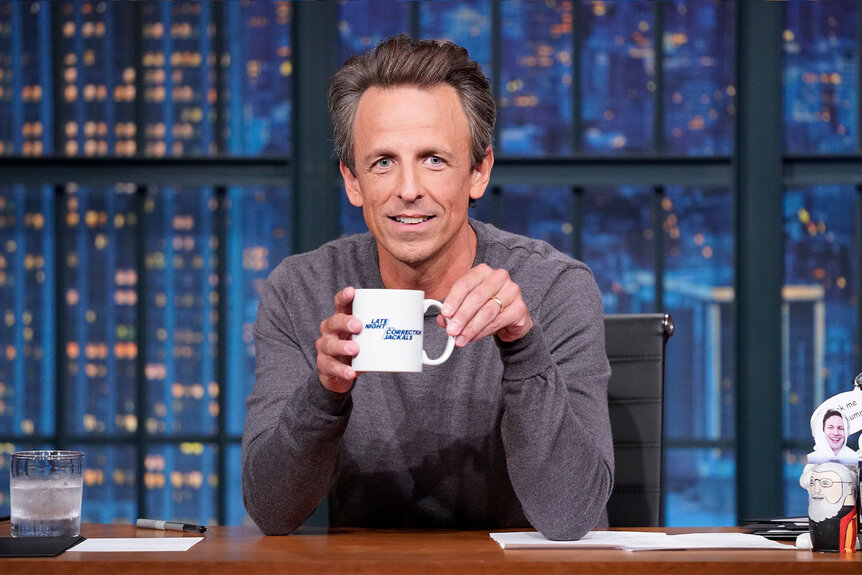
In this charged environment, Fallon’s monologue felt less like a simple show of support and more like a declaration. He was joined by a chorus of his peers. Seth Meyers, Stephen Colbert, and Jon Stewart all used their platforms on Thursday night to address the situation, pushing back against Trump and the perceived threat of censorship. It was a rare, unified front, a sign that the late-night comics understood that the stakes were higher than ever before.
Fallon’s decision to stand his ground represents a pivotal moment. It raises profound questions about the role of comedy in public discourse, the influence of political pressure on media corporations, and the resilience of free speech in a deeply polarized nation. For years, late-night television has served as a modern-day court jester, using humor to speak truth to power and hold leaders accountable. The suspension of Kimmel, and the subsequent threats leveled at others, is seen by many as an attempt to dismantle that tradition.
In the end, Jimmy Fallon’s stand was not just about saving his own show or defending a rival. It was a stand for the very soul of late-night television. By staring into the face of potential censorship and refusing to blink, he sent a clear message: the laughter will not be silenced. Whether the networks will ultimately heed that message remains to be seen, but for one night, in a studio in New York City, the jesters reminded the court that their voices would not be so easily quieted.