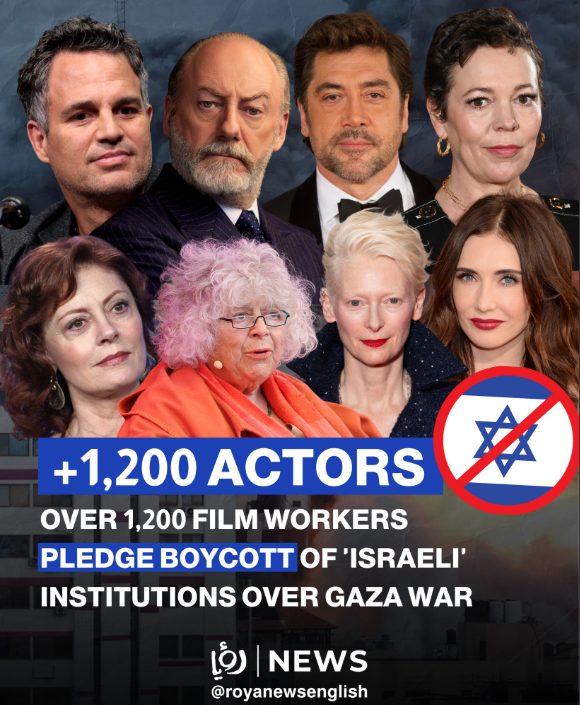
In a move that has sent shockwaves through Hollywood and beyond, over 1,300 prominent figures from the international film industry have signed a controversial pledge, vowing to boycott Israeli film institutions. This isn’t just a quiet protest; it’s a public declaration that pits some of the world’s most famous actors, directors, and producers against a key part of the global entertainment landscape. The pledge, spearheaded by the advocacy group Film Workers for Palestine, is a dramatic escalation in a long-simmering conflict, and it threatens to create a permanent chasm in the industry.

The list of signatories reads like a who’s who of global cinema, including Oscar winners and nominees such as Olivia Colman, Mark Ruffalo, Tilda Swinton, and Javier Bardem. They, along with more than a thousand of their colleagues, have put their names on a document that states their refusal “to screen films, appear at or otherwise work with Israeli film institutions—including festivals, cinemas, broadcasters and production companies—that are implicated in genocide and apartheid against the Palestinian people.”
For these artists, the decision is a moral one, a direct response to what they describe as “the carnage in Gaza.” The pledge explicitly cites the International Court of Justice’s ruling on a “plausible risk of genocide,” using language that is both incendiary and deeply personal. “As filmmakers, actors, film industry workers, and institutions,” the statement reads, “we recognise the power of cinema to shape perceptions. In this urgent moment of crisis, where many of our governments are enabling the carnage in Gaza, we must do everything we can to address complicity in that unrelenting horror.”
The signatories are not just acting in a vacuum; they are drawing inspiration from a historic precedent. The pledge references “Filmmakers United Against Apartheid” who refused to screen their films in South Africa, a movement that is widely credited with helping to bring an end to the brutal regime. This comparison elevates their actions from a simple boycott to a historic stand against what they see as systemic injustice.
While the pledge is comprehensive, it is also carefully worded. It clarifies that its target is not Israeli individuals but rather the institutions they accuse of being complicit. “The call is for film workers to refuse to work with Israeli institutions that are complicit in Israel’s human rights abuses against the Palestinian people,” the statement explains. “This refusal takes aim at institutional complicity, not identity.”
The public nature of this pledge is what makes it so explosive. It forces a choice upon the film community: stand with the signatories or stand against them. And for many, the decision is not a simple one. The pledge comes in the wake of other industry-related protests, including an open letter signed by actors and directors like Joaquin Phoenix and Pedro Pascal, and a motion from the British performing arts union, Equity UK, affirming the rights of its members to speak out on the issue. This new pledge is a culmination of a growing sentiment that the entertainment industry, which often sees itself as a champion of social causes, has been too silent on this particular conflict.
The reaction has been swift and, as expected, deeply polarized. While supporters hail the move as a courageous and necessary act of solidarity, critics are already pushing back, accusing the signatories of engaging in a cultural boycott that is unfair and counterproductive. One response from Israeli producers called the boycott “profoundly misguided,” arguing that it undermines the very collaborative efforts that are working toward peace.
The long-term effects of this pledge are yet to be seen. Will it lead to a lasting boycott that cripples Israeli film institutions? Or will it simply serve as a temporary protest that fades over time? The film industry is a global network, and these kinds of actions have the potential to disrupt everything from festival lineups to film financing. What is certain is that the once-unifying power of cinema now faces one of its biggest challenges, a conflict that threatens to divide artists and audiences for years to come
News

THEY LAUGHED WHEN THE “COFFEE GIRL” ASKED TO SHOOT — BUT WHEN SHE TOUCHED THE GUN OF THAT DIFFICULT RIFLE, A GENERAL CAME UP AND SALUTED HER.
CHAPTER 1: THE INVISIBLE WOMAN Dawn cracks over the Arizona desert like a bruised knuckle—purple, orange, and violent. Captain Emily Brooks woke without an alarm at 0400. She always did. Her body was tuned to a rhythm that didn’t exist…

They Called Her “De3d Weight” And Mocked Her “PTSD” — But When The Commander Whispered Two Words, The “BROKEN” Soldier Didn’t Just Wake Up… She Became The Most Dangerous Person In The Room
Chapter 1: The Dead Weight The brake lights of the transport van burned red against the bleaching sun of the Nevada desert. Staff Sergeant Olivia Harper stepped onto the cracked asphalt, her boots crunching on the grit. She favored her…
MY FATHER ACCUSED ME OF BEING A TRAITOR AND HE TOASTED HIS GLASS FOR IT. BUT UNFORTUNATELY HE CELEBRATED TOO SOON, BECAUSE RIGHT THERE, MY SEAL TEAM BURST IN SAYING, “ADMIRAL, WE’VE ARRIVED”
PART 1: THE ACCUSATION Chapter 1: The Sound of Steel The applause was polite, measured, the kind of sound that fills a room but never actually reaches the heart. It was the sound of Charleston high society pretending to care…

THEY LAUGHED AT THE “OFFICE GIRL” WHO SAID SHE COULD DISARM THE NUKE… UNTIL SHE TYPED IN A CODE THAT DOESN’T EXIST?
PART 1: THE INVISIBLE WOMAN Chapter 1: The Dead Man’s Switch The radio crackles with the sound of a man dying. Then, static. Then, the terrified voice of a corporal screaming into the void. “All units, code black! I repeat,…
THEY RIPPED HER FACE APART TO “SAVE THE UNIVERSE” — The horrifying truth about ancient Egypt’s most terrifying, censored fears that they hid from textbooks that you never knew existed.
PART 1: THE PURIFICATION Chapter 1: The Weight of the Placard The year is 1473 Before Christ. The location is the west bank of the Nile, just outside the sprawling, golden city of Thebes. Dawn is breaking, but it brings…
Jon Stewart SLAMS Desk, Calls Out 25 Hollywood Names on Live TV; The One Line That Sent Panic Across Los Angeles Studios
THE NIGHT THE DAILY SHOW STOPPED LAUGHING: How Eight Heavyweights, One Line, and Twenty Minutes Ignited a National Reckoning On most nights, late-night television functions as America’s unofficial cultural therapy, an escape valve where comedy dilutes the severity of the…
End of content
No more pages to load