By mid-October, the final, excruciating act of her ordeal began.
On October 14, 1793, Marie Antoinette faced the Revolutionary Tribunal. This was no real trial, but a chilling performance scripted by her political enemies. Unlike her husband, Louis XVI, who had weeks to mount a defense, she had less than a day. The charges leveled against her were a grotesque mix of political accusation and absurd fantasy, lifted directly from the slanderous pamphlets that had haunted her for years. She was accused of funneling money to Austria, plotting massacres, and hosting depraved orgies at Versailles.
And then there was the most poisonous, annihilating accusation of all, designed to shatter her very character and maternal identity: incest with her own son.
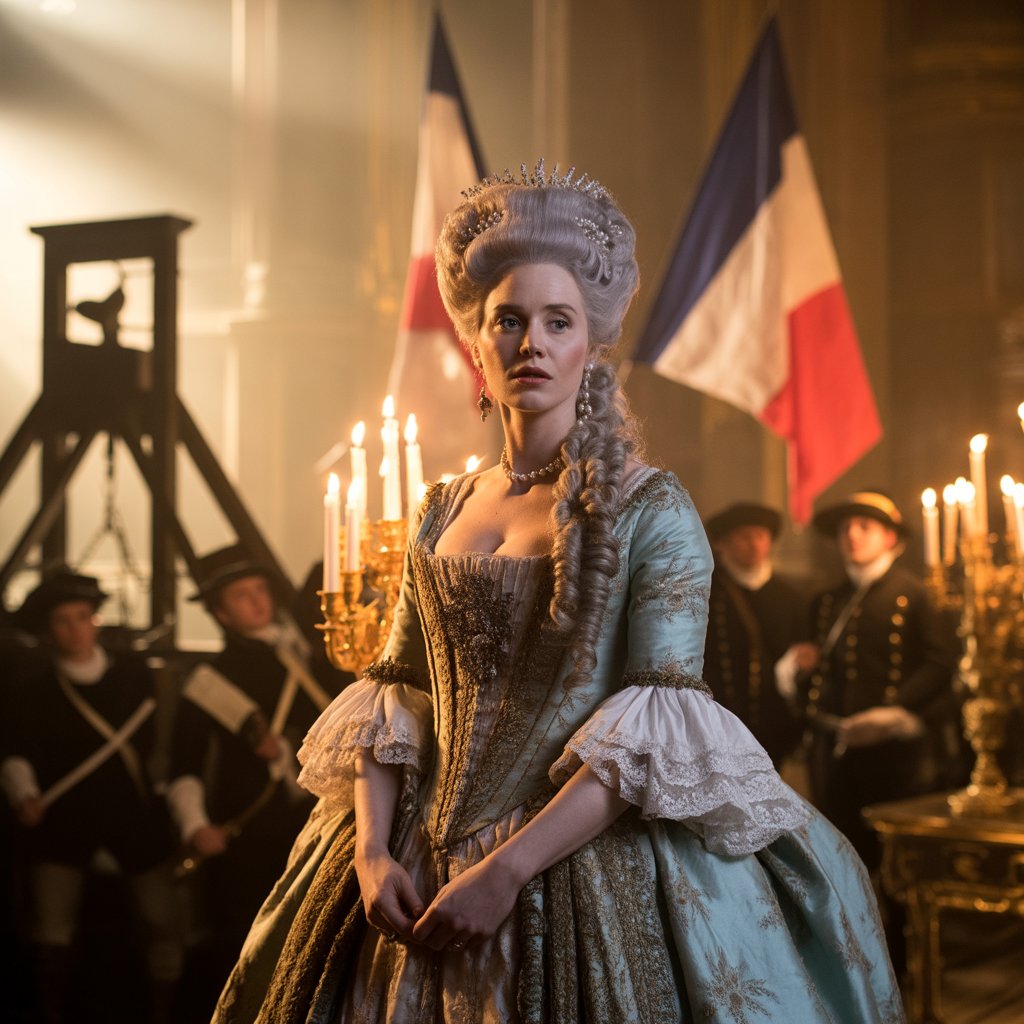
They had forced young Louis-Charles, her eight-year-old boy, to sign a statement against his mother. The courtroom, filled with the self-righteous zeal of the Revolution, fell silent as Marie Antoinette absorbed the claim. The prosecution, led by the zealot Antoine Quentin Fouquier-Tinville, seemed almost giddy at the cruelty of the charge.
For a moment, she didn’t speak. The room buzzed with tension, the anticipation of a queen finally breaking. Then she rose. Not to plead, not to beg, but to confront this last monstrous lie with a presence that shocked everyone watching. Her defiance wasn’t theatrical; it was precise. She turned to the gallery, her eyes sweeping over the faces of the Parisian women who had once shouted for her death.
“I appeal to all mothers here present,” she stated, her voice clear and steady.
“Is such a thing possible?”
In that single, bold, desperate gesture, she reminded them and the world that she was a mother first, a woman defending her fundamental honor against an unspeakable lie. The charge of political treason was abstract; the charge of maternal depravity was an attack on the deepest instinct of womanhood, and she met it with a timeless appeal to humanity.
The trial was over quickly. On October 16, after barely two days, the all-male jury declared her guilty of high treason. The sentence: death by guillotine. When asked for her last words, Marie Antoinette simply shook her head. There was nothing left to say to this court.
Back in her cell, she refused a final meal. Calmly, she told her maid Rosalie.
“I need nothing now, my child. It’s all over for me.”
Then she sat and wrote a heartbreaking letter to her sister-in-law, Madame Élisabeth. In it, she pleaded that her son, Louis-Charles, be forgiven for the forced testimony he had given against her, a clear understanding that his young mind had been poisoned by his captors. This letter, a final testament to her enduring love and grief, was intercepted and only discovered years later.
With dawn came the next wave of humiliation, meticulously planned to strip away every symbol of her royal past. Guards ordered her to remove the black mourning dress she had worn since Louis XVI’s execution—a garment that had symbolized her status and her history. In its place, they forced her into a tattered white linen shirt, the rough attire of a common penitent, not a queen.
She had to beg for a moment’s privacy just to dress. When her captives ignored her protest, she refused to comply immediately, a small, stubborn act of control in a day designed to strip her of any autonomy.
The executioner, Charles-Henri Sanson, and his assistants took further steps to dehumanize her. An assistant grabbed her hair, already prematurely white from stress and grief, and hacked it off with crude scissors. It was a symbolic erasure of her femininity and rank, and a practical preparation for the guillotine. Her hands were bound tightly behind her back with thick ropes, pulled so tight they caused real pain. Even basic bodily functions required permission, which she had to request with humility.
She was then led to a wooden cart, the kind used for common criminals, not the closed carriage afforded to her husband. She was entirely exposed to the jeers and hatred of tens of thousands lining the streets. The parade to the Place de la Révolution would be more than an hour long, a public spectacle of degradation meant to crush her spirit before the blade ever touched her neck.
And yet, as she sat on that plank, hands tied, surrounded by the venom of hostility, Marie Antoinette endured. Every lurch of the cart, every stare, every screamed insult tested her, but she remained composed, her chin held high. She knew her final hours would define her more than any trial or punishment. The Queen of France had been stripped of her crown, her family, and her palace, but on that bare wooden seat, she held onto her inner core.
This hour-long procession through the heart of Paris was intended to turn her into a defeated symbol of the revolution’s triumph. Yet, ironically, it also cemented her legend for the quiet defiance she displayed. By the time the cart reached the Place de la Révolution, she had survived an ordeal that would have shattered any ordinary person. But as the guillotine came into view, she knew the ultimate test of her composure, her courage, and her humanity awaited.
The square was a boiling cauldron of rage, curiosity, and bloodlust. In the center stood the guillotine, its wooden frame towering against the gray autumn sky, a silent predator waiting. The crowd surged, tens of thousands strong, hungry for the fall of the queen who had become a symbol of everything they hated.
Yet, as the cart jerked to a stop, something unexpected happened. Marie Antoinette, who had been stripped of every luxury, title, and piece of dignity, did not crumble. She stepped down with deliberate composure. Observers later described her as calm, almost elegant. Her hands were still bound. Her head was shorn.
The wooden steps to the guillotine were waiting. It would have been easy, ordinary even, to collapse, to tremble, to scream. But she didn’t. She climbed alone, refusing the executioner’s hand, refusing that final act of subjugation. Every step was a silent defiance, a reminder that while they could end her life, they could not crush her spirit.
And then, in a twist almost too surreal to believe, she stumbled. Her rough shoe caught on the steps, and she accidentally stepped on the foot of Charles-Henri Sanson, the executioner himself. The man who had severed her hair, bound her hands, and was now seconds away from taking her life, flinched. The crowd’s eyes fell on the moment, tense with anticipation.
Marie Antoinette, without a hint of fear, whispered a quiet apology.
“Forgive me, sir. I didn’t mean to.”
That small, simple act, mere seconds before death, was extraordinary. It was human. It was graceful. And it was defiant in the only way that truly mattered: she retained her dignity when all else had been stripped from her. The blade would take her life, but not her essence.
At exactly 12:15 p.m., the guillotine fell, swift, precise, and final. The assistant held her severed head aloft, and the crowd erupted in a roar, chanting.
“Long live the Republic.”
In death, they tried to reduce her to a common criminal, erasing the last queen of France as if she had never existed. Her body was unceremoniously loaded onto a cart and dumped into an unmarked grave at a nearby cemetery.
Yet, history has a way of preserving what cruelty seeks to destroy. They wanted the world to see a monster, but in her final moments, they revealed a woman of remarkable endurance, courage, and unexpected grace.
The legend of Marie Antoinette isn’t only about excess or monarchy. It is about survival, grace under pressure, and the human spirit’s stubbornness in the face of dehumanization. Every cruel act, every humiliation intended to diminish her instead highlighted the strength that remained unbreakable.
Even as the blade fell, her story refused to end with the revolution’s violence. She was more than the sum of her misfortunes. She was a queen stripped bare, a mother grieving for her child, a human being meeting death with dignity. And in that, she left a legacy no guillotine could erase.
News

THEY LAUGHED WHEN THE “COFFEE GIRL” ASKED TO SHOOT — BUT WHEN SHE TOUCHED THE GUN OF THAT DIFFICULT RIFLE, A GENERAL CAME UP AND SALUTED HER.
CHAPTER 1: THE INVISIBLE WOMAN Dawn cracks over the Arizona desert like a bruised knuckle—purple, orange, and violent. Captain Emily Brooks woke without an alarm at 0400. She always did. Her body was tuned to a rhythm that didn’t exist…

They Called Her “De3d Weight” And Mocked Her “PTSD” — But When The Commander Whispered Two Words, The “BROKEN” Soldier Didn’t Just Wake Up… She Became The Most Dangerous Person In The Room
Chapter 1: The Dead Weight The brake lights of the transport van burned red against the bleaching sun of the Nevada desert. Staff Sergeant Olivia Harper stepped onto the cracked asphalt, her boots crunching on the grit. She favored her…
MY FATHER ACCUSED ME OF BEING A TRAITOR AND HE TOASTED HIS GLASS FOR IT. BUT UNFORTUNATELY HE CELEBRATED TOO SOON, BECAUSE RIGHT THERE, MY SEAL TEAM BURST IN SAYING, “ADMIRAL, WE’VE ARRIVED”
PART 1: THE ACCUSATION Chapter 1: The Sound of Steel The applause was polite, measured, the kind of sound that fills a room but never actually reaches the heart. It was the sound of Charleston high society pretending to care…

THEY LAUGHED AT THE “OFFICE GIRL” WHO SAID SHE COULD DISARM THE NUKE… UNTIL SHE TYPED IN A CODE THAT DOESN’T EXIST?
PART 1: THE INVISIBLE WOMAN Chapter 1: The Dead Man’s Switch The radio crackles with the sound of a man dying. Then, static. Then, the terrified voice of a corporal screaming into the void. “All units, code black! I repeat,…

THEY RIPPED HER FACE APART TO “SAVE THE UNIVERSE” — The horrifying truth about ancient Egypt’s most terrifying, censored fears that they hid from textbooks that you never knew existed.
PART 1: THE PURIFICATION Chapter 1: The Weight of the Placard The year is 1473 Before Christ. The location is the west bank of the Nile, just outside the sprawling, golden city of Thebes. Dawn is breaking, but it brings…

Jon Stewart SLAMS Desk, Calls Out 25 Hollywood Names on Live TV; The One Line That Sent Panic Across Los Angeles Studios
THE NIGHT THE DAILY SHOW STOPPED LAUGHING: How Eight Heavyweights, One Line, and Twenty Minutes Ignited a National Reckoning On most nights, late-night television functions as America’s unofficial cultural therapy, an escape valve where comedy dilutes the severity of the…
End of content
No more pages to load