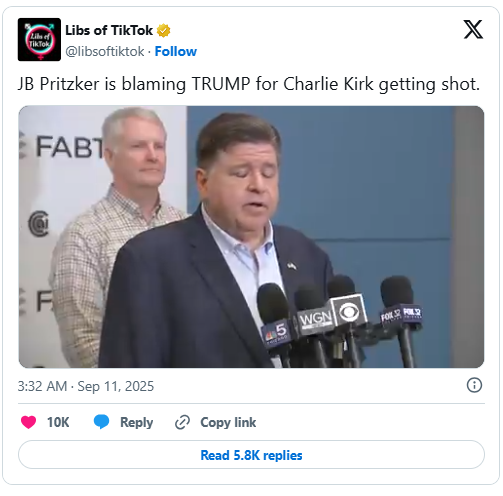
In the aftermath of a national tragedy that has left the country reeling, a political firestorm of unprecedented scale has erupted, this time from the unlikeliest of sources: a sitting state governor. In a stunning and unfiltered rebuke that has ignited a furious debate, Illinois Governor J.B. Pritzker has publicly and directly blamed President Donald Trump for the dangerous rise in political violence that has come to define our current era. Less than 24 hours after the assassination of conservative activist Charlie Kirk, Pritzker’s comments have not only injected raw politics into a moment of shared grief but have also served as a powerful reminder of the profound chasm that exists at the heart of the American political landscape.
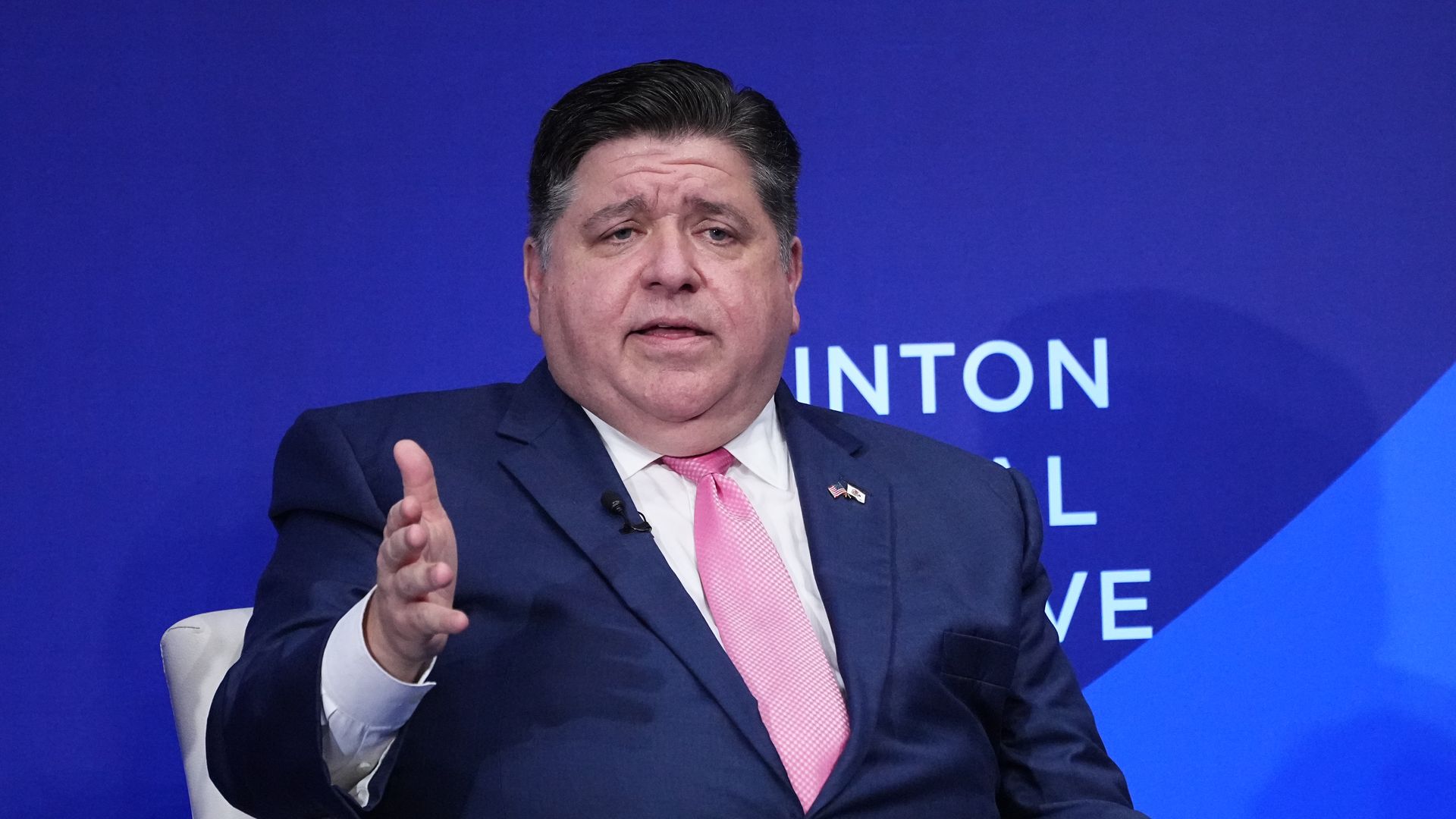
The governor’s words came at a time when the nation was still processing the full gravity of Kirk’s death. Pritzker, a Democrat with a national profile, began his statement with a formal acknowledgment of the tragedy, offering condolences to Kirk’s family. But the moment of solemnity was fleeting. In a swift pivot, Pritzker launched into a scathing indictment of the president, claiming that the violence now “ratcheting up” in the country is being actively fomented by people like Trump. It was a bold and audacious claim, delivered with the kind of certainty that only a politician in the middle of a high-stakes blame game can muster. Pritzker did not shy away from linking the violence directly to the president’s rhetoric, arguing that his words have created a climate where such acts are not only possible, but perhaps even inevitable.
The governor’s accusations were not limited to the present moment. He reached back into the recent past, citing the January 6, 2021, incursion at the Capitol, as a pivotal turning point in American history. In his view, the events of “that day tripped a new era of political violence,” a sentiment that has been widely echoed by the political left. By connecting Kirk’s death to the events of January 6, Pritzker was attempting to build a narrative of a long-standing pattern of political incitement, a pattern that, in his view, is being driven from the very top. This is a dangerous and highly charged accusation, one that has been met with immediate and furious backlash from conservatives who see it as a grotesque exploitation of a man’s death for political gain. “But I will say that political violence, unfortunately, has been ratcheting up in this country,” Pritzker added.
The debate that has erupted in the wake of Pritzker’s comments is not just about who is to blame for a single act of violence. It is about the very nature of political rhetoric in the 21st century. It is a debate about the lines between free speech and incitement, between passionate disagreement and outright hate. For Pritzker and his supporters, the language used by Trump and his allies is not just words; it is a match that is being struck in a tinderbox, and the assassination of Charlie Kirk is the tragic result. They argue that the repeated use of inflammatory language, the demonization of political opponents, and the calls for retribution have created a climate where the unthinkable can and does happen. “I would just say it’s got to stop, and I think there are people who are fomenting it in this country,” he continued. “I think the president’s rhetoric often foments it.” They see Kirk’s death not as an isolated incident, but as the inevitable consequence of a political strategy that relies on anger and division.
On the other side of the aisle, conservatives are condemning Pritzker’s comments as a cynical and opportunistic attempt to score political points in a moment of national mourning. They argue that it is the political left, with its constant accusations of “fascism,” “Nazism,” and “hate speech” against anyone who disagrees with them, that is truly fueling the violence. They point to the assassin’s alleged motives and the pro-transgender and pro-Antifa messages found on the rifle cartridges, arguing that the violence came from a specific ideological place, a place that is encouraged and celebrated by the very people now casting blame on the president. They see Pritzker’s comments not as a genuine expression of concern, but as a textbook example of political hypocrisy, a willingness to exploit a tragedy to advance a partisan agenda.
The public reaction to Pritzker’s comments has been a microcosm of the nation’s deep divisions. On social media, supporters have applauded the governor for his courage, for his willingness to say what they believe is the truth, no matter how difficult. They see him as a voice of moral clarity in a moment of moral ambiguity. But critics have condemned him as a “ghoul,” a man who is so consumed by his political hatred that he is willing to dance on the grave of a man who was just assassinated. They argue that his words are not healing, but are in fact further fueling the very divisions he claims to be against.
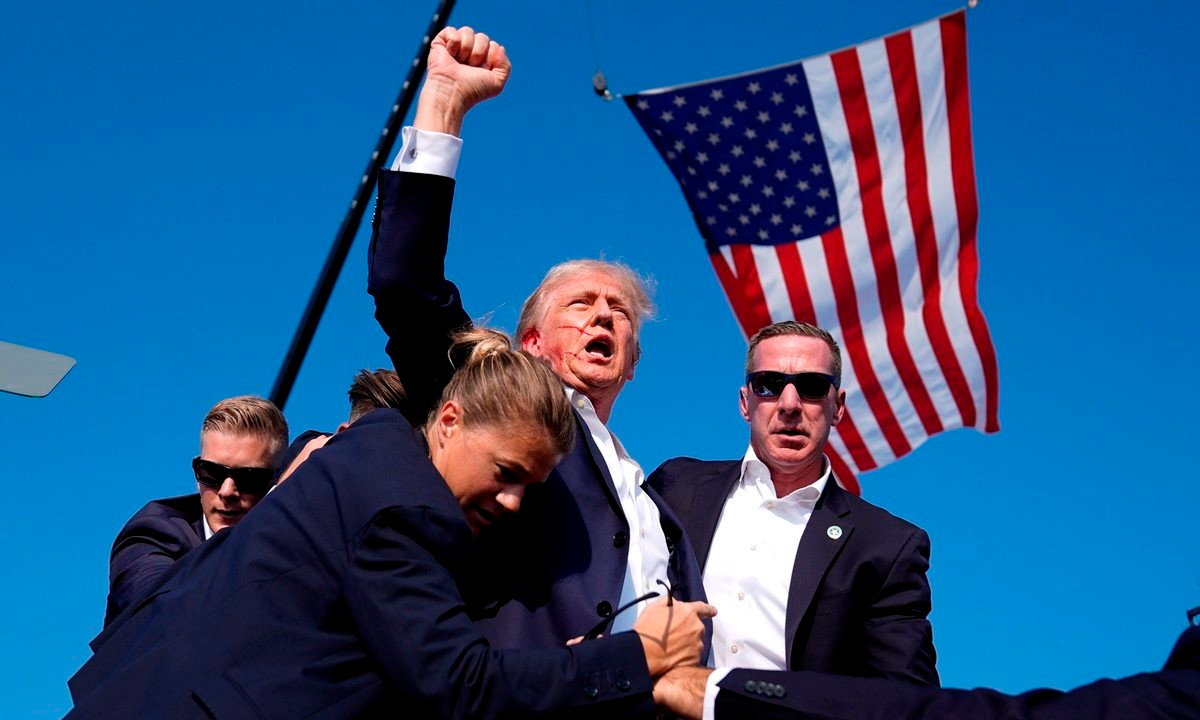
In the end, this is a story not just about Pritzker, or Trump, or even Charlie Kirk, called him “great, and even Legendary,” when confirming his passing on Truth Social. “No one understood or had the Heart of the Youth in the United States of America better than Charlie,” the commander-in-chief wrote. “He was loved and admired by ALL, especially me, and now, he is no longer with us.” Trump added, “Melania and my Sympathies go out to his beautiful wife Erika, and family. Charlie, we love you!”
It is a story about the state of American politics itself. It is a story about a country that is so deeply divided, so thoroughly consumed by its own political battles, that it can no longer find common ground, even in the face of a national tragedy. The assassination of Charlie Kirk was a horrific and shocking event, but Pritzker’s comments have proven that the aftermath will be just as painful, as different sides of the political spectrum seize on the tragedy to wage a new and more dangerous kind of war. It is a war of words, a war of narratives, and it is a war that has just been brought to a chilling and unprecedented new level.
News
THEY LAUGHED WHEN THE “COFFEE GIRL” ASKED TO SHOOT — BUT WHEN SHE TOUCHED THE GUN OF THAT DIFFICULT RIFLE, A GENERAL CAME UP AND SALUTED HER.
CHAPTER 1: THE INVISIBLE WOMAN Dawn cracks over the Arizona desert like a bruised knuckle—purple, orange, and violent. Captain Emily Brooks woke without an alarm at 0400. She always did. Her body was tuned to a rhythm that didn’t exist…
They Called Her “De3d Weight” And Mocked Her “PTSD” — But When The Commander Whispered Two Words, The “BROKEN” Soldier Didn’t Just Wake Up… She Became The Most Dangerous Person In The Room
Chapter 1: The Dead Weight The brake lights of the transport van burned red against the bleaching sun of the Nevada desert. Staff Sergeant Olivia Harper stepped onto the cracked asphalt, her boots crunching on the grit. She favored her…
MY FATHER ACCUSED ME OF BEING A TRAITOR AND HE TOASTED HIS GLASS FOR IT. BUT UNFORTUNATELY HE CELEBRATED TOO SOON, BECAUSE RIGHT THERE, MY SEAL TEAM BURST IN SAYING, “ADMIRAL, WE’VE ARRIVED”
PART 1: THE ACCUSATION Chapter 1: The Sound of Steel The applause was polite, measured, the kind of sound that fills a room but never actually reaches the heart. It was the sound of Charleston high society pretending to care…
THEY LAUGHED AT THE “OFFICE GIRL” WHO SAID SHE COULD DISARM THE NUKE… UNTIL SHE TYPED IN A CODE THAT DOESN’T EXIST?
PART 1: THE INVISIBLE WOMAN Chapter 1: The Dead Man’s Switch The radio crackles with the sound of a man dying. Then, static. Then, the terrified voice of a corporal screaming into the void. “All units, code black! I repeat,…

THEY RIPPED HER FACE APART TO “SAVE THE UNIVERSE” — The horrifying truth about ancient Egypt’s most terrifying, censored fears that they hid from textbooks that you never knew existed.
PART 1: THE PURIFICATION Chapter 1: The Weight of the Placard The year is 1473 Before Christ. The location is the west bank of the Nile, just outside the sprawling, golden city of Thebes. Dawn is breaking, but it brings…
Jon Stewart SLAMS Desk, Calls Out 25 Hollywood Names on Live TV; The One Line That Sent Panic Across Los Angeles Studios
THE NIGHT THE DAILY SHOW STOPPED LAUGHING: How Eight Heavyweights, One Line, and Twenty Minutes Ignited a National Reckoning On most nights, late-night television functions as America’s unofficial cultural therapy, an escape valve where comedy dilutes the severity of the…
End of content
No more pages to load