The modern athlete’s life is a high-wire act, balanced precariously between public acclaim and the relentless scrutiny of the digital age. In a world where every word, action, and even a team’s performance can become a trending topic, the pressure to maintain a composed, professional image is immense. But every so often, the facade cracks, revealing a raw, unfiltered human response that captures the public’s imagination and exposes the simmering tension beneath the surface of professional sports. This is precisely what happened when Indiana Fever guard Sydney Colson took to social media, not to celebrate a victory, but to deliver a blistering rebuke that has become the talk of the WNBA.

The drama began, as it often does, with a single, seemingly innocuous tweet. Colson had commented on a game, noting what she perceived as a lack of foul calls for her teammate, Kelsey Mitchell. It was a typical athlete’s observation, a small critique of officiating that is common in professional sports. But the comment drew an unprompted and pointed response from a fan. The fan’s tweet was a jab, accusing Colson and teammate Sophie Cunningham of “becoming a Karen” after joining the Indiana Fever. The term, a highly charged and politically-loaded insult, was a personal attack, not a critique of basketball.
“Something about joining the Indiana Fever and becoming a Karen. SYD, Steph White, and Cunningham have all changed their tune since joining The Fever. Stop allat!!” – @Ciara1285045
The fan, hiding behind a Twitter handle, likely expected the silence or a generic, boilerplate response that athletes are often trained to provide. What they got instead was a firestorm. Sydney Colson, a veteran known for her lively personality and sharp wit, did not hold back. She responded directly and unequivocally, telling the fan to: “Ciara. Shut up and 1-2 step outta my mentions. I’m the same I’ve always been & so are you, oddly enough, bc clearly you’re still too dumb to read text and know what sarcasm is.”
The response was a digital grenade, exploding across social media and instantly becoming a viral sensation. Fans, sports analysts, and even other athletes weighed in, with opinions sharply divided. Some applauded Colson’s boldness, celebrating her for standing up to a faceless troll and refusing to let an insult go unanswered. They argued that in a world where players are expected to be perfect brands, it’s refreshing to see a human being respond with genuine anger and wit. In their view, Colson’s tweet wasn’t just a clap back; it was a righteous defense of herself and her teammate against a baseless attack.
However, others were more critical. They saw the response as unprofessional, a lapse in judgment that could damage her public image and the image of the league. They argued that professional athletes, especially those in the WNBA who are often under intense media scrutiny, have a responsibility to be above such fray. Engaging with trolls, they contended, only gives them power and validates their malicious behavior. The debate raged on, with both sides presenting compelling arguments. Was Colson a hero for fighting back, or did she fall into a trap that she should have avoided?
The incident highlights a growing issue in the sports world: the delicate and often volatile relationship between athletes and their fans in the age of social media. The platforms that allow players to connect with their audience on a personal level also expose them to a constant barrage of criticism, insults, and even harassment. For many athletes, the line between a passionate fan and a toxic troll has become increasingly blurred, and the emotional toll can be immense.
The “Karen” label, specifically, is a loaded term that has transcended its original meaning and is now often used to describe any woman, especially a white woman, who is perceived as entitled or overbearing. The fan’s use of the term against Colson and Cunningham was not just a comment on their play but a judgment of their character, a personal assault that went beyond the boundaries of sports fandom. Colson’s reaction shows that this kind of language is no longer just “part of the game.” Players are no longer willing to silently endure personal attacks that have nothing to do with their performance.
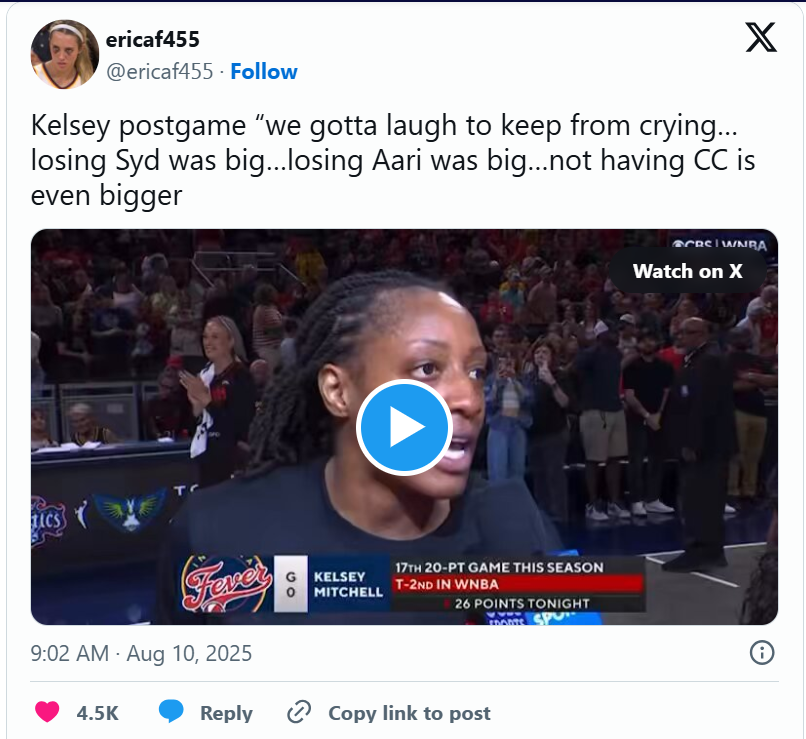
This public showdown also sheds light on the internal dynamics of the Indiana Fever team. The unwavering support Colson showed for her teammates, first for Kelsey Mitchell in her initial tweet and then for Sophie Cunningham in her defense against the troll, speaks volumes about the locker room culture. In a high-pressure season where every win and loss is magnified by the presence of a superstar like Caitlin Clark, team unity is more important than ever. Colson’s fierce loyalty, even in a digital confrontation, shows that the Fever players have each other’s backs, a fact that will undoubtedly resonate with their fan base.
In the end, this incident is more than just a viral tweet. It is a defining moment in the modern sports landscape, a case study in the power and peril of social media. It serves as a reminder that behind every uniform and every statistic is a person with feelings, a person who will not always turn the other cheek when attacked. Sydney Colson’s response may have been shocking and even controversial, but it was also a profoundly human moment, one that forced the public to confront the harsh reality of life as a professional athlete in the digital age. The conversation has just begun, and its echoes will likely be felt long after the initial fury has died down, forever changing the way we view the relationship between player and fan.
News

THEY LAUGHED WHEN THE “COFFEE GIRL” ASKED TO SHOOT — BUT WHEN SHE TOUCHED THE GUN OF THAT DIFFICULT RIFLE, A GENERAL CAME UP AND SALUTED HER.
CHAPTER 1: THE INVISIBLE WOMAN Dawn cracks over the Arizona desert like a bruised knuckle—purple, orange, and violent. Captain Emily Brooks woke without an alarm at 0400. She always did. Her body was tuned to a rhythm that didn’t exist…

They Called Her “De3d Weight” And Mocked Her “PTSD” — But When The Commander Whispered Two Words, The “BROKEN” Soldier Didn’t Just Wake Up… She Became The Most Dangerous Person In The Room
Chapter 1: The Dead Weight The brake lights of the transport van burned red against the bleaching sun of the Nevada desert. Staff Sergeant Olivia Harper stepped onto the cracked asphalt, her boots crunching on the grit. She favored her…

MY FATHER ACCUSED ME OF BEING A TRAITOR AND HE TOASTED HIS GLASS FOR IT. BUT UNFORTUNATELY HE CELEBRATED TOO SOON, BECAUSE RIGHT THERE, MY SEAL TEAM BURST IN SAYING, “ADMIRAL, WE’VE ARRIVED”
PART 1: THE ACCUSATION Chapter 1: The Sound of Steel The applause was polite, measured, the kind of sound that fills a room but never actually reaches the heart. It was the sound of Charleston high society pretending to care…

THEY LAUGHED AT THE “OFFICE GIRL” WHO SAID SHE COULD DISARM THE NUKE… UNTIL SHE TYPED IN A CODE THAT DOESN’T EXIST?
PART 1: THE INVISIBLE WOMAN Chapter 1: The Dead Man’s Switch The radio crackles with the sound of a man dying. Then, static. Then, the terrified voice of a corporal screaming into the void. “All units, code black! I repeat,…

THEY RIPPED HER FACE APART TO “SAVE THE UNIVERSE” — The horrifying truth about ancient Egypt’s most terrifying, censored fears that they hid from textbooks that you never knew existed.
PART 1: THE PURIFICATION Chapter 1: The Weight of the Placard The year is 1473 Before Christ. The location is the west bank of the Nile, just outside the sprawling, golden city of Thebes. Dawn is breaking, but it brings…

Jon Stewart SLAMS Desk, Calls Out 25 Hollywood Names on Live TV; The One Line That Sent Panic Across Los Angeles Studios
THE NIGHT THE DAILY SHOW STOPPED LAUGHING: How Eight Heavyweights, One Line, and Twenty Minutes Ignited a National Reckoning On most nights, late-night television functions as America’s unofficial cultural therapy, an escape valve where comedy dilutes the severity of the…
End of content
No more pages to load