A Tale of Two Trophies: How a Celebration Ignited the WNBA Rookie of the Year Controversy
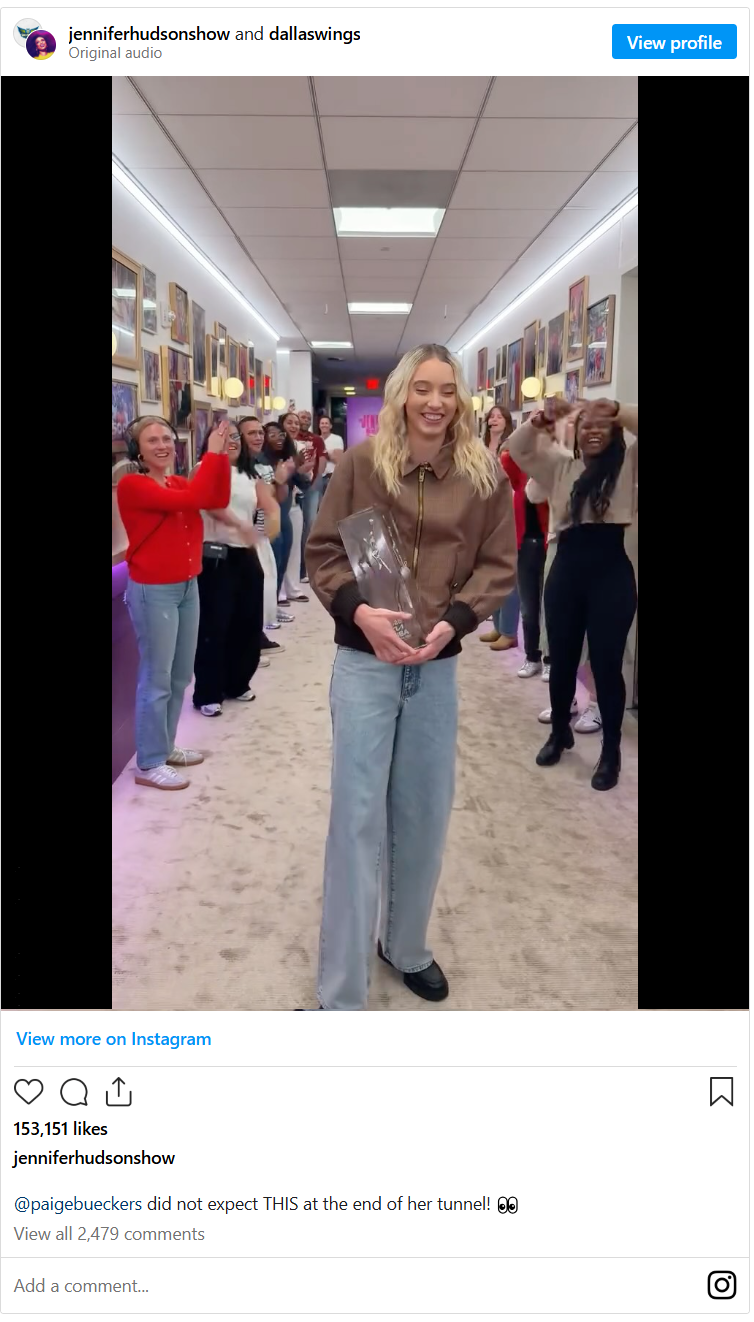
The flashing lights of a television studio, a cheering audience, and a surprise appearance from the league’s commissioner—this was the scene for Paige Bueckers as she was named the 2025 WNBA Rookie of the Year. The moment, meticulously orchestrated for the Jennifer Hudson show and broadcast across social media, was designed to be a heartwarming celebration of a rising star. Yet, for thousands of fans watching online, it felt less like a celebration and more like a declaration. The grand gesture immediately sparked a firestorm, triggering a widespread WNBA Rookie of the Year controversy that centered not on Bueckers, but on the star who won the award just one year prior: Caitlin Clark.
Fans instantly drew a stark comparison between Bueckers’ lavish ceremony and the quiet, almost non-existent acknowledgment Clark received. The disparity felt jarring to many, especially given Clark’s monumental impact on the league’s viewership, ticket sales, and mainstream relevance. The conversation exploded across platforms, with supporters questioning what they saw as a deliberate slight against the player who had brought unprecedented attention to the WNBA. This wasn’t just about a trophy; it was about respect, recognition, and a perceived double standard at the highest levels of the organization, placing Commissioner Cathy Engelbert directly in the crosshairs of a furious and vocal fanbase. The debate quickly evolved from a simple comparison into a broader critique of the league’s leadership and its handling of its most valuable asset.
:max_bytes(150000):strip_icc():focal(749x0:751x2):format(webp)/Paige-Bueckers-Cathy-Engelbert-the-jennifer-hudson-show-0-091625-9facbb9e53c54e7989a2781eebe763cc.jpg)
A Grand Unveiling for Paige Bueckers
The WNBA went to great lengths to ensure Paige Bueckers’ Rookie of the Year moment was a memorable media event. The league partnered with the Jennifer Hudson show to create a picture-perfect surprise. Commissioner Cathy Engelbert was personally on set, trophy in hand, to congratulate the Dallas Wings star. The clip was professionally produced and quickly disseminated across the WNBA’s official channels, showcasing a smiling Bueckers, a supportive talk show host, and a league celebrating its newest talent. It was a polished, public relations-friendly affair meant to highlight the league’s bright future.
However, the context of the win became a sticking point for critics. Fans were quick to point out that Bueckers’ team had a difficult season, securing fewer than 10 wins. This fact was weaponized by those arguing that the on-court results did not seem to align with the magnitude of the celebration. While Bueckers’ individual talent was not in dispute, the decision to stage such an elaborate event for a player on a struggling team, especially when contrasted with the previous year, fueled the perception that other factors were at play in the league’s decision-making. This celebration, intended to honor one player, inadvertently opened the door to a flood of criticism over a Caitlin Clark snub.
A Different Story: Caitlin Clark’s Quiet Win
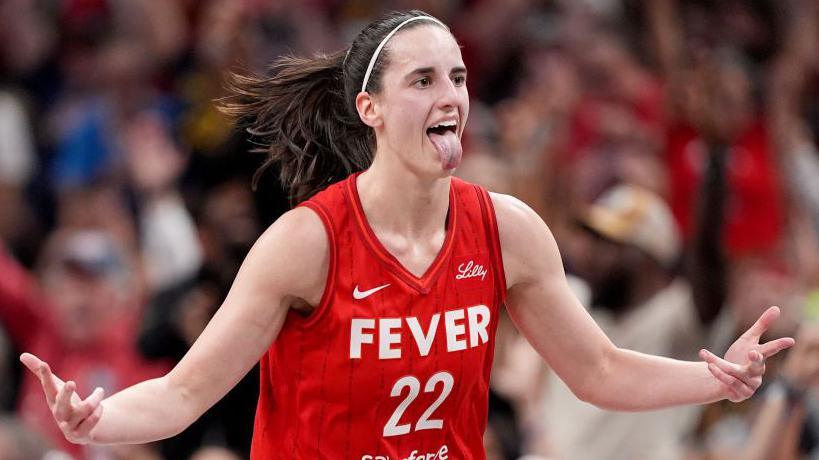
The memories of fans are long, and they immediately recalled how differently Caitlin Clark’s Rookie of the Year announcement was handled in 2024. There was no televised surprise, no on-stage appearance with the commissioner, and no viral social media moment produced by the league. Instead, reports and fan accounts from the time describe a much more subdued affair. Many claim Clark received a simple phone call weeks after the season ended, an announcement made in a locker room without any of the pomp and circumstance afforded to Bueckers.
This stark difference felt particularly pointed to Clark’s supporters. In her rookie season, Clark didn’t just play well; she transformed the league. She led the Indiana Fever to the playoffs, shattered viewership records, and sold out arenas across the country. Her arrival was hailed as a turning point for the WNBA, bringing in millions of new viewers and unprecedented media coverage. For the league to seemingly downplay her Rookie of the Year award, only to roll out the red carpet for her successor a year later, was seen as a profound sign of disrespect. The quiet phone call stood in galling contrast to the televised party, leaving many to wonder why the league’s biggest star received such a muted acknowledgment of her historic achievement.
Fan Backlash Erupts in the WNBA Rookie of the Year Controversy
The online reaction to the Bueckers ceremony was swift and unforgiving. Social media platforms became a battleground where fans voiced their anger and disappointment. “Where was all this for Caitlin last season? You know, the one who brought millions to the W,” one user commented, a sentiment echoed by thousands of others. The perceived disparity was not seen as a simple oversight but as a deliberate and “hateful” act by the organization.
Cathy Engelbert Under Fire
Much of the fury was directed squarely at WNBA Commissioner Cathy Engelbert. Her smiling appearance on the Jennifer Hudson show became a symbol of the league’s perceived hypocrisy. Fans accused her of orchestrating a “dog and pony show” for Bueckers while failing to even show up for Clark the year before. The criticism was relentless, with many labeling her the “worst commissioner in professional sports,” a title previously reserved for figures like the NFL’s Roger Goodell or the NBA’s Adam Silver. Commenters highlighted her perceived mismanagement of multiple issues, from the officiating in games to her public silence on the physical targeting Clark has faced on the court. The Cathy Engelbert criticism reached a fever pitch, with calls for her resignation trending online. Her leadership was characterized as a failure, and this latest incident was presented as the final straw for a fanbase that felt ignored and disrespected.
Accusations of a “Woke” Agenda
The criticism also took on a more pointed, political tone. Some fans suggested the difference in treatment was ideological. Comments flooded social media claiming that Clark, a straight, white athlete from Iowa, “leaves some boxes unchecked” for the league’s preferred narrative. These users argued that the league, which they labeled a “woke ass league,” was promoting certain players over others based on identity rather than merit or impact. One comment read, “Congratulations to Paige. This is how it should be done for all. But since CC is not woke, well, action speaks.” This narrative, while controversial, took deep root in the online discourse, framing the issue not just as one of inconsistency but of politically motivated favoritism. The WNBA fan backlash was no longer just about a trophy; it was about the perceived culture of the league itself.
Beyond the Ceremony: A Debate on Merit and Respect
At the heart of the WNBA Rookie of the Year controversy lies a deeper debate about what constitutes value in professional sports. For many fans, Caitlin Clark’s value is undeniable and quantifiable. She led her team to the playoffs, a significant achievement for a franchise that had struggled for years. Her impact is measured in sold-out arenas, record-breaking television ratings, and a massive surge in merchandise sales. She didn’t just join the WNBA; she elevated it to a new level of cultural relevance. From this perspective, the league’s failure to celebrate her rookie accomplishments with the same enthusiasm shown to Bueckers feels like a fundamental misunderstanding, or worse, a deliberate disregard, of her contributions.
This incident has exposed a raw nerve in the relationship between the WNBA’s leadership and a significant portion of its new, rapidly growing fanbase. The debate is no longer about whether Paige Bueckers deserved her award, but about whether the league is capable of recognizing and respecting the player who has arguably done more for its business than anyone in its history. As the controversy continues to simmer, it serves as a stark reminder that in the world of professional sports, perception is reality. For thousands of fans, the perception is that the WNBA celebrated a ceremony but failed to honor its champion.
News

THEY LAUGHED WHEN THE “COFFEE GIRL” ASKED TO SHOOT — BUT WHEN SHE TOUCHED THE GUN OF THAT DIFFICULT RIFLE, A GENERAL CAME UP AND SALUTED HER.
CHAPTER 1: THE INVISIBLE WOMAN Dawn cracks over the Arizona desert like a bruised knuckle—purple, orange, and violent. Captain Emily Brooks woke without an alarm at 0400. She always did. Her body was tuned to a rhythm that didn’t exist…

They Called Her “De3d Weight” And Mocked Her “PTSD” — But When The Commander Whispered Two Words, The “BROKEN” Soldier Didn’t Just Wake Up… She Became The Most Dangerous Person In The Room
Chapter 1: The Dead Weight The brake lights of the transport van burned red against the bleaching sun of the Nevada desert. Staff Sergeant Olivia Harper stepped onto the cracked asphalt, her boots crunching on the grit. She favored her…
MY FATHER ACCUSED ME OF BEING A TRAITOR AND HE TOASTED HIS GLASS FOR IT. BUT UNFORTUNATELY HE CELEBRATED TOO SOON, BECAUSE RIGHT THERE, MY SEAL TEAM BURST IN SAYING, “ADMIRAL, WE’VE ARRIVED”
PART 1: THE ACCUSATION Chapter 1: The Sound of Steel The applause was polite, measured, the kind of sound that fills a room but never actually reaches the heart. It was the sound of Charleston high society pretending to care…

THEY LAUGHED AT THE “OFFICE GIRL” WHO SAID SHE COULD DISARM THE NUKE… UNTIL SHE TYPED IN A CODE THAT DOESN’T EXIST?
PART 1: THE INVISIBLE WOMAN Chapter 1: The Dead Man’s Switch The radio crackles with the sound of a man dying. Then, static. Then, the terrified voice of a corporal screaming into the void. “All units, code black! I repeat,…

THEY RIPPED HER FACE APART TO “SAVE THE UNIVERSE” — The horrifying truth about ancient Egypt’s most terrifying, censored fears that they hid from textbooks that you never knew existed.
PART 1: THE PURIFICATION Chapter 1: The Weight of the Placard The year is 1473 Before Christ. The location is the west bank of the Nile, just outside the sprawling, golden city of Thebes. Dawn is breaking, but it brings…

Jon Stewart SLAMS Desk, Calls Out 25 Hollywood Names on Live TV; The One Line That Sent Panic Across Los Angeles Studios
THE NIGHT THE DAILY SHOW STOPPED LAUGHING: How Eight Heavyweights, One Line, and Twenty Minutes Ignited a National Reckoning On most nights, late-night television functions as America’s unofficial cultural therapy, an escape valve where comedy dilutes the severity of the…
End of content
No more pages to load