Part 1: The Ghost in the Room
Chapter 1: The Art of Disappearing
My name is Eliza Rowan. I am thirty-three years old, and for the better part of a decade, I have been the kind of person people forget to ask about.
It wasn’t that I vanished. I didn’t run away to join a circus or move to a commune in Vermont. I was right there. I was at every Thanksgiving dinner, every Christmas morning, every hospital waiting room. I was smiling. I was present. I was useful.
But I wasn’t impressive. Not by the Rowan family standards.
You have to understand the architecture of my family to understand the silence that surrounded me. They liked their success loud. They liked it visible. They wanted things you could frame on a wall, pin to a chest, or salute at a podium.
My father, Robert, retired after twenty-three years in the Navy. Even in retirement, he wore his military blazer to casual brunches. He had a specific way of standing—arms crossed over his chest, chin tilted up—not as a defensive measure, but as a man who had already assessed the room and decided who was worth his limited attention.
My mother, Catherine, was a former high school principal. She didn’t smile; she approved. Her affection was a currency, and she spent it exclusively on people who reflected her own self-image: polished, orderly, and ready with the correct answers.
And then, the siblings.
Luke, my younger brother, joined the police force at twenty. He never took off the badge, even when he was off duty. He wasn’t particularly brilliant—he barely scraped a C average in high school—but he fit the narrative my parents craved. He had the square jaw, the firm handshake, and the rehearsed authority. Dad called him “solid.” Mom said he made her feel “safe.”
Then there was Talia. The youngest. The golden child. Born with the instincts of a shark and the smile of a diplomat. Student Body President, Model UN, full ride to Georgetown. She married Marcus Wyn, a Navy officer with an impeccable record, and she now worked in foreign affairs.
Every move Talia made was curated. She never raised her voice. She never wore an outfit that didn’t feature a belt. She never walked into a room without checking her lighting.
And then there was me.
I studied Computer Science and Engineering. I skipped the Ivy League for a boutique cybersecurity firm that recruited me out of my sophomore year. By the time I was twenty-six, I had transitioned to black contract defense work.
I worked on threat simulations. I conducted critical infrastructure audits. I wrote the protocols that kept the water running and the traffic lights changing. My work came with clearance levels that required background checks on everyone I’d ever met. It came with silence.
But none of that looks good on a holiday card.
When I told my family I worked in “consulting,” they heard “unemployed.” When I told them I had a “federal contract,” they heard “temporary temp work.”
Once, over Easter brunch, my mother placed a hand on my wrist and asked, with genuine pity in her eyes, if I had ever considered going back to school to get a “real specialization.”
I just smiled and took a sip of my coffee. There was no explaining a job you weren’t allowed to talk about.
Chapter 2: The Soft Erosion
They didn’t mock me openly. Not at first. It wasn’t like a teen movie where they threw food at me. It was more a soft erosion, like water dripping on a stone, wearing me down one year at a time.
At the dinner table, the conversation followed a predictable script. They asked Luke about his precinct and the “action” on the streets. They asked Talia about embassy rotations and gala invites.
When it came to me, there was usually just a pause. A clearing of throats. Maybe a request to pass the salt.
Sometimes I told myself it didn’t matter. I wasn’t in this life for applause. I knew who I was. I knew that three days ago, I had patched a zero-day vulnerability in a naval communication buoy that could have compromised the Pacific Fleet. I knew my worth.
But the truth is, it chipped at me. It’s hard to feel important when the people who made you treat you like furniture.
I didn’t realize how much of their burden I had taken on until I started listing it in my head one night, staring at the ceiling fan in my quiet, paid-off apartment.
When Luke got pulled over for a DUI two counties over, he didn’t call Dad. He called me. I sent the bail money electronically, wiped the record of the transaction from the family shared cloud, and never spoke of it.
Two weeks later, he posted a selfie in uniform with the caption: “The grind never stops. protect and serve.”
I didn’t like the post. I didn’t comment. I just watched the algorithm swallow the truth.
When Talia had a panic attack during her final semester of grad school—right when Marcus was deployed—she called me crying at midnight. She hadn’t started her final two papers. She was going to fail.
I cleared my schedule. I stayed up three nights in a row, ghostwriting essays on international trade agreements. She graduated with distinction. She gave a speech about the “power of resilience.”
My name wasn’t mentioned.
When Mom needed a cardiac procedure, her “gold standard” insurance denied the claim. She called me in tears. I was already opening my banking app before she finished the sentence. I transferred fifteen thousand dollars.
She sent Luke a framed photo of her recovery in the hospital. He posted it: “Glad I could be there for her. Family first.”
I didn’t do these things for credit. I did them because I believed that love meant showing up, even when no one noticed. But they didn’t just overlook me. They redefined me.
I wasn’t the systems analyst. I was the “helpful” one. The one with “time on her hands.” The deadbeat in nice clothes.
Part 2: The Breaking Point
Chapter 3: The Erasure
I thought I could handle the silence. I thought I was strong enough to exist in the margins. But silence gathers weight. And one day, you look up and realize it’s pressing the air out of your lungs.
I started noticing the edits.
It began with a missing group photo from a barbecue I had attended. Then, a conversation about a vacation I wasn’t looped into. A casual reference by my mother at brunch to “just the three of us kids”—meaning Luke, Talia, and Marcus.
I almost thought I’d misheard. I hadn’t.
When Talia threw her bridal shower, I wasn’t invited. When I confronted her, the excuse was vague. “Oh, it was just work friends, Eliza. You wouldn’t have known anyone. It would have been awkward for you.”
I saw the pictures later. Cousins were there. Neighbors were there. Her entire office team was there. Marcus was there in uniform, making a toast.
I had sent her a custom gift anyway—a encrypted digital drive for safeguarding their personal documents during deployments. Practical. Expensive.
She never acknowledged it.
When Luke was promoted to Sergeant, there was a full cookout. Banners. Speeches. A photo booth. He took the mic and thanked everyone who believed in him. He named Dad. Mom. Talia. His high school football coach.
I stood at the back, near the recycling bin, clutching a half-empty plastic cup of warm soda. He didn’t look at me once.
That night, I drove home with both windows down, hoping the cold air would clear the pressure in my chest. It didn’t.
Then came the dinner for Dad’s 70th birthday.
I got the invite two days before via an forwarded email. Mom said it was a mix-up with the Evite system. I arrived on time, gift in hand, dressed with care.
They seated me at the far end of the table, beside a cousin I hadn’t seen since high school. At some point during the meal, Luke leaned over the centerpiece, his voice booming.
“So, Eliza,” he grinned, swirling his scotch. “Still working from your couch? Or is that top secret too?”
A few people chuckled. My father didn’t look up from his steak.
“I’m doing well, Luke,” I said quietly.
“Must be nice,” he scoffed.
“Some of us actually have to put on a vest to earn a paycheck.”
No one stopped him. Not even Marcus. Not even Talia.
I took a sip of my drink and watched them keep talking like I wasn’t there. That was the moment. That was the click.
They hadn’t just forgotten me. They had rewritten me. They needed me to be the failure so they could feel more successful by comparison.
Chapter 4: The Invitation That Wasn’t For Me
The invitation to the “Command Dinner” wasn’t meant for me.
I got it by mistake—an automated email from a catering service confirming the headcount for “Captain Wyn’s Promotion Celebration.” The email was addressed to a woman named “Elisa” with an ‘s’, a coworker of Talia’s.
I stared at the screen for a full minute.
Marcus had been promoted. There was going to be a formal dinner. A black-tie event. And I wasn’t on the list.
It wasn’t a “mix-up” this time. It was deliberate. It was clean. It was silent.
I didn’t reply to the caterer. I didn’t text Talia. I didn’t ask why.
That Saturday, while they dressed in tailored outfits and posed beside flags and plaques, I sat at my kitchen counter in my oversized hoodie. I was reviewing a classified report on cybersecurity vulnerabilities in naval communication protocols—the very systems Marcus and his unit would eventually use.
The irony was almost funny. I was literally protecting the career of a man who wouldn’t invite me to dinner.
When the photos surfaced online two days later, I let myself look.
Marcus in full uniform. Talia in a sharp navy dress, standing just close enough to be in the frame but far enough to look demure. My parents on either side, beaming like they were on a magazine cover. Luke in the background, red plastic cup in hand, already mid-toast.
The caption read: “Proud night for the family. Captain Wyn. Honor, Courage, Commitment.”
There was no mention of me.
I closed my laptop and sat in the silence. I wasn’t angry. I wasn’t sad. I was just… still.
And in that stillness, I realized something. The Eliza they knew—the doormat, the ATM, the ghost—was dead.
Chapter 5: Into the Lion’s Den
Talia’s birthday dinner was two weeks later. It was held at a private banquet hall just outside the city. Polished floors, gold centerpieces, the kind of lighting that made everything look expensive.
The invitation came via group text. This time, my name was on it. I suspect my mother felt a pang of guilt after the promotion dinner snub, or maybe they just needed a seat filler to balance the table.
I almost didn’t go. I had a deadline—a massive deliverable for a federal client involving grid redundancies.
But something in me—a cold, sharp instinct—said, Go.
I arrived early. I parked in the back corner of the lot. I wore black. A simple, sharp sheath dress. No jewelry. No explanations.
Inside, the room was already humming.
I spotted Mom first, moving between tables like a host at a fundraiser. She saw me, blinked once, then walked over with a tight, pained smile.
“You made it,” she said, as if it were a mild inconvenience.
“Just… try not to make this about you, okay? It’s her night.”
“I wouldn’t dream of it,” I said.
Then came Luke.
“Well, look who got out of her apartment,” he boomed, drink already in hand.
“Deadbeat made it after all.”
A few heads turned. A few smirks followed.
“Good to see you, Luke,” I said, my voice steady.
He leaned in, smelling of bourbon and arrogance.
“Try to look like you enjoy being around successful people for once, yeah?”
I didn’t respond. I found my seat near the back wall, where I could blend into the blur of military jackets and curated success stories.
Chapter 6: The Turn
Dinner started. People laughed. Toasts were made. I ate in silence, cutting my chicken with precision.
Then, the double doors at the front of the hall opened.
Marcus stepped in.
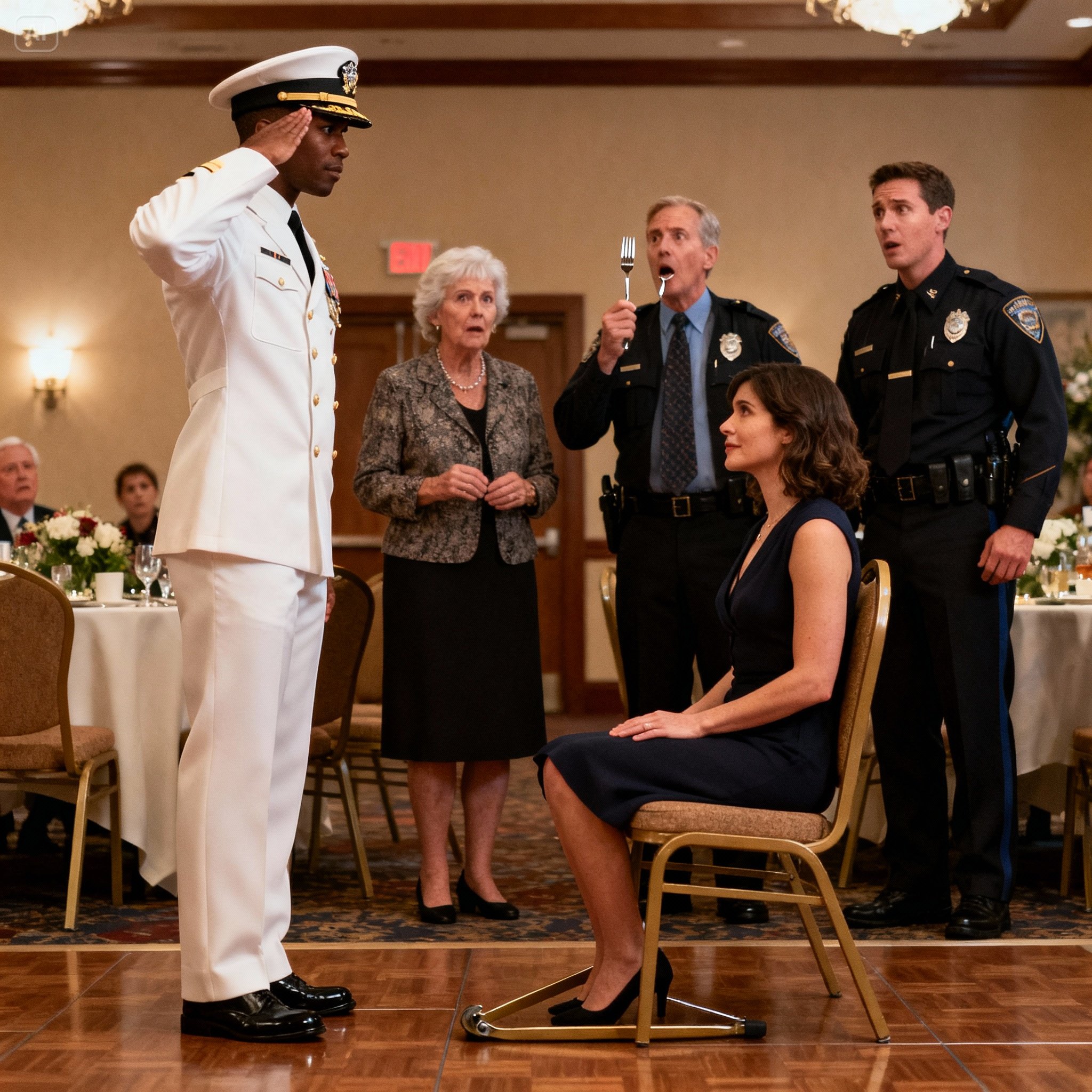
He looked every inch the Commander. Dress whites, gold trim, ribbons in perfect formation on his chest. He was the center of gravity in the room.
He scanned the room once.
He saw Talia at the head table, waving him over. He saw my father, standing up to shake his hand.
But Marcus didn’t go to the head table. He didn’t go to my father.
He locked eyes with me in the back corner. And he stopped.
The room quieted. People turned to see what he was looking at.
He began to walk. Slow. Deliberate. The sound of his dress shoes on the hardwood floor was the only sound in the room. He walked past the Mayor. He walked past the Chief of Police. He walked past his own wife.
When he reached my table, he stopped just short of where I sat.
He stood tall, heels together. And he saluted.
It wasn’t a casual wave. It was a clean, textbook, formal salute. Rigid hand, eyes locked on mine.
“Ma’am,” he said. His voice was deep, loud enough to carry to the vaulted ceiling.
A fork clinked against a plate. Someone inhaled sharply. My father stared, frozen, his mouth slightly open. Talia’s smile cracked at the edges, freezing into a rictus of confusion.
I stood slowly. I didn’t smile. I returned the salute with a sharp nod.
“Lieutenant Commander,” I said softly, using his full rank.
“Didn’t think I’d see you here,” he said, dropping the salute but keeping his posture respectful.
“Neither did I,” I replied.
He gestured to the empty seat beside me—the seat meant for the outcast cousin.
“May I?”
I nodded.
“Please.”
And just like that, the entire room tilted.
Chapter 7: The Shift
They didn’t know what I did. But suddenly, they knew I wasn’t who they thought I was.
You don’t salute a civilian like that unless they outrank you, or unless they are part of a world you respect deeply. Marcus knew. He had clearly seen my name on a briefing, or crossed paths with my clearance level in the new systems he was using.
No one said a word for a full minute after Marcus sat down next to me.
Conversations resumed eventually, but they were quieter, stilted. People glanced over at our table and quickly looked away. The noise in the room had shifted—less laughter, more whispers behind napkins.
Talia came over with a slice of composure too carefully arranged. She placed a hand on Marcus’s shoulder, claiming him.
“You made it,” she said, her voice high and tight.
Marcus didn’t rise. He didn’t look at her. He kept his eyes on me.
“Wouldn’t miss it,” he replied.
She looked at me, then back at him, terrified to ask the question that was screaming in her eyes. She squeezed his shoulder and retreated to the head table.
My parents didn’t speak to me for the rest of the night. My mother avoided my eyes completely. My father looked like he was trying to solve a complex math equation that suddenly didn’t add up.
Luke kept glancing our way. That swagger of his, so practiced, so performative, had drained from his posture. He looked small. He made a joke about the cake being dry—”like government work”—but no one laughed. Not this time.
Chapter 8: The Aftermath
Marcus didn’t explain the salute. He didn’t have to. His presence beside me did all the talking.
We talked about the weather. We talked about the wine. We didn’t talk about work. We didn’t need to.
When dessert was served, I stayed seated while people moved around me in a kind of quiet recalibration. I felt none of the weight I used to carry at these events. No need to prove myself. No urge to shrink. Just stillness.
I left before the cake was cut.
I walked out alone, no coat over my dress, the night air sharp against my arms. The parking lot was nearly empty. I got in my car and sat for a while, not crying, not shaking, just breathing.
Because for the first time in years, I had been seen. Not explained. Not defended. Just recognized.
And the ones who had built an entire mythology around my invisibility? They didn’t know what to do with it.
Later that week, a text from Talia arrived. No greeting. Just a line.
What exactly do you do?
I stared at it for a long time. Then I locked my phone, slid it across the table, and went back to my work. She wasn’t ready for the answer, and I wasn’t offering it anymore.
The texts kept coming after that. Talia sent another: Adam won’t tell me, but I think I messed up. Just… if you ever want to talk.
It wasn’t an apology. It was curiosity masked as guilt. I deleted it.
The next invitation came for Easter brunch. Group text. Mom added a winking emoji and signed it “From the real adults”—a nervous attempt to diffuse the tension with the same old joke.
I didn’t respond.
Three days later, Talia followed up: “Hope you can come. It would be nice to move past everything.”
I locked my phone again. I wasn’t interested in moving past things they refused to name.
I stopped going to the dinners. I stopped sending the bail money. I stopped writing the papers.
My life is quiet now. It is full of systems I hold together, teams who trust me, and a silence that no longer takes something from me.
Some legacies are screamed from podiums. Some are framed on walls. And some walk into a room, lift a hand, and say nothing at all except, “Ma’am.”
And that is enough.
News
THEY LAUGHED WHEN THE “COFFEE GIRL” ASKED TO SHOOT — BUT WHEN SHE TOUCHED THE GUN OF THAT DIFFICULT RIFLE, A GENERAL CAME UP AND SALUTED HER.
CHAPTER 1: THE INVISIBLE WOMAN Dawn cracks over the Arizona desert like a bruised knuckle—purple, orange, and violent. Captain Emily Brooks woke without an alarm at 0400. She always did. Her body was tuned to a rhythm that didn’t exist…
They Called Her “De3d Weight” And Mocked Her “PTSD” — But When The Commander Whispered Two Words, The “BROKEN” Soldier Didn’t Just Wake Up… She Became The Most Dangerous Person In The Room
Chapter 1: The Dead Weight The brake lights of the transport van burned red against the bleaching sun of the Nevada desert. Staff Sergeant Olivia Harper stepped onto the cracked asphalt, her boots crunching on the grit. She favored her…
MY FATHER ACCUSED ME OF BEING A TRAITOR AND HE TOASTED HIS GLASS FOR IT. BUT UNFORTUNATELY HE CELEBRATED TOO SOON, BECAUSE RIGHT THERE, MY SEAL TEAM BURST IN SAYING, “ADMIRAL, WE’VE ARRIVED”
PART 1: THE ACCUSATION Chapter 1: The Sound of Steel The applause was polite, measured, the kind of sound that fills a room but never actually reaches the heart. It was the sound of Charleston high society pretending to care…
THEY LAUGHED AT THE “OFFICE GIRL” WHO SAID SHE COULD DISARM THE NUKE… UNTIL SHE TYPED IN A CODE THAT DOESN’T EXIST?
PART 1: THE INVISIBLE WOMAN Chapter 1: The Dead Man’s Switch The radio crackles with the sound of a man dying. Then, static. Then, the terrified voice of a corporal screaming into the void. “All units, code black! I repeat,…

THEY RIPPED HER FACE APART TO “SAVE THE UNIVERSE” — The horrifying truth about ancient Egypt’s most terrifying, censored fears that they hid from textbooks that you never knew existed.
PART 1: THE PURIFICATION Chapter 1: The Weight of the Placard The year is 1473 Before Christ. The location is the west bank of the Nile, just outside the sprawling, golden city of Thebes. Dawn is breaking, but it brings…

Jon Stewart SLAMS Desk, Calls Out 25 Hollywood Names on Live TV; The One Line That Sent Panic Across Los Angeles Studios
THE NIGHT THE DAILY SHOW STOPPED LAUGHING: How Eight Heavyweights, One Line, and Twenty Minutes Ignited a National Reckoning On most nights, late-night television functions as America’s unofficial cultural therapy, an escape valve where comedy dilutes the severity of the…
End of content
No more pages to load