The university corridor was a river of bodies, a torrent of youthful energy and ambition that threatened to sweep Lien away. She clutched her stack of books to her chest, a flimsy shield against the overwhelming feeling of being utterly invisible. Then, she saw him. Dr. Alistair Finch, a man who seemed more like a historical monument than a professor, was walking toward her. His lectures were legendary, his mind a fortress of knowledge she could only admire from the distant back row of a three-hundred-seat auditorium.
Panic seized her. She tried to become one with the wall, to let the current of students carry him past. But fate, in its infinite and often clumsy wisdom, had other plans. A careless shoulder sent her stumbling, her books cascading to the floor in a clatter of paper and embarrassment. Mortified, she knelt to gather the mess, her cheeks burning.
A pair of polished leather shoes stopped beside her. A hand reached down, not with impatience, but with a quiet grace, and picked up a well-worn copy of “The Politics of Nations.”
“A challenging text for an elective,” a deep, familiar voice remarked.
She looked up into the piercing blue eyes of Dr. Finch. He was looking right at her. “Miss Pham, isn’t it?” he asked, a flicker of recognition in his gaze. He remembered her. From a sea of faces, he remembered hers. Her heart hammered against her ribs.
“Yes, professor,” she managed to whisper.
He handed her the book, his expression thoughtful. “I remember the question you asked about post-colonial economic theory. It was… insightful.” He paused, the river of students parting around them as if they stood on a protected island. “What are your plans after this, Miss Pham? Have you considered what comes next?”
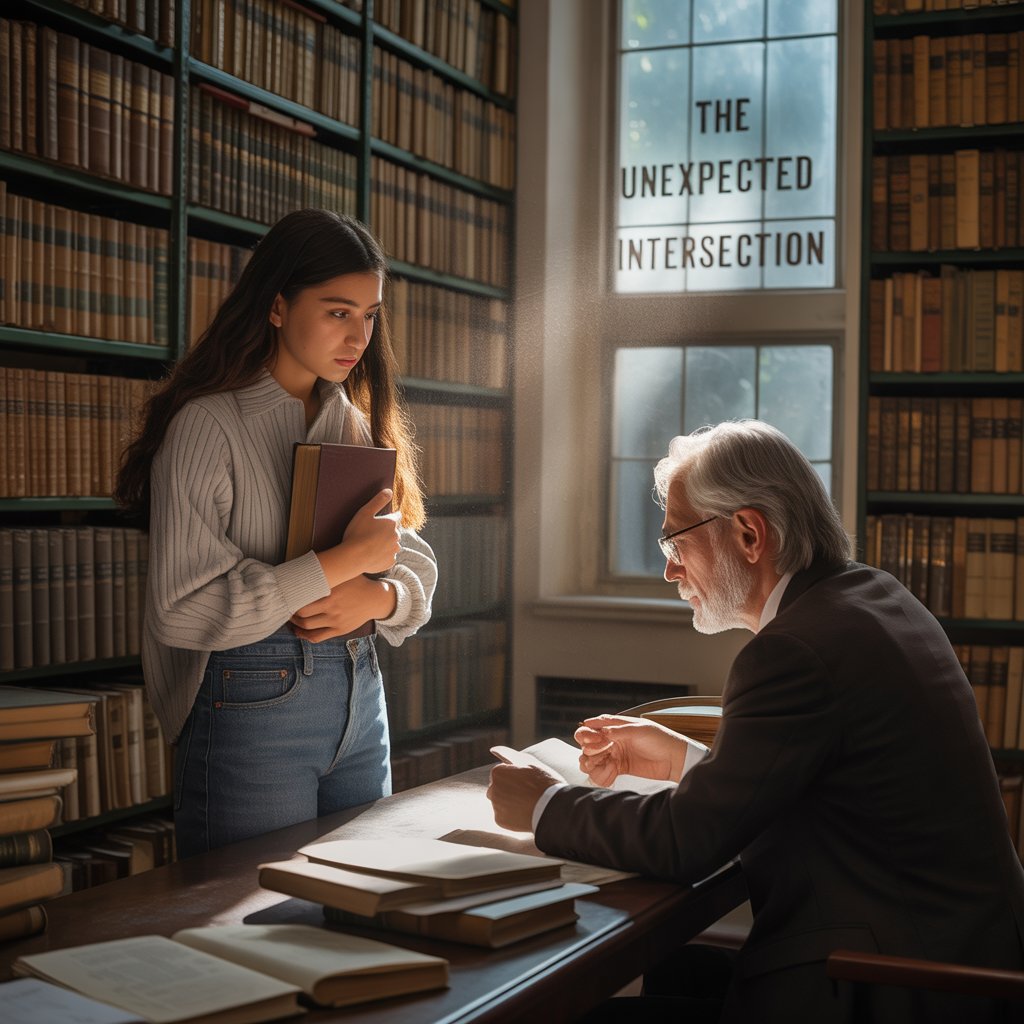
A Face in the Crowd
Lien Pham had always been good at being invisible. Growing up, she was the quiet observer, the one who preferred the company of books to the noisy chaos of playgrounds. Coming to America for her master’s degree was the boldest stroke she had ever painted on the canvas of her life, and it had left her feeling small, muted, and utterly lost in a landscape of bewildering scale. The university was a city unto itself, a sprawling metropolis of brick and ivy where she was just another anonymous face in a lecture hall that felt as vast and impersonal as an airport terminal.
She had chosen this path for her family, to honor the sacrifices they had made to send her here. The weight of their expectations was a constant, heavy presence, a quiet reminder that failure was not an option. She attended her classes, took meticulous notes, and retreated to the library, a sanctuary of silence where the only voices were the ones on the page. She was a ghost haunting the hallowed halls of academia, leaving no trace, making no sound.
And then there was Dr. Alistair Finch. He was a titan in his field, a man whose articles she had studied and cited, whose intellect was as sharp and intimidating as the tailored suits he wore. In his “Global Dynamics” class, she sat in the very back row, a tiny figure in a sea of confident, articulate American students who seemed to have been born debating foreign policy. She listened, absorbed, and never, ever spoke.
Dr. Finch commanded the lecture hall not with volume, but with a quiet, intense authority. He had a way of dissecting complex global issues with the precision of a surgeon, laying bare the intricate network of cause and effect that shaped the world. Lien admired him with a reverence that bordered on awe, but the idea of speaking to him, of drawing his attention to her insignificant self, was terrifying. He was a distant star in a galaxy she could only view from afar.
She told herself that being invisible was a strategy. It was safe. It protected her from the humiliation of making a mistake, of revealing the accent she was so self-conscious of, of proving that she didn’t truly belong. She would get her degree, make her family proud, and return home, her American adventure a neat, tidy chapter in her life story.
The Sound of a Single Voice
The moment that changed everything came on a crisp October afternoon. Dr. Finch was lecturing on the long-term economic impact of colonialism in Southeast Asia. He spoke with a detached, academic precision, his words a cascade of data and theory. But as he spoke, something stirred within Lien. He was talking about the history that had shaped her own country, the forces that had trickled down through generations to create the world she knew. He was talking about her.
He paused, opening the floor for questions. The usual hands shot up, the same confident voices eager to challenge, to debate, to perform. Lien’s heart began to pound. A question had formed in her mind, not a challenge, but a clarification, a point of nuance he had overlooked. It was a small thing, a detail about the role of local merchants in pre-colonial trade networks. But it felt important.
Her hand, as if with a will of its own, began to rise. It was a small, hesitant gesture, a tremor of courage in a body rigid with fear. Dr. Finch’s gaze swept across the room, and for a heart-stopping moment, his eyes met hers. He nodded. “Yes, in the back.”
The room fell silent. All eyes turned to her. She felt the blood rush to her face, a hot wave of panic. She opened her mouth, but the words caught in her throat. She took a breath, the words of her grandmother echoing in her mind: “Even the smallest bird has a song the world needs to hear.”
She spoke. Her voice was quiet, trembling at first, but it grew stronger as she laid out her question. She didn’t look at the other students. She looked only at Dr. Finch. When she finished, the silence stretched, and for a terrible moment, she was convinced she had made a fool of herself.
But then, Dr. Finch smiled. It was not a broad, condescending smile, but a small, genuine expression of intellectual curiosity. “That,” he said, his voice thoughtful, “is an excellent point. One that the established literature often overlooks.” He addressed her question not as a student’s query, but as a colleague’s observation, launching into a brief but insightful discussion that validated her point.
The moment was fleeting. The lecture moved on. But for Lien, something had fundamentally shifted. She had spoken. And she had been heard.
An Unexpected Intersection
Weeks passed, and the memory of that small act of courage faded into the background of her daily routine. She returned to her comfortable invisibility, her one moment in the spotlight a brief, terrifying, and ultimately insignificant anomaly. Or so she thought.
The end of the semester was approaching, a frantic blur of final papers and exams. Lien was in the university library, a stack of books threatening to topple over in her arms, when she saw him. Dr. Finch was leaving his office, a briefcase in one hand, a trench coat slung over the other.
This time, the panic was different. It was not the fear of being seen, but the fear of a missed opportunity. A quiet, insistent voice in her head urged her to say something, to thank him for his class, to make some small connection before the semester ended and she disappeared from his world forever. But the moment passed. He was walking away, and she was frozen, a prisoner of her own shyness.
Then, in a scene that felt like it was lifted from a clumsy romantic comedy, a student rushing past her bumped her arm. The tower of books in her arms swayed, then collapsed, scattering across the polished floor. Mortified, she dropped to her knees, her face burning with a familiar, searing embarrassment.
A pair of polished leather shoes stopped beside her. A hand reached down and picked up a book. “A challenging text for an elective,” a deep, familiar voice remarked.
She looked up into the piercing blue eyes of Dr. Finch. “Miss Pham, isn’t it?” he asked, a flicker of recognition in his gaze.
He remembered her. From a sea of faces, from a single question asked weeks ago, he remembered her. Her heart hammered against her ribs, a wild, chaotic rhythm. “Yes, professor,” she managed to whisper, her voice barely audible.
He helped her gather the rest of her books, his movements unhurried, his presence a calm island in the chaotic river of the corridor. “I remember the question you asked about post-colonial economic theory,” he said, his expression thoughtful. “It was… insightful.” He paused, and in that small pocket of silence, Lien felt the world shift on its axis. “What are your plans after this, Miss Pham? Have you considered what comes next?”
The question was so direct, so unexpected, that she answered without thinking. “I want to apply for the doctoral program,” she blurted out, the words tumbling out before she could stop them. “In international relations. But… it’s very competitive.”
Dr. Finch nodded slowly, his gaze steady, assessing. “It is,” he agreed. “And it requires strong letters of recommendation.” He held her gaze, and in that moment, Lien felt as though he could see not just the shy, insecure student before him, but the woman she could become. “I would be happy to write one for you,” he said, his voice matter-of-fact, as if he were offering her a pen. “If you’d like.”
Lien stared at him, speechless. The world around her seemed to fade into a blur. The distant chatter of students, the scent of old books and floor wax, it all disappeared. All that existed was the quiet, unassuming kindness of this man, this intellectual giant, who had not only seen her, but had chosen to believe in her.
The Open Door
Dr. Finch’s offer was more than just a letter of recommendation; it was a key. It was a key that unlocked a door within Lien she hadn’t even known was locked. His belief in her became a mirror in which she began to see her own potential.
They met in his office the following week, a room that had once seemed as intimidating as a king’s throne room, but now felt like a sanctuary. He didn’t just ask for her resume and transcript. He asked about her life, her family, her dreams. He listened, truly listened, as she spoke of her desire to return to her country, to use her education to make a difference, to build bridges between worlds.
He became more than a professor; he became a mentor. He guided her through the labyrinthine application process, helping her refine her personal statement, suggesting other scholars in her field she should read. He treated her not as a student, but as a future colleague, a fellow traveler on the long, winding road of intellectual discovery.
With his letter of recommendation, a glowing testament to her “incisive mind and profound intellectual curiosity,” doors that had once seemed welded shut began to creak open. She was accepted into a prestigious Ph.D. program, her dream, once a distant, shimmering mirage, now a tangible reality.
The day before she was set to leave for her new university, she met with Dr. Finch one last time to say goodbye. She tried to express the depth of her gratitude, to explain how his small, unexpected act of kindness had changed the entire trajectory of her life.
He listened patiently, a gentle smile playing on his lips. “Lien,” he said, using her first name for the first time, “a teacher’s greatest joy is not in the knowledge they impart, but in the sparks they ignite. I saw a spark in you that day in the lecture hall. All I did was provide a little kindling.”
As she walked out of his office, out into the bright, promising future that now lay before her, she understood the true meaning of “cái duyên.” It was not just about luck, or chance, or serendipity. It was about the unexpected, life-altering intersections that are possible when one person takes the time to truly see another. It was a lesson she would carry with her, a spark she would spend the rest of her life trying to pass on.
News

THEY LAUGHED WHEN THE “COFFEE GIRL” ASKED TO SHOOT — BUT WHEN SHE TOUCHED THE GUN OF THAT DIFFICULT RIFLE, A GENERAL CAME UP AND SALUTED HER.
CHAPTER 1: THE INVISIBLE WOMAN Dawn cracks over the Arizona desert like a bruised knuckle—purple, orange, and violent. Captain Emily Brooks woke without an alarm at 0400. She always did. Her body was tuned to a rhythm that didn’t exist…

They Called Her “De3d Weight” And Mocked Her “PTSD” — But When The Commander Whispered Two Words, The “BROKEN” Soldier Didn’t Just Wake Up… She Became The Most Dangerous Person In The Room
Chapter 1: The Dead Weight The brake lights of the transport van burned red against the bleaching sun of the Nevada desert. Staff Sergeant Olivia Harper stepped onto the cracked asphalt, her boots crunching on the grit. She favored her…
MY FATHER ACCUSED ME OF BEING A TRAITOR AND HE TOASTED HIS GLASS FOR IT. BUT UNFORTUNATELY HE CELEBRATED TOO SOON, BECAUSE RIGHT THERE, MY SEAL TEAM BURST IN SAYING, “ADMIRAL, WE’VE ARRIVED”
PART 1: THE ACCUSATION Chapter 1: The Sound of Steel The applause was polite, measured, the kind of sound that fills a room but never actually reaches the heart. It was the sound of Charleston high society pretending to care…
THEY LAUGHED AT THE “OFFICE GIRL” WHO SAID SHE COULD DISARM THE NUKE… UNTIL SHE TYPED IN A CODE THAT DOESN’T EXIST?
PART 1: THE INVISIBLE WOMAN Chapter 1: The Dead Man’s Switch The radio crackles with the sound of a man dying. Then, static. Then, the terrified voice of a corporal screaming into the void. “All units, code black! I repeat,…

THEY RIPPED HER FACE APART TO “SAVE THE UNIVERSE” — The horrifying truth about ancient Egypt’s most terrifying, censored fears that they hid from textbooks that you never knew existed.
PART 1: THE PURIFICATION Chapter 1: The Weight of the Placard The year is 1473 Before Christ. The location is the west bank of the Nile, just outside the sprawling, golden city of Thebes. Dawn is breaking, but it brings…

Jon Stewart SLAMS Desk, Calls Out 25 Hollywood Names on Live TV; The One Line That Sent Panic Across Los Angeles Studios
THE NIGHT THE DAILY SHOW STOPPED LAUGHING: How Eight Heavyweights, One Line, and Twenty Minutes Ignited a National Reckoning On most nights, late-night television functions as America’s unofficial cultural therapy, an escape valve where comedy dilutes the severity of the…
End of content
No more pages to load