The air around the Chicago Sky’s locker room has been thick with tension, a palpable sense of unease that has finally spilled into the public eye. In a sudden and dramatic turn of events, one of the WNBA’s most recognizable and polarizing figures, Angel Reese, has found herself at the center of a firestorm she herself ignited. After an explosive interview where she openly aired her frustrations with the team’s roster and management, Reese issued a public apology, a move that has only intensified the scrutiny and raised more questions than it answered.

The controversy began with comments that were seen as a direct challenge to the Sky’s front office and a pointed critique of her teammates. Reese reportedly voiced a desire for the team to acquire “great players” and expressed a willingness to leave if the team’s direction didn’t change. These unfiltered remarks, which quickly spread across social media, painted a picture of a player at her breaking point, frustrated with a season that has fallen short of expectations. The public reaction was immediate and divided, with some fans praising her honesty while others criticized what they saw as a betrayal of her teammates.
The fallout was reportedly swift and severe within the team itself. While Reese’s comments were aimed at the organization’s overall strategy, they were taken as a personal insult by those who have been fighting alongside her all season. The unstated yet powerful bond of a team was seemingly fractured by her public airing of grievances. This is where the story pivots. Instead of letting the controversy fester, Reese chose to address it head-on during a post-game press conference.
In what was described as a moment of sincere reflection, she publicly apologized to her teammates. She insisted that her words had been “taken out of context” and that she “didn’t intentionally mean to put down my teammates” her fellow players. She spoke of their shared struggles and the hard work they have all put in, saying they have “busted their ass just like I’ve busted my ass.” It was a powerful, if not entirely convincing, attempt to mend a rift that had become all too visible. She acknowledged the need to be more careful with her language, stating, “I know it’s not the message, it’s the messenger.”
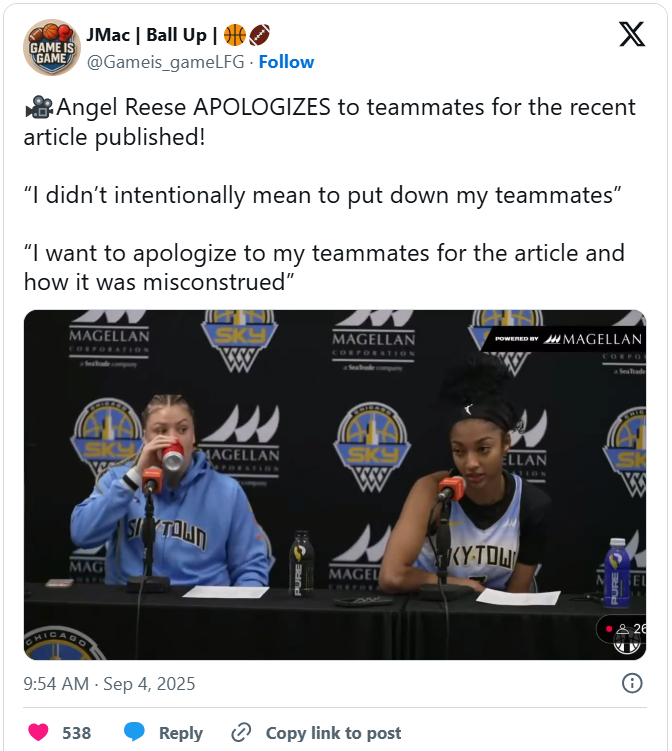
But the question looms: was this apology enough? An apology, no matter how sincere, cannot simply erase the sting of betrayal. In the competitive and high-stakes world of professional sports, trust is a fragile commodity. A locker room is a sacred space, and what is said behind closed doors is meant to stay there. When a star player breaks that code, even with good intentions, the ripple effects can be long-lasting. The Sky’s season, already a disappointment, now faces the added burden of internal strife. The team’s focus must now shift from simply winning games to repairing the trust and camaraderie that is essential for any success.
This incident also shines a light on the unique pressures faced by young athletes in the modern media landscape. With every comment, every post-game remark, dissected and analyzed, a single misstep can ignite a national debate. Reese, who has always been known for her fiery and outspoken personality, is learning a hard lesson in the power of her words. Her frustrations, which may have been legitimate, were expressed in a way that had immediate, negative consequences for those closest to her.
Tyler Marsh reacts to Angel Reese’s criticism of her Sky teammates: “I haven’t read the whole article. I’ve seen bits and pieces of it. So yeah, we are aware of it,” Marsh said. “We’re addressing it in house as we’re currently speaking, so that’s where we’ll leave it.” The future of the Chicago Sky now hangs in the balance. Will Reese’s apology be the catalyst for a renewed sense of purpose and unity, a wake-up call that forces the team to come together? Or will it be remembered as a final, desperate attempt to save a situation that had already spiraled out of control? The answer will unfold in the coming weeks and months, not just on the court, but behind the scenes, where the real drama of a professional sports team is always played out.
News

THEY LAUGHED WHEN THE “COFFEE GIRL” ASKED TO SHOOT — BUT WHEN SHE TOUCHED THE GUN OF THAT DIFFICULT RIFLE, A GENERAL CAME UP AND SALUTED HER.
CHAPTER 1: THE INVISIBLE WOMAN Dawn cracks over the Arizona desert like a bruised knuckle—purple, orange, and violent. Captain Emily Brooks woke without an alarm at 0400. She always did. Her body was tuned to a rhythm that didn’t exist…

They Called Her “De3d Weight” And Mocked Her “PTSD” — But When The Commander Whispered Two Words, The “BROKEN” Soldier Didn’t Just Wake Up… She Became The Most Dangerous Person In The Room
Chapter 1: The Dead Weight The brake lights of the transport van burned red against the bleaching sun of the Nevada desert. Staff Sergeant Olivia Harper stepped onto the cracked asphalt, her boots crunching on the grit. She favored her…

MY FATHER ACCUSED ME OF BEING A TRAITOR AND HE TOASTED HIS GLASS FOR IT. BUT UNFORTUNATELY HE CELEBRATED TOO SOON, BECAUSE RIGHT THERE, MY SEAL TEAM BURST IN SAYING, “ADMIRAL, WE’VE ARRIVED”
PART 1: THE ACCUSATION Chapter 1: The Sound of Steel The applause was polite, measured, the kind of sound that fills a room but never actually reaches the heart. It was the sound of Charleston high society pretending to care…

THEY LAUGHED AT THE “OFFICE GIRL” WHO SAID SHE COULD DISARM THE NUKE… UNTIL SHE TYPED IN A CODE THAT DOESN’T EXIST?
PART 1: THE INVISIBLE WOMAN Chapter 1: The Dead Man’s Switch The radio crackles with the sound of a man dying. Then, static. Then, the terrified voice of a corporal screaming into the void. “All units, code black! I repeat,…

THEY RIPPED HER FACE APART TO “SAVE THE UNIVERSE” — The horrifying truth about ancient Egypt’s most terrifying, censored fears that they hid from textbooks that you never knew existed.
PART 1: THE PURIFICATION Chapter 1: The Weight of the Placard The year is 1473 Before Christ. The location is the west bank of the Nile, just outside the sprawling, golden city of Thebes. Dawn is breaking, but it brings…

Jon Stewart SLAMS Desk, Calls Out 25 Hollywood Names on Live TV; The One Line That Sent Panic Across Los Angeles Studios
THE NIGHT THE DAILY SHOW STOPPED LAUGHING: How Eight Heavyweights, One Line, and Twenty Minutes Ignited a National Reckoning On most nights, late-night television functions as America’s unofficial cultural therapy, an escape valve where comedy dilutes the severity of the…
End of content
No more pages to load