US-South Africa Diplomatic Rift Deepens Over Conflicting G20 Participation Claims
A sharp and unusually public diplomatic dispute has broken out between the United States and South Africa, casting a shadow over the Group of 20 (G20) summit set to open in Johannesburg this weekend. The conflict centers on starkly contradictory statements from the White House and South African President Cyril Ramaphosa regarding the nature and extent of American involvement in the high-stakes global meeting.
The controversy ignited on Thursday when White House Press Secretary Karoline Leavitt delivered a forceful denial of any shift in the Trump administration’s policy to boycott the summit. Responding to a reporter’s question about a New York Times report suggesting a policy reversal, Leavitt left no room for ambiguity. “There is not a shift,” she stated firmly during a press briefing. “The United States is not participating in official talks at the G20 in South Africa.”
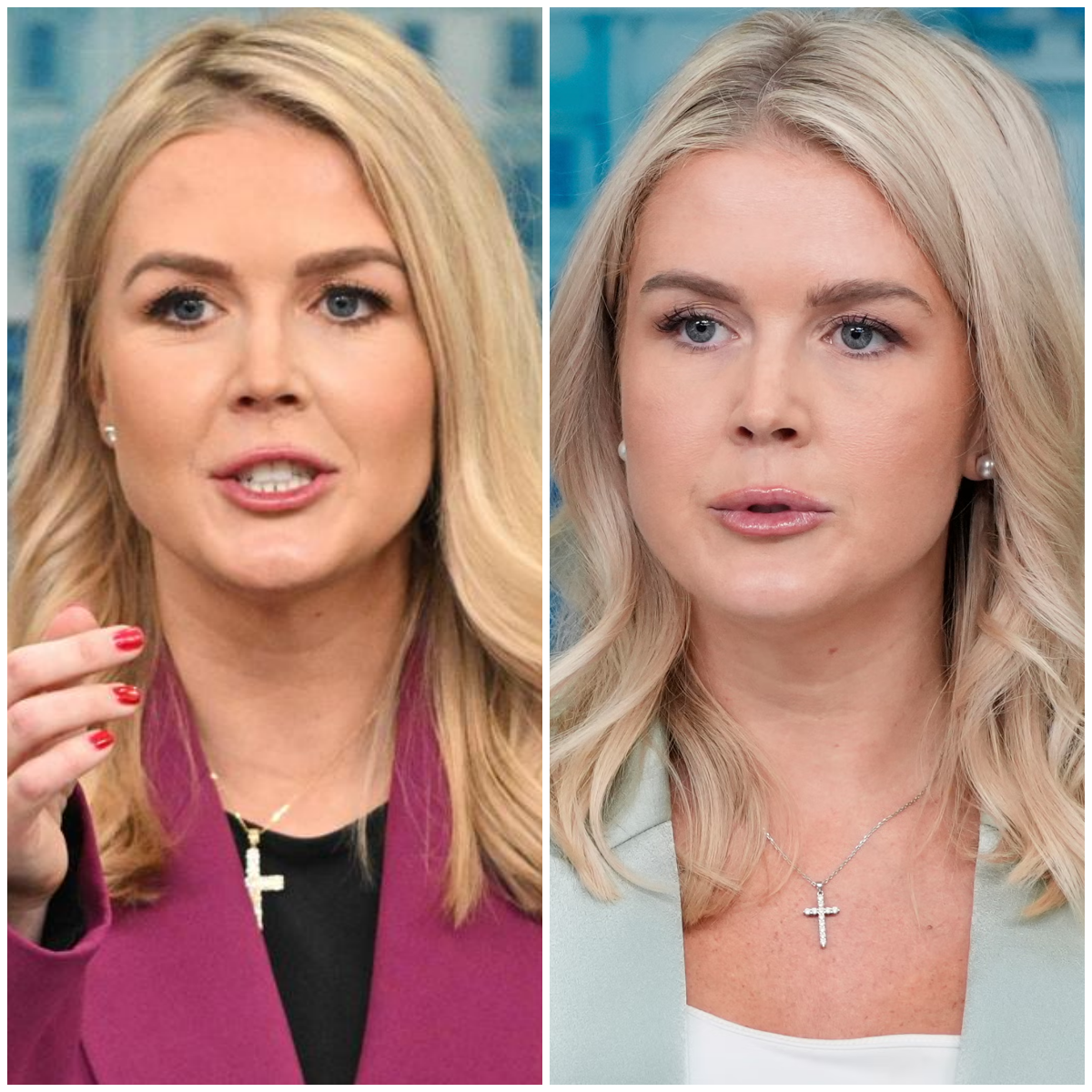
Leavitt then took direct aim at the South African head of state, employing uncharacteristically blunt language. “I saw the South African president running his mouth a little bit against the United States and the president of the United States earlier today and that language is not appreciated by the president or his team,” she declared. Leavitt accused Ramaphosa of “falsely claiming” that the U.S. would be a participant in the summit’s proceedings.
Her comments were a direct rebuttal to remarks made by President Ramaphosa earlier the same day. During a press conference in Johannesburg, Ramaphosa had announced what he framed as a welcome development. “We have received notice from the United States, a notice which we are still in discussions with them over about a change of mind, about participating in one shape, form or other in the summit,” he told reporters. He characterized the communication as a positive diplomatic signal, stating, “In a way we see this as a positive sign, very positive, because as I’ve often said, boycott politics never work.”
The core of the disagreement appears to be the planned attendance of a U.S. official, identified in reports as South African ambassador Marc Dillard. The White House maintains that Dillard’s presence is strictly limited and ceremonial. Leavitt explained that the U.S. representative’s sole purpose is to formally accept the G20 presidency, as the United States is scheduled to host the next summit in December 2026. “The ambassador, or the representative of the embassy in South Africa is there to recognize that the United States will be the host of the G20,” she clarified. “They are receiving that send-off at the end of the event. They’re not there to participate in official talks.”
This position was echoed by a senior Trump administration official who spoke to The New York Times, characterizing America’s involvement as being on a “purely ceremonial” basis. Another White House official, speaking on condition of anonymity, confirmed that a representative from the U.S. Embassy in South Africa would attend the formal handover but stressed that Washington would not take part in any substantive talks.
This public clash is the latest chapter in a diplomatic rift that has grown since President Donald Trump announced this month that no U.S. government official would attend the meeting of leaders from the world’s major economies. The official reason cited for the U.S. boycott was Trump’s unsubstantiated claims that South Africa’s government is engaged in the violent persecution of the country’s white Afrikaner minority farmers. These claims have been widely rejected by international observers and the South African government. Trump has repeated these criticisms in the lead-up to the G20, confronting Ramaphosa with the baseless allegations during a tense White House meeting in May.
The G20, a bloc comprising 19 nations plus the European Union and the African Union, serves as a primary forum for international economic cooperation. South Africa, as the first African nation to hold the rotating presidency, has prioritized an agenda focused on issues acutely affecting developing countries. These include strategies to mitigate climate change impacts, ease sovereign debt burdens, and address global wealth inequality. This agenda has previously drawn scorn from U.S. officials, with Secretary of State Marco Rubio dismissing the priorities as being about “diversity, equity and inclusion and climate change” when he skipped a G20 foreign ministers’ meeting in February.
The U.S. boycott and the ensuing controversy threaten to undermine the summit and its outcomes. Earlier in the week, a South African G20 official revealed that the U.S. had sent a diplomatic communication advising that no joint declaration, a traditional outcome of G20 summits, should be adopted. The U.S. reasoning was that its absence would preclude the necessary consensus. Washington reportedly preferred a less formal, toned-down statement issued only by the South African presidency.
President Ramaphosa, however, has pushed back forcefully against this pressure. “We will have a declaration,” he asserted on Thursday. “The talks are going extremely well. I’m confident we are moving towards a declaration, and they are now just dotting the i’s and crossing the t’s.” In a clear reference to the U.S. position, he added, “Without the United States, the whole process of the G20 is moving forward. We will not be bullied. We will not agree to be bullied.”
Other world leaders have expressed hope for a meaningful outcome. German Chancellor Friedrich Merz stated on Wednesday that he hopes for “joint decisions,” while acknowledging that “that is not entirely certain.”
The United States is not the only major power whose leader will be absent. Chinese leader Xi Jinping, Russian President Vladimir Putin, and Argentine President Javier Milei are also skipping the Johannesburg summit. However, unlike the U.S., these nations have sent high-level delegations to represent them in all official talks and negotiations.
“The only country that is not in the room is the United States and, of course, it is their choice not to be in the room,” noted Xolisa Mabhongo, a South African ambassador to the G20, in an interview with the national broadcaster SABC.
As leaders gather, the diplomatic friction between the host nation and the world’s largest economy has created an atmosphere of uncertainty. The public disagreement over a simple matter of attendance has exposed deeper tensions, raising questions about the effectiveness of the G20 in fostering global cooperation when a key member chooses not only to be absent but to actively dispute the narrative of the event itself.
News

The gavel fell, sealing the one-armed veteran’s fate. But from the back of the courtroom, a single, mournful howl became the first shot in a new war—one fought by a dog who remembered everything they buried.
Courtroom 3 of the Hamilton District Court was a vessel of held breath. The morning light, strained through tall, dusty windows, seemed to congeal in the air, thick and heavy as the silence itself. On the polished wooden benches, people…

He went to an Alaskan cabin to silence the echoes of war. But in the heart of a blizzard, his dog sensed a secret the storm was sent to bury—a secret that would force him into one last fight.
The wilderness beyond Anchorage doesn’t ask for permission; it simply takes. It swallows roads, erases landmarks, and devours the faint, tinny signal of a cell phone until the only voice left is the wind. It was in this vast, unforgiving…
He told the quiet woman she didn’t belong on his elite sniper range. But when her backpack split open, a single photo fell out that made every decorated Marine in the room snap to a salute in shame.
The crack of a rifle shot was the only sound that made sense anymore. It split the dry California air over Marine Corps Base Camp Pendleton, a clean, percussive thunder that echoed off the brown hills and settled in your…
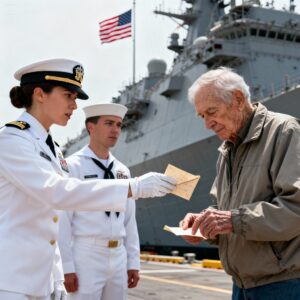
As the young officer moved to detain the 89-year-old man, she was blind to the truth. The very name of the warship she guarded was a whisper of the 70-year-old secret hidden on his faded patch.
The voice sliced through the humid air of the naval pier, a sharp tool meant to carve out immediate compliance. “Sir, I’m going to have to ask you to step away from the gangway. This area is for authorized personnel…
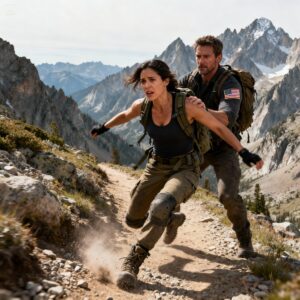
They chose a desolate mountain to be her grave, thinking a thousand-foot drop was the perfect, silent crime. But as she fell into the void, they made a fatal miscalculation about the kind of woman they just betrayed.
The mountain didn’t make a sound when it happened. There was no grand echo to mark the moment, no sympathetic rumble from the ancient stone. There was only the sharp, scattering kick of gravel, a sudden, violent silence where a…
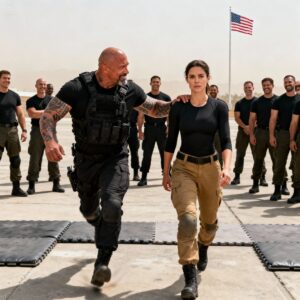
In a circle of 282 elite soldiers, two men decided to humiliate the quiet medic during a demonstration. They intended to break her spirit. Instead, in seven brutal seconds, they discovered a truth that broke them completely.
The wind that came off the Atlantic that morning had teeth. It wasn’t a breeze; it was a hard, scouring force that snapped across the open-air corridors of Naval Special Warfare Command Unit 7, carrying the briny scent of the…
End of content
No more pages to load