From San Diego Suburbs to the National Stage: Usha Vance Reflects on Her Unique Path to Washington
In the highly scrutinized world of American politics, the spouses of potential leaders often find themselves under a microscope, their backgrounds dissected for clues about the values they might bring to the national stage. Usha Chilukuri Vance, the wife of Senator and Vice Presidential candidate JD Vance, has largely avoided the spotlight compared to her husband. However, as the campaign trail intensifies, her personal narrative has emerged as a point of significant public interest. In recent candid remarks, Usha Vance has sought to clarify her origins, distancing herself from the “typical DC fairy tale” and emphasizing an upbringing defined by academic focus rather than financial abundance.
Usha Vance’s story begins not in the corridors of established political power, but in the suburbs of San Diego, California. Born to Indian immigrant parents—her father a mechanical engineer and lecturer, and her mother a biologist and provost—her early life was characterized by a strong emphasis on education and hard work. Despite the elite circles she moves in today, she has explicitly stated, “I’m not from a particularly wealthy background.” This assertion serves to contrast her middle-class reality with the assumptions often made about those who attend Ivy League institutions and clerk for the Supreme Court.
Her academic journey is undeniably impressive, marking her as a figure of high achievement long before her husband entered the political arena. She graduated summa cum laude from Yale University with a bachelor’s degree in history. Following her undergraduate studies, she continued her education as a Gates Cambridge Scholar at the University of Cambridge, where she earned a Master of Philosophy in early modern history. She later returned to the United States to attend Yale Law School, where she served as the Executive Development Editor of the Yale Law Journal and the Managing Editor of the Yale Journal of Law & Technology.
It was at Yale Law School that she met JD Vance. Their relationship began in a setting known for producing future leaders, yet their backgrounds offered a stark contrast that became central to their partnership. While JD Vance’s memoir, Hillbilly Elegy, chronicled his turbulent upbringing in the Rust Belt and Appalachia, Usha’s upbringing provided a stable, albeit culturally distinct, counterpoint. She has been credited by her husband as being his “spirit guide” during their time at Yale, helping him navigate a social and academic environment that felt foreign to him. This dynamic suggests that while she may not have come from extreme wealth, her cultural capital and academic discipline were formidable assets.
Professionally, Usha Vance carved out a career that rivals the most accomplished legal minds in the country. Following law school, she secured prestigious clerkships, first for then-Judge Brett Kavanaugh on the U.S. Court of Appeals for the District of Columbia Circuit, and subsequently for Chief Justice John Roberts on the U.S. Supreme Court. These positions are highly coveted and reserved for the top tier of law school graduates, placing her firmly within the legal elite. Until recently, she worked as a litigator at Munger, Tolles & Olson, a prominent law firm with a reputation for handling complex corporate cases.
Despite these professional accolades, Usha Vance maintains that her identity is rooted in her humbler beginnings. Her comment about not being from a “particularly wealthy background” resonates as an attempt to bridge the gap between her current status and the average American voter. It highlights the immigrant experience—specifically the story of highly educated professionals who migrate to the United States to build a stable life for their children. This narrative arc is distinct from the “old money” lineages that frequently populate Washington D.C., offering a different version of the American Dream.
Observers note that Usha Vance’s presence on the campaign trail offers a softening influence on her husband’s often fiery political rhetoric. Her background as a Hindu and a daughter of immigrants adds a layer of diversity to the ticket, potentially appealing to demographics that might otherwise be skeptical. However, she has largely preferred to let her husband take the lead, stepping in primarily to offer support and context regarding their family life.
Her story is also one of balancing high-stakes career ambitions with family obligations. The Vances have three children, and Usha has spoken about the challenges and rewards of raising a family while navigating the demands of public life. Her transition from a private legal career to the public eye involves a recalibration of privacy and exposure, a challenge she appears to be managing with careful deliberation.
As the nation looks toward the future administration, Usha Vance represents a modern iteration of the political spouse: highly educated, professionally accomplished in her own right, yet grounded in a background that she insists is far more ordinary than it appears from the outside. Her insistence on her middle-class roots serves as a reminder that the path to the White House is not monolithic, and that the stories influencing national policy are becoming increasingly diverse.
News
The gavel fell, sealing the one-armed veteran’s fate. But from the back of the courtroom, a single, mournful howl became the first shot in a new war—one fought by a dog who remembered everything they buried.
Courtroom 3 of the Hamilton District Court was a vessel of held breath. The morning light, strained through tall, dusty windows, seemed to congeal in the air, thick and heavy as the silence itself. On the polished wooden benches, people…
He went to an Alaskan cabin to silence the echoes of war. But in the heart of a blizzard, his dog sensed a secret the storm was sent to bury—a secret that would force him into one last fight.
The wilderness beyond Anchorage doesn’t ask for permission; it simply takes. It swallows roads, erases landmarks, and devours the faint, tinny signal of a cell phone until the only voice left is the wind. It was in this vast, unforgiving…
He told the quiet woman she didn’t belong on his elite sniper range. But when her backpack split open, a single photo fell out that made every decorated Marine in the room snap to a salute in shame.
The crack of a rifle shot was the only sound that made sense anymore. It split the dry California air over Marine Corps Base Camp Pendleton, a clean, percussive thunder that echoed off the brown hills and settled in your…
As the young officer moved to detain the 89-year-old man, she was blind to the truth. The very name of the warship she guarded was a whisper of the 70-year-old secret hidden on his faded patch.
The voice sliced through the humid air of the naval pier, a sharp tool meant to carve out immediate compliance. “Sir, I’m going to have to ask you to step away from the gangway. This area is for authorized personnel…
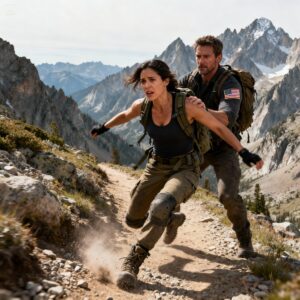
They chose a desolate mountain to be her grave, thinking a thousand-foot drop was the perfect, silent crime. But as she fell into the void, they made a fatal miscalculation about the kind of woman they just betrayed.
The mountain didn’t make a sound when it happened. There was no grand echo to mark the moment, no sympathetic rumble from the ancient stone. There was only the sharp, scattering kick of gravel, a sudden, violent silence where a…
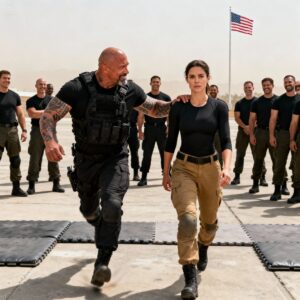
In a circle of 282 elite soldiers, two men decided to humiliate the quiet medic during a demonstration. They intended to break her spirit. Instead, in seven brutal seconds, they discovered a truth that broke them completely.
The wind that came off the Atlantic that morning had teeth. It wasn’t a breeze; it was a hard, scouring force that snapped across the open-air corridors of Naval Special Warfare Command Unit 7, carrying the briny scent of the…
End of content
No more pages to load