The Megyn Kelly Gavin Newsom Dispute: A Political Feud Ignites Over a Resurfaced Trump Clip
A war of words has erupted between prominent media personality Megyn Kelly and California Governor Gavin Newsom, transforming a social media post into a fiery public debate over political priorities, state governance, and the weaponization of past commentary. What began as another strategic jab from Newsom in his ongoing campaign against former President Donald Trump quickly spiraled into a direct confrontation with Kelly, who accused the governor of using her for political “trolling” while ignoring critical issues within his own state. The Megyn Kelly Gavin Newsom dispute serves as a stark example of the modern political landscape, where old clips can be repurposed as ammunition and public figures are forced to navigate complex alliances and rivalries in real-time. At the heart of the conflict is a resurfaced video in which Kelly critically analyzed the constitutional limits of presidential power, a nuanced argument that Newsom seized upon to paint a picture of a fractured conservative base. Kelly’s heated response, however, shifted the battlefield from federal authority to the streets of California, challenging Newsom’s leadership and questioning where his true focus lies. This clash highlights the volatile nature of political discourse, where a single tweet can ignite a firestorm that consumes headlines and fuels partisan divides.
The Spark of the Feud: How an Old Clip Fueled a New Battle
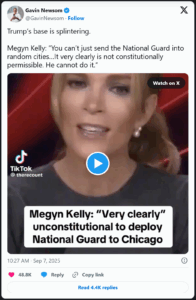
The latest chapter in the Megyn Kelly Gavin Newsom dispute began over the weekend when Governor Newsom posted a video montage to his X account. The carefully edited clip featured Kelly from a previous broadcast discussing Donald Trump’s controversial decision to deploy federal troops to American cities, sometimes against the wishes of local leaders. Newsom’s intent was clear: to showcase that even historically conservative voices had raised serious alarms about Trump’s actions. Accompanying the video, Newsom wrote, “Trump’s base is splintering,” a caption designed to sow doubt and highlight internal GOP conflict. This move is part of a broader strategy by the California governor, who has become one of the Democratic party’s most vocal critics of Trump and his allies, often using social media to land sharp, targeted blows.
Kelly’s Original Commentary on Trump’s Authority
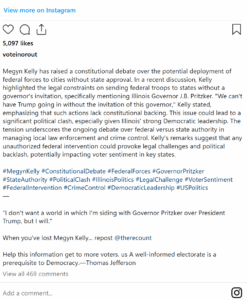
The footage Newsom shared captured Megyn Kelly delivering a legal and constitutional analysis of presidential power. In the original segment, she warned against the overreach of deploying federal forces without a governor’s request. “You can’t just send them into random cities in support of just fighting crime. That, you really can’t do without the invitation of a governor,” Kelly stated with conviction. She referenced the standoff between Trump and Illinois Governor J.B. Pritzker over threats to send troops to Chicago, siding with the constitutional limits on the presidency. “I’m sorry but we can’t have it, he does not have the constitutional permission to do it,” she explained. “It very clearly is not constitutional.” Her argument was not a blanket condemnation of Trump but a specific critique of a potential executive overstep, a distinction she would later emphasize in her response to Newsom’s post. By isolating this specific criticism, Newsom effectively repurposed her words to fit his narrative about Trump’s unfitness for office.
Kelly Fires Back: Shifting the Focus to California Crime Rates
Megyn Kelly did not take kindly to her commentary being used as a pawn in Newsom’s political game. During an episode of her YouTube show, she unleashed a blistering critique of the governor, accusing him of deflecting from his own responsibilities. Rather than engaging with the substance of the old clip, she pivoted, turning the spotlight directly onto what she described as rampant crime in California. Her response was not just defensive but aggressively offensive, reframing the debate around Newsom’s gubernatorial record. This move escalated the Megyn Kelly Gavin Newsom dispute from a simple social media spat into a direct challenge of his leadership. Kelly argued that while Newsom was busy “trolling” political opponents online, his constituents were suffering from a breakdown of law and order.
A Pointed Accusation Over a Violent Robbery
To substantiate her claims about California crime rates, Kelly highlighted a recent and particularly violent robbery in San Jose where an 88-year-old jewelry store owner was seriously injured by a mob of criminals. “What did Gavin Newsom say? Nothing,” she charged, her voice filled with indignation. “We’ve seen him say absolutely nothing about it.” Kelly drove her point home by describing the scene in vivid detail: “When you have 20 criminals, masked, bursting into your jewelry stores in the middle of the day, you have a crime problem.” Her argument was that Newsom was more concerned with his national political profile and his feud with Donald Trump than with the safety of the people he was elected to govern. With palpable frustration, Kelly delivered her most pointed line: “Rather than tweeting about me, he should be thrilled to receive President Trump’s offer of help.” This statement not only served as a rebuke but also cleverly realigned her with Trump while simultaneously criticizing Newsom’s handling of state affairs.
Newsom’s Calculated Silence and Broader Political Strategy
In the face of Kelly’s fiery accusations, Governor Newsom remained publicly silent, choosing not to engage directly with her counterattack. This is a familiar tactic in his political social media feud with conservative figures. Just days earlier, he employed a similar strategy against Senator JD Vance, sharing old clips of Vance harshly criticizing Trump before he became a staunch supporter. Newsom’s approach appears to be one of provocation without direct engagement in the ensuing fallout. His goal is not to win a debate with Kelly or Vance but to use their own words to create content that resonates with his anti-Trump base and paints a picture of hypocrisy and division on the right. By refusing to respond to Kelly’s points about crime in California, he kept the focus on his original message about Trump, effectively sidestepping her attempts to change the subject.
This strategy is part of a larger political chess game. As Newsom’s national profile grows, his attacks on Trump and other high-profile Republicans serve to position him as a leading voice for the Democratic party. His use of social media is aggressive and modern, leveraging the fast-paced, clip-driven nature of platforms like X to score political points. While critics like Kelly accuse him of ignoring his duties, his supporters see him as effectively holding the opposition accountable. The source material, however, did note an interesting inconsistency: while Kelly suggested Newsom should welcome Trump’s help with crime, Trump himself never made similar offers to Republican-led states that have crime rates equal to or higher than California’s.
Conclusion: An Unresolved Clash in the Digital Arena
The Megyn Kelly Gavin Newsom dispute remains unresolved, a lingering testament to the fractious and unpredictable nature of modern political discourse. It encapsulates a moment where a governor’s social media strategy collided with a media figure’s powerful platform, resulting in a public clash over constitutional law, state crime, and political priorities. Governor Newsom successfully used a fragment of Kelly’s past to advance his narrative against Donald Trump, but in doing so, he opened himself up to a fierce counteroffensive that questioned his effectiveness as a leader. For her part, Megyn Kelly demonstrated her refusal to be used as a political prop, skillfully redirecting the conversation toward an issue she believed would damage the governor most: his record on public safety. This feud is more than just a fleeting online spat; it is a microcosm of the larger battles being fought in the American political arena. It illustrates how past statements can be endlessly recycled, how public figures must constantly navigate their own records, and how the line between national politics and state governance is increasingly blurred in an era of perpetual online conflict. As both sides retreat to their respective corners, the digital echoes of their confrontation continue to reverberate.
News

The gavel fell, sealing the one-armed veteran’s fate. But from the back of the courtroom, a single, mournful howl became the first shot in a new war—one fought by a dog who remembered everything they buried.
Courtroom 3 of the Hamilton District Court was a vessel of held breath. The morning light, strained through tall, dusty windows, seemed to congeal in the air, thick and heavy as the silence itself. On the polished wooden benches, people…

He went to an Alaskan cabin to silence the echoes of war. But in the heart of a blizzard, his dog sensed a secret the storm was sent to bury—a secret that would force him into one last fight.
The wilderness beyond Anchorage doesn’t ask for permission; it simply takes. It swallows roads, erases landmarks, and devours the faint, tinny signal of a cell phone until the only voice left is the wind. It was in this vast, unforgiving…

He told the quiet woman she didn’t belong on his elite sniper range. But when her backpack split open, a single photo fell out that made every decorated Marine in the room snap to a salute in shame.
The crack of a rifle shot was the only sound that made sense anymore. It split the dry California air over Marine Corps Base Camp Pendleton, a clean, percussive thunder that echoed off the brown hills and settled in your…

As the young officer moved to detain the 89-year-old man, she was blind to the truth. The very name of the warship she guarded was a whisper of the 70-year-old secret hidden on his faded patch.
The voice sliced through the humid air of the naval pier, a sharp tool meant to carve out immediate compliance. “Sir, I’m going to have to ask you to step away from the gangway. This area is for authorized personnel…

They chose a desolate mountain to be her grave, thinking a thousand-foot drop was the perfect, silent crime. But as she fell into the void, they made a fatal miscalculation about the kind of woman they just betrayed.
The mountain didn’t make a sound when it happened. There was no grand echo to mark the moment, no sympathetic rumble from the ancient stone. There was only the sharp, scattering kick of gravel, a sudden, violent silence where a…

In a circle of 282 elite soldiers, two men decided to humiliate the quiet medic during a demonstration. They intended to break her spirit. Instead, in seven brutal seconds, they discovered a truth that broke them completely.
The wind that came off the Atlantic that morning had teeth. It wasn’t a breeze; it was a hard, scouring force that snapped across the open-air corridors of Naval Special Warfare Command Unit 7, carrying the briny scent of the…
End of content
No more pages to load