The Great Escalator Caper: How a Stephen Colbert and Donald Trump Feud Took Over the U.N.
In the hallowed halls of the United Nations, where global crises are debated and international diplomacy shapes the future, the most talked-about conflict of the week wasn’t between nations, but between a former president and a stationary staircase. The world of politics often produces moments of high drama, but it’s the theater of the absurd that truly captures the public imagination. This was certainly the case when Donald Trump faced a series of technical mishaps at the U.N. General Assembly, prompting him to allege a sinister plot against him. The resulting fallout provided the perfect material for late-night television, where the ongoing comedic rivalry between Stephen Colbert and Donald Trump reached a new level of surreal humor. Colbert, a master of political satire, seized the opportunity to dissect the former president’s claims with a level of theatricality that matched the original accusations, transforming a bizarre footnote in diplomatic history into a viral moment of comedic gold. This incident became more than just a news story; it was a perfect storm of political grievance, technological failure, and primetime parody.
The “Triple Sabotage”: Trump’s Bizarre U.N. Experience
The stage for this peculiar drama was set on Tuesday, ahead of Donald Trump’s scheduled speech at the U.N. General Assembly. What should have been a routine appearance quickly devolved into a series of frustrating glitches. First, the former president’s grand entrance was unceremoniously halted by a stopped escalator, forcing him and his entourage to find an alternative route. This was followed by technical issues with his teleprompter during his address, a critical tool for any major speech. Finally, Trump claimed that attendees using the U.N.’s interpretation system “couldn’t hear a thing.”
For most, these would be annoying but ultimately forgettable inconveniences. For Trump, however, they were evidence of a coordinated attack. He took to his social media platform, Truth Social, to lay out his case, declaring the events a “triple sabotage.” In a lengthy post, he proclaimed, “three very sinister events! This wasn’t a coincidence…” The language was stark and accusatory, framing the mundane malfunctions as part of a “campaign of vengeance against his enemies.” The gravity of his response escalated quickly, as the White House reportedly opened an investigation with the Secret Service and demanded that the U.N. launch its own formal inquiry into the matter. The escalator incident, in particular, became a symbol of this supposed conspiracy.
The U.N. Responds: A Case of Technical Difficulties, Not Conspiracy
While Trump’s team was spinning a tale of international intrigue, the United Nations offered a far more prosaic series of explanations. U.N. spokesperson Stephane Dujarric addressed the claims one by one, methodically dismantling the conspiracy theory with simple facts.
Regarding the now-infamous escalator, Dujarric reported that it “had stopped after a built-in safety mechanism on the comb step was triggered at the top of the escalator.” The likely culprit? According to the U.N., it was probably a member of Trump’s own entourage—his videographer—who inadvertently tripped the safety feature. The great escalator plot was, in reality, a simple case of a safety sensor doing its job.
What about the teleprompter? The U.N.’s response was even more direct. Dujarric stated plainly for the record, “We have no comment since the teleprompter for the U.S. president is operated by the White House.” The implication was clear: if the device failed, the responsibility lay with Trump’s own staff, not the U.N.
As for the “third sabotage,” the allegedly faulty sound system, a U.N. official clarified its function. In a statement, they explained, “The sound system was designed to allow people at their seats to hear speeches being translated into six different languages through earpieces.” It was never intended to be a public address system for the entire hall. In essence, all three “sinister events” had logical, non-conspiratorial explanations. The sabotage narrative was falling apart under the weight of basic technical facts.
Enter the “Escalator Investigator”: How Stephen Colbert and Donald Trump Collided on ‘The Late Show’
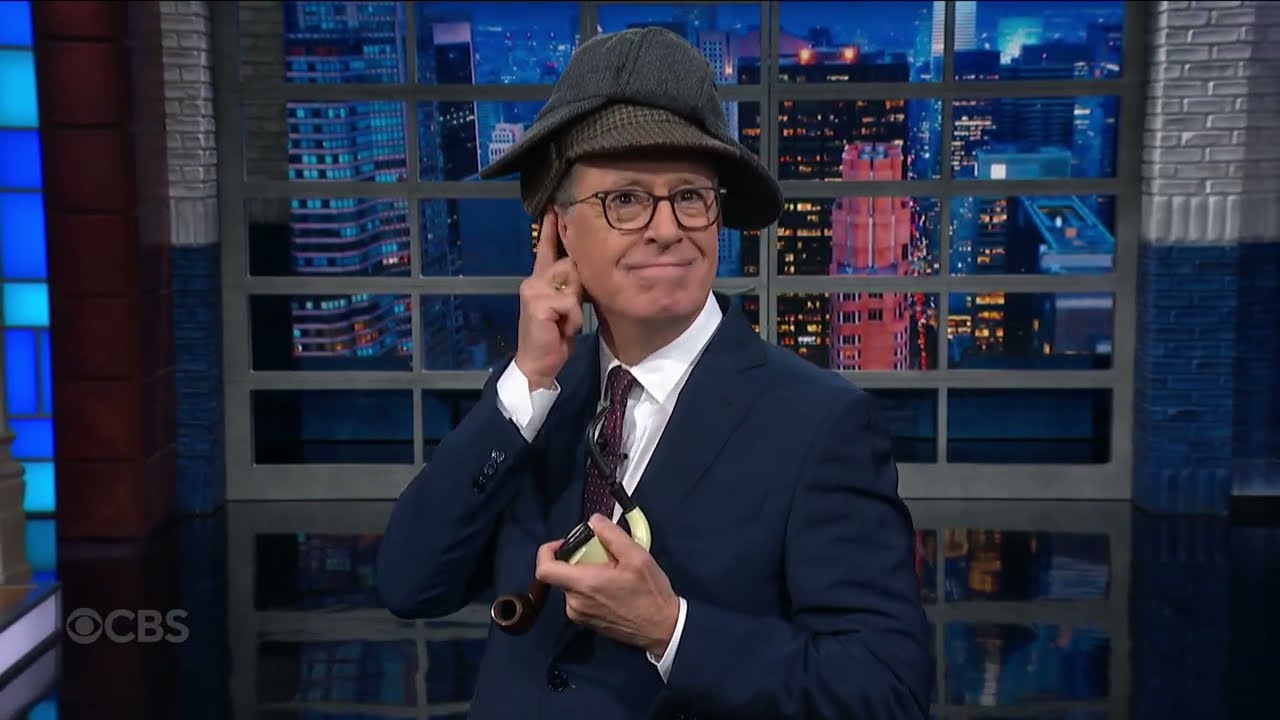
The stark contrast between Trump’s dramatic accusations and the U.N.’s mundane reality was comedic dynamite, and no one was better equipped to light the fuse than Stephen Colbert. On Thursday’s episode of “The Late Show,” the host dedicated a segment to what he called Trump’s “campaign of vengeance,” focusing on the U.N. debacle. Acknowledging that unpacking such a complex “conspiracy” would require a multi-talented investigator, Colbert took matters into his own hands.
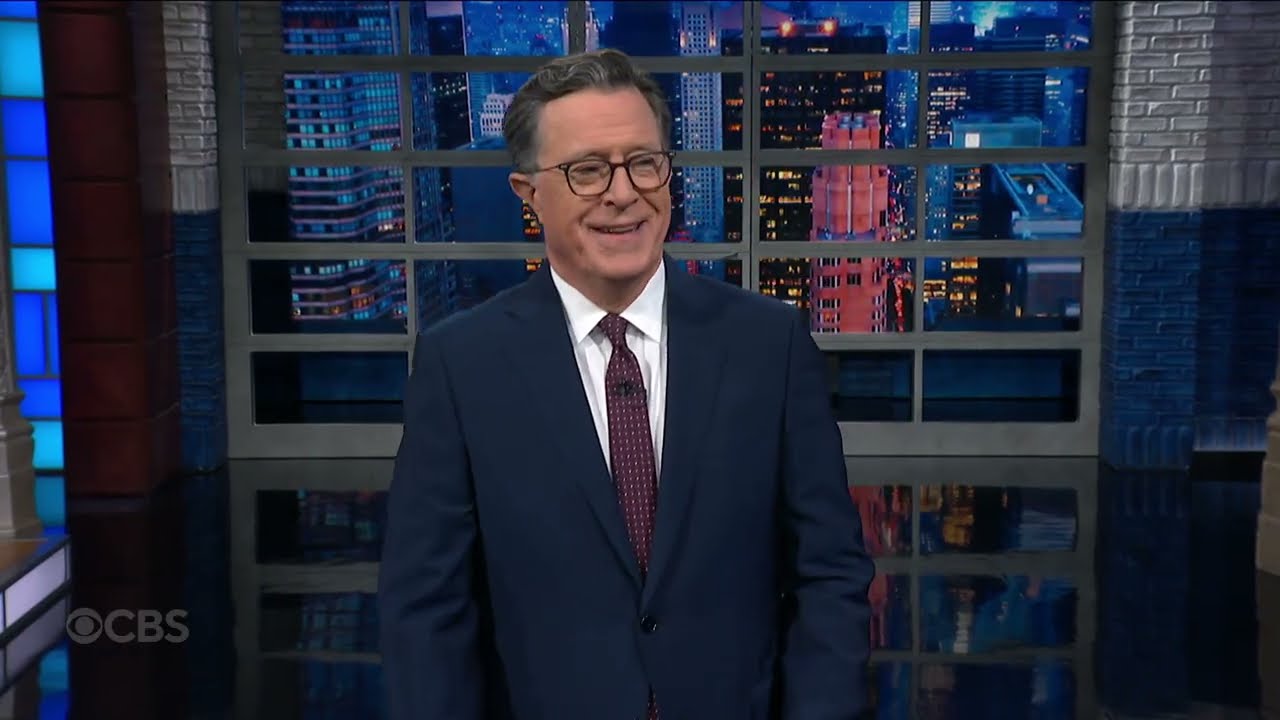
In a brilliant piece of visual comedy, he donned not one, but three Sherlock Holmes-style detective hats, each stacked atop the other, and held three corresponding pipes. He introduced his new personas, created specifically for this case: the “Escalator Investigator,” the “Teleprompter Investigompter,” and the “Ineffective Acoustics Detective Sleuth-Fix.” The Late Show segment was a masterclass in satire, using parody to highlight the absurdity of launching a federal-level investigation into a broken escalator. The apathetic and comical “investigation” by Colbert’s characters served as a perfect foil to the genuine outrage expressed by Trump. This segment perfectly encapsulated the modern dynamic between Stephen Colbert and Donald Trump, where late-night comedy has become a primary venue for fact-checking and critiquing political theater.
A Pattern of Grievance: The Broader Context of Trump’s Claims
While the U.N. incident provided a uniquely humorous set of circumstances, Trump’s reaction fits a well-established pattern of behavior. Throughout his political career, he has frequently framed setbacks, criticisms, and even minor inconveniences as evidence of vast conspiracies orchestrated by his enemies. This “triple sabotage” claim is just the latest chapter in a long narrative of perceived persecution, a worldview where nothing is a coincidence and every mishap is a malicious act.
By immediately alleging a sinister plot, Trump bypasses any possibility of simple human error or mechanical failure, instead casting himself as the victim of powerful, shadowy forces. This approach resonates with his political base, reinforcing a sense of shared grievance and validating the belief that established institutions are aligned against them. In this context, Colbert’s comedic takedown does more than just mock a single event; it critiques the entire political strategy of leveraging conspiracy to deflect responsibility and rally support. The escalator, the teleprompter, and the earpiece become more than just objects; they are props in a larger political performance that comedians like Colbert are uniquely positioned to deconstruct for a mass audience.
In the end, the story of the U.N. mishaps is a tale of two realities. In one, a series of unfortunate but explainable technical glitches occurred. In the other, a coordinated, sinister attack was carried out against a former world leader. The chasm between these two interpretations is where political satire thrives. The ongoing comedic saga of Stephen Colbert and Donald Trump continues because one creates the political theater and the other provides the hilarious, and often insightful, review. As long as mundane objects like escalators are elevated to the status of political saboteurs, there will be a need for “investigators” in tweed hats and multiple pipes to help the public make sense of the absurdity and, more importantly, to laugh at it. This incident serves as a potent reminder that in the modern political landscape, sometimes the most effective analysis comes not from a pundit’s desk, but from a comedian’s stage.
News

The gavel fell, sealing the one-armed veteran’s fate. But from the back of the courtroom, a single, mournful howl became the first shot in a new war—one fought by a dog who remembered everything they buried.
Courtroom 3 of the Hamilton District Court was a vessel of held breath. The morning light, strained through tall, dusty windows, seemed to congeal in the air, thick and heavy as the silence itself. On the polished wooden benches, people…

He went to an Alaskan cabin to silence the echoes of war. But in the heart of a blizzard, his dog sensed a secret the storm was sent to bury—a secret that would force him into one last fight.
The wilderness beyond Anchorage doesn’t ask for permission; it simply takes. It swallows roads, erases landmarks, and devours the faint, tinny signal of a cell phone until the only voice left is the wind. It was in this vast, unforgiving…
He told the quiet woman she didn’t belong on his elite sniper range. But when her backpack split open, a single photo fell out that made every decorated Marine in the room snap to a salute in shame.
The crack of a rifle shot was the only sound that made sense anymore. It split the dry California air over Marine Corps Base Camp Pendleton, a clean, percussive thunder that echoed off the brown hills and settled in your…
As the young officer moved to detain the 89-year-old man, she was blind to the truth. The very name of the warship she guarded was a whisper of the 70-year-old secret hidden on his faded patch.
The voice sliced through the humid air of the naval pier, a sharp tool meant to carve out immediate compliance. “Sir, I’m going to have to ask you to step away from the gangway. This area is for authorized personnel…

They chose a desolate mountain to be her grave, thinking a thousand-foot drop was the perfect, silent crime. But as she fell into the void, they made a fatal miscalculation about the kind of woman they just betrayed.
The mountain didn’t make a sound when it happened. There was no grand echo to mark the moment, no sympathetic rumble from the ancient stone. There was only the sharp, scattering kick of gravel, a sudden, violent silence where a…
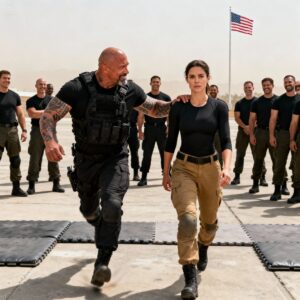
In a circle of 282 elite soldiers, two men decided to humiliate the quiet medic during a demonstration. They intended to break her spirit. Instead, in seven brutal seconds, they discovered a truth that broke them completely.
The wind that came off the Atlantic that morning had teeth. It wasn’t a breeze; it was a hard, scouring force that snapped across the open-air corridors of Naval Special Warfare Command Unit 7, carrying the briny scent of the…
End of content
No more pages to load