Scarlet took a shaky breath. When she spoke again, her voice was a near-inaudible whisper. “Sir… could you pretend to be my daddy? Just for one day?”
Time seemed to freeze. It felt as if a hand had reached inside Caleb’s chest and clenched his heart. The question was so impossibly simple, so modest in its scope, yet so profoundly heartbreaking. She wasn’t asking for a real father, not for forever. Just for a day. Just pretend.
“Scarlet…” he started, his voice thick.
“I know it’s weird,” she rushed, her gaze falling to her hands, which were twisting in her lap. “I’m sorry. Forget I asked. It’s stupid.”
“It’s not stupid.” Caleb reached out, his fingers gently lifting her chin until their eyes met. Hers were swimming with tears, with the terror of rejection, with a sliver of hope she was too scared to embrace. “It’s not stupid at all.”
He thought of the empty apartment waiting for him, of the suffocating silence that had become his roommate for over a year. He thought of how he’d been moving through life like a ghost, physically present but emotionally absent. And he thought about the reason he’d started volunteering here in the first place.
“I would be honored,” he said.
Scarlet’s eyes widened. “Really? Really?”
“Really. What do you want to do for your birthday?”
For a second, she just stared, as if his words were in a language she couldn’t quite process. Then, a light bloomed across her face, transforming her. Those too-old eyes were suddenly young and bright, filled with a dazzling wonder. “Could we… could we go to the aquarium? I’ve always wanted to see one.”
“Then that’s what we’ll do.”
Scarlet launched herself forward in her wheelchair, throwing her arms around his neck. The tears came again, but these were different. They were tears of relief, of pure joy—the kind that break free after you’ve held your breath for so long you’ve forgotten how to exhale. Caleb held her close, a burn starting behind his own eyes. He didn’t know the entirety of her story, not really. And she certainly didn’t know his. But in that moment, none of the past mattered. All that mattered was that for the first time in a very long time, he felt he had a purpose.
That evening, Caleb sat in his truck in the hospital parking lot, the glow of his phone illuminating his face. He had already spoken with Cindy, Scarlet’s social worker, securing initial approval for a day trip. “You’re sure about this?” Cindy had asked, her voice cautious. “It’s a big responsibility, taking her out. She’ll need…”
“I know what she needs,” Caleb had interjected, and he did. He had been paying attention.
Now, he stared at his contacts, his thumb hovering over a name he hadn’t dialed in months: Lauren, his ex-wife. They barely spoke anymore. Not since Annie.
Annie. His daughter would have been six when she died. A routine surgery, they had called it. Tonsils. A procedure thousands of kids underwent without issue. But Annie had been the one in a thousand. Complications with anesthesia, cardiac arrest. She was gone before he could even make it to the hospital. That was eighteen months ago. The divorce had been finalized two years before that, when Lauren could no longer tolerate his long hours as a construction foreman. “You’re never here,” she’d said. “I’m raising Annie alone.” Maybe she was right. Maybe he’d been so fixated on building their future that he’d failed to notice the present was crumbling around him.
After Annie’s death, the apartment became a mausoleum. Work was a series of meaningless motions. Wake up, go to the job site, come home, eat, sleep, repeat. It was his therapist, Dr. Morrison, who had suggested volunteering. “Channel the grief into something positive,” she’d urged. So, eight months ago, he had started coming to Riverside. He played board games, read stories, and sat quietly with the children too sick for much else.
And then he had noticed Scarlet. She was always by the window in her wheelchair, a knitted blanket over her legs, her blonde hair in a neat ponytail. She had warm brown skin and eyes that seemed to hold the weight of the world.
“You don’t want to play?” he had asked one afternoon, pulling up a chair beside her.
She had shrugged. “They don’t know how to play with someone in a chair. They get weird about it.”
“That’s their loss,” Caleb had replied. “You play chess?”
“No.”
“Want to learn?”
That first, small smile had been a crack in her armor. Okay.
Over the ensuing weeks, he learned about her in small increments. Her favorite food was the boxed mac and cheese with powdered cheese, not the fancy kind. She devoured books about adventure, especially those set at sea. She dreamed of being a marine biologist, though she had never seen the ocean.
Gradually, the bigger, heavier facts emerged. Paralyzed from the waist down at four from a severe spinal infection. A mother who battled substance abuse and lost custody when Scarlet was five. A non-existent father. Three foster placements that dissolved when the families were overwhelmed by the realities of her care: bathroom assistance, thrice-weekly physical therapy, the need for a fully accessible home. It was, for most people, too much. So she lived here, a child of the hospital, belonging to no one and learning to expect nothing.
Week after week, Caleb had watched her by that window, a silent observer as other children were embraced by their families, as life unfolded for everyone but her. And in watching, something had stirred in him, a feeling he hadn’t known since Annie died. The instinct to protect, to provide, to matter to someone.
Saturday morning arrived with a nervous energy. Caleb got to Riverside at eight o’clock sharp, his truck freshly cleaned. On the passenger seat sat a bouquet of daisies; Scarlet had once mentioned they were her favorite because they “looked happy.” He had barely slept, his mind running through a checklist for the day. He’d confirmed the aquarium’s wheelchair accessibility, arranged for entry through a staff entrance to bypass the crowds, and even secured a private viewing of the dolphin tank after sharing their story with the aquarium’s director.
But as he walked the familiar hospital corridors toward her room, an unexpected anxiety took hold. What if she had changed her mind? What if she’d woken up and felt the strangeness of her own request? What if he let her down?
He reached her door and knocked softly. “Scarlet? It’s Caleb.”
“Come in.”
He pushed the door open and froze. The nurses had helped her get ready. She was wearing a yellow sundress adorned with tiny white embroidered flowers. She sat in her wheelchair, her hands folded primly in her lap, trying and failing to project an image of calm. Her eyes were luminous, her smile a fragile blend of nerves and excitement.
“Hi,” she said shyly.
“Hi yourself, birthday girl.” Caleb presented the daisies. “These are for you.”
Scarlet’s eyes instantly welled with tears. “You remembered?”
“Of course I remembered.”
She took the bouquet, burying her face in the cheerful blossoms. When she looked up, she was smiling through her tears. “Thank you.”
Patricia, a kind nurse in her fifties who was a fixture on the pediatric wing, appeared in the doorway, her own eyes misty. “You two have a wonderful day,” she said. “And Scarlet, you look absolutely beautiful.”
“Thank you for helping me get ready,” Scarlet replied.
“Anytime, sweetheart.”
Caleb wheeled her down the corridor, past the nurses’ station where staff waved and called out birthday wishes, and past the rec room where other children paused their games to watch them leave. In the elevator, Scarlet fell silent. Caleb glanced down and saw her gripping the daisies tightly.
“You okay?” he asked.
She nodded, then said softly, “I’m scared it won’t be real. Like I’ll wake up and still be in my room.”
Right there in the elevator, Caleb knelt beside her wheelchair. “It’s real, Scarlet. I’m here. This is happening. Today is your day.”
The doors opened to the main lobby, where sunlight streamed through the large windows. As the automatic doors slid open, Scarlet left the hospital for the first time in months.
The forty-minute drive to the aquarium in downtown Columbus passed in a joyful blur. Caleb had worried about filling the time, but Scarlet’s excitement was a torrent. Her words tumbled over one another as she recounted everything she had read about marine life—how dolphins use echolocation, how certain jellyfish are biologically immortal, the mysteries of the Mariana Trench.
“Did you know that more people have been to space than to the deepest part of the ocean?” she said, her voice filled with awe. “We know more about the surface of Mars than we do about our own ocean floor.”
“I didn’t know that,” Caleb said, a genuine smile on his face. “You really know your stuff.”
“I read everything I can find,” she said, then added quietly, “Even though I’ve never seen the ocean.”
“You will,” Caleb heard himself say, the words feeling truer than anything he had said in a long time. “Someday, I’ll take you.”
Scarlet turned to him, her eyes wide. “You mean it?”
“I mean it.”
The aquarium director, a woman named Elena, greeted them at the side entrance. “You must be Scarlet,” she said with a warm smile. “Happy birthday.”
“Thank you,” Scarlet whispered, suddenly shy.
“We have a very special day planned for you. Are you ready?”
The first exhibit, the Pacific Ocean Tank, was a colossal wall of blue, teeming with sharks, rays, and sea turtles. Scarlet pressed her hands to the glass, her face illuminated by the aquatic light, her expression one of pure wonder. “They’re so beautiful,” she breathed.
They navigated the exhibits at a leisurely pace, Caleb pushing her wheelchair from one tank to the next. She was a font of knowledge, identifying species, explaining behaviors, and pointing out details he never would have noticed. At the jellyfish exhibit, she let out her first genuine laugh of the day. “They look like they’re dancing.” The underwater tunnel, with fish swimming all around them, drew a gasp of delight. “It’s like we’re underwater.”
But it was the dolphin tank that truly mesmerized her. Elena led them to a private overlook. “We usually only do this for school groups,” she explained, “but when your father called and told us your story, we wanted to make an exception.”
At the word “father,” Scarlet glanced at Caleb, a question in her eyes. He just smiled and gave her shoulder a reassuring squeeze.
The dolphins leaped and spun, their clicks and whistles echoing in the large enclosure. A trainer named Marcus explained their complex social structures and intelligence. “Would you like to feed one?” he asked Scarlet.
Her eyes grew impossibly wide. “Really? Can I?”
Marcus brought over a small bucket of fish and showed her how to offer one to a dolphin. She was hesitant at first, but when the sleek animal gently took the fish from her outstretched hand and chattered at her, she lit up like the Fourth of July. “Did you hear that?” she exclaimed to Caleb. “He’s talking to me!”
Watching her—this child who had been invisible for so long, finally seen, finally awash in pure joy—Caleb felt something crack open inside him, a seal that had been shut tight since Annie’s death. It felt like healing.
After the dolphins, they visited the touch pool, where Scarlet tentatively petted starfish and sea urchins. Her hands trembled as she reached into the water, but once her fingers brushed against the rough texture of a starfish, a smile bloomed and stayed. “They’re so weird,” she laughed, “but kind of amazing.”
Later, at a small Italian restaurant Caleb had vetted for accessibility, they shared a pizza—pepperoni for her, mushroom and olive for him. “This is the best day of my life,” Scarlet declared around a mouthful of food. “The absolute best.”
“Mine, too,” Caleb said, realizing it was the truth.
When the waiter brought out a small chocolate cake with vanilla frosting—her favorite, he’d remembered—the staff gathered to sing “Happy Birthday.” A single candle flickered in the center.
“Make a wish,” Caleb prompted.
Scarlet closed her eyes, her face a mask of intense concentration. She took a deep breath and blew, extinguishing the flame with a force that made Caleb hope with all his might that her wish would come true.
They sat in the truck for a while afterward, neither ready for the day to end. The setting sun painted the sky in brilliant shades of orange and pink.
“Can I ask you something?” Scarlet said quietly.
“Anything.”
“Why did you say yes? When I asked you to pretend.”
Caleb was silent for a long moment, the images flashing through his mind: Annie’s laugh, her terrible jokes, the way she used to curl up in his lap. The cavernous hole her absence had left. The eighteen months of moving through a gray, muted world. He thought of Dr. Morrison’s words: Grief isn’t something you get over, Caleb. It’s something you learn to carry. And sometimes, the way through it is to love again.
“Because,” he said, choosing his words with care, “you reminded me that I could still be someone’s dad. Even if just for pretend, even if just for a day. You reminded me that I could still matter to someone.”
Scarlet reached over and took his hand, her small fingers wrapping around his calloused palm. “You’re really good at it.”
“Thanks, kiddo.”
Back at the hospital, as the sky deepened to indigo, Caleb helped her get settled and read two chapters of 20,000 Leagues Under the Sea. As her eyelids grew heavy, he stood to leave.
“Caleb?” Her voice was soft with sleep.
“Yeah?”
“Today was perfect. Thank you for being my dad, even if it was just pretend.”
He leaned down and kissed her forehead. “Thank you for letting me.”
Driving home through the empty streets, Caleb cried harder than he had since Annie’s funeral. But these tears were different. They weren’t just grief anymore. They were infused with something else. They were hope.
On Monday morning, before his shift, Caleb called Cindy.
“What would it take?” he asked without preamble. “For me to become Scarlet’s foster parent?”
A long silence stretched over the line. “Mr. Mitchell, that’s… that’s a significant commitment. Scarlet needs specialized care, the house modifications alone…”
“I’m a construction foreman. I can do the modifications myself. I’ve been researching wheelchair accessibility all weekend. My apartment won’t work, but I can find a house. I have good insurance. I can make this work.”
“It’s not just the physical requirements,” Cindy said gently. “It’s doctor’s appointments, physical therapy, possible surgeries. It’s being there for every hard day, every disappointment. It’s understanding her needs are complex and require a level of commitment most people underestimate.”
“I know it won’t be easy. I’m not asking for easy. I’m asking for a chance. She asked me to pretend for one day. I don’t want to pretend anymore. I want to be the real thing.”
Another pause, the sound of papers shuffling. “Let me pull up the foster parent requirements,” Cindy said finally, her tone shifting. “I’ll email you the packet and schedule you for the orientation. It starts next week.”
“I’ll be there.”
“Mr. Mitchell… Caleb. For what it’s worth, I think you’re doing a beautiful thing. Scarlet deserves someone who chooses her. But this process takes time. Months. Background checks, home studies, training, interviews. We can’t tell her anything until it’s finalized. If you change your mind… I don’t want her to be hurt again.”
“I won’t change my mind,” Caleb said, a resolve hardening in his voice.
“We’ll see,” Cindy replied, but her tone was warm, hopeful.
The process was every bit as grueling as Cindy had warned. It began with a fifteen-page application covering his entire life. He spent a week at his kitchen table filling it out. Then came the background checks—fingerprints, credit reports, interviews with his ex-wife, his boss, his neighbors, even his therapist. Dr. Morrison’s letter was a godsend. Mr. Mitchell’s desire to foster stems from a place of healing and genuine love, she wrote. He understands the difference between honoring a memory and trying to replace what he has lost. I believe he would be an excellent father.
The home study was the first major hurdle. His third-floor walk-up was immediately disqualified. He started house hunting, and three weeks later found a small ranch house in a quiet neighborhood. It was a single level with wide doorways and a yard big enough for a garden. It needed work, but that was his world. The mortgage took a huge bite out of his savings, but he didn’t hesitate.
He closed in early June and the real work began. Every evening after his shift, he was there, widening doorways, installing ramps and grab bars, building a roll-in shower, lowering a section of the kitchen counters. On weekends, his crew from work started showing up, burly men with big hearts, bringing tools and pizza.
“You’re really doing this, huh?” his foreman, Tommy, asked one Saturday as they laid down hardwood flooring. “Taking in a kid?”
“Yeah,” Caleb said.
“Good for you, man. Annie would be proud.”
Through it all, Caleb never missed a visit with Scarlet. Tuesdays, Thursdays, Saturdays. They played chess. They slowly assembled the coral reef puzzle. He never mentioned his secret plan; Cindy’s warning about protecting Scarlet’s heart echoed in his mind. But sometimes he’d catch her watching him with those old, wise eyes, as if trying to gauge his permanence.
“You keep coming back,” she observed one afternoon in late July, advancing a chess piece.
“Because I want to,” Caleb said simply. “I like spending time with you.”
“But you don’t have to. Your volunteer hours are on Thursdays. You come other days, too.”
“Is that okay?”
She nodded quickly. “Yeah. I just… I don’t want you to feel like you have to.”
“I don’t feel like I have to,” he said, looking at her across the board. This girl, who had learned not to trust that anything good could last. “I feel like I want to. There’s a difference.”
She moved another piece, her eyes on the board. “Checkmate.”
Caleb looked down. She’d beaten him again. “When did you get so good at this?”
“You’re a good teacher,” Scarlet said, then added softly, “And I pay attention when someone actually stays.”
The training classes were every Tuesday for eight weeks. He sat with other prospective foster parents, learning about trauma and attachment and the labyrinthine foster care system. The statistics were sickening, but the stories of resilience offered hope. One evening, the instructor asked them to share their reasons for being there. When it was Caleb’s turn, he said, “There’s a little girl who asked me to pretend to be her dad for one day. I want to be the real thing.”
The home inspection happened in August. Two social workers scrutinized every detail. Finally, one of them smiled. “You’ve done beautiful work here, Mr. Mitchell. This house is ready for a child.”
The final interviews were the most intense, probing his grief, his divorce, his support system. “Why Scarlet specifically?” Cindy asked him.
Caleb thought for a moment. “Because she asked,” he said. “Because in that moment, I really saw her. Not as a case file, but as a kid who deserved to be chosen. And I realized I wanted to be the person who chose her.”
“And if she never walks again? If her medical needs increase?”
“Then we’ll figure it out together,” he said. “Isn’t that what families do?”
Cindy studied him, then made a note. “I’ll recommend approval.”
The final call came in mid-October, almost six months to the day after the aquarium trip. Caleb was on-site when his phone rang. He saw Cindy’s name and his heart leaped.
“Mr. Mitchell, I have good news. The board has approved your application. You can bring Scarlet home next Saturday.”
He sat down hard on a stack of lumber, his hand trembling. “Really?”
“Congratulations. You’re about to become a foster parent.”
He took the rest of the day off and walked through the new house. Scarlet’s room was painted a soft ocean blue. The bookshelf he’d built stood empty, waiting. He was ready. Now, he just had to tell her.
That Thursday, he walked into her hospital room with a bouquet of daisies.
“You already came on Tuesday,” she said, looking up from her book, a line of worry creasing her brow.
“I know.” Caleb pulled up a chair, his heart hammering. “I need to talk to you about something.”
“Did I do something wrong?”
“No, nothing like that.” He took a breath. “Do you remember your birthday, when you asked me to pretend to be your dad for a day?” She nodded, her eyes wary. “That day changed my life. It made me realize… I didn’t want it to be pretend. And I didn’t want it to be just for one day.”
Scarlet stared at him, her breath hitched.
“So, I started the process to become a foster parent. I’ve been working on it for six months… taking classes, fixing up a house… and yesterday, I got the final approval.”
Tears were already streaming down her face, but she was silent, seemingly unable to form words.
“Scarlet,” Caleb said gently, “I want you to come live with me. For real. Not pretend, not for one day, but for as long as you want. Would that be okay with you?”
For a moment, there was only the sound of her ragged breathing. Then, a whisper: “You mean it? For real? Not pretend?”
“For real. If you want to.”
With a cry that was part sob, part cheer, she launched herself from her wheelchair into his arms with a force that nearly sent him tumbling backward. He caught her, holding her tight as ten years of loneliness and fear poured out of her.
“I wished for this,” she sobbed into his shoulder. “On my birthday candle. I wished the pretend would become real.”
Caleb felt his own tears fall. “Looks like wishes can come true.”
They stayed like that for a long time, holding each other while the nurses in the doorway quietly wiped their own eyes. When Scarlet finally pulled back, her face was blotchy but radiant.
“Can I call you Dad now?” she asked. “Or is it too soon?”
His heart felt like it might burst. “You can call me Dad.”
A brilliant smile broke across her face. “Okay, Dad. When can I see the house?”
“This Saturday. We’ll pick up your things and take you home.”
“Home?” she whispered the word as if tasting it for the first time. “I’m going home.”
On Saturday morning, Caleb arrived with his truck. Scarlet’s belongings were few: some clothes, books, a purple blanket, and the framed photo from the aquarium—the two of them smiling in front of the dolphin tank. The nurses gave tearful goodbyes. Cindy was there, too. “I’ve been a social worker for fifteen years,” she told Caleb quietly. “This one feels different. You’re going to do right by her.”
“I’m going to try,” he said. “That’s all any parent can do.”
As he wheeled her toward the exit, Scarlet looked back at the hospital one last time, not with sadness, but with a sense of closure. It had been her sanctuary, but it had never been her home.
The drive was quiet at first. “Nervous?” Caleb asked.
“A little,” she admitted. “What if I’m bad at this? At having a family?”
He reached over and squeezed her hand. “We’ll figure it out together. That’s what families do.”
When he pulled up to the small ranch house with its white siding and blue shutters, Scarlet gasped. A ramp led to the front door, flanked by freshly planted flowers. “This is it,” Caleb said. “This is home.”
He wheeled her inside. Her eyes went wide, taking in the warm, simple living room, the kitchen with its accessible counters. He led her to a bedroom painted ocean blue. A desk sat by the window, and a large bookshelf waited to be filled. But it was the wall opposite the bed that made her cry again. Caleb had painted a mural of the ocean—dolphins, sea turtles, and a vibrant coral reef.
“You did this?” she whispered.
“I thought you might like a little bit of the ocean in your room, until I can take you to the real thing.”
She wheeled herself closer, her hand reaching out to touch a painted dolphin. “This is the most beautiful thing anyone’s ever done for me.”
That evening, after unpacking and ordering pizza, they sat in the living room, a comfortable silence settling between them.
“Dad?” Scarlet said softly. The word still made his heart jump.
“Yeah?”
“Can we work on that coral reef puzzle this weekend?”
“Absolutely.”
She was quiet for a moment. “This is going to be good, isn’t it?”
Caleb looked at his daughter—because that’s what she was, in every way that mattered. He felt Annie’s presence, not as a haunting, but as a blessing. It’s okay, Daddy. You can be happy again.
“Yeah,” he said, his voice thick with emotion. “This is going to be really good.”
Scarlet smiled, settling back into the couch. For the first time in six years, she was not in a hospital. For the first time in her life, she was in a place where someone had chosen her, where she belonged. What began with a simple, whispered plea had become the most real thing in both of their lives. They had found each other, and in doing so, they had both found home.
News

The gavel fell, sealing the one-armed veteran’s fate. But from the back of the courtroom, a single, mournful howl became the first shot in a new war—one fought by a dog who remembered everything they buried.
Courtroom 3 of the Hamilton District Court was a vessel of held breath. The morning light, strained through tall, dusty windows, seemed to congeal in the air, thick and heavy as the silence itself. On the polished wooden benches, people…

He went to an Alaskan cabin to silence the echoes of war. But in the heart of a blizzard, his dog sensed a secret the storm was sent to bury—a secret that would force him into one last fight.
The wilderness beyond Anchorage doesn’t ask for permission; it simply takes. It swallows roads, erases landmarks, and devours the faint, tinny signal of a cell phone until the only voice left is the wind. It was in this vast, unforgiving…

He told the quiet woman she didn’t belong on his elite sniper range. But when her backpack split open, a single photo fell out that made every decorated Marine in the room snap to a salute in shame.
The crack of a rifle shot was the only sound that made sense anymore. It split the dry California air over Marine Corps Base Camp Pendleton, a clean, percussive thunder that echoed off the brown hills and settled in your…
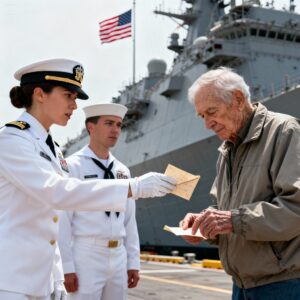
As the young officer moved to detain the 89-year-old man, she was blind to the truth. The very name of the warship she guarded was a whisper of the 70-year-old secret hidden on his faded patch.
The voice sliced through the humid air of the naval pier, a sharp tool meant to carve out immediate compliance. “Sir, I’m going to have to ask you to step away from the gangway. This area is for authorized personnel…

They chose a desolate mountain to be her grave, thinking a thousand-foot drop was the perfect, silent crime. But as she fell into the void, they made a fatal miscalculation about the kind of woman they just betrayed.
The mountain didn’t make a sound when it happened. There was no grand echo to mark the moment, no sympathetic rumble from the ancient stone. There was only the sharp, scattering kick of gravel, a sudden, violent silence where a…

In a circle of 282 elite soldiers, two men decided to humiliate the quiet medic during a demonstration. They intended to break her spirit. Instead, in seven brutal seconds, they discovered a truth that broke them completely.
The wind that came off the Atlantic that morning had teeth. It wasn’t a breeze; it was a hard, scouring force that snapped across the open-air corridors of Naval Special Warfare Command Unit 7, carrying the briny scent of the…
End of content
No more pages to load