In a dramatic turn during a tense session on the floor of the U.S. House of Representatives, a prominent Democratic lawmaker’s attempt to highlight perceived hypocrisy in the Republican party backfired following a significant factual error involving campaign donations and the notorious financier Jeffrey Epstein. Representative Jasmine Crockett of Texas, a figure widely seen as a rising star within her party, made a series of striking accusations that were swiftly and publicly corrected, underscoring the treacherous landscape of real-time political attacks and the enduringly toxic association with the Epstein name.
The incident unfolded on a Tuesday as the House was embroiled in a contentious debate over a proposed resolution to censure Delegate Stacey Plaskett, a nonvoting Democrat who represents the U.S. Virgin Islands. The censure measure, a severe form of public rebuke, was introduced after recently released documents, analyzed by The Washington Post, appeared to show Plaskett exchanging text messages with the convicted sex offender Jeffrey Epstein in 2019. The communication allegedly occurred in real-time during a high-profile House Oversight Committee hearing featuring Michael Cohen, the former personal attorney to Donald Trump. The resolution sought not only to censure Plaskett but also to strip her of her influential committee assignments.

It was against this backdrop of partisan rancor that Representative Crockett took to the floor to deliver a passionate defense of her colleague and a sharp counterattack against the Republicans driving the censure effort. In her remarks, Crockett argued that if associations with Epstein were to become the new standard for congressional punishment, then many members of the opposition party would also be implicated. She then proceeded to list several high-profile Republican figures and organizations.
“Folks who also took money from somebody named Jeffrey Epstein, as I had my team dig in very quickly: Mitt Romney, the NRCC, Lee Zeldin, George Bush, Win Red, McCain-Palin, Rick Lazio,” Crockett stated from the podium. Her declaration was a clear attempt to broaden the scope of scrutiny and paint the censure effort as a politically motivated and selectively applied standard. She followed up with a warning, adding, “If this is the standard that we’re going to make, just know we’re going to expose it all and just know that the FEC filings, they are available for everybody to review.”
However, the foundation of her argument quickly crumbled. Lee Zeldin, a former New York Representative who served as the Environmental Protection Agency administrator under President Trump and was one of the individuals Crockett named, was quick to issue a public rebuttal. Taking to the social media platform X, Zeldin directly addressed Crockett’s claim and exposed a critical case of mistaken identity.
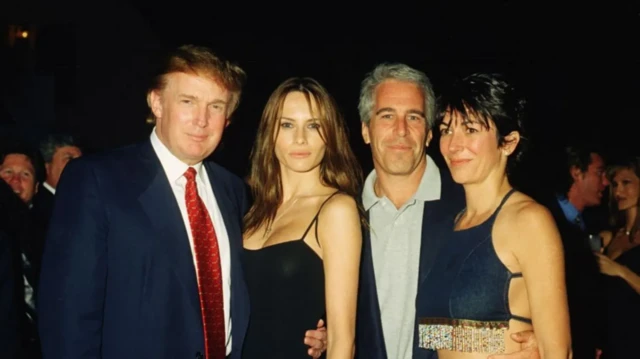
“Yes Crockett, a physician named Dr. Jeffrey Epstein (who is a totally different person than the other Jeffrey Epstein) donated to a prior campaign of mine,” Zeldin wrote. His post clarified that while his campaign had indeed received a donation from a “Jeffrey Epstein,” it was not the disgraced financier but a Long Island-based medical doctor who shares the same name.
Subsequent reviews of Federal Election Commission (FEC) records confirmed Zeldin’s correction. The public filings do show campaign contributions to Zeldin from a Jeffrey Epstein, but the donor’s listed address and occupation correspond with Dr. Jeffrey Epstein, the physician, not the late financier. Further investigation into the FEC database revealed a similar pattern for other Republicans Crockett had named. Records indicate that political campaigns associated with Mitt Romney, Rick Lazio, and the late John McCain had also received donations from a physician named Jeffrey Epstein, not from the convicted sex offender who died in a Manhattan jail cell in 2019. The revelation transformed what was intended to be a powerful political indictment into a public relations blunder, highlighting the risks of deploying hastily compiled opposition research in a high-stakes environment. In response to the unfolding situation, The Daily Beast reported that it had reached out to Representative Crockett’s office seeking comment on the matter.
The distinction between the two men is critical. The late financier Jeffrey Epstein cultivated a vast network of powerful connections across politics, business, academia, and royalty, which he used to facilitate a sprawling sex trafficking operation. Any association with him has become politically radioactive. While he was known to make substantial political donations, the source material indicates these contributions, some reaching as high as $20,000 at a time, were primarily directed toward Democratic candidates and campaign committees, with many of the larger donations occurring in the 1990s. The effort by Crockett appeared to be an attempt to show that Epstein’s financial influence crossed party lines, a point that may be true in a broader social context but was unsupported by the specific evidence she presented on the House floor.
Ultimately, the political drama surrounding Crockett’s remarks served as a sidebar to the central issue of the day: the fate of Delegate Plaskett. The resolution to censure her and remove her from her committee post was brought to a vote late on Tuesday. Despite the Republican majority in the House, the measure failed to pass. In a significant break from party lines, three Republican members voted with every Democrat against the censure. Compounding the Republican leadership’s failure, three other GOP members voted “present,” effectively abstaining and denying the resolution the majority it needed to succeed. The failed vote marked a setback for the conservative faction of the party that had pushed for Plaskett’s punishment and demonstrated the challenges the current House leadership faces in maintaining party discipline on sensitive and politically charged votes.
The episode involving Representative Crockett’s speech serves as a potent case study in the dynamics of modern American politics, where the speed of information, the pressure for viral moments, and the weaponization of personal associations can lead to embarrassing and counterproductive outcomes. The incident not only provided a moment of public correction for a rising Democratic congresswoman but also diverted attention, however briefly, from the serious allegations at the heart of the censure debate itself. It underscored the absolute necessity for meticulous verification in an era where a single, unvetted claim can be broadcast to millions before it can be properly fact-checked, with lasting consequences for the credibility of the messenger.
News

The gavel fell, sealing the one-armed veteran’s fate. But from the back of the courtroom, a single, mournful howl became the first shot in a new war—one fought by a dog who remembered everything they buried.
Courtroom 3 of the Hamilton District Court was a vessel of held breath. The morning light, strained through tall, dusty windows, seemed to congeal in the air, thick and heavy as the silence itself. On the polished wooden benches, people…

He went to an Alaskan cabin to silence the echoes of war. But in the heart of a blizzard, his dog sensed a secret the storm was sent to bury—a secret that would force him into one last fight.
The wilderness beyond Anchorage doesn’t ask for permission; it simply takes. It swallows roads, erases landmarks, and devours the faint, tinny signal of a cell phone until the only voice left is the wind. It was in this vast, unforgiving…

He told the quiet woman she didn’t belong on his elite sniper range. But when her backpack split open, a single photo fell out that made every decorated Marine in the room snap to a salute in shame.
The crack of a rifle shot was the only sound that made sense anymore. It split the dry California air over Marine Corps Base Camp Pendleton, a clean, percussive thunder that echoed off the brown hills and settled in your…

As the young officer moved to detain the 89-year-old man, she was blind to the truth. The very name of the warship she guarded was a whisper of the 70-year-old secret hidden on his faded patch.
The voice sliced through the humid air of the naval pier, a sharp tool meant to carve out immediate compliance. “Sir, I’m going to have to ask you to step away from the gangway. This area is for authorized personnel…

They chose a desolate mountain to be her grave, thinking a thousand-foot drop was the perfect, silent crime. But as she fell into the void, they made a fatal miscalculation about the kind of woman they just betrayed.
The mountain didn’t make a sound when it happened. There was no grand echo to mark the moment, no sympathetic rumble from the ancient stone. There was only the sharp, scattering kick of gravel, a sudden, violent silence where a…

In a circle of 282 elite soldiers, two men decided to humiliate the quiet medic during a demonstration. They intended to break her spirit. Instead, in seven brutal seconds, they discovered a truth that broke them completely.
The wind that came off the Atlantic that morning had teeth. It wasn’t a breeze; it was a hard, scouring force that snapped across the open-air corridors of Naval Special Warfare Command Unit 7, carrying the briny scent of the…
End of content
No more pages to load