Lexie Hull’s Future With Indiana Fever Hinges on League-Wide Labor Negotiations
A standout season for Indiana Fever guard Lexie Hull has concluded not with a straightforward contract extension but with significant uncertainty regarding her future, a situation reflective of a league-wide impasse. Hull, who has become a cornerstone of the team’s identity and a fan favorite, is now a restricted free agent, but her status is complicated by the ongoing negotiations for a new WNBA Collective Bargaining Agreement that has effectively frozen veteran contract discussions across the league.
A League-Wide Contract Stalemate
The primary source of ambiguity surrounding Hull’s future is an issue that extends far beyond the Indiana Fever’s front office. The WNBA and its players’ union are currently negotiating a new Collective Bargaining Agreement (CBA), the foundational document governing player salaries, team salary caps, and free agency rules. With the terms of the new agreement still undetermined, teams throughout the league are hesitant to commit to long-term deals. This has resulted in a holding pattern for dozens of veteran players whose contracts are expiring.
The Indiana Fever’s own roster illustrates this predicament, with only three players currently signed for the 2026 season. Until the new CBA is finalized, the financial and regulatory landscape of the league remains unknown, making it difficult for teams to build their rosters and for players to secure their futures. This overarching context is the critical factor delaying a resolution for Hull, despite her proven value to the team. Her recent comments during the team’s exit interviews directly acknowledged this pervasive uncertainty.
Hull Addresses Her Unclear Future
When asked about her status as a restricted free agent, Lexie Hull offered a response that balanced her deep affection for the franchise with a candid admission of the external factors at play. “I’m a restricted free agent so I think that changes things a little bit,” Hull stated. “I’ve loved my years here in Indiana. Obviously, with a lot of uncertainty, you don’t know what’s to come, but I’ve built a life here. I love this franchise. I love the people, the fans, so we’ll see what comes.”
Her phrase, “you don’t know what’s to come,” directly points to the unresolved CBA negotiations that are casting a shadow over the entire offseason. While her desire to return is evident, her future is inextricably linked to these high-level discussions. Her status as a “restricted” free agent does, however, provide the Fever with a significant advantage. This designation gives Indiana the “right to match” any contract offer she might receive from another team. Given her integral role, it is widely expected that the Fever would match any reasonable offer to retain the young talent they drafted and developed.
A Career-Defining Season
The contractual crossroads for Hull comes directly after the most productive season of her young career. Selected with the No. 6 overall pick in the 2022 WNBA Draft, Hull delivered on her potential this past year by establishing new personal benchmarks across the board. She averaged “7.2 points, a career-high 4.3 rebounds, a career-high 1.8 assists and a career-high 1.2 steals per game.”
These statistics, however, only partially capture her impact. Hull has earned a reputation as a relentless defender, frequently tasked with guarding the opposing team’s top perimeter threat. Her hustle and infectious energy have made her a beloved figure at Gainbridge Fieldhouse. Her development over her initial three-year rookie contract, which included a team option for the third year, has been a significant bright spot for a franchise in the process of building a championship contender.
Strategic Importance in the Caitlin Clark Era
The arrival of generational talent Caitlin Clark has dramatically accelerated the Indiana Fever’s timeline and raised the stakes for every roster decision. The franchise is no longer simply rebuilding; it is actively constructing a team capable of competing for a title. This strategic shift places a premium on retaining high-character, complementary players who can thrive alongside a superstar.
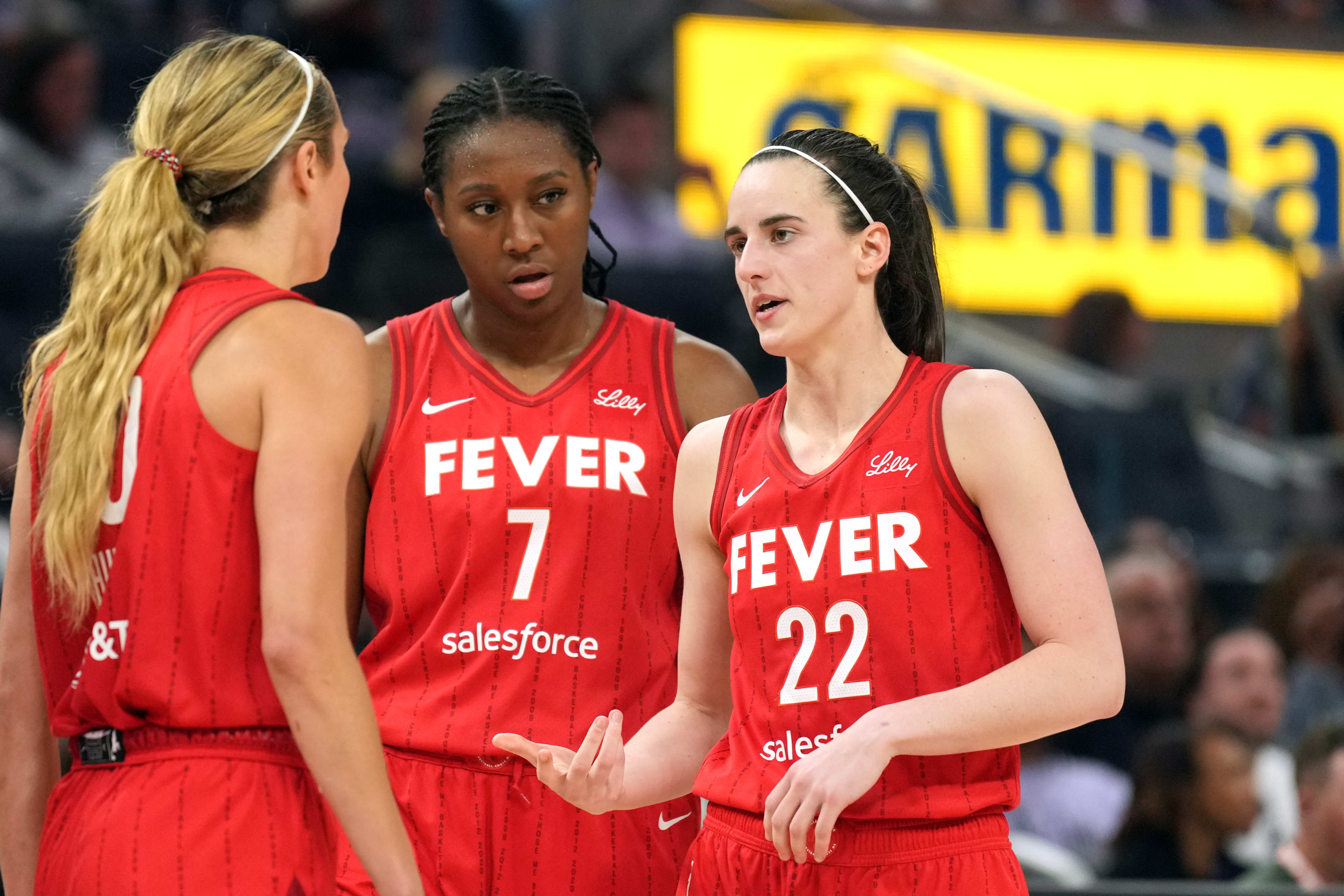
Hull is precisely that type of player. Her on-court synergy with Clark and other young stars like Aliyah Boston is a key component of the team’s success. She is one-third of the popular “Tres Leches” trio, alongside Clark and veteran Sophie Cunningham, a group celebrated for its chemistry and connection with the fan base. Dismantling this core group would risk disrupting the positive locker room culture the team has cultivated. In the era of the “Caitlin Clark effect,” where every move is under intense scrutiny, ensuring Clark is surrounded by reliable and hardworking teammates is essential. Retaining Hull is not just about keeping a valuable role player; it is about reinforcing the winning environment necessary to support a superstar.
As the WNBA and its players work toward a new CBA, Hull’s future remains in flux. She has done everything on the court to prove her worth and has openly expressed her desire to stay in Indiana. For now, her fate, along with that of many other players in the league, rests in the hands of negotiators. The eventual outcome of the Lexie Hull free agency will be a telling indicator of the Fever’s strategy for building a champion in this new and exciting era.
News

The gavel fell, sealing the one-armed veteran’s fate. But from the back of the courtroom, a single, mournful howl became the first shot in a new war—one fought by a dog who remembered everything they buried.
Courtroom 3 of the Hamilton District Court was a vessel of held breath. The morning light, strained through tall, dusty windows, seemed to congeal in the air, thick and heavy as the silence itself. On the polished wooden benches, people…

He went to an Alaskan cabin to silence the echoes of war. But in the heart of a blizzard, his dog sensed a secret the storm was sent to bury—a secret that would force him into one last fight.
The wilderness beyond Anchorage doesn’t ask for permission; it simply takes. It swallows roads, erases landmarks, and devours the faint, tinny signal of a cell phone until the only voice left is the wind. It was in this vast, unforgiving…

He told the quiet woman she didn’t belong on his elite sniper range. But when her backpack split open, a single photo fell out that made every decorated Marine in the room snap to a salute in shame.
The crack of a rifle shot was the only sound that made sense anymore. It split the dry California air over Marine Corps Base Camp Pendleton, a clean, percussive thunder that echoed off the brown hills and settled in your…

As the young officer moved to detain the 89-year-old man, she was blind to the truth. The very name of the warship she guarded was a whisper of the 70-year-old secret hidden on his faded patch.
The voice sliced through the humid air of the naval pier, a sharp tool meant to carve out immediate compliance. “Sir, I’m going to have to ask you to step away from the gangway. This area is for authorized personnel…

They chose a desolate mountain to be her grave, thinking a thousand-foot drop was the perfect, silent crime. But as she fell into the void, they made a fatal miscalculation about the kind of woman they just betrayed.
The mountain didn’t make a sound when it happened. There was no grand echo to mark the moment, no sympathetic rumble from the ancient stone. There was only the sharp, scattering kick of gravel, a sudden, violent silence where a…

In a circle of 282 elite soldiers, two men decided to humiliate the quiet medic during a demonstration. They intended to break her spirit. Instead, in seven brutal seconds, they discovered a truth that broke them completely.
The wind that came off the Atlantic that morning had teeth. It wasn’t a breeze; it was a hard, scouring force that snapped across the open-air corridors of Naval Special Warfare Command Unit 7, carrying the briny scent of the…
End of content
No more pages to load