Major News Organizations Unify Against New Pentagon Reporting Mandates
A broad coalition of the nation’s leading news organizations, including the former employer of the Secretary of Defense, has formally refused to adhere to a new set of restrictive reporting rules issued by the Pentagon. The move signals a significant escalation in tensions between the press and the defense establishment over journalistic access and First Amendment rights. On Tuesday, a deadline set by the Department of Defense, outlets including Fox News, ABC News, CBS News, CNN, and NBC News solidified their opposition by signing a joint statement against the policy.
The new regulations, championed by Secretary of Defense Pete Hegseth, have been characterized by media groups as a direct threat to transparency in national security reporting. The joint statement from the five major networks articulated this concern, asserting that the requirements “would restrict journalists’ ability to keep the nation and the world informed of important national security issues.” The organizations further condemned the directive, stating, “The policy is without precedent and threatens core journalistic protections.” This unified front represents a rare moment of solidarity among competing media entities, underscoring the gravity with which they view the Pentagon’s new stance.

Details of the Controversial Policy
The controversial rules were first announced last month by Secretary Hegseth, a former host of “Fox & Friends Weekend.” The directive fundamentally alters the terms of engagement for journalists covering the Department of Defense. According to an initial memo distributed to reporters, all “information must be approved for public release by an appropriate authorizing official before it is released, even if it is unclassified.” This requirement for pre-approval on non-classified material is a sticking point for news organizations, who argue it amounts to a form of prior restraint.
Furthermore, the policy threatens punitive action against reporters who either solicit or publish information that has not been officially sanctioned for release. The primary consequence for non-compliance is the denial of press credentials, effectively barring journalists from accessing the Pentagon and its officials. The ultimatum forces news outlets to choose between forfeiting their access or agreeing to conditions they argue compromise their journalistic independence and constitutional protections.
Widespread Rejection from the Media
The list of organizations rejecting the Pentagon’s terms extends beyond the initial five networks. POLITICO also confirmed it has declined to agree to the rules. In a formal statement, the company elaborated on its position, explaining that the new policy “infringes on First Amendment protections and limits the ability to produce rigorous and transparent reporting.” POLITICO affirmed its commitment to its journalistic mission, adding that it will continue to cover the military “fairly and independently.”
Other prominent media institutions, such as The Washington Post, The New York Times, and The Atlantic, have also refused to sign the agreement. Secretary Hegseth has publicly displayed a dismissive attitude toward the growing opposition. In response to statements from these three outlets detailing their refusal, he reportedly posted the handwaving emoji on social media, suggesting he is unconcerned by their unified stance. As of the Tuesday deadline, the Trump-friendly One America News Network was the only media organization to have publicly announced its acceptance of the new terms.
White House and Pentagon Defend the New Rules
The policy has received vocal support from the highest level of the administration. President Donald Trump commented on the matter Tuesday, aligning himself with the Secretary of Defense’s position. Trump told reporters that Hegseth “finds the press to be very disruptive in terms of world peace, and maybe security for our nation.” He followed this by stating, “The press is very dishonest.”
Secretary Hegseth defended the regulations as essential for safeguarding sensitive information. Speaking on Tuesday, he framed the policy as a “commonsense” measure. “It used to be, Mr. President, the press could go pretty much anywhere in the Pentagon, the most classified area in the world,” Hegseth said. “Also, if they sign onto the credentialing, they’re not going to try to get soldiers to break the law by giving them classified information. So it’s commonsense stuff, Mr. President, we’re trying to make sure national security is respected and we’re proud of the policy.”
This standoff follows other recent actions by the Department of Defense that have strained its relationship with the media. Earlier this year, the Department revoked dedicated workspaces from several major news organizations, including POLITICO, The Washington Post, and The New York Times, further limiting the press corps’ footprint within the building. The current conflict over credentialing rules marks a critical juncture in the ongoing debate over press freedom and government transparency.
News

The gavel fell, sealing the one-armed veteran’s fate. But from the back of the courtroom, a single, mournful howl became the first shot in a new war—one fought by a dog who remembered everything they buried.
Courtroom 3 of the Hamilton District Court was a vessel of held breath. The morning light, strained through tall, dusty windows, seemed to congeal in the air, thick and heavy as the silence itself. On the polished wooden benches, people…

He went to an Alaskan cabin to silence the echoes of war. But in the heart of a blizzard, his dog sensed a secret the storm was sent to bury—a secret that would force him into one last fight.
The wilderness beyond Anchorage doesn’t ask for permission; it simply takes. It swallows roads, erases landmarks, and devours the faint, tinny signal of a cell phone until the only voice left is the wind. It was in this vast, unforgiving…

He told the quiet woman she didn’t belong on his elite sniper range. But when her backpack split open, a single photo fell out that made every decorated Marine in the room snap to a salute in shame.
The crack of a rifle shot was the only sound that made sense anymore. It split the dry California air over Marine Corps Base Camp Pendleton, a clean, percussive thunder that echoed off the brown hills and settled in your…
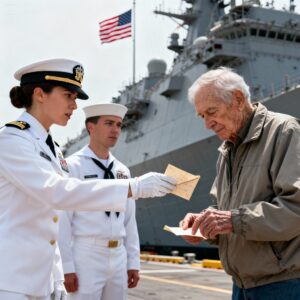
As the young officer moved to detain the 89-year-old man, she was blind to the truth. The very name of the warship she guarded was a whisper of the 70-year-old secret hidden on his faded patch.
The voice sliced through the humid air of the naval pier, a sharp tool meant to carve out immediate compliance. “Sir, I’m going to have to ask you to step away from the gangway. This area is for authorized personnel…

They chose a desolate mountain to be her grave, thinking a thousand-foot drop was the perfect, silent crime. But as she fell into the void, they made a fatal miscalculation about the kind of woman they just betrayed.
The mountain didn’t make a sound when it happened. There was no grand echo to mark the moment, no sympathetic rumble from the ancient stone. There was only the sharp, scattering kick of gravel, a sudden, violent silence where a…

In a circle of 282 elite soldiers, two men decided to humiliate the quiet medic during a demonstration. They intended to break her spirit. Instead, in seven brutal seconds, they discovered a truth that broke them completely.
The wind that came off the Atlantic that morning had teeth. It wasn’t a breeze; it was a hard, scouring force that snapped across the open-air corridors of Naval Special Warfare Command Unit 7, carrying the briny scent of the…
End of content
No more pages to load